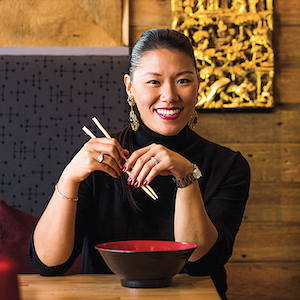
[00:00:10] Ray Latif: Hello, friends. I'm Ray Latif, and you're listening to the number one podcast for anyone building a business in food or beverage, Taste Radio. In this episode, we're joined by Nadia Liu Spelman, the founder and CEO of Dumpling Daughter. When a competitive figure skater, Wall Street analyst, and third-generation foodie sets out to share her family's cherished recipes with the world, the result is Dumpling Daughter, a bold new voice in Chinese-American comfort food. What began as a beloved local restaurant has since expanded into a nationally distributed CPG brand featuring frozen dumplings, bao buns, and sauces that celebrate generational flavors. In this episode, Dumpling Daughter founder and CEO Nadia Liu Spellman takes us on a journey from her Boston roots and business school days at Babson College to the high-pressure world of Wall Street and ultimately back to her cultural heritage in the kitchen. Along the way, Nadia opens up about honoring her family's culinary legacy, including her mother's legendary fine dining restaurant Sally Ling's, and what it takes to build a brand defined by authenticity, innovation, and uncompromising quality. From the challenges of food manufacturing to the nuances of flavor storytelling, she gives us an inside look at redefining premium in the world of ready-to-cook cuisine. Hey folks, it's Ray with Taste Radio. Right now, I am honored to be sitting down with Nadia Liu Spellman, who is the founder and CEO of Dumpling Daughter. Nadia, great to see you.
[00:01:46] Nadia Liu: Thank you for having me.
[00:01:47] Ray Latif: Yeah, you're not too far away from our office here in Newton. Weston is how many miles away?
[00:01:52] Nadia Liu: Two.
[00:01:53] Ray Latif: Two? I didn't realize it was that close.
[00:01:55] Nadia Liu: Probably, yeah. If you go the back roads, I'm born and raised in Boston. Okay. And actually was born to a house in Newton and then moved to Weston when I was three. I did not know that.
[00:02:05] Ray Latif: You went to school in Boston too, yeah?
[00:02:07] Nadia Liu: I went to Babson College.
[00:02:08] Ray Latif: Amazing, amazing. Babson'Babson College is well known as being the best business school in New England, one of the best in the country. Did you study just general management or? Entrepreneurship. Entrepreneurship. Did you have an idea, did you have a project that you had to focus on, a brand that you had to create, a company that you had to create when you were in college?
[00:02:26] Nadia Liu: Yes, we had to write business plans. So I was constantly writing business plans for restaurants and actually devices for cooking.
[00:02:36] Ray Latif: Devices for cooking?
[00:02:37] Nadia Liu: Yeah, like gloves, heat proof gloves.
[00:02:40] Ray Latif: Okay.
[00:02:41] Nadia Liu: Interesting, fun things that I felt like were necessary. And every year you have to write a business plan at Babson.
[00:02:48] Ray Latif: Okay.
[00:02:49] Nadia Liu: So I was always thinking in the lines of food, food products, devices, restaurant concepts.
[00:02:55] Ray Latif: Interesting. But you didn't go right into the food business. I mean, you were always kind of in the food business. And I want to talk about your family history in a sec, but you didn't go directly from college into food. There was a time in banking. Why did you feel like you wanted to get into the finance world as opposed to launching a business from the outset?
[00:03:15] Nadia Liu: I guess Babson did influence me. All of my peers were going into banking. And we were all watching Wall Street, the movie, and everybody felt like we had to go to New York. So, you know, you just go to New York. And my parents really encouraged me to do something different. I actually wanted to do restaurant consulting out of college, but my father said, who would hire you? You're 21. You have family experience. No, go get a real job. And so I went into banking because there were so many opportunities and it was fun. It was fun to get a paycheck and to live in New York and have everything at your fingertips and be with your friends and explore the city. You learn a lot by going through the motions. It's all the beginning of the journey of being an adult and managing your money and having freedom, true freedom. It was a great time. And I learned so much about myself and what I liked and didn't like. I observed the people that I worked with, my boss, and I realized very quickly that I did not want my boss's job. And so finance was not for me. So during that time I did my job, but I also figured out what my next step would be, which was definitely and undeniably in food.
[00:04:36] Ray Latif: What year was that, that you said, I'm going to start Dumpling Daughter?
[00:04:39] Nadia Liu: Well, I had an idea for frozen dumplings even back when I was at Babson College. And I spoke with my late father about it. We sat, we ate dumplings together. And through my experience at Babson, it was always in the back of my mind. And when I was in New York, I was looking for dumpling shops. When I was working in banking, I was looking for concepts that I kind of imagined in my head and dreamed of, and nothing quite fit the bill in my mind. And I was thinking, do I want to sell frozen dumplings? Do I want to go into the quick service restaurant business? Because that was really up and coming in the 2005s to 10s. And New York was booming with all different kinds of food. And I started jotting notes in my journal right out of college while I was in the cubicle, in the office, reading the New York Times, following the New York Magazine on what was hot, and just taking notes on what inspired me, what was interesting to me, where I saw opportunity. And that is when the brainstorming really was very intense when I was in New York. And so when I moved back to Boston upon marrying my high school sweetheart from Weston, I thought, I think this is time to really refine and focus all of these bullet points into some business plans. So I took all these ideas and I wrote various business plans and I started showing them to people that I trusted. And they said, you're Chinese. Look at your culture, your heritage, your upbringing. It should be dumplings. It shouldn't be pasta. It shouldn't be burgers. It has to be dumplings. And so that's when I started looking for the first location.
[00:06:31] Ray Latif: You thought about burgers, huh?
[00:06:33] Nadia Liu: Oh yeah, there's a burger place in New York that's just, I crave it all the time called Corner Bistro and it's in the Lower West Side and I would love to have a Corner Bistro in Boston. I still think about it.
[00:06:47] Ray Latif: Is it like smash burgers?
[00:06:48] Nadia Liu: No, it's big, thick, juicy burgers that are served on paper plates. And that's all they do. Burgers, grilled cheese and French fries.
[00:06:58] Ray Latif: Corner Bistro. Yes. Lower West Side you said? Yes. Okay. I'm going to New York pretty soon. So now you got my mouth watering thinking about that. But you always have my mouth watering when you're talking about Dumpling Cotter. We had lunch brought in earlier this week. You were so gracious to send us. this incredible spread of food and everyone was raving about it. And it was clear that you and your team know how to make great food. And you have a family history that is steeped in making traditional, delicious Chinese food. Your mom is a bit of an icon here in the Boston area. Your family history, how much did that actually influence your journey and your interest in getting into this space? If you could talk about your mom, your mom's influence on Chinese cuisine here in Boston, that'd be amazing.
[00:07:46] Nadia Liu: Right. I was raised in a family where food was really the focus. We would gather every night for family dinner and on the weekends we would go out to our own restaurant or go to great restaurants in Boston.
[00:08:01] Ray Latif: And by your own restaurant, you mean the family's restaurant?
[00:08:03] Nadia Liu: Yes. My parents had a white tablecloth, fresh flour, French service style Chinese restaurant.
[00:08:13] Ray Latif: Which was called?
[00:08:14] Nadia Liu: Sally Ling's. And it was the first of its kind in Boston and arguably one of the most high-end Chinese restaurants in the nation at the time. And at a very young age, I was watching Julia Child have her birthday celebrations there. Martin Yan, Yan Can Cook, Channel 2, was coming to Boston to eat there. the governor, Yo-Yo Ma, I knew how special it was. I had to wear a fancy dress to eat there. And meals would last for hours, course after course. And when I think about those traditions and the family that we would have to the restaurant, my grandparents, my aunt and uncle, who were also restaurateurs, These memories are the sweetest, most wonderful times of my life. And so the culture, the joy, the traditions, like these are the things that when I think back to are very emotional for me and that I really value. And that's why I think food and family is just so strong in my life. I couldn't have done anything else. We can't live without food, but if we can live with luxurious food, we really are kings and queens.
[00:09:35] Ray Latif: The frozen aspect of what you do speaks to the convenience of your brand. Fresh dumplings, fresh bao buns. You see them in certain places, but again, the frozen aspect just allows families to be able to have it at their fingertips in a really convenient way. I almost feel like there's pressure perhaps, and maybe I'm wrong, to sort of Americanize what you do to meet that modern consumer, to be able to give them that convenient way to make dinner. Did you feel that pressure when you were building the restaurant and certainly when you were developing the CPG brand?
[00:10:18] Nadia Liu: No, I did not feel pressure. to go away from authenticity ever. And I think it was because I was raised with honesty and transparency and what I love. I'm going to serve that. I'm going to serve it to my kids. I'm going to serve it to my friends. I'm not going to do something that I don't think is absolutely delicious. And transparency, clean products, premium is delicious. I love being able to serve the current times. My parents had very high-end restaurants in the 80s. They were glamorous. And now people are busy. They're on the go. They're doing so many things at once. But smart people wanna eat healthy and convenience doesn't have to be unhealthy. Good food can be effortless and that's what dumplings are. The customization beyond just boiling your dumplings is our sauces. And so you had at the office dumplings with different sauces. It's really fun to be able to empower the mom, the dad, the college kid. to boil some water, cook some dumplings just as easy as pasta, and put the different sauces and garnish with herbs. You know, that kind of fun at home activity is delicious, convenient. I really think it's my calling and my job as the next generation to serve the people, but in the way they need it today. Because that's what my parents did. And I'm really happy that we were able to make the dumplings. in a manufacturing facility that really tastes like my grandmother's hand work. The dough is al dente, a little chewy. It's truly the Northern style dumpling that my grandmother would make me when I was little. And we were able to simulate that in a factory. And yes, when I opened the restaurant, people said, well, you're Sally Ling's daughter. Everything must be handmade. Everything must be, you know, art. A dumpling is a work of art. But in order to sell many and thousands and tens of thousands in one night, you have to make them by machine. And machine-made products are more consistent, they're cleaner, and you can't achieve a price when you're making them by hand that people can afford. And so I thought about that when I was writing the business plan. Everything needs to be machine-made to my spec, to what I would wanna eat. And the flavors have to be so on point that people are just gonna love it, have fun with it. And it just brings me so much joy that our family's recipes are now in many homes.
[00:13:24] Ray Latif: Were you selling all these products out of your restaurants or were you just a consumer? Were you in supermarkets at that point?
[00:13:29] Nadia Liu: Right in 2020, we just immediately started making things that people could take home and prepare at their convenience. And I think all the right people, you know, luck plays a big role and all the right people came. Owners of supermarkets were coming to Dumpling Daughter for takeout and buying the frozen. And it was fascinating to see people see us in all these different channels. And so that's the feedback, right? Literal actions, not structured, but people calling, emailing and saying, I loved this. Can you do more of that? Can you box it up for my supermarket? Volante Farms in Needham, a family generational supermarket business that I love and respect said, can you box these up for me? I said, you know what? In fact, I'm designing a box for direct consumer nationwide shipping, so let's just throw it in that box. I think when things happen and you feel like, oh, there's an opportunity, you take it and it becomes multi-pronged, but it was never planned that way with a business plan. The business plan was one restaurant.
[00:14:34] Ray Latif: It was one restaurant. Okay. When you go from selling your dumplings to a Volante Farms, and then you get a call from, or you knock on the door of, say, a much larger retailer, like a Market Basket, which is a regional grocer here in the New England area that does quite a bit of business. You can't necessarily say yes immediately, I would think, because they're going to ask for orders that are significantly bigger. Going from, again, Yes, we'll sell to these small local businesses too. We're going to sell to chain retailers. How did you process that? How did you strategize around the opportunity?
[00:15:15] Nadia Liu: I think that when we started selling in the gourmet smaller supermarkets, we were seeing an incredible opportunity because We really didn't know what we were doing. I was a restaurant person. I was selling dumplings for $18 retail a box, which nothing in the freezer aisle is $18.
[00:15:39] Ray Latif: How many dumplings were- 22. Okay.
[00:15:42] Nadia Liu: And I did it because the supermarket said, Oh, our customer will pay that. And I was going to customers like Roach Brothers and Market Basket and saying, hey, look, I've got dumplings for $17. And they laughed and said, no, no one's going to pay that. You have to decrease the size of the box.
[00:16:01] Ray Latif: Did you just walk in or did you have contacts there?
[00:16:03] Nadia Liu: Yeah, you know, you, you network your way through and, um, you know, I started with a store manager of the Roach Brothers next door to my restaurant and then got to the buyer. And for Market Basket, it was through a partner that worked with them already. And I think that you learn along the way. And people actually really like that you adjust and you change based on their feedback. Just like in the restaurant business, now I'm getting buyers' feedbacks. And I think that that is so valuable to build relationships. And so when we scaled up, I knew that a lot of small emerging brands would go straight to the Whole Foods. or to the natural segment. But my mom and I always agreed dumplings are for everybody and they should not just be in the most expensive supermarkets. And so Market Basket was a major goal for me because I knew how many people shopped there and how many people walked through that store. And because we sold at incredible velocities at small markets, I thought if this were a market basket and it was priced appropriately, this would sell way beyond expectations. And so scaling up was just a matter of telling your team, this is what we're doing, we're gonna figure it out. And the backstory is, is that my mom used to own a small factory in New Jersey that made the dumplings for the restaurants. And my sister was running the factory for my mom, for Dumpling Daughter. And so we were vertically integrated very early and we were able to refine the recipe and perfect it.
[00:17:44] Ray Latif: Did you get a good price from you just from your sister?
[00:17:46] Nadia Liu: Oh boy. Was that hard? It was so hard working with family, you know at the end of the day I said we're incredible because we did it and we're incredible that we stopped. Oh, you don't do it that you don't do that No, because we outgrew the factory. Oh, wow and so my mom invested in this factory because quality was my biggest focus and right when I opened the restaurant, was I wasn't getting the quality of products that I needed to serve to my customers. And so my mother bought the factory that was making the dumplings for me in New Jersey, put my sister in there and they built a team to make the dumplings for Dumpling Daughter. And that's why we were also able to control our products so well and also fulfill D2C nationwide shipping off the bat. We were able to make our sauces because it was a family factory. But when you take on a customer like Market Basket, you need to find co-packers and you need to find help. And so we quickly, moved to a bigger factory. And we said, you know what? We know the recipe. We have the machines. You're just going to help us. And so, you know, scaling up is, is really just the work of the team and building the capacity and moving factories. You have to grow.
[00:19:02] Ray Latif: How did you get to a place where you felt comfortable that the quality you were getting from your mom's factory was going to be the same at your co-packer?
[00:19:11] Nadia Liu: I think that's all eyes on the manufacturing. Having somebody on the Dumpling Daughter's side in the factory watching over the quality.
[00:19:20] Ray Latif: So every time they did a production run, you had someone there?
[00:19:22] Nadia Liu: Yes. Because for me, what keeps me up at night is bad quality, right? Because premium and fine quality is the focus here. And so I want to make sure that everything's perfect. Before I had my sister, once we moved factories, we need somebody in there.
[00:19:39] Ray Latif: Did you hire an operations manager to do that job or did you already have someone on your team?
[00:19:44] Nadia Liu: No, when you're small, you really start with people that are willing to do anything. And we can always talk about what makes a great dumpling and cook it off the line when they're making it. And so everyone took turns in the process. And everyone that works at Dumpling Daughter absolutely loves food. And so, you know, we're all willing to put on the hairnet and go in there and just oversee the process. But As the quantities become larger and as you figure out who you need to hire, you hire the right people and put them in the right place. And so only this year have we had a full-time person doing that. But before that, it was really whoever was available.
[00:20:25] Ray Latif: So whoever was available to get in their car and drive to Jersey.
[00:20:27] Nadia Liu: Correct.
[00:20:29] Ray Latif: I mean, I think that's brilliant. I think you're a hundred percent right about when you're starting out, you have to have people that are willing to do jobs that they weren't necessarily hired to do and do things with an entrepreneurial mindset. I imagine it could be sometimes difficult for folks who aren't necessarily the most assertive or have the most assertive personality to talk to a manufacturer about something that may not be as perfect as it should be. Did you feel like you had to train everyone to represent Dumpling Goddard in the same voice that you had? Was it very much hiring people that had the same kind of personality and tone of voice as you? Or was it really about, does this person believe in the brand as much as I do?
[00:21:14] Nadia Liu: I think that the team and the people are truly the ingredients to the success of the brand. And I can't emphasize that enough. Everybody that is dedicated and on our team, there's a piece of them in Dumpling Daughter. I learned that from the restaurant business. The restaurant business is like a lemonade stand, right? Everybody that has access to the product from the person that cooks it to the person that packs it to the person that washes the dishes and sees if there's food left over that the customer didn't eat. Everyone sees a stage of this service and of this product. And I've learned that from the ground up running a restaurant and now this company with dedicated entrepreneurial thinkers that they have access to every point. And that's why when you're growing the team, I think it's so important to involve everyone and to let everyone know their feedback and their opinions are valued. And I think that bringing on people that are inspired by the brand and the idea and by my story is really important because they buy into it, they are invigorated, they wake up thinking about it. And I'm so lucky to have that from the restaurants, to the corporation and the people in the office, everyone understands what our mission is, is to serve high quality premium comfort food and to share this story. And I think it's so important to empower people. And there was a situation once where someone didn't speak up because he was not sure. And then we did two pallets of flavorless dumplings. There wasn't enough salt in the dumplings because he wasn't gutsy enough to speak up. And we had a meeting about it, the whole team. And I said, every single mistake is a learning opportunity. It's okay. We learn them now because when we're making 50 pallets, that's when we can't make those mistakes. So let's learn them now. And I never, berate or get upset about anything. Nothing is worth getting upset about unless somebody is actually hurt or sick, right? And so we always take it back to the table and we have a meeting about it. And I want to empower people to make decisions. And also if they don't feel comfortable saying something or speaking up, come to me because then I can understand and I can speak about it. And I think this is where working with people and understanding what it's like to be in their shoes and telling them, you know what, I'm here for you. That's the kind of leader that I'm trying to be. And I think it's really rewarding because people see my compassion. And I really like leading in that way because it really instills teamwork. Just like I was in the first restaurant, working the line with everyone, serving food, busing tables. I mean, you have to be in it with your people. And that's the joy of it. You know, the grind is the most fun part.
[00:24:24] Ray Latif: your employees, as great as they are, have another job too. And that's to be advocates for the brand. And you yourself are a great advocate for the brand and an ambassador for people to understand what the brand is all about through you, through your experiences, through social media. You are all over the Dumpling Daughter Instagram page. And it's really cool to see because you're not only the founder of the company, but you are a consumer of the products. You know, I see you eating Dumpling Daughter food and it's great. It's not like, oh, I'm arms length away from the brand as the founder. You are literally in it and eating the food. How did you get comfortable with it? Were you always comfortable being the face of the brand and being someone who was going to be perhaps the most visible part of it?
[00:25:12] Nadia Liu: I am an extremely passionate person and when it comes to food, even more so. I'm also very emotional about food, as I said before. And if I'm needed to be on Instagram, if I'm needed to be at an event, I'm showing up. I'm always showing up wherever I'm needed and wherever I can add value. And I've learned that Being self-aware is really big too, knowing that you can hire people that are way better than you at certain things. And I love hiring people that are better than me at many things. And I think my job and what I'm best at is being Dumpling Daughter, the brand. And I would never make food that I wouldn't serve my children or eat myself. And we eat Dumpling Daughter three, four times a week. Why do something if you're not completely 100% immersed and in love with it, right? I wouldn't be able to do anything else. And I love being able to serve and having convenient, beautiful comfort food accessible to all and empowering people to create dishes at home and show off to their friends and family the way I did when I was little. I would make dishes and show off to my friends or my dad, my mom. It feels so good to bond over those moments And the brand is all about nostalgia. It's really about the childhood comfort, those memories and the traditions that we have as a family. And I can't wait to instill them in my kids. And my biggest joys actually are making dumplings. with my mom and my kids because they're watching me make them. I'm not as good as making them as my mom. And they're not as good as making them as me. And it's really fun to see the progression. It is so fulfilling. And I love being the face of Dumpling Daughter because nobody else could do that.
[00:27:25] Ray Latif: You are the Dumpling Daughter.
[00:27:26] Nadia Liu: I am the Dumpling Daughter. And I love it because People want to see what it's like to be a mom, an entrepreneur, a leader, a founder, a restaurant owner, a cookbook author, all these things that I find great joy in. People want to see the backstage part. They want to see what I do. to function in my life. And so I even post things about my meditation and my spiritual side and my lifting and all the things that I need so that I can be prepared for my kids and my team. And always putting me first. And I think Instagram is a beautiful way to share how moms and entrepreneurs, we can really do it all. And I like that. A lot of my followers are women. And this year, we're really going to start leaning into collaborating with brands that are like-minded, women-owned, and things that I personally enjoy in my life. So the brand is really about our family and about my upbringing and all the things that make me so happy. And I hope to just have that privilege to continue spreading it.
[00:28:35] Ray Latif: Do you run your own social media strategy? Do you outsource it? It feels like you're intimately involved, so intimately to the point that you decide what's going to be posted and what's not going to be posted.
[00:28:44] Nadia Liu: I have a manager that I work really closely with. It's funny, I actually don't scroll on Instagram. I don't look at Instagram. And so she knows what's trending. She knows what's fun and cool right now. because I don't scroll and I don't look. I will get on there and I'll post a story and then I'll get off because my social media manager said the activity engagement is great when you do something personal. So I want you to get on there and do something personal. Try to do it once a day and I'll take care of the rest. But yes, we do discuss what we're gonna do this month.
[00:29:22] Ray Latif: We talked briefly about the frozen food aisle and I think about how competitive that set has become because we're seeing so many more dumpling brands and bao bun brands come to market. I think in 2019, I barely saw any. You'd have to go to the ethnic food aisle and a lot of the products, the brands were made overseas and You sometimes wondered about the ingredients in there. Nowadays, you will go into that freezer aisle and you'll see U.S. based brands using very high quality ingredients, clean labels. Yeah, it's becoming tighter out there. How are you navigating the competition that exists and that that is coming?
[00:30:02] Nadia Liu: I don't know if it was because I was raised as a child figure skater, competitive figure skater. actually training for the Olympics. I love competition. I absolutely love it. I think competition creates the category. And I think that the category is in the best place it's ever been. You're right. There was a lot of imported looking brands, even if they were domestically made in the last 30 years. But now there are sexy, fun, interesting dumpling brands out there, and we are all helping each other. In the supermarkets in Chinatown and in Flushing, Queens, you're going to see an entire frozen aisle of dumplings. Ten doors.
[00:30:50] Ray Latif: Yeah.
[00:30:51] Nadia Liu: All different kinds.
[00:30:52] Ray Latif: Even in, there's an H Mart in Brookline and you can go there and you will see three or four doors of dumplings.
[00:30:58] Nadia Liu: Right. Dumplings are the essential comfort food and the Chinese invented dumplings. There's probably 45 types around the world, but the Chinese invented dumplings and It is the epitome of comfort food in China. And I think that there's a lot more space for more types of dumplings in the Western market. I think right now we are just entering that world where people want more flavors. They want more selection. They are interested in unique flavors. flavor profiles. And that's where I think our sauce and our dumplings go so well together. We are one of the only brands that offer the suite of products because of our restaurants. I want people to have the full experience. And I think it's only going to get more competitive and more fun and interesting. And I welcome that because We raise each other up and I think that there's so much space for this category and there's so much untapped products and things that need to be brought here from other countries.
[00:32:08] Ray Latif: But how do you stand out? Yes, it's great to have a broad range of better for you dumpling brands out there. But how do you stand out from the competition? How do you get consumers to say, Hey, I want Dumpling Daughter versus the other brand?
[00:32:25] Nadia Liu: I think at the end of the day, in this world, it's about quality and brand. It's having the consumer look in the freezer door. They have just a few seconds to figure out which one they want to take off the shelf. And it's really challenging in the frozen section. because it's behind glass. And it's first off the branding, communicating to the consumer, you know, pick me, pick me. Why? Because this is authentic, because it's premium, because it's a bright, beautiful red box. I think that it's a really interesting choice that certain brands go with bags versus boxes. I was always fascinated by cereal boxes and mascots. I loved Frosted Flakes tricks. And I liked Lucky Charms when I was a kid, not that I was allowed to have them, but when I had them, I would really like put that box on the shelf and admire it. And I've always even thought about putting stickers or toys inside because it's nostalgic for me. But that's why we have a box, because for me, it speaks special, it speaks premium, and I love the color. And I think that the mascot, Dee Dee, is also very fun.
[00:33:37] Ray Latif: And young, it feels very young.
[00:33:39] Nadia Liu: Yeah, it's feminine and it's young and it's fun. She's wearing heels and she has a ponytail. And I think that's just the DNA of me in the brand. So I think the brand jumps off the shelf and furthermore, the quality of the product. When you boil it and you taste the difference, our dumplings are manufactured and frozen raw at the factory site, just like the way my grandmother would make them raw frozen. And then when you boil them, you're cooking them fresh for the first time. And so I think the common misperception is frozen food is not fresh. Actually, it is the most fresh because it's made fresh, then frozen right away. And when you cook it, it's the first time it's ever being cooked. And a lot of other dumplings on the market are just easy to heat because they're already cooked. and they're convenient. And I get that, there's a place for that. If you don't have a stove, if you don't want to boil water, you can cook it in the microwave, but the difference is astronomical. And you really feel like you're in my grandmother's house when you boil our dumplings. And so I think it's the brand to the quality and the brand is also the story. And I would say that authenticity speaks very loudly at Dumpling Daughter.
[00:35:00] Ray Latif: Well, it's definitely on trend. I mean, good, high quality ethnic food. That's convenient. It seems to be the key for any modern brand out there, at least to resonate with consumers today. But where do you go from here? You have three plus another restaurant. You have a great CPG business. You have a great direct-to-consumer business. I mean, how much further do you want to go? Is this kind of sky's the limit strategy for the brand or are you taking things sort of one day at a time?
[00:35:30] Nadia Liu: I hate to say it this way, but when I find that people are interested and my customers have ideas for me, or there are landlords that want us there in their spaces that are incredible landlords in locations, I always entertain those ideas. I never say no until I absolutely know I can't. And that's what makes it fun and interesting is now there is Every six months, what are we doing next? What are we seeing in the next year, two years? I think that the path changes as my personal journey changes as well. And it's all really fun to dream big. Now I know that if you do dream big, it can happen. And so I'm not scared to dream bigger. I dream that there are Dumpling Daughter restaurants everywhere. And I think we can do it. I think that the more you distribute, the more access you have to the rest of the country and even the world. And there's opportunities to open restaurants because you're distributed, people see you. And now we're really seeing that flywheel effect of they're seeing the dumplings in the supermarket. They look it up, they see there's restaurants. they see their sauce on Amazon, they get it on Amazon, send it to their friends. Being able to meet the customers where they are and to continue to do that is our goal. And to just share this incredible from our family to yours flavors. I'm not scared to dream big. And so I really am excited about the next 10, 15, 20 years.
[00:37:16] Ray Latif: I had a perspective on and an appreciation for Dumpling Daughter before this interview, and I feel like it is. 10X what it was because hearing your story, hearing about how you thoughtfully built this business and where you want to take it from here is really remarkable. So thank you so much again for being here. I know our audience is going to love this podcast and I got to get you back in the studio soon. Perhaps we'll do another check-in in about a year.
[00:37:50] Nadia Liu: I mean, this is not, I'm not just saying this because I'm with you right now, but this is the podcast, right? And everybody listens to this and they know that your guests become very successful. It's almost like a good luck benchmark. And so I'm really privileged and blessed to be here. And I hope that we can meet again when things grow and change. And I'll be a very different person probably at that time, whether it's a success or it's not the success I dreamed. I think that it's all an incredible journey that we're going to learn. So I'm excited and I'm privileged to be here.
[00:38:28] Ray Latif: Well, we're honored that you're here and thank you once again for being here.
[00:38:31] Nadia Liu: Thank you.
[00:38:35] Ray Latif: That brings us to the end of this episode of Taste Radio. Thank you so much for listening. Taste Radio is a production of BevNET.com Incorporated. Our audio engineer for Taste Radio is Joe Cracci. Our technical director is Joshua Pratt, and our video editor is Ryan Galang. Our social marketing manager is Amanda Smerlinski, and our designer is Amanda Huang. Just a reminder, if you like what you hear on Taste Radio, please share the podcast with friends and colleagues. And of course, we would love it if you could review us on the Apple Podcasts app or your listening platform of choice. Check us out on Instagram. Our handle is bevnettasteradio. As always, for questions, comments, ideas for future podcasts, please send us an email to ask at Taste Radio.com. On behalf of the entire Taste Radio team, thank you for listening, and we'll talk to you next time.
[00:39:25] Dumpling Daughter: you