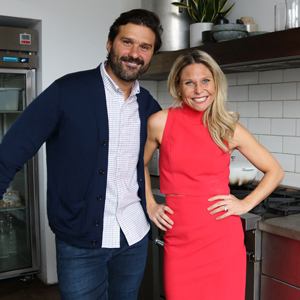
[00:00:10] Ray Latif: Hey folks, thanks for tuning in to Taste Radio, the number one podcast for the food and beverage industry. I'm editor and producer Ray Latif, and you're listening to episode 208, which features an interview with Bantam Bagels co-founders Nick & Elyse Oleksek, who discuss the remarkable rise of their innovative brand, which was acquired in 2018 for $34 million. Just a reminder, if you like what you hear on Taste Radio, please share the podcast with friends and colleagues. And of course, we'd love it if you could review us on the Apple Podcasts app or your listening platform of choice. Now, if you're like me, you enjoy bagels with a schmear of cream cheese. Nick & Elyse Oleksek figured out a way for folks like us to skip a step. The husband and wife team behind Bantam Bagels, Nick & Elyse created a mini bagel pre-filled with your favorite accoutrement. Launched as a retail storefront in New York City's West Village, Bantam Bagels has since evolved into a sprawling platform brand with its products, which now include mini stuffed pancakes and egg bites, sold at major retailers such as Walmart, Safeway, Target and Costco. The brand's bagels are also available in Starbucks pastry cases nationwide and regularly seen on shopping network QVC. Approximately 18 months ago, Nick & Lee sold their company to Lancaster Colony subsidiary T. Marzetti for $34 million. Yet they remain at the helm of day-to-day operations and say their passion and commitment to the brand and its growth remains as strong as ever. In the following interview, I spoke with The Oleksaks about their transition from Wall Street analysts to bagel entrepreneurs, the role that Shark Tank had on the brand's genesis and its rapid development, how they assessed opportunities to scale the brand, and why they said yes to everything. They also explained why cold emailing works and how to do it effectively, why investing in PR has been crucial to the brand's success, and why the timing was right to sell the company. Hey folks, it's Ray with Taste Radio. I'm on a call right now with Nick & Elyse Oleksek, who are the co-founders of Bantam Bagels. Nick & Elyse, how are you? Good, how are you?
[00:02:17] Elyse Oleksek: Hi, how are you?
[00:02:19] Ray Latif: I'm doing great. Thank you so much for taking the time to speak with me. I really appreciate it. Bagel Bites, you know, my first interaction with Bantam Bagels Bites. By the way, do you call them Bagel Bites or do you call them Bagel Balls?
[00:02:29] Elyse Oleksek: We call them mini stuffed bagels, hidden on number three.
[00:02:34] Ray Latif: Okay. I like mini stuffed bagels better than the ones that I just said.
[00:02:38] Elyse Oleksek: Okay.
[00:02:40] Ray Latif: Mini stuffed bagels, my first interaction with them was at a Starbucks and you see them in Starbucks cases all over America and they are pretty fantastic products. And I got to ask, since you started in 2013, how many mini stuffed bagels have you made to this point? Oh my gosh.
[00:03:00] Elyse Oleksek: Oh, that's a good trivia question.
[00:03:01] Nick Oleksek: That is a really good question. I would say, oh geez, and now I'm trying to do math in my head while we're on the phone.
[00:03:12] Elyse Oleksek: 500 million.
[00:03:13] Nick Oleksek: Probably.
[00:03:14] Elyse Oleksek: Probably.
[00:03:16] Ray Latif: 500 million, that's incredible.
[00:03:18] Elyse Oleksek: Give or take.
[00:03:20] Ray Latif: Wow. Wow. You know, I've talked to a lot of entrepreneurs who've never had a job. They are like, look, I'm going from college or right from high school and I'm starting my own business. I can't work for anyone else. It almost seems like entrepreneurship found you. You know, Shark Tank has a great influence in our society in getting people to start their own businesses. And I think there was a little bit of that with Bantam Bagels as well, right?
[00:03:47] Elyse Oleksek: Absolutely. I think Shark Tank is a mechanism of absolute, just sheer inspiration. You see ideas come to life with your wheels turning. But something I would love to debunk, just as we're talking and sharing advice or background, is that just because you're an entrepreneur and you technically work for yourself, It's not to be remiss that we still work and live in a world and a world is interconnected. Everything that we do, like when Nick and I approach business and phantom, we approach every single person, the people who work for us, the people that we sell to our customers like target or Starbucks, all of those people are technically, you know, part, our bosses, people we have to answer to. So, when you treat business not as, I'm on my own, I get to do anything I want, but rather a series of relationships that if you're good to your relationships, your relationships are good to you in return. I think it's a more productive way to approach entrepreneurship. Yes, you do get to determine your own hours and where you actually sit in your office, Business doesn't exist without a series of relationships with people you sell to and people who you are buying from. And those can be some of the toughest bosses that you'll ever see in your life. So that's, you know, one thing to remember as people embark on running their own business, to really respect and develop every relationship that they have. Even if it's somebody that you, like your co-packer who is working for you, technically you pay them, but that's a really important relationship that you have to make sure is happy and functioning properly and is delivering so that you can get what you need to service your business. Then your question about Shark Tank, isn't it just so inspiring? I think that Shark Tank turned the concept of taking an idea and bringing it to a business environment and turned it sexy because it was the first time that we saw that it was a way to you know, own your own future or turn sort of those ruminations that you may have on the weekend into a livelihood. It certainly inspired us. And let me say, Nick was like the biggest fan. We were both the biggest fans at the beginning, but he was the idea guy. Every day, every week, he would be calling with the next best idea. And it wasn't until that one idea of mini stuffed bagels that had us both just on pause this is our idea, we have to do it. And once we were able to develop a product that was actually as good as the concept seemed, we got real deal reactions from the external world that was telling us that this actually is a good business idea. And that was really what pushed us over the edge to make this thing happen. And by validation from the external world, I mean like polling friends, sampling people in our world, talking about the concept, raising money, having people getting press before we opened. We went out and we spun the concept around and we developed it in the external world and made sure that the external world accepted our concept before we just dove right into the deep end. And I do think that's an important thing to do before you just throw everything to the wind and dive in.
[00:07:20] Ray Latif: That's a really good point among a lot of really good points that you just made, Elise. The concept of leaping in with two feet right into the deep end is a scary prospect for a lot of entrepreneurs. I've talked to some that say that's the only way to do it. There was a bit of hedging your bets on your part, right? I mean, would you call it that in keeping your day jobs prior to going all in with Bantam?
[00:07:41] Nick Oleksek: I don't know if I would call it hedging our bets. I think there is just, there is some validation that you need to have to make sure that it is that great idea. You know, to Elise's point, sharing the product with people, getting them behind it, getting them so excited. But in terms of keeping our jobs, like when Bantam actually launched and we opened the Elise was pregnant, you know, and I think it was more about how do we make sure that we have, you know, the means to support our now soon to be growing family and make sure that, you know, we're doing the right things by just ensuring that we have the support, you know, for our new baby that was on the way, which is why I kept my job and worked both for almost a year and a half. where I would be at the bakery in the morning before work, and then at the bakery after work, at least, she quit her job and started running the shop full time. There's no set rubric or no set path to being a successful entrepreneur. I think you have to be able to be flexible, but you have to be able to be realistic in what matters.
[00:08:45] Elyse Oleksek: But I also want to make sure it's clear that we were all in. I agree with you. Like entrepreneurs, you decide. We tested the concept and we validated that was a good concept. But then we went all in. Just because Nick had a day job, every penny of our savings, every hour, minute, we never had weekends. We went four years thinking, oh my God, people get paid to have two days off a week. Is this a joke? We were all in, and I do agree with that. You have to heart hustle and absolutely bleed what you're doing. It's a different kind of commitment where it almost is like another extension of yourself. It's like it was our first child. Also, with regards to raising capital, the very, very nanosecond that you take $1 from somebody else, you are all in. That pressure is so real deal. that it's hard to even explain how real it is and I think any successful entrepreneur has that burning feeling in their pocket when someone else's money goes in there and you're responsible for that money and turning it for them. That's an all-in kind of experience.
[00:09:55] Ray Latif: Totally. You know, I'm sure there were a few folks who initially saw Bantam Bagels a niche concept. There's a lot of niche concepts, a lot of niche foods in New York City, and they can work in New York City because it's a densely populated place and you can have a shop that sells literally one thing and it'd be a huge success. At what point did you realize of an opportunity, there was an opportunity to scale Bantam? And how did you think about the ways you could do it? How did you think about what the ways you could expand as in more retail stores, you know, package products, food service, eventually you did all of them. But you know, when did you what did you think about, you know, the process of what should we do first?
[00:10:32] Elyse Oleksek: So like any entrepreneur, we had our sights on the world, anywhere and everywhere, and we were willing to throw everything against the wall until it stuck, right, in order to get there. But the truth is, when we first started this out, we didn't see mini stuffed bagels as a niche concept. We saw it as a lifestyle change. And the way that we went on developing this brand was to approach it as a lifestyle brand. So while our competitors in New York City, like at the time, the Corona was the most famous one and there were other single food restaurants at the time, they were all, you know, going after Bon Appetit or like food based forums. We actually took a different approach and we said we're changing, you know, our mantra at the time was change the way America bagels. Let's change the way that people eat an iconic food. And so that is more of a lifestyle change. Of course, we had to make sure our product was so delicious that you wanted to come back for more. and we had our authentic credibility in our New York City roots. But when we went on to develop a lifestyle brand, we started approaching magazine outlets, Us Weekly, Oprah's Magazine. We developed a catering program for Condé Nast. We sponsored different Hamptons events. We wanted to be associated with a lifestyle of being able to reassociate bagels with something that was cool and worth eating in your regular everyday life, not something that's unapproachable and makes me want to die. I can't eat dinner tonight because I just had a bagel today. So that was how we approached it, not as a niche brand, but as we were developing a brand new way of eating something that was iconic.
[00:12:23] Bantam Bagels: guessing your margins, that's risky. Belay Financial gives CPG brands the clarity to scale smarter, faster, stronger. Get your free inventory ebook by texting TASTE to 55123 and start making data work for you.
[00:12:43] Lancaster Colony: Tune in at the end of this episode for an exclusive interview with Matt Lin of Belay Solutions. He sits down with Melissa Traverse to break down the biggest inventory and accounting mistakes CPG founders often make. You'll learn how to bring clarity to your numbers so you can scale with confidence.
[00:13:01] Ray Latif: What you're talking about is PR, public relations, really getting your message out there, getting it to the right outlets, getting people talking about your brand and your products.
[00:13:09] Elyse Oleksek: Yeah.
[00:13:10] Ray Latif: Oftentimes PR is overlooked, especially with early stage brands, early stage entrepreneurs, it's expensive. Why did you feel the need? I mean, what, what compelled you to invest in PR early on?
[00:13:23] Nick Oleksek: Honestly, I think we felt like there was so much to this idea that we wanted to do it right from the beginning. And, you know, you asked the question of like, kind of, how did we know what the next step for the business would be and where should we go next? And I think The fact that we had Erica, who's our publicist, she's been our publicist from day one. The fact that we had her bringing the brand out into the marketplace in a unique and different way, to Elise's point, allowed us to make those decisions in a much more strategic analytical way than if we didn't have someone who was sharing the brand with the media, getting the brand out there, allowing our story to grow. in both like the conventional media channels, but also in like a very holistic way, like through blogs and Instagram and influencer posts, like having that public relations side to growing a business, we knew we had to do it. We knew from the very beginning, we had to have an outlet to share what we were doing, because what we were doing was so different and unique. Like no one had done this before with such an iconic food. We knew that we needed the support to get it out beyond New York City. And I think That is when we realized we needed to get the product beyond New York City. We were getting all of this national media exposure and this buzz around the brand and the product. And there was just such a demand to get it outside of that little retail shop in the West Village and to go explore the wholesale route. Our first major wholesale customer was QVC. we baked all the bagels for QVC out of that small little bakery. It was insane. We were running 24-hour baking shifts. It was madness. But we got that opportunity because we had got placement in Specialty Food Magazine. And that's where the QVC buyer saw it. And that's how she called our phone to ask us if we could get her 30,000 bagels 2 weeks after that. That was driven so much by our focus on PR and our focus on spreading the brand and spreading awareness of what the product does and what we were trying to do. So I think as you look at entrepreneurs, maybe PR isn't on the top five list of things to include when you start, but from our perspective, it had to be. And I think it changed the way that the brand grew and it allowed us to be in a lot more places a lot faster than if we didn't have it.
[00:15:46] Ray Latif: Getting into places a lot faster helps when you are running 24 hour shifts and baking bagels all the time.
[00:15:52] Elyse Oleksek: Well, you got to get the sale and the demand before you can create the supply when you're on a budget. So you got to elicit that demand and marketing is not to be overlooked. Everybody thinks if I build it, they will come. But the truth is when you build it, they often don't come unless you tell them to come. And we weren't, we didn't have enough money to invest in advertising and PR is so organic. It's like the voice of a trusted person is spreading your word for you and there's nothing more organic and authentic than, you know, like the New York, you know, articles.
[00:16:28] Ray Latif: Absolutely. I want to go back to your storefront and were you baking everything in that little storefront or did you have a separate operation?
[00:16:35] Nick Oleksek: We were baking every single bagel until 2015 in that bakery.
[00:16:42] Ray Latif: That is incredible.
[00:16:43] Nick Oleksek: It is. Looking back on it, it is also terrifying how small that place was and what we were able to do in those four walls is just, you know, it really is a, uh, a feat that we really just have to thank our team and our staff who helped us in the beginning. They just believed in us and believed in the product, and they were willing to work part of those 24-hour shifts and be part of what we felt was just this amazing, crazy energy of just continuing to do everything we could to get the product out there. So it was pretty wild and scary and fun, but I think that's what makes Starting a business and growing it quickly, that's what makes it exciting is having the opportunities to have to run a 24-hour shift and have to bring in new people and asking employees if they have any friends who know how to roll out dough and just crazy stuff. And looking back on it, that's another thing. Starting with that little retail shop, it gave us the ability to get to market so much faster than if we had to take time and go find a commercial kitchen or a secondary baking location. We could say yes to opportunities, I think, a lot faster because we did have the ability to bake the product in the retail shop.
[00:18:00] Ray Latif: you had an infrastructure, you had a very small infrastructure, but you had, you did have an infrastructure.
[00:18:04] Nick Oleksek: You had it. Right.
[00:18:05] Ray Latif: Yeah. And you know, when I think about Bantam, I'm reminded of an interview that I did with another New York based entrepreneur, Siggy Holmarsen, who was the founder of Siggy's Yogurt or Siggy's Skier to be more precise. And he said that, you know, it's really important for entrepreneurs to build the infrastructure for success. You have to know what success looks like and know how what you're doing today can scale. At that point in 2015, when you were running 24-7 and had, you know, massive orders coming through, when did you realize that you needed to adjust that infrastructure to build upon that infrastructure? And how much of that was planning for one year versus, say, five years down the line?
[00:18:44] Nick Oleksek: Yeah, it was basically like July of 14 is when we were like, Oh my God, we need a bigger boat, because we were notified that we had just gotten Oprah's favorite things list. And that list publishes at the end of October. and we had filmed Shark Tank.
[00:19:02] Elyse Oleksek: We were going to film for Shark Tank, and what happened was, when we were preparing for Shark Tank, we watched every episode that had ever aired, and we wrote down every question, and we prepared every answer. What had emerged in a lot of the historical Shark Tank episodes was this concept of a co-man. We had never heard of it. Our initial business plan, if we showed it to you from seven years ago, actually had Bantam becoming a franchise. So total, total different school of thought. And we were getting all this demand that was not associated with the shop. You know, people were coming to the shop, but the demand was in other people's stores like QVC or other retailers. So Shark Tank gave us the idea of a co-man and we looked at each other and we were like, oh my God, we cannot stand in front of the Shark Tank pitch without having done some research on a co-man. We spent weeks leading up to the pitch calling Johnny, Frank, every big old guy in New York City. Google does not have a list of co-manufacturers, let me tell you that much. You have to know a guy who knows a guy who doesn't wear shoes half the time. through our New York connections and just being people who learn as we go and talk to everybody and use relationships as one of the most important parts of business. Actually, I was walking into bagel shops around New York City. I would just walk around the city, walk into bagel shops and talk to the managers and ask, where do you guys bake? Do you bake everything here? And we started calling up different factories. One thing led to another, and we ended up finally finding the right co-man who was willing to bake our bagels for us. But our customers led us to changing our business model, which we listened to the customers. They wanted us elsewhere. And a new business model meant we needed to learn how to service that. We had no idea or plans for our co-manufacturer, but we figured it out from different mediums, learning from Shark Tank, learning from Johnny, you know, Frank, the bagel guy. And that's really how we landed on our infrastructure for expansion.
[00:21:16] Ray Latif: You know, this is, this is the hustle I'm talking about, you know, knocking on every door, picking up, calling every phone, you know, that's what it takes. And, you know, you're, I'm sure you're going to get a lot of doors slammed in your face and a lot of people want nothing to do with you. But after that hundredth call, that hundredth, you know, door, it might work. It might've all paid off.
[00:21:34] Elyse Oleksek: Exactly.
[00:21:35] Ray Latif: I want to go off on a tangent real quick because I'm sure going and talking to a lot of folks about this idea might have been kind of scary because you're worried about somebody taking that idea. How much of your bagel was protected by intellectual property? I mean, did you get a patent on the stuffed bagels?
[00:21:53] Nick Oleksek: So we, when we first got the idea, we Googled feverishly because we were like, I mean, this has to, a mini stuffed bagel like this just, we can't be the first ones. And, you know, we Googled around and Googled around and there was nothing like what we were doing. So we were like, well, how do, yeah, to your point, how do we, how do we make sure this is protected? How do we make sure that, you know, someone doesn't come on and knock us off? And food is just so hard to get an actual patent on. We filed a provisional patent on the process that we used to make the product and just to make us feel better about it, that we were at least doing something from an IP protection standpoint. But honestly, with food and this is kind of the three things that we've said from the very beginning in order to to grow and build a successful food brand on a unique item is you have to be first best and biggest and You know that was really just how we looked at it from the very beginning is We have to be the first to market we have to have the best product that anyone's ever had and we have to work our butts off to make it the biggest brand that we can make it before someone comes along in a meaningful way and tries to knock us off. So that goes back to your question around infrastructure and planning. How do you see 2 years in the future when you're on the 11th hour of your 12th hour of a baking shift? But for us, it was really always looking at those next steps ahead to make sure that we were prepared as we were trying to make this the biggest thing we could, so that we could say yes to those opportunities.
[00:23:30] Elyse Oleksek: And we always said that our best defense, even talking to our attorneys, our best defense was always to be the first, the biggest, and the best. And each one of those is like equally as important. And so it's like Nick said, that's part of where that hustle comes from, because you're racing against time to be the biggest. You might already be the best. You might already be the first. But if you don't have that third item of also being the biggest, once a competitor attempts to strike, then it's all for nothing.
[00:24:00] Ray Latif: Going back to the QVC deal, you know, that's an interesting retail avenue or that's an interesting sales opportunity for brands. And I'm seeing more food brands pop up on that network, more than I guess I had been paying attention to. I wonder if QVC was looking at you as, okay, this is the first, this is the best we've seen. Did you think about a QVC as a real sales opportunity for the brand?
[00:24:26] Nick Oleksek: Yeah, they approached us. Again, they saw an article about our product in Specialty Food magazine, and literally, we got a call from the main buyer at QVC. She started the conversation with being, I'm going to be up front with you. We are a very big organization and we have a lot of set rules. And we're not easy to deal with sometimes. But if you guys can fit your product and your pricing within our models, we can be successful together." That was literally how the conversation started. And she was like, we would put an order of like 30,000 bagels and we would need it in 2 weeks. Is that something you think you could do? And we were like, yeah, absolutely. No problem. And then hung up the phone, looked at each other. We're like, oh my god, how are we actually going to do this? Because to your point, we had no idea that QVC sold food. In our minds, growing up, QVC was the place to go and get clothing and jewelry and dry goods. And food never crossed our minds of being an avenue to sell there. And they are our longest standing customer. Our first airing was March of 2014. So we've been on there for six years.
[00:25:30] Ray Latif: Wow. Why have you kept going back on? I mean, is it just because sales have just been great?
[00:25:34] Nick Oleksek: Honestly, it's the sales are great. And what is so meaningful about QVC is the actual interaction and relationship that you have with your customer. The QVC customer trusts you and trusts your product and trusts your brand so much that to continue to go back and just really talk to them and give them updates on the business and what you're doing and maybe some new products or new flavors that you have. It's been such an amazing outlet and channel for us as the business has grown to continue to be really, really customer-facing in a way that is super unique to any other way that we sell our product.
[00:26:15] Ray Latif: Was there any hesitation to partner with QVC when they first called you? I mean, Elise, before we jumped on the mics, you had mentioned that, you know, a key to your success or key to Bantam Bagels's success to this point has been saying yes to everything. But was there any hesitation when they came knocking?
[00:26:31] Elyse Oleksek: No, it was a deal and we wanted to take it. I mean, we were, the energy and I mean, we were just catapulting forward. There was no no's. It was saying yes to everything. I mean, like Nick told you, we said yes. We took two weeks, 24 hour shifts. We overhauled our basement with freezers. We had Nick driving out to Long Island freezer space when those got full to drive the rest of the inventory out there. We googled nutrition facts and figured out how to put a nutrition fact on a package. We have always been very opportunistic. And when there's an opportunity in your hand and you're just starting out as an entrepreneur, you have big visions. You got to just figure it out and get it to work. I think profitability is important to us now, but at the very, very beginning stages, it was about getting bagels in people's mouths and getting our brand out there. And we figured, okay, this first run might like run us to the ground, but the second run will get a little bit better. And the third round we'll get a co-man doing. And the fourth round, you know, we'll have a printer that will print these nutrition facts and we won't be hand-stickering, you know, so we had confidence in ourselves that we would be able to find the profits when the time came, but, you know, we didn't want to be so myopic as to get in our own way of opportunity.
[00:27:54] Lancaster Colony: Do you want more repeat buyers on Amazon? Well, this free resource in collaboration with Straight Up Growth will help your brand turn first-time buyers into long-term subscribers. Download Winning the Repeat Purchase Game on Amazon now at Taste Radio slash SUG. That's Taste Radio slash S-U-G to start building retention-driven growth for your brand on Amazon. Scaling a beverage brand into major retail comes down to operational readiness. From packaging lead times to co-manufacturing strategy, the details can make or break a launch. In a new e-book in collaboration with Octopi and Asahi Beer USA, industry leaders share what they've learned in helping brands scale. Download it now at Taste Radio slash octopi. Do you need to scale your team faster without compromising on talent? Join Oceans for a live webinar on April 20th and learn how leading companies are hiring top global professionals who are ready to grow with your business. Register for the webinar now at Taste Radio slash oceans. That's Taste Radio slash oceans.
[00:29:05] Ray Latif: say yes to everything, a core tenant of the business, work your butt off, another core tenant. There's another, we'll call it an adage that I've seen associated with Bantam, which is fake it till you make it. And that's prevalent in the food and beverage industry, that notion of we've got to make it look like we're making it until we actually do. But I think it's a misunderstood phrase sometimes. I mean, what does it mean to you guys?
[00:29:30] Nick Oleksek: I think it means present the product and the brand in a way that people will say yes to you. Present yourself in a way where you show up like you are backed by this 24-hour, 7-day-a-week production facility that you are the brand that they can rely on to stock their shelves, to be the product that can meet the partnership with a retailer. When we did our first retailer selling, it was out in the West Coast in 2016, I think. And we, again, had never done retail before. We didn't really understand the landscape. But we went in with confidence. We went in that we could be the product that they needed. And it worked. And we sold in. And I think it was just like, that first taste of just having this confidence in how the product can be successful and kind of sharing that with the people that you're pitching or the potential partnerships that you may be going into business with, I think is kind of how we look at, I guess, the fake it till you make it adage is really doing everything you can to present yourself that you can handle anything, and then figuring out how to actually handle it if the opportunity comes through.
[00:30:49] Elyse Oleksek: While we may have presented, yes, we got this, we got this, and then behind the scenes been learning as we take that next step and been growing along with our growth, at the same time, we've never let a customer down. We've never literally in three years, 8,000 stores plus, 500 million bagels shorted in order, missed production, you know, fallen short on anything that we've promised. So I do think like maybe the fake it till you make it wouldn't be well received if you don't deliver on what you're promising. We never promise something that we don't literally fall on our sword to make happen.
[00:31:32] Ray Latif: That's a great point. And going back to Starbucks, I'm sure you have to convince them that you're willing to do literally anything, but that you also have the ability to follow through on those orders, that you do have some redundancies in production in case something goes wrong.
[00:31:48] Elyse Oleksek: And here are some ways that we showed them. So they knew what our production was at the time. We were working incredibly closely and they knew that we would need to ramp up actual capacity in order to meet their needs. But we proved to them through almost a year of working together through smaller scale rollouts We proved to them that we could keep up every step of the way and that we were smart enough to actually do good on our word. For example, when we were in just three stores, Nick and I spent every single day of the week for two weeks straight sampling in those stores, going from every store, printing out signs for them, talking to the baristas, toasting up bacon goudas. serving them behind the counter. And then when we went into 50 stores, we did the very same thing. We dedicated our heart and soul into that deal and we showed them what we were willing to put in if they were willing to lean in for us as well. And we pulled everything off every step of the way. When we expanded into 500 stores and we were in three different cities. We actually put our two-year-old at the time on a plane. We like scrounged up some airline miles, we had no money at the time, and literally went to Indianapolis, every single store with the baby, chatting the baristas, going behind, sampling, and this was what we did on our own. We went to every store in New York City, every store in Indy, and every single store in Philly, just showing them that we were going to ooze the sort of authenticity and passion that would like make a difference of having the product in their case. And it worked out having sort of like performance measures of showing them this passion and showing them this dedication allowed them to have a trust in us that once we did actually get launched in the full nationwide system that we would be pulling this off. There was no way we were going to mess it up by that time.
[00:33:39] Ray Latif: mess it up, you did not. That's amazing to hear that you didn't miss a single order. You haven't missed a single order in the three years that you've been in Starbucks. I want to go back into your first sale at Starbucks. It's an interesting story about how you first got connected to a Starbucks buyer. Can you talk about that?
[00:33:56] Nick Oleksek: Yeah. So when we were first looking at what are the opportunities for the brand and the product? How do we really impact the rest of this country? How do we get the product into larger wholesale distribution channels? What can we do? Literally, every two weeks, Elise and I would go and make a list of where we thought would be a great place that could sell Bantam Bagels. And then we would go on LinkedIn, and we would look up that company. And then we would try to guess the email address of the people in the food and beverage space. And if we didn't get a bounce back, we knew we guessed the email right. And then we blast them all out with our story, who we were with the product, and hope that we'd get a response. And we did this for literally every major food company or place that would sell food you can think of, we did that. And we did it with Starbucks. And we got an email back from their regional director in New York City. His name was Chris Flett. And Chris wrote us an email and said, Hey, so nice to hear from you. I actually know you guys. I saw you on Shark Tank. Funny story. We're actually thinking about doing a regional product rollout, maybe in New York City, where I think this could work really well. And also, whenever we have people come in from outside of New York, we bring them downtown to three places. our Starbucks on Christopher Street, Bantam Bagels on Bleecker, and our Starbucks on Bleecker." He's like, so I think there may be something here. And that was it. That's how the relationship started. We obviously had more meetings with them after that to get everything set up. But it was really just us trying to do whatever we could, reaching out to whoever we could to make sure that the brand and the product succeeded. Were you raising money during this time as well? Everything was self-funded, bootstrapped. We had our initial friends and family round to just even open the retail shop in the city. And then obviously we did the deal on Shark Tank. But outside of that, everything was just self-funded on us just continuing to grow the business and run the business in a healthy way.
[00:36:06] Ray Latif: Hindsight's 20-20, but looking back, when you did the Shark Tank deal, it was for $275,000 in exchange for 25% of the company. Now, the company was sold in 2018, Bantam Bagels, for $34 million. So looking back, was that a good deal for you at the time? And do you think it's still a good deal? 100%. Yeah.
[00:36:32] Nick Oleksek: And we get that question, or I guess a variation of that question a lot. And I think our answer has never changed. Shark Tank changed our business in a way that is so meaningful that I don't think there is a storyline where we wouldn't do what we did.
[00:36:48] Elyse Oleksek: Yeah, Shark Tank was so much more than PR. It was a connection with customers. a real deal connection, where they rooted for us. They watched us walk down the hallway. They watched us hug Lori. And they watched our success and growth afterwards. And they followed along. Having people who genuinely care and root for your brand is literally one of the most invaluable assets that we've acquired along the way. And I think Lori is a tremendous partner. that connection with customers, that real, genuine, authentic connection. I don't know that we would have been able to forge without Shark Tank. We feel forever indebted to it. We have always believed that 100% of zero is zero. If you're an entrepreneur and think that you're just going to hold on to your whole business, I don't know how far you can go. Business is nothing but a series of relationships. You need to be smart about which relationships you bring into your family. When you bring the right people in and you make the right deals, that is the game changer for a business. So to us, it wasn't even about the percentage. It was about this was the right person in the right format that was creating the right customer environment for us.
[00:38:01] Nick Oleksek: At the right time.
[00:38:02] Elyse Oleksek: At the right time. And it sincerely made the difference. of our entire company's growth that we rely on even now. Those customer connections still mean a lot to us as we forge new grocery stores, as we expand innovation. Having a business that people root for is really, really, really unique and really, really hard to create.
[00:38:28] Ray Latif: So for as much success and organic success as you had, I mean, certainly, you know, you've had some big opportunities with QVC, with Starbucks, with Shark Tank, but it sounds like everything has been going exceedingly well. So why sell the company?
[00:38:45] Elyse Oleksek: Because business is relationships. Business is more than just what we are able to do. Like we were growing too fast for Nick & Elyse to be able to prop it up. We needed infrastructure that was bigger than we had the capability of creating in a shorter amount of time than we had the ability to create it. Our line, even at the co-man was exploding with capacity. And at this point, you know, we were looking for a true, true partner. We weren't looking to say whether we wanted a capital raise or sell. That wasn't part of what we were looking for. We were looking for someone who was willing to lean in, who had sort of like the left side to our right side. And that was exactly what Mars Eddie had and people who were willing to keep the culture and the vibrancy and like what made Bantam Tick alive. Once you end up going on the, you know, going on a capital raising program, like we had a banker and we were looking for capital, you meet a lot of people and you learn that personality and fit actually supersedes even like what the deal structure is because at the end of the day, this is your baby and you want it to succeed and you want to lead it to success. And that's what we found in Marzetti. It was incredible. We had all of these synergies in our culture, and they wanted to preserve the way that we worked, the way that we sold, the way that we thought. They had easy access to manufacturing. We needed a new packaging line. This is all boring stuff, but it was stuff that we didn't have the capital to create. We didn't know how to develop, but they had the teams in place. They had the engineers, all of that back office stuff that isn't our strong suit and that would take a long time for us to learn and grow on our own. they had it easily accessible. So it was more about finding this match made in heaven than sell, don't sell, raise, don't raise. We wanted the best for this business. We have a vision. We're still not done. We're still running the show. It just happens to be under a different structure, but to us, it really doesn't make a difference.
[00:40:55] Ray Latif: Does it help to have a partner like that when you're thinking about your own personal lives? I mean, you have a family, you have two young kids. Does the deal give you that kind of flexibility to spend more time with your family, to be a little bit more present at home, or is it still 24-7?
[00:41:11] Elyse Oleksek: We're still working our hardest. Like we're still grinding. We're still on flights. We're still leading the business. But I think what weighed more heavily on our family was as we grew and as more and more weight and more and more just like financial weight was on our shoulders. that that weight is so heavy just on you physically, mentally, anxiety. It's a lot to carry and to, you know, as a family, like it's hard to have your work and your life really merge into one as an entrepreneur. And obviously that will, that anxiety and that heaviness and that weight will seep into your family life. So it's less about like hours in the day that are changed. It's more about we don't put the kids to bed and then lay awake at night staring at the ceiling saying, oh my God, what's going to happen next? Or like, oh my God, what fire are we going to put out tomorrow? We have a feeling of safety that like, I could only have dreamt of before. We know that Marzetti has our backs when we have problems, you know, they're right there to help us. We work hand in hand with the chief strategist there who solves every single problem with us. So we have a third opinion. We don't just have to rely on our gut anymore. And I think just that security, forget the financial piece of the security, just like the knowing that you have people who have your back, and they have access to things that we otherwise would have had to invent or create from scratch is like a peace of mind that is definitely has transcended into our family.
[00:42:41] Ray Latif: This has been a rockstar conversation. I mean, I feel like you guys are rockstar entrepreneurs. I don't use that word very often. I really loved every minute of our conversation, of our talk. Thank you so, so much for taking the time to speak with me. And let's try to meet up when we have an opportunity, because I'd love to meet you guys in person.
[00:42:58] Nick Oleksek: That would be great. Yeah. We once all of this craziness and unprecedented times, you know, hopefully abates and we can all kind of go back to some semblance of normal. We'll definitely be up and around the Boston area. So that'd be awesome. Outstanding. I'd love to have a bagel and coffee with you guys. Awesome. Well, thank you for your time. And you know, for, for talking to us, it always, you know, it means a lot for us to be able to kind of share our story and thank you.
[00:43:25] Ray Latif: Well, you are thoroughly welcome. Much appreciated. That brings us to the end of episode 208. Thank you so much for listening and thanks to our guests, Nick & Elyse Oleksek. You can catch both Taste Radio and Taste Radio Insider on Taste Radio, the Apple Podcasts app, Stitcher, Google Podcasts, and Spotify. As always, for questions, comments, ideas for future podcasts, please send us an email to ask at Taste Radio. On behalf of the entire Taste Radio team, thank you so much for listening and we'll talk to you next time.
[00:44:12] Elyse Oleksek: Hello, I am Melissa Traverse here for the Taste Radio podcast, talking about some of the biggest tension points that CPG brands and founders face when they're scaling a brand, and those are financial accounting and inventory management. I am joined by Matt Lynn, inventory accounting guru from Belay Solutions, and he's going to shed some light on all of this that is going to help everybody out quite a bit. Matt, thank you so much for joining us today.
[00:44:42] Wall Street: Thank you for having us, Melissa. It's great to be out here at Expo West and it's great to sit down and be able to chat this because it's kind of a passion project of ours, working mainly with CPG brands and hoping to help them scale.
[00:44:53] Elyse Oleksek: It's been such a pleasure chatting with you and the team and learning all about what you do over there at Belay Solutions. Can you tell us a little bit about yourself and what your role is and the kinds of solutions that Belay gives to CPG brands and founders?
[00:45:09] Wall Street: Yeah, absolutely. My role with Belay, I'm actually our inventory accounting manager. I run our inventory department. So we work with CPG brands, taking them from spreadsheets, putting them on inventory management systems, and really helping connect their tech stack between their sales, online marketplaces to that inventory management system, even down to their financial systems like QuickBooks. Belay overall is kind of an outsourced accounting firm. And with that, we're helping teams. We have different levels with bookkeeping, controller level work, even high level into CFO type items. So we really help those brands in any way that they need financially. And then I just have a subset of a department where we're really just laser focused on inventory.
[00:45:52] Elyse Oleksek: It's certainly a complex topic and there are plenty of places to go wrong. Let's start by going right and start super simple. Can you tell us what some of the biggest red flags are that would help a founder understand or, you know, the person running a brand understand that it really is time to get some help with some of these areas?
[00:46:13] Wall Street: WKYT. They have a lot of transactions that don't get coded or they just put them into placeholders to just get rid of it so it's not an eyesore. They'll notice they have revenue but no cash or they notice that they have a good amount of cash but their blind spot is really seeing the vendor invoices that are sitting there just needing to be paid and so they just lack that clarity that's going to really be around the corner.
[00:46:50] Elyse Oleksek: You know, you were talking about one of the red flags that comes up that I think makes so much sense. When somebody asks you what your numbers are and you can't come up with the right number, that's a big problem because that's something that you really should be able to share with decision makers who, you know, you're ideally looking to do business with. What should you be able to call up at a moment's notice?
[00:47:14] Wall Street: Really at any time, you should be able to know an accurate margin. It's amazing how many founders we end up talking to that they can tell you their revenue numbers, they can tell you their selling price, and then the minute you start talking about cost or their cost of goods sold, they just get a deer in headlights look. So really it's very hard to tell, am I even making money? Or if you don't know your entire landed cost. Maybe you know what the freight cost is, the duties separately, but you're not really getting that as part of your unit cost. So it's really hard to tell. Am I even making money or am I losing money from the very beginning?
[00:47:47] Elyse Oleksek: And do you recommend that founders are able to call up a margin by channel?
[00:47:52] Wall Street: Absolutely. And depending on the number of products and channels, you kind of want to know what are your best sellers, which ones are making the most and which ones maybe you're not making as much. But especially if you're branching out and you're doing D to C with B to B, absolutely want to know that.
[00:48:09] Elyse Oleksek: Gotcha. You mentioned that when things feel really chaotic, that's probably a red flag. I would say that it probably almost always feels chaotic if you're running a CBD brand. And I know this may be hard to quantify, but is there a revenue number? Is there a number of doors number that would help a brand understand whether or not it makes sense to bring on a partner like Belay? Understanding that so many brands are bootstrapped or they might be tight for cash. What is that friction point?
[00:48:42] Wall Street: a little bit different for everybody depending on where you're at in your process and sometimes just your level of understanding of financial aspects. You know, when you're first starting and you really cash conscious and don't want to spend that much money, you may keep it on yourself. But as you're growing, as you're getting to those six-figure revenue numbers, and especially as you're approaching seven, you want to make sure you've got good financials. Because as you scale to that point, most likely you're going to be looking to raise capital. And investors, the first thing they're going to look at is your books. And are they clean? And do they show a clear picture of your business?
[00:49:12] Elyse Oleksek: You know, another area that folks might look to to organize some of the chaos are their systems. So many folks stick with Excel spreadsheets for a good amount of time. How do you know that you need to outsource some of your accounting to an organization like Belay Solutions versus maybe signing on to a Synth7 or a NetSuite or something like that?
[00:49:34] Wall Street: Well, that's actually something we really help with when it comes to that cost question. That's something that trips people up. And sometimes if you just have a turnkey business, you buy and sell a finished good, you can maintain with spreadsheets. And we've had clients with million dollar revenue that can do that. But we see so many brands nowadays are using contract manufacturers. and they're just sourcing certain parts of their product. So when you start talking cost, they have no idea exactly what their unit cost is. So that's where we come in and we kind of understand, we'll speak with the customers and the clients and get their needs. And then if we think they're ready for a system, then we'll help put them on that system so they can get some of that clarity. And it's not something we force on anybody. There are plenty of times where founders come to us and we'll tell them bluntly, you're not ready for it right now, but we'll let you know when we think you are.
[00:50:20] Elyse Oleksek: That sounds like excellent advice. What should a founder or somebody running a brand look for in an outsourced accounting partner? Are there certain checklist items that they should make sure that their partner be able to execute or be able to help them understand?
[00:50:37] Wall Street: Absolutely. I think one of the keys, there's, there's a lot of outsourced accounting firms out there. Some focus on service-based SaaS companies, but if you're a CPG founder, you really want to make sure that your accounting firm has CPG experience. I would ask them, you know, what kind of brands have they worked with? And even beyond that industry specific, because there's so many subsets of CPG. And that's something that I think is great about what we do with Belay is that we kind of run the gamut. It's kind of like the insurance commercial. We know a thing or two because we've seen a thing or two across a broad spectrum.
[00:51:07] Elyse Oleksek: Probably getting references is always helpful, right?
[00:51:10] Wall Street: Absolutely.
[00:51:12] Elyse Oleksek: All right. So this all sounds great. I think we have a really good understanding of would it make sense to hire an outsourced partner? You know, what some of the things you should be looking for are. What does offloading this kind of work mean for the brand? What can this do for lightening the load of a founder or lightening the load of a brand operator? Like, how does that help them in their everyday business?
[00:51:36] Wall Street: It just tries to really help quiet the chaos. So what we're looking to do is just take some of the weight off that founder's shoulder. Let them focus on building the brand, building the business, getting that exposure. If you don't have sales, you really don't have anything. So we want them to be able to focus on that while we take care of your back-end office work. And we can just present that to you on a monthly basis. You can help make decisions. You can take that to investors. And really, you can just focus on growing your business.
[00:52:02] Elyse Oleksek: I feel like I felt founders and the folks who are running brands collectively sigh. Breath of relief just hearing that. How can people learn more about Belay Solutions?
[00:52:13] Wall Street: So people can text TASTE to 55123 for their free inventory guide to get started.
[00:52:19] Elyse Oleksek: Matt Lin, Inventory Accounting Guru at Belay Solutions. Thank you so much for joining me here at Expo West. It's been such a pleasure to chat with you and learn about what you all do over there to help founders and brands with their financial accounting and inventory management. For everybody else out there, thank you for listening to the Taste Radio podcast. I am Melissa Traverse and we'll see you next time.