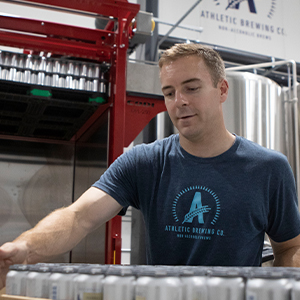
[00:00:10] Ray Latif: Hey folks, I'm Ray Latif and you're listening to the number one podcast for the food and beverage industry, Taste Radio. This is episode 239, which features an interview with Bill Shufelt, the co-founder and CEO of non-alcoholic craft beer brand Athletic Brewing, who discussed his journey from industry outsider to helming one of the hottest beverage companies in the U.S. Just a reminder to our listeners, if you like what you hear on Taste Radio, please share the podcast with friends and colleagues, and of course we'd love it if you could review us on the Apple Podcasts app or your listening platform of choice. The opportunity, as Bill Shufelt explained, was hidden in plain sight. Despite decades of stigma and ridicule for non-alcoholic beer, Bill Shufelt that modern consumers were ready and waiting for a better tasting and premium option. Launched in 2017, Athletic Brewing Company proved him correct and paved the way for dozens of new non-alcoholic beer brands that have since come to the rapidly expanding market. Athletic has dominated the craft side of the category and holds a 54% share of the segment which, according to Bill, is the fastest growing within non-alcoholic beer and grew over 300% in 2020. Speaking from the company's San Diego production facility, which opened last year following a $17.5 million capital raise, Bill discussed how a high-pressure career in finance led him to non-alcoholic beer, why expansive research and market analysis were key to the initial business plan, how he dealt with consistent rejection from beer industry professionals, and how he landed his first investors. He also spoke about the yin and yang of his relationship with Athletic's co-founder, why he believes that drama is so unproductive, how he planned for and is managing explosive growth, and how he evaluates strategic partnerships. Hey, folks, it's Ray with Taste Radio. Right now, I'm honored to be on a call with Bill Shufelt, who is the co-founder and CEO of Athletic Brewing Company. Bill, how are you?
[00:02:12] Bill Shufelt: Great, thanks, Ray. Thank you so much for having me on. Long time dream to be on here.
[00:02:16] Ray Latif: Well, it's been a long time coming because I know you've been a fan of Taste Radio for quite some time, and we're kind of coming full circle here in that when you started listening, you were a small startup, and now you're a bigger startup. perhaps even a much bigger startup than you ever imagined. And it's amazing to see how far the company has come in just a relatively short amount of time. As I mentioned, you're a longtime listener of Taste Radio. I'm curious as to whether you have any favorite episodes or guests of the show.
[00:02:50] Bill Shufelt: Yeah, and I mean, I do just want to say thank you guys, like you guys do provide such a great service to entrepreneurs out there and the industry as a whole. It's not only the website, it's the conferences, it's the podcast, you get so many different levels of experience. Plus, you guys are so reachable in person. And yeah, the people I've gotten to hear over the years that have been like really formative lessons, like, it's basically who's who, I mean, from like Stonyfield Farm, to Honest Tea, to GT Dave, to Suja, John Sebastiani of Krave, I remember being, it's so funny to like, hear these people's stories on your podcast early in my journey, and then like bump into them at your conference, like two or three years later, and like, just a really cool life cycle. I'm thankful to be here. Thank you.
[00:03:37] Ray Latif: Well, thank you very much again for joining me today. I think there's a bunch of folks who are regular listeners of the podcast who are familiar with Athletic Brewing, either as consumers of the brand or from us praising everything that you guys have done to this point. But for folks who are not, obviously you're a non-alcoholic beer brand, but what makes your beer different from other non-alcoholic beers?
[00:04:05] Bill Shufelt: I definitely appreciate you guys sampling our beers on the show and the preludes to the interviews. I think the big thing that separates athletic is we really built this product and reimagine the category out of our lifestyles. And it's authentically what our lifestyles led us into and what we wanted to see in the beer world. It wasn't something that it emerged in a marketing and sales meeting. And like, then they went to Athletic Brewing team at the 11th hour to ask me, it wasn't something that like, We just had the idea and started contract brewing it. It was John and I, it originally emerged out of my lifestyle, but like we homebrewed in an empty warehouse for a full year, perfecting our process. We saw what the category was and we knew what we wanted it to be, be this like great craft beer that you don't have to compromise for. And so I think that's what really differentiates us is that we're so invested in it. built this from the ground up. We use a totally different process than anyone. And we're really looking out to the future of the category and what it should be in the bigger world.
[00:05:09] Ray Latif: Yeah, you said you used a little bit of a different process. I think there's been a sort of legacy way of making non-alcoholic beer. And we don't necessarily need to get into, you know, the fine points, but when it comes to how you craft your beverage versus how it's been done, is there something that's so significantly different, or is it just a reflection of your desire to deliver a quality that just hasn't existed in the past?
[00:05:38] Bill Shufelt: I think part of it is John Walker, our co-founder, focusing on it and him being probably the most talented person to ever turn his focus fully on non-alcoholic beer and not just have it be one line extension. But also before John and I went commercial, I mean, we Brad Avery brewing textbook out there to try to figure out how to make better non-alcoholic beer. And while I was at my old job, I would on nights and weekends just read brewing textbooks and underline things I thought might be extractable for a non-alcoholic beer process while still getting all the nuance like essers and aromas and everything of fermentation. We looked at all those technologies that have been used for 60, 70 years to make non-alcoholic beer and decided that that wasn't enough. If that worked, the craft beer world is incredible. They would already be using those to make great beer. So we kind of started from the ground up and came up with our own process that's really 10 to 12 different steps in the process versus traditional brewing rather than one magic silver bullet step that's different.
[00:06:42] Ray Latif: you're doing something right because your beer is fantastic. It's just a great tasting liquid beer or otherwise and I think that's why so many people have taken to it. Some people might be pretty surprised to hear your calm demeanor and the way you present yourself. I know that I always recognized you as being a very easygoing, friendly person. So I was even more shocked to learn that you actually worked at a hedge fund for a number of years, a high-pressure hedge fund at that, one which came with a lot of strife from what you tell me.
[00:07:17] Bill Shufelt: Yeah, I mean, it's kind of just something where I like view drama and emotion and blowing up about problems as just like, totally unproductive and a waste of resources, waste of time and a step backward rather than forward. Yeah, I did work at one of the biggest hedge funds in the world, definitely known for its intensity. And there have been shows about it. People did used to get mad at me that I was so relaxed. And it was It's kind of getting that ethos from it But that being said the lifestyle was super intense and every day had to be on my game It was a room full of intellectually very smart very fast acting people but I loved going out to work dinners sports bars with friends nice dinners with my wife and all sorts of occasions like that and Mixing in three or four of those things a week and trying to be at my best at my day job just wasn't really leveling out and I I kind of got to the point where I like wanted no days off at work like no down days at work and Cutting out alcohol was really the easiest solution to that not to mention like health fitness plant-based eating and things like that and Really wanted to take the edge off words like sober and vegan Also that are like such alienating words like I was sober for really positive reasons I wanted to be healthier be sharper at work be more mindful with my friends and family and But I wanted to do all the same things. And that's really the impact we've set out to have.
[00:08:45] Ray Latif: One interesting thing you told me last time we spoke was that in the years since you launched Athletic Brewing Company, you and John Kraven never raised your voices at each other or anyone in the company. I don't want to say I find that hard to believe, but I find that incredible because I assume a lot of things can go wrong, and that there are people that are responsible for these things going wrong, and sometimes it requires raising your voice. How have you been able to do it?
[00:09:13] Bill Shufelt: I think it's incredibly lucky John and I found each other as like a co-founder match. We're perfectly suited. through various things over the past few years, I've actually taken like management characteristic tests. And if I look at all my weaknesses, I would like describe that person as John, which is funny to have like the skills perfectly counterbalance. And that's, it's really been something where things I'm super confident in, I can run with, but like, I know where my weaknesses are, and we have no ego and like, very much depend on each other and all of our teammates. It's also just a function of both being cool operators. I mean, we walk in with the expectation that things are going wrong every day when we walk in and things are laughably bad from time to time. And John and I know every inch of our breweries because something's gone wrong in every corner of the breweries and we've had to scope it out, repair it, fix it. For example, we had this machine in 2018 that It was in our parking lot. It wasn't inside the building, but it was blowing up and basically drenching, drenching the parking lot. And every time it would blow up was a four or $5,000 mistake basically. And we could really only afford one of those. And so John and I spent basically a week sitting in a, in a lawn chair next to this machine. So we could catch it early enough. And we'd eventually turn it off at like 10 o'clock when we went home at night. I've spilled full pallets of beers on forklifts before and crazy things go wrong every day. And I'm a huge believer in saying the obstacles the way Bill Belichick and a lot of coaches live by it. But really seeing those obstacles and challenges that happen every day as things that all progress is right on the other side of those. And As we get over those obstacles and hurdles and challenges, there'll be a big moat behind us too. And so we're really excited to face those every day as a team. And things are going to go wrong. And a lot of those mistakes are my mistakes. So I don't want to hold our team to standards that I'm not holding myself to also.
[00:11:19] Athletic Brewing: Guessing your margins? That's risky. Belay Financial gives CPG brands the clarity to scale smarter, faster, stronger. Get your free inventory ebook by texting TASTE to 55123 and start making data work for you. Vibrant Ingredients is the natural ingredient partner powering food and beverage innovation, delivering flavor, function, and protection through a science-backed portfolio. Vibrant delivers purpose-driven solutions that help brands create extraordinary experiences. Discover what's possible with Vibrant today. Visit VibrantIngredients.com.
[00:12:06] Ray Latif: Did you say you look forward to problems because they help you to understand how to better the brand, the company? Is that what I'm hearing?
[00:12:17] Bill Shufelt: Yeah, for sure. I mean, some of our biggest challenges have then been ways where we've actually been able to make our product safer, make it higher quality. And we've learned so many things at a small scale over the years that like now, as we grow to bigger scale, we have such confidence in having a safe, high quality, repeatable product and processes. And where if we had been really well funded from the jump and just launched a scalable product, it would have been a lot of really hard learnings And that's something we're worried about the future of the category as well as people trying to follow in our footsteps at scale.
[00:12:53] Ray Latif: Just going back to you and John as being sort of a yin and yang in terms of co-founders. It seems like understanding how to work with people, understanding how to work with partners requires a lot of understanding of who you are and self-evaluation. So, I guess, how well do you know yourself and how important is that to knowing how to work with your colleagues?
[00:13:22] Bill Shufelt: I would have never thought to put myself through one of those tests. And I was really glad someone did recommend I do it. I forget the exact name of it, but it did help me learn about my skills and weaknesses. And also really just approaching entrepreneurship with no ego has helped me a lot too. There's been a ton of personal growth over the past five years. And yeah, really no one starts any company of any size from the smallest to the largest without so much personal growth. So yeah, definitely. have a low bar of expectations for myself and definitely a really high, like a high willingness to listen and learn and change my mind and get new data points because they change all the time.
[00:14:03] Ray Latif: You did a ton of research beforehand before launching this company. How did you assess the opportunity for non-alcoholic beer and more specifically for a brand like Athletic Brewing to carve out not only a niche within the industry, but carve out a potentially really big segment that could change the way people look at non-alcoholic beer for decades to come?
[00:14:31] Bill Shufelt: I appreciate you saying that. It's definitely something where if I hadn't done my research, I might have gotten rattled by just how negative the feedback was. But while I was at my prior job, I did do a full two years of research. And that was on nights, it was 10 hours on weekend days. Was waking up early in the morning at 4 a.m And calling people in germany and asking questions about how to make non-alcoholic beer and doing market sizing doing probably hundreds of google surveys just asking people questions like what they think about the market and It gave me the confidence that this market that had been flatlined for 30 years in the u.s It was 0.3 percent of beer sales It was stuck at 80 million dollars and hadn't seen a hint of growth or a new product in almost 25 years that it actually did align really well with modern health trends. People wanted it. And it was a huge market everywhere else except in the US. And all that got me so excited. Plus just the positive impact it could have too. I would say through all the hard times the positive impact we have as a company has definitely been a driving force and helped my feet hit the floor in the morning and tackle the day no matter how tough it is. So I had that unflappable confidence in the size of the market and the impact we could have and quit my job going into 2017. And immediately I thought I had this great business plan, great idea, and thought it was just going to take off. And really the first 200, 250 brewers I talked to, I think I actually counted a couple of years ago, it was like 220, but in mostly very nice ways like said no very quickly and said you know no one's ever asked our brewery for non-alcoholic beer or there's no market for it i'd save your money non-alcoholic beer is terrible and it's not even possible there was really no interest i would say out of those 200 there wasn't even like a warm lead it was until i talked to john and by the time i talked to john i'd taken non-alcoholic out of the job description and like basically Totally stripped down the job description until I got people on the phone And john applied and it was this guy with he had won multiple great american beer festival medals his ipa won a silver in the world beer cup and Was the most credentialed person I'd talked to the whole time And I basically started the conversation by being like, please give me five minutes and don't hang up and don't say no till monday He gave me like a half hour to talk about it and like what i'm thinking about john had young kids and It was a super talented brewer. So he like definitely heard me out and he hit me back on Monday and he was like, full disclosure, I was a hundred percent going to say no on the spot. And he's like, I thought about it over the weekend. I hung out with my kids and all day on Saturday, I wished I had a good beer that I could drink with my kids. And he was like, I was tucking my kids into bed. And I just realized that like, there is a huge market for this. And he's like, the technical, the innovative challenge, the impact. He's like, I'm down for it all. And so like, while the water was still warm, I flew down to Santa Fe to meet him in person, share process stuff. And we really, from that moment, started exchanging like hundreds of emails before he moved across the country to do this. But yeah, there was, until that moment, there had been almost no warm reception at all in the industry. I'd been going to conferences just to learn as much as I can. I was at BevNET and Brewbound 2017 in New York and met one of our future investors there. One of the only other positive conversations I had that year. But I went to Crap Brewers conference in D.C. that year and Must have talked to over a hundred people and it was a super discouraging week. But yeah, it's a all those challenges from Athletic Brewing side Our original plan wasn't even to build a brewery we were going to contract brew and I had all these dots on the map of where I was going to travel around the country and meet with contract brewers and like pitch our story and Every single one of the twelve said no So I like canceled the trip and like went back to the drawing board on the business model where then we're gonna build a brewery so It was pretty dark for a while. When you're working in a home office alone and like all 10 of your phone calls in a given day are just hard no's, it was a tough few months for sure.
[00:18:56] Ray Latif: I think it was in 2017, I don't remember the exact year, that Ballast Point was acquired for a billion dollars. And now you guys are in one of their former breweries, which is pretty remarkable. So I guess that says something about the potential for the market that you were talking about. Going back to what you said, people wanted this. Well, people in the beer industry didn't want it. So who are those people you're talking about? And how did you know that they wanted this? And you mentioned you did hundreds of Google surveys. What was your methodology for really understanding what this demand was and how big it could be?
[00:19:35] Bill Shufelt: Started at the most granular unscientific level there was me and my brother and some people I'd bumped into who were all like relatively high-performing adults into fitness had serious day jobs, but still loved craft beer and food and going out with friends and In that it was such a painful experience that there were no options for me anywhere at all those things from My local sports bar to weddings and venues and everything So there are all these occasions where I intuitively knew non-alcoholic beer went great And I was trying to buy anything online. I could I was even buying non-alcoholic beer from europe and it was still just like okay But then you know doing surveys asking people with what frequency would you drink non-alcoholic beer? I think it was 55 percent of people said somewhat regularly If given a good option, the barriers to not drinking non-alcoholic beer were all about quality and stigma in the category, which rightfully so. I mean, the U.S. has a really unique experience with prohibition and alcohol being taken away. So it's such a badge of pride that people don't want to give up their alcohol. And so like that stigma around not drinking is really 80 something years old and still has like really powerful meaning attached to sober But I think as modern data and information becomes more readily available people are more outward and vulnerable with their feelings and how they feel and like what honestly makes them feel good and bad and what inputs in their life help them perform and are additive versus like what inputs in their life, maybe put a, like a lower ceiling on their life. And I think that information, not to mention like aura rings and whoop bands and I watches and stuff like that. If you have five alcoholic drinks and like a big steak, like you can see it in your sleep data. So like, it's so much easier to share information and variables and everything. And so I think all that is really, also helped this wave towards the category. But it was there just hiding in plain sight to me. There was all this data, all this survey data. Really, any question I asked, 40% to 60% were pretty warm and receptive to an idea where the market was less than 1%. And these people were clearly telling me it was just because of the stigma and the quality. And those are two things you can correct with product and marketing. with the right effort and the right enthusiasm and the right passion. So this was a category that was just sitting in the corner of a grocery store untouched for decades while the whole grocery store around it changed. Like there isn't a single other set in the grocery store that hasn't totally turned over. And it was a really exciting hiding in plain sight moment for me. And all the data was pointing in the same direction. And my first business plan was something like 96 pages. It was like a white paper on the non-alcoholic space with just like tons of data. And a lot of our early investors were like This isn't really how most people do business plans, but this is like a great white paper on the space. Pretty funny.
[00:22:45] Ray Latif: I don't think you're the first person to write a white paper on non-alcoholic beer. And I would assume that, you know, major beer companies, Anheuser-Busch, Molson Coors, they've probably investigated the opportunity for non-alcoholic beer. But was it that they were sort of waiting for an opening, waiting to see if anyone could have any kind of momentum with this? Or was it that they were just getting different data than you were? And I know I'm asking a question that you may be to kind of answer because you don't have, you don't work for any of those companies. But I guess in your opinion, do you think that they probably say they saw the same information, but in their gut, they just decided not to follow it?
[00:23:22] Bill Shufelt: I think a lot is probably in common with say, like stock analysis in the financial world, where if a stock's already going up, it's really easy to project it going higher. But if it's flat lined and hasn't done anything in 25 years, it's really hard to all of a sudden projected hockey sticking up. I think someone really just had to have the zero to one moment where get that rock going, get some excitement going and like kind of put the playbook out there on how to reach modern adults with beer. I mean, how to change this beverage that people have been drinking for thousands of years and really get it up to modern standards. So I think the thought was there that it's going to be big at some point, but a lot of people wanted to see someone else push the rock to start. And we're very grateful for Heineken coming in with a huge marketing effort behind ZeroZero also. It definitely helps bring awareness to the category as we grow as well.
[00:24:17] Ray Latif: Yeah, well first Heineken, I was watching the super bowl yesterday. The commercials for Budweiser zero are out there. There's a bunch of craft players getting in the game now. So it's getting crowded and it's getting crowded pretty fast. And that wasn't necessarily something in the back of your mind. I assume that wasn't something in the back of your mind when you first started. If I'm just doing like a, Back in the napkin squat analysis here, I'm thinking about strengths and I'm like, okay, great partnership between Bill and John, John, you know, an award winning brewer. Okay. All strengths here, especially as strengths in that you understand business and you understand how to write white papers opportunities. Obviously you've outlined the opportunities. for the growth of this category. Threats, at the time, doesn't seem like anyone wanted anything to do with non-alcoholic beer. So the W in SWAT, where were your weaknesses? Where did you guys need the most help? Where did you think that you had fallen short of where you needed to be when you launched the company?
[00:25:12] Bill Shufelt: So I'd say a lot of it is in the stigma, really. I mean, taking something that so many people know to be one thing and convincing them it's another thing is something that is really tough. It's a big marketing lift. And that first summer, I was at 65 finish lines all over New England, just handing out probably 1000 beers a weekend, waking up at three in the morning and driving five hours to some Ironman race or a local 5k or anywhere I could really get the beer in the hands of a couple hundred people made a huge difference and it was mostly just a grassroots horsepower left. But yeah, definitely current category awareness was definitely a weakness, but I'd say we're really glad to learn a lot of those lessons at a small scale to where it was just me, John and one other person in the company doing all the jobs from brewing, packing, canning, mailing all the e-commerce packages, making sales calls at retail, fundraising, I was the CFO, I was the marketing director, like every job from left to right across the organization. John and I know what it feels like to do every job. So it's really tough to do it at that scale and grow quickly. And yeah, we're really excited about the new entrance in the category too. I know it seems intuitively like a threat, but Heineken and Buzzer have done such a great job helping bring awareness to this category with marketing budgets. We think there is a wind blowing in the sails of this category that's going to be here for decades to come. And like really such a durable mega trend because of how it aligns with better for you health trends, because it's literally going from zero and has potential to be a huge category in terms of like runway and potential. The beer market's $115 billion. The non-alcoholic beverage market is $1.2 trillion worldwide. Even categories like kombucha, which are still very niche are two billion dollars The non-alcoholic beer market at the time was 80 million dollars. It's now 200 million dollars, but We couldn't do that left all ourselves And so we're super excited to have other people come into this category and help us grow it it's things we couldn't do ourselves, but we do want to be a leader in that category and We are very complimentary to the other brands on the set. Be it Heineken but zero like you have your import you have your macro value longer and like we have a line of high end craft beers that are artisanal largely organic and it's just a totally different proposition. And we do think Regional brewers of all kinds are going to come out with a non-alcoholic beer of their flagship, and that'll help grow local awareness. I think we're just going to be the national brand out there that really runs at the front of the category.
[00:28:04] San Diego: Do you want more repeat buyers on Amazon? Well, this free resource in collaboration with Straight Up Growth will help your brand turn first-time buyers into long-term subscribers. Download Winning the Repeat Purchase Game on Amazon now at Taste Radio slash SUG. That's Taste Radio slash S-U-G to start building retention-driven growth for your brand on Amazon. Scaling a beverage brand into major retail comes down to operational readiness. From packaging lead times to co-manufacturing strategy, the details can make or break a launch. In a new e-book in collaboration with Octopi and Asahi Beer USA, industry leaders share what they've learned in helping brands scale. Download it now at Taste Radio slash octopi.
[00:28:54] Ray Latif: We skipped over one, in my opinion, one important point. And you reminded me of it when you said that you were at events, at finish lines, handing out Athletic Brewing samples. And that's the name itself, Athletic Brewing. Why did you choose that word athletic for a beer company? I mean, without it being a non-alcoholic beer, without people knowing it's a non-alcoholic beer, it seems to be a bit of an oxymoron, right?
[00:29:21] Bill Shufelt: Yeah, and that was really kind of the fun with it. I mean, we considered hundreds and hundreds of names for six plus months, whenever I'd get anyone at a dinner, I would steer the conversation towards naming this company eventually. And the word athletic I had thought of previously, and it seems so basic, and there's no way that would work. And then It kept coming back to me and I was like, oh my goodness, it's the perfect word. It's like athletic is something where everyone's Athletic Brewing some way. It's so easily recognizable in a loud, crowded bar or restaurant. The non-alcoholic beer world had previously been something that was so shameful that people turned the label in their hand whenever like, there with their friends at a bar if a waiter asked you like oh what would you like to drink and you'd ask like do you have any non-alcoholic beer they'd be like what and you'd be like non-alcoholic beer it was just such an embarrassing category that implied you were in the penalty box for that night like we wanted to take it out of that penalty box and make it something positive and aspirational and athletic is just that it's something people universally like to think of themselves as Athletic Brewing some way. And so it's just a positive, easily pronounced word and kind of embodies our ethos really well too.
[00:30:39] Ray Latif: Any names on the cutting room floor that you care to share with us? I'm curious.
[00:30:45] Bill Shufelt: There were some really bad ones that got way farther along than they should have. Run Wild, the name of our flagship IPA was definitely a finalist. And so that was an easy slot to our flagship beer. But yeah, like there was nothing more embarrassing than ordering these beers in the past and we wanted to change that and have it be something where Like if a group of people asked you what you were drinking You'd actually like hold it forward and be like you gotta check this out. I drink these all the time.
[00:31:13] Ray Latif: I wake up feeling great So trying to take it out of the penalty box and having some fun with it Well, let's talk about something that beverage entrepreneurs loathe to talk about which is fundraising because You have to do it, you have to do it all the time, seemingly all the time, and be ready to hear a lot of no's. In your case, you heard a lot of no's before you got to that one yes. Talk about the investors that you met with and the reception, the initial reception you got, and how you got to that first yes.
[00:31:52] Bill Shufelt: It was like searching for a co-founder. It was a super dark journey. So caveat two that we didn't have product yet. So I was pitching idea for like a totally reimagined non-alcoholic beer category without the actual beer. I met with experts from every field and CPG background and so a lot of great learnings from them. But also it really set us up for the future because I knew I had this group that was so into what we're doing. I write the monthly updates along the way. I've written over 50 monthly updates now to that same group of people, just keeping them involved in the journey, the wins, the progress, the challenges, what's next. And to those updates, I get some of the best feedback I've gotten. And for a long time, it seemed like we weren't going to get off the ground. I mean, it came to the point where I had to actually buy Athletic Brewing equipment and lease the facility. And I ended up writing those checks myself after talking to my wife. But that was basically like, we didn't know if we were going to get to the finish line of fundraising. So at that point, it was basically like us committing 100% of our savings on that. And thank goodness for my wife and her advice. I mean, she was so formative behind the whole idea in the first place. But at some point, four or five months in, one person got excited, and they told three friends. And before I knew it, I don't know how we went from 10% of our goal to about 80%. But it was like the snowball. And before I knew it, we were way oversubscribed. And I had to say no to about 20 people at the end. And they've supported us the whole way along. It can be really hard to find your investor team. But once you have them that group can be supportive for the road ahead. And they've been an incredible group supporting us all the way from the small Connecticut brewery to our San Diego brewery. That's about 10 times the size.
[00:33:48] Ray Latif: You can have a great team, you can have a great product, you can have great investors. You've got to have someone to sell your product, to distribute your product. Let's talk a little bit about retail and distribution. Was it difficult to land your first distributor? How did you convince them that this was a product that they needed to carry? And by extension, who were the retailers that were really receptive to Athletic? at the outset and really helped you build a name and a cachet for the brand?
[00:34:21] Bill Shufelt: I mean, there's so many delusional and lucky experiences along the way. I don't really know what I was thinking, but I was like walking into Whole Foods with hand bottled. John and I, once we started construction, we were homebrewing in his garage. We're hand bottling beer in like 40 degree weather. And I was taking those hand bottled beers and like walking into Whole Foods with them and asking if they wanted to start stocking us in three months when our canning line was in place. And actually, you wouldn't be the first person.
[00:34:50] Ray Latif: You wouldn't be the first person to do that, Bill.
[00:34:53] Bill Shufelt: And actually, they were really receptive. There are a bunch of local independent liquor stores and stores that were really receptive. And then Whole Foods was like our first major account. And they gave us trial. I went down to the New Jersey regional office and they gave us our first trial in seven different stores in Connecticut. And Whole Foods has been a huge advocate right from day one. And in terms of distribution, I've got to hand it to Star Distributors in Connecticut. I mean, they basically like heard about us and like walked into our brewery and we connected to them. And like I went and did a pitch with hand-bottled home-brewed beer. And it was basically like all their senior management, totally crazy moment in hindsight, but they were super receptive and they got it. And I'd say Star Distributors in Connecticut and Night Shift Distributing in Massachusetts. They just really got the concept so ahead of the curve and brought us into their portfolios and really helped us build the brand. A great distributor partner goes so far in building out your retail presence and retail relationships because they have those decade plus relationships with the retailers in the States. So we're very thankful for them growing with us and also just giving us an ear and an honest shot when we're very small and humble.
[00:36:11] Ray Latif: Was the pitch you gave to investors kind of similar as the ones you gave to distributors, or at least, you know, the data and the survey information that you had compiled, was that part of the way that distributors and retailers, like a Whole Foods, became convinced to this opportunity?
[00:36:30] Bill Shufelt: Yeah, really just like a great 10 page presentation that like hit all the important data points and occasions. But also like what are you going to invest in the relationship? Like what kind of resources are you bringing to the table as well? And I told them I was going to support the hell out of our products in the market, sampling, trade activations, everything. They really appreciate that. I did tons of ride alongs with our distributors. I was in grocery stores. I was in liquor stores on Friday nights till 10 o'clock just getting made fun of by high school kids. And it was literally brick by brick. And then every new teammate we brought on to has brought new ideas fresh energy. And like now it's not just me and my 50 to 100 events a year. We have 30 teammates across the country in different states all doing 50 to 100 events a year. That just ripples out. Yeah I think in this day and age distributors and retailers want so much more than just someone to launch a product into their market. You've got to be there in person supporting it and really providing the resources and the education to make sure it moves.
[00:37:37] Ray Latif: You know, it's funny you mention these sampling events and demos because the only beer sampling demo I have seen since the launch of the pandemic was an Athletic Brewing demo outside of a liquor store not too far from where I live. It was just a guy all bundled up in the cold, handing out small samples of Athletic Brewing. I'm like, wow, this is fantastic. I'm like, these guys are so committed. There were plenty of people who wanted to try it and talk about it. You would think that sampling because of a pandemic or just because it's cold outside is not something that anyone would want to participate in. But it really showed something to me about the commitment that you were willing to make. That was late 2020. We're in early 2021 right now. And as I mentioned, Athletic Brewing is on fire. I mean, you guys are doing really, really well, so well that the demand was outpacing your own expectations. Talk about how you forecasted demand and how you caught up to this wave of interest in non-alcohol beer.
[00:38:53] Bill Shufelt: Yeah, and got to give a shout out to Lauren up in Massachusetts. He's definitely the one you bumped into. He's a total killer. But we're all over doing that. And like our team in Chicago last weekend was sampling in such cold temperatures, it was actually negative that they're putting beer in the coolers to warm it up before it froze. But really, it's like it's definitely a heart and hustle and supporting the brand and making sure people have a good experience with it. So I mean, in terms of Forecasting growth, I mean, the best learning I think I could pass on is kind of the need to do scenario analysis. And you can be the best in the world at numbers. And there is always a certain amount of science and art in any decision and planning. And you can be as organized and as buttoned up. And gut and art will be equally as valuable as the science and math along the way. So I think really, we've always had like, what does our baseline look like? What does down 50% look like? But also, what does up 200% look like? And what triggers and what steps are we going to take along the way where we buy new tanks, we cut back on purchasing or like all different triggers? And really I think the best way to be able to flexibly approach that unpredictability is to avoid debt as much as you can from Experiences I've heard and learnings in the industry. I think that is probably the most unforgiving mechanism out there where You can be growing very stable 10 out of 12 months but two months could really put you in a bad spot or anything like that where if you are debt free and have a great investor team, you can always have a, like an honest conversation with them and try to figure things out. But debt, if you're trying to raise more after already having debt, every element of fundraising comes more restrictive after that too. So yeah, I wish I had more exact answers, but I would say avoid debt and count on there being a certain amount of art and science every step of the way.
[00:41:02] Ray Latif: Well, those are two great answers for sure. One question I think some people have trouble answering is how to evaluate branding and your positioning as you scale. How has the company's personality evolved since the launch? You talked about, you know, sort of resonating with the fitness community at the outset. It's significantly expanded beyond that, but have you sort of let it grow and develop organically or are you trying to steer it in a certain direction?
[00:41:38] Bill Shufelt: I'd say marketing for Athletic has always been easy because it's always like our authentic self. We didn't have anyone in the marketing department until about a year ago. And it was basically me with my iPhone just taking pictures of what we were doing. And what you see outside the company is what is going on inside the company. And it would hit 11 o'clock in the morning, and I'd be like, all right, what's going on Instagram today? And I'd look around for something cool. Or if I was at an event, I would take pictures with the beer and a racer. And all the events I was pouring beer at were races I wanted to do myself. So it was very authentic in how we grew our brand voice and marketing. I will say two of the best decisions we made really early in the life cycle were finding a great lawyer who understood our industry. I mean he's kept us out of the ditch more than I would like to admit. And then having a great branding and creative team. Our creative partners have been awesome since day one. And they've really taken what I've expressed and like helped me find my voice in logos and imagery and just things that as a guy who specialized in like finance and ops and things like that, learnings in the marketing and branding world were super helpful and really just diving into Like I was so excited about the marketing naturally that I did everything to like learn more about marketing too and like reading Seth Godin and stuff like that. But really thankful for our creative partners up at Fair Folk in Boston. They've been great friends and teammates since long before day one.
[00:43:09] Ray Latif: Strategics are sometimes, from what I understand, a difficult nut to crack, whether they're interested in you or have no interest in you. How do you evaluate strategic partners? How have you listened to what they have to say in their interest in your brand in the category?
[00:43:30] Bill Shufelt: Honestly, there's a lot to be learned. I mean, I have no ego, and I came into this industry from the outside, and I love having an outsider's perspective, but I also love listening to what insiders have to say, and I'm well aware there's a lot I don't know about the category, and strategists come in a lot of forms. They could be an amazing angel investor all the way up to the biggest companies, and Really, all those have been helpful to us. We've gotten some amazing lessons from some very big companies where I know there's a lot of independent versus the mega brewer type stuff, but we haven't seen that competition. They've been very friendly in helping us along and to grow and be like, hey, would you want to talk about sustainability or something? This is what we've learned. They're really helpful in the industry in a lot of ways. But our phone rings for a lot of different reasons. And we're really laser-focused on what we're building and the category we're trying to lead and investing like no one's ever invested in this segment before. And we really think this category is in maybe the second or third inning. And the wind's going to be blowing behind it for a long time. And so we're razor-focused on what we're building, where we're going, be that in the US, we're starting to sell internationally. And so we're having way too much fun to seriously have any of those conversations.
[00:44:55] Ray Latif: But you must have an idea of what a perfect phone call would sound like. Is there a perfect phone call that you've imagined or am I imagining things?
[00:45:05] Bill Shufelt: A perfect phone call is just from our broom team about like an incredible pilot beer, something that like I'm going to buy off our email newsletter or we not only have our San Diego, we're building more on the East Coast and I mean, there's just so much going on and so many exciting phone calls these days.
[00:45:23] Ray Latif: Well said. Bill, it's been so great speaking with you. I've had the opportunity to chat with you on a number of occasions, not at this length. And I'm so happy that we were able to have this time. Cool.
[00:45:35] Bill Shufelt: Thank you so much. I really appreciate you having me on. And it's fun to like from going to your conferences to being on the other side of the microphone is super fun. And we're all really thankful for the place and the service you guys provide, the industry and the friendship. And can't wait to see everyone in person, not too long at BevNET and Brewbound and Nosh events in the near future.
[00:45:56] Ray Latif: I certainly hope that happens soon. And I certainly hope I get to come by to the brewery in San Diego. I'd love to check it out.
[00:46:03] Bill Shufelt: For sure. Yeah. Come by anytime. Landis has already been by.
[00:46:08] Ray Latif: Well, if Flanders has been by, then I need to get by very soon. All right. Once again, Bill, thanks so much for taking the time to be with me today.
[00:46:16] Bill Shufelt: Thanks, Ryan.
[00:46:17] Ray Latif: All right. That brings us to the end of episode 239. Thank you so much for listening. And thanks to our guest, Bill Shufelt. As always, for questions, comments, ideas for future podcasts, please send us an email to ask at Taste Radio. On behalf of the entire Taste Radio team, thanks for listening, and we'll talk to you next time.