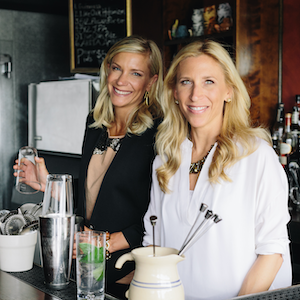
[00:00:10] Ray Latif: Hello, friends. I'm Ray Latif, and you're listening to the number one podcast for anyone building a business in food or beverage, Taste Radio. This episode features an interview with Tom Spier and Dayton Miller, the Managing Partners of BFG Partners, a venture capital firm with investments in several high profile and fast growing brands, including Athletic Greens and Olipop. What compels an established VC firm with a track record of investments in high-growth companies to take a leap of faith on a small and relatively unproven brand? Investing in early-stage companies is inherent to BFG partners, but Managing Partners Tom Spier and Dayton Miller say that regardless of a brand's size, their evaluation is always led by four pillars—people, product, brand, and strategy. Established in 2014, BFG funds better-for-you and sustainable brands seeking seed through Series B rounds of capital. The firm recently announced the activation of its third fund, which according to a February press release, has commitments already approaching 70% of its $125 million target size. Fund 3 follows ones valued at $54 million and $108 million, respectively. BFG's portfolio includes stakes in several food and beverage companies, including Olipop, Mid-Day Squares, Barnana, Athletic Greens, Caulipower and Graza. Successful exits include Chameleon Cold Brew, which was bought by Nestle in 2017, Birch Benders, acquired by Sovos Brands in 2020. I sat down with Tom and Dayton at Expo West 2024 for an expansive conversation that dives deep into BFG's investment strategy and includes their evaluation of fast-growing categories, how they assess gross margin in the near and long-term lifecycle of a brand, and what a polished pitch says about a founder. Hey folks, it's Ray with Taste Radio. Right now, I'm honored to be sitting down with Tom Spier and Dayton Miller of BFG Partners. Tom, great to see you. You too, Ray. Great to see you. Dayton, how are you? Wonderful. Thanks for having us, Ray. It's like a tradition now. Every five years, we need to sit down, evaluate how the industry is going, evaluate how you're investing in emerging food and beverage brands, and, you know, kind of crystal ball the future as it were, because we did this in 2019 at this show, Expo West. And it's funny how on point you guys have been with your investments. I think about some of the companies that are part of your portfolio, including Olipop, that would be the crown jewel for a lot of funds. And it's really cool to see how it's all developed.
[00:02:55] Tom Spier: Thank you, Ray. Yeah, it's been a fun five years, and yeah, we appreciate that.
[00:03:00] Ray Latif: Yeah. Dayton, you know, it's a trade show that everyone is waiting for. It's an exciting place, Expo West, that is. But like everyone else here, we're trying to sift through the booze, the brands, the products that are going to be the next level, the next gen leaders of their categories, their respective categories. When you come to a show like this, how are you trying to figure out the best places to be? Because I don't think you guys can walk the entire floor, right? I mean, the entire show floor. I mean, you may try to, but how do you zero in on the things that are most valuable for you?
[00:03:37] Dayton Miller: I think everybody has their own strategy. I'd say my personal strategy is I'm here to taste as many products as I can and have as many quick conversations as I can with entrepreneurs. And to your point, it's really is it kind of push forward or do you kind of maybe not pass is too strong of a word, but like who's worth following up with? And so hopefully we're meeting a lot of entrepreneurs. I think it serves no better place and kind of time in the in our industry than the next bit west to do that and also really try a lot of things and both stuff that's on the tables as well as behind the tables. and then getting a better sense for just holistically where maybe different trends are going. But Tom kind of say, you know, these are the two trends or three trends, and we're going to kind of opportunistically target them when you have 85,000 people here, to me, doesn't feel realistic.
[00:04:22] Ray Latif: What's most important for you? Is it taste? Is it package design? Is it the entrepreneur themselves? You can't say all three. Don't say all three.
[00:04:28] Dayton Miller: Yeah, I mean, I would say taste. I think taste rules. I think without taste, you don't get repeat. And without repeat, you can't have a sustainable business. I would agree.
[00:04:38] Ray Latif: And it's funny how often taste gets forgotten with really cool ingredients or package design or a really interesting founder story. And then you're like, wow, they have all this. And then you take a bite and you're like, you're missing something. You're missing something. Do you tell entrepreneurs that they need to improve taste or how do you gently explain that to them?
[00:04:58] Tom Spier: Yeah, I mean, I think you need to be thoughtful about it. And different people do have different taste preferences, too. So, I mean, you know, just because I may feel one way about a certain profile, it might really be someone else's cup of tea. So, yeah, I think that, you know, you might say something like, you know, make sure that you're solving for a large enough audience here with a taste profile like this. And, you know, you may want to consider that. But, yeah, I think generally people are putting a lot of effort into these projects and companies. And so, yeah, the products, you know, but you have to solve for mass appeal to get scale and scale is sort of what's needed to do what we do, which is try to find companies that are hopefully attractive to, you know, larger fish in the ocean.
[00:05:42] Ray Latif: You're a good guy, Tom, because I see folks who sometimes don't like what they're eating and they just toss it into the trash, flick it into the trash and walk away. That's not a nice thing to do. I've eaten a lot worse over the years. I don't need to tell you where or when, but yeah. You've also seen a lot worse. I mean, in terms of package design and branding, I think everything these days seems so slick. And it feels like amazing package design is just table stakes now. Five years ago when we did our interview, it wasn't. And with everything looking nice these days, everything looking cool and looking like they spent a lot of money, the founders spent a lot of money on labels and brand. What really stands out to you guys?
[00:06:20] Tom Spier: I mean, maybe I would shift even away from the packaging then, and it's then more going back to, you know, and even away from taste. And then you're talking about the people, you know, who's behind the business. How much, you know, discipline and perseverance do they have? And what does the business model look like? What are their margins like? If you have two packages that are beautiful, but one's at a 70% margin and one's at a 40% margin, I'm probably going to choose the 70%. So I think that it really, that's where the homework is as we try to dive in and figure out which companies are the most suitable for our partnership.
[00:06:53] Ray Latif: How many early stage brands do you know have a 70% gross margin?
[00:06:58] Tom Spier: There's a few. There definitely are a few. Yeah, there are. Yeah, there's certain categories that lend themselves to higher margins. Personal care comes to mind, of course, just broadly speaking. And then, yeah, even in food, depending on what you're talking about, if you really have figured out your supply chain and your manufacturing, you can accomplish a lot. 70% is a huge margin. Yes, it is.
[00:07:20] Dayton Miller: On the packaging side, while I agree everything's looking really slick and kind of definitely stepped up, to me it's just about being different. So you've probably tried the tortillas coyotes.
[00:07:31] Tom Spier: Sure.
[00:07:32] Dayton Miller: And it's like just very different packaging. It's almost feels a bit homemade. And even though the products are super forward and amazing tasting, it's a package that really pops on the shelf when you think about its competitive set. That's how I tend to think about packaging.
[00:07:49] Ray Latif: I'm glad you brought up Coyotes because the industry has embraced and I think consumers have embraced ethnic foods and ethnic foods that are developed for modern consumers. Great branding, great communication about what they are, great story and great flavor. I wonder about the opportunity, the big mainstream opportunity for ethnic foods and how that sort of fits into your investment criteria and investment strategy.
[00:08:17] Tom Spier: Sure, yeah, it is a big opportunity. When you're thinking about brands, obviously Sovos Brands really lend themselves to going after the multi-ethnic opportunities and others may not. In the frozen food world, certainly that's an area where I think we've had success within ethnicity. You know, there's a lot of areas, But Tom of the key areas, Asian influenced food, Mexican, South American influenced food. And then, you know, Italian is just sort of an area. Those are really huge segments. And then beyond that, you start to look at other key areas as well. And there's just a lot out there. And I just think you need to think about how do you have a brand either that's so deep in one ethnicity, that you're going to own it, or do you have something that's more of a platform that allows you to move across in a way that's still credible and authentic? And I think that's not easy to do.
[00:09:11] Ray Latif: No, it's not. But you're seeing a lot of companies. that are making their way beyond that ethnic food aisle and getting into the traditional center store shelves and aisles. You know, Fly-By-Jing is a great example. Everybody brings up Fly-By-Jing because they've done such an incredible job. And I don't know, 10 years ago, you'd expect to see that somewhere in the ethnic food aisle and just you'd never really pay much attention to it. And now it feels like they've given other brands permission to break out and become a more mainstream offering.
[00:09:46] Tom Spier: Again, they're playing within the Asian subset, which is a huge subset. So that's a great place to play. There's pure authenticity behind what they're doing. And so they have something that ladders up. And you say, oh, yeah, that makes a ton of sense. For those entrepreneurs that are trying to go after that opportunity, I just think You have to look at the overall addressable market and make sure you're not playing in an area where it doesn't work. And maybe it does work. I mean, you could be a small giant, have a great business in a category that may not be the biggest, but if you own it and you control a lot of the category, you're still going to have a great business. So I'm not diminishing the value of that. I just think if you're going after a big idea, you need to be in big categories or you have to be able to access multi-ethnicities.
[00:10:31] Dayton Miller: Dayton, did Fly By Jing ever come across your desk? I think we did chat to them, not me specifically. But yeah, I mean, it's certainly an area of interest for sure. And, you know, I think a lot of more kind of ethnically forward position brands kind of start in that sauces and seasoning area and then is able to kind of bring it to multiple different products and parts of the store. And so that strategy is a good one.
[00:10:57] Ray Latif: Are more investment opportunities generated by inbound interest, or are you seeking out brands that BFG think would be a good fit for its portfolio?
[00:11:07] Tom Spier: It goes both ways. Certainly, we love to get inbounds. You know, of course, that's critical to our business. And it's how we, you know, a lot of the deals, you know, we learn about them the first time. And then, you know, our team is canvassing you know, any way we can to try to understand what's out there. And if there's a company that's really interesting to one of our partners, then, you know, that individual would reach out and try to, you know, make a connection. So, yeah, we all have our own sort of personal ideas on potential opportunities that we're chasing. And then sometimes there's an inbound that comes in. That just makes a ton of sense, and we track it down.
[00:11:43] Dayton Miller: Mid-Day Squares, for the record, was an inbound on LinkedIn. And speaking of product first, it was one where we got the product and we loved it. Obviously, Nick, Jake, and Les over-delivered in terms of people and connection and community building, but it was first and foremost a product bet.
[00:12:01] Ray Latif: First and foremost, products, great leadership in terms of the personalities and what they bring as a team to the industry feels very, very different than a lot of things we've seen in the past. But since you brought up gross margin, Tom, we'll talk about that. When you are evaluating an investment opportunity, when you're evaluating a brand, how much does gross margin factor into your decision to invest or not?
[00:12:27] Tom Spier: It's incredibly important both in the near term and the long term. There are certain projects, Mid-Day Squares as being a good example, they had not dialed their supply chain when we met them and we took a bit of a leap of faith at that stage. But, you know, that's sort of what we're in business to do with being a venture firm. You know, we're not buying bonds. So, yeah, it's sometimes, you know, we have to sort of do a little bit of back of the napkin math and say, yeah, if they're selling it for this and, you know, they, you know, can make it more efficiently, could we get there and could it make sense? And, you know, sometimes we're wrong and sometimes the companies figure it out and ultimately can deliver on that. And then then you're in a pretty good spot.
[00:13:11] Dayton Miller: I think there are ways, too, to increase your gross margin without just reducing the cost of goods sold. Pack size, in particular. Mid-Day Squares went from a two-pack down to a one-pack. It was really helpful. And yeah, when we first invested, they were making it out of Nick and Les's apartment in Montreal. And we knew that wasn't the long-term vision, but we have faith in them in figuring it out. Did it help that they own their own manufacturing? So at the time, they just signed the lease for not their current facility. So they went from the apartment into their first facility. And in that situation, I mean, this is something we talk about quite a bit internally, there was no other alternative. I think if you, and they've done a really great job being very methodical in their growth, and they've been very cognizant of bottom line as well. But it's really hard to just have exponential growth if you're not outsourcing some piece of it because Just it takes time to beef up your supply chain and your production capabilities. So it's not for everybody, but for them, it made a lot of sense.
[00:14:11] Ray Latif: As a venture firm, yeah, you're making a bet that other funds or other investors may not make. Why would you take a leap of faith? What is it about a company? What is it about Mid-Day Squares that made you confident that you were taking
[00:14:27] Tom Spier: a calculated leap. Yeah, it really has to ladder up with, you know, some key factors, some of which we've already mentioned, people, product, brand, strategy. So it's sort of these four pillars. And, you know, we have to believe that the people are the type of people who, you know, have the wherewithal to, you know, manage the ups and downs of our industry. You know, the brand, Mid-Day Squares in particular, I mean, it made sense to us. I mean, it was a simple proposition and something that we really felt like, yeah, that's something we can get behind. You know, that's something that makes sense for a lot of people. So, it was a simple kind of value proposition there. The product, Dayton mentioned, it stood on its own at the very beginning, so we believed in that. And yeah, the leap of faith was really, you know, could they execute and could they deliver on the margin? And that's the hardest piece. And over the years, when we see the most challenging situations, it's quite often that the supply chain really is that difficult to build and scale. So it's not an easy one to figure out.
[00:15:31] Ray Latif: Were you also concerned maybe that you would miss your shot on a great brand if you didn't invest, that is?
[00:15:38] Dayton Miller: Not necessarily at that time. I think, you know, there are definitely brands that we've known for years prior to making an investment. So it has to be a good fit on both sides. We definitely miss things for sure. In this situation in particular, it was so early and, you know, we just, lined up really well for us. So yeah, I think we would have hopefully gotten another look at it, given the relationship. And a lot of times, you know, how you pass really matters. So like on the, you know, Ollipop side, like we passed on Obi, but thankfully, hopefully did it in a thoughtful way, in a way that allowed us to get a look at Ollipop really early.
[00:16:14] Ray Latif: Yeah, OB being sort of a forerunner to this Better for You Soda category, probiotic soda, and Olipop being one of the pioneers of this Better for You Soda space. When I first met the Olipop folks in 2020, Again, I mentioned this before we hopped on the mics. I was like, well, that's an interesting idea. And they had some traction. They had some interest, a lot of interest in Southern California. They were big in Erewhon. I don't think I could have imagined that they would be where they are today. And that's no stain on the better for you soda category. I think it's just I didn't see them getting as big as they are now. When you first met those folks and when you were sort of assessing the opportunity, did you see it being where it is now?
[00:17:02] Dayton Miller: So does always been an enormous category. I think we would never underwrite it Hopefully there's an upside scenario where you can be pleasantly surprised and things just exceed your your wildest expectations I do think these businesses can run a lot further a lot faster than you you maybe realize and you know we've seen it even in our portfolio where where brands might plateau for a period of time and then they launch some innovation and it's just a It's amazing how fast it grows from there. But Tom me, it's a sign of a really great product that the word of mouth kind of takes on a life of its own. It's hard to remember now, but like a year and a half ago, I couldn't even really find it in LA. It was selling that fast. And so, I mean, people were really talking about it and really, when they saw it, they were buying a ton of it. And so, yeah, it's just been amazing. So, total credit to the team there. They've done a fabulous job.
[00:17:56] Ray Latif: How much has it helped that they have running mates in the space, like a poppy or a culture pop?
[00:18:02] Tom Spier: Generally, I think that if you're bringing more awareness to a new area like that, having that take place can help buoy everyone. Clearly, competition can be a challenge in terms of trade promotions and aspects of being on the commercial side, but I do think that the awareness piece is a lever.
[00:18:28] Ray Latif: How do you advise founders like those of Olipop when there's so much hype around a category or a brand? I mean, earlier this year we'd heard, you know, Pepsi's interested in this space, Coke's interested in this space, Kroger, Dr. Pepper's interested in this space. And when you're talking to these founders and operators, are you encouraging them to Throttle up and press the gas on what they can do and what's possible Given all the hype or is it is it time to be more cautious?
[00:18:59] Dayton Miller: Our advice is generally play your own game. I think no matter what, like the brands that have really just created a good connection with their communities have done things differently and done it their own way. I do think competition does matter. I think to Tom's point, generally awareness in a category is a really good thing, especially in beverage when you think back to like the coconut wars and water wars and things along those lines. So I think the awareness is good, but you know, there's more than one way to win is the other thing. And so you got to do kind of what feels right to you as an entrepreneur. Some people are comfortable kind of, you know, really laying on the gas on the marketing side. And other folks want to take a more thoughtful, methodical approach. And I think you can be successful with both.
[00:19:44] Ray Latif: Do you have a heavier or a lighter hand in how brands operate their businesses? Because sometimes investors and They have a bad reputation. I'm saying, you know, this is what, but I hear about a lot of investors who are like, no, you need to be doing this. You need to be doing that. And then founders just like, thank you, but you know, I need to run my own company. But I mean, is there a balance between.
[00:20:05] Tom Spier: Yeah, we're a minority growth investor. So we are not seeking to acquire control of businesses. We, you know, sort of recognize that where we play in the market allows us to be a great minority partner and sometimes that means we're, you know, one of our partners is on the board, you know, advocating for great ideas, but a lot of times we're just a phone call away and we hope we get a phone call when there's a great outcome or bad outcome. And, you know, we think we're often the first phone call, even if we're not on the board, because we try to just give good advice. We recognize that, you know, we're not in control and people don't have to listen to us, but we'll try to, you know, be as thoughtful as possible.
[00:20:48] Ray Latif: I have noticed that, I wouldn't call it a theme, but I've noticed that a lot of your investments have been in categories that I think other people would be wary of. Refrigerated, frozen, these are difficult categories because of all the issues you mentioned, supply chain issues and just... you know, it's a tougher business for a lot of reasons. What's given you confidence that a refrigerated brand or a frozen brand can avoid some of those pitfalls, those challenges that have tripped up so many other brands in their spaces?
[00:21:21] Dayton Miller: I guess I think it's a double-edged sword because I think difficult can be good. And for that reason, maybe it's easier to break through the noise and get your message and product out there. At the end of the day, the consumer is the one leading it. And if you're following the consumer and they want more nutrient-dense and cleaner labels, then by virtue of that, you can't always have the fillers. the things that create the shelf stability. So, you know, it does present some problems from like a supply chain standpoint. Maybe that infrastructure isn't built out quite as much, but at the end of the day, like the consumer wins. And so to me, it's following the consumer. And that gives me a little bit of confidence.
[00:22:03] Tom Spier: Generally, we've worked in a lot of these areas, so we can draw from those experiences. Shelf life for us is important. Working in areas where it's very short-coded items, produce, I think that maybe that's not our area of expertise. We haven't done anything there. I don't think we would do that. It's just not what we're good at. So yeah, we definitely want to work in areas where we have some confidence and some knowledge to bring.
[00:22:32] Ray Latif: OK. Well, let's do some word association then. I'll mention a category or an area of the store. Uh-oh. Am I in trouble?
[00:22:43] Tom Spier: I don't think so. No, no, no. It's all good.
[00:22:45] Ray Latif: And you know, you can just give me a one word answer or just a phrase about how you feel about it. All right. Ready? Sure. Tom, we'll start with you. Kids foods. Good. Okay. Dayton dairy.
[00:22:57] Dayton Miller: Innovation. Expound on that, please. You know, huge category, flatlined or declining, that can be solved with innovation. Candy and confection.
[00:23:09] Tom Spier: Opportunity.
[00:23:11] Ray Latif: Yeah?
[00:23:11] Tom Spier: Why so? Just a lot of the products out there, I think, still have a lot of, you know, kind of packaging challenge with the ingredients and nutritionals. And, you know, it has been proven already by a few of the winners, SmartSweets, of course, being the most notable. You know, there's a lot of opportunity there to deliver on products that are healthier for people.
[00:23:34] Dayton Miller: Alcoholic beverages. Tricky. I mean, I don't know if we want to get into like the GLP-1 discussion, but I think I'm generally a believer that, you know, in addition to kind of suppressing appetite, it suppresses cravings more, more generally. And I think that can overlay into alcohol as well. Plant-based meats. patience.
[00:23:54] Ray Latif: Okay. Yeah, you're still a believer in the potential for the category?
[00:23:57] Tom Spier: I am. Yeah, you know, I think that just as we look at where the planet's heading long term and the need for production and the type of, you know, proteins and fibers that people are looking for, that it's gonna be a big part of the mix. The products, there's a lot of money that's been invested. The innovation is still happening and getting better. And once I think these products are more broadly available at price points that are really competitive, I think it's just gonna take more and more share. But this is not a five-year fight or a 10-year fight. I mean, this is gonna play out for decades.
[00:24:35] Ray Latif: I don't know if I'd call this a category as much as I would something that has been talked about or a phrase that's been talked about quite a bit. Ultra processed foods, Dayton.
[00:24:44] Dayton Miller: Curse word, basically. Yeah. Right now. I don't know. I think so. You know, rightly or wrongly, I think the perception is that for sure. But yeah, every single day, I mean, there was just that article in the journal a few days ago talking about how they impact cognitive development. I think probably unfairly, like I think, you know, going back to, it's great for folks in our industry and folks who are doing great to kind of lift their noses at ultra-processed food, but like, there's a huge swath of the market that's just trying to kind of get their kids fed and try to do the best they can in holding it together. And their food needs too, they need to be solved.
[00:25:21] Ray Latif: But what about the better-for-you ultra-processed foods that are out there? Because there are. Errol Schweitzer wrote about this in Forbes a couple of weeks ago, and he had talked about, we need a new sort of era for ultra-processed foods.
[00:25:35] Dayton Miller: I just don't think that word, that message is out there enough yet, at least today, on ultra-processed foods.
[00:25:41] Tom Spier: You know, I think some of this comes back to, you know, the ingredients, not necessarily maybe the processing of how those ingredients are assembled, but, you know, are these organic products, are there, you know, are there pesticides in the products that are, you know, residue from pesticides? I mean, so some of these issues are beyond just the processing and get more down to sort of the agricultural aspects of where these products come from.
[00:26:06] Ray Latif: All right, last one, and it's very much tied to ultra-processed foods, cereal.
[00:26:11] Tom Spier: could be the next domino that falls. That's always more than one word, but I should have just said dominoes. So the hype around premium cereal, you think, is But Tom fade. I don't think it's But Tom fade. I think it's kind of the other, you know, I think that there's, it's still a pretty big category. It's definitely been under a lot of pressure over the last decade, but, you know, similar maybe to what's happened in the functional soda space, as these products continue to deliver more and more consumer value, nutritional density, you know, having a really solid foundation to start your day with breakfast, you know, it makes a lot of sense. convenient, fast. I mean, these are all really important things. And I think there's a lot of opportunity because a lot of the share still is products that maybe are a bit, you know, challenged in certain ways.
[00:27:01] Ray Latif: So, yeah, I misread what you're talking about. You said you think that better-for-you cereal is a real big opportunity.
[00:27:07] Tom Spier: I think it's a big, I think it's a big category. And, you know, yeah, I think it's a real opportunity for brands to still share. Yeah. Dayton, you were But Tom say something.
[00:27:15] Dayton Miller: No, I was just going to say the only other thing that comes to mind on cereal specifically is, you know, consumers are increasingly on the go. And so portability, compression of time, those are some other themes that I think, even though cereal is really quick to make, you can't just put it in your cup holder on your way to work. So I think some of the Oats Overnight products and things are attacking cereal, and it's not just being replaced by cereal, it's being replaced by other substitutes.
[00:27:41] Ray Latif: As has been reported, BFG Partners has launched its third fund, $125 million fund. Folks listening to this podcast right now are being like, okay, how do I get a piece of that? And obviously, I'm not saying it like that. You know, they definitely, I know there are going to be people listening who are like, I want to be part of the BFG portfolio. I want to talk to Dayton. I want to talk to Tom. And I want to really get them to know us and our brand well. But you know, you're going to be talking to tens and dozens, if not hundreds of people. But how should folks approach you? You know, what is the best way to connect? And I mean, beyond that initial email, beyond that, like, that phone call, what should be part of that initial message and what should be part of that follow up?
[00:28:27] Dayton Miller: Good question. I think it really comes down to kind of falling in love with the product first and the story and kind of people second. In terms of how to actually go about doing that, I think, again, you got to kind of play your own game. It's not like, you know, just emailing us with a really strong cover letter and sending a package to the office is what will do it. You know, I already referenced Mid-Day Squares's doing the the LinkedIn outreach, you know, we like to think we have really strong networks across the industry, whether one of those folks is bringing us a product, you know, seeing products in store, just relating to it on social media. Again, all of those avenues are really valuable and valid, but if they're doing something different, if there's just a nice energy around the business, because they're doing something different and unique, that's the conversation we wanna have.
[00:29:18] Ray Latif: I mean, I think that's, The best way to approach an investor is to really come with a well thought out pitch and make sure that you're buttoned up before you're asking for money. And a lot of people are not necessarily buttoned up, but where do you see the biggest holes in a pitch or an ask?
[00:29:37] Tom Spier: You know, sometimes it depends where the team is and their development. If it's a single founder and they're an expert in product development, maybe their product is beautiful, but they don't really have the acumen to develop a beautiful PowerPoint or haven't done it before. And so, you know, sometimes it's just... Yeah, they may not know, but just like packaging on the presentation side, the presentations over the years have gotten better and better and better. And when you get a presentation that really shows, you know, just the depth of knowledge that the team has about the category, the opportunity, their own brand, their own consumers. that starts to become pretty obvious that, oh, we can come in here and help to push this forward, but we don't have to, you know, become a consumer products 101, which feels pretty good, you know, not to have to necessarily become a university.
[00:30:28] Ray Latif: Yeah, if I'm hearing this right, it's a polished presentation, but a detail-laden presentation as well.
[00:30:35] Tom Spier: For sure, yeah. If it's just kind of statements that don't have a lot of depth or information, but it's a lot of platitudes, it really doesn't get us excited. We really want to understand what's going on underneath. Yeah.
[00:30:51] Dayton Miller: Yeah, how seriously do you care about this issue or product? And the depth of knowledge comes through from that. If this is something that is going to be your life's work for the next 10 plus years, then you're going to want to have tried to turn over every stone even before coming to us.
[00:31:05] Ray Latif: Yeah, and I guess the last thing I would say about that is I've hosted enough pitch slams and brand competitions to see founders who are going to listen and those who might be a little bullheaded in their approach. And I feel like listening is a really important aspect of working with folks in this industry. Can you talk about that and the importance of founders being able to listen first and respond second?
[00:31:30] Tom Spier: Yeah, for sure. I mean, we like people that are strong thinkers and independent thinkers, so no problem there, but it's really challenging when you can't break through and there's messages that you might repeat multiple times. In my own head, I'm thinking about examples right now of situations where I just, you know, wish that, that, uh, you know, a founder or founding team might've, uh, responded to some of the things we were saying, you know, because yeah, we, we've seen this before. We've seen the pitfalls and, uh, doesn't mean we're going to stay out of all of them, but, you know, we, we definitely, you know, have some pretty strong opinions. And what you're talking about isn't a pitch or a brand that you're investing in? This is more when we're involved in something and we're working with them and we might see something and sometimes they're so wedded with what they've created or how they envision it that they may not adjust and you really have to be willing to adjust. Absolutely.
[00:32:26] Ray Latif: Well, Tom Dayton, it's been so great speaking with you. I feel like we could speak for another half hour or so, but we have a floor to walk and brands to meet and food to taste. I'll just leave it with, you know, the call to action here. What's the best way to connect with you guys on your website?
[00:32:41] Tom Spier: Yeah, you know, our website, bfgpartners.com, there's a way to reach us through that. And, you know, certainly, you know, we look forward to hearing from you as 2024 rolls ahead. Absolutely.
[00:32:53] Ray Latif: And if anyone, is wondering if your brand or your product is right for the portfolio. Yeah, definitely check out the website. And I guess send product too, right? I mean, you never know.
[00:33:05] Tom Spier: I usually ask folks to send an email first. I mean, I really respect people's capital. And if it's something we're not interested in, I'd rather say, hey, please don't send it right now. We're working on another category because I don't want you to spend the money on shipping.
[00:33:19] Ray Latif: Yeah, $20 adds up here.
[00:33:21] Tom Spier: It adds up.
[00:33:22] Ray Latif: For sure. Once again, guys, thank you so much and look forward to catching up again soon. Thank you, Ray. Thanks, Ray. That brings us to the end of this episode of Taste Radio. Thank you so much for listening. Taste Radio is a production of BevNET.com, Incorporated. Our audio engineer for Taste Radio is Joe Kratchy. Our technical director is Joshua Pratt, and our video editor is Ryan Galang. Our social marketing manager is Amanda Smerlinski, and our designer is Amanda Huang. Just a reminder, if you like what you hear on Taste Radio, please share the podcast with friends and colleagues. And of course, we would love it if you could review us on the Apple Podcasts app or your listening platform of choice. Check us out on Instagram. Our handle is bevnettasteradio. As always, for questions, comments, ideas for future podcasts, please send us an email to ask at Taste Radio. On behalf of the entire Taste Radio team, thank you for listening, and we'll talk to you next time.
[00:34:22] Dayton Miller: you