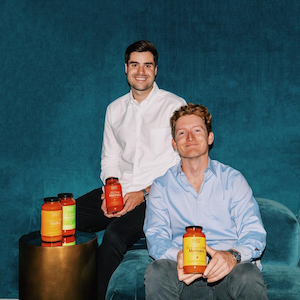
[00:00:10] Ray Latif: Hello, friends. I'm Ray Latif, and you're listening to the number one podcast for anyone building a business in food or beverage, Taste Radio. In this episode, we sit down with Troy Bonde and Winston Alfieri, the brains behind Saws, a fast-growing sauce brand that's bringing serious flavor and attitude to your pantry. At just 25 years old, Troy Bonde and Winston Alfieri are shaking up the food industry. As the co-founders of Saws, a bold, culture-forward pasta sauce brand, they're not selling your standard ragu. They're reimagining what it means to build a modern food company from the ground up. Launched in 2023, Sauce has quickly made a name for itself with an unconventional lineup of jarred sauces, including Hot Honey Marinara, Creamy Calabrian Vodka, Miso Garlic Marinara, and Brown Butter Alfredo. These inventive flavors, combined with a strong brand voice and sharp social presence, have propelled saws onto the shelves of over 6,000 stores nationwide, including those of Whole Foods, Sprouts, Target, Wegmans, Kroger, and more. In this episode, Troy and Winston dive into their journey from outsiders to industry disruptors. They also share how a scrappy, solutions-first mindset powers everything they do, the intentionality behind their brand's unique digital presence, and why their path to being everywhere starts with obsessing over the details. Hey folks, it's Ray with Taste Radio, and right now I'm honored to be sitting down with Troy Bonde and Winston Alfieri, the co-founders of Saws. Troy, how are you? Good. Doing well. Thank you for having us. Yeah. Winston, how's it going? Same here. Doing well. Thank you for having us. Yeah. Is this your first expo? our second expo, second expo. And you're walking the show, you don't have a booth here. We're walking, no booth this year. How do you walk the show floor with saws? Do you have small packets that you're giving to folks? You know, I wish.
[00:02:17] Troy Bonde: We don't have enough volume for us to do that quite yet at Expo, right? No saws on us. But maybe we should have brought like a wagon full Hot Honey marinara.
[00:02:30] Winston Alfieri: We got our marketing team running around here in costumes, big jars.
[00:02:34] Troy Bonde: Okay.
[00:02:34] Ray Latif: We got the visuals covered.
[00:02:35] Winston Alfieri: So the brand awareness is around here somewhere. Yeah.
[00:02:39] Ray Latif: I like that you guys made somebody else wear the costumes.
[00:02:41] Winston Alfieri: Yeah, exactly.
[00:02:42] Troy Bonde: We can't do this anymore. They've actually been asking us to do it and we're like, nah, it's okay. Yeah, they tried to get us to wear them and it was like, we either flip a coin or we don't flip the coin and we have you guys wear them. Yeah.
[00:02:54] Ray Latif: Well, I hear your marketing team is an integral part of what you guys do. And in this day and age, you got to get people to know who you are, why you're relevant, why people should be trying your brand. And I think Saws has really done an incredible job in that regard. Thank you. It's not easy to stand out in a crowded food and beverage industry. It's really difficult to stand out in a legacy category like sauce, tomato sauce more specifically. And I think that's a big reason why I want to sit down with both of you today. Of course. The origin story of Saws is one that's been told a number of times, but I don't think I know the full story. I mean, the story that's been put out there is these two crazy kids, you know, came together like, why can't we have a tomato sauce for Gen Z-ers? And I think that's a great story. But was it as simple as that?
[00:03:46] Troy Bonde: I think it's much more complex. And thank you for that, first of all, on the marketing side. But it's a long story. I can tell it if you'd like. But Winston and I went to middle school together, preschool together, high school together. You went backwards. You went to middle school, then you went to preschool. preschool, middle school, high school, and maybe college. Should we cut that one?
[00:04:07] Ray Latif: It didn't take long. No, no, we'll keep that going because I feel like that's a really interesting part of your story.
[00:04:12] Troy Bonde: I've never heard of such an education. Exactly. Winston and I went from preschool to middle school to high school to college together. We were sophomores at USC when COVID hit, and we were sent home to Pasadena here in a suburb of LA. And we felt like we were in these lectures with hundreds of students and masks were being handed out and temperatures were being taken every time a student would look to enter a classroom, right? And so we felt like there was an opportunity to provide a product that would streamline that process in offering effectively a hand sanitizer dispenser with a built-in infrared thermometer. So you could take your temperature, it would display it, and you could sanitize your hands simultaneously. And to make a long story short, we began selling this product to school districts. We would cold email as many school districts throughout California as we could Troy and Winston's dad had an office in Pasadena, and we'd sleep in the office. We were sophomores sent home from school. I'd sleep on the couch. He'd sleep on the floor. We would draft emails all night to school administrators, and at 8 a.m., we'd send out as many as we could, right? And there was a single stovetop burner in that office and we would cook pasta four or five nights a week. And we got very lucky. The business scaled really quickly, but we knew it would scale straight up and it would scale straight down and down, hoping that COVID wouldn't last forever. So we knew every time we walked into grocery to buy pasta sauce, We had these entrepreneurial wheels turning, knowing that Winston was in real estate at the time, interning at a commercial real estate firm. I was interning at an investment bank. Winston didn't want to be in real estate. I didn't want to be an investment banker. So we figured we had an opportunity to kind of parlay what we had done with the sanitizer business into one new business. And we could take one shot, and it had to work, right?
[00:06:02] Ray Latif: And by parlay, you mean using the money that you raised.
[00:06:08] Troy Bonde: Exactly. For a couple of sophomores in college, it was a good chunk of money. But in the grand scheme, it was enough to start a business, right? And we would walk into Whole Foods in Pasadena. And to get to the pasta sauce aisle, we'd walk by Beverage, right? And Beverage was bright and colorful and trendy and exciting and unique. as two Gen Z consumers, there was this emotional response that those brands would elicit, right?
[00:06:31] Winston Alfieri: Yeah, I think too, on the beverage side, you walk down any sort of aisle of grocery and there's granola and cereal and so many different subcategories of grocery that elicit that emotional response. And Trina were like the one aisle that we were shopping for, which was pasta sauce. It was so boring. We would look at the aisle, we would look at the category, we would say, you know, there's 10 different marineras on shelf. And when you look at the premium side of the category, there's not much differentiation. It's really, you turn those labels around, similar nutritional facts. One might be a dollar less than the other one. Would you buy that one over that one? There's really no differentiation.
[00:07:09] Troy Bonde: And it's not a knock-on. Like it was really a category dominated by old Italian 10-label cursive writing brands, right? And it's a great element of premium in that consumers are given the opportunity to enjoy restaurant-quality product at home. And we entirely understood that thesis, but we felt like if there wasn't something that pulled us in visually, there wasn't a brand that would elicit any sort of emotional response from us in a way that other categories seemed to do, we would defer to flavor. And on the flavor side, everything seemed to be marinara, arbiata, pomodoro, tomato basil, and roasted garlic, right? And we felt like there was a lot of value in that, but we weren't necessarily excited by it. And we felt that there wasn't a single brand that meaningfully communicated value or differentiation to us, right? And so, you know, we'd kind of pick up a new jar every time we went into grocery. And after a while, we were honestly a little bit bored of the experience. We felt like the experience was lacking. There was always a new beverage to pick up that was always an exciting flavor. And we'd be enamored by these brands. And there was just really no affinity for us toward any single brand in the set. So we felt like there was plenty of opportunity there and we decided that we felt the lowest hanging fruit for us in really building a brand that could be meaningfully different was in Pasta Sauce.
[00:08:42] Ray Latif: So we did it. Did you start cooking your own pasta sauce at home? Was this something where you hired a chef to start creating some recipes for you?
[00:08:50] Winston Alfieri: Troy and I really ultimately came up with the flavor profiles and the innovation. We were looking at ingredients cross-category, trending flavors like Hot Honey. Honey on pizzas was so popular at the time. We were like, why can't we just put this in a jarred tomato sauce? We come up with the flavors ultimately, and we have a food scientist that makes our recipes for us. So we work with her to come up with our flavor profile. We do some market research to see, you know, even at scale, what ingredients we can use that, you know, we can manufacture. We were going to come out with one flavor early on where we were importing an ingredient from Japan, and it was just too difficult. We realized that, you know, if we're in 5,000 stores, it might be a product that's very difficult for us to source and manufacture at scale.
[00:09:38] Troy Bonde: And I think one component of that too is that, like, we found early on in trying to cook this product in our own kitchen that It's very difficult to make at home. Like to make a Hot Honey marinara in your kitchen is a near impossible process. Even on our line today, we have to wait like a day to try Hot Honey marinara. We can't be tasting it off the line because the way that that product sits and marinates together over the course of 24, 48 hours leads you to an entirely different product than it is fresh off the line. And even, you know, think about summer lemon marinara. You're mixing acidic tomatoes with acidic lemon. It's very difficult to make that product at home if you put a drop, and to procure, to go to, you know, grocery and buy lemon juice and buy, you know, lemon oil and all these ingredients that are, first, tough to procure, like Winston's saying, but also incredibly difficult to mix together in a way that we feel we have in production. We found that to be a really difficult part of at-home R&D and something that food science and these food scientists were able to really master in a way that we couldn't.
[00:10:49] Ray Latif: This all makes sense. And I wonder if you ever thought you'd know so much about acidity levels in food and trying to figure out what works with what and how difficult it is to make a Hot Honey marinara. I mean, just to think about that as a founder, I'd be like, how did this happen? You know? I know, I know.
[00:11:08] Winston Alfieri: You learn so much. We were actually laughing the other day because like, we were at a manufacturer and we're talking about BOSWIC and we're like, what is BOSWIC? And it's something that you would never think about. But it's, you know, we, we're learning all these different things. And as young founders, I think we, we learn every single day about, you know, new products, how the process works at scale.
[00:11:29] Troy Bonde: Yeah. And it's, it's even straight. I mean, it's, we wake up in the morning and sometimes we're kind of like, We're really selling tomato sauce for a living, right? We're having a lot of fun doing it. But when we had first told our parents that we graduated from USC and we weren't going to go into finance and real estate, we were going to disrupt the tomato sauce aisle of grocery, they were like, what the heck is going on with our kids, right? And so it's been a strange couple of years in building. It keeps us up at night, but it does get us up in the morning. We're excited to wake up in the morning.
[00:12:03] Ray Latif: That's the most important thing. Yeah, totally. For entrepreneurs is to continue loving what you're doing. Because if you're not, why are you doing it?
[00:12:11] Winston Alfieri: Exactly. You're right.
[00:12:12] Ray Latif: I think any job is kind of like that. But for entrepreneurship in particular, I think that's true.
[00:12:15] Winston Alfieri: Totally. Yeah.
[00:12:16] Ray Latif: I can only imagine your parents being like, we just spent 200 bucks.
[00:12:20] Troy Bonde: Yeah, I know. Exactly.
[00:12:21] Ray Latif: You guys are makings. And it's not even spelled correctly. It's S-A-U-C. What is this?
[00:12:26] Troy Bonde: What's these kids saying? And they totally didn't understand the thesis of really building a culturally relevant brand. That didn't quite hit home with them, right?
[00:12:40] Ray Latif: This goes back to, I think, the overall question and I guess the overall thesis of SAWS is, who is it for? And how do you market to people who are very much like you, the founders, and do it in a way that can scale beyond Gen Z and millennials? But going back to the name, SAWS, where'd that come from? I think Winston said it one day on the couch.
[00:13:01] Winston Alfieri: Yeah, it was kind of out of the blue. You know, we, when we were coming up with the name, we were like, we want a four letter word. We want something that's catchy. We also want something that later down the road, we can use this name for cross category innovation. So it just kind of came to us.
[00:13:16] Troy Bonde: I think Winston said it and we, we both were like, wait, that's it. That one's good. And then being able to obtain the IP on it. And, you know, we're like, there's no way we can trademark this. Right. And we found that we were able to, and we were full speed from there.
[00:13:32] Ray Latif: Well, it's not pronounced sauce. It's sauce. Well, I spoke with the founders of Truffle a while back and It's interesting how they built their brand based on an Instagram handle, which was Sauce. And they, you know, created a whole obviously hot sauce line and the rest is history. But Sauce feels like it's very intuitive, even if you don't necessarily know why there's a Z there, you're like, I could probably guess it's sauce. And I think it does speak to a younger consumer. You know, there's some playfulness to it. Maybe the old, you know, 60-year-old person who's just looking for some Prego, whatever, they're not going to get it. And we'll get to that in a sec. But talking about a Hot Honey marinara, you know, a summer lemon marinara, a mild rosemary, these are for specific use cases, I think. You're not going to just make your Sunday traditional pasta with one of these. Therefore, a Tuesday night occasion when you don't necessarily... What is the occasion? What is the use occasion that's most resonated with consumers?
[00:14:37] Troy Bonde: You know, I think we found in actual product use, like a use case for what we're doing, we feel is more widely applicable than just a tomato sauce, right? What we'd heard from a lot of consumers was that they were buying tomato sauce, either making it at home or buying it and doctoring it up, right? Adding garlic and onion and salt. And I think what we found, like, we have a lot of UGC where we see consumers dipping grilled cheese sandwiches in summer lemon marinara, right? We've seen Bloody Mary Hot Honey marinaras. Like, I think there are a lot of ways that excite the consumer by virtue of just the flavor profiles themselves in actually like sparking this creative ideation for what the use case is. Like, I think by virtue of a consumer seeing Hot Honey marinara, it begins getting those creative juices flowing on what it should be used for.
[00:15:29] Winston Alfieri: Yeah, no, for sure. And I think on the marketing side too, that's where we leverage that a lot. You know, we look at some of our competitors and We're not strict to a brand Bible where we have to do these Italian type of ways where we can go out and market the brand and do stuff on social media that's a little more out there than your typical. And that's what we like about our flavors.
[00:15:53] Troy Bonde: And I think the other component of, like what I'd mentioned earlier, like the fact that we feel product is irreplicable in the kitchen also gives the consumer a real opportunity to feel like it's an experience, right? Like we joke that whether a consumer tries Hot Honey marinara and loves it or hates it, they're not gonna forget it, right? It's unlike anything, whether they eat it on pasta or they put it on a sandwich or they dip a grilled cheese in it, they're never going to forget that experience of, going into initial acquisition without any expectation of what's been done in the past. And I think the problem that we saw with the category early on was that it felt commoditized. It felt like there had just been this push for a handful of brands.
[00:16:39] Ray Latif: It didn't feel that way. It had become commoditized.
[00:16:42] Troy Bonde: Exactly. you know, being able to add real incremental experience and decommoditize this commoditized category is something that I think has struck a chord with a new generation of consumers.
[00:16:54] Ray Latif: Yeah, I'm glad you used the word incremental because that was the word I was going to use. When I have sauce in my pantry, I think about it. Okay, this is an incremental value for me because I don't have to rely on whatever tomato sauce I have in there. If I want to make something that's a little different, spice things up. maybe mild things down if that's a term, I can use saws. When you talk about retailers, they're always looking for incremental value as well. But it's more, what are you bringing to our stores that are going to bring more customers into our stores that's going to make our shelf, our tomato sauce shelf, better and more dynamic. Was that the simple pitch when you started out? I mean, because in, correct me if I'm wrong, Target was your first major retailer.
[00:17:39] Troy Bonde: Yes. Yeah, we'd launched in Whole Foods SOPAC prior to Target, but our first national account was Target, chain-wide. And that was honestly exactly the pitch. We felt like we were And we still feel today that we are the most incremental brand that the category has ever seen, right? And I think, really, like Winston had touched on, having this blank slate of opportunity in marketing the brand in a fundamentally different way than anybody else, we feel, than really anybody else has permission to, gives us this opportunity to digitally engage a younger Gen Z millennial follower. And we think there's enough brand affinity that we can build to actually get that consumer into store. On the flip side, in thinking about the consumer that's actually in their habitual shopping routine in-store, the way the brand presents itself with bright, exciting colors on shelf and winning secondary display and off shelves, and then building that interest in a consumer reading Hot Honey Marinara and knowing what Hot Honey is and knowing what Marinara is, but never seeing the two together, is we even feel we can drive in-store incrementality with the existing shopper.
[00:18:46] Winston Alfieri: I think to go off Troy's point, all the buyer meetings we do, when we're pitching retailers, they're so excited to be, and they really say, like, we've gotten this a few times, we hate reviewing the pasta sauce category because every single time we get a new brand in here and they say, we have the freshest Italian tomatoes. And we actually go against conventional wisdom and use California grown tomatoes, which is not like a big pitch for us, but it's just ironic how a lot of the buyers have been telling us that and they're excited when they leave our meetings.
[00:19:20] Troy Bonde: And I think it's, we want to really shift category dynamics and that for us, the category hasn't been this way in the past, but it should be a discovery category. The consumer should go walk to the pasta set and expect innovation, right? We want the consumer to be excited to shop the category, whether it's us or somebody else. But that was always confusing to us in a sense. It seemed so obvious for us as young consumers to crave excitement and innovation. And we just felt like there was nothing that was incremental enough to drive the discovery consumer to the category.
[00:19:56] Ray Latif: It's so confusing, but obvious. I mean, there's something about that shelf where you look at it, and I've done this a million times, you go to Whole Foods, you look at the shelf and you're like, okay, I got Rao's, I got Carbone, and I got all these like local brands that look more Italian. One looks a little bit more Italian than the other. And what do I choose here? I'm going to choose the one that's probably on promotion and try that out. But nothing really says different. It all kind of says the same thing. I wonder if that's as simple as it was for the pitch to Whole Foods and Sprouts as well, or going national in both those retailers as well. Were you able to show data? Were you able to sort of walk the walk on your thesis about bringing incremental value to target? How much did that data, how much did your sales metrics matter when you were pitching Whole Foods and Sprouts?
[00:20:49] Troy Bonde: I think it was difficult to delineate whether our sales data was truly incremental at the time. It was so early, right? But we were able to package existing velocities and show that in very little time, with just a few months to build brand equity on certain shelves. We were able to drive best-in-class velocities, challenge legacy brands. And whether those were incremental consumers or not, we were clearly offering a more meaningful value proposition. We weren't having to get caught in this promo environment, like you said, of consumers expecting to just buy on deal. And at the time, we were able to show, we're able to break that and move at full price and challenge velocities of brands that have been around for decades or have had years and years and tens of millions of dollars, hundreds of millions of dollars to really build a relationship with the consumer. And that consumer wasn't nearly as loyal as maybe they thought they might've been. Yeah.
[00:21:47] Winston Alfieri: And I think the best test of that was when Target came to us when we were in probably about a hundred stores and they said, we want to authorize you guys chain wide. That was the biggest test. They took a big bet on us and the brand's doing really well.
[00:22:02] Troy Bonde: We didn't have a ton of highly intricate data. It was more so us sharing our vision for the category and really conveying that we're not going to enter your set and cannibalize existing dollars, we're going to grow the set. We're going to lead category growth by adding new dollars to the category. And we can't really necessarily, at the time, we couldn't necessarily show the buyer that. But I think the buyer understood that maybe we were onto something in disrupting the category.
[00:22:33] Ray Latif: I'm going to sound like a jerk, and I'm sure you get this a lot. How old are you guys? 25.
[00:22:37] Troy Bonde: We're 25.
[00:22:38] Ray Latif: You have an incredibly sophisticated understanding of the industry, much more so than a lot of folks who have already been in this business for a long time. Thank you. Where did this come from, your education?
[00:22:49] Winston Alfieri: We're first-time CPG founders. The biggest thing for us, I think, is networking. We try and do as much networking as we can. learning off of other founders. We've made a bunch of mistakes in the last few years. And I think, you know, we've also not made mistakes by, you know, networking and talking to other founders, learning from their mistakes.
[00:23:09] Troy Bonde: Like you'd mentioned the Truff guys, right? Yeah. They were hugely influential. I think You know, we've probably listened to every podcast Eric Skay has ever given, right? Like, Eric Skay from Rayo's and now Carbine. I mean, I've been a CEO of both brands. Anytime he's speaking in public, maybe now he'll stop public speaking so we can't learn from him. Every time he's spoken in public, we've listened, right? Kevin Lee from EMI comes to mind. We listen to every podcast Kevin has ever been on, right? And the guys at Truff have been, they were of anybody, the influence, right? We thought they, and we saw a lot of similarities. There's definitely a lot. Best friends. Yeah, I can see that. You know, and so we, they've been great. They've been, but Winston's right. We've surrounded ourselves, fortunately. The industry is, It's very small, as you know. But it's also incredibly welcoming. We were so surprised by how welcoming other founders were to two young guys who, a year and a half ago, did not know what they were doing.
[00:24:08] Winston Alfieri: And we know what we don't know, and there's still a lot that we don't know.
[00:24:14] Ray Latif: There really is. Well, even the most sophisticated entrepreneur typically admits they don't know a lot about operations. Operations is extremely difficult. It's old school kind of business. And it typically takes someone who really knows the ins and outs of how to manage inventory, how to oversee production and lead times and things like that. Demand planning. When you get it to target nationally, then you get it to Whole Foods nationally, then you get it to Sprouts nationally, operations becomes critical. You have to know. how much you need, when it's going to be fulfilled, et cetera, et cetera, et cetera. How are you managing that process? Yeah, we learned that quickly. And just to be clear, if you get that wrong, Target's not going to bring you back.
[00:24:54] Troy Bonde: No, no, no. You have one shot to make it right. There were some sleepless nights in preparing to launch at Target. We had cooked at our co-manufacturing facility for, was it like 62 days straight? You know, at the time we were cooked on a single line, open kettle. as slow a manufacturing process as anybody in hot fill glass, right? And two shifts a day, including the weekends. I mean, we... 62 days straight. We stress tested our supply chain and found quickly that You know, we need to prepare. Look six, seven, eight months ahead and prepare that way. But we brought in a couple of really talented team members in ops. And honestly, we owe them. I mean, we learn from them every single day. Exactly. And as two young founders, when we think about building the team, We want to bring people in who we can really delegate a ton of responsibility to and lean into to learn from and to understand how they think about making decisions with all that they've learned in the past, right? I mean, we have a lot of young team members as well who we learn from too on the marketing side, but Ops comes to mind as one that daily we learn something from our Ops team and we owe them a ton of credit in being able to scale the way we have. You know, I mean, we were, We were really in 10 stores up until about January of last year. So to be able to maintain that scale with a lean team takes a lot of great talent, and I think we've been fortunate to have talented people who we can learn from.
[00:26:27] Ray Latif: How do you walk the line between being humble and saying, I don't know, I'm willing to learn, and maintaining that leadership position, saying, we're the founders, we're the bosses, essentially?
[00:26:40] Winston Alfieri: It's not easy. I think we're still learning. Yeah, we're definitely still learning. I think it's a, you know, we've had times where we're just like, we have to figure this out. It's the figure it out mentality of like, we just got to figure it out or else we can't fail.
[00:26:53] Troy Bonde: I think that that is the ultimate role we play is like constant problem solving problems for our team and problems for the business as a whole. And this feeling of constant crisis management in many ways, right? We will make really good, you know, a great PR team one day. No, I think it's it's more so building a team and understanding, you know, at the same time, you're building culture that didn't exist a year ago that now has to exist in a way that keeps everybody motivated and happy and willing and bought in is something we're still learning, right? We're really still learning that. And I don't know the answer yet. Yeah, you know, to be honest.
[00:27:34] Ray Latif: You were only in 10 stores until about a year ago, well, 14 months. And it's a constant education, this business. You're constantly learning about what works, what doesn't work. And your marketing has worked, as I mentioned at the top of our conversation. Someone on your team almost seems like a third co-founder. Cameron.
[00:27:52] Troy Bonde: Cameron, yes. She's our head of brand. She joined very early. She joined October of 23. Yeah.
[00:27:57] Ray Latif: Yeah, she's front and center. And it seems like a lot of you're so talented.
[00:28:02] Troy Bonde: And I owe a lot of it to Winston to Winston is a much more creative.
[00:28:06] Winston Alfieri: I work with Cameron probably the most we're we're day to day together. So she's very talented. You know, I think like, The biggest differentiator for our brand is knowing the trends, especially in our category. And I think Cameron really sets us apart in knowing those things. On the daily, I think that's the benefit of having a young, lean team that's hungry to create content, be the differentiator in our category.
[00:28:31] Troy Bonde: Yeah, we're seeing it today. So I learned to stop questioning her posting content because, you know, she posted one photo of a broken jar on the on the floor of Target. She had dropped a jar of saws at Target and it shattered. And I called her and I was, you know, I was joking with her and said, Cam, that was that was a lazy post and started laughing. And she said, Watch, it is going to perform. And it went viral. And it's like, It just shows, I think, also learning quickly to stay in my own lane and let Winston understand. People like the fun stuff.
[00:29:04] Winston Alfieri: I think that's what really, you know, we like to have fun on our social media. As we've kind of mentioned before, it's like, we're not stuck to that brand Bible in terms of what we do on social media. And I think that's the biggest benefit for the brand right now. Yeah.
[00:29:18] Ray Latif: There's a post I'm looking at right now where someone said, yo, they're writing to Cameron. Timothee Chalamet is a fan of Saws and she's like, how do you know this? And I think out of all the posts, I'm like, okay, I want to click on that one. I can definitely see where people are responding to the content that you're putting out there. It is very much for a younger audience, even though I'm looking at this and I'm not going to call myself young, but how do you market to people who are not young? How do you think about those folks who you want to bring into the brand and not alienate them?
[00:29:51] Winston Alfieri: Yeah, I think the biggest thing for us is it's like a double-edged sword. We have a lot of the people from social media that are a little more Gen Z, younger, coming into stores, you know, they're coming into retailers because they're seeing our social media. And then on the other flip side, you have, you know, people that shop at their stores in their routine manner. And we do a lot of demos to, you know, get our products because they are very innovative products. We have high quality ingredients and being such a unique product, we're very optimistic that someone's going to pick up our jar of sauce and try ours. And once they try it, they're never going to go back to their other pasta sauce. So we like to kind of differentiate, you know, getting two sides. You have the people coming from social media and then the people in their habitual routines that are in store shopping on a daily basis.
[00:30:39] Troy Bonde: And I think also what we found in retail is like the brand presents itself so well on shelf that Secondary placement goes a long way. And organically, I think the grocery teams open up a case of saws. They're kind of like, this is cool. What we've seen, you know, Graz has done an incredible job in a lot of their retailers of earning organic secondary placement and display. And I think that's a really good way to bring a consumer that's never going to interact with the brand on social media in. I also think that marketing to Gen Z or a young millennial does creep a little bit into, you know, I was looking at the Instagram metrics actually the other day, and we had a lot of 50 plus consumers on Instagram viewing and engaging content, right? So like, I actually, I think it might look like it's cheeky and fun and youthful, but I think everybody wants to be youthful. And maybe some look at it and say, you know what?
[00:31:31] Ray Latif: I was just going to say, not to interrupt, but you're a hundred percent right. I'm kind of rolling my eyes up here because I'm thinking about the super bowl. And all of a sudden you start seeing like people on LinkedIn posting not like us. And I'm like, stop saying that.
[00:31:44] Troy Bonde: Don't do that anymore.
[00:31:46] Ray Latif: Stop posting things that say hashtag not like us. Stop doing it. But yeah, no, going back to the, it's, it is funny how I think youth culture or whatever you want to call it, really does creep into older generations and people want to feel young and they want to feel like they're a part of a movement. I think you guys have created a movement. You're creating something that is exciting, is different, doesn't necessarily need to be anything more than it is. It's just different. But how do you keep it going? How do you stay relevant? How do you make sure that, okay, 2025 is not just sort of a blip on the... I don't put it on the radar, but it's the beginning of a continuation of much, much more.
[00:32:25] Troy Bonde: Exactly. I think we feel like we're just getting started in capitalizing on all of the momentum. But for us, it's leaning in on innovation. We want to go further than we have thus far. And we think, honestly, for us, we feel the data is showing and our consumers are telling us that they want us to go further too. And I think there's a... There's an opportunity for us to go just as far as the consumer wants us to go. And we think that's a lot further than anyone has ever gone and that many others in the set could go, right?
[00:32:58] Winston Alfieri: I think on the marketing side too, the opportunities are endless. We have a lot of fun collaborations and partnerships coming up for the year that you would not expect pasta sauce to be in. So we're super excited for this year. I think, you know, now, given, you know, the retail distribution, we're always working on brand awareness. And I think the world is so large. It's how can you really, you know, capture the audience.
[00:33:22] Troy Bonde: And there's, like Winston said, thinking about food service opportunities and brand partnerships, you know, we haven't really leaned in much there. And We haven't really pulled the lever on awareness quite yet. Everything we've done has been entirely organic, grown by Troy and Winston across all socials. We really feel like we're going to double down on the marketing side this year. And I think there's plenty of upside that actually we haven't realized yet. I think you'll see marketing across the board and awareness. You're talking about traditional marketing?
[00:33:57] Winston Alfieri: Well, traditional, I think, mostly, I would say, mostly social media marketing, because I think the stuff that makes us go viral so much is the unique and fun stuff that you wouldn't see every day.
[00:34:08] Troy Bonde: We really want to be everywhere. We want to be everywhere. I mean, that's like, our goal is, and we see, you know, I think a lot of brands that we look up to that have done it so well have attacked from every angle on the marketing side. And there's plenty of avenues that we haven't yet pursued. And a lot of that is the partnership side, the food service side. We create a lot of great organic content, but we still have operated really like a bootstrapped Gen Z team. We haven't formally really gone full speed and cranked the dial on both traditional and some of the non-traditional partnership.
[00:34:46] Ray Latif: Two things on innovation. How do you know when you're taking your eye off the ball and not focusing on your core top-selling products?
[00:34:55] Troy Bonde: We're focused on our category. We've made it packed internally. We don't want to just launch Skyrock. We're not chasing revenues, right? We're not chasing revenues. We're still looking at innovating in our category. And I think We learn pretty quickly when post-launch of a new product, whether it's hit with our consumers or not. And thus far, I think we've really hit the mark on what our innovation pipeline should look like and what our consumers would like it to look like. But we're not going to innovate too quickly. We don't want to go add 20 SKUs, like Winston said, to our assortment. We're not chasing revenues. We're still validating a data story. We're still building brand awareness and affinity. And I think we want to innovate just enough to excite, but there's a fine line of innovating too fast or going too far too quickly. And we have a lot of brand to build, right? You know, thus far, it's more so ensuring that we're just hitting the brakes a little bit in terms of thinking about, you know, we have so many ideas. We've got dozens of flavor ideas that we'd like to bring to market, but we'll hold them in the back pocket for a little bit. And when the time is right, and we feel the brand and really awareness has caught up to where we are in distribution and door count, we'll be able to move a bit quicker then. Yeah.
[00:36:16] Ray Latif: The second thing is about being everywhere. That's a very ambitious goal. It can be a scary goal. It can be an unrealistic goal, depending on what your vision is. How do you define being everywhere? How do you plan for something like that? How do you support being everywhere?
[00:36:32] Troy Bonde: Yeah, I would say being everywhere digitally. being everywhere digitally. We're saying more no's to retail expansion than yes. I don't mean that from the perspective of retail growth, more so digitally. I think we like to create content that is organically viral. We were sitting at dinner in New York about two months ago, and the waiter stopped and he said, do you guys sell pasta sauce?
[00:37:02] Winston Alfieri: I saw you guys on TikTok.
[00:37:03] Troy Bonde: I saw you on TikTok. Oh, wow. And like that, I think, you know, being able to break the algorithm and be on everyone's For You page is what we mean when we say be everywhere. We want the consumer to feel like, not in a way that is overdone, but we want to create content that consumers want to consume. And we want that content to be on their For You page on TikTok, Instagram, YouTube Reels, a meta ad maybe that we're running on their X profile. I think that's where digitally, we have an opportunity to build a brand in a category that hasn't really had a brand be on the forefront of culture.
[00:37:41] Ray Latif: I can tell you guys are very influenced by the Trump guys. And they were influenced themselves by others as well. So it's very much, you know, paying it forward in terms of guidance and knowledge and just understanding that culture plays so much into the potential of a CPG brand to be viral and everywhere in so many ways. Just to touch on one more thing that you guys mentioned about retail, you've said no a lot. And I'm sure it's very difficult to say no a lot because you don't necessarily know when they're going to knock on your door again. Club is really difficult. I'm sure that you've thought about that channel. But how have you taught yourself to say no more strategically?
[00:38:22] Winston Alfieri: Yeah, that's a tough one. I think we're always second-guessing ourselves, I would say, on the retail front in terms of, did we do that right? What's the strategy here? As we kind of did earlier, said earlier, in leaning in on our connections with founders and networking, that was super important, I still think, to this day, in terms of retail and what we decide to do. But it's always very tough to really, you know, we have to look in. In the early days, that was the hardest, I think, because we were going from like, when Target comes to you and says, anyone to give you chain wide in Target, when we're in 50 stores, that's the decision where we actually talked to most people and they were like, don't do it. And Jordan and I were like, we have to do this.
[00:39:07] Troy Bonde: We're doing this. And I think also, the toughest part is when buyers are so excited about the brand and the category and really disrupting their own set in their own store and building a planogram.
[00:39:19] Ray Latif: There are people listening to this being like, that's the most challenging part? No, no, I know, but it's always saying that.
[00:39:25] Troy Bonde: I mean, buyers have been so supportive and really leaning in on our vision, too, that it's not easy. I would say, like we'd mentioned on supply chain, most of the time, up until recently, we just haven't had the opportunity. We couldn't say yes. Our supply chain had been tested to a point that it couldn't be tested further. I think today, we still have to, there's still a data story for us to validate. We feel we've proven concept and we're seeing best in class velocities cross channel and now really in mass conventional and in natural. There's a lot that we have to do, and we think there's a lot of brand building that we have to catch up on. There's a lot on the awareness side that needs to be done to build a brand that we feel can scale outside of LA, New York, Miami, Chicago, and Dallas. We're really building a brand that we feel appeals best in between the coasts. That can't be done overnight. That's something that takes a lot of time and constantly iterating on product, but also driving awareness in a way that reaches more than just the two coasts.
[00:40:33] Ray Latif: It takes a lot of time. It may take a lot of money. Yeah. Based on what I'm hearing right now, though, I think investors would be pretty interested, would have their ears perked up about the realities, your understanding of the realities of your brand. some of the challenges and some of the potential pitfalls going forward. How have investors evaluated SaaS and the brand's performance and its potential?
[00:40:57] Winston Alfieri: I think the biggest thing for us and when we pitch retailers is, you know, as many other categories, I think it's the innovation in the set. We're ultimately bringing something completely different to a category that's never really seen innovation. So, It's been exciting on the investor front.
[00:41:14] Troy Bonde: And I think it's always, I think it's a difficult story for investors to ignore when, you know, we're, like Winston has said, leading innovation in a category that's seen very little to no disruption, a category that's as familiar as ours with an addressable market that's huge. And I think the opportunity to really build a new generation of pasta sauce at scale And to own this product platform of flavor innovation is, it's a tough one to ignore, right? So I think, you know, we found that there's an appetite from, you know, traditional venture and angels and across capital markets for investment into the category. And we like to think that we're really the ones leading innovation. So I think it's a culmination of a great brand and the opportunity to market the brand in a fundamentally different way that investors can buy into. And they've seen work in so many of their portfolio companies, right? But also on the flip side to build this organic system of lifetime value and reacquisition by virtue of experiential product. Everything for us has been downstream of great product. It took us an extra couple of years to bring this brand to market because we were not satisfied until we felt product was as near perfect as it could be, and we would not sacrifice, and to this day, we will not sacrifice product. That is the common denominator in every element of, and we got a long way to go, but all the successes that we've had thus far have been a direct result of a hyper obsession with product.
[00:42:55] Winston Alfieri: We were building this brand in the early days for so long that even our parents were like, is this even a real thing? We're launching in six months.
[00:43:03] Troy Bonde: You can't live here anymore.
[00:43:05] Winston Alfieri: I don't know if your company is real.
[00:43:09] Troy Bonde: I was living in my grandma's basement up until about two months ago.
[00:43:13] Ray Latif: I mean, talk about the entrepreneurial experience. Yeah, exactly. Clearly being young has a ton of advantages in this business and understanding social marketing, et cetera. Do you feel like you've been disadvantaged by being young when it comes to investment? I don't think so.
[00:43:29] Troy Bonde: No, I don't think so at all. Yeah. And that's kudos to the partners that we've partnered with, right? I think maybe, and looking from their perspective, I would maybe understand why, especially early on, why, you know, I might question a 22-year-old kid who wants to disrupt a category that's dominated by, you know, now big CPG. But I don't think we have.
[00:43:54] Winston Alfieri: I think it's coming to the table, knowing, you know, when we go into the investor meetings, just really knowing about the category. And as you kind of mentioned earlier about us knowing what we've learned in the past four years.
[00:44:07] Troy Bonde: It almost motivates us to be on top of our game in a way that I think the expectation, especially early and still probably today, is that we're just two kids, right? And we really are. I'm not saying it in some arrogant way, but we do all that we can to be prepared and understand every element of our category and every element of brand building, whether it's what goes on at the store level, at Whole Foods in Tribeca, or what happens on the production line in iterating with product, or what happens on social media in being able to engage a huge digital following to enter a store to buy our product. I think we, if anything, maybe it motivates us more to really come across as knowing what we're doing, even though we're always throwing darts at the board.
[00:44:57] Ray Latif: We're learning something every single day. I just feel like when I first sat down with you guys, I didn't know I was going to get this story, and I think a lot of our listeners might feel the same way.
[00:45:06] Troy Bonde: Thank you. Which is an amazing thing. Thank you. We appreciate it. We're happy to be here. I mean, it's exciting. It keeps us up at night, but again, it kind of wakes us up in the morning. Where we'd be today. It's been an amazing, amazing couple of years, and we feel fortunate. for the community and all that you all do, seriously, for an early stage, right, in highlighting not just brand and product, but the story and the ethos behind all that's happening in CBG.
[00:45:35] Hot Honey: Yeah.
[00:45:35] Ray Latif: Well, thank you so much for saying that, and thank you so much for taking the time. I know how busy you guys are.
[00:45:40] Troy Bonde: Thank you.
[00:45:41] Ray Latif: We appreciate it. Really appreciate it. I know our audience is going to eat this up.
[00:45:44] Troy Bonde: That's great.
[00:45:44] Ray Latif: We love it. We're happy to be here.
[00:45:45] Winston Alfieri: Thank you.
[00:45:46] Ray Latif: We always love telling the story. Yeah. Go Saws.
[00:45:48] Winston Alfieri: Thank you.
[00:45:49] Ray Latif: Thank you. Appreciate it. That brings us to the end of this episode of Taste Radio. Thank you so much for listening. Taste Radio is a production of BevNET.com Incorporated. Our audio engineer for Taste Radio is Joe Cracci. Our technical director is Joshua Pratt, and our video editor is Ryan Galang. Our social marketing manager is Amanda Smerlinski, and our designer is Amanda Huang. Just a reminder, if you like what you hear on Taste Radio, please share the podcast with friends and colleagues. And of course, we would love it if you could review us on the Apple Podcasts app or your listening platform of choice. Check us out on Instagram. Our handle is BevNetTasteRadio. As always, for questions, comments, ideas for future podcasts, please send us an email to ask at Taste Radio.com. On behalf of the entire Taste Radio team, thank you for listening, and we'll talk to you next time.
[00:46:43] Hot Honey: you