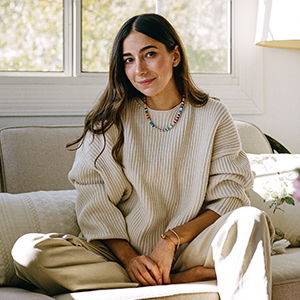
[00:00:10] Ray Latif: Hey everyone, I'm Ray Latif, and you're listening to the number one podcast for the food and beverage industry, Taste Radio. This episode features an interview with Mélanie Masarin, the founder and CEO of Guia, a brand of non-alcoholic aperitifs that has redefined expectations for booze-free cocktails and is attempting to reframe social drinking norms for modern consumers. Just a reminder to our listeners, if you like what you hear on Taste Radio, please share the podcast with friends and colleagues. And of course, we would love it if you could review us on the Apple Podcasts app or your listening platform of choice. Ghia takes its name from an Italian car designer who wanted his vehicles to convey the sophistication of a Ferrari while being as accessible as a Fiat. It's not surprising that the beverage brand's aesthetic and business strategy are similar in nature. Founded by former Glossier executive Mélanie Masarin, Ghia aligns three fast-growing beverage trends, premium ingredients, ready-to-drink cocktails, and alcohol-free alternatives. Inspired by Mediterranean aperitivo culture, Ghia made its debut in June 2020 with its flagship product, The Aperitif, a glass-bottled still beverage made with Riesling grape juice, gentian root, lemon balm, fig, and elderflower. Ten months later, the company launched Le Spritz, a ready-to-drink, single-serve can made with Ghia's signature formula and blended with sparkling water, yuzu, and rosemary. That was followed by Ghia Ginger, a ginger-infused take on Le Spritz. Lauded by mainstream media publications including the New York Times, Vanity Fair, and Forbes for its sleek package design and novel formulation, Ghia is currently sold at several hundred retailers and direct-to-consumer via its website. In the following interview, I sat down with Melanie for a deep dive into the origins, launch, and development of Gia, including the influence of her previous work experience at Goldman Sachs and Glossier, how her plans to build Gia as an experiential brand were sidelined by the pandemic, and why she's not thrilled about social media despite her prowess on Instagram. She also shared a remarkable story about how she won over Gia's brand and package designer, why, quote, growing up in the right way often means pumping the brakes, why she's optimistic about achieving a lofty goal in the near future. Hey, folks, it's Ray with Taste Radio. Right now, I'm honored to be sitting down with Mélanie Masarin, who is the founder and CEO of Gia. Melanie, how are you?
[00:02:59] Mélanie Masarin: I'm good. Thank you for having me.
[00:03:01] Ray Latif: Thanks so much for joining me today. You look very healthy and rested. Now, this is the first time I think we've met face-to-face or screen-to-screen in the Zoom era, but it seems like you are at peace and at ease. Is this because you've been on vacation, perhaps?
[00:03:17] Mélanie Masarin: I just spent the weekend at the beach, so no complaining. I feel like this is a trick question from the beginning.
[00:03:26] Ray Latif: I mean, it was kind of a trick question because I know I've been following you on Instagram and I've seen that you have spent quite a bit of time in Mexico over the last few weeks. You're based in L.A., but you've been in Mexico. Seems like you've seen and experienced some really amazing things. Anything that our listeners should know about those travels and perhaps where they should go if they visit the country?
[00:03:49] Mélanie Masarin: Yeah, so last year, because everyone was remote during COVID, I decided to spend a couple months in Mexico City, which I had never visited before. And I fell in love with it, and I fell in love with the country, and I love the ocean, and I love to surf. So in October, I went to Baja to surf for a few days. And then when Omicron started ruining our lives again this year, I came back down to Mexico for a couple of months. And I took a little trip this weekend to Puerto Escondido, which is really beautiful, and I highly recommend everyone visits. And I'm in Mexico for a few more weeks until we reopen the office in March.
[00:04:22] Ray Latif: Outstanding. Well, I'm going to have to come out and visit the office. It's in L.A., right?
[00:04:26] Mélanie Masarin: Yes, it's it's in L.A. It's a house.
[00:04:29] Ray Latif: It's a house. OK, are you going to have Gia on draft perhaps? Or is it all still in bottles and cans?
[00:04:35] Mélanie Masarin: It's still in the bottles in Canada, but we get asked a lot. So I was thinking something more like a gear fountain, you know, for drama.
[00:04:42] Ray Latif: I would love that. That would be incredible. That would also be probably one of the most Instagrammable things you could possibly photograph or they could possibly put on a social site. You know, I mentioned that I saw where you were and what you've been experiencing on Instagram. You have a very beautiful, personal Instagram page. How intentionally do you curate the page? Is it very, very specific or is it something that just tends to evolve with your mood and how you feel on a particular day or week?
[00:05:17] Mélanie Masarin: I have this very love-hate relationship with Instagram because I'm definitely someone who I like to think that I'm better in real life. Like I don't like. devices and terrible with them. And I think, you know, if it were up to me, like I wouldn't even be on the internet, but when we launched Kia and we were supposed to launch Kia, you know, offline only at first, it was supposed to be in restaurants only. And then COVID hits and it became, you know, this like almost battle to like get people to find out about us and give us a try because we couldn't give them a taste of the product. Like we launched in June, 2020, we were supposed to launch in April, 2020 in restaurants only. And now my name is all over the internet. And of course, that's done a lot for the brand. And my personal page, I think is just like, very complimentary to the gear one. But no, I don't, I don't curate it. I curate the gear one very intentionally. And I'm a bit of a control freak. So I still run it. And I really like the goal for 2022 is to not be doing that anymore. But you know, there's like a finesse to our brand and like all of the inspiration obviously comes from very, very personal experiences of growing up by the Mediterranean and tasting my mom and my grandmother's recipes and all of the ingredients and this kind of like just Mediterranean lifestyle that is very personal. So I do that, but my own, it's like, when you look at my page, you think I'm just on vacation all the time because I actually only post when I travel. And so it's just, it's like the truest Instagram versus reality, because it's like, it reflects maybe 10% of my life. And actually, my stories are just a lot more spontaneous than it's all of my like kitchen experiments and sort of like more funny, like insider narrative. So it's a bit high low, I like to think.
[00:06:59] Ray Latif: Well, you mentioned that 10% of what your life is actually like is shown on your Instagram page. I think that's probably true for a lot of folks or that percentage is probably even smaller for most folks because people only put the good stuff on Instagram, right?
[00:07:14] Mélanie Masarin: Yeah. And I think that's definitely true of me, even if it's like not intentional, you know, I think like you look at my page today and it was like my beautiful weekend in Porto Escondido. And, and it's like, well, the truth is like, I've been working 14 hours a day at my computer since October and we're kicking off fundraising. And I'm actually in Mexico because I'm freezing my eggs here, you know? So it's like, this is like all this, like behind the scenes that you don't see. And I guess people should talk about more, but that's the true life.
[00:07:41] Ray Latif: Yeah, well, you share quite a bit from behind the scenes, which, you know, you mentioned, and I think that's amazing. The behind the scenes compilation, by the way, if you are in Melanie's Instagram page, you should definitely check it out. It really is. It's like it's like a perfect history or this beautiful history of the creation of your brand.
[00:08:00] Mélanie Masarin: Yeah, it's actually, it's funny because I guess like I posted it and I never looked at it now, but when we go back to like these times when we were choosing bottles and you know, some of this stuff is pre COVID before we knew what was about to happen to us. And it's cool because it's also like we celebrate the win. So there was our first, you know, big feature in the Wall Street Journal and that very much like kind of changed our business and brought so many new customers. And when we finally got on the shelves at Erwan Market, which was a supermarket we visit all the time in LA and all of the, you know, things like that, we also had like, you know, the first departure of like our first employee. And I was like, very emotional. And that's, you know, we're posting that this week. And it's, it's truly a roller coaster, but looking at it in hindsight is really beautiful.
[00:08:46] Ray Latif: Yeah, it really is. One thing I didn't see in there is where the name came from. And again, it's Ghia, G-H-I-A. Where did the name come from?
[00:08:58] Mélanie Masarin: So we didn't say it for a long time and probably we still shouldn't because it can be associated with another Italian brand. But it's actually, I'm a huge petrol head and I love vintage cars and we really wanted a name that had, that was a feeling. So we didn't want a name that meant something related to the product. We wanted a name to be the spirit of the brand. And that spirit of the brand is that you can feel like so alive without feeling inebriated. And that happens, you know, a lot in different instances, you know, when you're dancing to incredible music or, you know, when you're driving down the coast of Italy. And so Ghia is actually inspired by Gio Ghia, who was the founder of Carrozzeria in Italy that made really beautiful cars. Most notable, the Carmen Ghia, which was a car that kind of looked like a sports car, but was a Volkswagen. So it was very approachable and very affordable to everyone. And it's a really beautiful car that's like really easy to maintain. There's still some today. They're not very expensive. They're like really gorgeous. And the brand doesn't exist anymore, but Ghia was his last name. And so Ghia is inspired by him.
[00:10:03] Ray Latif: All right. Well, that's a really good story, actually. Did you call yourself a petrolhead? Yes. That's the first time I've ever heard that phrase. Like, you know, a car enthusiast. I don't know, F1 fan or something. Petrolhead. I like it. I like it a lot, actually.
[00:10:18] The Aperitif: Something like F1 fan is more like for F1, like in sports. And I actually just like like the mechanics.
[00:10:26] Ray Latif: Gotcha, gotcha. Well, you really do have a way with words, Melanie. You have a really amazing way of describing a feeling or the reason behind something. And I say that because going back to your behind-the-scenes compilation for your first production run, there was a caption in there and it said, the entire facility smells like vacation in France and the warm sun of the Riviera. Why wouldn't you want to buy this product? It sounds incredible.
[00:10:58] Mélanie Masarin: Such a moment, the first production run, because for anyone, and I'm sure a lot of people who listen to this podcast are very familiar with the production process. It's pretty unglamorous. You know, you rent time from factory lines and you have these giant vats of products and you figure out how to scale up your recipe. And then we started like the emotion process and then was started to fill the air. It was incredible. And we just knew like, that's, you know, it was going to work because it just smelled so good. And actually, We got that feedback from customers because when we launched, we really want to do no plastic and the whole company. And we had this corn-based temper seal, which temper seals are mandatory to close the bottle. And the corn-based temper seal just didn't hold the cap tight enough with the bottle. And so we had like a pretty high explosion rates in our first month, which was really like, we're talking like 9%, right?
[00:11:47] Ray Latif: You said 90?
[00:11:48] Mélanie Masarin: Nine, nine. Oh, nine. Nine's bad enough.
[00:11:51] Ray Latif: Yeah.
[00:11:51] Mélanie Masarin: It's way higher than what you want. And thankfully, we figured out it was a temper seal really early on and were able to fix it. But we were getting the feedback from customers. I was like, my bottle came shattered, but the box smells so good. I was like, oh, my God. And so we fixed the temper seal and we obviously replaced all of the bottles. But the smell of the product, it was like really important for us from the beginning and thankfully convinced the customers to wait for another bottle.
[00:12:19] Ray Latif: Well, the customers are clearly looking at it as the bottle half full, even if the bottle is shattered. And the way you describe gear and just the passion I can feel that you have for the brand, it very much feels like a mood more than it does a beverage or brand. Was that the intention when you started this company?
[00:12:44] Mélanie Masarin: I think so. I think the way that when I started the company, and again, that was really from personal experience because I haven't been drinking for a number of years. I'm not sober. I just feel better without booze, which I think most humans feel better without booze is what these past years of experience I've come to learn. But I was like, I love food and I wanted something to really pair well with my food. But it was as much about the culinary experience as it was about the social experience. And so the way that I described Gia at first was Gia as an invitation to participate because I felt like if you were having a traditional mocktail or sparkling water, you know, it came this time to cheer and no one wants to cheer with you because it's bad luck. Or there was this moment of like, you always felt like an outsider. And so that's really what we wanted to change. But that idea came, you know, late 2018, early 2019. And there were many, many more months of development afterwards, because as much as the brand and the experience are really important, I think for people to give us a try, you know, we really wanted to create a product that was different. We wanted to create a unique formula. We wanted to create a grownup drink. We wanted to have a really high standard for ingredients sourcing. And so when people say, well, the brand is so beautiful, I'm like, I'm obviously very touched because that was so much work, but I always say like, it's what's inside that matters and you have to taste it.
[00:14:08] Le Spritz: Guessing your margins? That's risky. Belay Financial gives CPG brands the clarity to scale smarter, faster, stronger. Get your free inventory ebook by texting TASTE to 55123 and start making data work for you. Vibrant Ingredients is the natural ingredient partner powering food and beverage innovation, delivering flavor, function, and protection through a science-backed portfolio. Vibrant delivers purpose-driven solutions that help brands create extraordinary experiences. Discover what's possible with Vibrant today. Visit vibrantingredients.com.
[00:14:55] Ray Latif: Let's talk about your career for a second, you know, leading up to the development of Gia. You graduated from Brown and then you went to work at Goldman Sachs. Now, I apologize in advance if this comes across as wrong. I can't imagine you as an investment banker. And that's not because I can't see you doing the role, but it's because when I think about investment banking, I think about stayed personalities and sort of the tactical nature of investment banking. So I understand why you might have gotten out of it, but getting into it is a different thing. What, if anything, did you incorporate from that experience into GIIA?
[00:15:33] Mélanie Masarin: For sure. Well, actually looking back, you know, investment banking definitely was not for me, but it took me a few years to realize that I was actually a creative. I'd never had this like creative confidence. And I was always, I was a bit of a nerd, you know, growing up and I'm still like very much a nerd. Um, I was really good at math. I was really good in school and I was very analytical and numbers felt very safe. And, you know, I graduated, I went to Brown in 2008 and that was kind of like peak financial crisis during my years there. So as an international student in college, it was really hard to get sponsored for a visa. And I was really worried I was going to have to go back to France after getting a very expensive education. And when I got an internship at Goldman and then subsequently an offer, it was just such a great opportunity. And in hindsight, I'm so glad that I did it. And I might someday be this mother who forces her kids to go to investment banking because it was just the best experience ever from a learning standpoint. attention to detail and the attention to client service that they have at the firm is just completely unparalleled. And of course, it was really difficult, but the work ethic that they instill in you and, you know, the ability to read numbers, like now I can look at the gear PNL and it's just like a skill set that I have where I'm able to analyze that without necessarily, you know, yeah, without struggling. And then I can focus the rest of my energy on, you know, the creative and furthering the customer experience and product and all of those other things that are much less Cartesian. But it was just a great experience in terms of starting a business and especially a beverage business that is so capital intensive, you know, has such low margins where you have to be on top of it. So in hindsight, I'm really grateful, actually.
[00:17:17] Ray Latif: That wasn't the answer I was expecting, but I'm glad you gave it to me because I think some folks think, well, investment bankers or the transition from investment banker to entrepreneur is a pretty wide gap. But that being said, it sounds like the financials were totally worth it, or at least, you know, education about the financials of running a business. How about Glossier? Because when I say Glossier, people's eyes light up their ears perk up and you had a really interesting role at the company. It was the head of retail and offline experiences. Your time at the company, though, was relatively short, though impactful, I'm sure. Was it as impactful as I imagine?
[00:17:59] Mélanie Masarin: Yeah, I was there for almost two years. I was talking to them for a long time before and I was waiting for my green card. So we had, you know, I think I joined in 2016. Glossier is just the most extraordinary company that I ever worked for. To be honest, it was just such a creative time. And we always say like working there is like dog years because we were growing so fast and we were working so much. And the kind of like customer desire for this engagement with the brand was so strong, like it was very much like an always on culture, but the learning experience was so great. I was given the incredible opportunity to sort of figure out what the third dimension of Glossier would look like, because the brand was very much digitally native. It was a brand that, you know, it was like the first big brand on Instagram, like changed the beauty aesthetic on our phones and customers really wanted to meet glossy IRL? And what is glossy IRL? Like, how does it translate? Um, how does that translate to an offline experience when at the time, like the only digital brands that had gone offline were the brands like Warby Parker, or, you know, I think maybe Reformation was another one that people were talking about at the time. So they were really focusing on full omni-channel experience. How do you make the online experience and the offline experience as close to each other as possible, as seamless as possible. And Glossier took a completely different approach where they wanted these experiences to be really complementary by creating these stores that were all different. Like anyone who does retail strategy which is kind of like my expertise. Anyone who does retail strategy will tell you that it is not how you should be doing things. And we went at it with a completely different approach that was like, you want to blow people's minds and you want to delight the customer and then they'll come back through Glossier.com.
[00:19:44] Ray Latif: When it comes to Ghia, I see some of the elements, or I think I see some of the elements of Glossier in terms of branding in Ghia. Let's start from the concept itself. You talked about why you saw a need for this type of product, and it was based on your own personal needs. But when it came to actually creating the concept or conceptualizing this brand, what came first? Was it the who, the why, the form, or the experience?
[00:20:11] Mélanie Masarin: I think first it was the why, because that's how I got the idea. And then it was the experience very much so. And it's actually how we approach product development for every product that we create that includes like non beverage products. We launched, you know, a Nutella alternative over the holidays. And that was the same. We use the same treatment, which was what is the experience what is the occasion and how do we create a product that will support and be a catalyst for this occasion in a more meaningful way. So for us it was like we want people together, we want to change the way people drink, gather and think. How do you do that? What is this moment of decompression? The moment of decompression was aperitivo hour, which is obviously very anchored in kind of like French culture. French Italian culture, my mom is French, my dad's Italian. So, you know, I spend so much time every summer pretty much by the Mediterranean. And so it was this moment of decompression, like that first drink before dinner. I'm someone who hosts a lot. And I always say the most important thing is how quickly between the time your guest enters the door or sits down at a restaurant, like their first drink is in their hand. It doesn't have to be an alcoholic drink, but that really helps set the tone for the night. And so that first drink to me was so important. And that's kind of what came, the product sort of came from that experience of The Aperitif.
[00:21:32] Ray Latif: So if the experience was so important and then COVID hit right as you were planning to launch, I'm sure all the work you put into thinking about the experience had to be shifted a bit. and shifted into the branding and marketing that you talked about earlier, as I've mentioned, as I'm sure you've heard thousands of times at this point, is branding and design, just absolutely stunning. Did you have an idea in mind at the outset what you wanted it to look like, or was it more, I'm just going to find the best designer I can to create the look and feel of my product?
[00:22:07] Mélanie Masarin: It was a little bit of both. I'm not a designer, like a technical designer, but I definitely curate. And I had a pretty strong idea for what I wanted the Ghia feeling to be and all of the inspiration. So there's a lot of cues from postmodern design. There's a lot of cues from, you know, the back label of our bottle is like a totem pole, which like I'm obsessed with sculpture and totems. So that was like another kind of postmodern reference. And even in terms of like, postmodern designers and just how they approached creating things. We took a lot of those references. We also inspired ourselves a lot from old hospitality signage. I really wanted the brand to be designed as if it was an in real life brand because I felt like at the time and that's starting to change a little bit now, but everything was sort of just designed for Instagram and you had a lot of pastel colors and a lot of like, it was like glossy and microwaved, you know, and so I really wanted to like not use pastel colors and I really wanted to not use a sans-serif font and I really wanted a hand-drawn logo, things that make it a little bit more difficult digitally, but I think make it look more like a quintessential Forever brand in the real world and so that was really important to me.
[00:23:17] Ray Latif: Isn't that the goal for most brand founders though, is to create something that, you know, can last forever and, you know, create this iconic brand?
[00:23:27] Mélanie Masarin: I don't know. You tell me, because I see a lot of copycats out there and, you know, I'm happy to go into that. I have strong feelings over here. So we're trying to be different. All that we think about always is how can we differentiate? And I think that that's actually pretty unique because I'm seeing a lot of people not do that.
[00:23:46] Ray Latif: You sound agitated.
[00:23:50] Mélanie Masarin: There's been like some recent ones and I'm just like, just using our shapes, you know, like, and I'm just, I'm irritated because we put so much work into it. And then, you know, it just feels like a shortcut, but, but I do really believe that in the long run that will hopefully work in our favor.
[00:24:06] Ray Latif: I think so. And you know, there's something to be said about being the first, because everything that comes after is typically known to be a copycat or an imitation of the real thing. In your case, the real thing, that being the design, has an incredible story. You shared this with me when we first spoke. You have a pretty incredible design partner.
[00:24:25] Mélanie Masarin: Yes. So we work with Perron Rottinger. They're a studio based in Los Angeles. We were looking at hiring a number of design agencies and some of them had worked with really beautiful brands and we didn't want a studio that worked with a lot of CPG companies because I felt like everything sort of looked too similar and I just... wanted to maybe find someone that had worked with more experiential and you know I would say like space design because again of my experience in just like environmental design and we went to we were like really we couldn't find a name that we liked you know trademarks like I understand now why a lot of brand names have no vowels, it's because literally every word's been used, and even a trademark that's been defunct for years, you can't use it, it hasn't been cleaned up. So it was just really difficult, and we were kind of banging our heads against the wall, and I had tickets for a concert that evening, so I told Henry, who's still on our team today, let's just go see the concert and kind of forget about this branding situation for a minute. and the concert had been designed by this designer and we just had such a great time. It was a Tame Impala concert. We danced all night.
[00:25:39] Ray Latif: You say Tame Impala? Love Tame Impala.
[00:25:42] Mélanie Masarin: Yeah, just an amazing concert, like pre-COVID. And, you know, I ended up figuring out who had designed the concert and getting in touch with Willow, who was the head of the studio and the founder of the studio. And of course, like, I think I found this gem that no one knows. And it's like, Willow's worked for Kanye and Jay-Z. And Henry at the time was like, I give you 48 hours because we're on a timeline here and this could go in the wrong direction. And I was like, okay, 48 hours. And so ended up figuring out how to get an introduction to Willow who happened to be traveling to New York and staying at the Bowery Hotel. And I chased him down and just like begged him. We did not talk about budget. We did not talk, but I just like begged him to take us on. And he just couldn't say no. And I think like,
[00:26:27] SPEAKER_??: Thank you.
[00:26:28] Mélanie Masarin: Like, I don't want to say that I forced him, but he was just like, sure, you know, to make me go away. And then a few weeks later, I was actually moving to LA for what I thought would be three months. And now it's been three years and, you know, I just showed up there and he started designing Ghia. And it was actually the first, Ghia was the first logo that Brian on his team, Brian is just the most incredible designer. And he hand drew the logo in one night and the following day I came and he showed it to me and I was like, this is it, this is the logo. I just knew, you know, it looked like, And he found a name, Willow found a name for us as well. And like the first brainstorm that we had. And since then, it's just been like a really amazing collaboration. Anyone who's worked with design agencies will know that, you know, it's a process to getting to know each other. And now we've sort of gotten to the point where I can tell Willow and Brian and their team, like, this is what I'm envisioning. And I'm, I think more hands-on than most clients. Like I'll usually go and like have them tweak things on the computer in front of me, which like they will never do with others. But, Literally, they will send me things and there will be no changes to the design. It will be just like the first pass is the past because we know each other's brain so much and that's such a special relationship to have. So I'm really grateful for them and we still work with them today. I know they will not design other non-alcoholic drinks. I'm sorry, everyone. We're the one.
[00:27:47] Ray Latif: At this point, you've got everything. You're ready to go. You've got your formulation, you've got your bottle, you've got your packaging, you've got your logo, and it's all great. Now you just have to learn how to operate in the beverage industry. The beverage industry is easy, right? All you do is you go to a distributor or the distributor sells your product to a retailer and boom, customer buys it. No, that's not really the way it works. Did you have any sense about the beverage industry before you got started? How did you learn the ropes?
[00:28:13] Mélanie Masarin: Zero, honestly, still don't really. I think everything that we've been really successful at to date has been the stuff that is not beverage industry specific. So even, you know, we were, we really wanted to create a drink that could be sold in the restaurants. And I think that's been the main differentiator for us. Like our main audience is an audience that appreciates food, appreciates the culinary world, you know, likes a bitter flavor, has maybe a less sweet palate. And so we wanted to launch in restaurants only because we felt like we wanted chef to introduce our product and we wanted people to try it in real life. And then when we pivoted to DTC really not by choice. I think there were some silver linings to it but we just had to because of covid is the complete reality of it. So we thought about this experience and how this experience would translate to receiving a package at home, and all of the branding that came on the secondary packaging and all of that. But, you know, we're just starting to scratch the surface in terms of distribution, offline distribution. And actually, we're hiring ahead of sales. So if anyone has a lot of experience in fine foods and appreciates Kia as a product, please, please reach out.
[00:29:22] Ray Latif: Is that job listing out there right now or is this it? Okay, good.
[00:29:27] Mélanie Masarin: Our job listing is on our site and we're looking for a director of ops and a head of sales like as soon as possible. So that little plug here for sure. But you know we have about 500 accounts today. We're on over 100 menus and that's been with one person doing this work. And as self-distributing, we even operate our own warehouse. So we don't even have a distributor right now, you know? So that's going to be the big challenge for 2022, because I think we've almost over-indexed on marketing where people have seen Ghia and have been meaning to try it, but because it hasn't been available on the shelves, we're missing out on some sales.
[00:30:03] Ray Latif: Why did you initially decide to self-distribute? And I recall seeing somewhere that it was an 11th hour decision.
[00:30:11] Mélanie Masarin: There was self-fulfill and self-distribute. And so, you know, we were always launching without a distributor because we wanted to ensure we had velocity and we were starting small. We had a really small production run. But self-fulfilling was because of COVID. The warehouse that we had selected wouldn't let us go into the warehouse to train people. And I just remembered that every time we launched a product at Glossier, members of the ops team would be at the warehouse overseeing it and making sure that things went well. And that was a much bigger, much better established company with a product that was much less fragile in transit than ours. And I just had this like... terrible gut feeling. We're talking like three days before launching, this terrible gut feeling at the moment of moving our inventory there. And I told Henry, our CEO, I was like, I don't think we should do it. And he looked at me, that was another one of like, Henry looking at me like, please, please let this not be true. And then we reached out to one of our friends who had a restaurant called Westbourne in Soho. who actually subsequently invested in Guia. And her restaurant was closed because of COVID. And I said, can we use your space? We'll rent you the space and we'll just ship it from there. And so here comes the day that we're launching Guia. And it's like us and thousands of bottles in the space. Mind you, at the time, we're still labeling every bottle and applying the temper seal. So every time there's an order on Shopify, We pulled the gun to wrap the tamper seal on the top of the bottle and put it in the box and print a shipping label. And actually, obviously it's grown. We've now been in business for 18 months and we have changed warehouses four times. Well, we're about to change for our fourth warehouse, so three times. And we have not looked back on the decision because we've been able to, you know, handwrite customer notes in our first 1200 customers. We've been able to add little surprises in the box based on the emails that we received. Like we have this very integrated system where if people, we have like feedback from someone coming on email, we immediately are able to respond in the warehouse because it's like, we're just vertically integrated in that sense. And to me, from a customer experience standpoint, with all of the shipping issues that, you know, have been brought to the surface because of COVID, because people have just been ordering online so much more. It's just been priceless to be able to keep that.
[00:32:37] In September: Do you want more repeat buyers on Amazon? Well, this free resource in collaboration with Straight Up Growth will help your brand turn first-time buyers into long-term subscribers. Download Winning the Repeat Purchase Game on Amazon now at Taste Radio slash SUG. That's Taste Radio slash S-U-G to start building retention-driven growth for your brand on Amazon. Scaling a beverage brand into major retail comes down to operational readiness. From packaging lead times to co-manufacturing strategy, the details can make or break a launch. In a new e-book in collaboration with Octopi and Asahi Beer USA, industry leaders share what they've learned in helping brands scale. Download it now at Taste Radio slash octopi.
[00:33:27] Ray Latif: You told me that your advisors have been so important to these first few months or to the first few months, and obviously for the first couple of years of Gia. They're also very, very successful people, your advisory team. And I wonder, and I'm sure our audience is wondering as well, how do you get very successful people to become advisors and possibly investors for the company?
[00:33:52] Mélanie Masarin: So we have two advisors. One of them is someone who worked in the beverage industry, took a keen interest in Ghia, reached out to us. We took the time to get to know each other over a period of a few months on a consulting basis, and then realized that he could really add value to our business. And we really enjoyed working with him. And so we brought him on as an advisor. The other advisor that you're probably referencing is Nicolas Jammet from Sweetgreen. He's the founder of Sweetgreen, one of the three founders of Sweetgreen. And I actually worked for Nick and I think that, you know, I often get asked about fundraising and I don't know that I have all the answers. We've only raised a seed round, a friends and family round and then a seed round for Ghia, but the people that I turned to were the people that I had worked for because I had a good relationship with every single one of them. I think that the people that you worked for in the past, like they have, you know, everyone who's investing really early on in a company is actually investing in the founder and who has better knowledge of your capacity to execute than someone that, for whom, you know, you've done this work before. And so when I had the idea, I just turned to the people that I knew had been successful entrepreneurs or that I had worked for to kind of run this idea by them. And immediately they offered to invest, even though I was not raising money at all at the time, And that's kind of how things started. And actually, when I left, we didn't really touch on that. But between my time at Bowman, and my time at Glossier, I worked for DIG in New York, fast casual, you know, restaurant group. And through my time at DIG, started, you know, talking to the guys at Sweetgreen. And later, when I left Glossier, I did some work for Sweetgreen. Up until recently, actually, I did a really fun design project designing their headquarters in LA during COVID, which was like just the most amazing opportunity. And I'm so grateful to them for it. And so they also knew how I worked. You know, Nick was just so helpful that I said, like, we need to compensate you more for all of your help. Will you be one of our advisors? And he said, yes.
[00:35:49] Ray Latif: Well, I certainly hope that Nick will start selling gear at Sweetgreen stores. I mean, what a perfect compliment to some of their menu items. In terms of grab-and-go opportunities, you know, your spritz, just be able to go to a Sweetgreen and grab one, even if you don't buy anything else at Sweetgreen, sounds like the best idea to me. When we spoke last, you talked about how you want gear to grow up in the right way. I've heard more than a few folks say that that's their goal for the company in terms of its development, the right way. And I think I've asked entrepreneurs, well, what does right mean? What does that entail? What does that entail for Kia?
[00:36:34] Mélanie Masarin: No pressure, Nick, but if you hear us, the people have spoken, we would like to tell you in America. So growing up in the right way, that's actually something that. I ask myself a lot because, you know, I think a lot of people can relate to running businesses of all different sizes during COVID and it feels like everything is hard and you can have these very lofty goals, but just the execution is challenging, right? Shipping product is challenging, finding materials is challenging, costs have increased as customers are maybe more price sensitive than before. you know, when we set out to start Guia, we established a set of rules and maybe someday we'll call them brand values, but I also feel like we need for the brand to be more established before we have a set of unbendable brand values. But the first rule was no plastic. I have a personal hatred for plastic. I find plastic in the ocean everywhere I go. And I just think of just the ocean with a capital O, meaning like sort of all water on earth. So it's like this, just healing thing that we have to respect and honor. And just the way that we're treating it right now is just really soul crushing for me. And so I just really wanted a company that respected the planet as much as possible. And we're talking like we're shipping liquid around the country like it has environmental impacts. Right. So the first rule was no plastic. How do we do that. You know, we're not yet at 100% of that because we have that temper seal and we're working on alternatives for that temper seal. But you'll never get a product that's shipped in bubble wrap with Ghia. Every time we receive bubble wrap, we even keep it so that if we use bubble wrap for photoshoots, it's always bubble wrap that's already been out in the world. We recycle absolutely everything. Our Ghia house has TerraCycle bins so that people can bring their shampoo bottle from home. There's no single-use plastic. We try to recycle every plastic that might be even used in our employees' households. That's a really big priority. So that was the one rule that I think we've upheld the most. There are rules around customer experience. I think one thing that is really important for us to consider is that there's a lot of people that might be turning to this category because they have an alcohol addiction. And there are a lot of people that are just trying to figure out where they are on their drinking journey. And so for us, the rule was, we're not preaching to people not to drink. We are just here if they decide not to. But we also want to be really mindful of not triggering people that might have this addiction. So there's a lot of how we talk to customers rules. And that means, you know, not growing as fast as possible, but growing as thoughtfully as possible. and also with the respect of our community as much as possible. Then there's also like the way that we that we treat our team, that was like another big one for us is like, you know, people are remote, people are not remote. Like my team did not want to be remote in COVID. And what do you do? That's obviously really great that they didn't want to. So for a year and a half, we worked out of my house, you know, because we couldn't have an office. So there's just things like this. And for a year and a half, like I made lunch for the team every day, because I felt like that was a way of honoring the fact that they wanted to be here in person, even in these times. So as we grow, we want to make sure we adjust and bend the rules so that we create this ecosystem of people, of employees, of customers, that is a virtuous cycle more than a hamster wheel. And I think it's really easy with high growth startups to sometimes feel like you're on the hamster wheel of growing as fast as possible, of raising money as fast as possible, of doing all these things. And so we're just trying to be really intentional.
[00:40:16] Ray Latif: Do you worry about the downsides of growing too fast? And if so, how are you pulling back on the rains?
[00:40:24] Mélanie Masarin: Of course, there is like dreams for us that are growth related and that we have to kind of put on the back burner for a little bit because we've been getting asked so much, for instance, to bring GIA to new countries. And like, don't you think I would love to have GIA in France? That would be amazing. You know, it's like, if you want to see GIA in Europe, imagine how much I want to see GIA in Europe. But we just can't thinking about the customer experience, we can't just like, do a joint venture with someone in Europe and export the product as it's made here, because people in France have amazing bottles of wine for 12 euros. So I'm not going to go and sell a bottle of beer for 45. That's just wouldn't work. Like we're really thinking about how the occasion and the decision-making process of this customer. And also, you know, Canada, like we get asked all the time, why are we not in Canada? It's so close. It's like, truly, you know, there's like a big part of the country that's like English speaking. They have similar products. It's like pretty health conscious customer. And it's the same thing. It's like, unless we can actually all go in person, like travel to Canada up until recently was very restricted, like go in person, meet customers, put it on the menu in restaurants so that people will be able to taste it before they have to buy it. Unless we can find like a shipping partner that offers the same experience as ours. we don't want to be in Canada and offer a lesser version of like, there's just this standard for quality that we are committed to sticking to. So Canada will probably come in the next 12 to 18 months. Hopefully France, you know, comes a little bit after that, but until we know that we are doing everything we can for the customer to have as good an experience as possible, like we're just not doing it, even though it would be really fun.
[00:42:01] Ray Latif: One day it'll happen for sure.
[00:42:04] The Aperitif: Exactly.
[00:42:05] Ray Latif: One thing that I'm not sure will happen anytime soon, but you seem optimistic about it, is redefining the word drinking as it relates to social occasions. Like when you say, I'm going out for a drink, or I'm going drinking, and it always refers to an alcoholic beverage drinking experience. And obviously Guy is non-alcoholic and it's a little bit of this taking back a word that is so entrenched in our social norms. I mean, how do you get to a point where people think about social drinking as both non-alcoholic or alcoholic or whatever?
[00:42:45] Mélanie Masarin: Yeah, that's a question that we get asked a lot. And I think the pandemic has actually accelerated this shift from drinking to not drinking. You know, it's a lofty goal to say, we're trying to take back the word drinking from alcohol. I think in practice, what we're just trying to do is normalize not drinking. And I really started considering Guia as a business opportunity when I realized that whenever I opted out of drinking at the dinner table, someone else would often follow and say, you're not drinking. Okay, I'll send that one out as well. And so I realized like that was almost giving the permission for someone to participate without boozing. And so I've been working on all of the stats for our deck, because we're kicking off fundraising and I found like an article like two years ago that said the category is expected to grow 400% in the next four years. And then I found an article from a few months ago that said the category has grown 320 something percent in the past year. And so it's just happening like much faster than anyone expected to, probably because people have more information than ever about what makes them feel good and makes them feel bad. And also without having all the social pressure of events during the pandemic, people have renegotiated their relationship to alcohol a little bit. and maybe realize that they feel much better without it. What we're seeing is like a massive shift that is cross-generational. Like we have a customer base that is more diverse than I think you'd expect, but younger generations are just drinking much, much less. And I think the real like transition is with millennials who are, I would call the moderation generation because you know, 85% of our customers identify as drinkers. And we're hearing now that 66% of millennials self-report that they're trying to cut down on their drinking. So there's really this mindset of maybe like maybe drinking only on the weekend or like just trying to cut down to feel better. But what we're seeing is that Gen Zs, for instance, like really default to not drinking or drinking much less. And As much as, you know, saying, taking back the word drinking from alcohol is like a very lofty goal, I truly believe we're maybe five years away from, you know, pushing a drink on someone being as socially unacceptable as pushing a cigarette on someone.
[00:44:59] Ray Latif: Maybe we could just use the word boozing like you did before for people who are drinking alcoholic beverages. Oh, are you boozing tonight? Yeah, I'm boozing tonight. I'm just drinking for everything else.
[00:45:08] Mélanie Masarin: Exactly.
[00:45:08] Ray Latif: There you go. There is a rising tide for non-alcoholic alternatives to booze products. It's very varied in terms of what you can get out there. Non-alcoholic quote-unquote spirits, non-alcoholic cocktails, people will call certain CBD and THC infused products, you know, a non-alcoholic alternative. So there is this rising tide, but do you want gear to be associated with that rising tide given the brand's positioning?
[00:45:40] Mélanie Masarin: So yes and no. I think on the one hand, I'm just going to say it. I think there's a lot of bad products on the markets that are trying to catch this trend, you know, and so. I think that maybe people try one, have a bad experience, and then are maybe wary of trying another. But on the other hand, it is actually really good that there are more products on the market because one, we're now fully talking about a category and that wasn't really the case a few years ago. Two, it's really allowing us to go to supermarkets and really lobby for them to change their merchandising and create room for us together. We're seeing, you know, the rise of non-alcoholic liquor stores like Boisson and Spirited Away and like a few more and being very successful. And that's a good thing. People know where to find us and there are people who have the expertise to help you find the one that is right for you. I think the ones that we're trying not to associate with are the ones that are more functional and not because like, it's bad that they're functional, but just because from an ESO standpoint, like we're just taking a different direction. Like we're honoring ingredients. We are very focused on like culinary expertise. Like we're really just trying to create really delicious flavors that will make you feel socially accepted, even if you're not drinking. So we're not trying to kind of like, buzz you in a different way and I wouldn't want for people to think that. I also think that that can be triggering to some, but I think a lot of customers today are seeking that and it's maybe like an even better business opportunity.
[00:47:10] The Aperitif: So yes and no.
[00:47:13] Ray Latif: Melanie, thank you so much for sharing this incredible story of Ghia with us. If you couldn't tell before, I'm a big fan. I really love everything that you guys are doing. And I just see such an incredible runway for this brand. And even though you're trying to be as diligent and careful and cautious as possible, I just imagine that we'll start seeing Ghia everywhere in the near future. And I hope that's the case because I would just love to go out right now get my lunch at Sweetgreen and go have a can of Ghia with it. So yeah, please talk to Nick about that. And let's see if we can make that happen.
[00:47:51] Mélanie Masarin: Thank you so much. Thank you for having me and helping me voice over all my opinions.
[00:47:56] Ray Latif: It's wonderful. And thanks so much for being so authentic and transparent with everything that we talked about. It says a lot about you and how you're running this company. So really appreciate it.
[00:48:06] Mélanie Masarin: Thank you.
[00:48:10] Ray Latif: That brings us to the end of this episode of Taste Radio. Thank you so much for listening, and thanks to our guest, Mélanie Masarin. As always, for questions, comments, ideas for future podcasts, please send us an email to ask at Taste Radio. On behalf of the entire Taste Radio team, thank you for listening, and we'll talk to you next time.