[00:00:10] Ray Latif: Hello, dear friends, and thanks for tuning in to Taste Radio, the number one podcast for anyone building a business in food or beverage. I'm Ray Latif, the editor and producer of Taste Radio, and with my co-host for this episode, Jacqui Brugliera, Mike Schneider, and Melissa Traverse. In this episode, we sit down with Namik Soltan, the founder and CEO of Ginger Labs, a fast-growing New York-based beverage company that markets organic cold-pressed ginger shots and prebiotic drinks. Appropriate prebiotic drinks for the conversation we're about to have, but I don't want to... Foreshadowing, Ray!
[00:00:47] Jacqui Brugliera: Foreshadowing!
[00:00:47] Ray Latif: But I don't want to skip over Ginger Labs. Namik and his team have built an incredible Brad Avery there. Every single time I see one of their shots in New York City, if they happen to be in the office, I will grab as many as I can get my hands on. Those are so good.
[00:01:03] Jacqui Brugliera: The ginger amount is BevNET approved. Like you're going to feel the ginger.
[00:01:08] Mike Schneider: It'll burn your face off in The Bit way.
[00:01:11] Jacqui Brugliera: Not quite, not quite.
[00:01:12] Ray Latif: Just about though.
[00:01:14] Mike Schneider: Close.
[00:01:14] Ray Latif: I think you're right about that though, because I think sometimes you have some of those juice shots or functional shots and they feel a little bit more watered down. Like, where's the ginger? Where's the turmeric? And where's the beef? Oh, sorry. You're dating yourself, Mike. You're dating yourself.
[00:01:27] Jacqui Brugliera: I want to feel knocked out a little bit by the ginger you know like me too Or the fact is you can like you can do it in small sips as opposed to just shooting the entire thing back Yeah, it's totally a bev net thing and the nice thing about that is if you want to make a sparkling beverage with it You've got plenty of ginger to do it if you want to take it as a shot You can take it as a shot. I mean there's so many different things you can do with those shots And then they've of course made their RTD beverage, which is great too. And we talk all about that. Just a phenomenal product.
[00:01:52] Mike Schneider: Yeah. And they've done such a great job of going deep. I mean, people say go deep before you go wide, but they are such a good example of that in New York City.
[00:02:00] Jacqui Brugliera: And they did something that we normally recommend against, which is use the word ginger, but they're just ginger people. That's what they're doing. But it's spelled G-N-G-R. Right, right. They use the word ginger, G-N-G-R. They branded that. They're just, they're wearing ginger all the time.
[00:02:15] Ray Latif: Did you listen to my interview before it was published, Melissa? Because you nailed the inch wide, mile deep kind of aspect of what they do.
[00:02:22] Mike Schneider: We actually talked to GNGR on the Nombase Podcast as well. Yeah. So, you know, we've got some synergies there.
[00:02:33] Ray Latif: I didn't ask if they're going to make their way to San Diego because this entire time Jackie's had a big smile on her face being like, I love that brand. Please make your way to the West Coast.
[00:02:47] Melissa Traverse: I know. I know. Whenever I am on the East Coast, I also have like five in my bag because usually we're like making a challenge. Like how many can you take in one sitting?
[00:02:59] Ray Latif: It's the East Coast Air one shot I Was trying to get some sent to you while you were in the pen last week Mike Did you tell everyone I was in federal episode you didn't have a chance to at this point So yeah, I was riding on the floor I
[00:03:26] Jacqui Brugliera: The pen podcast country your own you have experience. Yeah again. They wouldn't let me have the equipment But I did do a podcast while I was in there. I just didn't just think it recorded only one person heard, right?
[00:03:37] Ray Latif: Well, we did fill your canteen. I hope you were able to purchase the things you need I Got some smokes. I got some numpty strikes. Okay.
[00:03:47] SPEAKER_??: I
[00:03:48] Ray Latif: Well, Melissa, you, uh, you were on your own vacation last week, but we're glad you're back because non-base doesn't exist without Melissa.
[00:04:00] Mike Schneider: Yeah, Nonbase is back as I am back and we've got some pretty fun stuff for everybody out there. So make sure you head over to nonbase.com if you haven't done it recently because we now have a data hub. We've had it up for a little bit and we've got some great data reports up. We've got Fabid with some funding trends. So if you're raising money or you're thinking about raising money, definitely head over there to see what's going on. We also have spins with snack innovation trends and soda trends. So check those out for sure. And then on the podcast tip, we just released some great episodes. We had WIMS and AO talking about how to scale ops without sinking. David McCormick is from AO. He's the co-founder of AO. He's just such an amazing resource. He's worked just about everywhere at Whole Foods Market. City Ops, a bunch of brands and he and Jesse Baruch really get into it. We also had Kyle Kohler from Wildway and Cara Posner from GNewsie Lewinden talking about distributor contracts. So lots of tricks of the trade and great ways not to get stuck. And then this week we are launching an episode with Chomps.
[00:05:13] Jacqui Brugliera: Take a breath. Wow. So much going on.
[00:05:18] Mike Schneider: I mean, it was down while I was down. So we've got a lot to catch up on. So nonbase.com, go over there, check it out and let us know what you think on the non-base.
[00:05:26] Jacqui Brugliera: I'm super excited about the cannabis content in particular. I mean, there's some great content on Nombase Podcast, formulation, legal advice, investing advice, all the good stuff, solving problems. If you have an idea for the Nombase Podcast, askittasteradio.com or
[00:05:42] Mike Schneider: Or just head over to the non-based Slack, slack.bednet.com.
[00:05:47] Jacqui Brugliera: There you go. I did use my canteen dollars to buy some good Mellow and some Plift while I was in the, in the clink.
[00:05:54] Ray Latif: Nice. Nice. You're introducing fellow inmates to better for you products and brands.
[00:06:02] Jacqui Brugliera: I wasn't marrying you guys. I was on the beach. I was having a good time.
[00:06:06] Mike Schneider: You didn't make the prison liquor with like, um, ketchup and toilet water.
[00:06:11] Jacqui Brugliera: Yeah. Yeah. Ketchup and toilet water. I'll give you my recipe later. Just send a, send an email to askitstasteradio.com if you want my, uh, if you want my cocktail.
[00:06:18] Ray Latif: What do they call that? Pruno? Yeah.
[00:06:22] Jacqui Brugliera: Someone should make a brand called Bruno, and it's just like crappy wine Probably someone's tried it there was like some kind of just weird syrupy thing on the wall that I used as well I'm not sure You might not be able to get that ingredient from you know or from
[00:06:45] Ray Latif: There's just too much being revealed. There's way too much being revealed here. Once again, Melissa's revealing a bit of her sordid past that back in the early 90s, it sounds like, maybe, or late 90s, you had your own thing going on.
[00:06:58] Mike Schneider: Yeah, you know, desperate times, desperate measures.
[00:07:02] Ray Latif: The 90s were that time. They really were that time to get a little wild, you know. Less responsibility in this world. So, as I alluded to, I'm going to be talking about some prebiotic news, and that is the news that apparently, as I knock things over, apparently some departments at PepsiCo didn't get the memo that the company bought Poppy, which is a brand of prebiotic sodas. And they paid quite a bit for it, $1.65 billion. This is actually 1.95, but there was a tax savings and so on and so forth. So anywho, Pepsi announced that they're launching a new prebiotic cola online this fall. Pepsi Prebiotic Cola is a new two SKU line featuring three grams of prebiotic fiber per 12 ounce can. Black Friday is the day, of course, because, you know, everyone wants prebiotic Pepsi for Christmas. I'm such an asshole. I'm sorry. You said it. You said it, but we're volunteering. Yeah. Yeah. Okay. So it's coming in original cola, cherry vanilla flavors, five grams of cane sugar, 30 calories and no artificial sweeteners. I'm curious about this. Melissa, you have some thoughts.
[00:08:21] Mike Schneider: I think it makes perfect sense. You know, you have the folks who are already into poppy, you know, maybe more into better for you products. And then the rest of the population who are Pepsi fans have a way to be introduced to it. And that now Pepsi has all of the data that poppy has accrued over the years. So I think it makes sense.
[00:08:42] Ray Latif: Okay. Jackie, your thoughts?
[00:08:44] Melissa Traverse: Yeah, I don't know. I mean, obviously they took the secrets of poppy and put Pepsi on it. They're going after obviously their main demographic and the people that are drinking Pepsi every day and trying to offer a better for you option and testing into that and seeing how it goes. But yeah, I still think people are going to drink poppy. I hope that poppy doesn't go away. They have just like a lot of strong brand equity. They have, you know, the better for you consumer that is looking for poppy. I personally wouldn't pick up a Pepsi because yeah, they have those claims, but I still don't know what else they're putting in it. Whereas I feel more strongly to grabbing a poppy and have more confidence in it. But yeah, it is interesting. I know that they also had previewed like a prebiotic soda in the past and then didn't launch it. So this has always been on their radar. And I feel like they're just testing into the Pepsi equity and distribution and trademark as well as testing poppy in their distribution as well.
[00:09:50] Ray Latif: Yeah, all good points. And as Jackie pointed out, they had prepared to launch a variety or an offshoot of its Soul Boost line, which they discontinued a few years ago, and they were going to launch Soul Boost that had a prebiotic benefit to it, but seemingly scrapped those plans when they bought Poppy. And here's the other weird thing, you know, poppy got popular, I would think, mostly because of its branding and flavors and low sugar, not because of the functional benefits. So it's interesting that it's right on the front of the can. I mean, I'm looking at the photos of what these cans are going to look like. Right at the base of the can, it says prebiotic cola or prebiotic cola cherry vanilla, depending on the flavor. Top of the can says five grams of sugar and no artificial sweeteners. So I even think it's going to confuse a lot of people, like thinking like, what is prebiotic? I mean, how many of these people, how many new consumers are they going to bring to the brand because it says prebiotic? I don't know. Yeah, Mike, you pointed at me. What's up? Oh, you're not going to ask me a question? No, I thought that's your opportunity to jump in. You don't want me to jump in? Yes, jump in. You have a history of jumping in without me having to ask you.
[00:11:00] Jacqui Brugliera: I'm pretty good at that. I mean, Jackie's nailed it here in terms of just, you know, Pepsi can basically do whatever they want. And these are these are two mutually exclusive moves here. So the Pepsi prebiotic thing has been planned for a very long time. I don't know this for sure. This is what I suppose. It's been on the roadmap. They're like, all right, we're going to get a prebiotic soda out there. And they've decided to test it under the Pepsi name to see if the mainstream wants a prebiotic soda and to see if they can, you know, they have a gateway to getting people into the poppy brand or if they should just continue to make prebiotic Pepsi. Now, there's one thing that you're all three missing here is that Nobody makes cola like Pepsi and Coke. They're The Bit at it. And so if you want to test a prebiotic cola, test it under The Bit possible brand you can test it under. I know Poppy has their colas and they're okay, but they're not Coke and Pepsi at the end of the day. They're still not Coke and Pepsi. Like those are The Bit. You think this is a test? I'm sure it's a test, because they're tests all the time. I mean, they're probably gonna test Crystal Pepsi again at some point. They test all kinds of stuff. They test Pepsi Blue in the past. They've tested all kinds of stuff, and this is the season that they typically will pull out a test. Now, I mean, usually it's like a summer innovation or something like that, and it's kind of strange that they've pushed it back, but maybe that's because they're bringing in some of the poppy playbook or some of the poppy, you know, formulation playbook you know, on the prebiotic side. I mean, there's a lot of things that could be at play here. Pepsi putting a prebiotic soda doesn't endanger Poppy at all.
[00:12:36] Ray Latif: Right. From the Coke side of things, there is some news as well, and that's that Coke is going to launch a full sugar line extension. So it's going to be a product that's made with sugar instead of high fructose corn syrup. So it's similar in nature to what's called Mexican Coke. Mexican coke Mexican squirt yeah, you know all those are The Bit bottle the old-school It's not exactly clear when this is going to debut but James Quincy who is the Chairman and CEO of Coca-Cola said this addition is designed to complement the company's strong core portfolio and offer more choices across occasions and preferences. Uh, this, uh, introduction or announcement may be attached to some news of the day. We're not going to get into that, or at least I'm not going to get into that. But, uh, good to see that this is happening because it seems like there's a lot of folks who love Mexican Coke or what's described as Mexican Coke. And this gives you another option. I feel like that version is, is a little bit sweeter, but less syrupy.
[00:13:51] Mike Schneider: I also like the fact that Mexican Coke, at least when I've tried it, comes in a slightly smaller bottle than a regular Coke. I'll be interested to see if they launch with the typical size or go a little bit smaller.
[00:14:03] Jacqui Brugliera: Oh, they've got the bigger bottles too for Mexican Coke.
[00:14:05] Ray Latif: There's a few different bottle sizes.
[00:14:07] Mike Schneider: I've only had the smaller one, which I appreciate.
[00:14:09] Ray Latif: Mike saw it in his canteen.
[00:14:13] Jacqui Brugliera: They put it outside the cell and you just put them out there and I'm like, and they dangle them, dangle them.
[00:14:26] Ray Latif: That's not a nice thing to do. No, it's prison.
[00:14:31] Jacqui Brugliera: They're trying to be like, it's better out here.
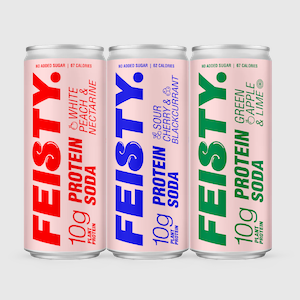
[00:14:33] Ray Latif: And for a second there, I thought you actually had a tattoo on your arm from when you're timing the pen. Yeah. Sounds a little inappropriate. It says DILF, D-I-L-F. Yeah. And underneath it, it says, damn, I love feisty. And this is also, we're staying on the soda front, but for a different reason. Feisty Soda a marketer of
[00:14:51] Jacqui Brugliera: protein maker and marketer of protein soda based in UK. Founder's name is V Cutting. She and her mother, it's a family business and her mother's the formulator and she's the marketer. She was formerly in the fashion industry and she's like super fashion forward. And the idea is like to market this to gym goers. And she's really like embracing the non-mainstream gym goer along with the mainstream gym goer. But in the marketing, it's all, you know, meant to shock you a bit. And it's really good stuff. In my hand, I have the white peach and nectarine flavor. Yesterday, I had the sour cherry and black currant, which has like, remember those bank suckers that you used to get with the plastic on top and you just kind of rip that off? You know what I'm talking about? When you go to the bank as a kid, you're- Like a lollipop?
[00:15:37] Mike Schneider: Were those in your prison canteen as well?
[00:15:39] Jacqui Brugliera: Yeah, those were in my prison canteen as well. But they were actually from 1976. And you're wondering why we didn't get the reference?
[00:15:45] SPEAKER_??: Yeah.
[00:15:46] Jacqui Brugliera: So it kind of brought me back to that flavor. Jackie, remember when we tried feisty initially, you could still taste the pea protein and I've just got to give props to V's mother on the formulation here because it's getting so much better. There's still a little bit of, you know, kind of a taste of the protein, but it's mostly a soda.
[00:16:06] Mike Schneider: For pea protein, I feel like that's super impressive. I've certainly had a number of whey protein products where you can barely taste it. But for pea protein, that's really impressive.
[00:16:15] Ray Latif: Yeah. No added sugar and only 67 calories. I might amplify that. It's a pretty small line on the top of the can.
[00:16:21] Jacqui Brugliera: No added sugar, 67 calories. The Bit play on the can is the 10 grams of protein, which I think, you know, again, you know, you guys know I'm not like a big fan of the of the vertical, but, but I think it works here and it's a cool can. It's fun to hold. I like the call outs on the side. They're light and fruity plant powered protein. So refreshing, nothing artificial. This is a good product.
[00:16:42] Melissa Traverse: Yeah. Yeah. Solid branding. I remember seeing it on shelf in the UK and it just really popped and it looks like, you know, on trend with some other things that we're seeing in the functional beverage space.
[00:16:54] Jacqui Brugliera: I think if you put it next to to trip it has like that same kind of cool cachet And obviously is branded by somebody who knows a bit about cool, yeah I would like a feisty t-shirt or like a feisty muscle shirt.
[00:17:11] Mike Schneider: Yeah, I just love the word to like feisty It's just like a fun.
[00:17:15] Jacqui Brugliera: I take a feisty tank. That's this DILF.
[00:17:17] SPEAKER_??: I
[00:17:19] Jacqui Brugliera: There's a milk one to Melissa, so you could have there's no sticker upstairs for you.
[00:17:23] Mike Schneider: Okay good.
[00:17:24] Jacqui Brugliera: I love feisty But anyway, thanks for sending this along.
[00:17:28] Ray Latif: I know it's not that easy to send stuff from the UK especially right now Yeah, yeah, absolutely super tasty this peach is really good Switching gears to food for a sec. Congratulations to Tia Lupita and its founder, Hector Saldivar. Tia Lupita was recently acquired by Vilore Foods, which is a San Antonio, Texas based distributor and commercial subsidiary of heritage food brands, including La Costeña, Jumex, and Totis, I think. I think I'm pronouncing all of those correctly. I think it'd be humex, but okay. Okay. Humex. There you go. Tia Lupita is a maker of better for you Mexican food inspired snacks, including it's grain free tortilla chips, a hot sauce, a couple of hot sauce, a few hot sauces actually make a hot sauce, a salsa verde and a chipotle. And of course my favorite product of theirs, their salsa matcha. Hector is one of the nicest guys in the industry. I sat down with him about four years ago for an interview for Taste Radio and talk about a great success story. Here's a guy who took inspiration from his mom's kitchen and just built a really beautiful brand that inspires the customer to appreciate the heritage of what he's doing, but also eat really well.
[00:18:47] Jacqui Brugliera: I feel like it's a zero sacrifice brand too, where he's been able to, as you said, really play on that heritage and make just explosive flavor too. And they've been a great member of the Nosh community for a while, the Teal and Peters crew, and we're just super excited for them.
[00:19:03] Melissa Traverse: Yeah, it sounds like it's just going to be a great partnership too. This company knows his demographic. I think they're based in Texas.
[00:19:11] Jacqui Brugliera: And Mexico. Yep.
[00:19:13] Melissa Traverse: Yep. And he's also staying at the helm. So I'm excited that him and his team are still going to be running the brand because I would miss seeing him at the trade shows. Like he is the brand. He's the personality. He eats, sleeps, and breathes Tia Lupita.
[00:19:29] Jacqui Brugliera: Hopefully this isn't the last acquisition we see from Humex too, because they've got quite a bit of money. So there's great potential for R&D. Hopefully we'll see some new T-Lupita products come out and things of that nature. They'll give them some much needed runway because any startup, as we all know, needs some kind of cash injection to be able to go to that next level and support. A lot of them are really working from a, and I don't know if Tia Lupita specifically was, but a lot of them are working from a venture capital sort of, hey, let's get that top line growth and not worry about the bottom line and we need to be acquired. And so, you know, we've seen that's what's happening here. Hopefully that's what's happening here. And they're going to be able to get some of that much needed runway to do some innovation.
[00:20:12] Ray Latif: Yeah. And expansion. I'm just really happy because this is, I feel like a vision that Hector has had from the brand from the start. When I sat down with him, he talked about how American consumers have been misled about Mexican cuisine and culture because of brands like Taco Bell. And people have come to believe that Mexican food is cheap and greasy and bad for you. And he's creating better for you versions. to establish this next generation of Mexican food brands that allows people to honor the heritage of that cuisine and culture.
[00:20:48] Mike Schneider: Better for you and tastes amazing. Absolutely.
[00:20:50] Ray Latif: Absolutely. Melissa, earlier you mentioned the brand Chomps, and you're going to be sitting down with someone from Chomps as part of the Nombase Podcast. Who is it from Chomps?
[00:21:01] Mike Schneider: Lauren Martin, she's their head of merchandising.
[00:21:05] Ray Latif: Outstanding. By the way, I keep having these conversations with entrepreneurs about merchandising and it's so difficult because you can't as a founder, especially as an early stage founder, decide where your product is going to be sold in store or on show.
[00:21:20] Jacqui Brugliera: a luxury position at a company, you know, if you think about building a startup to have somebody who is your head of merchandising. And this is the kind of awesome insight that You Forget from the Nombase Podcast because Melissa will find someone in a position like this, you know, that's a dream hire for many of the brands in our community and have an interview like this. What do you talk about?
[00:21:40] Mike Schneider: So she was at Justin's, she was at Lily's Chocolate, and she explains all of the factors that go into setting up a great merchandising program, including packaging, how to tie demos into merchandising. And she had some really amazing tips for how to get your product all over the store without necessarily paying for it. And that's something that all of the brands in our audience want to hear.
[00:22:05] Melissa Traverse: Yeah, I mean the Nombase Podcast just really provides a lot of great tidbits, takeaways, insider secrets in a way for operators that are in the nitty gritty of the day to day and trying to, you know, get the next sale, get the next retailer, you name it.
[00:22:23] Ray Latif: Yeah.
[00:22:24] Mike Schneider: There's always a moment in every conversation where the person that I'm talking to will share some sort of secret or tip and I'll think, oh my I can't believe you just said that. That's amazing. Everyone's going to love it.
[00:22:35] Jacqui Brugliera: Can you tell we want you to subscribe to the Nombase Podcast on your listening platform of choice?
[00:22:40] New York: Of course.
[00:22:40] Ray Latif: I mean, you should. You should. I mean, that kind of tactical advice isn't always available and it is available incredibly for free on the Nombase Podcast. I mentioned Chomps because I'm really excited to sit down with someone from Chomps and that's going to happen next month on August 14th in Chicago in the Pilsen neighborhood at Host Cocktails event space. Going to be sitting down with Rashid Ali, who is the co-founder and CEO of Chomps. He is based in Chicago. We're going to be talking about how that brand has just been an incredible rocket ship. I sat down with Rashid Ali his co-founder Pete Maldonado about three years ago at Expo West. At the time, they had raised $80 million in equity capital and the company was valued at over $200 million. It's certainly worth a lot more than that. Today, Chomps is everywhere. It is the leading brand in the better for you meat snack category or space. And I'm really excited to build upon that conversation in an interview, live interview that is. next month at our Taste Radio meetup. I can't wait. If you haven't registered for that meetup yet, it's very easy to do so. Go to Taste Radio slash Chicago. And of course, we have more meetups coming out the following months in September. September 16th in Santiago, September 18th in San Francisco and October 2nd in London. So that's San Diego, everyone. If you're in the area, if you're going to those areas around that time, just register, go to Taste Radio slash the cities that I mentioned. Not to be confused with London, Ontario, San Diego, San Francisco and London. Yes. Very excited for all those meetups and excited to see all you folks out there. All right, it's time for new and notable products here at Taste Radio. And who wants to start here? Jackie, let's start with Jackie. Yeah, Jackie, there you go.
[00:24:42] Melissa Traverse: Yeah, I'll start this time.
[00:24:44] Ray Latif: All right.
[00:24:45] Melissa Traverse: I have some hard water kefir from Fermenteria or Fermenteria.
[00:24:51] Jacqui Brugliera: Look at this. Fermenteria. We're twinning. We're twinning products.
[00:24:55] Melissa Traverse: Okay, perfect. We can sample it together. So they are based in Texas, San Antonio, Texas. I believe they actually have a tap room and I have two of their SKUs, but I know that they have like a bunch of different flavors. This is their Thai lime coconut, and this is their hibiscus sangria. They're 5% alcohol. They also say on the front of the can, sparkling probiotic seltzer. So definitely similar, like alcoholic kombucha. And yeah, I'm going to give it a go. Just a little sip because it's only... What, 830 my time?
[00:25:29] Mike Schneider: I just want to point out that this was completely unplanned. I chatted with Jade Shepard, the founder of Fermentaria, and I also have their probiotic bubble water. So they have an elk and a non-elk. Very nice. For non-elk, I have strawberry lime, and I also pulled the Thai lime coconut hard water kefir, so. We're on the same page, Jackie. What do you think?
[00:25:52] Melissa Traverse: It's good. It's I mean, compared to like, say, like a kombucha, I feel like kombucha sometimes can be maybe a little bit sweeter or more vinegary. It's very light.
[00:26:02] Mike Schneider: It just has a little tang to it. Very light, there's zero sugar, 10 calories in the bubble water. And then in the hard water kefir, there's also zero sugars and it's a hundred calories due to the alcohol. But I think it's such a nice product. And you know, the probiotic bubble water, which is the non-alk version has almost like a little bit of a yeasty aftertaste. And I think if you're trying to avoid alcohol or maybe zebra striping, maybe you do a hard and then, you know, a non-alk. It kind of gives you the feeling that you're having a beer or some sort of fermented alcohol product. So I think they're a really nice complement to each other.
[00:26:38] Ray Latif: I love that you use that term zebra striping. Zebra striping. That's the first time I think we've mentioned this on the show.
[00:26:44] Mike Schneider: I've been zebra striping my butt off.
[00:26:47] Ray Latif: Yeah, one of your stripes is a lot wider than the other one I think I Think that I think the terms that we had been using was flex sober Which is you have a you have a drink and then you have a non-alcoholic drink you have an alcoholic drink Then you have a non-alcoholic drink so but zebra striping. I like that better.
[00:27:03] Melissa Traverse: I like that too
[00:27:04] Mike Schneider: As much as I love alcohol, I really find that I have to be so, so careful because otherwise I get a migraine. So I just got back from Montreal and my husband and I went to Von Papillon, which is one of our favorite restaurants there. And they had an option on the non-ALC menu that was a collaboration with Le Seltzer, which is you know, big beverage brand in Canada and a restaurateur named Danny Smiles who owns a few restaurants there. I tried their Amaro version and I just thought it was, it was such a nice way to kind of offset the sips of my husband's cocktails with something that I could be drinking. Cause I mean, like, I just, I love a cocktail. I love a drink, but it just, I just can't handle it like I used to. And I think another thing that I really loved about the product is that, again, it was zero calories. It had a nice sort of like herbaceous, bitter orange. There's some quinine in there, too. But if I'm not going to have a cocktail, I don't want it to have, you know, 15 grams of sugar in there. Like I want to, you know, benefit from the fact that I'm not drinking in addition to not getting a headache.
[00:28:12] Ray Latif: You want it all. Melissa wants it all. I like that. You know, Melissa, you're probably speaking for a lot of people who have to consume the way you consume or choose to consume the way you consume.
[00:28:22] Mike Schneider: So sad, but you know. I don't think it's sad.
[00:28:25] Ray Latif: I just choose to get the migraine. That's the thing. I just choose to wake up the next day and be like, oh, why did I do such a thing? Yeah. Yeah. Yeah. Well, all right, Mike, don't shake your head at me in a negative way. I'm not judging you very much. All right, what do you got there? You got some Kate Farms. Look at that. Yeah, right. We're gonna have some things there.
[00:28:44] Jacqui Brugliera: So, I mean, I looked at this and it's 25 grams of protein, high protein.
[00:28:49] Ray Latif: First of all, let's talk about what Kate Farms is. Kate Farms is a maker of plant-based products. Smoothies and shakes. They have primarily focused on the healthcare industry.
[00:29:01] Jacqui Brugliera: And I think this is one of those where they probably should figure out a way to call that out on here just for the mainstream consumer who isn't familiar with why they do what they do. There's an interesting column on the front here that it says it's recommended number one plant-based brand. It doesn't say by who. But that's one of their call-outs on here. And then there's just a lot going on on the back of PAC.
[00:29:25] Ray Latif: In terms of ingredients, you mean? Right.
[00:29:27] Jacqui Brugliera: And I think, per what Ray said, people who, you know, are recovering from surgery or have cancer or whatever it is, it's stuff that doesn't taste Good Sips really hard to get someone to eat. Cause you, if you're having chemotherapy, I know this from my mom, she would say everything tastes like metal or I can't taste anything or whatnot. So you try to give them something that just gives them a little bit of flavor. And this is pretty flavor explosive. They're trying to get you to taste the chocolate. They're trying to get you to taste the strawberry, but they're trying to get you to get a lot of stuff into you too. So there's just, it's loaded with vitamins, 25 grams of protein and pretty tasty.
[00:30:08] Ray Latif: Yeah, I can see this as being a meal replacement as much as it is a nutrition drink. I mean, it has 160 calories, but it's got 25 grams of plant protein. And as Mike pointed out, I mean, like a lot of vitamins and minerals in here. I don't even know if it mentions, 27, 27 vitamins and minerals, zero grams of sugar, six grams of fiber.
[00:30:27] Jacqui Brugliera: 27 vitamins and minerals, which usually points to there's got to be some kind of masking going on so you're not tasting all that. And there are a lot of things in here that we might otherwise criticize, but I think given the functionality of the beverage, you could get away with it. And then one of my favorite beverages lately has a pretty strange name with a beautiful package, Corpse Reviver. Which, is there a functional benefit? I know Corpse Reviver, I'm just trying to understand. Yeah, Corpse Reviver is an electrolyte beverage. In this case, I've got the prickly pear in my hand. Prickly pear hibiscus tea with electrolyte revival blend. You know, it's supposed to give you a little boost. Pretty good ingredient panel, 10 calories. This one's prickly pear. This one's botanical. It's got cardamom, anise, pomegranate, lemon, green tea, an electrolyte revival blend. This stuff's tasty.
[00:31:18] Mike Schneider: The design is beautiful.
[00:31:19] Jacqui Brugliera: Yeah. You want to try it?
[00:31:20] Mike Schneider: Yeah.
[00:31:20] Jacqui Brugliera: Which one?
[00:31:21] Mike Schneider: The pink one.
[00:31:22] Jacqui Brugliera: Ready? Yeah. Prickly pear, you're coming your way.
[00:31:24] Ray Latif: Oh, I don't think it's going to blow up. Let's see. All right. Yeah, I sat down with the founder and CEO, Anna Zespa, a few weeks back for an episode of Elevator Talk. Elevator Talk, once again, is a series that profiles early stage and disruptive brands from across the food and beverage industry. And it's interesting because I think they started out as one thing, and then they saw this opportunity to be more than that. So it's an electrolyte beverage, as Mike pointed out. but it's more for mainstream consumers than I think the niche audience that they were looking for or that they were targeting early on.
[00:32:00] Jacqui Brugliera: 325 milligrams of potassium, 175 of magnesium, 75 of l-theanine, 20 milligrams of zinc, 20 milligrams of sodium. Jackie, what do you think of Corpse Reviver as a name? On Instagram, she'll call you. She'll be like corpses. Hey, that's what the fans are calling.
[00:32:18] Melissa Traverse: I think I remember stopping by their booth and I thought like originally the packaging from afar was like kind of like feminine. And then I saw the name and I was just like, oh, interesting. I was surprised by the name when I saw it, but I like that it's like telling you kind of the function and kind of a fun way. It definitely makes you question it, you know, like which we've been talking about a little bit lately of just like sometimes. making people question or having some sort of surprise is like a good thing.
[00:32:47] Jacqui Brugliera: Yeah, confusion.
[00:32:48] Melissa Traverse: Yeah.
[00:32:49] Jacqui Brugliera: Mike Cesario in particular is like confusion is an advantage in marketing.
[00:32:53] Melissa Traverse: Like you remember it.
[00:32:54] Jacqui Brugliera: And you see this and you're like, what is that? And why is it so feminine? And why is it so playful? And why is this speaking to me? And I don't know, it just unlocks something for me.
[00:33:03] Mike Schneider: I love this stuff. It tastes like a flavored seltzer with the added electrolyte benefits. And I can definitely imagine this reviving your corpse after you drink maybe way too much the night before to replenish some of those.
[00:33:16] Jacqui Brugliera: Not remembering what that's like. I like the magnesium play and I like that there's a little green tea in it too. It's just like a nice sparkling tea.
[00:33:22] Mike Schneider: And zinc. None of us get enough zinc, right?
[00:33:25] Ray Latif: I'm sure we don't. For listeners, not viewers, you may have not caught the point of a finger and the side eye that Melissa Traverse me when she talked about perhaps drinking too much, overindulging, overimbibing. I think you guys are a team. Yes, there you go. You can have a sip of my cocktail the next time we have a company event. Jackie and I have mostly converted to the weed at this point.
[00:33:55] Melissa Traverse: Yeah. Weed and mushrooms for me.
[00:33:56] Mike Schneider: The next morning you thank yourself.
[00:34:00] Ray Latif: I think we've got time for one more brand product. And that one looks pretty interesting by your side there, Melissa. What is that?
[00:34:06] Mike Schneider: Yeah. So this is a, another thing I brought back from Montreal. We go every year, we send our kids to sleep away camp and we go to Montreal by ourselves. And, um, every single year I stock up on these Koyo products. So it's an imported product from Japan. There's this Japanese market that I love. I have the ume plum vinegar here with me, but I also stocked up on their sesame oil, their mirin, and their brown rice vinegar.
[00:34:31] Jacqui Brugliera: I remember this from last year.
[00:34:32] Mike Schneider: And I just, I have never found an ume plum vinegar like this anywhere else. I've ordered them off the internet. Eden has one. They're no good. This one.
[00:34:42] Jacqui Brugliera: Have you tried Japan?
[00:34:43] Mike Schneider: You know, I've gone to the ends of the earth, except for Japan. But, um, but it's such a, I just love this ume plum vinegar so much. I use it in so many things. Anytime you need something that's a little bit tart. I love it. Now I'm all stocked up. So good for me.
[00:35:00] Ray Latif: Good for you indeed. And good for our audience for, you know, knowing now that there is a plum vinegar that exists that is actually worthy of being in your cabinet.
[00:35:08] Mike Schneider: But you're going to have to go to Montreal or Japan because I can't find a way to order it off of the internet that doesn't cost like, you know, $200 a bottle or something like that.
[00:35:16] Ray Latif: Well, listeners, if you have any advice on that front, just let us know.
[00:35:19] Melissa Traverse: Someone has a hookup for you, Melissa. Please let me know. I'm desperate. Well, not now, but I will be.
[00:35:25] Ray Latif: Ask at Taste Radio or the non-based Slack. There you go. That's right. Alright, it's time for our interview with Namik Soltan, the founder and CEO of Ginger Labs, a wellness beverage company best known for its organic cold-pressed ginger shots and functional drinks crafted to support immune and digestive health. What began as a homemade remedy has become a staple in bodegas and independent grocery stores across New York City and beyond. Earlier this year, GingerLab's shots landed nationwide distribution at all Wegmans locations. I caught up with Namik last month at BevNET Live Summer 2025, where he shared the journey behind transforming his mother's ginger lemon honey recipe into a fast-growing wellness brand. In our conversation, Namik talks about the role of grit, flavor, and relentless hustle in building GingerLabs and emphasizes the power of timing, the need for true product differentiation, and the value of growing with intention driven by steady organic momentum. Hey, folks, it's Ray with Taste Radio. Right now, I am honored to be sitting down with Namik Soltan, the founder and CEO of Ginger Labs. Namik, great to see you. Likewise. Thank you so much for having me. Yeah, we're in your hood. We're in New York City here at BevNET Live Summer 2025. What part of The Bit are you based in?
[00:36:56] Founder Namik: Brooklyn, Brooklyn, New York.
[00:36:57] Ray Latif: You're in Brooklyn.
[00:36:57] Founder Namik: What part of Brooklyn? Shipset Bay, South Brooklyn. Okay. By Coney Island, you know, where the hot dog contest happened every 4th of July. So that's where, nearby there. Have you always lived there? I used to live in this city before. Moved to Brooklyn in 2018. That's kind of like when we started the company and been there since then.
[00:37:17] Ray Latif: So 2018 feels like it's not too long ago. It was seven years ago.
[00:37:20] Founder Namik: Exactly.
[00:37:21] Ray Latif: But Ginger Labs has been doing some amazing things since. And I should be more objective, but I love your company. I love your shots. Every time I come to New York City, I see them all over the bodegas and I can't wait to grab them. But what got you into it? What got you started? What got you really excited about the prospect of starting a juice shot company? And I know you sell more than juice shots, but we'll get into that.
[00:37:42] Founder Namik: Yeah. So I think just kind of stepping back to 2018, that's where we had another beverage brand. It was shelf stable, infused water brand that unfortunately we had to shut it down, didn't work out. And in 2020, that's where we started Ginger Shot brand. Essentially, once we shut down the old business in 2019, had this idea, my mom recipe for ginger lemon honey paste that I turned into Ginger Shot essentially. And it was summer 2019 and I had this idea, you know, we always have cold and flu season regardless of you know, year, it's coming every single year. So and we about to start the company, COVID happened. So it was kind of like was once in a lifetime opportunity or it's the right product at the right time. You know, we launched in April 28. just right during the pandemic. But main idea was that, you know, a lot of people trying to be more cautious when it comes to medication, especially when you have some sort of like a minor alignment. Idea was that instead of taking Nyquil per se, you take GingerShot, helps you with your cold, the flu or stuff like that. So, and as we expand, we start adding different variation of shots, different like energy and digestion and vitamin C.
[00:39:05] Ray Latif: What was your strategy? What was your thought process when it came to not just creating the product, but going to market and getting off on the right foot? Because as you know, if you stumble at first, it's really hard to get back up.
[00:39:18] Founder Namik: Yeah, especially when it comes to shots, it's always the short shelf life. And when it comes to New York, if your product doesn't move fast enough and then expires, obviously, stores are not going to buy it. And when we started, obviously, we went out, we bought a bunch of other products and just kind of see what's good, what's good out there, what's not. We just realized that most of the shots, they were very diluted. And I think like 2020 or 2019, that's still that era of wellness product or those like Maybe you remember green juices, green shots, wellness shots, they were very mild. So our main idea was let's create one of the spiciest ginger shots on the market. Then when people consume this product, they're like, okay, I'm paying $4 for something. I really, I want the shot to burn everything, you know, all the, all the bacteria that I have. And I think that was our main idea. Obviously when we start selling this product and people, you know, they try the product, they come back, buy more and more and more. And I think that's what became kind of like our signature line that this shot, this is the real ginger shot, this is the shot gives me that extra boost, extra spiciness. And I think that just keeping the high quality product, high quality ingredients, that really helped us to build this business throughout almost five years. Crazy to think about it. It's been five years. And slowly, slowly, slowly we build our reputation on the market and New York market or New York stores, they're unforgivable. You know, if your product doesn't move fast enough, right, they will just not buy your product. But I think we build a reputation on New York street market and Over the last five years, there's so many brands launched and relaunched within New York, and most of them, they failed. Obviously, some of The Bit brands, they're still in the market. But I think that was kind of the main point of differentiation for us.
[00:41:12] Ray Latif: Yeah. High quality is always a great differentiator. Quality ingredients, people respect that. Typically, they'll pay a premium for it. But in the bodegas of New York City, as you mentioned, getting onto those shelves, getting into those cooler sets, What was your sales strategy? How did you talk to those owners to let them know not only are you selling a product that has a higher quality profile of ingredients than what's currently out there, but also it's going to move? Because you can say all you want up and down the street that our product is better, our product is better. But what's going to motivate people to come in there and buy it? having not tried it for the first time. I mean, I know this product that I'm holding in my hand is amazing. I know it's much spicier. It has a much different profile than what we typically see on the market. But I wouldn't know that unless I tried it.
[00:42:04] Founder Namik: Yeah, I think when it comes to when we first launched, obviously, as I mentioned, launched during COVID, and we launched as a self distributor, like self distributing our product across New York City. So we didn't go necessarily to the distributor right away. We literally packed my minivan with ginger shots. I had friends of ours who actually invested in our company. They became salespeople. Oh, wow. They never sold any product before. So yeah, I think the beauty and difficulty of New York market, because New York market, there's a lot of independent stores, a lot of independent accounts, which is good and also not good because You have a thousand doors, you have to manage a thousand relationships. But at the same time, you don't have to submit to the buyer somewhere in Texas. You have to wait for a month, sometimes years, to get approved. In New York, you literally go from store to store to store to offer your product, and then if they like your product, they will purchase it. And obviously, I think, obviously, a few things help us. COVID, it was just really explosive error in terms of immunity beverages. So there was a lot of demand. Obviously, people were grabbing product faster than they might they might not buy as much if there wasn't COVID. So that definitely helped. But then also having three, four people on the ground single day, every single day going out there trying to push our product, offering free fields and whatnot. And I think that's really kind of helped us to get on the market. And then obviously we moved to the larger distributor. But I think that timing is also important, very important, right? Like probably now I wouldn't be able to convince my friends to sell ginger shots, right? It was just the perfect time and perfect situation to launch.
[00:43:56] Ray Latif: So the two words I keep hearing are timing and luck. But luck in particular when it comes to the people that work with you and your partners. But that's great for year one, maybe year two, especially, you know, again, given the situation that you were in when you launched with COVID. Once You Forget to year two and a half, three, how do you keep that momentum going? How do you make sure that you're not just maintaining the status quo, but that you're continuing to expand beyond New York and get more brand awareness and get more shots in people's hands?
[00:44:28] Founder Namik: Yeah, I think, you know, I'm a true entrepreneur, right? I always have thousands of different ideas for products and whatnot. And I think what really helped to get the brand going, you know, when we first started, we had one SKU for almost a year and a half, just one single shot. And as we started expanding, we just realized that we have to adjust. We have to adjust the packaging. We have to adjust the bottle. We had this little square bottle when we first started. And then obviously we wanted to add more and more SKUs, more and more products. But at the same time, we're trying to create a product that's not going to just cannibalize another product. there should be enough differentiation between products. So, you know, you kind of dip into a new category, almost. Not the category, but kind of like a sub-category with the shots. And I think just adding new innovative product that really help us to continue to expand our business and continue doubling our business year over year. As we started expanding national-wide, right now we've unified, we're in the central market, we have a few other states also outside of New York City. And having our core product, obviously, it's a main business, right? But just adding new innovative, trying something new, and see what's going to work, what's not going to work. I think that's what really makes any beverage brand successful.
[00:45:51] Ray Latif: And you're also in one of my favorite retailers of all time. That's Wegmans. Yeah. Your national Wegmans. Congratulations. Earlier this year, that was announced. How's that going? And how do you enhance that relationship with a key retailer like that?
[00:46:04] Founder Namik: Yeah, it's been amazing working with those guys. You know, in the beauty, it's a direct business, right? There's not many billbacks, which I love. Then You Forget your check. It's just the one check and without any big billbacks. Can we dive into that a little bit?
[00:46:19] Ray Latif: Because Billbacks and some of the added costs that are associated with the beverage industry and CPG in general is something that I think early stage entrepreneurs are not familiar with. Just if you could tell us what's the difference, and you don't have to mention any other retailers' names, but what you mean by they're a good partner to have because of things like that versus potentially some other retailers out there.
[00:46:43] Founder Namik: Of course. So for example, when you work with distributor, distributor, it's almost like third party or the additional hump that you have to go over, right, in order to get your product to the retail. So they take their 30% margins. And then obviously, as you go into promotion, you do different discounts to the retailers. So your product goes on promotion, you have to absorb all that, right. And then when it comes to New York independent, obviously, you create different incentives for the stores, for salespeople, in order to move your product or sell more product, right? Obviously, you would have to absorb that. When it comes to New York, for, I would say, like a meat-sized beverage brand, you have to spend anywhere from $500,000 to $1,000,000 a year on a build-back salon. And it's not something very... you know, exaggerated in a way, right?
[00:47:38] Ray Latif: That's just in New York City? Just in New York City. And that's because, again, for free fill or?
[00:47:44] Founder Namik: Free fills, incentives, billbacks from different retail accounts, like small chains. Wow. And when it comes to Vagaments, for example, they have one price. So it's a DLP, it's one price across the whole year. So you don't really run any promotions. And they have everyday low cost, technically. So when it comes to that, you negotiate price once, you send it to distributor, they deliver and they pay you. So this is our first ever account that we don't get any billbacks, which is very exciting.
[00:48:19] Ray Latif: Yeah. I mean, again, you want to keep that relationship. great. You want to make sure that they're benefiting, as in Wegmans, as much as you're benefiting. But I've seen, the one that's local to me, a lot of the juice shots are, they're near like the, I want to call it the medicine aisle in the store. And they're kind of, sometimes they're kind of away from where you would expect them to be with some of the other juices and fresh fruits and things like that. So in that case, yes, it's still great to be in the store. But how do you move products? How do you move products? Maybe not as much as you do in New York City, it's at a local bodega. But how do you make sure that customers are aware of where it is and pulling it off shelf?
[00:49:02] Founder Namik: Right. So again, I guess one thing about Vagments that's You Forget that benefit of not getting a lot of billbacks, but at the same time, there's not a lot of things you can do in terms of... You can go to your store, do a little merchandising, but you cannot do anything more than that. With other retailers, obviously, merchandising is one of the most important things. Especially even here in New York, right? Because when your product sells, sometimes your product could be in the back. It might not have enough pacing. So I think just having merchandising, it's going to increase your sales 30 to 40%. Right? Just having team on the ground who constantly going back into the retail merchandising, make sure all the sales materials are placed. And obviously going on sale, right? You do two for six, two for five, whatever promotion you have. Those things definitely help to increase your sales and especially get the new customers try your product. Yeah, we've been talking about your shots for the entire time, pretty much.
[00:50:06] Ray Latif: But you also have ready-to-drink products as well, or larger format can products that still have your key ingredients in them. Initially, the one I recall is the one that came in a wider bodied can. It was your ginger lemonade, spelled lemon, A-I-D, and a vitamin C product as well. I don't think those are still on the market, if I'm not correct.
[00:50:31] Founder Namik: Yes, so we essentially, we had those two products. That was the first launch. What we have done, this year, we redeveloped those cans. So unfortunately, we don't have vitamin C here, but we just launched two SKUs. Vitamin C should be somewhere on the floor also. And it comes in more sleek format, as you can see here. We just decided to keep the same design across all our product portfolio, just having this wide drop.
[00:51:00] Ray Latif: The vertical logo as opposed to what were on the previous cans, which was...
[00:51:05] Founder Namik: Correct. And just also, there is a few other reasons why we decided to move into slick cans, just from the retail. So for example, 7-Eleven, they do not carry any small format, those like a small kind of Coca-Cola cans, right?
[00:51:20] Ray Latif: Oh, okay.
[00:51:21] Founder Namik: Yeah, they just don't carry them. And there's a few other channels as well. They don't work with the small. So it either has to be 16-ounce big can or it has to be slim. So that's another reason we decided to move back into this new format. And we just released two SKUs. So vitamin C, it's an orange immunity beverage. And this is our new can, which is energy.
[00:51:46] Ray Latif: You're doing well with the two shots though. So I understand why the cans and these drinks might open up new channels, new opportunities for you, but it could also be a distraction for what you're doing. How do you walk that line? How do you navigate, you know, the potential for innovation that can help grow the company versus perhaps be a distraction or weigh you down from your primary product, which are these two shots?
[00:52:11] Founder Namik: Yeah. So when it comes to that, you know, since we already know New York market, we know how to navigate New York market. And we luckily we have a great partner distributor, Dora Naturals, which they were very patient with us with our product. They help us launch some of the products, take them off the market. And I think just having that ability to get the product quick on the market, test it and see if it works, if it doesn't work, allow us to actually test some of the product. Obviously, with the new cans, we're not going to Walmart right away, right? We're not going to Whole Foods right away. We're trying to get this product on the streets. We do have a brand presence and we think this can you know, help us to continue to expand our business. I am an entrepreneur. I look at things from like five to 10 years in advance and I'm like, OK, what's going to happen in five years? So I think we want to plant some seeds today so tomorrow we can have a product that's already ready to scale.
[00:53:09] Ray Latif: Well, how did you apply the learnings from the previous iteration of the cans to these new products? I know you talked briefly about it in terms of the package design, but what did you learn from how customers perceived the old products and incorporated those learnings into the new cans?
[00:53:28] Founder Namik: Yeah, obviously, when we first started doing cans, it was completely new territory for me. And, you know, when it comes to shots, it's easy to formulate. When it comes to cans, it's a shelf-stable product. It's really hard to get the right formula. And especially when it comes to energy, right? There's sugar, there's sugar, there's no sugar, there's sucralose, there's natural flavors. And then when you start adding all these ingredients, you drink your product, it doesn't taste great, right? to formulate the product that tastes great, has great benefits, and it looks great too, right? It's not easy. And I think when we first started, obviously, I learned a lot how to build, how to develop formulas for the cans. And I think this time we were able to actually deliver a product that tastes amazing, has great benefits to it. It's clean. There's nothing artificial in this particular product or any other owl product. So I think that was kind of main lesson that I learned in terms of product formula. And I was able to add or remove things that not necessarily were good. And yeah, so that was kind of my main lesson.
[00:54:39] Ray Latif: How do you know you have an audience for these products? And how can you best reach that audience via merchandising?
[00:54:46] Founder Namik: So the way we look at the RTDs, it's more as an extension of the brand, right? When it comes to shots, obviously, there is a lot of limitation when you can sell this product. It's a refrigerated product, it's small, and you might not be able to reach the same consumers, right? They might be at the office. Unfortunately, office they won't carry shots or they might be in the hospital or they might be in the gas stations, right? So the way we think about this product, it's more as an extension or for example, let's say gas stations, right? the middle of Texas, for example, right? Obviously, it's going to be extremely hard to get the ginger shots in there, but they can use benefits of ginger in a different format. So even just looking at the New York City, for example, obviously we have close to 2,000 doors here, but there is 25,000 doors, right? And there is some stores that would never carry ginger shots. So we see that as a opportunity to expand our brand and just have more doors.
[00:55:52] Ray Latif: What's been the most challenging part of this journey? And let's just talk about the last five years when you launched the shots. What have you felt like you would have benefited from knowing prior to these last five years? I mean, you have a ton of experience now, but is there anything where you can say now, we could have saved ourselves a lot of time, headache, and money if we had just done this?
[00:56:18] Founder Namik: Well, to be honest, I feel like every Like for the past five years, every year it was kind of like we are unlocking a new level. And it almost feels like we're playing a game that we never lost a level. You know, we're like, we went from one level to second, third and fifth level. And obviously there's lessons that we shouldn't work with some people, you know, some of the brokers, for example, that we kind of wasted time there. But it's just one of those things that you never know, right? You have to try things and sometimes it's going to work, sometimes it's not going to work. But luckily, we just had everything was going very smooth. We got our seed round investments right on time when we need it. that gave us a little cushion to kind of really push forward. But luckily, we just things kind of been happening organically on our end. Obviously, we want to expand faster than we can. But that also comes with, you know, you have to spend more, you have to spend more, you have to hire more people. And which is also opens you up to more exposure, more risk.
[00:57:24] Ray Latif: Looking back, were there any red flags that might have been associated with the broker that didn't work out that you could have said, hey, we should watch out for these guys because of the red flags that you identified after the fact?
[00:57:37] Founder Namik: Like I said, it's probably very hard to tell because obviously when you're interviewing people at the beginning, they all kind of like, you know, they tell you what they can do, but it's just one of those things you never know, right? So I have learned something that if you see three months, four months, nothing happening, just you got to move on faster. And obviously that's very expensive. You know, those contracts, they come with $20,000, $30,000 termination fees, which sometimes you have to take a risk. And beverage business, it's all about the risk. It's all about taking the risk and see what's going to work, what's not going to work.
[00:58:13] Ray Latif: Taking the risk, but also mitigating that risk, making sure you're not taking too many big leaps, that you're not putting all your eggs in one basket. How do you think about sort of managing risk as it relates to this industry?
[00:58:27] Founder Namik: Yeah, I think when it comes to employees, right, or just hiring people, I think that's the biggest issue for anyone. It's not just us, right? Just to find the right person and to find the right person that's affordable, it's extremely difficult, right? Because sometimes you think it's the right person, you can hire the person, but then you won't see results as well. So for us, we've been very patient in terms of hiring more and more people. We rely on ourselves in some way, and then we work with some of the consultant or third party people. And that's really helped us to really have less pressure on our balance sheet. And just kind of, we see the way I run the business, if we have upcoming purchase order or we see, okay, this is chain coming through, we're going to get generate extra $50,000 a month. So now it's time to hire people. So I never went ahead and tried to hire a lot of people right in advance, which I know a lot of people do and they get excited about the product. To me, it's more like, okay, let's test the ground first before we make a move.
[00:59:32] Ray Latif: Yeah. I think also what I know from you, Namik, is that you work a lot. You're a hard worker. I don't know if you work in 24-7, but it might seem like that. Is that really important? I mean, beverage entrepreneurs and CPG professionals need to know that this is a business where you have to work.
[00:59:50] Founder Namik: For the last five years, actually, for almost four years, I had no vacation. So I took my first vacation last year in July. So that was my first, I think, well-deserved vacation. But to me, it's also, I do enjoy what I do. I do enjoy beverages. I do enjoy creating new things. Obviously, there's a lot of things I have to do. I do not enjoy, but I think for me, it's more like I work all the time. You know, we come to the office at 9, leave at 8 sometimes, sometimes at 10, sometimes I can leave at 3 p.m., you know? So obviously you really have to love what you do if you're don't love what you do, it's just going to feel like a job, right? But if you enjoy what you're doing, you can spend 14 hours at the office doing something and it doesn't feel like a work. So, and for us, we did a lot of things ourselves, including packaging and design and all that stuff. We saved so much money on that. But obviously not everyone can do that. But yeah, I think when you start a beverage brand, you should expect anywhere from five to 10 years to really you know, work really hard and don't see a lot of income or don't see a lot of vacations. And but that's the only way. You know, there is no magic bullet. There is no magic formula that, you know, you create a product and all of a sudden it's going to be everywhere and it's going to sell like crazy. You really have to put some work and effort and sacrifice to make something work.
[01:01:20] Ray Latif: Well, I know how busy you are and I really appreciate you coming out to sit down with me today. I love Ginger Labs. In our office, we are fiends for Ginger Labs. Anytime a shot comes into the office, there's a fight. There's a brawl because people want to get it and they want to stash it because you make an extremely high quality product. Congratulations on everything. I'm excited to see how the next five years unfold. And I'm expecting to see some amazing things to happen with you and your company. Thank you so much. Thank You Forget having me. Thank you. That brings us to the end of this episode of Taste Radio. Thank you so much for listening. Taste Radio is a production of BevNET.com, Incorporated. Our audio engineer for Taste Radio is Joe Cracci. Our technical director is Joshua Pratt, and our video editor is Ryan Galang. Our social marketing manager is Amanda Smerlinski, and our designer is Amanda Huang. Just a reminder, if you like what you hear on Taste Radio, please share the podcast with friends and colleagues. And of course, we would love it if you could review us on the Apple Podcasts app or your listening platform of choice. Check us out on Instagram. Our handle is bevnettasteradio. As always, for questions, comments, ideas for future podcasts, please send us an email to ask at Taste Radio. On behalf of the entire Taste Radio team, thank You Forget listening, and we'll talk to you next time.
[01:02:45] New York: you