[00:00:10] Ray Latif: Hey folks, I'm Ray Latif and you're listening to the number one podcast for the food and beverage industry, Taste Radio. This episode features an interview with Chitra Agrawal, the founder and CEO of Brooklyn Delhi, a celebrated brand of Indian-inspired pantry staples crafted for modern kitchens. Just a reminder to our listeners, if you like what you hear on Taste Radio, please share the podcast with friends and colleagues. And of course, we would love it if you could review us on the Apple Podcasts app or your listening platform of choice. Chitra Agrawal had no experience in CPG prior to launching Brooklyn Delhi in 2014, and yet she's built it into a profitable brand that generates millions of dollars in annual revenue. As remarkable as that might seem, it wasn't her goal when she started the company. The daughter of immigrants and a first-generation American, Chitra believed that Brooklyn Delhi could connect Americans to authentic Indian cuisine through products rooted in culture and designed for modern consumers. The brand's flagship product is achar, a staple Indian condiment made from pickled ingredients and often spicy. Chitra developed her own recipe for achar, one that eventually caught the attention of a Whole Foods global buyer and also meal kit company Blue Apron, both of which became key partners in the brand's rise to national prominence. Brooklyn Delhi has since expanded its product offerings to include Simmer Sauce like its Golden Coconut Curry Simmer Sauce and Tikka Masala Simmer Sauce, as well as condiments including Curry Ketchup, Curry Mustard, and Guntur Sannam Hot Sauce. The products are sold in natural and specialty retailers across the U.S., online, and via food service. In the following interview, I spoke with Chitra about her vision for achar as a pantry staple in American homes, the influence of her popular blog in the early development of Brooklyn Delhi, why consumer education requires patience, and how she leveraged the brand's strengths to win over Whole Foods. She also explained why the company has no outside investors, why profitability has always been top of mind, creating favorable contracts with co-manufacturers, and how an omnichannel sales strategy has benefited the company. Hey, folks, it's Ray with Taste Radio. Right now, I'm honored to be sitting down with Chitra Agrawal, who is the founder and CEO of Brooklyn Delhi. Chitra, so great to see you.
[00:02:46] Chitra Agrawal: Thanks for having me. I'm a huge fan.
[00:02:48] Ray Latif: Well, we're huge fans of you and your brand as well. So the feeling is mutual. It's really exciting to speak with you. Right off the bat, I gotta ask, you know, the name of your brand is Brooklyn Delhi. And I assume you lived in the borough for a number of years, but you're no longer there. You moved to the burbs.
[00:03:05] Chitra Agrawal: Right, right. Yeah, I lived in the city for about 15 years. So, you know, I have two small kids. We ended up moving up here about a year ago to the Hudson Valley. I didn't really know what to expect. But the funny thing is, there's tons of food people that live up here. I think Kingston is a little bit of a magnet to the food industry. And so we've been settling in well. And I go back to the city, you know, still. But our life is here. We produce up here. So it's easy. I can go to the factory and go back to the same day, which is great.
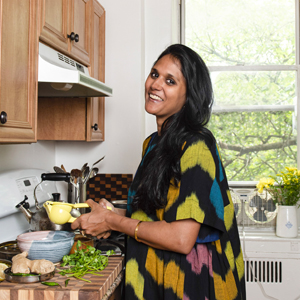
[00:03:43] Ray Latif: You know, it's funny. I was reading an article about you and there was an accompanying photo that showed you preparing food in this tiny galley kitchen. I was wondering, was that your Brooklyn apartment?
[00:03:56] Chitra Agrawal: Yes, yeah. Oh my goodness. Well, galley kitchen. I know. I remember. I mean, I've always I always had small kitchens in Brooklyn too. And we I also tested a cookbook over three years and we didn't have a dishwasher. That was probably I've never washed so many dishes before.
[00:04:17] Ray Latif: And it's tough to because like if you have a small sink, you have lots of like pots and pans. That's like the worst. What do you do with all that stuff?
[00:04:25] Chitra Agrawal: It was the worst, and I now have a dishwasher, which is huge. I step up, but I never have enough counter space. No matter how big the kitchen is, I never have enough counter space.
[00:04:39] Ray Latif: It's the little things in life, right? Now I have a dishwasher. Hopefully they have a better oven. I think the one I saw was like this white electric oven that had like the coils, right?
[00:04:50] Chitra Agrawal: Yes, yes, definitely upgraded.
[00:04:53] Ray Latif: Nice, outstanding. Let's talk a bit about Brooklyn and Daly. You guys sell a variety of condiments and Simmer Sauce, but your flagship product is something called achar. For folks who are not familiar with this product, what is achar?
[00:05:11] Chitra Agrawal: So achar in Hindi means pickled or preserved. So it's a pickled condiment. It's actually made all over South Asia and it's really a staple. So you would find it on the table at every South Asian home at almost every meal. And it is, if I were to describe the flavor, is really intense. So you and sour all at once. Um bit usually to whatever yo
[00:05:49] Ray Latif: Yeah, I would say so. It's a really delicious condiment. And you guys make the best one that I've had. And we'll get to some controversy in a moment. But, you know, I want to get to this idea of, you know, a vision for achar as being a pantry staple in America. You said it was a pantry staple in other parts of the world. I mean, did you see it as being something that could be in, you know, fridges across the United States?
[00:06:14] Chitra Agrawal: Yeah, I definitely did because I mean, the flavors are, I mean, I've been obsessed with these flavors since I was young. And the one thing though is that when you find an achar, an Indian pickle in stores, it's really, really salty. And it has, a lot of times there's a lot of preservatives, but I grew up eating homemade achar, and those types of varieties are a lot different than what you find in the stores. And so when I kind of was missing those flavors and realizing I couldn't really find them anywhere, because I usually would bring back a lot of achars from family members, I decided to just make my own. And Um, what I ended up doing is that the recipes that I developed were really had the essence of what an achar is, but ours have about 75% less sodium than what you find, um, on store shelves, like in, in an Indian shop. And you can take that flavor and like use it in so many different ways. And that's, I think it's very particular to our achars where, I would be kind of smearing it on a sandwich or like putting it with eggs or, you know, in a different context than just in an Indian meal.
[00:07:32] Ray Latif: Well, there's certainly an education component to getting people to understand how to use it and why it is a very versatile ingredient or condiment. And I think more and more people are finding out about its usefulness in everyday cooking, so much so that you're starting to see it in grocery stores across the country. You're also seeing it in one very big specialty retail chain called Trader Joe's. They recently launched their own private label, Achar. And as I mentioned, there's been some controversy around it. It feels like it's kind of a frustrating product for you, reading some of the comments that I've read.
[00:08:10] Chitra Agrawal: Yeah, it definitely was an experience. You know, we had been contacted by Trader Joe's and they had kind of contacted us to say that they felt like we had some interesting products and so we started a conversation with them and We went down pretty far and they were interested in a couple of our products and, you know, the conversation kind of progress, but then came to a standstill and I just remember reaching out and just saying, you know, just following up what's going on and. I was told that they were going to be launching another Indian product. And they really love the flavor of the product that they were looking at of ours, but they're going to kind of have to circle back on that. And I felt that, you know, being in this business, you definitely get a lot of no's along the way. And I didn't really think anything of it. But then I started to get some DMs and messages from customers, kind of excited, asking, oh, are you now selling your garlic achar at Trader Joe's? And some of them had sent me photos of what it looked like. And it was startling to me a little bit because the label kind of looked like Curry Simmer Sauce, and they also spelled achar with two A's. which is kind of, we decided to go out with achar spelled like that because it's phonetic. And we knew that a lot of people that didn't know what achar was wouldn't know how to pronounce it. But usually when you go to an Indian store, you'll see it just called pickle or spelled with one A possibly. And then the other piece is that I had developed a roasted garlic char. And I grew up in Jersey. I love roasted garlic. And so that was kind of my innovation because I grew up eating garlic, achar, but it was pickled garlic that was crunchy, actually. So, ours is a little bit different in that. the garlic is roasted. So that was another thing, because in the ingredient deck, there was roasted garlic in their version, except there was also water. So it was like a watered-down version of our achar. Usually, you know, yeah, we don't use any water in our garlic achar. It's really, really concentrated garlic flavor. And so, yeah, so that was kind of, I mean, it was disappointing at least because, you know, a lot of the customers also that had tried it. They were basically saying like it doesn't taste like you're achar, and it doesn't taste good. And I think, you know, we worked so hard over the years to educate people on what achar is and how, you know, how it should Taste Radio how you use it. So it was really disappointing to kind of see that this version was not really being true to, you know, what in achar is.
[00:11:20] Ray Latif: Well, if there's anything that was good that came out of it, it was that there's a lot of coverage about how it was not yours. It was not Brooklyn Delhi's achar. I think there was at least a dozen articles that I saw about it. So hopefully people are getting the message that they are not one in the same.
[00:11:37] Chitra Agrawal: I know, I know that was the main reason I feel like that I even said anything was that there was so much consumer confusion that I definitely didn't want people to think that, you know, we put out that watered down version of achart.
[00:11:52] Ray Latif: Well, back in 2014, I don't think many people knew what achar was at all. I think there's probably household penetration is probably a little bit higher than what it was eight years ago. But achar was still something new, unless people were reading your blog. You had a very popular blog called the ABCDs of cooking. Is that right?
[00:12:11] Chitra Agrawal: Yes.
[00:12:12] Ray Latif: Yeah, great name. Popular blog, like I mentioned. How much did having a built-in audience help with the launch of Brooklyn Delhi, which was born out of the blog?
[00:12:24] Chitra Agrawal: Right. I mean, it definitely helped us because our first customers were people that read the blog and that's how we launched the product. It was to those readers and through our followers on social media. So I think that it helped us a great deal. But the other piece was that when I was blogging, I was also doing a lot of events in Brooklyn. So I was serving food at markets and I was hosting pop-up dinners. And I had already gotten the attention of a lot of food writers. So when I came out with the achar, they wanted to know more about it. And those were our first pieces of press were people that had already covered me before. And I didn't really do any press outreach. We just did an announcement on an email and then stuff just started to happen. And I think that it definitely gave us a leg up though.
[00:13:20] Ray Latif: When you say consumers started to know more about the brand and the products, were they finding it in retail stores or were you selling just direct to consumer at that point? I mean, I guess, did the blog and its popularity help in finding retailers and connecting with retail buyers?
[00:13:38] Chitra Agrawal: I think that the retail buyer part came about after we started to sell at markets. We weren't selling at any retailers to begin with. We were selling at the Brooklyn Flea and you know, all these different New York City markets. And that was where press, again, started to kind of really pick up on what was achar, what was going on here. And that got the attention of a lot of retail buyers. And so a lot of our first stores came to us because they may have read about us on Sovereign or seen an article on Bon Appetit. And so that's how, like, the store owners started to kind of, like, you know, know what Brooklyn Delhi was about.
[00:14:24] Ray Latif: Now, early on, there was some interest locally in New York City, but again, it still took a long time for many people to know what achar was and again, how to use it. The last time we spoke, you talked about how patience is so important in this business, but patience is tough for entrepreneurs. How did you stay patient? And I guess, what does patience mean to you as an entrepreneur?
[00:14:50] Chitra Agrawal: I think that for us, I mean, I believe in this company so much and I believe in really expanding this conversation around Indian cuisine and achar is part of that. I want people to go beyond what they think of as Indian food is what you find in restaurants and achar is such this staple of South Asian cuisine. And I feel like there is a lot of value in it. So I was willing to just stick it out and figure out how we can get it out to as many people as possible. I mean, when I was demoing at stores in the beginning, it was just that when people tried it, then it would sell right off the shelf. But it was a matter of trying to reach more and more people. And I knew that that was going to take time or we were going to have to figure out how to sample to as many people as we could.
[00:15:51] Brooklyn Delhi: Guessing your margins? That's risky. Belay Financial gives CPG brands the clarity to scale smarter, faster, stronger. Get your free inventory e-book by texting TASTE to 55123 and start making data work for you. Vibrant Ingredients is the natural ingredient partner powering food and beverage innovation, delivering flavor, function, and protection through a science-backed portfolio. Vibrant delivers purpose-driven solutions that help brands create extraordinary experiences. Discover what's possible with Vibrant today. Visit vibrantingredients.com.
[00:16:38] Ray Latif: How much of your personal story was a gateway to people learning about the brand and the products? So how much of the brand was about you and your story early on?
[00:16:50] Chitra Agrawal: I think that Brooklyn Delhi, in every sense of the word, is a reflection of my identity. It really kind of is this cultural bridge. That's how I see it, basically. And it's a reflection of Indian American identity. um, I think that you know a lot of times um products kind of in the international aisle get um, I guess I guess you get sucked up into the conversation around authenticity, right and um, I think that with Brooklyn Delhi, I wanted to make a statement that um, there is value um, and um to this perspective and that The products are authentic to me and the way that I kind of thought about recipe development on the blog really kind of bleeds into how we educate people on the products at Brooklyn Delhi. So a lot of my recipes are very much rooted in Indian culinary traditions. but they take inspiration from different cuisines from around the world. I remember just to educate people at first for Brooklyn Delhi, we came up with these recipe cards. I was really into making shakshuka, but making it with the tomato achar. That became one of our first recipe cards that we gave to customers as a way to make like this shakshuka that was infused with the flavor of the tomato achar. And that's where I really, that's my passion to come up with these types of recipes that are this kind of like mashup basically of culture.
[00:18:34] Ray Latif: I would love to try some shakshuka or make shakshuka with your char. That sounds incredible. I'm going to go do that right after we're done with this interview. Last time we spoke, you shared with me something that was, I wasn't expecting. And then, you know, you have this beautiful vision and such a passion for Indian cuisine and bringing something new and interesting and flavorful to American plates and dinner tables. But you told me that you didn't get into this business to make money. Did you feel like your passion would eventually lead to a business that could be profitable and sustainable? I mean, was the passion very much like, let's stay focused on this and the money will come later?
[00:19:17] Chitra Agrawal: I think so. I mean, for me, it was that with anything, I feel like that I've done a Brooklyn gallery even before in food. It's that I've just kind of followed this path that felt natural to me. And, and I think also going with my gut and it has led to places that I never really imagined. I mean, even starting that blog. I mean, if anybody were to tell me that I would be running a food CPG company, I would just laugh in their face, basically. So I think with Brooklyn Delhi, it's the same thing where I wake up and I can't believe that I get to run a business that is fueled by my passion and the fact that I can actually pay myself and live comfortably. With this business, it's like anything above that is a bonus for me. I just am so happy to run this business.
[00:20:17] Ray Latif: You didn't pay yourself for a long time, though. The first four years, you didn't pay yourself a salary. How did that work out? And how did you fund the business early on?
[00:20:27] Chitra Agrawal: So at the same time that I started Brooklyn Delhi, I also had gotten a cookbook deal. And so I had used the advance also to help support myself and the business, but I also was working freelance in marketing. So I, I guess, you know, for me, I just wanted to be able to get the business on the ground to show that it was viable. Before I thought about even, you know, getting outside funding in a sense I wanted to show that this business could stand on its own. Um, and, uh, we, it was a long four years. I mean, it's like, um, having to balance, um, figuring out how to even make this product, put it on the shelf and everything that goes along with it. Um, but also writing a cookbook and, um all managing a freelance um job, but uh, we we made it through and I definitely I mean I I say this it's like I basically ate a lot of beads and lentils during that time period and I did not buy Clothes for those whole four like new clothes for the four years, but I didn't care because I loved what I was doing um, and it's weird because this mental shift happened I felt like when I started Brooklyn Delhi because I was working a regular day job where Um, you know, I would look forward to the weekends and you know going shopping and and doing all these things that were very much um, you know, uh material Materially focused and a lot of that stuff kind of didn't interest me as much when I found what I was doing at Brooklyn Delhi
[00:22:12] Ray Latif: When did you feel like you could quit your quote unquote day job and really focus on Brooklyn Delhi and also pay yourself a salary?
[00:22:22] Chitra Agrawal: I mean, that was basically it. I felt like once I could, we could run the business and I could pay myself, at that point, that was when I just, I quit everything else.
[00:22:37] Ray Latif: It certainly helps when you have a big partner on your side, and I'm talking about Whole Foods. This is an amazing story, and one that in so many ways saved the business. Correct me if I'm wrong. I'd read that three years in, there was some talk about just shutting it down, but there was a bit of a lucky break, so to speak. Can you talk about that story and how you saw it through?
[00:23:03] Chitra Agrawal: Yeah, I mean, yeah, so we were at a crossroads, I feel like, at that point. And I remember having a conversation with Ben, who is my husband and co founder. And, you know, really serious conversation about, you know, is this viable? We were accepting our first kid and, and It was just that we were not profitable at that point. We had these two trade shows that we had planned for, and the plan was that we were going to go to those two trade shows, and that was going to be the last effort to see if we could get some leads there that would lead to the growth of the company. And so we ended up going to the Fancy Food Show in San Francisco and met the global buyer at Whole Foods there. And at the time, we had just started selling to a lot of the local Whole Foods around us and we were a featured local vendor. We were just selling the achars and she was interested in the achars. But knowing what we knew that um when we had the um the achars on the shelf um they kind of just sat there because a lot of people didn't know what achar was so i would have to go into the stores to demo in order for it to start moving but i knew that if we took those two products and put them into 500 Whole Foods that it was going to be a whole different story and not having outside funding you need a lot of support or budget in order to demo in each of those stores. So, and before we had gone to the, to the trade show Ben and I had come up with a bunch of different ideas to to pitch. In addition to the HRS, and one of them was. this Curry Ketchup idea. So at home, we would take ketchup and mix it with a tomato jar, and we loved eating it with eggs. And so Ben kind of designed this, this Curry Ketchup bottle package. And I remember we laminated, we laminated these, these different ideas. So when we were talking to the buyer, she was interested in DHRs, but we kind of said, you know, we don't have the funding maybe to support worth that type of a launch, but we have these other ideas. And so she really hit on the Curry Ketchup idea as well. And she was like, you know, I'd love to try this. And we're like, Okay, and she's like, Can you send it to me? You know, this week or so and we were In San Francisco, we definitely don't have the Curry Ketchup sample made. So that day, we ran back to our Airbnb, and we made homemade ketchup. We mixed it with a tomato char. And I just remember my parents were there, my brother, my nephew. And we were just taste testing all of these different versions. And we came out with one of them, and we overnighted it to our And we got a phone call from her the next day saying that she loved it and that everybody on the team loved it and they wanted to take it national. And then though she was like, and can you develop a Curry Mustard for us too. I was like, sure.
[00:26:24] Ray Latif: Incredible, incredible story. Now trade show season is upon us. We have a few more coming up this fall, including Expo East. And I think there are some folks listening who are like, well, what did you do at your booth? Was there something specific? that, you know, help that Whole Foods buyer to spot you and want to try your products and develop a rapport and a relationship with you. Because, you know, you went to this show looking for exactly that. Was there something about your approach, be it the booth or how you connected with the, with the buyer that you felt like made a difference?
[00:27:04] Chitra Agrawal: I wonder, I mean, we were in the Brooklyn aisle. I feel like that kind of was a draw because it was just known for an aisle of very innovative food artisans. So we had a lot of buyers coming through there. In addition, I mean, my husband is a designer, a food packaging designer, so he designed our booth. So, I mean, definitely have an eye-catching, booth will take you far. But you don't have to really invest that much. I mean, you don't have to do like a build out or anything. We just had a cloth banner behind us, but it was really striking. And then just before the show, also reaching out to as many contacts as you can. just to tell them where you are, your booth number. And that's kind of what we did. We just got, I mean, I feel like we got lucky maybe, because she was walking down that aisle. And also staying in front of your booth. I feel like if you're behind your booth, it's a little bit more passive, but kind of getting in front and in the aisle, I feel like there's definitely something to that.
[00:28:18] Ray Latif: That's really good advice. And thank you for sharing that. Just one more question. In terms of how you manage that relationship, in terms of how you, you know, discussed this opportunity to not, you know, sell your chars and 500 Whole Foods, but gave her another option, you know, that made a little bit more sense for the company. I guess, what was that approach like or talk about the approach that you had to convincing her and helping her see your vision for the brand and its future in the retailer?
[00:28:50] Chitra Agrawal: I think that when you're building a relationship with a buyer, I do think they appreciate it for you to give them as much information as possible because, I mean, there's just, they're dealing with so many factors, right? But to get intel from a brand, I think is very valuable for them. So in that sense, it becomes this partnership where they may share information with you as to maybe they're looking for a certain type of product or you're kind of telling them, well, this is what we have been seeing in the marketplace. And so I think that they respect also you saying no. when it may not make sense. And so I think that that's probably was a factor in how well we were able to grow that relationship. There was a lot of trust between both parties that we were looking out for each other and wanting to make sure that it was successful on both ends.
[00:29:55] Ray Latif: Entrepreneurs often have an idea of where their products should be sold in the store. Merchandising is such an important part of the CPG business, any CPG business. When it came to the ketchups and mustards, were they merchandised next to traditional products or were they in the ethnic aisle? And, you know, depending on where they were, did you have a sense of where best they would be placed and sold?
[00:30:24] Chitra Agrawal: Yeah, so that was definitely also a discussion with the buyer and we ended up putting the Curry Ketchup and the Curry Mustard into the condiments aisle. The reason was is the rationale we thought is that a consumer goes in looking for ketchup Curry Mustard, right? And so they're in that aisle already. So they would see our different offering and say like, oh, maybe I'd like to try that. But then say it's a consumer going into the international aisle. And I mean, I know for myself, I'm not going to that aisle to look for ketchup Curry Mustard. So I feel like it would almost be like this weird, confusing experience to have like a Curry Mustard in that aisle. So that's kind of how we kind of thought about it.
[00:31:12] Ray Latif: Another really big partnership that Brooklyn and Delhi landed was with Blue Apron, which is a pretty interesting partnership. Can you talk about the origins of that relationship?
[00:31:24] Chitra Agrawal: Yeah, so I actually used to teach cooking classes at Brooklyn Kitchen and one of the people that worked there at the time became a culinary person at Blue Apron and she had really always kind of loved the achars and when she got to the new post at Blue Apron She had seen that there was definitely something that we could probably work on together. And I think that this was kind of interesting for us because, you know, we were always struggling with how do we get more people to try the HR and understand what it is, and Blue Apron really was. the perfect partner for that because they were not only getting, you know, millions of people to try the achar, to taste it, but they were also teaching people, how do you use it? And so it was a perfect type of partnership there. And so we worked with them and we got our achars into these 1.5 ounce cups. And now they have reached, I mean, millions of homes basically through through Blue Apron. And yeah, definitely helped us. And it also helps us on the retail side, because we are now sampling to all these Blue Apron customers who then are looking for us in retail. So they may go to Whole Foods then and buy the jar. And so we've definitely seen a lot of crossover from that relationship.
[00:32:50] Ray Latif: Was the HR branded? Was there like a sticker or their branded cups inside that Blue Apron box?
[00:32:56] Chitra Agrawal: Yeah, the cups are branded for Brooklyn Delhi.
[00:33:00] Ray Latif: How do you negotiate that? Because that's that's pretty amazing.
[00:33:03] Chitra Agrawal: I, we, we just, I think the other, the piece of that is that we were the only ones producing this tomato achar. And it may have kind of been weird if it was just like private label tomato achar in a sense. And so I think it made sense for us to have our brand name there because in a way, achar and Brooklyn Delhi kind of, we go together.
[00:33:32] Ray Latif: Yeah, it's interesting you say that because it's almost like you want to make achar or at least package the char synonymous with the Brooklyn Delhi brand to the point where people don't even say, oh, I'm going to buy some char. You say, I'm going to buy some Brooklyn Delhi. I mean, I think that's the best case scenario for most brands, I think. You know, one more thing on the Blue Apron deal. You're selling your product and millions of people are able to try it. Just from an exposure standpoint, that sounds pretty amazing. From a revenue standpoint, did it move the needle or was it, again, mostly about exposure?
[00:34:09] Chitra Agrawal: It's, it's a profitable revenue stream for us. But, of course, the margins are, you know, not as high as they are when we sell to distributors but it's still a profitable. I guess channel and I think that it makes sense that it may be kind of lower because I also see it as this hybrid of revenue as well as marketing in a sense. And that was the other piece that we kind of realized too is that with Blue Apron customers and kind of where Brooklyn Delhi even came from, we always had this audience of people that wanted to discover something new, and achar really fit well into it. And I think people order Blue Apron because they want to learn something and they want to. to discover something new. But achar in the supermarket context at the time, in a sense was really different because as a consumer, you go into the grocery store and a lot of times you may have tunnel vision, right? So it's like, you kind of know what you want to get and seeing something on the shelf that doesn't really look that familiar. A lot of times, I know, I have a list. I know what I get at the store every week. I rarely deviate from that unless I may have tried it somewhere else or I've heard about it. So that's kind of what we understood as what was going on with the char at the time. But hopefully now people have sampled it and, you know, will take a chance on it in the store too.
[00:35:49] Whole Foods: Yeah. Do you want more repeat buyers on Amazon? Well, this free resource in collaboration with Straight Up Growth will help your brand turn first-time buyers into long-term subscribers. Download Winning the Repeat Purchase Game on Amazon now at Taste Radio slash SUG. That's Taste Radio slash S-U-G to start building retention-driven growth for your brand on Amazon. Scaling a beverage brand into major retail comes down to operational readiness. From packaging lead times to co-manufacturing strategy, the details can make or break a launch. In a new ebook in collaboration with Octopi and Asahi Beer USA, industry leaders share what they've learned in helping brands scale. Download it now at Taste Radio slash octopi.
[00:36:40] Ray Latif: You mentioned profitability with Blue Apron, and it's so great to hear that that's a profitable revenue stream for the brand. And profitability, you told me, has been such a key focus for Brooklyn Delhi for, well, I guess since the beginning. This is going to be a very strange question to ask, but why is profitability so important to you?
[00:37:02] Chitra Agrawal: Well, we always built this business to stand on its own. I'd say so, I didn't wanna rely on outside money in that sense, because we could always get money for the right valuation, but I never really wanted to be in the position where we needed money to survive. And I think also it's that, Like I have a lot of friends in food and I have seen, you know, a lot of businesses grow extremely rapidly and then fold. And so I, because of that, I have been cautious and that's why I wanted to, at least from the beginning, really maintain as much as I could of my own autonomy in running this business.
[00:37:53] Ray Latif: Still no outside investors, right?
[00:37:55] Chitra Agrawal: No outside investors, no.
[00:37:57] Ray Latif: That is amazing. How have you managed the growth that you've had over the past eight years with no outside funding?
[00:38:06] Chitra Agrawal: Well, I think it has a lot to do with planning. So we're definitely still a small batch company in that I'm not doing huge runs, because we can't really support that from a financial point of view. So there, there's definitely a lot of timing, that that we're aware of as far as cash flow goes. And, you know, it's a lot more work to do. But at the end of the day, you know, I own it all. And I am kind of dictating how fast this business grows. The other piece about retailers too, we have made a conscious effort to not go too wide, but to be very specific about the retailers that we are targeting, and then to really drill down once we get into those retailers to help support the business instead of going wide. Because when you go wide in grocery, there's a lot of other expenses that go with it, which you know, there's free fills and then there's added promotions. So I think for us, we've been concentrating on the retailers we're in and making sure we win there.
[00:39:20] Ray Latif: What's been the impact of being this sort of omnichannel brand and that you do have, you know, a Blue Apron deal, you do have traditional retail with Whole Foods. I think you guys do food service as well. I mean, has that helped with sort of maintaining this consistent cash flow and revenue and hopefully profitability?
[00:39:41] Chitra Agrawal: Yeah, no, it's definitely I think that the diversification of our revenue streams has very much helped us because, I mean, depending so like for Blue Apron it's like we get that money cash to hand I know that I'm not going to get any more any chargebacks or there's no promotions that happened there. as well as the business that we have online. So all of our direct-to-consumer sales, that's all cash in our pocket. So all of these channels or the different ways that we think about kind of going about our sales strategy definitely has helped us as far as cash flow goes.
[00:40:22] Ray Latif: When it comes to direct-to-consumer, I think there have been some concerns over the past year. I mean, certainly COVID and the pandemic got a lot of people excited about direct-to-consumer, a lot of people in the CPG industry, but now it feels like there's a lot more people that look at traditional retail brick and mortar as the bigger opportunity. That being said, I feel like for your business, it's a great way to connect with customers. You already have a foundation, a strong foundation there. How much deeper do you go with direct-to-consumer? Do you see it as something that can grow in tandem with everything else that you're doing?
[00:41:00] Chitra Agrawal: I think so. I mean, I think that our strategy for a direct-to-consumer though is going to be a little bit going forward is gonna be different from what we offer in store. And I think that for us, the differentiation is probably gonna be an important factor. We're actually kind of doing a lot of work on that now. So we have a lot to announce, but I think that It's tough because as you said, there's a lot of hidden charges when it comes to direct-to-consumer. There's the warehousing, the shipping, and for us, it's actually cheaper on the shelf because we're just selling to a distributor that is doing it at scale. Our products end up lower on the shelf at a retail store than they would on our website. But it's really kind of those super Brooklyn Delhi fans that want to have the Brooklyn Delhi experience, basically, when they're getting products from us directly.
[00:42:13] Ray Latif: As you continue to grow online, in-store, food service, production needs are increased. And early on, Brooklyn Delhi, I think you told me that it was all self-production for some time, which I'm sure was a lot of fun. But managing your relationships with co-packers is also a key part of the puzzle here. If you have a good relationship, it can be the most important part of your business. How have you navigated co-manufacturing and working with co-packers?
[00:42:50] Chitra Agrawal: Yeah, so yeah, so I did I hand-packed Brooklyn Delhi for the first four years of our business and it was not until we scaled up and got the Whole Foods and Blue Apron opportunities that we found a co-packer and I think that for me and I'm different from I'm sure a lot of other food business owners, but I felt like my strengths lie in the recipe development and other areas but not really in the running of a factory, in a sense. So, but where we kind of have a hybrid model here is that we actually still source all of our ingredients. I think that that piece is also because I'm a little bit of a control freak, but Brooklyn Delhi has always been focused on flavor. If I have a co-manufacturer, I need to have control over the ingredients that are going into our products. I don't think a lot of people realize this, but a lot of co-manufacturers will not allow their customers to source ingredients. And so for us, that's a key differentiator and something that we had to negotiate with the co-manufacturers that we use.
[00:44:09] Ray Latif: How do you negotiate something like that? Typically, co-mans have the upper hand when it comes to contracts. So, I mean, how do you get what you want out of that deal?
[00:44:20] Chitra Agrawal: I think that we, um, I mean, we definitely went through a lot of, uh, you know, research when it came to the co-packers and because we had that specific need, um, we were able to find, um, a co-packer that was aligned with us. Um, and I think also that we had POs in our hand at the time. It's kind of like, we have this business, we can give it to you, but these are kind of the non-negotiables for us.
[00:44:53] Ray Latif: So when you have leverage, that's the best way to go to a co-backer?
[00:44:59] Chitra Agrawal: I would say so. I'm a risk-averse person, so I definitely was waiting for a PO in order to hit the go button on the Go manufacturer. I feel like we come from a food artisan background in a sense, right? Because I was hand-making it and I'm from this Brooklyn food community that I feel like That's what I knew, really. And so for me, going to a co-manufacturer was kind of like this huge step. And being able to own that piece of sourcing made it a lot easier for me to make that step though.
[00:45:43] Ray Latif: Jethro, this has been such a great conversation. Thank you so much once again. I got to ask about something that has been challenging, I think, for some entrepreneurs, and surprisingly so, and that's the issue around certification, certifying your business as a woman-owned business or as a minority-owned business. But from what you've told me, it's a process.
[00:46:04] Chitra Agrawal: Right. Yeah, it's definitely a process. I had applied, if you like, through a New York agency for both. And I just remember not hearing back. And I was like, wait, I applied for that like a year ago. And then finally, through a friend, she had said, well, to fast track it, you have to, you know, pay another agency in order to get priority. I went that route and finally got our minority certification, but I'm still waiting on my women-owned business certification. We're in an appeal process right now. How is that possible?
[00:46:44] Ray Latif: What's going on here?
[00:46:45] Chitra Agrawal: I know, it is really, it's, I don't understand it. But yeah, so in any case, if you do see a business that is minority and woman owned certified, that means that they had to jump through a lot of hoops to get there.
[00:46:59] Ray Latif: Okay, well, let this be. the first foray, I'm sure there've been many at this point, but the opening salvo in a call to change however this process works, because it makes no sense. Why are you going through an appeal process? That doesn't make sense. I don't get it.
[00:47:18] Chitra Agrawal: No, it doesn't make any sense. It really doesn't. You know, because our business is, it's part owned by myself and my husband, but I'm a majority owner. And so that's kind of what is tripping them up.
[00:47:33] Ray Latif: Okay.
[00:47:35] Chitra Agrawal: But yeah, it's it's definitely has been an experience.
[00:47:41] Ray Latif: Well, it's been a great experience, an amazing experience sitting down with you, Chistora. Thank you so much for taking the time. It's so exciting, you know, to hear about entrepreneurship and, you know, bootstrapping the brand and and doing all the things that you need to do to get where you are today. And I could feel throughout the conversation that there was so much energy and excitement about what you've accomplished and what you will continue to do with Brooklyn Delhi. It's just awesome. So thank you so much for sharing your story with us and our audience.
[00:48:15] Chitra Agrawal: Thanks for having me, Ray.
[00:48:20] Ray Latif: That brings us to the end of this episode of Taste Radio. Thank you so much for listening. And thanks to our guest, Chitra Agrawal. As always, for questions, comments, ideas for future podcasts, please send us an email to askatasteradio.com. On behalf of the entire Taste Radio team, thank you for listening, and we'll talk to you next time.