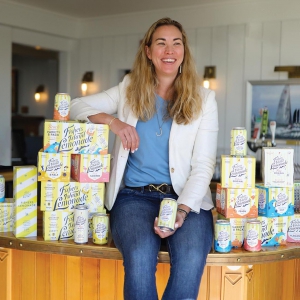
[00:00:10] Ray Latif: Hey folks, I'm Ray Latif and you're listening to the number one podcast for the food and beverage industry, Taste Radio. This episode features an interview with Bronya Shillo, the founder of pioneering canned cocktail brand, Fisher's Island Lemonade. It's been nearly 10 years since Bronya Shillo launched Fisher's Island Lemonade, and despite selling her company to one of the largest beverage alcohol companies in the world, she's still on the grind, promoting her brand one customer at a time, and wouldn't want it any other way. Fisher's Island Lemonade markets premium canned cocktails made with a base of barrel-aged whiskey, vodka, lemon, and honey. Lauded for its unique taste profile and commitment to high-quality ingredients, the brand comes in several flavor varieties and is sold nationally at a suggested retail price of $15.99 for a four-pack of 12-ounce cans. In May, Spirit of Gallo, the spirit's arm of E&J Gallo Winery, announced that it would acquire Fisher's Island Lemonade for an undisclosed fee. In May press release, the company noted that the purchase in part reflected consumers, quote, trading up to spirit-based cocktails and demanding more full-flavored, higher ABV products. Brawner remains on the Fisher's Island board and serves as the brand's official spokesperson. In the following interview, Bronnie discusses the brand's origins, why quality of ingredients matters when meeting with retail buyers, how, after a variety of challenges, she aligned with the right manufacturing partners, why the adage inch-wide, mile-deep guided the brand's distribution strategy for years, and how she built and maintained a relationship with E&J Gallo's leadership. Hey, folks, it's Ray with Taste Radio right now. I'm honored to be sitting down with Bronya Shillo, who is the founder of Fisher's Island Lemonade. Bronya, great to see you.
[00:02:08] Bronya Shillo: Hey, Ray. Fantastic to be here. Thank you so much.
[00:02:10] Ray Latif: We've seen each other many times over the years. I recall you coming to our events more than a few times. Brewbound Live. Did you ever come to a BevNET Live as well?
[00:02:20] Bronya Shillo: I did. I think that's actually where I first met you and Jon Landis, maybe in Massachusetts, a couple of times in New York.
[00:02:27] Ray Latif: Yeah, yeah. It's been a long time coming to sit down with you and talk about the amazing things that you've been doing with your brand. Just congratulations on everything that you've achieved. There's just so many things, so many great things to talk about, but I got to ask about the name of Fisher's Island Lemonade and how often people butcher it. Cause I think when I first heard about your brand, I think I called it Fishers Island's lemonade or Fisher Lemonade or Island. So I'm assuming I'm not the only one.
[00:03:02] Bronya Shillo: There's definitely a few moments where people say, you know, Fisher's Island, Fishers Island, Fishers Island iced tea. That's what we're here for. We're here to tell people the true story and educate them on RTDs and how great they taste from Fisher's Island Lemonade's portfolio.
[00:03:20] Ray Latif: Well, obviously you have a long history and deep ties to Fishers Island. Where did the name come from?
[00:03:27] Bronya Shillo: So Fishers Island Lemonade was created on the actual island itself, which is right off the coast of Connecticut in Long Island Sound, but actually a part of New York state itself. So my family owned the only bar out there called the Pequod Inn, which has been around for over 100 years. And this was the house recipe, Fisher's Island Lemonade. So, you know, back when I was bartending well over a decade ago, this is pretty much how I got the idea behind the bar on a late night of saying, why don't I just can this? It's, you know, flowing so frequently and so fast and I can't keep up with it. I was into brewing beer and I was into other things culinary wise and really wanted to kind of tap into the beverage industry and fix a problem that I felt was needed.
[00:04:18] Ray Latif: Going from a family recipe that you can make in your kitchen to creating a packaged beverage brand is, it might be a little easy to start, but actually scaling your business is not the easiest thing to do. And I want to talk about that In May moment. But the cocktail itself, the Fisher's Island Lemonade Cocktail was beloved by the patrons of the Pequod Inn and also beloved by so many people who didn't even know it existed. The last time you and I spoke was during our very first, BevNET's first Cocktail Showdown competition, which featured a range of RTD cocktail brands all competing against each other for the crown of, well, Cocktail Showdown Champion. And one of our judges, the acclaimed Tony Aboganum, who's an OG mixologist and someone who's pretty well known and revered in the industry, was raving, raving about Fisher's Island Lemonade. He's like, where'd this come from? I can't believe I've never heard of this. It's just like, he just loved how well-crafted and beautiful the cocktail was and continues to be. What is it about the cocktail that makes it so special?
[00:05:34] Bronya Shillo: Well, situations like this when people who are very well versed in the industry and have quite a bit to back that up, it's always a wonderful compliment to get them to give that blue checkmark, if you will. But really, what it boils down to is real and premium ingredients. And that seems to be 1 of the things that really disrupted a bit of the industry was. You know, we were a can cocktail made by a bartender that came from a real place that already had pre existing customers that knew of the brand. and, you know, had shared this for generations. We really kind of just put it on the map, but also made it convenient and, you know, be able to sort of drink cocktails, you know, wherever you're enjoying your happy place is kind of our motto. So if you're out on the beach, you know, 4th of July, barbecues, out on the water fishing, or just, you know, going to a festival and you want something that's a little more premium than say like a flavored malt beverage or craft beer that may be a little bit heavy for, you know, your session ability of that experience. So, you know, using premium vodka and whiskey is, is what really just continues to tie us to the roots of the recipe itself and not altering that, but just continuing to deliver on you know, ingredients that you can pronounce and ingredients that you can identify and you really do see and taste in our mix with the whiskey coming through in the original quite prominently. I think that's where people definitely appreciate the fact that it's a canned cocktail that's very convenient and hopefully more available wherever people are these days.
[00:07:16] Ray Latif: Yeah. You know, the term canned cocktail wasn't, I don't even know if it was a term back when you started the company. And now obviously, you know, you can find a canned cocktail pretty much at any retailer, any major retailer across the country. But at the time it just wasn't a known thing. And you said earlier that, you know, you wanted to solve a problem. At the time, you know, did you think it was a problem that consumers were looking for? Or is it more specific to your ability to service, you know, your customers and the region or the local area where the Pequod Inn was located?
[00:07:56] Bronya Shillo: I think it starts, you know, initially behind the bar when you're trying to duplicate yourself when you're trying to become more efficient In May very seasonal place such as New England. And, you know, for my family's bar, we were only open roughly 14 weeks out of the year. So trying to capitalize on that, especially when you deal with weather as well. That was the thing that I was trying to do is pretty much duplicate myself and make it consistent. So if someone asked for a drink, it was always made the same way, or I wouldn't get pulled off the bar to go ahead and batch up more of it for a really busy weekend that you know, we had more people than expected. But additionally, I always was looking for, you know, reasons to probably improve on the product. But then also off island, you know, on the mainland, as we say, is, you know, just just trying to carry that memory with you wherever you're going. So if you know, you know, Benda Fishers, you couldn't get there, you could still get something that brought you back to that happy place. And then as sort of the food and the restaurant industry continue to evolve on sort of this farm to table type concept, it really started to sort of scratch an itch for me, which was, why can't we get this In May convenient form in our beverages? Why can't we get this type of quality when it comes down to cocktails? There was a beer craze, there was a seltzer craze, And I think we were certainly ahead of our times back in 2014 of launching canned cocktails. As you mentioned before, there was no category for it. There was no hashtags that people were trying to tag it towards, or sections and categories of write-ups, or even in Nielsen reporting, menus and stuff like that. It was always like, ciders and such. You never really had Canned cocktails or even dubbing sort of the category RTDs. So we continue to sort of push and educate and explain what we were and year by year continue to carve out this category that we all now know as canned cocktails or ready to drinks.
[00:10:06] Ray Latif: I once spoke with Charles Jolie, who is also an acclaimed mixologist. He's one of the founders of Craft House Cocktails. When he launched the company, he was talking about how he created the world's largest Moscow mule, and that he was batching hundreds and if not thousands of gallons of the cocktail at a time and bottling it. And again, going from a family recipe where you're measuring spirits in ounces to one where you're, again, using a vast quantity of liquid can sometimes dilute the flavor or quality of what you're doing. How did you get up to speed on how to mass produce the cocktail itself?
[00:10:54] Bronya Shillo: So that was definitely an interesting feat, you know, science experiment all in all in itself of, you know, trying to go from your back kitchen where a cocktail is traditionally served over ice. And for us, it was, it was batched usually like that day, that weekend. But when it came down to putting it In May can, nobody, nobody wanted to really get involved. It was like, oh, you're crazy. That's gonna be too expensive. How are you gonna, you know, put liquor In May can that combines too many regulations and too many industries that just hasn't really been done before. So, you know, we, we knew we wanted to work In May can, and I just felt like that that was the best vessel for it versus say glass, specifically coming from, you know, an island, you know, habitat and doing a lot of boating and traveling, you don't really want glass on a boat. Plus, there's a lot more real estate for being able to design and tell your story on a can. Cans were also getting hot again. So we're just trying to work together to basically put this idea into manufacturing. And when you mentioned scaling up, that certainly had its rounds of trying to get the flavor profile correct to try to source things on a larger level, which on some level, you can have better access to those ingredients and better pricing depending on what you're going for. I mean, I remember certainly throwing down large chunk of money in the early days, just trying to buy tractor trailer load of cans, making sure that we were investing in the right route to market and like shrink sleeves at the time, 10 years ago, weren't quite really as good as they are today. And I just felt that the lines on the can with a shrink sleeve that had a little bit of a bump or a wave in them wouldn't come through in our intention with the branding, with all the stripes that we have on our logo. But liquid wise, just trial, trial, trial and taste. I love being in the kitchen. That's something that, you know, I take a lot of pride in. And, you know, I think that comes through in our cocktail and staying patient. and believing in what you do. It was something that I constantly rooted myself in and it was hard for me to be patient. Specifically, my family can back me up on that. But knowing that this was something that I saw in our customers and felt that the industry hadn't quite really embarked on yet and continuing to focus on premium, premium, premium. And our story was something that I started to see the light bulb come off with our distributors and with the retailers and specifically at events. As soon as people tasted our product, it was just, it was lights out. People were lining up down the hallway, just trying to get a sip of what this new thing was. And honestly, lemonade is a category and what we are, you know, making for canned cocktails, lemonade based. It's a win-win. It's America. It's, you know, it's something that people grew up with. So it's a familiar palette. It's a familiar recipe that people can approach with confidence.
[00:14:02] Ray Latif: Yeah, that's a really good point. Sometimes when people hear about cocktails that they're not familiar with, they might be a little hesitant to try them or buy them or invest their money, spend their money on that type of product. But lemonade, as you mentioned, is ubiquitous. It is American. It is America, as you pointed out. It's just something that everyone knows. But the cocktail itself and what people know about its flavor and expectations on how it should taste was pretty specific to the Pequod Inn. When you were introducing it to others, I assume you wanted that experience and those expectations to remain the same. But when you're using, as you mentioned, premium ingredients, premium vodka, barrel aged whiskey, lemon and honey. There can be a pretty significant variation in flavor across those ingredients. You know, how did you find suppliers that could help you maintain consistency and Taste Radio quality across those ingredients?
[00:15:02] Bronya Shillo: I was pretty particular. I went and met everybody and that came down to, you know, a lot of in-person meetings, trying to be, you know, very particular and defined in what I was looking for. But I also had a base, you know, we were making this for generations. And, you know, for years, I had mixed and made this behind our bar. So I knew what I was looking for. I was just trying to basically source and put everything together, you know, with a budget in mind, too, was probably the hardest thing. But ultimately, the manufacturing process of putting, you know, our recipe In May can was also quite a large hurdle more so than sourcing. because you're putting basically the beer industry together with the liquor industry on a manufacturing level. And the TTB probably didn't have that come across their desk really before. And that was a lot of different rounds and revisions of explaining what we were from day one. So there's a handful of sort of threads you can pull on there with how did you stay consistent with sourcing and keeping things you know, true to the roots is really getting to know your vendors and getting to know your ingredient base and just staying true to what you believe in. I mean, there's a lot of times where people would say, hey, this is really great, but it would be more widely distributed if you went malt and a lot easier to make and less hurdles for you to get through. But I guess that's where my stubbornness paid off.
[00:16:35] Ray Latif: For sure. Although when you're starting out, you don't have a ton of leverage with your vendors. You don't have a ton of leeway with your suppliers. You can ask for a certain price, but they certainly don't have to meet that price. How do you negotiate when you are young? And by young, I mean a young brand and, you know, are looking for quality, but can't necessarily pay for it.
[00:17:02] Bronya Shillo: I'm scratching back 10 years thinking about how that all came together. You know, I felt that not sacrificing on quality was a big piece. So the investment that I made in things like our whiskey and supplying and finding the spirits and working with vendors to try to work on terms and tell them my story, they got behind it. There's a lot of people that were like, this is interesting. I want to work with you. I've never done something like this before. But it was it was pinching pennies for a long time. Yeah, I remember having to be turned away when one of our first deliveries was getting ready to be picked up. And I didn't have the funds to, you know, have that truck hit the road and that truck did not hit the road. So I had to go back to a bit of the drawing board and figure out how I was gonna make ends meet so that we could get enough money back into the bank and, you know, really working those terms with distributors and, you know, trying to sell in larger orders was kind of the name of the game and getting those distributors and those sales teams and those, you know, accounts in those territories to believe in it so that it would build up our capital so that we had more to work with. And I definitely attest that to some of the early distributors in the Connecticut market that got on board from day one. But one of the other things that came with that was the fact that we were already an operating place. So people knew of Fisher's Island Lemonade. It wasn't this brand new thing where you're coming out with a brand new name and trying to market something. It was There's something that was oh, my God, I can't believe you did this. This is this is gonna be amazing. So you already had built in liquor stores and restaurants and consumers asking for it and demanding it and other state borders. And that quickly really just propelled us forward, which I think. isn't always the case when you're starting out and you're building something from scratch and you're trying to scale it. So that's definitely a bit of an area of luck for us, but we knew that going into it. We knew that there was something that we didn't want to mess with, especially when it came down to the recipe. You want to stay consistent with what people already knew and had for years before it came In May can.
[00:19:23] Ray Latif: Did you have a sense of how you wanted to price the product and what margins you needed to be successful or at least break even?
[00:19:32] Bronya Shillo: Yeah, this was a fun story. I remember trying to learn the industry at the same time and say, okay, I need to make X in order to stay profitable and afloat and pay my bills. I need to make sure that the distributor has a certain percentage in the retailer and so on and so forth. But then back into a price that specifically, say a consumer is purchasing at a liquor store for a four-pack, that's not going to break the bank on that sort of trial. So I was like, all right, me, I'm not going to probably spend more than a $20 bill on something that's brand new for trial. roughly working within that price range. And we were never $20 a four pack. But I figured once you get up to the register, you're really not going to be appealing more than that. So we priced it at $15.99, a four pack. And roughly around $9 to $10 was a suggested price on premise because that's also what it was priced at our bar. And we wanted to make sure that that didn't fluctuate too much and everything stayed whole. Fun story is I remember when I first had to convince my mother, who was the manager of the Pequot, to buy my own product and have to pick a hit on the margins. She definitely was a pretty difficult gatekeeper and saying, well, why should I pay more for something that I can make myself? And I was like, well, this is part of a bigger situation of building a brand. And it's about fixing a problem of efficiency so your bartenders can go ahead and make something else and be available to wait on customers more so than just being pulled off and making something batch by batch. That was always a fun sort of family dinner conversation. And I think to this day, I have in our office, you know, the signed bill from our distributor that I signed for and delivered off the hand truck. And, you know, buying that wholesale is, you know, pretty, pretty fun memory. But ultimately, taxes too. Taxes came in real quick, real fast. You know, we didn't, we didn't know what to price it at. We thought we knew what to price it at, but then all of a sudden being taxed as a liquor item and not as a beer item, specifically being In May 12 ounce can, was a new hurdle for everybody who ever touched the product. From the state to the distributor to retailers having to understand why we were almost sometimes double the beer that they purchased. And that was a learning curve for everybody. There was definitely a turning point where I was like, We're either going to fold real quick or we're going to have to fight some of this legislation. So still a bit of both. We're trying to make sure that each state is understanding what RTDs and canned cocktails are so that it can be fairly available and on shelf for people to consume, just as if they were going to have, say, a double IPA or a canned wine.
[00:22:37] Ray Latif: Just going back to your mom and handing her the invoice to be a fly on the wall when you were like, mom, you owe me $4,000. And she's like, what? Whatever the cost of the invoice was, you know, getting customers to understand the value of what they're buying. can sometimes be the most challenging part of marketing a premium brand. Getting them to understand that a four pack at $16 is a much better use of their money and better way to spend their money than say, you know, a four pack or a six pack of beer, or going to a bar and buying, you know, a single cocktail. So what was that process? Cause as we know, and you know, despite the fact that you had great relationships with your distributors, we know that distributors don't sell your product.
[00:23:23] Bronya Shillo: Oh, yeah, that's quite the statement. You know, liquid to lips, as they say, is definitely a major tool. And I think everybody's toolbox in this industry, you got to taste it, you got to make sure that people understand what they're investing in what they're buying, whether it's a retailer, bar, or even customers themselves. I have tried to, you know, do as many festivals and, you know, just general liquor store tastings as possible, because We're not something like a leading lemonade out there that's a malt beverage. This is a much different taste on the palate. It's very clean. It's non-carbonated, which is something that's different than what's out there even a decade later. And we're also one of the only dual spirit-based RTDs still today. And that's a major thing that I think comes through when you first Taste Radio you have that, you know, hit your palate and really punch your thirst. So we try to do as many of the tastings as possible so people understand the quality that they're actually tasting with Fisher's Island lemonade specifically. And then after that, you know, we start to talk about the ABV. Fisher's Island Lemonade Original is 9%. So at 12 ounces, that almost drinks and can be, you know, served two drinks per can practically. It's very easily seen, too. You know, you grab a pint glass, pour that over ice, and you're still going to have like almost a quarter can left. So it's hard to, you know, push back when you can see and Taste Radio deliver on those things. And then when you compare that to what's being priced out on, say, a menu, you know, when you go out for maybe a margarita, you can pay 14, 15, 16 bucks these days for a margarita over rice. You don't have that little like, you know, side back of extra lemonade to sip on. So there's real value there when you start to look at all the comparables apples to apples. And then when you look at the sessionability of the product, you're like, wow, that's really smooth. That's 9%. That has all of that in there. So those seem to very much go a long way when we can kind of deliver on some of those bullet points. And then it's really fun to get into the story. It's nice to be able to talk about how this was developed and why I started this product. But those are things specifically that I try to hold for, you know, as sort of round two, but ultimately sort of discuss the facts first, because other things you just can't deny.
[00:25:57] Ray Latif: Now, I recall 10 years ago and many years even prior, the lemonade, the hard lemonade that was out there and most well-known as Mike's Hard Lemonade. And I'm sure there was some confusion among consumers and probably retailers and distributors as to whether Fishers Island was directly competing with or a similar kind of product to Mike's. How did you overcome that confusion? And, you know, what really resonated with all parties involved?
[00:26:25] Bronya Shillo: You know, surprisingly, that wasn't as big of a hurdle as one would have thought. Like I mentioned before, the tastings were just, you know, a huge component as to how we got, you know, fishers on the map. We were doing tastings at beer and wine festivals. I gotta be honest, I don't think I've ever seen mics at some of these festivals. So that was something where, you know, if we were doing a trade show, you'd be seeing new items. And Mike's has been around for a long time. And that was something that even side by side, it's a very different product. It's a different category with the base and then even some of the sweetness as well. And again, non-carbonated. So there's a couple of different features that are outside of the fact that it's just lemonade, lemonade, and it's got alcohol in it. When it also refers to You know the the cooler or where you're going to be merchandising Fishers Island eliminate we didn't want it next to my card lemonade because of six pack for 999 was something that you're not able to really explain to a customer. when you're not able to do tastings. So I remember at the time, spiked seltzers and honestly, double IPAs were still much the rage about a decade ago. And we wanted to be in the cooler set, cold, lemonade, purchase it as if you're going to go and consume it a couple hours later, going to the beach or going to the party. You don't want to buy it warm. And so getting in the cooler was really important, but making sure that we were in that cooler door where other people were shopping that would maybe trade and trial Fishers Island that was spike seltzer at the time. And so when people are building a cooler, and they're looking for those, you know, those refreshing products, we wanted to make sure we were there and. Thankfully, that's where a lot of the retailers also saw fit and distributors continued to follow suit and work with their teams to make sure that Fishers was merchandised correctly and that it was cold. I owe a lot of that to the beer distributorships in the early days who were definitely big proponents of merchandising those cooler sets.
[00:28:34] Ray Latif: Now, a lot of times beer, F&Bs, can cocktails, they are sold in the cooler case, but in the instances where they're not, it seems like an issue that beverage entrepreneurs have been facing forever. Whether you're a non-alcoholic brand or operate a non-alcoholic brand or an alcoholic beverage brand, everyone wants to be in the cooler. Everyone wants to be in the cold case. It's great for trial. But again, there's a limited amount of space in the cooler and convincing a retailer that you belong there is not an easy task. You know, what was your approach? What was your pitch to getting into the cold case?
[00:29:10] Bronya Shillo: I think it stems even more deeply than just convincing the retailer. I think it starts with the relationships. It starts with the relationships from the top down at the distributor level to, you know, tell your story, to sample them, get them to believe in your product. Because as you mentioned before, Especially when you're building a brand and you're selling that product probably by hand yourself for the first few years, which I did for the first six, and then continue to build a team out from there. I would sell in store by store by store. So if I had an event going on that I knew about a month in advance, I would work just that territory and just that zip code so that when people came out of that event, hopefully they were locals, they would go down the street. I could say these five liquor stores, Carrie Fisher's Island Limited, and I would do those tastings myself. By gaining the trust of those retailers, that's what got me access to those cold boxes. That's what also got me access to getting 10 case drops on the floor in time for tasting. So. Investing a lot of the time into the territory and building those relationships with retailers, I think was part of the success that got us to the to the cold box. But ultimately, we did not expand really past Connecticut, Massachusetts and Rhode Island for almost four or five years. So. trying to manage what we had in our backyard before you're biting off all those inquiries. And they're good inquiries, but as a one woman team, you had to make sure that you were managing those resources appropriately.
[00:30:48] Ray Latif: Even though you were in three states, I imagine you were on the road a lot.
[00:30:52] Bronya Shillo: I am still on the road a lot. I'm lucky if I see my bed two days a week.
[00:30:57] Ray Latif: Wow. Wow. I mean, how do you manage that? Is it just, you know, the belief in the brand, the belief that this can eventually become a success or, you know, was it just the fact that you couldn't afford anyone else to do these days things?
[00:31:09] Bronya Shillo: I think it's a little bit of both of those, you know, building something, being a part of something and having that belief definitely excites you and propels you forward. And I think personally too, when I get my mind on something, I just go and it's, it's something that, you know, I, I go a hundred percent and really like dive into. But again, going back to those relationships, I find that fun, you know, not everybody who, who does, you know, building a brand or gets involved with those things. I enjoyed wearing a lot of different hats. I enjoyed crunching the numbers and building those spreadsheets and looking at the recipes and talking to the manufacturers and the vendors and the marketing. It was definitely a lot, and it still at times is, but I don't get out of bed any morning and think, oh, geez, I wish I could be doing something else. It's an absolute dream to have the privilege to be working on something that you get to dream up. I've always enjoyed the beverage industry, having been born in the restaurant side of things. This was something that, you know, I pretty much took the approach of instead of going to business school and teach myself a little bit more about this industry. And wow, did I find quite the interesting one.
[00:32:22] Ray Latif: The beverage industry.
[00:32:24] Bronya Shillo: All sorts of tunnels and rabbit holes and challenges and TTV is certainly one of them.
[00:32:32] Ray Latif: Yeah, well, the TTV is a whole nother way. I'm sure we could do an entire podcast just on the TTV, but we'll set that aside for now. But it is amazing when you are living your dream and waking up every morning and saying, I'm doing the thing that I've always wanted to do. That is, you know, the most beautiful thing you can do in your career for your work life and probably for your personal life as well. So you were a one-woman team for a long time. Who was your first hire? What were you looking for in your first hire?
[00:33:02] Bronya Shillo: So technically it was actually, I was an intern. I had a fantastic internship experience when I was in college, really getting to kind of understand the nuts and bolts of, you know, a brand and a little bit of an industry. And I just, I remembered how awesome and hands-on that was. And I went back to my college and was asked to speak In May marketing class. And I learned a little bit about their internship program. And it kind of was, you know, match made in heaven. I was looking for some help. I was trying to understand, you know, the ways in which I can start delegating and getting some assistance. And, but I also was really interested in teaching people a little bit more about entrepreneurism. And, you know, that's something that was really near and dear to my heart from the beginning because I was, working as a teacher or a teacher's assistant at the Fishers Island School while I was getting my business started. And I just knew that I wanted to share this experience with others, whether it be our community or people just trying to get a start in working the business route. I think just hands-on experience is really the best way to go, and there's not enough of it in some of the school systems. So kind of opened up that channel pretty quickly, and we were off to the, the races with, again, tastings and continuing to share our story and work with distributor teams. So it just continued to build from there. And then usually from those events and tastings and festivals, people would reach out to me and say, hey, are you hiring? And that hasn't stopped.
[00:34:43] Ray Latif: You know, it's helpful when people want to come work for your company, that passion is really meaningful. But also hiring the right people who are experienced In May particular area of the business that you need help with is sometimes the hardest position to fill. But you also have to know where you need help and how to evaluate the person that you're hiring. Where was it that you needed the most help and how did you go about searching for the right fit?
[00:35:15] Bronya Shillo: I think the part that was most important kind of came back down to the roots of why I Decided to can our recipe was trying to be more efficient. You're trying to solve a problem behind the bar and duplicate yourself. So I needed to duplicate myself in the field. I needed to be able to reach more accounts. And as I met more people who were working for distributors or other suppliers, you share stories in the trade and you ask questions to each other about what they're doing and how they're doing it. And I definitely learned a lot on the ground building this brand and just continuing to ask questions and probe and not be afraid to admit where you don't know stuff and kind of put that olive branch out there to continue to learn. and build and be better, is where I leaned on those relationships to build a sales team. So that was really the first hire. And then from there, getting support with some of the marketing when it came down to these lovely platforms that were also brand new at the time in 2014, such as Instagram and more Facebook and you know, doing newsletters and continuing to get our word out there and reach our customers. And, you know, the base of the community of Fisher's Island, you know, that was a big key component of continuing to, you know, reach our consumers that already existed and wherever they lived full time, if it wasn't, you know, the summer season. So sales and marketing, really, really key. I had to learn a lot when it came down to distributor management and understanding all the facets that go into that relationship and supporting one another. But you're truly, at a small brand, you're really building that and maintaining that portfolio with a distributor a hell of a lot. So good people certainly help. I think it turns a little bit of a different tide when they're selling something that they're really passionate and they believe in. And that's one thing that I think we're really fortunate here with Fisher's Isle Lemonade is that it hits home a lot of people. They love the product. They like to drink it themselves. And so it's a natural sell. So that's one of the big things that we're really fortunate for is that it's a great product to get behind.
[00:37:42] Ray Latif: When did you introduce your first brand extension, your first new flavor? As far as I can tell, you have four or five flavors now?
[00:37:50] Bronya Shillo: In 2021, we actually went six years with Fisher's Island Original before we decided to innovate into any new flavor. And then our new flavors in 2021, which actually during COVID, we released was our Pink Flamingo, which is a pink cranberry lemonade. And then we did a half and half, so like an Arnold Palmer. And then we released Fisher's Island Fizz, which was our first carbonated product, but kind of like a little sister of the original, it's 5% sparkling. And then we also came out with a Spirit Popsicle, which is kind of like, you know, a hundred milliliter adult popsicle that you can put in the freezer and enjoy on a nice cool day or hot day, excuse me. Yeah, those were our first innovations all in one. So I had a bit of built up Rolodex.
[00:38:40] Ray Latif: A lot of times people will introduce a line extension or brand extension relatively close to the launch of their product. Why did it take six years or why did you want to wait so long to introduce that first new product?
[00:38:54] Bronya Shillo: So I'd say it was more of, we wanted to wait that long. There was all sorts of different things that we could have invested in. You know, you could have done more out of home. You could have built out, you know, your, your territory, your distribution. But I really felt that educating our consumers as to what Fisher's Island Lemonade really was as a can cocktail and the prices we were talking about earlier was something that Was near and dear to my heart because we just needed to continue to focus on. You know, the backyard base, and there is still always accounts that we could continue to sell into on premise and off premise chains a little bit in the northeast. So that's really what made me just rethink. having to really expand when I didn't feel like the brand needed it yet. And usually a lot of times I feel like brands expand and go into releases when they really have to. And for us, the have to was probably when it came down to the cooler set. We were starting to see more spiked seltzers, more of the malt-based seltzers, And they're a little bit cheaper price point wise and a little bit lower ABV. And so Fisher's one four pack wasn't just quite cutting it. And so, you know, we need to kind of throw some elbows out there and make sure that we continue to be fighting for that shelf space to stay for us as our TDs became a little bit more, you know, understood that also came with some competition. whether it was directly, you know, in the canned cocktail space or in the alternative space. So those cooler doors were continuing to grow, but our, you know, our sets weren't really more than one or two, four packs. And so we released those flavors on purpose, but we also created those flavors by listening to consumers, you know, at those tastings and at those festivals, because those are very approachable flavors. It's not as risky to go for an Arnold Palmer when you've probably tried to maybe already put some iced tea in your Fisher's Island lemonade and mix it and muddle it a little bit. So that was the strategy, is to make something that was approachable yet again for consumers to trial as they switched up the different flavor that they were reaching for, but still within the Fisher's Island family.
[00:41:19] Ray Latif: You know, what's interesting, Branya, is that I'm just looking at your cans here and I don't see the word Cocktail Showdown the front of your labels. It might be on the back. I just can't see it on your website right now. And I mentioned that because the term cocktail and canned cocktails, as we mentioned earlier, have become a much buzzier, trendier concept for the beverage industry and just consumers at large. When you're thinking about the trend and how people are perceiving this product versus the trend, you know, how do you think about adjusting your marketing or do you adjust your marketing to reflect that trend?
[00:41:59] Bronya Shillo: That's a great question. So what we actually did this past year is we went from a pack tech which is the clip on sort of exposed cans packaging. And we went to a wrap, which was like the soft cardboard that shows a little bit more of the entire brand, has a little more real estate for the messaging. That was something that we were also holding out on for a handful of years. mainly because we wanted to make sure that the transition from Fisher's original as a standalone four pack to a new family of different flavor options, including a variety pack, was Our 1st trial into getting into that paperboard and see if we could compete as a variety pack at that price point and consumers had the threshold to purchase that we had tons of demand for it, but we just weren't really sure again if that was. where we wanted to start investing in and lo and behold, that was our number two SKU. But that allowed us to tell more about the canned cocktail base and the story of the brand itself and what the ingredients are outside of just having to twist that can a lot or having to constantly taste people in the product. People very much share our brand, whether it's on social media or in the wild, it's definitely something that If you know, you know, sort of grassroots sort of conversation on our brand. And we're very thankful for that with the customers being the first adopters and continuing to spread the word to their friends and their family. So the marketing move to go to the four pack and the wrap pack was hands down coming very soon. And I'm glad we did it because we get to share a little bit more of a lot of the lifestyle components of the roots of the brand. you know, the activities that we very much enjoy when we're consuming Fisher's Island Lemonade.
[00:43:57] Ray Latif: Strategic companies, strategic beverage alcohol companies are looking closely at the canned cocktail, the RTD cocktail category and seeing its development. There are a number of brands that already have investment from strategics, whether it's been publicized or otherwise. And I mentioned all this because earlier this year, E&J Gallo Winery through their Spirit of Gallo arm acquired Fisher's Island Lemonade. And I would think that a large part of that has to do with, again, growing interest in this category. But you had a relationship, according to the press release that was put out there, you had a relationship with Britt West, who is, I believe, the general manager of Spirit of Gallo for a decade. How do you cultivate a relationship like that? And how do you maintain it such that, you know, when there is that opportunity for investment or a full out acquisition, that it is done In May way that, you know, suits the needs of your company and frankly, you know, gets you what you want.
[00:45:00] Bronya Shillo: Right place, right time, I guess. No, so you're right. The relationship with Brit West, who's the VP of spirits at EJ Gallo and is really the gentleman who reached out to me a few years ago, just kind of stoking the relationship and kind of checking in on what we were doing. Lo and behold, to me, I didn't realize he was tracking Fisher's Island Lemonade and you know, keeping an eye on the RTD category, but it makes a lot of sense when Nielsen numbers are showing Fisher's Island Lemonade right next to their number one RTD High Noon. So it made a lot of sense when you kind of go back and you look at it, but ultimately for me, the relationship we had was through mutual friends actually John Fischer's Island. And we met at a dinner party and we were probably two of the only people in the room that actually worked in the liquor space. And so we headed off and talked about shop and there's definitely comparing notes about what I was doing and starting out 10 years ago of trying to put liquor In May can. And ironically, here we are, you know, 10 years later and, and still, you know, continue to build a fantastic brand, uh, with the Gallo family.
[00:46:19] Ray Latif: Now, did they invest or were they investors prior to the acquisition or was it just a sort of good relationship that you had with Brit?
[00:46:26] Bronya Shillo: No, no one was really an investor in the brand before this year. It was really the relationship with Britt and the Spirit of Gallo and basically trying to figure out if this was something that I wanted to pursue with the brand and take it to the direction of working with a larger partner. The belief that I had is that Fisher's Island Lemonade is a real place and it's a community and I'm a real person behind the brand. As we talked a lot about relationships before, I felt like finding a home for Fisher's Island Lemonade to continue to build on its success was really important that they understood that sense of place and community. With Gallo as a family-owned brand and a lot of the same values lined up quite well compared to a lot of other options I guess they could have taken.
[00:47:15] Ray Latif: Well, it sounds like you didn't have to sell. I mean, the numbers you quoted are pretty amazing. If, you know, Fisher's Island Lemonade is getting pretty close to high noon in terms of sales, it sounds like maybe the brand would be valued even higher next year or the year after. So what made the timing right for you now?
[00:47:35] Bronya Shillo: I think the timing really came down to where we were in the relationship, Britt and I, as well as how RTDs have been tracking. And the boost from COVID was fantastic for everybody to understand a little bit more about RTDs and become educated on the availability of them. So for me, it was the right time. We had just gotten done with some R&D on our newest innovation with Blueberry Wave and Nude Peach and our second variety pack and continuing to expand our distribution footprint. And the benefits of Gallo's sales team are things that you definitely want to join forces with.
[00:48:21] Ray Latif: Well, Branya, this has been a long time coming. I recall meeting you again, you know, many years ago, and I'm sure me and some of the other folks on the team were like, this is a cool idea. How scalable is this idea? You know, remains to be seen. And what we've seen, it is quite scalable and quite amazing what you've built. Congratulations again on everything that you've done here. I know there's still a long runway for Fisher's Island and I'm excited to see where the brain goes from here.
[00:48:51] Bronya Shillo: Yes, thank you very much. We've got a definitely a long runway and many more states to bring Fisher's Isle lemonade to all of you thirsty drinkers.
[00:49:00] Ray Latif: And I got to ask you, please, the next time you're in Massachusetts doing a tasting, you got to come by the office and we got to toast to everything that you've accomplished and all of your success.
[00:49:11] Bronya Shillo: That sounds like a fantastic idea. We have a little reunion 10 years later.
[00:49:16] Ray Latif: I'd love it. I'd love it. Once again, Bronya, thank you so much.
[00:49:19] Bronya Shillo: Absolutely. Thanks, Fred.
[00:49:23] Ray Latif: That brings us to the end of this episode of Taste Radio. Thank you so much for listening. Taste Radio is a production of BevNET.com Incorporated. Our audio engineer for Taste Radio is Joe Kratchy, our technical director is Joshua Pratt, and our video editor is Ryan Galang. Our social marketing manager is Amanda Smerlinski, and our designer is Amanda Huang. Just a reminder, if you like what you hear on Taste Radio, please share the podcast with friends and colleagues. And of course, we would love it if you could review us on the Apple Podcasts app or your listening platform of choice. Check us out on Instagram. Our handle is bevnettasteradio. As always, for questions, comments, ideas for future podcasts, please send us an email to ask at Taste Radio. On behalf of the entire Taste Radio team, thank you for listening.
[00:50:12] Bronya Shillo: And we'll talk to you next time.