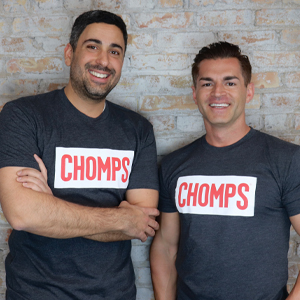
[00:00:10] Ray Latif: Hey folks, I'm Ray Latif and you're listening to the number one podcast for the food and beverage industry, Taste Radio. This episode features an interview with Pete Maldonado and Ali Ali, the co-founders of better for you meat snack brand, Chomps. And just a reminder to our loyal listeners, become a Taste Radio VIP. It's easy to do so. Just head to Taste Radio slash VIP. In 2012, Pete Maldonado and Ali Ali each invested $3,250 to launch Chomps, money they used for the brand's first production run. After bootstrapping the company for a decade, Pete and Rashid decided it was time to bring in a strategic partner, one that made a slightly larger investment in Chomps, $80 million in equity capital at a valuation north of $200 million. The fastest-growing natural meat snack brand in both the natural and conventional retail channels, Chomps markets meat snacks made from grass-fed and finished beef and venison and free-range turkey that contain no hormones, no antibiotics, and no added sugar. The products are Whole30 Certified Gluten-Free and Non Project Verified. The meat sticks are carried by several national grocery chains, including Trader Joe's, Walmart and Whole Foods. Chomp's growth has been remarkable, and yet very intentional. While not everything has gone according to plan, Pete and Rashid's emphasis on strong unit economics and profitability, and their ambition to thoughtfully and patiently develop a billion-dollar brand, have positioned Chomps to become a primetime player in the meat snack business. Hey folks, it's Ray with Taste Radio. Right now I'm in the press room at Expo West 2023. And sitting down with me are the founders of Chomps, Pete Maldonado and Ali Ali. Gentlemen, great to see you. Thanks for having us. That's Pete. Great to see you. That's Rashid Ali'm a bit winded because I ran from a team photo. about 10 minutes ago into the press room here. And I'm just so excited to be sitting down with you. Pete, I spoke with you about four years ago for Taste Radio, and a few things have happened with the brand since. You're on pace to generate nearly $200 million in sales this year. That's about 10X from 2018, essentially. Might be generous, but yeah. Okay, fair enough. It's not too far off. Not too far off. Again, this is not common. I know this is going to be kind of a broad question, but if you were to say there were three things, three things that got us to where we are now from four years ago, what would those three things be? Ooh, is it like one word each one? Or is it just like three things? Okay.
[00:02:59] Pete Maldonado: Yeah, you can say, yeah, it doesn't necessarily need to be one word. So I would say scrappiness, I think discipline and our team.
[00:03:09] Ray Latif: Okay, Rashid, would you agree?
[00:03:11] Rashid Ali: And the overarching theme is we have a great tasting product. I think you have to have that too. That's table stakes. But I think at the end of the day, the way we approach the company is really somewhat unique and different than some of the other folks in the space. And I think one of the key drivers is rooted in the fact that we never took outside money early, and we were forced to make decisions that would build a sustainable business, making sure we're on the shelves that we know the product would perform, and the customer's already kind of gravitating that. But I'd agree with Pete's points.
[00:03:40] Ray Latif: Scrappiness has been a hallmark of CHOMP's. Rasheed, as you mentioned, had not taken outside capital for a long time, and were very wary of taking outside capital. In fact, when I spoke with you, Pete, in 2018, I think the quote I have was extremely cautious. about accepting outside capital. However, in 2022, for she is chuckling, after 10 years of bootstrapping, you did accept some investment. And it's more than just some. It was an $80 million minority investment from Stride Consumer Partners. That's not a small amount of money. It's also something where I wonder if it was Always something in the back of your mind, you know, maybe this is going to happen and we just happen to find the right person, the right partner. But let me just ask you, you know, what really precipitated that decision and how did you decide who to take it from? Investment, that is.
[00:04:46] Pete Maldonado: First and foremost, it wasn't for the need of money. We've always had a profitable business. And so we didn't really need cash to continue building the business. This was more about aligning ourselves with people that are much smarter than ourselves and that have been there and done it. And so the way we're thinking about this is like, you know, Rasheed and I never had a CPG background prior to starting Chomps. Obviously, we've been doing it for 10 years now. We've learned a lot over the years. But we also realized that we built the business to, you know, where it is today in terms of scale, building a business from $1 to the first million to the 10 million to 100 million and then beyond. It's like these are huge milestones and they're completely like business looks completely different each time. The problem is right now is we have so much at stake. We have a lot to lose. We used to learn on the job and it was okay to do that back then. At this stage, if you're kind of making these big pivots, you know, and you make the wrong step, you can screw up and you can lose everything. And so in our minds, you know, we want to learn from someone else's scar tissue and you want somebody else to kind of take us by the hand and lead us through the process of building this business to the next stage of growth.
[00:05:53] Ray Latif: If I'm hearing you right, fear was a reason why the investment was an important thing to take, what capital was important to take.
[00:06:01] Pete Maldonado: So like going through COVID was a learning experience for Rashid Ali I. I mean, obviously, these are those are unprecedented times and all of that. But during, you know, 2020, we went through a really rocky time, like we almost lost the business. It got that bad. And so we realized then, like, maybe we should have had a financial partner all along that to help us kind of weather this, like this type of storm that we never could have foreseen, you know, but it's, but you know, when it was too late, that's when we kind of realized that. And so once we got through it, we decided, you know, we'll start gearing up and do something. So end of 2021, we were able to bring on stride.
[00:06:39] Rashid Ali: And I wouldn't I wouldn't use the word fear to describe it. I think at the end of the day, with significant and rapid scale, come significant or rabid risk. And I think Pete and Rashid actually strive in stressful, risky situations. I think that's when we do our best work and we have a great clarity of thought. But COVID just magnify the situation and brought different things into perspective where it was almost like, wow, like we could lose the business overnight. Like there's so many variables almost outside of our control, at least based on our skill set. And we're saying like, hey, if we had the right partners to help foresee some of these things, maybe we would be able to operate a little bit better. And We had both have families that are growing, right, which that again puts additional stress on us. And then our team, which is an extension of our family, was growing. And, you know, we never want to, you know, we're reading all these articles now about the tech companies that are pulling back and all these other things like that's something that Pete and Rashid never wanted to do, right? We wanted to build the team and continue to grow it. And we were always very disciplined around when we'd bring individuals in and we didn't want that situation where like, wow, we got to pull back. And that means kind of making that hard decision of pulling back the team. So I think there was a lot of factors that went into it. But I think both of us agree that we made the right decision and we timed it very well as well.
[00:07:54] Ray Latif: Pete, you had said that COVID had given way to some serious problems to the point where you thought you might lose the company. What were those problems? What were you so concerned about?
[00:08:06] Pete Maldonado: So if you remember, like early on, there was this kind of rapid, you know, increase in demand, right? Everybody's, you know, pulling every bit of product they can off the shelves. We saw that as well. We saw it on D2C, but we also saw that in retail. We had some, you know, big retail partners that wanted to gear up for that. So they were, you know, if they had set POs they would normally give to us, you can imagine they were two to three times the size and they were ordering out even further than they normally would. So we ended up with just, you know, millions and millions of dollars of POs and tons of product that we ended up producing, you know, and POs that we produced against, thinking that this was the right thing to do. And then, I think a lot of them made these decisions where they were going to start limiting the foot traffic in the store. So they started limiting it from doors wide open to, you know, whatever, 10 or 15 people in the store at a time. And then on top of it, they started putting up plexiglass at the front end, where you find it's at the front end in most retailers where we do all. And so overnight, sales just plummeted, like to basically, you know, about 90% or more of a decrease overnight.
[00:09:12] Ray Latif: Wow.
[00:09:13] Pete Maldonado: And so you got to imagine for us, like we had already produced for all of those retailers, but we produced for all of the other channels to be selling to. So we had no home for it. So yeah, it was, it was a nerve wracking time. But you know, I got to say like our team without our team, we would not be here right now. We actually would have lost everything. Our team is scrappy. And to that point, like they just figured out how to move the product and how to get through it. Also from like, uh, cash management standpoint, we were able to pull back on a lot of marketing spend and things that we just didn't absolutely need at the time. And that allowed us to get through.
[00:09:48] Ray Latif: Were you able to keep your team intact? Yeah. What was that like?
[00:09:53] Pete Maldonado: Listen, it was scary, but it was no layoffs. We didn't have to, uh, which was again, even with a 90% decline in revenue. Yeah.
[00:10:01] Rashid Ali: I would say, you know, we took a look at the team and I think we took an opportunity to clean up house a bit. So what I would say, like, I think there was some churn, but it was, it was needed. And I think it forced us to make the decisions we should have. But outside of that, there wasn't like, we're not going to make payroll. It was more like. We need to find the right people to make sure they're structured for the business going forward, not the now. So there was a little bit of churn, but it wasn't because of the financial situation. The working capital was like the biggest challenge we faced. If you think about it, all our cash was tied up in inventory. We weren't selling anymore. But, you know, we brought some really good folks in that, I mean, they were, it was cash was hand to mouth and they were monitoring like nothing and finding creative solutions to make sure that we can get through to when foot traffic increased again.
[00:10:43] Ray Latif: It's so interesting because when I think about 2020 and people stocking up, you know, food in their houses and all kinds of other, you know, household items, I would think that Chomps would be one of those products that people would quote unquote hoard. But then, you know, if it is something that's sold by the cash register, and that's typically where I find it at my local Trader Joe's, the brand that is, is it more of a grab and go item? I mean, is that one of the reasons why you experienced that decline in revenue?
[00:11:08] Pete Maldonado: Yeah, so historically, we've been an impulse item. Luckily for us, and a little bit prior to COVID even, we were positioning ourselves more as a pantry item and realizing that because people were buying and they were stocking their pantries with it, even though it was sold in like impulse at the front end, they were buying entire boxes of the product and then sticking them in their pantries. And so we were kind of realizing, okay, well, we need like a pantry pack, sell it to them and meet them where they are and give them the product that they know and the pack size they want. So we were already positioned to do that, which was great for us. I mean, obviously that is actually what got us through. One of the other things is we were positioning the product almost as an ingredient in other meals, right? And so rather than just an on-the-go snack, nobody's on the go anymore. We're teaching people how to use it as, you know, for the meat in their tacos, for, you know, whatever you name it. There's a whole list of recipes that we have on our website and our customers and users of the product love to learn about new ways to use chomps.
[00:12:04] Ray Latif: Funny you mentioned the meat in your tacos. You do have a new taco beef stick variety that I actually chomped on on my flight to Los Angeles. It's fantastic. And I always love seeing all the stick without the ick. If you think about old beef stick snacks. Oh my gosh. We've come a long way, folks. I just want to go back one more time to this idea of just being in crisis mode and sort of managing and navigating that process. As an individual entrepreneur, as an individual founder, I can imagine you just don't sleep at night. Having a partnership, having you both being able to lean on each other and call each other and talk about, talk this through. Was that helpful? Did you feel like, you know, being co-founders, you could sort of manage this crisis better than you had otherwise? Absolutely.
[00:12:49] Pete Maldonado: And it's funny, he and I are both kind of the same where we have to be facing some sort of issue or problem or challenge in order to really kind of get the wheels turning. And so that's first and foremost. But then secondly, it's like, you know, for me, I like to call him random times in the morning or at night, whenever it is, when I have a thought or idea. I kind of plant a seed and he's able to take my ideas and always refine them and kind of say like, you know, Pete, that idea is okay, but it doesn't work because of this, this and this, but we can do something else. And so it always kind of snowballs into this. It's for some reason, it's the way it's always worked for us. And we always come up with a solution to solve problems.
[00:13:25] Rashid Ali: Yeah, and I'd say on the flip side, I'm going to ask questions. I'm going to need data. I'm going to analyze it. Sometimes Pete helps me move a little bit faster, but also his ideas are out there and he's going to challenge me. So it's a good dynamic where we push each other. But I think the one thing is, leading up to kind of 2020, you know, there were a lot of challenges in the business, like when you're trying to scale production, when you deal with packaging challenges, when you're like, you know, discoloration of the product on shelf, like there's all these things that happened. And I think over time, we developed really thick skin. So we were able to handle and I think me and him kind of lived it the day to day. So our team wasn't necessarily exposed to this, but at least him and I had that shared history where we could handle a little bit better. And I think no matter how big the situation was, we knew we could get on the other side of it because the hurdles we faced early on kind of prepared us for that. But yeah, it would have been pretty lonely if I didn't have Pete to kind of like lean on when we when we got through this. But, um, I would say because of the differences, like with any partnership, like what's not always kumbaya because we would look at the world differently. But I think that's what kind of, that's kind of some of the secret sauce and chomps is that we have two individuals at the top that think so differently about the world, but also have mutual respect and we can always find a common ground. There's not a decision, a big decision that we haven't made in the decision that we haven't fully aligned on before we move forward.
[00:14:48] Ray Latif: And you have another major voice partner in this now with Stride Consumer Partners. From what I read, a full acquisition of Chomps was on the table, but Pete, I think you know, we wanted to maintain control of the business. We wanted to maintain control of the business. Why? Because you guys could be sitting on a beach right now. Go to the beach, though.
[00:15:12] Pete Maldonado: You're from Chicago, right? No, I live in Naples, Florida. Oh, why did I think you were? I'm in Chicago. Yeah. OK. We started in Chicago.
[00:15:18] Ray Latif: Rashid Ali thinking about the beach on Lake Michigan, which isn't all that great from what I understand. No, it's just not. you're a beach in Naples. That's a nicer beach.
[00:15:26] Pete Maldonado: Yeah. Well, listen, I think, I think we're, she and I are both wired the same way where we have to have something going. And so if you put me on a beach right now and told me like, okay, you're done working. I would have an anxiety attack, like very quickly. I think my wife knows that too. So, and it's funny, like pre COVID our favorite, her favorite vacations were always cruises because that was the only time she could actually get me to unplug. But that's just how we are, man. We love this. We love the business. We love what we're doing. And we love the challenges and all that. And so this is what gets us up in the morning, you know? So yeah, that being said, there was also a lot of low hanging fruit, I think, and things that we knew that we could do very easily with just a little bit of, you know, time. We realized that very quickly, I think, when and once you saw like some of those offers and became real, we were like, No, that's not the right thing to do.
[00:16:13] Rashid Ali: It just didn't feel right. And I think, you know, we understood the amount of work it was going to take to actually test the market. And so we strategically did it broad. We looked at minority, we looked at control, we looked at full buyout, we looked at sponsors, we looked at strategics, because if we were going to go out into the market, let's get as much feedback as possible. from folks on the other side to see like, what are they looking for, right? What weaknesses do they see in the business? What challenges, where do we have blind spots? So we're like, we're gonna be out there, we're gonna invest the time, might as well keep it somewhat broad. I say broad in the sense that we were open to solutions. The actual folks we talked to was pretty targeted and curated a list of individuals, but I mean, we learned a lot about the business. We were definitely challenged as we hoped, and we're pretty happy where we landed with Stride.
[00:17:00] Ray Latif: And maintaining control of business, literally keeping your roles as co-CEOs, I mean, I feel like that is just as important. I see not a ton, but enough founders who have been ousted from their companies in really undignified ways, honestly. Yeah. And, you know, you could read about it in the news. I mean, that's something that just happened a couple weeks ago, or at least we found out about it a couple weeks ago. And, you know, losing control of your company is almost like losing your kid, right, in so many ways.
[00:17:27] Rashid Ali: I would say like Pete and Rashid are pretty self-aware and we know like we're the right folks in the seat right now. The piece of control was, I mean, at the end of the day, we're trying to build a legacy, right? At the end of the day, Chomps is very important to us and there's a lot of work to be done. And I think being founder-led is critical for us to kind of get to that next milestone of growth. And we didn't want to sell ourselves short. We were humbled by the valuations that came out. I mean, it's just crazy to think about how much we've grown the company, but when we went through, when you go through a transaction, one of the pieces you do is you do a white space analysis. So you say, what's the art of possible? How big can you get this based on your current product line? How big can you get it when you launch other products? So we started seeing the scale. I mean, it looks like, you know, half a billion to about 600 million. We just started stick business and we're like, holy shit, like this is pretty significant. And there's so many channels and retails that we're not even in right now. And it almost energized us. And we were like, we're not done yet. Like we wanna keep working. So I think that was part of it. But I see the other side too, like at some point, is the company going to get so big? Do we need to have that seasoned individual? But I feel like we're so far from that point that it was important for us to kind of be at the helm.
[00:18:35] Ray Latif: Well, you are experiencing explosive growth. Rashid, you just mentioned, you know, the numbers. And when you are forecasting demand, when you're thinking about how much you need to grow this business, I mean, let's talk about that. How do you plan for production, you know, for 2024, 2025 and beyond? Because I know that is, it's gotta be top of mind for you guys at this point.
[00:18:58] Rashid Ali: I'd be lying if I said that Pete and Rashid are involved in that, but I think the team's approach is a bottoms up build. We estimate forecasts based on like doors and points of distribution within those doors, and they build it all the way up based on estimated velocities. We've continued to invest heavily in data and analytics and being able to get as good as possible. We used to be okay at forecasting, but we were typically forecasting more at the store level, but we realized that we were really missing from a product mix perspective. It was always a challenge to kind of get that right. But I think the way we think about it is we look at the door, we look at the retailer, we look at velocities and we think about like as we grow and as we scale, what that will mean to the, to the top line. And then we also always consider each of these retailers as adding door counts as well. Right. And so it's other ways to think about like what other variables are going to continue to impact what we're seeing. So it's a pretty granular process and we have a really amazing team that kind of drives it forward now.
[00:19:53] Ray Latif: That's great to hear that you have partners you can rely on within the company to determine how you can build and scale for the future. When did you realize that you needed those kinds of people in the company?
[00:20:05] Pete Maldonado: We realized that very early on. So if you think even this way, we built our sales team. We had two sales people on the team up until about three weeks ago. What? And, and yeah. You had a sales team of two? So like, like boots in the ground sales people that would actually go, you know. Were you outsourcing sales? No, but what we did, we actually built like sales ops and category management insights first. So that's what we brought in that team very early on. And most brands, I think when they're smaller, they think like, well, we don't have the money for this data. We don't have the money to bring in these category management insights. I need people kicking in doors, just selling, selling, selling. Like we brought in, her name's Claire. She was the first category management and insights person that we brought in. And it was such a game changer. And I was still doing sales for a while when she joined. But I would just say, once she joined, my sales meetings were completely different, right? She had all, you know, it's all fact-based selling. She's building this beautiful deck with amazing data that no one can argue with. And it was allowing us to really show the incrementality and, you know, reasons for a category manager to really believe in the product. They just made, again, sales meetings go so much more smoothly. And, um, it opened up a ton of, ton of new doors for us because of it.
[00:21:22] Rashid Ali: Yeah. And I think what we realized is the easy part of the sales cycle is closing the deal and getting the first PO. The hard part is getting the reorders, driving velocity off the shelf and really performing. And that's why we invested more in the sales ops side is to better tell the story, but also make sure we have folks monitoring the situation constantly to make sure that we continue to perform. And I think. We're about depth, right? We want to have the fewest points of distribution as necessary, and we want to make sure we're on the shelf that is going to perform. Like, the way we think about it is we need the customer already moving in the direction. Like, we shouldn't have to over-invest in trade to convince them to buy the product. They should get the value proper, at least be moving in that direction. I think that's what the sales ops and the category management team has helped us do. And you can see it in the data.
[00:22:07] Ray Latif: Trader Joe's is a massive retailer. I mean, they sell a ton of products. They sell a ton of chomps. But when you are thinking about getting into larger chains and you are thinking about, you know, going into convenience or doubling down on convenience where you, you know, beef sticks had traditionally been sold. How do you think about that opportunity between channel and retailer?
[00:22:27] Pete Maldonado: Yeah, it's a good question. I mean, if we're not in C-Store right now, and that's one of the conversations we are having, I think if you think about the rest of the meat snacks category, especially the larger incumbents that we're kind of starting now to finally compete with, the bulk of their business is in C-Store. We see it as a huge opportunity, but the way we think about it is brand awareness needs to stay light years ahead of distribution. There's hundreds of thousands of C-store locations that we could potentially be in. We just don't know if and we're not 100% confident that we have that brand awareness yet to be successful. And so we want to make sure that when we are partnering with whether it be a C-store or any kind of retailer for that matter, to Rasheed's point, it makes sense. It's a good fit with our customer base. That's first and foremost. So we have like specific retailers in the C-Store channel that we're kind of thinking about and targeting. That's where we're going to start. And yeah, before we go into the kind of a rural C-Store somewhere in the middle of nowhere, I don't know if Chomps is going to sell as well as other brands.
[00:23:26] Ray Latif: It's so unusual because if someone were to ask you when you started out where CHOMS would be sold, I think they would say, oh yeah, it's gonna be sold at a 7-Eleven. It's not gonna be sold at Trader Joe's. Clearly, it was a conscious decision not to get into C-Stores. Not even one at this point? Well, maybe one you should have sold in, but like a one-off. But you're not in, you know, the big C-Store chains. There's no chains. Why were C-Stores off the table?
[00:23:51] Rashid Ali: It's a distribution piece. I think when you think about dollar per door, like the amount of revenue can generate per door, C-store is just going to be lower compared to a grocery store. But the cost of distribution to get to that point is the same as it would be for a grocery store. So in my mind, it's always been like, how do we get the unit economics to work? And a lot of the big guys in the space, they have, a DSD model, they have their own trucks. And so from our perspective, we're a single product going in there. When you're going up against big CBG or these other large incumbents, they have this infrastructure in place and they have economies of scale to justify it. So we see some of our competitors in the space have gone down that path and it's not successful because you can't compete with the big guys at this point. And I think C-Store is just I mean, I'm definitely not a C-Store expert, but what I understand is it's a different beast. And, you know, we're not going to go after something that we don't fully understand because we are so disciplined and fiscally responsible. So I think the C-Store, the margin requirements, the cost to get in the store is just somewhat different and unique compared to the conventional natural club mass, the other channels where we've been successful. We're going to figure it out. We're moving in the right direction, but I don't think we've necessarily nailed it yet.
[00:25:02] Pete Maldonado: One of the things I would add to that I think is merchandising strategy, like where you are in the store. It's challenging in the C-store setting versus like, you know, think about like a Whole Foods or Sprouts or wherever they have end caps, they've got, you know, you could do off shelves, you can do front end placement. That's where we thrive because it's all about driving trial. Again, as we're building brand awareness, we need to make sure that we are driving trial. So getting someone to buy a single stick one time, try it for the first time, then they can focus on trying to trade up to doing more of like a pantry pack. It's easier for us to execute in that trial and trade up strategy in a natural channel retailer versus a C-store. So that's one of the things I would add to that.
[00:25:41] Ray Latif: It sounds like you guys probably have a lot of fans and investors within the investment community. Because all I hear these days are brands need to get their unit economics right. They have to achieve, you know, a path to profitability and they have to be fiscally responsible. When did it hit you guys that you need to do all those things? Was it early on? Or did you start to realize that, you know, to build a sustainable business and brand, these are the things that are really important, the fundamentals, essentially?
[00:26:05] Pete Maldonado: It was both. I mean, we, again, we started the business with I put $3,250. And he put $3,250. And we weren't, we didn't have additional money to put into it. So we had to figure it out very early on. And what is $6,500 get you? One production run? Okay.
[00:26:21] Rashid Ali: It was like 500 pounds of product.
[00:26:24] Pete Maldonado: That's not bad, actually. Yeah, we were able to incorporate the business, we were able to get some other stuff done, trademark. But yeah, it was just, you know, working with what we had. But yeah, every stick we made, we had to sell and turn a profit on it and reinvest it. We did that for years before we started actually drawing a salary or taking any kind of money out of the business.
[00:26:43] Ray Latif: What were you doing for money when you weren't drawing a salary?
[00:26:46] Pete Maldonado: So this started as a side hustle.
[00:26:47] Rashid Ali: So I was in commercial real estate. I did operational consulting. The firm that I was at prior to going full-time at Chomps, it was rooted in bankruptcy and restructuring. And a lot of times when I was brought in, I served the mid-market private equity space. Like I saw company after company, just the mistakes they were making, like looking at their P&L, looking at the profitability, looking at how they were thinking about things. And I think it kind of rooted a seed like in the back of my mind on how to do things the right way. And that's the other thing is like, we didn't want to take outside money. because we want to be able to make the right decisions to build that sustainable business. I would say like Pete and Rashid are also a sponge. I think we are way smarter now than we were 10 years ago when we started this. And I think to Pete's point about learning from other scar tissue, like we watch other companies closely in the space, the wins, the failures, and make sure that we don't repeat mistakes that could be avoided. What are the obvious mistakes that you would see on a P&L, Rashid Ali mean, I think the biggest thing is not understanding your gross margin and thinking you're going to move material points through scale. I think you really have to understand what your true gross margin is. And then also like SG&A, all the below the line stuff, like a lot of times people say spend aggressively up front, assuming it's going to be able to carry the business if you're growing top line. And it doesn't grow as quickly as you ever think. So kind of easing into that. But I think right now, I mean, I'm sure you're hearing too. Everyone's talking about gross margin. There's a certain target everyone's trying to get to. And a lot of people have to be somewhat realistic on what they're going to move. Like a scale doesn't necessarily mean you're going to drop your costs. If you're using a co-man, typically at some point, volume is a bad thing because there's only so much volume out there. So sometimes you're having to pay a premium to get additional line time. Right. And if you're using an input cost, that's somewhat challenging when you're, when you're like, we're a significant consumer of beef and the volumes that we're getting right now, like we're really having to grow our infrastructure to continue to grow the business. So it's kind of counter when people just think we're going to, you know, as we grow, our costs are going to go down. going to happen.
[00:28:49] Ray Latif: Quick tangent. I'm really curious when you said we're a significant buyer of beef, how much beef in terms of pounds, tons, would you say you buy annually?
[00:28:58] Rashid Ali: annually, I would say right now we're anywhere from 800,000 to 900,000 pounds of trim a month. Wow. Yeah. A month? A month. Wow. Okay. You're selling a lot of these days. That's just beef. We move a lot of turkey as well. And then we have a little bit of venison. But yeah, I mean, it's a lot different than a couple thousand pounds a month that we used to do back in the day.
[00:29:22] Ray Latif: Yeah. It's more than $6,500 worth of beef. You know, taking advice and getting mentorship and hearing from others on how to build a business is really, really important in CPG. But getting the right advice, making sure that you can trust the advice that you're getting is also just as important. How did you come to trust your advisors and trust mentors that have helped you get to where you are today?
[00:29:45] Pete Maldonado: It's interesting, I feel like, you know, with Stride in particular, I mean, they've forced us to think very differently about the business. And it's actually counterintuitive. I think you would expect most investors to give you opposite advice than what they're giving us. It would be almost more like, over-investing in packaging equipment, for instance. That was one of the things where Rasheed and I were kind of penny-pinching and making sure, like, yo, we got to make sure we have this much volume to make sure we're fully utilizing this equipment. And if we're not fully utilizing it, we don't buy it.
[00:30:14] Ray Latif: And to be clear, the equipment you're buying is for your co-backers specifically. You don't have a factory.
[00:30:19] Rashid Ali: We have a very unique model. We 100% co-man.
[00:30:21] Pete Maldonado: But we own the packaging assets, right? But they made some great points to us where they were like, you're better off having this line underutilized, even if you're doing like 25% utilized, rather than not producing, and that loss of revenue is much more costly. So it was more about like thinking about that opportunity cost. And so we never really thought like that. It was always kind of like, you know, we just kind of closed minded. So anyway, they kind of take the blinders off and allow you to see the business in a much different way. So that was just one example, but there's been many, many examples just like that, where they, you kind of have this aha moment and it's all because of the advice they're giving you.
[00:30:58] Rashid Ali: I'd also add that, you know, Pete and Rashid felt like we were doing a good job thinking forward on where the business is going. But I think one thing Stride's really pressed us to say is, you know, truly understand what the future is going to look like, helping us prioritize where we should be focusing our time. Because like a lot of times, I don't think anyone would describe P&I as patient. Like we want everything and we want it now. And we'll push the team sometimes. And so when we're when we're having board meetings, which before the investment, we didn't have a board. So it's interesting to see how we're kind of growing up a little bit. You guys on the couch being like, let's see if we can get a Costco tomorrow, you know. you know, they've challenged us in the right way, saying, you know, do you need to grow this fast? Do you want to go national in this partner versus just focusing on a regional strategy to really understand what the implications are on your other channels? And like, really challenging us in a way that's quite counter to what you would think of an investor, right? You think they want to show top line cut costs and drive profitability. But I think What's unique about Stride is we're their first food investment. And I think they're kind of chasing down a few deals, but they haven't closed anything else. So we're the only one right now. They just brought a new fund to market, but they come from another family office where they have a lot of experience. So it's unique where they're kind of new doing their own thing, but they have a wealth of experience within the space. And, you know, in the short period of time we worked with them, they've definitely taught us a lot.
[00:32:22] Ray Latif: So be willing to hear the advice and be flexible enough to implement it is what I'm hearing. Yeah. Yeah. You guys have made it very clear that you want to continue to grow and grow big. In the, I think the Nosh article about the investment from Stride, I can't recall who said this, but the quote was, we realized that for us to build a billion dollar brand, which we have aspirations to do, we're going to have to innovate outside of the category, the category of beefsteaks that is. So when you know that you have to get into a different category, How do you make that decision? How does data come into play when you are thinking about brand extensions?
[00:33:05] Pete Maldonado: Yeah. So again, like going back to what I was talking about earlier with category management insights, we rely on insights and data for every decision we make. I think innovation would definitely be one of those, but you know, we've always leveraged the, you know, spins, Nielsen, IRI, all of that data, but now we're also working with Mindsight in particular. We do a lot with them. We just did a, um, multiple studies where we kind of look at innovation. There was a turf study that we did, kind of thinking through like flavor profiles, even just with our own sticks, like we've been thinking about what we just launched just now, what's going to work best. And then it's really understanding, do you have permission to play and do customers and do the general public, do they view your brand and do they have that unaided awareness where you're actually able to continue scaling into other adjacencies and So you have to get smart about those things before you just jump right in. I think a lot of brands do it too quickly. And again, going back to what I was saying before about brand awareness being light years ahead of distribution. I think that's also true when it comes to innovation. You should focus on your core. Don't get distracted by all the shiny things. Focus on your core, stay in your lane. And then at one day, you'll be ready where you can, you know, you can expand into other adjacencies.
[00:34:16] Ray Latif: Well, this goes back to my last question of How do you trust the advice you're getting? Because I'm sure there were people advising you to get into different categories earlier than you have when you haven't yet. But when people told you you need to do that, I have a feeling retailers were like, hey, can you guys create a different kind of meat product? I mean, how did you sort of fend that off?
[00:34:37] Pete Maldonado: How did you know that, by the way? It was really just kind of out of necessity. We always operated very lean. And back, I think, when we were probably having some of those early conversations, it was really just still Rashid Ali I running the business on our own and a lot of outsourced partners. Yeah, we just really didn't have the bandwidth to do it. But again, we just can't do it.
[00:34:59] Rashid Ali: Well, I would say it's we also like the word that comes to mind is incrementality. Like a lot of times, like we we have a snack stick, we could launch a jerky, we could launch a bar, we could launch a bite. But is it going to bring incrementality to our business? Or is it just going to cannibalize on existing sales? And that's where we kind of struggled. It's like a lot of the other folks out there are just doing different formats. But it's all the snacking space. And that's likely taking share away from, you know, what they would have done on their core. And that's what we're trying to think about is we want to bring real innovation to the table that drives incrementality, helps the buyer bring more people to the set. And so the way we think about it is you think about like Apple, Steve Jobs, you know, they had so much innovation on the shelf, they can pull it out whenever they needed to. Like we have a lot of exciting things in the works, but it's just it's not we don't need to launch anything right now. We have a lot of work to do with our existing set. And I think that's where, again, prioritizing what's going to move the needle now, but being ready for the future.
[00:35:52] Ray Latif: Was it also a matter of sort of day part use and consumption occasion that helped drive that decision and learning more about how people are using your product?
[00:36:02] Pete Maldonado: That was helpful, but I think it was also just relying on data, just realizing that we were already in the format that was driving all the growth in the category and still is. And it's been this way for years now. So we kind of felt like we already had the best format within meat snacking. Still feel very strongly about that. So there's no need for us to go into turkey and all the other. And that's like, I'm talking not only just on velocities and growth, I'm also talking from a profitability standpoint. So yeah, there's just, there's been no reason to do that.
[00:36:31] Ray Latif: Speaking with you guys, I just get this sense that you are very level-headed and focused. And I think entrepreneurs can sometimes get knocked for being sort of pie-in-the-sky visionaries and, you know, thinking about sort of falling in love with their brand and their products. I think you have to have a little bit of both. But, I mean, do you really feel passionate about the product as much as you do the business?
[00:36:54] Pete Maldonado: For sure. We have a great product. I mean, it's kind of funny. We talk about, back to brand awareness and brand and all the things that we've done to actually get us to where we are right now. And we always hear people being like, you guys have such a great brand. And the way I feel about it, by the way, we're going to be pretty hard on ourselves because we always are. That's just the way we are. I don't feel like we did a lot of great brand work in terms of brand building. I think when we launched the product, it was at the right time with some really great kind of niche diet tribes and, you know, fitness communities that were trending in a big way. It was CrossFit, Whole30, Paleo, you know, Keto. And that really just allowed us to have kind of this platform to really continue building the brand. Again, we have a great product. It tastes great. People love it. And they come back and repeat purchases are really strong. But for us to get to the half a billion and beyond with what we have right now, there's gonna be some really great brand work that needs to be done now to gear us up for that. That's another thing that Stride's bringing to the table. Sharon, shout out to you. She's awesome. Awesome marketer that comes. She's an operating partner at Stride. Does a lot of work with us and we're learning so much from her right now.
[00:38:03] Rashid Ali: And I'll add that, I mean, when we first started, I would say we were in love with the business, but it also, you know, P and I were not married. We didn't have kids. And then once we started having kids and seeing what they were eating on a regular basis, what type of snacks that they were getting kind of marketed towards, It did change and really kind of reinvigorate the passion we had for the product itself. I mean, like we both have three kids. I have three boys, seven, five and a six month old and my seven to five year old. I mean, like I have to cap them on about three chomps a day because it's a little aggressive if they're eating too much, but it's like you're seeing like what else they would eat instead of chomps and it's all going to be. sugar or carbs, especially as you get later in the day, like that's the last thing you want them to eat. They're never going to sleep. So it is important because, you know, we're feeding that generation and it's, it's, it's kind of humbling when you go to a friend's house and their kids are eating chomps too. And you're starting to see how kind of, like to Pete's point, how the brand awareness is growing and how it's really spreading. So there was a, there's a deep love for the product itself and the brand, but also kind of the business itself as our baby.
[00:39:09] Ray Latif: Yeah. Managing family, especially when you have three kids, three young kids like you do, Rashid. How old are your kids, Pete? A six-year-old boy, three-year-old girl, and now we have a four-month-old boy. Wow. You guys are pretty close in terms of how your families are. We planned that out too. It's all strategic. It's amazing. And God bless you guys for, you know, being able to, you know, have these types of families and have that. I mean, I'm going to, I was going to say large families, I guess the same age and having three kids is relatively large family. But I mean, how do you manage it? Like when you have, and you're running a company that's growing exponentially, while having three young children per household, what kind of work-life balance do you have?
[00:39:47] Rashid Ali: I would say both of our wives are pretty fantastic. I think we can't necessarily take credit for that side of it, but their understanding, they lean in when they need to. They both actually helped really early on when we were getting things started. But I think, you know, to have that strong partner at home is, we wouldn't have been able to do what we're doing. you know, when Pete and Rashid needed to go to the trade shows or go to the facilities or do whatever, I mean, there was never a question about, oh, why aren't you guys doing this? Because they believed in what we were doing as well. And they were willing to kind of pick up the slack at home to make this happen.
[00:40:20] Ray Latif: Just going back to family for a second, I'm sure you want to impart a lot of the learnings that you have had as entrepreneurs to your children. What is top of mind? What is most important to you guys right now as you are raising your children?
[00:40:33] Pete Maldonado: I mean, with my own kids, I mean, I reiterate all the time that family is most important all the time. We just try to kind of instill that at least. I also want to teach my kids to work hard. I think me growing up in a kind of an immigrant family, my grandmother came from Colombia with my grandfather. He passed away very early. So my dad was seven years old. She had six kids already. So she was a single woman, spoke very little English. was always working two to three jobs just to support the family and raise them. And then she did that up until I left for college. And so up and, you know, as long as I can remember, until she was in a wheelchair, she was working two or three jobs. And my dad has that same mentality. I've got that same mentality. And I think Rashid Ali actually raised in a very similar way. I just want to make sure that, you know, We've got a level of success now, I think, that no one in my family really has had before. I just want to make sure that my kids know what it's like and how important it is to work hard. It's fulfilling, it's all of those things, but I just don't want to raise little punk kids. Don't appreciate.
[00:41:40] Rashid Ali: I hear you. Yeah, like it's interesting because like that work ethic is really important. But the other thing like, it's funny, my boys say it all the time, because I say to them is stay humble. Like, that's the one thing is like, you know, I grew up grew up in lower middle class Des Moines, Iowa, and like everything I have today I've worked for and I truly appreciate because of my upbringing. And It's just tough because I don't want to spoil my kids, but I want to spoil my kids. And like, how do you, how do you keep them grounded? So I don't know what the answer is. We're living it right now. We're hopefully, hopefully we're not, we're not screwing them up too bad, but it's important to figure out like, how do we get that, make sure they have that fire and that work ethic, but also continue to stay grounded and appreciate everything they have.
[00:42:19] Ray Latif: Well, if you spoil them with three chopsticks a day, I think you're okay, Rashid Ali think you're in the clear for that. When it gets to four, people might start questioning that. Guys, this has been an incredible conversation. I've been waiting for this conversation. I'm so excited we got to make it happen. Thank you so much for taking the time to sit down with me today. I really, really appreciate it. Thanks, Ray. Appreciate it.
[00:42:40] Rashid Ali: Yeah, this has been awesome. Thank you.
[00:42:44] Ray Latif: That brings us to the end of this episode of Taste Radio. Thank you so much, and thanks to our guests, Pete Maldonado and Ali Ali. Taste Radio is a production of BevNET.com, Incorporated. Our audio engineer for Taste Radio is Joe Cracci. Our technical director is Joshua Pratt, and our video editor is Ryan Galang. Our social marketing manager is Amanda Smerlinski, and our designer is Amanda Huang. Just a reminder, if you like what you hear on Taste Radio, please share the podcast with friends and colleagues. And of course, we would love it if you could review us on the Apple Podcasts app or your listening platform of choice. Be sure to check us out on Instagram. Our handle is BevNetTasteRadio. As always, for questions, comments, ideas for future podcasts, please send us an email to ask at Taste Radio. On behalf of the entire Taste Radio team, thank you for listening, and we'll talk to you next time. you