[00:00:10] Ray Latif: Hello, friends, and thanks for tuning in to Taste Radio, the number one podcast for anyone building a business in food or beverage. I'm Ray Latif, the editor and producer of Taste Radio. And I'm with my co-hosts for this episode, John Craven, Jackie Rubliera, and Mike Schneider. In this episode, we sit down with acclaimed Boston-based chefs, Jamie Bissonnette and Kenta Katagai, as they take us behind the scenes of an unforgettable culinary collaboration where Basque flavors meet refined Japanese techniques. My mouth is watering just thinking about this interview.
[00:00:42] John Craven: All those words are like, uh, you and Adam Stern wet dream. Jesus. Can you say that on the podcast?
[00:00:53] Ray Latif: We're back in Boston a day after returning from New York city, where we held the Taste Radio, New York city meetup was on April 15th tax day. Did you, did you pay your taxes, John Craven? I don't believe in that.
[00:01:08] John Craven: Just straight up. Leave a long pause. I'm honestly kidding. Okay. I don't believe in that. Taxes have been done for a while. I think that's the day they either give you the money or take the money out of your bank though. Yeah.
[00:01:19] Ray Latif: Well, no one was talking about taxes that day. Everyone was talking about CPG, food, beverage, all the great things that are happening in this amazing industry of ours. We had over a hundred folks attend and my goodness, I, my expectations were met and then some. I, uh, I just was so happy that we had so many folks come out to this thing and it was investors, we had founders, we had service suppliers, we had consultants, we had attorneys, we had all kinds of people come out. And it seemed like, I don't know, maybe it's Just Ice, it seemed like everyone was having a really, really good time.
[00:01:56] John Craven: Yeah, I mean, I think from start to finish, it was pretty packed and noisy and lots of great energy. You know, it's just always so Good Eat reconnect and, you know, people you haven't seen in a while as well as meet new founders who, in some cases, this is like the first time they're out there with their brand new product. I mean, there was at least one beverage where it was like they'd just done their first run a couple of days ago and they were, you know, there. This is like the first time. I'm sure a little nerves of like... Same with the food product, I think. We had, Oh So Easy was there with their brownies that Wow. Did you try those brownies?
[00:02:36] Ray Latif: I didn't get to try them. You took so many samples that nobody else got a chance to try them.
[00:02:40] John Craven: Well, I did share them with other people, but I did eat more than my fair share. I had probably three ube and three miso caramel brownies. They were so good.
[00:02:50] Ray Latif: Yeah, well, you're a great advocate for brands, Mike, and you were advocating very much on their behalf at the event, on social. Jackie, did you see Mike's call out of the brownies and how they were the greatest thing he's eaten in weeks?
[00:03:03] John Craven: I thought I saw God when I ate the caramel. Oh my gosh, geez guy. I did. I was like, whoa. She also was like, when she came in, she set herself up in the corner, like, you know, trying to share the space with everybody.
[00:03:17] Ray Latif: And what's the name of the brand again?
[00:03:18] John Craven: Oh So easy. Oh So easy. And so like, she was kind of behind some other brands too. So I kept going over and grabbing and she was doing a really good job of networking with people and telling her story. And so I was trying to,
[00:03:30] Ray Latif: You know, get the product out of the corner and make sure people got a chance to taste it because it's really good.
[00:03:35] Jackie Rubliera: Yeah.
[00:03:36] Ray Latif: Ava, the founder and CEO of Oh So Easy was very visible. And I think that's what you got to be when you're trying to introduce a new product to a lot of folks.
[00:03:43] Jackie Rubliera: I was following along on Instagram. I saw some people were trying to crash. I believe it was like, Bake Me Healthy.
[00:03:49] Ray Latif: That was Kimberly Lau. No, no. Look, to be fair, I told Kim that she could come because we had to close registration. We had to shut it down because we were at capacity. And so I got a few people emailing me, sending me notes on Instagram and whatnot. I may have told a few folks that they can come, and I didn't necessarily relay that information to our wonderful COO, Carolyn Craven. And she would have to come over to me at some point. She said, Ray, did you let this person in? A few minutes later, Ray, did you say this person could come in? A few minutes later, Ray, did you say this person could come in? I loved it. And then she was Just Ice, right.
[00:04:26] John Craven: She was ready to crash though. She was, she was like psyching herself up on Instagram.
[00:04:31] Jackie Rubliera: I know I was watching and I was like, is she going to get in?
[00:04:34] John Craven: She just acted like she's supposed to I mean free event, you could have just registered in advance. I'm just saying.
[00:04:43] Ray Latif: Well, we did tell a lot of people to register in advance. And I just want to remind folks that our next meetup is going to be in Austin, Austin, Texas on May 6th. It's Tuesday at the Torchy's Tacos, their Escarpment location. So good. If you want to be there, you need to register because we're probably going to face the same kind of capacity issue that we had in New York. So register now, Taste Radio slash Austin, be there because we want to see you there. I got to give a few more shout outs to folks that, well, first of all, I want to give a shout out to our partners for this event who are so gracious in helping us put it all together, beginning with Rethink Food. I sat down with Cole Riley of Rethink and he talked about their vision of turning food waste from restaurants, from food brands, from beverage brands into food that feeds underserved communities. And it's just such a brilliant company and organization in what they're doing. And they were so gracious in opening up their Community Kitchen to us, not just the front, of the kitchen, but the kitchen itself in the back. And people got to see how the food was being made. They got to see and talk to the chefs that were there. And it was all just this really welcoming and great experience. Thank you so much to Rethink. Thanks so much to Rachel Krupa, who is the founder of the Goodsmart, and Krupa Consulting, who was so instrumental in putting this event together. Matriarch Wealth Management, Steven Santangelo and team, thank you. Beyond Brands, Ginger Labs, Suite 9C, High Beam, and Ocean's Talent, thank you all for your amazing contribution to the event. Hey, Suite 9C, you can catch on our non-based podcast right now. Yeah, we talked a lot about that. Paula Grant, who is the founder of Sweet 9C and a veteran designer in the food and beverage industry, specifically known for brands like- Core. Core. Zen Water. Body Armor. Body Armor. Yeah. She and I actually sat down with Yanni Hufnagel because Sweet 9C just did a redesign, rebrand, whatever you want to call it. It's more of like a brand refresh of Lemon Perfect. And we kind of went behind the scenes on what it took to get it to where it is today. And it was, very eye-opening. Was he wearing his lemon jacket? He was wearing a lemon perfect something, but it wasn't a lemon jacket. But interestingly enough that you bring that up, Mike, because the refresh was all about owning the color yellow. They really wanted to own that color on shelf. And yeah, it's a, it's a fun, it's exciting conversation. There was one moment where I asked Johnny a question and he goes, Ray, I am admittedly insane. He's like man time goes really fast up here yeah Energy he really does really does But yeah, just a couple, a few other shout outs to folks that attended. It was great to see Dan Osborne, who's one of the co-founders of Zenjoy. Dan was there with handfuls of his Zenjoy product. He got there early and it was so great to see him and talk to him there. Anjali Bhargava from Anjali's Cup. She's been in the news quite a bit lately talking about tariffs and the impact of tariffs on her business. She was on CNN recently and a bunch of other news stations talking exactly about that. I wish she was just talking about Chai. Yeah, well, she does too. Yeah. Russell Cohn from Pale Blue Dot was there. Great to see him. We also got to see Dan Levison from Viable Energy Tea, who gave me a bottle of his reformulated tropical punch, which is absolutely delicious. Thanks so much, Dan. Gerard McMullen from the Next Great American Lager. Thank you so much for your contributions. Also got to give a big shout out to Tip Top Cocktails and Archer Roose. who provided canned cocktails and canned wine, respectively, that people were guzzling. Maybe it was Just Ice, actually. No, I wasn't guzzling there. Wim Reinders, who is with Culinary Argan Oil, he was there early, great to see him as well. Nina Roberts. Nina Roberts was all over the place, taking photos for everyone. So thank you so much, Nina. Thank you, Nina. Did you meet Keisha from Live Loud Foods? Yes, briefly. Yeah. Keisha was fantastic. Siwat from Recoup was there. Thank you so much for coming out. Founders of Awesome and also Lucky Ox were there too.
[00:09:13] John Craven: Yep. Matt Weiss from Ryan was there. Oh, that was so Good Eat see. And you know who else we saw? Who's that?
[00:09:18] Ray Latif: The famous legendary Alex from ZestDZ. Yes, indeed. He was there as well. It's really Good Eat see him. Yeah. Apologies if I'm missing anyone, but thank you all for coming out. Fun times. If you want to be involved in future meetups, including our Austin meetup, just let us know. Send me a note directly. rlatif at BevNET.com. Love to talk to you about being a partner for the event. There's quite a bit of awareness and excitement generated for our partners at these meetups. So it's a good way to you know, do something that's really cool for the community and also build awareness for your brand.
[00:09:53] John Craven: One more shout out to the unknown gooner on the street who walked up to you when you were wearing your United hat.
[00:10:00] Ray Latif: So this happened, this happened yesterday. I was coming back from Paula'See Sweets nine C suite and walking down the street, mind my own business with my menu hat on, looking down at my phone, trying to find a bagel place that I could grab something quick before my train. And I hear someone go, Broski. I was like, yeah. I look up and it's this dude, probably looked like he was like 23. He lifts up his black hoodie and underneath it, he's got a red home Arsenal jersey. And he's pointing repeatedly at the logo. And I'm like, okay.
[00:10:38] Jackie Rubliera: Wow.
[00:10:39] Ray Latif: And Ray was very, I was, I, no, I, I laughed. I laughed because he said, he goes, Broski. And he's just pointing at this, at this logo. And I said, good luck today, because yesterday was the day that Arsenal and Real Madrid played the second leg of their Champions League quarterfinal. We're always thinking of United fans and we just want you guys to be as Good Eat United so that we can beat you.
[00:10:59] John Craven: And it means something.
[00:11:00] Jackie Rubliera: I feel like which side is more obsessed with the other?
[00:11:03] John Craven: How to not have altercations with random people No, he was a cool don't wear sports like logo merchandise. He was like a numpty as you guys he was a harmless person I mean, it's kind of like wearing Red Sox gear in New York City, right? Do I want to wear that anywhere don't want to talk about well, I don't like the Red Sox boot Do you wear Red Sox stuff because you want to talk to other Red Sox fans? I don't know. It's kind of weird man.
[00:11:33] SPEAKER_??: I
[00:11:33] John Craven: Weird. Anyway, we get it. Okay. Fair enough.
[00:11:37] Ray Latif: I get it. We get it. I get it. But no, I mean, we get why he'd wear it. I offered him good luck and the game and Arsenal discount on tickets were in there. No, you had nothing. Arsenal did indeed win the game. They are in the champions league semifinals. Congratulations, Mike. Look at how Mike is beaming.
[00:11:54] Jackie Rubliera: Are you going to be okay?
[00:11:55] Ray Latif: He's trying to hold it. He's losing it over here. Beaming for someone else's accomplishments. Yes. Well done. You sound like my dad. Why are you rooting for this person? What'd they do for you? Anyway, gotta, gotta troll you guys. Sorry. For sure. For sure. In other news, it was amazing this past week to see, maybe not amazing is the wrong word, but it was great to see that there was more investment happening in the beverage industry. Culture Pop, a maker of better for you, gut friendly sodas and Ryl Tea. I think you can guess what they make. Each picked up $15 million in new funding. We reported on both raises on BevNET.com. If you want to read all about them, you got to be an insider, head to BevNET.com slash insider to Oh So. But I'm really impressed with the fact that M&A and investment in food and beverage, just four and a half months into the year, seems to be going really, really strong. And it's I'm certainly not complaining, but it's a little strange given all the economic uncertainty that's happening.
[00:13:00] John Craven: Well, sometimes, I mean, not for these particular deals, but economic uncertainty also kind of drives M&A because there are deals to be had. Not totally surprising that there's a lot of deals, but I think these two, you know, realty and Culture Pop growth capital for, you know, two brands that I think certainly seem like they've got a, I guess we'll call it a spark at least, you know, and I think, feel like there's a lot of upside and obviously investors do too.
[00:13:28] Ray Latif: Yeah, I would say so. I mean, Culture Pop raised $21 million last February and Howard Schultz is on their cap table as well, which says a lot about that brand and its potential. And I would say that in terms of better for you sodas, it seems like a lot of people want to be part of that business, especially when you think about Poppy and its exit at 1.6. You ready for this? Billion dollars, Mike. There you go with the pinky. But how much more room is there, I think, for better for you soda brands coming to market? How much more investment money is there out there? Do you have to have a presence, a pretty big presence in the market right now to get that investment? I wonder, John.
[00:14:11] John Craven: Well, I mean, I think for Culture Pop, you know, it's similar to other things we've talked about before, I think. You know, they have a really well-crafted brand, the Liquid Solid, and they're in a category where certainly right now there seems to be opportunity. And I don't think that this is sort of a race that can only have two horses of Poppy and Olipop. I mean, to some degree, I think I've always admired what Tom First and team have done with Culture Pop that, you know, there's two other brands that have taken on like a lot of money and spent a lot of money. And, you know, Culture Pop, I think, been doing sort of a maybe more tried and true approach to like how they've gotten the product out there. And now it's maybe time to step on the gas more. So I think that's pretty darn smart.
[00:15:00] Ray Latif: And with Ryl Tea, I gotta tell you, I think they're kind of under the radar in terms of what they're doing. $50 Million For accelerate into quote, hyper growth and increase its retail footprint 4X this year. For a company that was founded in 2022, it just seems like the opportunity for brands that are doing simple yet differentiated things like the Ryl Tea Company, which is described as an iced tea with benefits, It seems like there's, there's a ton of runway for it. And I mean, it's like brands we saw at the meetup at the NYC meetup where you're like, you know, how far can this brand go? And it seems like consumers are really interested and willing to spend money on products that they understand, but do a little bit more for them.
[00:15:43] John Craven: Yeah, I mean, I don't even know if they necessarily have to do more for them. I mean, you could also look at a brand like Just Ice Tea or Saint James, you know, they're kind of just modern brands, right? And yes, to what you just said, I think they're going after categories where there is proven demand, like consumers are always going to drink iced tea, they're probably always going to drink soda in some sort of way. So it's neat to see that brands that are going after that are getting the recognition for that and are able to raise money without maybe having something that on paper is like game-changing innovation, you know.
[00:16:21] Ray Latif: One thing that's a common thread among both companies is you mentioned Tom first, who's had a ton of success in the beverage industry and the CEO and founder of Realty is a former Owen executive. His name is Blodin Ukela. Having that kind of experience with brands that have scaled and built very successful businesses seems to go a long way when it comes to raising money.
[00:16:48] John Craven: I would imagine so.
[00:16:49] Ray Latif: Yeah, there you go. Well, speaking of really interesting tea brands, John, you just took a swig of Halfday's new Half and Half product. Halfday, a maker of tea. Better for you tea, that is.
[00:17:02] John Craven: Yeah, really impressed with what these guys have done and how the product has matured. They've got this tagline now of new era iced tea, which I guess you could take that to mean whatever you want. But it is, you know, just a clean, nice looking product. And this is a can of their half and half. Super tasty.
[00:17:23] Ray Latif: Well, to be clear, it's an iced tea that's made to benefit your gut health as well. Good for your gut is at the top of the can. It's described as a prebiotic iced tea. You don't see too many of those on the market, do you?
[00:17:36] John Craven: There's a couple.
[00:17:37] Ray Latif: You have to recently underwent a brand refresh that call it of a new era iced tea. I like it. Jackie, as a marketer yourself, does that resonate with you?
[00:17:47] Jackie Rubliera: Yeah, I think like a lot of people think of iced tea is like sweetened iced tea or, you know, just very basic. And I think it's cool that they're doing something a little bit fresh, new, better for you. And the branding is definitely, you know, speaks to younger consumer.
[00:18:05] Ray Latif: As long as they don't call it New Age. Remember when New Age was the term everyone used? It was a catch-all term for...
[00:18:11] John Craven: It kind of still is, unfortunately.
[00:18:13] Ray Latif: Is it really? Why do I want to put New Era iced tea on a hat? Because there's a company that makes caps called New Era? It's not funny if you explain it. Oh. Oh, I see.
[00:18:23] John Craven: Because you want to get sued? Is that the answer?
[00:18:25] Ray Latif: So they don't put it on a hat?
[00:18:26] John Craven: Half day, that's... Yeah, I mean, you know, look, I'm not really sure the New Era... Ice tea taglines all that important in the grand scheme of this like hierarchy either and also I would say that in the longer term I'd give the same feedback that I've given to other prebiotic products, which is I don't really Think that the consumer cares that much about that. It's like this low sugar five grams of sugar. Yeah 40 calories Taste cool. I like the branding. Like, I don't know. Half day, half and half. That's all you need. I mean, those are the things that will keep you drinking it. Not the promise of gut health, in my opinion. I mean, the imagery is kind of cool, too. This is definitely a refresh of their brand. The last one was a little more, I don't know, psychedelic, kind of. And this one is a little more straightforward, I'd say. But it's super inviting, and they still have a very heroic brand on there. The half day is huge. But so is the flavor call out. So good on him.
[00:19:24] Ray Latif: And also that five grams is pretty easy to see. Well, this was something interesting. When I talked to Yanni and Paula yesterday, they were talking about how important it was for certain information to be above the fold. So zero sugar and being above the fold means that you can see it. when it's on shelf at a C store, you know, they have those sliders. And so being able to- Glide Racks. What's that? Glide Racks. Glide Racks, exactly. And so he felt it was really important with that brand refresh to have zero sugar above the fold, so to speak. And in the case of Half Day, they have that five grams of sugar very easy to see on that top half of the can. So yeah, totally makes sense. I have a brand that was represented- I got some too, Ray. Represented at- From Morocco. Oh, Jackie's got one.
[00:20:09] John Craven: How do you have one? You know, there's a thing called UPS, right? Oh, I see. I just wanted you to know.
[00:20:14] Jackie Rubliera: Things go on planes and land in San Diego.
[00:20:18] Ray Latif: Yeah, well, I got to tell you, Salad Sprinkles is the name of the brand and they come in these little jars. They're basically toppings for anything that you want. You could put them on salads. You could put them on pasta. You could put them on anything really. And the one I have in my hand is their chili crisp variety. And the call out, the tagline is put crunch in every bite. We talked about this last week with Melissa, actually, when she was here, cause she had a small sample of this, but we have full jars, which is, which is really great.
[00:20:45] John Craven: Yeah, it's like anything you kind of want a little, you need a little crunch in salads. I was drawn to the chili crisp flavor, but personally, for the way I prefer to eat salad, the classic curbs, probably the way to go. What do you have, Jackie?
[00:20:59] Jackie Rubliera: I have the chili crisp and then I also have the maple sea salt. And honestly, I've just been like eating it like a snack because you would think like a crouton or something and be a little bit more muted for the flavor. But these are actually very flavorful.
[00:21:12] Ray Latif: Yeah. And it was so great to talk to Jordan at the event and her PR partner, Delaney Vetter. And I was really happy that they were there and got to learn a little bit more about the company and what they're doing. And as I mentioned last week, I really feel like there's a growing market for added flavor via crunch or what have you. Again, chutney punch, a good example of that. So yeah. Great stuff. Salad Sprinkles. What do you got Mike? No, he doesn't I got him.
[00:21:41] John Craven: I got him right. Yes Might have gotten into him, but I've got the Harkin the Harkin little ones so Yeah, it's just love candy again. This is the coconutty ones.
[00:21:52] Ray Latif: I think this is this might be a new flavor so Harkin a maker yeah better for you can do a Snickers or Mounds is the wrong one. I always forget what they reference, an Almond Joy. This one is like their Almond Joy take. And as you can see, there's only one left. So it's pretty awesome. Yeah. So they've taken their bars and they've made smaller versions of them and they're sold in these three ounce bags. And there's probably, it says there's five servings per container. So there's five bars in each bag. Yeah. This one's not going to have five servings for a lot.
[00:22:26] Jackie Rubliera: That's perfect for like trick or treating, party bags. Yeah.
[00:22:31] Ray Latif: Yeah. Monica Watrous posted this on Instagram during Expo West and I did everything I could to get to the Harkin booth and I couldn't get down there. So I'm so happy to have these here. They're so good. Help yourself. Harkin, love what you're doing.
[00:22:45] John Craven: Also got another, I mean, Jackie, I'd say, you know, this is among our favorites, right?
[00:22:49] Ray Latif: Yeah. This is another Mike and Jackie favorite.
[00:22:51] Mike Schneider: Yes. Good Eat'. Good Eat'.
[00:22:53] Ray Latif: Before we get there, you know, we saw another Better For You candy bar represented. at the meetup yesterday and that was gigantic. Davidoff is the founder. He was way ahead of the game back in the day with Gigantti coming out with a Better for You candy bar.
[00:23:08] John Craven: And he's got some new stuff coming. Yeah. Stay tuned. I saw him, but he was so busy talking to people, he kind of popped in and popped out. And I never got to even say hi to him. I was bummed. I love that, dude. You call yourself a fan? I kept talking about him to people. I was like, hey, you see it's Stu from Gigantti here.
[00:23:23] Ray Latif: All right, Good Eat'.
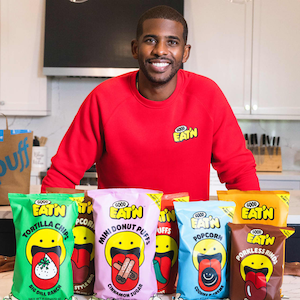
[00:23:25] John Craven: Good Eat', Chris Paul's brand. Chris Paul, the NBA superstar. Chris Paul, NBA superstar. These are the hot, hot puffs. We've got a few different skews, but I only brought two. And this is, this is probably my favorite, the dill ranch.
[00:23:40] Ray Latif: That's so good. So what, it's just the corn balls or something?
[00:23:44] Jackie Rubliera: He's vegan and he was trying to eat like Doritos. So this is like his version of like a cool ranch Dorito. So he wanted to recreate like better for you snack foods. And they are quite tasty. Like you can actually see the dill in those.
[00:23:59] Ray Latif: Yes, it's a great branding. I'll get one in a sec. And it says, surprisingly plant-based, is the color on the back of the package. I haven't seen these in stores yet. I feel like I've seen them on Instagram and certain places.
[00:24:12] John Craven: I think they launched, well, originally exclusively with GoPuff.
[00:24:16] Ray Latif: Ah, okay.
[00:24:16] John Craven: They've been around for a while. Yeah, good stuff. Well, glad- Very bold graphics. I did not know that I needed pickle in my ranch Doritos. There you go. I did.
[00:24:26] Ray Latif: Yes. I've got- I'm Good Eat. I've got in my hand a bottle of a brand called Jozo. They're a maker of soy sauces. And this one is their tamari soy sauce. It's described as naturally gluten-free. It comes in a squeezable nine ounce plastic bottle. It's barrel aged and the flavor is described as bold, balanced umami. I think that's our only skew. Is it their only skew? Yeah. Really good stuff. Yeah. We got to meet with the founders, Oliver Martin and Julia Morrison at the Taste Radio meetup in New York City. And they describe it as being a brand for the next generation of flavor seeking home chefs. Yeah.
[00:25:13] John Craven: So, yeah, I mean, you could try it on your gas station sushi that I know you like to.
[00:25:18] Ray Latif: I don't need gas station. I ate Penn Station sushi. What's the difference?
[00:25:24] Jackie Rubliera: That's like grocery store sushi, right? It's like the same.
[00:25:26] John Craven: But that stuff is really, you know, I think I sampled that at the StartupCBG Alley Rally at Expo West. You know, someone pitches you a soy sauce, kind of like, how good can it be? But I mean, the flavor that just umami in that is like, I mean, it's pretty intense.
[00:25:44] Temple Records: It's pretty intense.
[00:25:46] John Craven: It's got soul. Yeah. I mean, yeah, it sticks with you and you can't forget the flavor of it.
[00:25:51] Jackie Rubliera: Yeah. I feel like a lot of the soy sauces we traditionally have are like, you know, mass produced and watered down stuff. Yeah, exactly. You can taste the difference.
[00:26:00] Ray Latif: Yeah, I'm really excited to try this. I haven't had a chance to yet. I should have put it on the sushi I had yesterday actually. That would have been smart. Yeah, instead I just had the nasty packets that they give you. Jackie, what do you got over there?
[00:26:13] Jackie Rubliera: I have some premium products as well.
[00:26:16] Ray Latif: Oh, I saw that.
[00:26:17] Jackie Rubliera: Yeah. Match Tonic water. I have four different varieties. So this is a UK brand and the founder and CEO, Alexander Caridger, he reached out and they launched in the UK, but they just entered into the Texas market. So they have a different varieties. This is spicy. They have floral. They also have Mediterranean and Indian. And I'm drinking the spicy right now, and it's just very, like, I don't know. They're really delicious, like, very, like, nuanced flavors, and it tastes premium. I think the, we were talking about how, like, the stout little bottles almost look like it would be, like, a little, like, whiskey bottle or RTD cocktail. I thought it was whiskey originally.
[00:26:58] Ray Latif: It's this square-shouldered, square-shaped bottle. And it screams premium. It looks almost like a perfume. You don't see bottles like that for beverages. I said cologne. No. You said cologne? Didn't hear you. Sorry. Wasn't paying attention, Mike. That rarely happens. Usually it's you guys that are paying attention.
[00:27:15] John Craven: Yeah. What's that? Usually reading a book while you're talking. Writing a dissertation.
[00:27:22] Ray Latif: Well, I want to wrap with two more quick brands. You're going to wrap? Yeah. Are you going to wrap about Javin? You're drinking it in the cabin? Come on, let's hear it. I'm not going to do anything as crazy as that. Javin is a maker of beverages described as electrolyte refreshers. The benefits are that they're all natural, gut health friendly, and hydrating. They come in these 12 ounce cans. And it's also described as an ancient recipe for the modern day adventurer. Homayoun Orshadi is the founder. He came into the office. Stopped in. Stopped in last week, spoke with Mike. Jaban is a maker of, well, the two flavors we have here are their cucumber mint and their pomegranate. Excited to get into these soon. Thanks so much for stopping by.
[00:28:08] John Craven: Yeah, it's funny because we're always talking about, hey, you know, you're in the area. Stop by. We'd love to see you. And Homayoun is one of the few people who just calls our bluff on that. Stop in. It's great. Love to see you. Is that a bluff? No, it's great. I mean, people think it's a bluff. People think it's a bluff. Really? We're just so happy to see you.
[00:28:24] Ray Latif: Oh, I always thought that people wanted to come and we just don't give them enough.
[00:28:28] John Craven: Yeah.
[00:28:29] Ray Latif: You know, reason to Oh So. Come on in. Come on in. I'm just sad I missed the dumpling daughter visit.
[00:28:34] Jackie Rubliera: And no one left me any. I saw photos and it looked delicious.
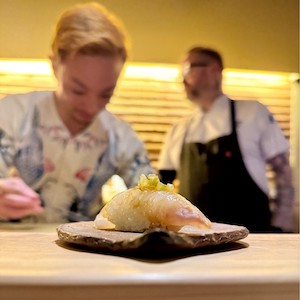
[00:28:37] Ray Latif: It's incredible. Last brand I want to mention, we saw Ross Shepard, who's the CEO of Moss at the New York events. Moss, a maker of Sea Moss beverages. Love that brand. Excited to see where they're going. I know it's tough trying to market Sea Moss in beverage form, but I think they're doing it. They're the only ones doing it as far as I know and love their products. So Ross, great to see you. All right, let's get to our featured interview for this episode, a conversation with chefs Jamie Bissonnette and Kenta Katagai. A celebrated culinary force in Boston and beyond, Jamie is the co-founder of BCB3 Hospitality Group, the team behind four standout restaurants in the city, including Zerito, a Basque-inspired eatery, and Temple Records, a stylish cocktail bar channeling the vibe of 1950s Japanese listening lounges. Nestled beneath Temple Records is Sushi At, an intimate subterranean sushi bar led by Kenta's meticulous direction. Last month's Dorito & Sushi At joined forces for a one-of-a-kind omakase dinner, a fusion of Basque flavors and Edome-style sushi that pushed boundaries while honoring deep-rooted culinary traditions. In this interview, Jamie reflects on his journey from a young chef in acclaimed restaurants to crafting a dynamic, globally-inspired dining experience. Kenta shares how his deep respect for heritage and simplicity drives every slice and plate, and together they dive into the art of educating diners, the power of narrative, and the joy of staying true to their vision, all while delivering unforgettable meals that resonate far beyond the plate. Hey folks, it's Ray Latif for Taste Radio, and right now I am honored to be sitting down with Jamie Bissonnette and Kenta Katagai, chefs in Boston who have prepared some of the most delicious food that I've eaten in a long time. Jamie, how are you?
[00:30:40] Temple Records: I'm awesome, man. How are you today?
[00:30:41] Ray Latif: I'm doing well. Kenta, how are you?
[00:30:43] Temple Records: I'm good.
[00:30:44] Ray Latif: Outstanding. Thank you so much again for having me at Temple Records for an amazing dinner about a week ago. It was a Basque-inspired omakase dinner, which was among the best I've had in a long time. And let me tell you something. I was in San Sebastian a year ago, and some of the food that I ate last week rivaled what I ate in 2024. So thank you again. Before we get into that dinner, I'd love to talk to you both a bit about your backgrounds. Jamie, you are... Dare I say, a bit of a legend here in the Boston area, a very well-known chef, been a very high profile person in the restaurant industry for about two decades, beginning with one of my favorite restaurants, or at least from what I remember, Eastern Standard, when it was originally in Kenmore Square and you were cooking up some very audacious cuisine. But talk a bit about your history as a chef in Boston.
[00:31:42] Temple Records: Sure. I moved to Boston in the late 90s. I worked for Legal Seafood first and got to work with a kitchen manager who became their director named Rich Volante, who really taught me a lot and gave me a lot of confidence. I had done some work with Jasper White over the years, and then I ended up working at a bunch of great restaurants. eventually landing at Marc Orfali's Pagal, where we get to really dig into French regional cuisine. And from there, catapulted a couple of years later, joined up with Garrett Harker, and we opened up Eastern Standard. There was a lot of other restaurants along the way, but that's the short of it. That's the checkered story.
[00:32:21] Ray Latif: Kenta, I'm actually relatively new to you. I'm not familiar with your history as a chef, but based on what I ate last week, I am a fan, so to speak. And I'd love to hear from you about how you got into this business and your work at Sushi at Temple Records.
[00:32:40] Jamie Bissonnette: Well, I just moved to Boston last year. So I've only been in Boston for a year. And before that, I was in Hawaii. I was there for 12, almost 12 years. And I really wanted to come back to East Coast. I used to live in New York and D.C. And D.C. is a place I started working in a restaurant. I stopped being in this industry. And that's where I started learning all Japanese cuisine and sushi and etc. While I was in Hawaii, I really wanted to come back to East Coast again. And I met Chef Jamie and Babak and Andy, and they brought me here.
[00:33:20] Ray Latif: And that's all she wrote. I mean, it sounds like the partnership has really worked out well. The restaurant that we were at, or that I was at last week, is called Temple Records, which is a pretty unique concept, I would say. It has a music element, obviously, to it. It has a food element. The sushi bar is downstairs. There's another concept upstairs as well. How did this all come together, Jamie? Again, it's a very differentiated type of restaurant than what people are typically seeing these days.
[00:33:52] Temple Records: Yeah, it sure is, man. So a couple of years ago, I had been a partner in a restaurant group for about 18 years. And we had a bunch of restaurants all over the globe, New York, Dubai, Bangkok, and then a lot in Boston. And my business partner and I decided it was time to go chase our own creative outlets in different ways. And what that turned into was me leaving the group, selling my shares and taking some time off to figure out what I wanted to do. And Andy and Bobak have just been my friends for a long time. Andy and I worked together in West Hartford, Connecticut for Billy Grant back in the 90s, and we've always just been wicked good friends. So we started talking about the possibility of doing a project together. A couple things came up, we looked at it, we passed. And then this property was presented to us. And it was really appealing, like, logistically, and it was so unique. And to take one spot where we put Somac, the landlord said, we want you to take this part of the basement and this storage space next door. So we opened it all up, combined the three places together, and it didn't make sense to open up one concept that would have so many doors and stairs to go room to room. So we thought, okay, let's open up Somak, a very traditional non-fusion Korean restaurant. Next to it, I wanted to put in a record bar because my wife wanted all my records out of the house. I love record bars. I love that style. Having just spent a bunch of time in Korea and Japan, I was really inspired by a lot of the ones that I went to in Kyoto and Osaka, and a couple of the ones I went to in Seoul as well. We decided that that's what we were going to do. As we started doing a little bit of the demolition of the old space and pulling back the curtains, so to speak, We went into the basement one day and Bobak said, what do you think we should do down here? Should we do a private dining room, blah, blah, blah, short story longer. I said, what if we do a sushi bar? And he said, well, wow, that would be so cool. Because going down the stairs from Temple Records into Sushiette, it felt a lot to me like going into one of the subterranean sushi bars in Ginza, like Ginza Iwa, for instance. So the next step was finding Kenta, which was surprisingly serendipitous and the universe wanted us to meet, so we did. And in doing that, we wanted to keep the three concepts very unique to each other, where the collaboration of culture would be up in Temple Records, where there's some Korean food and some Japanese food. There's really no rules for the food in Temple Records. But in sushi, we wanted to do, you know, and Kenta and I were talking and ideating the menu. We really wanted it to be classic and traditional. Japanese, like Edome style, without the fusion that you see in America, which I love. Don't get me wrong. I think that that's really great. But Boston, in my opinion, was starting to feel like everywhere was a higher end omakase. There wasn't somewhere where you could get really great aged fish and properly cut fish and seasoned rice that wasn't tweaked with a bunch of different ingredients from other Culture Pop there we had it. We decided to do all of these three concepts.
[00:37:04] Ray Latif: And again, the food is something that I feel like I've been missing for a long time. I think the first time I tried sushi, and this is part of the meal, it wasn't entirely a sushi meal, but the sushi that I ate at the dinner felt really special. And in a lot of ways, I feel like sushi in America has become this homogenized, blandified, to create a word, product that You just eat and you don't really enjoy. You just eat it because that's what it is and that's what your expectations for it are. And Kenta, going from that baseline to what Americans have come to expect from sushi, to elevate that palate, to elevate those expectations, I think is something that you really excelled upon, particularly in that dinner. How are you attempting to reteach people, your customers, about what it means to serve and eat delicious food, particularly sushi?
[00:38:08] Jamie Bissonnette: To be honest to myself, I'm not even thinking that I'm doing anything special. I'm just doing what I've been experiencing through my life in Japan and the United States. I used to see a lot of time that my grandma was cooking. That's, I think, my baseline of my cooking experience in Japan, and also from my mom and dad. Simply, I just wanted to share my culture with all my guests, especially with Jamie and all my staff here. And I think that's really special to all of the guests, all the people here, and that really Bake Me happy and I really appreciate that people feel the same way as I do. That's really special to me.
[00:39:03] Ray Latif: Do you have to share your story? How much does your personal story impact a customer's experience when a guest walks in and they, again, have certain expectations for what they're going to eat and they have a much more elevated experience and they want to ask you about it. Does your story really resonate with them? Is it a big part of your presentation of the meal?
[00:39:24] Jamie Bissonnette: Well, I think so. I believe so. And they really enjoy when I explain what it is. What I really try to communicate with guests is try to talk to them. It doesn't matter if it's about food, about my experience in Japan, my culture. Whatever I talk to them, they're really enjoyable to listen. And that makes, to me, food taste better. Also, I try to tell my other sushi chefs that just try to talk to the guests and try to enjoy yourself. If you enjoy yourself, people see your enjoy moment, so they enjoy themselves also.
[00:40:08] Ray Latif: Yeah, making that connection between story and food is really important. It gives context. And I think you're right. It allows the guests to appreciate the food a bit more. You know, Jamie with Zorito, which is one of your newest restaurants, which is a Basque inspired restaurant. It was a coming together of Sushi at Temple Records and Zorito to create this wonderful dinner. Again, a Basque omakase dinner isn't necessarily the most intuitive thing, but I think it came together so beautifully. But Basque food isn't necessarily, I think, as well known, perhaps as say, Spanish tapas in this country. What has been the level of education that you've had to share with people, with your guests about Basque cuisine?
[00:40:54] Temple Records: You're spot on, Ray. A lot of people, they don't know the difference, but luckily there's so much similarities because the Basque region of Spain is still part of Spain. And, you know, between Catalan food, the food of like Madrid, and then the food of Basque country, the food of Galicia, like all of the different regional things kind of sometimes get blended together in classic pincho bars and tapas bars throughout that country. So for us opening up Zerito, we were able to kind of lean into some of the things that people know about it. In Basque, they don't use the word tapa, and in Zerito, we don't use the word tapa. But if a guest come in and says, oh, what's a racione? Is that like a tapa? We'll say, yeah, it's like a larger tapa. Exactly. What's a pincho? A pincho is like one of those little tapas that you get that's on a bread or on a stick. And we are able to use that comparison to set people at ease. And I think a lot of the guests coming into the restaurant know my history of with Toro and you know having run a tapas restaurant or four of them at one point all over the globe that they're comfortable with it and they're putting some trust into us and then from there the education comes with the simplicity of the food and the simplicity of the ingredients similarly to what Kenta is doing in sushi because That collaboration, that fusion menu that we did for the Omakase, the reason we're doing that at the Omakase is because there's so little fusion involved in any of the restaurants. you know, on a normal day-to-day. And we don't do omakase because we want it to, you know, be affordable and we don't want people to have to commit to an expensive meal. So when we decided we would do an omakase and have it be a collaboration, we decided that it would be so unique and so hyper-focused on something that we don't normally do that makes it a lot more fun for us. So the education at Zerito, to your initial question, It's been really seamless. People are comfortable and they get it. And there's like so many lateral comparisons to something that they already know.
[00:42:58] Ray Latif: Kenta, has your experience here in Boston been a bit different than your experiences elsewhere in that this is a very challenging and competitive market? Are you finding that you have to take a slightly different approach to menu curation and service that is different than elsewhere?
[00:43:16] Jamie Bissonnette: Yeah, I wasn't working in this straight up Japanese sushi restaurant before. Of course, when I make menu, I really focus on very traditional Japanese way. But the other restaurant I used to work is a little bit of everything. It's traditional Japanese, but they have a fryer so we can fry things. But down here, we don't have hotlines. So we have to create something we can do. with what we have down here.
[00:43:48] Temple Records: I think one of the things that Kenta's point there, if you don't mind, Chef, is there's so many people doing so many different competitive things in the sushi world in Boston. And what Kenta, when he got here, he had the benefit of a fresh set of eyes. So he didn't come in here thinking this is what restaurant X did, this is what restaurant Y did. The only time we really looked at other menus was to make sure that we weren't pricing ourselves too low or too high. that, you know, we were being competitive in that regard. And as we've opened, what Chef Kenta-san has done down here is he just does exactly the way he thinks it should be done in the way that he would want to want it done for him. And and that's been really great. And it's been a struggle. It did take a while for people to start to get it. You know, when people come in and they ask for avocado roll and we don't have any vegetarian rolls and they want a crab avocado stick, and they want salmon nigiri, and for instance, we don't have salmon. So those are some of the things that have been the challenges of like the fact that it is very Japanese. But then the people who spent time going to Japan come in, they meet Kenta, they come out, and you just see these like pie-eyed people that are Just Ice, like they've just gone to church for the first time and really found God, and they preach the benefits of it. And it's still catching on, which is what's really great to watch as Kent is developing his clientele, developing his team and developing the menu.
[00:45:18] Ray Latif: I think it's a gift and a curse to be different and specific and focused on what you want to serve.
[00:45:25] Temple Records: That's like a t-shirt that says that, bro. That's exactly our every day. Yeah.
[00:45:30] Ray Latif: Well, I mean, I'm sure as you pointed out, Jamie, you have people who walk in and say, hey, I want an avocado roll. And you're like, I'd love to serve you one, but that's not what we do here. But you don't want to throw away customers. So having said that, do you have to adjust? I mean, do you have to stick to your guns or do you feel like you have to evolve based on how the consumer perceives you, based on how the guests perceive your restaurant and your cuisine?
[00:45:54] Temple Records: Yes, but not to every whim, for sure. I mean, that's the key of staying relevant and staying ahead of the curve. You need to modify to your clientele a little bit here and there. But you also need to, to your point earlier, your question about education is so important. To compare it to Zerito, just to jump across the park for a sec, We don't serve paella and some of the other more like typical things that you see in Spanish like tapas bars and Spanish restaurants because they don't really serve a lot of paella in Basque country and we don't logistically have it, the space for it. And like that is something that we get over and over again. there's no chance that we're going to just all of a sudden knock down a wall, expand our kitchen and buy a range and start doing paella. It just wouldn't seem right to, you know, if a Basque person came in and they get it. So I guess to us, sticking to our guns a little bit is important. We want to stay true to what we are because that's, I think, what happens to a lot of the restaurants that don't do that. run and owned restaurants that kind of catered to every whim of every, every like, you know, general trend of people asking for things. And that's fun, too. And I'm not knocking it. I just think it's a nice breath of fresh air to be able to go somewhere in Boston and get like if a Filipino restaurant opened up and they were doing Filipino fusion food, I'm sure it would be great. But if a Filipino restaurant opened up in Boston and they were doing like a very true Filipino restaurant that's not modified to be towards the Western flip tastes, I think I wo for it. And I think that' is where we're trying to go get an omakase that i with great cut fish, am interesting, like garnis go to no relation, Good Eat you know, and then when C like what I love about th style of properly aged, p delicious rice wasabi and
[00:48:04] Ray Latif: Absolutely. You mentioned education, Jamie. I think the other aspect of this is the narrative, right? So on the one hand, you have the guest who's inside the restaurant. You can educate them there. You can cater to the experience that they want, or at least, you know, help them understand what experience they should be getting. On the other hand, when you're outside the restaurant, you want them to come in. You're trying to pull them in, explain what you're doing, and talk about what you're doing. And that narrative now is being told by a lot of different people. as being told by the restaurant, by your PR team, by Yelp, by influencers. And I think it's probably very, very challenging to make sure that everyone's speaking in the same way. In fact, it's probably impossible. But Kenta, I think from a social media perspective, it's helpful to be able to tell that story and tell it in a very consistent way. How are you creating your own social media presence and how are you talking about Sushi at Temple Records via social and again, helping to curate and talk about that narrative very consistently?
[00:49:09] Jamie Bissonnette: I really want to show them that I'm not doing anything special, very simple, but I really care what I do and how I cut, how I treat my fish. The other day I asked her to shoot my egg tamago making video. It's really simple. Everybody thinks, oh, that looks so easy. But it's not really easy. I've been making this, it took me like 20 years to make, but I still think that it's not perfect. I still need to fix a little bit here and there. But that small looks very easy, but make it look easy is not just easy. Does that make sense?
[00:49:53] Ray Latif: Yeah, totally. And Just Ice the last 60 seconds, I think you articulated exactly what Sushi at Temple Records is all about, which is the simplicity of what you do, but also the quality that goes into every dish that you serve, which is, again, I think what you're trying to share in terms of the narrative and the education behind your restaurant. Jamie, going back to the question of you have all these different sources to try to tell that story, to try to shape the narrative of your restaurants like Azurito or Temple Records. How are you navigating all those voices all at once?
[00:50:31] Temple Records: Consistency is key. So for us, it's taking care of our team, taking care of our staff, making sure that the people that we work with, the servers, the prep cooks, the dishwashers, et cetera, et cetera, all understand we have a common goal. And so all of the servers who work in Sushi know what Kenta's goals are. They know his ethos on food. They know what his vision is. So they can speak to the guests that way. And then when the guests interpret that however they want. It's like philosophy, you know. You replace a board on a boat every day for a year, there's 365 boards in that boat. When is that boat a new boat? When was it the old boat? You know, it's up for debate. So as we look at all of the things that are being sent out there on TikTok and Instagram and, you know, any other social medias and our review platforms, You're right, people definitely get different perspectives of it. And we just got to stay true to who we are and you'll start to see common themes. But the goal is when people leave here, if they come and they say, wow, this is such a great neighborhood sushi bar, I love being able to go in there and get a macamono and a nice, really awesome glass of sake and be in and out really quickly versus somebody else who might come and realize that we have a really dope wine list that's really in depth with 15 to 20 different champagnes and a lot of grower champagne and remarkable list of Chablis and white burgundy. And then they come in and they fall out and they're like, well, we can go there and we can eat all of this really unique Japanese fish that's not available at your normal neighborhood spot. They're both experiencing what we want here, because we want both of those experiences. We want people who can come in and get in Nodoguro and be excited for Hotaro Ika. And we also want people who can come in and be like, oh, wow, they have a spicy tuna maki and an affordable sake. And that's what not doing omakase every day you know, means to us is place where you can choose experience. So having peo
[00:52:34] Ray Latif: I would 100% agree. And I love the fact that it's not necessarily trying to frame what an influencer or just some regular person putting content on social media. Not that an influencer isn't a regular person, but some person who is not considered an influencer who's posting content on their social media. It's not necessarily trying to frame what they're doing, but it's very much about that consistency of what everyone is getting and making sure that they're having a good experience throughout. Chefs, thank you so much for taking the time. This has been a great conversation. You're both unquestionably Good Eat what you do. And for listeners who are in the Boston area or visiting the Boston area, Cerrito and Temple Records, just a definite must stop. in the dining scene in Boston. So thank you so much again for what you do and hope to catch up again soon.
[00:53:27] Temple Records: Great to have you in, man.
[00:53:28] Ray Latif: Thank you. That brings us to the end of this episode of Taste Radio. Thank you so much for listening. Taste Radio is a production of BevNET.com, Incorporated. Our audio engineer for Taste Radio is Joe Cracci. Our technical director is Joshua Pratt, and our video editor is Ryan Galang. Our social marketing manager is Amanda Smerlinski, and our designer is Amanda Huang. Just a reminder, if you like what you hear on Taste Radio, please share the podcast with friends and colleagues. And, of course, we would love it if you could review us on the Apple Podcasts app or your listening platform of choice. Check us out on Instagram. Our handle is bevnettasteradio. As always, for questions, comments, ideas for future podcasts, please send us an email to ask at Taste Radio. On behalf of the entire Taste Radio team, thank you for listening, and we'll talk to you next time.
[00:54:22] Mike Schneider: you