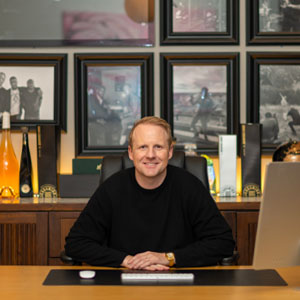
[00:00:10] Ray Latif: Hey folks, I'm Ray Latif and you're listening to the number one podcast for the food and beverage industry, Taste Radio. This episode features an interview with James Morrissey, the founder of Global Brand Equities, a creator and operator of premium beverage alcohol brands co-developed with celebrity founders. Get access to limited swag and exclusive content by becoming a Taste Radio VIP. It's easy for you to join that group of very important people. Just head to Taste Radio slash VIP and take one minute to sign up. A sensational hit from Post Malone, A$AP Rocky's critically acclaimed Crowd Pleaser, and Kevin Hart's Unexpected Number. Sounds like a Spotify playlist, right? But what I'm describing are three of the first brands built and marketed by Global Brand Equities. Founded in 2019 by Irish expat James Morrissey, Global Brand Equities is focused on developing innovative and creator-led beverage alcohol brands. The company has aligned with the aforementioned Malone, Rocky and Hart to launch fast-growing brands Maison No. 9 French Rosé, Mercer & Prince Canadian Whisky and Gran Coramino Tequila, respectively. The company also markets Sunny Vodka, a premium spirit co-founded by social media influencers Zach Bia and Stas Karanikolaou. Morrissey's vision is to meet modern consumers where they live and drink via a contemporary approach to alcoholic beverages, one that lives at the intersection of media, entertainment, and high-quality liquid. In the following interview, I spoke with Morrissey about how his prior experience in hospitality has shaped his outlook for novel consumer brands, the foundations for mutually beneficial celebrity partnerships, why it's critical to understand and operate within the traditional infrastructure for producing and distributing beverage alcohol brands, and the effectiveness of the company's multi-pronged marketing strategy. Hey folks, it's Ray with Taste Radio right now. I am in the SoHo neighborhood of New York City and in the office of Global Brand Equities and sitting in front of me right now is the founder of the company. That's James Morrissey. James, how are you?
[00:02:24] James Morrissey: How are you? Nice to be with you.
[00:02:26] Ray Latif: Nice to be with you as well. Thanks so much for taking the time. I know you're a busy man. Every time I hear your name, I feel like I've met you before because I don't know what it is. Is it a common name?
[00:02:36] James Morrissey: It's relatively common. I guess it's similar to other names. You got Jim Morrison from The Doors. You got Morrissey, the artist from the UK. So yeah, there's commonality. There's a couple of people out there.
[00:02:50] Ray Latif: You are from Ireland. Yes. Are there a lot of James Morrissey's in Ireland?
[00:02:53] James Morrissey: There are a couple. Yeah, Morrissey is a common name, more common in Ireland than it is probably here. So yeah, it's a relatively common surname in Ireland and the UK. When did you come to the States? I moved to New York 10 years ago.
[00:03:10] Ray Latif: Okay. And you came here specifically to start GBE?
[00:03:14] James Morrissey: I came here specifically to expand my business. I had a business in Ireland, which was in entertainment and nightlife. As I grew and developed that business in Ireland, I started to recognize the size of the global economy when it came to business and saw that although it is a great market to operate in, Ireland is relatively limited in terms of size and scale. There's 5 million people on the island of Ireland. And I really had my sights set on coming to the United States and expanding my business into North America, where I found very quickly when I started coming here that there was a very positive can-do energy when it came to entrepreneurship and the intention to create new business. It was a very pro-business community, which I liked. Very encouraging. A lot of people were very helpful and accommodating. When I moved here, I moved here with no local partners, no predetermined plan that I walked into. I essentially came here and really had to build from the ground up. But I soon learned that people were very willing to support and help the vision or the endeavors that I had in mind at the time.
[00:04:24] Ray Latif: That's nice to hear because I would think New York is pretty cutthroat in comparison to other countries like Ireland.
[00:04:30] James Morrissey: It's competitive. It's competitive as hell. But for the right people, there's an energy and an attitude here that is infectious. Some people come here and they think that people in New York are very rude. They don't have time to stop and chat. I think people are very direct here. I don't necessarily think they're rude, but I had to learn that as well. Coming here, that being direct doesn't mean that you're necessarily being rude. But I could see why a place like New York might have a reputation for that. If you're a tourist visiting for two or three days, someone being very frank and direct with you might come off a little rough around the edges. But certainly the energy of New York, the pace at which it moves, I gravitated to it instantly.
[00:05:10] Ray Latif: Well, people aren't getting enough sleep here. People aren't getting enough sleep in general. I think that can lead to some crankiness.
[00:05:16] James Morrissey: That's correct.
[00:05:17] Ray Latif: For someone who's been involved in nightlife forever, you look like you are actually quite healthy and get enough sleep in your life, which is great to see. These days I spend, you know, I stay until two and then I'm done for a couple of days.
[00:05:28] James Morrissey: Yeah. Yeah. I can't do the late nights anymore. That's for sure. But yeah, I mean, look, there's a certain commitment that you have to make to business. If you really want to excel and get to a certain level, that you have to make some sacrifices in your life. And that requires time, energy, dedication, commitment, contribution, and staying healthy physically and mentally is certainly not only a priority for me, but a necessity.
[00:05:53] Ray Latif: Is that hard when you're hanging out with Post Malone?
[00:05:56] James Morrissey: Um, it has a time and a place. No, I mean, look, at the end of the day, I handle the business for most of the ventures that I'm involved with. And, you know, we certainly have a lot of fun along the way. But I'm young enough. I've got the energy. I can get on, you know, get on the plane late at night, get up early in the morning. I'm willing to put in the hours now at a younger age. That's always been my mindset. And hopefully, you know, that will pay off long term. But it's certainly not a business for the faint hearted.
[00:06:25] Ray Latif: No, it's not. And the business that you're in, that of spirits and wine, has become a lot more competitive. Celebrity-backed spirit brands have become pretty ubiquitous at this point. And it's almost like, what's going to move the needle when it comes to a new brand that has a partner investor in an athlete, in an entertainer, musician? You seem to be on the right path with the brands that you're involved with and that you've just created and designed. But let's back up for a second, because making that transition from nightlife into entrepreneurship, essentially, and entrepreneurship in the beverage industry, seems like it might be a challenging leap. Was it?
[00:07:04] James Morrissey: It was like any creation of a new business, it's challenging. I guess my activity or endeavours professionally since I was 16, 17 years old have been very entrepreneurial in terms of creating my own businesses. I've always had an appetite for learning about new industries and I've always had an interest not necessarily in the outward facing brand or business, but who are the people behind the businesses that make these things move at scale. Oftentimes as consumers we see brand names, we see products, we see clothing, we see products on shelves all over the world, but The work that it takes behind the scenes to actually create success in that, that's what has always excited and interested me. So when I started to look into the alcohol business and the drinks business as a whole, I was fascinated by the different layers and complexities required to create success in the business. Everything from manufacturing and production, to importation, to compliance, to distribution, to retail, to outward facing consumer packaging. So many layers, so many people, so many groups. all of those facets need to fire simultaneously for there to be success. And that interested and excited me rather than intimidated me.
[00:08:24] Ray Latif: Can I ask you how you define success in this business? Typically when we see upstart brands grow at some scale, the playbook seems to be, okay, let's find a strategic partner and then eventually have that partner acquire us. Is that sort of the path that you see for yourself or is it something else you're building here with GBE?
[00:08:42] James Morrissey: The intention for us is to build a long-term portfolio company where we have brands that cut through and disrupt and connect with consumers in innovative ways compared to that of larger companies that have gone before us. What I mean by that is creating route to market and Brand Equities which connect with consumers in a more meaningful way than the brands that are more traditional and more established. The consumer habits have changed greatly, particularly in the last decade. And if you look at industries, most industries have evolved and pivoted to catch up with those consumer demand changes and how that consumer reacts in the market. However, the alcohol and liquor business has innovated, but not at the same pace. And that lag is where we see our opportunity to build Global Brand Equities in that white space.
[00:09:38] Ray Latif: How has consumer behavior changed specifically within Spirits and Wine?
[00:09:42] James Morrissey: Consumers want instant gratification. If they click order today, they want the product tomorrow. Consumer purchasing trends have changed greatly. Younger consumers are spending more per unit or per bottle than they would have in times gone past. So high volume growth drivers of bottles that were priced between $15 and $25 previously would have been the really strong tiers to be priced in. Now, if you look at that, the tier between $25 and $50 has exploded in terms of demand.
[00:10:15] Ray Latif: So are they spending less on other consumables and more on spirits and wines?
[00:10:19] James Morrissey: The consumer habits that we see with our consumers is they're spending overall more in the category and they're more selective about their purchases. So they'll purchase less bottles, but they'll purchase better quality products. And quality for us is across liquid, packaging, brand identity, etc.
[00:10:40] Ray Latif: The quality of the liquid is really important. The brand is, I don't know. I mean, I think in some ways it's more important in that you need to get someone to look at your product, to want to associate themselves with that product. And that happens through the brand, not necessarily the liquid. Having a celebrity partner gives you some validation, but where does it start? Do you start with the liquid? Do you start with the brand? Do you start with a partner?
[00:11:02] James Morrissey: We always start with the data of the industry and we have certain categories that we've intentionally wanted to grow in. Categories where there is a big uptick in growth, categories where there is an opportunity to innovate, where we feel that there's room for improvement. For us, you know, looking at when I look at celebrity brands, believe it or not, I'm very cynical about that term because there is a naivety in certain industries where the thought process is that once you put a celebrity's name on a product, you're going to have the next billion dollar business. And unfortunately, it's a lot more complex than that. So when we look at it, my mindset has, we have to create liquids that are truly incredible compared to the status quo. And we've had to do that because there have been a lot of bad quality liquids associated with the celebrity brand space. So we've kind of taken this viewpoint where we have to work a little harder and really create some really great products when it comes to liquid and taste profile.
[00:12:04] Ray Latif: Your first was a Rosé One. Correct. And Rosé has become a pretty popular beverage in recent years. It's always been popular in the summertime. It seems like there's some year-round demand for it. What were the numbers telling you? What was the data telling you about Rosé?
[00:12:18] James Morrissey: The category since, you know, 2010, 2012 to now has been the category for French premium rosé has been double digit growth every year. Looking at it, there were years where it was 20-30% increases annually, which is huge for a category. And the one thing that I saw in the market was The leaders within the French Rosé category that dominated most of the volume, the top two, three brands in it, were all incredible products, all had great brands, and came from great facilities in France. However, there was very little innovation when it came to consumer-facing brand identity. and how that product spoke to the new consumer. And that's typical, that has been typical of the wine industry as a whole, right? It's a very old traditional industry. It has incredible authenticity, incredible history and heritage, but the ability to be agile and adapt in a short space of time hasn't really happened. We're starting to see it more, but at the time, 2018, 2019, when we were getting ready to launch Maison No. 9, The French Rosé brands that exist were all very similar. And we saw that the 35-year-old consumer plus was very well educated when it came to brand names in the French Rosé space. They were specifically asking for certain brands over the bar counter at a bar, hotel, restaurant. But the under 35-year-old consumer was just asking for the category. So they were just asking for a glass of rosé. And that's the area we saw an opportunity to, to innovate within and to really create a brand that communicated with our consumers in a different way, in a way more of their own inept style.
[00:14:01] Ray Latif: When you say your consumers, are you talking about a specific group of consumers or are you talking about most consumers under the age of 35 who drink rosé wine?
[00:14:08] James Morrissey: 21 to 35 year old consumers. Yeah, we, we, I kind of look at it as a new era consumer. That 21 to 35 year old consumer is very different to the consumer that went before them. And it's a consumer that at Global Brand Equities, myself and my team really focus on catering towards because most of our team in the company are that consumer. We know the consumer really well. So we've created success within that space.
[00:14:36] Brand Equities: Vibrant Ingredients is the natural ingredient partner powering food and beverage innovation, delivering flavor, function, and protection through a science-backed portfolio. Vibrant delivers purpose-driven solutions that help brands create extraordinary experiences. Discover what's possible with Vibrant today. Visit vibrantingredients.com.
[00:15:03] Ray Latif: Are they consumers that are particularly interested in, say, hip-hop music, given that Post Malone is your partner on Maison No A$AP Rocky is your partner on Mercer and Prince? Or are you looking at a broader opportunity with more consumers?
[00:15:19] James Morrissey: We look broader. We absolutely look broader. The one thing we've really noticed with Maison No. 9 and indeed the other brands that we have has been that although the first consumer to try it might be a fan of our talent partner, the product and the product proposition in terms of brand identity, package and liquid is strong enough that we've actually created this wider net of consumers where we have people who like Rosé, who want to try our brand, like it, and come back to try it again. That was a real sign for us that we were on the right track when it came to creating quality products and something that the typical celebrity brand might not always be able to get right.
[00:16:02] Ray Latif: So consumers are asking for Maison No. 9, they're not asking for the Post Malone Rosé.
[00:16:07] James Morrissey: Correct.
[00:16:08] Ray Latif: Correct. How did you meet Post Malone?
[00:16:10] James Morrissey: I met Post Malone through mutual friends over dinner in Los Angeles back in 2018, 2019. I'd just returned from the winery in the South of France that I'd visited and was in the early stages of creating a venture within the Rosé business. And as we chatted more throughout the evening, myself, himself and his manager, Dre London, we started to see a kind of collaboration or a shared vision in terms of wanting to create something of real quality within the wine space, but a brand that spoke the language of the modern consumer. The conversations were evident from the start that the passion and the authentic commitment to wanting to create something special was shared among myself, Post Malone, and Dre London. So within seven days, we were in the South of France at the winery, sampling the grapes, exploring the land, and really started to put the plans together for the brand and for the business.
[00:17:12] Ray Latif: How did you talk to him about his involvement with the brand or did you? Did he kind of lead the conversation about what he wanted to do? Were there certain expectations that you had of him as a partner?
[00:17:21] James Morrissey: It was very organic. It was very organic. The one thing that I have been very strong on is if I respect an artist or a creator's previous work, no matter what the field, music, film, TV, sport, I think those skill sets are interchangeable through industries. So if I believe in you having created something very special and something very creative in another field that has nothing to do with wine or liquor or anything that we're doing. I strongly believe that that can be applied to our business and I encourage that creativity. So, you know, working with talent to bring a vision to life in an authentic way is an absolute priority. Putting someone's name on a bottle that we've already created and not collaborated on is not of interest. Because it's not authentic, it's not genuine. And authenticity is absolutely a backbone of the business that we've intended to create.
[00:18:21] Ray Latif: So did your success with Post and Maison give you a good foundation and give you the sort of validation and the story that you could bring to subsequent products and brands?
[00:18:31] James Morrissey: What the launch of Maison No. 9 helped do was help inform me that the plans or the intentions to go into the traditional wine business or alcohol business with something disruptive in a new way were in the right direction and that those ideas in reality worked. That validation was important because until you create a business, everything is an idea. And talking about an idea is great. Talking about full proof of concept with results is even greater. You know, we launched Maison No. 9 online in the depth of COVID-19 in June 2020 at a time when the country was going through a lot of unrest. People were in a pretty dark place and the business of brands had essentially stopped. Brands were internally putting a lot of plans on pause. And we had a decision to make where we looked at the business and said, well, look, our consumers are still engaged. Our consumers have an appetite for entertainment and products. They may be sitting at home instead of sitting in the office, but We always planned to launch this brand in an unconventional way. So let's continue on that clear path to launch the way we intended. So it was the objective from the first dinner I had with Post and Dre to launch the brand, not like any other wine launch that had happened in the industry before, but to launch it more similar to a street wear or a sneaker drop. What I mean by that is we announced the brand in a very short space after the brand was available online, online only, on Vivino, the world's largest wine platform. And within the first 48 hours, we'd sold over 50,000 bottles of wine. and Vivino's website crashed for the first time in history, which was demand related. 30 days later, we rolled out nationwide through distribution into stores nationwide. So we were able to back up that velocity that we had online, in person, in stores, even through COVID-19. And I think that really helped solidify the plans or the concepts that we had and really endorsed the fact that our business model works.
[00:20:56] Ray Latif: Did you have the product in the United States or was it coming in from?
[00:21:00] James Morrissey: No, we started manufacturing the product earlier in the year. It shipped through COVID into the US and landed mid 2020. So all the, all the, there were challenges to say the least. We had at one point, our winery partner in France had to source packaging and boxes from a secondary source in Italy to make sure that we had packaging in time. It was chaotic, to say the least, but we had a very clear intention. And among the partners, none of us really flinched in terms of the plan. When I look back on it, in hindsight, it's actually surprising, but we all were very, very intentional about what we wanted to do. And we shared that vision, which ultimately led to a successful business.
[00:21:45] Ray Latif: When I think about the other categories you're involved with, I guess when I think about Rosé, I can see the opportunity. When I think about, say, tequila, for example, or premium tequila more specifically, it feels like it's very saturated. It feels like the opportunity is pretty limited, honestly. And this is just me at a glance kind of looking at it. Why tequila? And how did Kevin Hart come into the picture?
[00:22:07] James Morrissey: So your viewpoint on it, I shared also, and I continue to share it. The category of tequila is extremely saturated. There is a lot of competition. There's a lot of noise. And really for us to look at the tequila category as something that we would pursue, it had to be something different. The category as a whole is growing through explosive growth. But equally, there are an explosive number of new brands launching every week, every month, every year. And there's been a lot of activity in the celebrity backspace also. So there's a lot of noise. For us, I needed to wait until something really grabbed our attention where I knew we could create something that was truly different and create our own lane within tequila. And that was twofold. One, picking the category of Cristalino as a category that we wanted to expand into. that was something new and interesting compared to what was going on in the market.
[00:23:01] Ray Latif: And that became a recognized expression of tequila relatively recently, right? Correct.
[00:23:06] James Morrissey: Cristalino is a clear reposado tequila for anyone that doesn't know. So if you like reposado tequila, you will like Cristalino. It's crystal clear, so there is no discoloring in the liquid, but it has the taste profile and the notes of a Reposado. The category as a whole has been a real success in the Mexican market. So when it comes to luxury in Mexico, Cristalino is a leader. So being able to see that proof of concept and that growth in that market, was a big endorsement for me in terms of the fact that it could be adopted in the luxury segment and it could be successful. I liked the way that data looked and the way that story unfolded in Mexico. The second part which aligned was my connection and meeting with Kevin Hart. Kevin is not a celebrity in my mind. Kevin is a true entrepreneur and committed businessman. And when we started to speak about the category of tequila and about Cristalino and about where we could go in creating a new product, I quickly understood that he was truly, authentically passionate about the category of tequila. He owns a home in Mexico. He has a tequila bar in his home in LA. He knew about brands that nine out of 10 consumers would not know about. He knew about the more obscure side of tequila, which instantly piqued my interest. Matched with that, Kevin's ability to understand how to build a business and not only the work that goes into it, but the commitment and responsibility as a partner. I'm not shy about telling a partner or a prospective partner about the work that's required to build a business of scale. It's not for the faint hearted. It's not for people who don't want to do the work. And I very soon realized that Kevin's energy and hands-on approach to the way he builds business and commitment of time was something that was a clear priority. So we really connected from an energy standpoint in terms of both of us being really driven and really committed. The next chapter in that business, which really we set out to do was let's create a proposition which is premium in its approach. Let's not create a product until we find a liquid that we truly believe will resonate with consumers in a really smooth fashion. Kevin's First instruction when it came to liquid sourcing was no face, no trace. He wanted to create a tequila that you could sip on, take a shot of, drink neat, drink straight, and not make that face that you make with some harsh tequilas that he'd had in the past. So there was a benchmark or a standard created from the outset that we were not going to create a tequila unless we could find a liquid of a certain pedigree and style, which was not easy. So as we set out to find the best possible tequila expression that we could, we went to the best in the world to do that, a gentleman by the name of Juan Domingo Beckman. Juan is an 11th generation tequila maker, businessman, entrepreneur. His family were the first family to receive a license from the King of Spain to produce tequila. And ever since then, Juan and his family have been responsible for creating some incredible brands within the world of tequila. and other alcohol categories, but he really has been and continues to be a leader within the space. So when we went down to Mexico and went through our plans, the liquids that Juan was able to show us were incredible. We collaborated in a very engaged way in terms of continuing to dial in the liquid taste profile through multiple, multiple rounds in different cities, different countries over the coming months. But it was evident from day one, that first morning we met in Mexico, all together in person, it was evident that we all had a shared vision in terms of wanting to create something that was up to a really high standard within the Cristalino category.
[00:27:16] Post Malone: Do you want more repeat buyers on Amazon? Well, this free resource in collaboration with Straight Up Growth will help your brand turn first-time buyers into long-term subscribers. Download Winning the Repeat Purchase Game on Amazon now at Taste Radio slash SUG. That's Taste Radio slash S-U-G to start building retention-driven growth for your brand on Amazon. Scaling a beverage brand into major retail comes down to operational readiness. From packaging lead times to co-manufacturing strategy, the details can make or break a launch. In a new ebook in collaboration with Octopi and Asahi Beer USA, industry leaders share what they've learned in helping brands scale. Download it now at Taste Radio slash octopi.
[00:28:06] Ray Latif: Did you have a consumer in mind for this? Was it, is it the same sort of 21 to 35 year old consumer as Maison No was it a different kind of consumer?
[00:28:14] James Morrissey: It was a slightly different consumer. It was, it's still, all of our consumers share certain attributes and characteristics in terms of the fact that they are dialed into what's happening in culture, what's happening in consumer trends and behavior. They have their finger on the pulse. The consumer has an attention to detail, an appetite for knowledge, and takes pride in what they wear, what they drink, what they consume. but a slightly wider net when it came to tequila and Cristalino, where we wanted to target anyone who had an appetite for tequila and educate them around this new category of Cristalino, which is truly incredible, but relatively unheard of in the United States and the rest of the world.
[00:28:56] Ray Latif: How do you keep your finger on the pulse of how the consumer is evolving? You talked about how there's been a lot of change over the past decade. There continues to be change. How do you stay on the ground in the trenches knowing what that consumer wants, not just today, but tomorrow?
[00:29:08] James Morrissey: Staying in touch with what's happening on the street with the consumer is probably one of our strongest assets as a company. We rely on it and we spend a lot of time and energy in the market with consumers, be at events, internationally, across multiple categories, music, fashion, tech, we're forever learning. My days from through, you know, early, late evening are consumed with meetings where we're meeting people of all walks of life. That is not traditionally done within the drinks industry. People in the drinks industry usually meet other people within the drinks industry and it's relatively one dimensional. I've been fortunate enough to surround myself with people from all walks of life across entertainment, business and the alcohol business, where among those three facets, I've had exposure to and continue to have exposure to all sorts of people, all types of demographics, all type of backgrounds and all ages. And that is truly essential for me and my team to keep our finger on the pulse on a daily and weekly basis.
[00:30:13] Ray Latif: What's an example of a learning that you've acquired as a result of one of these meetings?
[00:30:18] James Morrissey: Being able to move in real time, being agile, being dynamic as a company is one of the key pillars of how we function. We move at a very fast pace, which is not typically usual of a company of our size or a company within the drinks business. And we're able to move at the same pace or rate as the entertainment industry. that ability to move at that pace and not have the, how would I say it, maybe corporate baggage that some of the larger companies have. We've been able to be really opportunistic and I believe that the consumers nationally and internationally have been receptive to us moving in real time at the speed of culture. That has been, that's helped increase our connection with our consumers through our brands. That's been a real key learning and a learning that's very, very important to us.
[00:31:13] Ray Latif: Do you adjust marketing and potentially branding and package design to reflect what you've learned? What happens when you get this information in real time and need to make a pivot one way or the other? I mean, can you do that as quickly as you might want to?
[00:31:26] James Morrissey: Yeah, I mean, look, there's some things that are easier to pivot than others, but the way we've built our business is that we can pivot and remain agile throughout the whole process from manufacturing through consumer acquisition. Be it product design or tweaks or changes to packages or brand identity and how we can communicate with consumers or retail focused initiatives. We're constantly learning every week and we pride ourselves on that. We're not, we don't always get it right. We have been able to create success at each brand level in different ways, but there are key learnings from every single endeavor that we do. We always remain open-minded and empathetic about how the consumer receives what we're creating.
[00:32:13] Ray Latif: Are the folks that are going out there to these events, crisscrossing the country, are they part of the GBE team or are you outsourcing some of that knowledge acquisition?
[00:32:25] James Morrissey: No, they're all internal Global Brand Equities. So we've got a team around us who are very dialed in to what's going on at a global scale when it comes to entertainment and culture. We see a lot of crossover among certain events around the globe every year where there are commonalities or similar profiles of people at these events and at those meetings or events, That's really what defines pop culture. It's kind of like those events, we see them as almost like how people would see Davos within the business community, right? These certain cultural moments, be it Coachella, Formula One, Super Bowl, they are moments where pop culture is being defined. And we pride ourselves on being at the cutting edge, at the forefront of that.
[00:33:17] Ray Latif: I got to ask you about A$AP Rocky because I didn't see this one coming. I didn't see anyone really partnering with A$AP on, well, a whiskey brand for sure. Why not? I don't know. I just didn't see it. And you know why? That's a good question. I just didn't think anyone could do it in an authentic way. I mean, I see him as very influential in terms of fashion, music. I think the liquor business just for some reason just didn't feel like the right fit. But I think you guys did a really good job with that partnership.
[00:33:42] James Morrissey: The collaboration and the creation of Mercer and Prince was built out of a shared commonality and a shared vision to push the boundaries when it came to a product within the drinks business. So as I may have mentioned earlier, the success that someone like A$AP Rocky has had and the creative credibility that he maintains within the world of fashion, culture, streetwear, music, the influence he has within those other industries I don't believe that those skill sets should have boundaries. I truly believe that those skill sets can be applied to a wide array of different businesses. So when we set out to create Mercer and Prince, the one thing that we established really early was that the personal connection was real. The authenticity of the relationship, the way in which we spoke creatively and a vision that we had to create something that was truly disruptive. was very important to both of us. There was an alignment in the language there. When we looked at it, Rocky wanted to create a package which was truly different. He had a real and detailed vision in his mind of what he wanted to create. I haven't seen as intentional a creation from anybody in terms of knowing exactly, soup to nuts, how he wanted the outer package to be. So it started, you know, with a sketch on a napkin in a Soho hotel one afternoon in New York. He was kind of slow to show me this sketch that he had in mind because he thought that it wasn't going to be realistic or feasible or we would not be able to create it, it would be too challenging. But when I saw him explain it to me and how he thought it should fit horizontally and vertically, and I saw the passion behind it, I couldn't ignore that. And I liked it and felt a duty as a partner to bring this to life. That's one thing that I have and we have as a company is we feel a true responsibility being a business partner to anybody. It's on us to create success. We have to deliver so they can deliver. And what I mean by that is we have to create and bring to life a really quality product and make sure that from a business perspective, 24-7, 365 days of the year, it's operating to scale so that our partners can lean in and take that to another level. So with Mercer and Prince, it was, let's look at this industry through a different lens. Yes, let's look at whiskey. Let's look at a whiskey that can be accessible to all different genres of consumers. Females, male, different people who either like Asap Rocky or like whiskey or like consumer products. We wanted to create a product that was not restricted by the boundaries of being a certain type of whiskey. We went out with clear intentions to find an incredibly smooth liquid. We knew that we wanted to go down the route of dark liquor. His whiskey preference was typically scotch. He also dabbled in cognac. So he definitely gravitates towards dark liquors. and through different ranges of blind testing, we landed on this liquid that we instantly believed was incredibly smooth, could be consumed neat, and was very accessible to a first-time or new whiskey drinker, but also had the pedigree to stand the test with someone who was an experienced scotch drinker. So when we landed on the liquid, we then said, okay, well, it's Okay, this liquid's from Canada, it's a blend from Canada. We've found that with this technique, with an influence of Japanese mizunura oak, that the finished product was really incredible. So, although that's typically very unusual, we didn't think that our consumers would be closed-minded when it came to that. We thought they'd appreciate the open-mindedness. Now, within the whiskey industry, traditionally, that, I'm not going to say maybe frowned upon, But it's pretty innovative. It's Canadian blend with Japanese mizunora oak influences. But with our consumer of 21 to 35 year olds who were dialed in to details with an open mind and a willingness to try. new things, we thought that it would resonate with them, and it did. And the finished product turned out great. The package is truly innovative. It's got two cups affixed to it. And the price point of $30 to consumers is very accessible. So we wanted to create an accessible product that could cater to those who maybe before were intimidated by whiskey. Let's make it more accessible. Let's make it speak the language of other products that they're consuming. Because we didn't see that modern innovation within whiskey to those consumers.
[00:38:28] Ray Latif: Again, I think you did a phenomenal job with Mercer and Prince Canadian the price point really did surprise me because it does feel really premium and, you know, $30 is a premium price point for whiskey, but just looking at it, it looks like a $50 bottle easily. Sure. Yeah. No, thank you. James, I am so glad that I had this opportunity to sit down with you. Thank you so much for taking the time. Again, I know how busy you are and I really appreciate this. Thank you. Likewise. Thank you. Great to be here. That brings us to the end of this episode of Taste Radio. Thank you so much for listening, and thanks to our guest, James Morrissey. Taste Radio is a production of BevNET.com, Incorporated. Our audio engineer for Taste Radio is Joe Cracci, our technical director is Joshua Pratt, and our video editor is Ryan Galang. Our social marketing manager is Amanda Smerlinski, and our designer is Amanda Huang. Just a reminder, if you like what you hear on Taste Radio, please share the podcast with friends and colleagues. And of course, we would love it if you could review us on the Apple Podcasts app or your listening platform of choice. Check us out on Instagram. Our handle is BevNetTasteRadio. As always, for questions, comments, ideas for future podcasts, please send us an email to ask at Taste Radio. On behalf of the entire Taste Radio team, thank you for listening, and we'll talk to you next time.