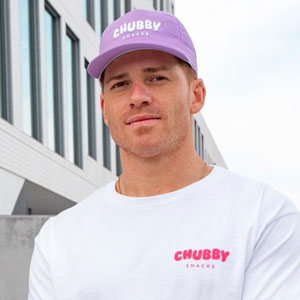
[00:00:10] Ray Latif: Hey folks, I'm Ray Latif and you're listening to the number one podcast for the food and beverage industry, Taste Radio. This episode features an interview with Dylan Seglio, the co-founder and CEO of Better For You PB&J brand Chubby Snacks. Get access to limited swag and exclusive content by becoming a Taste Radio VIP. It's easy for you to join that group of very important people. Just head to Taste Radio slash VIP and take one minute to sign up. For Dylan Seglio, becoming a food entrepreneur started with a simple question. Why hasn't anyone created a healthier version of Uncrustables? Getting to an answer, however, wasn't nearly as easy. Dylan is the co-founder and CEO of Los Angeles-based Snacks, which markets superfood nut butter and jelly sandwiches that the company describes as, quote, cloud-shaped. The individually wrapped sandwiches, which are typically sold frozen, are made with peanut or almond butter and strawberry or grape jam, with each sandwich containing eight to nine grams of protein, six to seven grams of fiber, and only two grams of sugar, depending on variety. Launched amid the outset of the COVID-19 pandemic, Chubby Snacks began as a direct-to-consumer brand, but has since gained distribution at natural and regional retailers, including Whole Foods, Central Market, Jimbo's, and Gelson's, and recently entered C-store chain Come & Go. The company has raised approximately $5 million over the past two and a half years from an investor pool that includes The Angel Group founder Adam Spriggs, Patrick Schwarzenegger and Villam Ventures, the family office of RxSpar's co-founder Jared Smith. In the following interview, I spoke with Dylan about his initial vision for Chubby Snacks, the duality of building a brand that is inextricably aligned with its primary competitor, why he strives to be an expert in everything related to the production and sale of Chubby Snacks, and why he believes that entrepreneurship shouldn't be viewed as a fun job. Hey folks, it's Ray with Taste Radio right now. I am in New York City and sitting down with Dylan Seglio, the co-founder and CEO of Chubby Snacks. Dylan, great to see you. Great to see you as well. Thanks for having me. Welcome to New York. You're based in LA, across the country. What are you doing here?
[00:02:43] Dylan Seglio: Yeah, correct. I've been in L.A. for about 12 years now, but I grew up right on the other side of the river in Jersey City, so happy to be home. I did not know that. Yep.
[00:02:51] Ray Latif: Jersey City, I feel like, gets a bad rap sometimes. All of New Jersey gets a bad rap. I think that's true, actually, yeah. Shout out to the Jersey Shore MTV show. Yeah. So it's great because we're here at BevNET Live and I'm glad that you were in town the same time I'm in town. Obviously you have a food business, not a beverage business, but you know, CPG in so many ways is universal in terms of what it takes to be successful. I have been a big fan of your brand, just like a lot of people as well. You were a pandemic baby, started in the summer of 2020 with this idea, which again, every time this comes up, people are like, well, why didn't people do this before? How come a brand like this never came about before? And I know you have a bunch of answers, but the first question I want to ask is why Chubby Snacks? Where did that name come from?
[00:03:39] Dylan Seglio: Yeah, great question. Yeah, we could go into a whole lot of things about why I started this and even what I didn't know about it. Yeah, I mean, at the end of the day, like, I saw kind of what was going on in the market. And I saw opportunity to not only create this product, but also to be loud and memorable. And ultimately, at the end of the day, yeah, I know Chubby Snacks is a polarizing name, but that's what's important about You go down a grocery store aisle, there's thousands of brands in the aisle. How do you stand out amongst the rest? And it is to be polarizing. That's the reason why, you know, liquid death probably does so well, right? It's not necessarily because they sell water in a can, but it's because of what the brand stands for and the name of the brand for that matter. And so, yeah, I mean, at the end of the day, it's oxymoronic, but it's loud, it's memorable, and it's gonna elicit a response from the consumer, which is what we wanted them. Absolutely. You guys stand for something, right?
[00:04:25] Ray Latif: 100%. Well, at the same time, Chubby might give the impression that it's not a better for you product. And what you are selling is a better for you version of the legacy brand and product that we all know. And I'm sure this name will come up, so I'll just say it now. Uncrustables. Correct. Does that happen at all? Do consumers ever look at Chubby Snacks and say, oh, this is not for me. It's going to be a high calorie, high sugar product.
[00:04:48] Dylan Seglio: Yeah. I mean, I think people probably when they see our name, they probably think that initially, but You know, what I think we focused on a lot is just showing our best attributes on our packaging to really stand out for what it is that we are. So we call out our no junk plant-based superfood jams, which I think is an important aspect of it, just because a lot of times that's where the sugar does come from. And being that we can boast that three to two gram amount of sugar, depending on the jams that we use, I think is really important, obviously. Showcasing those macros on the front of the package is very crucial as well. And then the fact that we're also on just whole wheat bread too, right? The Uncrustable is typically found on white bread, I think. there's a lot of negative connotations that come with white bread. And so that's a small aspect that we use to really point out that differentiation.
[00:05:31] Ray Latif: When you were doing your research and initially thinking about starting this brand, this company, had you seen other people try to create a better for you Uncrustable? And, you know, what did your research tell you about the challenges of doing so?
[00:05:43] Dylan Seglio: Yeah, I mean, I'm not going to lie. I was super naive coming into this. I did do research, obviously, but I didn't necessarily look to see if there was other brands that tried to create that better for you version. I mean, you know, simple Google search, you could put in superfood PB&Js or however you want to phrase it. Nothing comes up. Nothing did come up. I mean, now, obviously, there's some more players in the space, but, you know, every brand that essentially came out to compete against the Uncrustable tried to do the exact same thing as the Uncrustable. very low quality white bread, low quality ingredients, and really just go after that price value consumer. But what I noticed was there was a huge change. There was an evolution in the consumer. The reason why Whole Foods and Sprouts and all these other natural food stores continue to pop up more and more is because consumers actually care about what they're putting into their body. They care about what they're putting into their family's body. the way I saw it was this isn't necessarily a trend that's happening. This is an evolution. And so where I saw the opportunity was really playing in this white space that Smucker's Uncrustables weren't, which is this natural consumer. And, you know, there's a reason why there's more and more natural food stores popping up and less and less conventional grocery stores popping up. And so I really just like focused on that and wanted to play in places in which the Uncrustable wasn't to be able to really build out this use case.
[00:06:56] Ray Latif: Did you ever think that it could be an issue in that you would always be associated with another brand? I don't want to call you Pepsi, but you're the Pepsis, they're Coke, and a challenger brand in so many ways. Is that something that you guys are slowly, you and your co-founders that is, slowly trying to get away from in terms of naming that other product? Or is it just so built into what you are and what you represent that it's almost impossible to separate the two?
[00:07:23] Dylan Seglio: Yeah, that's a great question. I mean, at the end of the day, I think The Uncrustable has done an incredible job at pioneering this space. And realistically, like, are we competing against them? Absolutely. But what we're offering is an opportunity to expand this category even further. And so I have no problem being associated with them. I don't know if they necessarily want to be associated with us, but it's a big sell for us, right? Like if we go into a conventional grocery store, we're on a shelf, you know, eight times out of 10, we're probably sitting next to The Uncrustable. Consumers are going to that door for a specific reason. if they're not in stock for whatever reason, or if they just want to trade up for another reason, you know, we're there to essentially fill that void. And so, yeah, do I think there'll be a point where we could stand on our own two legs and not necessarily have to be associated with them? But I think in a sense, that'd be stupid not to take advantage of that opportunity right now.
[00:08:08] Ray Latif: Again, a pandemic baby born in summer of 2020. This is a complex product to make, and we'll get into manufacturing in a bit. How do you start a company when almost everything is shut down? There are limited resources. There's limited opportunity to use co-manufacturing space. I mean, how do you even get off the ground when it seems like everything's stacked against you?
[00:08:33] Dylan Seglio: Yeah, absolutely. I mean, what I'll say is that I came up with the idea in the fall of 2019. I was in digital marketing prior to this, performance marketer, mostly focusing on e-commerce brands. And that's when I started noticing, again, this trend that was happening in food and beverage where these brands were popping up that were recreating traditional products with elevated nutritionals, better for you ingredients. And that's when it dawned on me that there's an opportunity here because of this evolution of the consumer. Prior to launching, one of my business partners, Brett and I, we opened up a commercial kitchen in downtown Los Angeles-based. Obviously, because it's hard to manufacture, no commercial manufacturer across the country really wanted to entertain us. We had no sales, we just had an idea. And so the only thing we could do ultimately is do it ourselves. And so we opened up a 500 square foot facility in downtown and we just started putting bodies on the line and started making these things as if you would in your own kitchen. you know, kind of we laugh and say like we just threw ourselves in the deepest part of the pool and we're like, we're going to figure this out until we can't anymore. Or we're going to figure it out until we can continue to scale. And so ultimately it was just, you know, rinse and repeat, try to figure out how we can optimize the process. And so we went from making them as if you would in your own kitchen to figuring out how to essentially put their product together almost as if it was a puzzle. I put that into a PowerPoint presentation. We obviously started getting some sales online and some opportunities at retail. And that was really like the catalyst to figuring out how to get ourselves into a
[00:09:51] Ray Latif: The product that you sell is frozen. Was it frozen initially? Were you selling it frozen from the beginning?
[00:09:58] Dylan Seglio: No, actually, I wanted to be a refrigerated like protein bar competitor. So when we first launched, everything was made at essentially at room temperature. I did a really good job at essentially figuring out how to create packaging that would give us a shelf life upwards of 45 days. A lot of that was just like Mylar foil, zero oxygen permeation rate, figuring out how to get to that point. But at the end of the day, when you really think about it, there's oils, there's water, there's all these different components to what goes into this sandwich that even if you do make it 45 days, what is that product really going to look like? But at the end of the day, we did entertain a lot of opportunities refrigerated. We were in a bunch of coffee shops around Los Angeles-based as well as farmers markets too.
[00:10:37] Ray Latif: So who is the product for? When you initially came up with the idea, it feels like a really fun brand. Looking at the branding now, it feels like a fun, anytime kind of snack or in-between meal. Maybe it is your meal for if you know you're on the go, but it feels like it skews to a slightly younger consumer. Who did you initially see as the customer for Chubby Snacks and who is it now?
[00:11:00] Dylan Seglio: Yeah, absolutely. I mean, families, right? Smucker's actually said it best that the lunchbox is the gateway into the entire family's eating habits. And realistically, like we knew that moms were going to be the ones that were going to buy our product and kids were going to be the ones that enjoy the product. We really wanted to be that 20 minute saver for a mom to where she didn't have to necessarily make a bunch of PB&Js for the kids and said she just pulls them out of the fridge or the freezer. and just hands them off to the kids as they go out the door. And so our focus will continue to be with the family. I think that's where the biggest opportunity is. But with that being said, because of our macros, there's a great opportunity for us to scale into new consumer bases. And I mentioned to you before the podcast that when the New York City Marathon happened, we were tagged in all these different posts of people consuming our products while they ran. And so that opens up our minds to think like, all right, how could we start talking to different consumers that want to enjoy this product for reasons outside of what the families do?
[00:11:53] Ray Latif: Do you find that a lot of people are wary of PB&J because again, of the association of being sort of a high calorie, high sugar products, even though it's right on the front of your package, two grams of sugar, nine grams of protein, is that still a challenge for you explaining to people that no, PB&Js can be a healthy sandwich?
[00:12:12] Dylan Seglio: Yeah, I mean, absolutely. You go on to Twitter and you could search Uncrustables and a lot of people, you know, essentially related to like a guilty pleasure. And our goal really is to be that guiltless pleasure, right? I mean, there's sustenance in PB&Js that is actually nutritious for you. And that is one of our, I don't want to say necessarily our hurdles, but it's definitely one of our more focused talking points is just getting across the fact that you can enjoy our product and actually feel good about it after you eat it.
[00:12:38] Ray Latif: One of the things that I've really been impressed with when it comes to Chubby Snacks is your focus. You know who you are and what you're good at. In fact, you talked about this in an article from last year in which you said, our focus is to continue to lean into what we're really good at, manufacturing and selling crustless PBJs. But it took you some time to get good at manufacturing. We already alluded to this. How did you get to a point where you felt like you were good at manufacturing, that you did understand how to make this product, make it at scale?
[00:13:08] Dylan Seglio: Yeah, it takes a lot of work. It's a grueling process. It's not easy. It's one of the things that we struggle with the most on a day-to-day basis. I mean, right now we can't make enough peanut butter and jelly sandwiches, and that's a pain because it creates, you know, we essentially have to take opportunity off the table. But as I mentioned before the podcast, we recently invested in a fully automated peanut butter and jelly manufacturing machine. So with our machine, we'll be able to produce 2 million sandwiches a month, whereas today we're capped out at 120,000 units per month.
[00:13:37] Ray Latif: Two million sandwiches a month. Yeah. I'd say that's a jump in capacity.
[00:13:41] Dylan Seglio: Yeah. So, I mean, once we started this business, we realized that the only way for us to be sustainable is essentially, you know, kind of ride the coattails of what The Uncrustables did with an automated solution. And so it took us about 18 months to kind of figure this out and find the right people to help us architect this machine that we wanted to build. And so through a lot of hard work and dedication and persistence, we were able to find the right partners that will allow us to do everything from essentially throwing a full loaf unsliced bread into a machine and you run down to the other side of the machine, you have a fully packaged frozen sandwich. That sounds pretty amazing. I'd love to see that machine. I can't wait. A lot of people are doubting the fact that we could do it, but...
[00:14:19] Ray Latif: It's a custom machine, I'm sure. 100%. Yeah. Does it help that you have been doing this process? Is it help that you've been, you know, literally hands-on with the process since the beginning to understand what you need and how to apply learnings and tweak the process as needed?
[00:14:36] Dylan Seglio: Yeah, absolutely. We kind of look at our product and our brand as like a SaaS product, so software as a service, or even like an app like an Instagram, right? Like when you first launch the product, you expect to get bugs and to get feedback on those bugs. And then you iterate and then you relaunch. And so we're on Chubby 4.0 is what we kind of call in-house. And that's all just collecting feedback from consumers. You know, I think what was really beneficial to us is when we first launched, we launched at a farmer's market. And it was every Saturday morning, we saw the same people and they either bought us or they didn't. But we still asked the hard questions. What did or didn't you like about the product? And we asked them, and even at trade shows today, we don't want yes men. We want to know the hard truth. And that allowed us to really continue to like put our ego to the side and figure out how to continue to make the product better and better in order to be able to get the best consistency day after day.
[00:15:29] Ray Latif: Well, sugar is divisive and sugar alternatives are also divisive and you use monk fruit as a sweetener in your products. Is that something that was an issue, that has been less of an issue as you've improved the process? And not to downplay, I actually really like monk fruit, but it is a divisive sweetener.
[00:15:48] Dylan Seglio: Of course. I mean, if you'll see in our jam, it's actually our last ingredient. So it's one of those things that we use to obviously sweeten the product, but not so much to where you have a overpowering taste of monk fruit. And I think where we got really smart was really trying to figure out how we could bridge the gap between Whole Foods ingredients and food science. And so I'd like to think we have a phenomenal recipe developer that we work with that help us really get to that point. And a lot of that is just figuring out how we could use ingredients of our actual flavor to like help boost the profile of our jam. And that's, you know, extracts from strawberries or grapes, dehydrated fruit powders, purees, concentrates, even, you know, we use a lot of medjool dates as well as for our sweetener. And I think we've done a really good job at creating a product that really tastes like the traditional PB&J that you're used to, but has that added benefits of ingredients that we're utilizing.
[00:16:37] Ray Latif: You're at Chubby Snacks 4.0. Do you think it's a 5.0 or are you consistently looking to improve on the Taste Radio quality? And I guess I know preservation is an important issue for you as well, but do you see this just continuing to be another 0.0, 0.0, 0.0?
[00:16:51] Dylan Seglio: 100%. I mean, You know, when we try to do this pretty publicly as well, if you follow us on LinkedIn, we're constantly testing and we're letting people know that we're testing because it is important. And we want to get that real feedback from consumers before we jump in on a specific ingredient or a specific recipe that people aren't fond of. Case in point, with our machine, we have to figure out how to make our nut butters more consistent. And what we're testing and what we essentially landed on was to utilize cocoa butter. It's obviously going to cost us a little bit more, but at the end of the day, we found that it's better for us to use that than to go the palm oil route, which most nut butters you find on the market typically use.
[00:17:30] Ray Latif: I was really impressed by that post that you put out there on LinkedIn. This is from four months ago when you were talking about three possible solutions to thicken your almond and peanut butters. And you listed it right there on the post, cocoa butter, mango butter, RSPO, palm oil. And I almost feel like this is a great way to do a survey slash focus group with industry people who know more about processing production than the average person, the average consumer. Did you feel like that was a more useful way to get the quote unquote right answer than otherwise?
[00:18:04] Dylan Seglio: Yeah, absolutely. I think it's just a good exercise for us in general. And I think by being vocal about it, you're right, we do. There's so many people out there that know more than us, and I'm absolutely okay with knowing that. And that's the point. I want people to engage with us and be like, hey, you shouldn't use you know, X, Y, and Z ingredient for X, Y, and Z reasons. And mango butter was one particularly. Nobody uses mango butter. And when I started doing the research on how to source the mango butter, I quickly realized that majority of the times mango butter is used for cosmetics, not for food. So the opportunity for me to find a manufacturer at scale that I can rely on that actually utilize it for food purposes was very small. So although it checked all the other boxes, obviously sourcing the product is one of the most important. So that's ultimately the reason why we decided to move away from it.
[00:18:50] Ray Latif: I'd never even heard of mango butter.
[00:18:51] Dylan Seglio: Where does the quote unquote butter part of it come from? Essentially from the mango, I guess. I mean, honestly, at that point, I didn't know much about it. And it was one that we quickly like kind of checked off that wasn't worth it. I actually kind of added that into that post for more of like the wow factor. I mean, we again, we did the testing on it, but I really wanted to see what people's initial responses based off of seeing an oil or a butter that we were going to utilize that wasn't something that you normally see in conventional grocery.
[00:19:19] Ray Latif: You, as you said, have been quite vocal and active on LinkedIn. And every time you put out a post, it feels like you get a ton of interaction, comments, likes, etc. I feel like people are rooting for you, rooting for your co-founders, rooting for Chubby Snacks. Has that helped you sell? Has that helped you get into retail? Has that helped you ultimately know how to become a better salesperson?
[00:19:43] Dylan Seglio: Absolutely. Posting on LinkedIn has been phenomenal for our brand. Not only do I post, but my business partners also post and they often get better engagement than I even get, which is awesome, right? It's a testament to what you said about kind of having these brand advocates, if you will. And it 100% has helped. I mean, it helps us stay in front of our buyers. It helps us stay in front of investors, people of interest that are within the food and beverage industry. There's no doubt that it's been a huge benefit for us. I wouldn't say we necessarily rely on it, but it's definitely like a bit of like a tool that, or like a trick up our sleeves that we try to utilize when obviously things are of celebration that we could talk about specifically the come and go opportunity where we're launching into refrigerated. Like that was huge for us in the sense that it allowed us to get in front of some of the right people because of it, but never something that we put like at the forefront of our marketing or sales strategy, but definitely like an added tool that just continues to help.
[00:20:34] Ray Latif: It just feels like you're top of mind or you're more top of mind and better known by the industry than you would be otherwise. I don't think there's a direct line between, you know, posting on LinkedIn and say, getting into Whole Foods, but did you feel like the Whole Foods buyer was a bit more aware of what you were and what you were doing when you actually got into the chain because of something like LinkedIn?
[00:21:00] Dylan Seglio: Not Whole Foods particularly. We got into Whole Foods very early on prior to really like spending time on LinkedIn. When I was going out and fundraising initially, I really wanted to be strategic about who we brought on with the expectations that they'd be able to help us open up doors. And that's ultimately how we won Whole Foods. But for sure that what we're doing on LinkedIn has helped with those conversations with different buyers. And it really just is like coupled with like going to food shows, staying active with them through email and other types of like industry opportunities. But I think all of those things combined really kind of really drives home the opportunity.
[00:21:36] Ray Latif: Let's talk about your channel strategy because you are primarily sold, Chubby Snacks that is, in natural grocery stores. You talked about come and go and we'll get to that in a second. For a brand that seems like it has opportunity to resonate with a broad range of consumers, you know, you would think, oh, Target, Walmart, mass retailers like that would be a great fit. But right now, natural is, seems to be the bullseye for Chubby Snacks.
[00:22:05] Dylan Seglio: Yeah, absolutely. Kind of what I alluded to earlier, we want to play in the areas in which the uncrossables aren't. And I think that was a good place for us to really prove the concept out. The fact that we're not sitting next to him, I think helps us really carry that conversation that not only are we competing against him, but we're really bringing in incremental revenue to the set and moving that set further. The fact that we sell really well into Whole Foods and Central Market is a telling sign that we have a chance to compete with them at conventional. And so, When we first launched it, we were obviously a direct-to-consumer brand. We utilized that platform to help create these opportunities to get into retail. And now that we're in retail, it's just figuring out what are the best grocery stores that we could get into, either natural or conventional, that are really going to help move the needle before we start moving into mass channels. So not only is that part of the strategy, but then also waiting for our machine to go live. As I mentioned, the machine will allow us to not only increase our capacity, but it'll also allow us to increase our margins by a significant number. So that will allow us to get more strategic from a pricing perspective so that we could actually compete from a price perspective against the Uncrustable.
[00:23:08] Ray Latif: You started as a direct-to-consumer. It seemed like that was just born out of necessity. It was in the middle of the pandemic. It was really difficult to get into retail. But I wonder, is there still a significant opportunity for Chubby Snacks to have some sort of scale, to have some sort of significant revenue in direct-to-consumer going forward?
[00:23:27] Dylan Seglio: Absolutely. I think for us, obviously, like out of necessity, I didn't know retail. I mean, I only knew retail once we launched into retail. So my experience told me that direct-to-consumer is the way to move forward, or at least to start it. Moving forward, though, 100%. I think there's opportunities for us to be able to scale onto Amazon. I think there's opportunity for us to continue to build out a business direct-to-consumer. And a lot of that will be more experiential. I don't know if you saw, but Back in October of last year, we launched the collaboration with TBH, the chocolate hazelnut spread and peanut butter.
[00:23:59] Ray Latif: Of course, Nosh awarded that collaboration a best product of the year of 2022.
[00:24:05] Dylan Seglio: Absolutely. That was awesome. Shout out to Nosh for choosing us. That was a really cool experience. But yeah, the goal ultimately is to continue to kind of use that as a playbook, where we launch a LTO direct-to-consumer, we sell it out as quickly as possible, and then take that data and make data-driven decisions at retail. And so in 2024, you'll actually see a chocolate hazelnut and peanut butter sandwich on the market. I can't tell where that'll be just yet, but we're really excited to kind of showcase the fact that, you know, what we're doing online can potentially dictate our opportunities to expand at retail.
[00:24:40] Ray Latif: Do you manage your own fulfillment or do you have a 3PL that you work with?
[00:24:43] Dylan Seglio: Yeah, so initially, like I mentioned, we did manage our own fulfillment. Now we work with a 3PL and it's in strategic locations to where we could actually do two day crown and still get it to a consumer while still being frozen or at more of a refrigerated state.
[00:24:56] Ray Latif: Do you want to stay a frozen brand? I mean, are you trying to find a way to just be, say, a refrigerator or shelf stable brand at some point?
[00:25:03] Dylan Seglio: Yeah, I think self-stable is going to be really difficult. What I will say is we're becoming experts in frozen. And I really want to focus on frozen because I think that's where the biggest opportunities are. I mean, again, looking at the Uncrustables, they built a 500 to, I mean, the goals of a billion dollar brand on 95% frozen. But they do have a refrigerator component as well. And that is something that when we first launched this, like I said, that's something that was really interesting to me. And so as we kind of talked about in this conversation, we did just launch into come and go. It's a, you know, essentially a competitor to like a Wawa or a 7-Eleven, if you will. And so we worked with them on not only putting together a very specific display pack, but also working within their stores to find the best stores and the best locations in order for us to essentially succeed and really test this to be an opportunity for a viable channel for us in the future. And so, yeah, I mean, I wanna come for the refrigerated set. I think we could absolutely crush there being what it is that our product is, but it's about pulling the right levers at the right time and being diligent about that growth.
[00:26:10] Ray Latif: It feels like every step of the process, you have had to sort of master that part of the process. You mentioned you've become really good at manufacturing. You might call yourself an expert at manufacturing Chubby Snacks specifically. You said you've become experts at frozen. Do you feel like you need to be an expert at everything else that you do? And I ask that because I find that entrepreneurs who really know their business inside and out are usually pretty successful. But has that been something where you know, you say, look, if we're going to do this, we have to be exceptional at it.
[00:26:46] Dylan Seglio: A hundred percent. I mean, you know, if I see a product that doesn't look good of ours, I lose sleep over it. I don't think I'm necessarily like a incredible like OCD kind of guy, but you know, my name's attached to this. I want to put out a good product and in order to be able to do so, we need to be experts at it. We have to be exceptional at it. And so we focus very intently on how we can continue to just improve day after day. And so talking about refrigerated, that's a scary kind of channel for us. I don't necessarily want to jump into it exclusively or, you know, even further into refrigerated than frozen until we're absolutely ready and we feel 100% confident that we're going to succeed there. And with our product, I think a lot of it is based off of the consumer and how they handle our product. You know, you go on a hike and you put our sandwiches in the back seat and sun's beating down on it. I don't know what that sandwich is going to look like when you take it out of the package, but I think what we're really focused on is like how we could at least communicate the messaging as much as possible in order so that any consumer that picks up our product, they have a better understanding of how to enjoy it.
[00:27:50] Ray Latif: How often do you have you tweak the messaging? How often do you tweak that communication to the end consumer?
[00:27:55] Dylan Seglio: Quite often, actually. You'll see it in our product inserts, and now, most specifically, you see it on our packaging. Obviously, we're a thaw-and-eat product, but one of the ways that we really enjoy our product is heating it up through, like, a toaster oven or an air fryer. And so, making sure that that's loud and obvious on our packaging, I think, is really important, and we find that consumers actually really enjoy it that way. We'll continue to tweak that. We'll continue to find more ways to, you know, kind of get our messaging across the board, either it be through, you know, our social channels or our website or obviously through our packaging. I think that'll be like a forever ongoing conversation.
[00:28:31] Ray Latif: I want to go back to come and go for a second, because that is a pretty significant shift in your channel strategy, you know, focusing on natural, focusing on I guess, natural adjacent retailers and like a Central Market. Come and Go is a convenience store chain, mostly in the Midwest, right? Correct. Yeah. So were you presented with that opportunity or did you see this as an opportunity to test out Chubby Snacks in the C-Store channel?
[00:28:58] Dylan Seglio: Yeah, I mean, what I'll say is that I think being what we are and being that The Uncrustables has, you know, kind of paved the way for this category to, in a sense, explode, we've been kind of gifted with a lot of outreach from different opportunities to bring us in. And so a lot of it, again, is just kind of being diligent about our growth. And so with Come and Go specifically, again, we saw it. I don't want to say it's a test because we are very dedicated to winning there and continuing to win there. But it is in a sense a test for us because we haven't been in refrigerator for a while. So a lot of it is just figuring out how we can control the product integrity and the process in which the product is slacked out at individual stores as much as possible. And so nothing changes for us in terms of our logistics. We still ship frozen. We still ship the same way we do to any other grocery store. The only thing that's different is we allow them to slack out the product at store level And the only way that we really can control that is by showcasing a display box that can only allow a certain amount of sandwiches displayed at one time. And so if we can move at the velocities in which we can, there shouldn't be any sandwich that's sitting refrigerated for more than two days at a time. And that'll be key for us moving forward. So either we use a permanent display pack that sits in a refrigerator set that just constantly gets refilled, or we work with essentially tearaway boxes or disposable boxes that only can hold a certain amount of sandwiches at a time. That'll be really important for us in the future as we continue to scale through this channel.
[00:30:25] Ray Latif: Clearly you thought it through. I mean, there are a limited number of Chubby Snacks that can fit into one of those display cases or display boxes. And you told me something interesting before we hopped into mics, which is that you would rather be sold out of the sandwiches than have there be a larger amount of them that end up just going bad. That seems counterintuitive to CPG and that you never want to run out of product because You always want people to be buying your product, but quality has to be there. And you've talked about this. You know, you don't know how a Chubby Snacks is going to taste after someone's had it in their backpack for a little bit and went on a hike, but you can't control the product once it's been purchased. Are there ways to mitigate the, I guess, degradation of quality post-sale?
[00:31:14] Dylan Seglio: Yeah, I mean, it's a great point. By the way, I told you that off record, so no kidding. Did you know? Oh my gosh, we can cut that. Sorry. No, no, I'm only kidding. Okay. So yeah, I think for us like where I think we could get better or like where we can kind of control that consistency and that product integrity is through our packaging. Having like a thicker lining down the line, I think will ultimately help with like eliminating some of that oxygen permeation coming into the package. But you're right. But every food brand essentially is the same where it's like once it's in the hands of the consumer, it's up to them to kind of utilize it the right way. Right. So I don't lose sleep over that, but it is something that we will do up until the point in which we can't control. And I think that'll be, again, a big focus for us as we start scaling into this refrigerated set. But I do want it to be known that this isn't something that we're trying to just dive right into right now, like full board. But it is a place where I think that we'll have a huge opportunity for success in the future, either it be with just convenience stores, or it's an opportunity to have double placement when it's in a grocery store. grab-and-go placement would be amazing, as well as having a four-pack and a freezer. Obviously, we'll cross that bridge when we get there, but I do think having that ability to be flexible in terms of where we're placed is going to be huge for the growth of the business.
[00:32:29] Ray Latif: There is some risk in introducing the brand into a refrigerated space, but given all the challenges that you faced over the years, it seems like a manageable risk. And when I say challenges, I think back to when you started working with a co-packer and correct me if I'm wrong, they went bankrupt the day after you started working with them, essentially. I think about, you know, the cease and desist that you got from Smuckers about, I guess, they were comparing what you were doing to their Uncrustables line. These are all things that could have stop the brand in their tracks, stop Chubby Snacks and you and your partners in your tracks. How have you overcome some of these challenges and what's been your mindset to getting beyond things that seem like they are insurmountable?
[00:33:21] Dylan Seglio: Yeah, that's a tough question. Only because there's just so much emotion tied to it, right? I mean, I made a comment early on about just how naive I was when I first started this. And I ultimately think that I wouldn't be here today if I wasn't naive. Had I known what I know now, there's probably a good chance that I never would have started this thing. But I think I'm a pretty persistent person. I think I have a huge chip on my shoulder. And I think there's a lot that goes into that. But that determination is something that isn't necessarily taught. It's something that kind of is earned and or experienced. And I just think that my team and I, we just, we don't know how to take no for an answer. And so, you know, we kind of get hit with this cease and desist and that was super early on, but, you know, after the dust settled with that, we realized that that was actually a really good thing for us because not only did it show that we were already on their radar, but it also gave us the opportunity to differentiate ourselves at that point. And had that cease and desist never came, we probably wouldn't have our patented cloud-shaped sandwich at this point. And that's a huge part of our brand, for sure. The co-backer situation, you know, that was a tough one. I mean, I went there on our first day and I had, you know, this guy who I've been working with for the last three months getting onboarded, tell me that their business is going under and that I have to ship all my ingredients and my raw materials out of their facility by Friday. And I'm just like, The writing had to have been on the wall for at least the last three months. How is it that on day one of our production, you're telling me now that you're going out of business? So that was tough. I mean, I remember sitting in that office and there was like two 40-year-old guys and I was cursing at them because I was like, I can't allow you guys to be the reason why I go under and I won't. And so... Yeah, those trials and tribulations are more apparent and more consistent than I would like. But at the end of the day, I mean, this isn't supposed to be easy. We're not necessarily supposed to be having a ton of fun. Because if we are, there would be a hundred different PB&Js out there. And obviously there are, but if you look at all of them, there's not many that are actually doing exactly what we're doing, which is a sandwich. There's oat bar kind of things. There's some, you know, empanada looking things. But there's a reason why we're one of the only ones in the space and it's because this is really hard. And so my expectations are that it's going to continue to be really hard. But what I'll say is that we're ready for everything.
[00:35:43] Ray Latif: It is just truly incredible what you've built. I mean, again, thinking back to the naivete of saying, oh, yeah, no one's done this. I can do this. And then realizing how challenging it is to not just manufacture the product, how to find the right wrapper for the product or the right package for the product, how to learn how to sell frozen. All these things just seems to be very significant challenges that would have ended the business. And you've persisted, you've made it work, and you've made it work in a really big way that I think a lot of people see the potential of. Where do you want to see? I mean, what is your ultimate goal for Chubby Snacks? I mean, how do you, how do you see the brand evolving in the next, you know, two to three years?
[00:36:27] Dylan Seglio: Yeah, I appreciate that. It's hard to reflect on it when you're in it. You know, I talked to a lot of founders that have been successful and that have exited or whatever. And everybody always says it's when you're in the thick of it is what they miss the most. And I try to think about that in real time sometimes. And I'm just, you know, it's hard because like you don't know what the future holds. you just know what you're dealing with in present time. And a lot of times it's not fun, like I mentioned earlier. But, you know, I am very proud of what we built. I think the fact that we didn't really know anything about food and beverage, and we came in and we continued to figure out ways to push forward, I think says a lot about who we are as individuals, as well as who we are as operators. And so I'm incredibly stoked, obviously. But I think for the brand moving forward, my goal really is to manufacture and sell as many peanut butter and jelly sandwiches as I possibly can. Next year, with the machine going live, we could technically make and sell 30 million peanut butter and jelly sandwiches. This year, I won't be able to make more than 2 million based off of our current production methods. And so I am incredibly excited about the idea of having unlimited amount of PB&Js at my disposal. And so what's cool is that I can now think outside the box in terms of like what my marketing strategies are going to be like, what channels I could start selling into, who I could start talking to in terms of creating opportunity. It's incredibly exciting. So I think ultimately at the end of the day, I want a brand that is going to make people happy. And I know that sounds so basic, but I do think that like what we're doing in terms of like going against the grain with our name, creating a peanut butter and jelly sandwich, I think in the end of the day, like peanut butter and jelly sandwiches really are like the foundation of our youth in terms of, you know, either it be something that, you know, you just enjoyed eating as a kid, or it's something that was the first thing you ever made as a kid. there's like this kind of simple concept that comes with our product that to me just has like an uncapped potential. And so I just want what we're doing to kind of show that like, really anything is possible. And I hate even to say that, but I feel like I'm kind of like a telling sign that like somebody who just happened to be a digital marketer that had this crazy idea to create a peanut butter and jelly sandwich is at this point where we're now in, you know, close to 1500 grocery stores. We could potentially make 30 million sandwiches next year. Like I, in my wildest dreams would never imagine being at this point. So it's just kind of cool to see that there is this untapped potential and we're living in it right now. And so if people could relate to that, and can get some type of success out of that, I think is what ultimately would make me the happiest.
[00:39:02] Ray Latif: That is remarkable. And I think that is the essence of entrepreneurship, is doing something beyond what you ever thought you could do. And here you are now.
[00:39:11] Dylan Seglio: A hundred percent. I kind of laugh. I have my SAT score tattooed on my wrist.
[00:39:18] Ray Latif: I don't see what it is.
[00:39:20] Dylan Seglio: 1440. Oh, 1440.
[00:39:21] Ray Latif: That's not bad. No, so thank you. I was expecting like, oh yeah, 650 or something.
[00:39:27] Dylan Seglio: So what I'll say is that I was in The Angel range where the SATs were actually based out of 2400, not 1600. So it's an atrocious score. And so I kind of mentioned that, you know, I kind of have this chip on my shoulder. And a lot of it comes from just like, not living up to my own expectations at an earlier age. And now I have the ability to kind of prove that out to myself. And so you're right, I'm not living in a dream anymore. And we have done some pretty cool stuff over the course of the last couple of years. And so I just want to continue down that same path. I don't want to lose what I have with me right now, which is that chip. I want to, you know, kind of continue to push the ego aside and just do good business, meet a ton of people, and sell our product to as many households as we possibly can.
[00:40:11] Ray Latif: Dylan, it's just an incredible story and an amazing brand. And I really appreciate you taking the time to sit down with me. Thank you so much for coming out to BevNET Live. And so glad that we got to meet in person here in New York City. Good luck with everything going forward. Let's definitely stay in touch. And now I can have some PB&J sandwiches.
[00:40:31] Dylan Seglio: Yeah, thank you so much for the time, Ray. Really, really, really appreciate it.
[00:40:38] Ray Latif: That brings us to the end of this episode of Taste Radio. Thank you so much for listening, and thanks to our guest, Dylan Seglio. Taste Radio is a production of BevNET.com, Incorporated. Our audio engineer for Taste Radio is Joe Cracci, our technical director is Joshua Pratt, and our video editor is Ryan Galang. Our social marketing manager is Amanda Smerlinski, and our designer is Amanda Huang. Just a reminder, if you like what you hear on Taste Radio, please share the podcast with friends and colleagues. And of course, we would love it if you could review us on the Apple Podcasts app or your listening platform of choice. Check us out on Instagram, our handle is BevNetTasteRadio. As always, for questions, comments, ideas for future podcasts, please send us an email to askatTasteRadio.com. On behalf of the entire Taste Radio team, thank you for listening, and we'll talk to you next time.