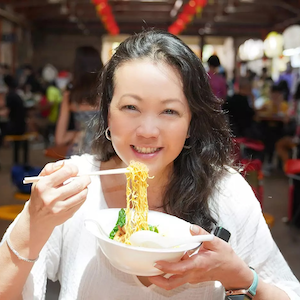
[00:00:10] Ray Latif: Hello friends, I'm Ray Latif, and you're listening to the number one podcast for anyone building a business in food or beverage, Taste Radio. In this episode, we sit down with Nona Lim, the founder of Nona Lim Foods, a trailblazing brand of convenient Asian-inspired meals, who reflects on the journey of building and eventually selling her company. Nona Lim describes the sale of her eponymous brand as quote, accidental. The way in which she positioned the company for success and an eventual exit, however, was anything but. Founded in 2014, Nona Lim Foods has become synonymous with better-for-you, easy-to-prepare Asian meals, offering everything from fresh noodles and broths to stir-fry kits. Nona, who first joined us for an interview back in 2020, has long advocated for the importance of product-market fit and a deep understanding of business fundamentals, two pillars that played a pivotal role in building a sustainable brand. Her focus and vision helped Nona Lim Foods achieve national distribution, securing shelf space in major retailers like Whole Foods, Target, Wegmans, and Kroger. In 2022, a serendipitous meeting led to the acquisition of Nona Lim Foods by Day Day Cook, a food and content brand platform based in Hong Kong. The partnership was seen as a perfect fit, with Day Day Cook's CEO highlighting their shared vision to bring delicious Asian dishes to the U.S., reimagined with clean ingredients for a modern, health-conscious audience. Nona continued to lead the brand as CEO until June of 2024. While the future of Nona Lim Foods is uncertain, its website is currently down and its social media has been inactive since July, Nona remains deeply engaged in the food and beverage industry as the chair of the board for the Specialty Food Association, which organizes the biannual Fancy Food Show. In this insightful conversation, Nona shares why founders should think intentionally about their end goal, the importance of generating retail velocity without heavy market spend, and why having a well-organized data room is essential for raising funds or preparing for an exit. She also opens up about the emotional impact of selling a business that she built from the ground up. Hey folks, it's Ray with Taste Radio. Right now, I am honored to be sitting down with Nona Lim, the founder of Nona Lim.
[00:02:45] Nona Lim: Hey, Ray, so good to talk to you again.
[00:02:47] Ray Latif: It is great to see you again. And for folks who might be saying, oh, wait, Nona Lim is the founder of Nona Lim. Yes, that's correct. She is the founder of one of the most innovative and influential ethnic food brands, I would say, of the past decade. So congratulations on all that you've built to this. Well, all that you built before your company got acquired, that is.
[00:03:08] Nona Lim: Thank you.
[00:03:09] Ray Latif: Yes. And congratulations on everything and all your work with the Specialty Food Association. You are the chair of the board of directors for the SFA and certainly one of the people that was behind its decision to move this show that we're at, the Winter Fancy Food Show, to San Diego or to actually adjust the name of it and just, I guess it's positioning a bit to the Winter Fancy Fair.
[00:03:31] Nona Lim: Correct.
[00:03:32] Ray Latif: And have it go to San Diego next year and back to San Francisco the year after that.
[00:03:36] Nona Lim: Yep, that's correct. You know, because I think that we felt that we wanted to be responsive to our members, to our attendees, to give them the best possible show. And the challenge that sometimes people don't realize is that with a lot of the convention centers, you have to actually book them two, three years ahead of time. And so that tied our hands in terms of how quickly we could respond to what people were looking for. But I'm excited. I think that San Diego is going to be fantastic. It is also a great foodie city. There are going to be some changes to the show, going to introduce much more experiential elements to the show. It's called Winter Fancy Fair, right? So that it provides a different theme to the New York show. We think that it's the beginning of the year, so it's the perfect time for your new product launches to see what's there as you come back from the holidays. So we're very, very excited about next year.
[00:04:27] Ray Latif: I gotta tell you, you know, every time I come to these shows, the Fancy Food Show, that is, I am just so happy to be here because The organization SFA does a really, really good job of attracting and incentivizing innovative brands to be here. Like if you go from the sections, I know there's no real context here, but from the 4,300 to the 3,000 aisles that are here at the Las Vegas Convention Center, you just see so much interesting, new, innovative brands. And they're all coming to market with something that's different, that's unique, that's exciting. And I love it.
[00:05:02] Nona Lim: Absolutely. There are hundreds of new brands, first-time exhibitors from the different incubators that we have relationships and partners with. And so you're really seeing the very beginning of trends, right? And what's great is that it is very affordable. You know, because we are a non-profit, we really focus on making it affordable for members to have a booth or have a small booth. In fact, I think I first launched at Fancy Food myself more than a decade ago in San Francisco.
[00:05:30] Ray Latif: I was going to ask you, how many Fancy Food Show is this for you now?
[00:05:33] Nona Lim: Oh my gosh.
[00:05:35] Ray Latif: I guess it would be 19 or 18 because of the COVID years. You missed a couple.
[00:05:40] Nona Lim: Yeah. Missed a couple because of COVID years. But yes, I've been at every Fancy Food Show since at least I think 2012 or 2013. Wow. Right. Or even maybe a year earlier, just walking in effect. Yeah. I mean, I love the show as well because it has such great food. It's so known for taste, right? Not just innovation, but flavor. That's a whole pavilion. I'm not sure whether you were there, that whole Wagyu pavilion. There were like seven different, right? Lots of different Wagyu providers from all different parts of Japan learning that A4 chuck roll. Actually, it's more to my liking than A5 because it has slightly less fat and a lot more flavor.
[00:06:15] Ray Latif: I'm going to say something that's controversial. I probably shouldn't say it, but I'll say it anyway. It was really cool to visit that booth. And I'm glad that they weren't serving plant-based Wagyu. Sorry to say it. Maybe one day there'll be plant-based wagyu that tastes like the stuff we tasted today, but my goodness, it really was fantastic.
[00:06:36] Nona Lim: It was, it was. In fact, there was a great plant-based gyoza as well that I tried, which was awesome, but they weren't trying to make it like some sort of plant-based protein. It's mostly made like a vegetable gyoza, right? So yes, definitely, I think taste, in my view, is the best at Fancy Food.
[00:06:52] Ray Latif: Yeah. So we chatted a few years back about how you built your brand on a limb and the power of saying no was the central theme of that conversation. The power of saying yes is also very important and you said yes. to an acquisition two years ago, about a year and a half ago. Congratulations again on that exit. And what I want to talk about today is how you think about preparing your brand for a potential acquisition. I know that's kind of a weird thing to say, and everyone's always like, don't think about the acquisition. Don't think about the exit. Just build a great business, build a great brand. But You know, at the end of the day, you have to give an acquirer a reason to want to look at you, to want to consider buying you. And I just want to start from the beginning because when you were initially building NonaLim and when you had the vision for the brand, I'm sure at the time you were like, look, I just want to put something on the market that's not out there already. But did you consider an exit even way back then?
[00:07:55] Nona Lim: Absolutely not, right? I think like many founders, we're also focused about creating fantastic products. You know, creating something that isn't in the market because we want to fill a market need, right? And that's how we think about it. I think that that gives us the passion to really focus on building the product. But, you know, if I were to do it again, I absolutely would look at the end goal in mind. I think a question that someone asked, which I never could answer, was that, are you building this business for your next generation? Are you building it, you know, to sell? You know, there are some businesses out there that are built for generations. Like, you know, my good friend Ken Shiro at Sun Noodle, that's a great example, right? It's kind of a pass down to him from his father. You know, there's something in there I think that will continue for generations. But then there are many others, right? Which is, if you're not going to build this and keep it for the next 50 years and pass it out to your children, what are you going to do with it? At some point, it has to go somewhere, right? So I think that that's probably the first thing to think about and to really understand within yourself which route you're going to go to.
[00:09:02] Ray Latif: I also think that brands that have come out of the gate with strong package design, a good sense of what they want to represent from a visual and design standpoint, have a much bigger head start than some of the brands that come out. Did you, I don't know, has the NonaLim, it's changed a little bit, the package design, the branding, has it changed a lot? Okay.
[00:09:24] Nona Lim: You know, this is an interesting one, right? Which is that whole philosophy, which is, you know, there are a few different ways to do it, right? Which is, I've probably gone through like three different rebranding, right? Over the years, packaging redesigns, in fact, maybe even four, yeah. And sometimes that happens because, you know, when we first start as an entrepreneur, we may not have a lot of money, so we're not hiring maybe the best people, the right people, or we don't know it. And in some ways that's okay, right? You have some brands that are started by maybe second-time founders, third-time founders, and they'll be able to raise quite a bit of money pre-revenue or early on, and they could hit it right, which is great. And you could move a lot faster because, you know, you're not making the same mistakes that you've made before. Like, you know, I remember speaking to the founders of Give me seaweed, right? One of the founders is Annie Chung. I remember her husband telling me that, you know, they have, in five years, done way exceeded what they did in 10 years. Because they've done it before, they know all the pitfalls to avoid. But as first-time founders, you know, the question is, sometimes you either make mistakes the hard way and you learn from it, or sometimes, you know, you are willing and you have the ability to hire experts to help you and then you can avoid some of those mistakes.
[00:10:39] Ray Latif: If I'm hearing you correctly, I think what you're saying, and correct me if I'm wrong, is that if you had invested in high quality package design from the get-go, it would have helped you in the long run. It would have made things a little bit easier for you in the long run.
[00:10:52] Nona Lim: Yes. But I think it's not so much high quality package design, right? I think that if I were to do this over again, I was just speaking to somebody before you got here, right? Which is what are the few things that I would really focus on. I think the first is really product market fit. You have to have product market fit with no friction. If you can get to that without investing a lot of money, it makes it so much easier to then have a really strong growth strategy, which will get you well placed for the acquisition. And by product market fit, what I mean is that making sure that the product has good velocity, even without a lot of marketing dollars behind it, right? There are some brands who have raised a lot of money and they're able to drive velocity with a lot of different kinds of marketing, whether it's social media or so forth, and to compensate for the friction that might exist there, right? And you have to think about it from, are you fulfilling the needs of the consumer that you want to go after? Does the packaging convey all the correct messaging so that they know what it is so that you're selling to your consumer, you know, is the pricing architecture, is the price point correct? Right? So if you can get that product market fit correct, then, you know, you will not waste as much time as I did, right? Because I think that I had a lot of issues in the earlier years with product market fit because I was too innovative.
[00:12:11] Ray Latif: Yes. And I think it's easier said than done. Oh, yes. And then I'll go back to package design. Sorry to keep going back to this, but wouldn't it make it easier for brands? Or maybe it doesn't. Maybe, you know, consumers see through, you know, the smoke and mirrors sometimes. And if you have great packaging, if you have a really slick looking front label, if they pick up your product and it doesn't taste good, it's not going to matter. wouldn't they be more inclined to see it? Wouldn't it be easier for a consumer to see it, want to pick it up, maybe even pay a premium?
[00:12:46] Nona Lim: Yes, but let's define what great packaging is. It's not just something that looks great visually, right? Great packaging means that you are communicating exactly the right hierarchy of messaging to your consumer, right? Whatever that might be. You know, what is the key messaging? Of course, there is that branding element, there is that, you know, the more artistic element. But your brand hierarchy, your messaging needs to be clear on your packaging as well. Are you selling health benefits? Are you selling flavor? Based on the product that you have, are the certifications relevant? And that's why I go back to really understanding that brand strategy and your great packaging translates from that. Otherwise, just having a great packaging designer to design a very cool looking package design, might not be great packaging because it does not address the consumer needs, right?
[00:13:37] Ray Latif: See, this is why I wanted to sit down with you, Nona, because I'm making it sound so simple and you're saying, no, no, no. There's a deeper analysis of how you think about your package design in terms of the holistic value of your brand to the end consumer. When you started to see some traction and you started to realize that, well, hey, I've got something that can actually be a good business, potentially even a profitable one. At what point did you start thinking, you know, maybe I could actually sell this to someone? How does that factor into your overall strategy?
[00:14:11] Nona Lim: Well, you know, my exit was actually somewhat accidental, right? So the story is that I was giving a keynote speech at a Fancy Food Show in, gosh, a year or so before I exited, you know, and someone saw me and then invited me to be on the panel with a bunch of Asian female entrepreneurs. And so my acquirer happened to be on that same panel. And after that, she reached out and said, hey, I'm going to be visiting San Francisco from Asia, would love to meet you. And then, you know, we met up, we talked about both our businesses and what we're aspiring to do. And, you know, she mentioned about her desire to acquire businesses in the US as a strategy, right? And then it just kind of organically happened that way. But what was important was that because I've always maintained my data room, So having a good data room makes it a lot easier to explore opportunities, whether it is with fundraising or with exits, right? It is one of the things that I did learn from one of my early investors to have that discipline. And that is key. So you don't have to spend a lot of time pulling it together when you actually want to fundraise or exit.
[00:15:25] Ray Latif: And what you just talked about is part of the conversation that we had in our first episode when you said, say no to opportunities where margin isn't what it needs to be for your brand. Say no to opportunities where you're gonna be stretched thin in terms of distribution, et cetera. And I think that's the thing that is probably most attractive to acquirers is that you've built a strong business that is rooted in fundamentals, if I'm hearing this correct.
[00:15:55] Nona Lim: That's correct. And then I think the same goes for fundraising these days, right? It felt a little bit like maybe in 2017 or 2018, the tendency was to kind of get distribution quickly and you spend quite a lot on trade, right? It's to grow top line. And of course, with COVID, you know, there was a huge focus on the bottom line, on gross margins, as well as your OPEX to make sure that you can get to profitability. And also there was a huge emphasis on managing working capital. Right? So understanding your balance sheet, understanding, you know, how many weeks of supply you have in your inventory and all those different things. So having those fundamentals, I think are essential, either for an exit, but also for fundraising, right? So that's number one. And so having the right unit economics in place. And then secondly, you know, having kind of growth strategy as well and having white space where you could grow after, you know, an investor gives you money or after an acquirer purchases you. So those are, I think those are quite similar in both ways.
[00:16:52] Ray Latif: Going back to when you said my acquisition was quite accidental. Yeah. Was there a point prior to that chance meeting where you had considered the long term or the longer term vision for your brand? You'd already been in business for almost a decade. And I'm sure you're thinking to yourself, well, you know, how much longer do I want to do this? And how much more of a runway does the Brad Avery? You were doing really innovative things, introducing new products, but was there a point at which you had said, I would welcome an acquisition? I know that's kind of a weird thing to say, because everyone wants to sell their brand at some point, right? And did you think about what you would want? And if you did, what were those things that you wanted? How did you assess your needs?
[00:17:36] Nona Lim: I think that, um, The biggest challenge for a founder is that we always need working capital in this industry, right? It's not like software where you can scale exponentially, whereas we're making products and then because you're making physical products, you need so much working capital because you have to, whether you're buying packaging in advance or storing products and you're not getting paid for 30 days or 60 days or whatever it is. And so the more we grow, the more money we need, the more resources we need. So at some point, it's like, where are those resources going to come from? And I think that when the opportunity came up, there were a number of things that factored into my decision making, right? Besides the opportunity to be acquired, it felt like a really good fit. because they had a lot of the supply chain in Asia, especially in China, which I wasn't as familiar with. I grew up in Singapore, so my supply chain was more focused around Southeast Asia and domestically in the U.S. So then being able to actually create all these innovative products that are authentic tasting, but clean label, and have access to that supply chain was huge. It meant that, you know, I could accelerate even more innovation. It meant that I could also get products at the right margins, right price points. So there were a lot of other things that I was considering in that decision-making process, right? And the team that I met, you know, they felt like really good people that I could work with. So I think those kind of were all factors in that decision-making process when I considered the exit and eventually took the exit.
[00:19:06] Ray Latif: Was it as much that you didn't want to fundraise anymore, that you were kind of tired of fundraising? No, because this is something that happened to an entrepreneur that I interviewed early last year. It was about a year ago. Her name is Alix Peabody. She's the founder of a canned wine brand called Bev. And she had this opportunity to sell her brand to Ian J Gallo's venture capital arm. And she was just like, look, I thought about this and I thought about what it would take mentally, physically, to run this brand for another five years, raise the kind of money we needed to raise, you know, to get new distribution in places that I knew E&J could take it without me having to raise all this money. She's like, look, I, this was a decision I needed to make for myself. And I would assume that, you know, raising money makes you want to tear your hair out.
[00:19:51] Nona Lim: But yeah, yeah, yeah, no, absolutely. There was that, but there was also all the value add that I was very attracted to, right? Because the access to the products, to the innovation, you know, and the acquirer was very strong or, you know, has strong roots on the social media front, on the marketing front. So it just felt like a really good fit versus just taking in money.
[00:20:15] Ray Latif: So how did your acquirer assess your innovation pipeline or the potential to take the brand to new places that hadn't currently existed?
[00:20:25] Nona Lim: I think that was a huge thing. I mean, definitely, you know, I think the acquirer was very excited with the brand that I've built. Because like you say, you know, I was one of the early trailblazers in kind of ethnic cuisine, Asian cuisine, clean labor in the country. And we chatted about what the innovation could look like, what are the products that existed out there actually in Asia or in East Asia that we could tweak. that we could improve on. And those were some of the things that were definitely a big factor.
[00:20:57] Ray Latif: So would you recommend to folks listening right now that, yes, I mean, they could come out with products that are innovative and unique, but even more important is to have an innovation pipeline, to create a brand where you could go in multiple directions, where you could do these things, even if you're not going to necessarily do them. Does that make sense?
[00:21:18] Nona Lim: You know, I remember I was reading something that John Forreca posted, right, which is kind of being very focused, being very focused on the category and not expanding everywhere. And I think that that sort of discipline is something that is fantastic, but then you need to understand the platform. But yeah, so what the innovation pipeline could look like, you know, what are the milestones, right? How would you expand it further so that it's not just a one hero product, which is important, but then where does it go? How is it a platform versus just a product, right?
[00:21:51] Ray Latif: The other part of this that we haven't talked about is the emotional part of this. You did this, you know, and you built your brand. It's your name. There's so much that is tied to you personally. And I think I can see, you know, this is something that really has affected you. You know, how do you think about that? How do you think about preparing yourself? to hand your baby, so to speak, over to someone else?
[00:22:18] Nona Lim: You know, I think that you always will have to kind of go through it. There will be a transition period, you know, there might be a honeymoon period, and then after that a transition period. So I'm not sure that's a lot that you can prepare yourself. You know that it's happening, right? It's kind of like, If your child goes off to college, you know that it's going to happen, but you're still going to miss it, right? You know that eventually your parent might pass as they get older, right? You know it's happening, but when it happens, you're still going to go through that process. So I don't think that you can prepare yourself by knowing that it's coming and then by being at peace with it and then feeling it and letting it go. I think those are some of the things you could do. It doesn't negate it, right?
[00:23:07] Ray Latif: No, it doesn't negate it.
[00:23:09] Nona Lim: You can prepare entirely for it, right?
[00:23:12] Ray Latif: I think there's a legacy component to it though, right? As long as you feel like you're putting the brand into good hands. And I think it sounds like, you know, you were happy with what the company that acquired your brand was considering when they were buying it. What it meant for them to be able to incorporate it into their organization, and you never know what's going to happen, right? Like, I think that's the thing, you know, you could say, okay, well, yeah, six months, it looks like it's going well. And 10 years later, you know, it's a completely different brand. But, you know, that's kind of how acquisitions work. I think so.
[00:23:46] Nona Lim: I think so. I think the main thing is letting go. I mean, once you've made a decision, if you can be at peace with that decision, you know, and then there would be time and then, you know, whether or not it happens the way you think it's going to happen, right? Those are the things. And I think that letting go is an act.
[00:24:03] Ray Latif: Yeah, for sure. You're also letting go and having opportunities to do things like you're doing right now, which is pay it forward. Absolutely. The experience that you have, the emotional toil of building a brand and perhaps the emotional toil of selling it are all things that you can help others prepare for. And you in your position as the chair of the board of the SFA, I'm sure there are people who are always coming to you looking for advice. And here we are in January of 2025. I mean, there was a time in my life where I was thinking about starting my own brand. I mean, look, the rewards can be amazing. And I think the opportunity to help feed other people and feed other people good food is a blessing, is an amazing thing to be able to do. But it takes a ton of hard work. At this point right now, where we are in the food and beverage industry, what are the things that keep you up at night for others? What are the things that make you worried about this next generation of founders?
[00:25:09] Nona Lim: I feel like as an industry, we're going through tough times, right? I'm not sure how much the fundraising environment has improved. You know, certainly I don't think it is the way it was, let's say back in 2017, 2018, right? The fundraising environment has generally not been great in the last few years. And then you have, you know, possible tariffs coming in, depending on what happens, what the new administration chooses to put in place. You could have labor costs going up exponentially. You could have tariffs making packaging, making a lot of things much more expensive. So the margins are already very thin for most of us. And so working capital is always an issue. Where are we going to get the working capital? As a new entrepreneur, how do you grow a business? And how do you get that scale? I think that all the challenges that I faced, years ago, building the business, I think it's just going to become, it's not getting easier for sure. And I think that's what's difficult.
[00:26:08] Ray Latif: I think another part of this is that there are just so many brands out there. The number of new food companies, of new beverage companies, you know, in the past, I think we'd see a failure rate where, you know, a brand would launch and then it wouldn't necessarily be there the next year. I think it's a good thing that they're able to make it to year two or three. But it feels like there's not many places for them. The grocery stores aren't getting that much bigger. The shelf space isn't getting that much more broad. And everyone talks about a shakeout, but there hasn't really been a shakeout and everyone's going after the same money. In fact, as you pointed out, there's less money out there. How much of an impact do you think that has on the future of this business?
[00:26:51] Nona Lim: I think there will be, you know, I think so. You know, of course, no, you're getting a lot of new brands because the barrier to entry is extremely low for someone to start a food company, right? So you can a lot of people starting, but to get it from zero to a million, it's not actually that easy. And then to get it from one to five, especially if there are no check sizes from investors coming in, you know, for even the one to five range, right? That's then how they're going to get from one to five. And then if you look at the grocery world, in the offline grocery world, some retailers are moving a lot more into private labor, right? So then that means there's even less space available for branded products, right? And then you have all the expenses that come with being on shelves, and then you have all the different expenses that come from working with distributors. So the... The amount of working capital needed to support the retail strategy is quite high. At the same time, DTC is no longer as easy as it used to be back in 2020. As we all know, CAG went crazy a couple of years ago, and food products aren't really that expensive. So what's the LTV that would justify that high CAG? And even if you have a LTV that would justify the high CAG, how long would it take to get to the LTV? You know, if you forecast that you have high repeats, that it would take you two years to get the LTV or three years, you know, how much working capital do you actually need to fund all of that till you can recoup the LTV of a consumer? Right, so it goes back to, you know, working capital, I think it's at a premium. And so, yeah, I feel like there will be a shakeout.
[00:28:29] Ray Latif: So then what's the answer? I mean, we have concerns for sure. There are ways to address those concerns. And I think maybe if I were to guess, I think it's about small and staying small for an extended period of time. I mean, perhaps.
[00:28:49] Nona Lim: I mean, because if you think about it, right, like companies that existed in the past, like Amy's, they took a very long time to grow, right? And I was so used to the narrative that, oh, you can come in and do this for five years and get explosive growth and exit. But I don't think that that is true. And so I think that staying small initially and being really, really scrappy initially to get that product market fit. But once you really have, you know, gotten that figure out, then you can fundraise a little bit less, a little bit later, right? And really figure that part of it out and be really, truly scrappy. And then, you know, you can think about growing. So grow at a slower pace. I feel like it's definitely a good way of doing it. You know, I was just talking to a couple of brands who are manufacturers, right? And one of them is happily growing at 20%, 15%, 20%, 30%, 15% year on year on year, has been around for a very long time, can afford to do that because they have their own manufacturing, so they have great margins, right? And it's able to do that. And that is a model that I don't think is normal or common in our industry in the last I don't know, five, six, seven years, 10 years? And maybe that is a model that we actually have to look at again, right? And it is still back to the art of saying no, but then it's still like kind of being strategic about expansion, continually being focused, I think, financially on the fundamentals.
[00:30:23] Ray Latif: The fundamentals. We've come full circle.
[00:30:25] Nona Lim: We've come full circle.
[00:30:26] Ray Latif: Yes, exactly. Nona, every time I sit down with you, every time I have an opportunity to have a conversation with you, I am so happy and honored to do so because you are open, you share the wisdom that you have, you're willing to help others, and it pays off in the end. I mean, good things happen to good people, right? So thank you so much for taking the time. I really appreciate it. I know our audience is going to get a lot out of this. So thank you once again.
[00:30:53] Nona Lim: Absolutely happy to be here. I'm glad that I can share.
[00:30:57] Ray Latif: I am too. That brings us to the end of this episode of Taste Radio. Thank you so much for listening. Taste Radio is a production of BevNET.com, Incorporated. Our audio engineer for Taste Radio is Joe Kratchy. Our technical director is Joshua Pratt, and our video editor is Ryan Galang. Our social marketing manager is Amanda Smerlinski, and our designer is Amanda Huang. Just a reminder, if you like what you hear on Taste Radio, please share the podcast with friends and colleagues. And of course, we would love it if you could review us on the Apple Podcasts app or your listening platform of choice. Check us out on Instagram. Our handle is bevnettasteradio. As always, for questions, comments, ideas for future podcasts, please send us an email to ask at Taste Radio. On behalf of the entire Taste Radio team, thank you for listening, and we'll talk to you next time.
[00:31:50] Nona Lim: you