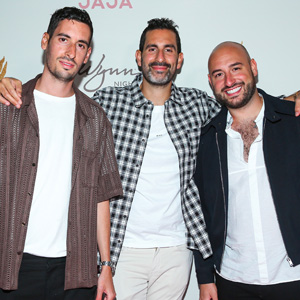
[00:00:10] Ray Latif: Hello, friends. I'm Ray Latif, and you're listening to the number one podcast for the food and beverage industry, Taste Radio. This episode features an interview with Maurice Tebele and Martin Hoffstein, who are the co-founders of fast-growing spirits brand, Ha Ha Tequila. Just a reminder to our listeners, if you like what you hear on Taste Radio, please share the podcast with friends and colleagues. And of course, we would love it if you could review us on the Apple Podcasts app or your listening platform of choice. How do you utilize social influence in an authentic way when promoting a consumer brand? That's the question faced by the five co-owners of Haha Tequila, who collectively have nearly 40 million followers across several social media platforms. Self-described as, quote, the first tequila created for the digital generation, HaHa was founded in 2018 by entrepreneurs Martin Hoffstein, Maurice Tebele, and brother Elliot Tebele, the latter of whom is best known as the creator of popular Instagram meme account, Fuck Jerry. HaHa is also co-owned by Alex Pall and Drew Taggart, who form globally renowned electronic DJ duo, The Chainsmokers. Leveraging their social capital and fame to promote HaHa has helped the brand achieve triple-digit growth year-over-year and outpace the overall category for premium tequila, according to the company. Haha's residence with younger LDA consumers attracted the attention of international spirits distributor Proximo Spirits, which signed a production and global distribution deal with the brand in 2021. In the following interview, I spoke with Maurice and Martin about how they evaluated the opportunity to launch a digital-centric tequila brand, why they describe Haha as an anti-celeb brand, and how subtle integration is the key to their social media strategy. They also explained how social marketing that is risqué and edgy, without crossing a line, has benefited the brand, how they elicit the best out of their respective skill sets, and how they determined that Proximo would be the right strategic partner for the company. Hey folks, it's Ray with Taste Radio. Right now, I'm honored to be sitting down with two of the co-founders of Ha Ha Tequila, Maurice Tebele and Martin Hoffstein. Maurice, Martin, how are you guys doing?
[00:02:36] Martin Hoffstein: Doing great. Good. Thank you. Good morning.
[00:02:39] Ray Latif: There are a couple other co-owners and co-founders of your brand. Well, one other co-founder and a couple other co-owners, maybe more than a couple, but Maurice, your brother Elliot is also a co-founder. And then you have co-owners who are quite well-known. They are known as The Chainsmokers. Now, uh, I'm sure anyone who's listening knows a tequila brand with a celebrity founder. However, I would never call HaHa Tequila a celebrity-backed brand or a celebrity tequila. That being said, you guys have noted that HaHa is in many ways an anti-celeb brand. That's kind of one of those Catch-22 moments where you have celebrities as owners, yet you're an anti-celebrity brand. How do you navigate that duality?
[00:03:28] Martin Hoffstein: It's very important for in this day and age for brands to have its own DNA. And I think what happens with celebrities is celebrities can go in and go out. And what happens is brand could live or die by their founders. So I'm not saying that Tebele and Martin and Allison Drew are going to go out of style one day. But what I'm trying to say is that We want the brand to be this living, breathing thing that continues to evoke the feeling that we set out to create when we made Haha. So it's more of an eternal type of energy that's going to be going on for hopefully many, many years with this brand. And it doesn't have to lean on a human being to get that feeling. I think that this brand has such a unique DNA that embodies everything that we love and stand for in terms of culture. But the brand itself stands on its own and doesn't have to lean on a person to get its message across. If you look at all the media surrounding some of our competitors in the space, they're always leaning on their founder. If you look at our content, we kind of lean on our own humorous lighthearted DNA that we put into the brand when we created it. So the brand kind of stands on its own. It's not reliant on a founder or a celebrity or a single person or a multitude of people. The brand is the celebrity here.
[00:04:58] Ray Latif: That's an interesting way of putting it. The brand is the celebrity. And I do want to talk about the content in a moment, but let's back up for a second and talk about the genesis of HaHa. You know, tequila, this is amazing, is poised to overtake whiskey as the most consumed spirit in America. Now, I think that would have been hard to imagine in 2018 when you guys launched. Martin, how did you guys evaluate the opportunity and the white space for Tequila when you guys launched?
[00:05:29] Maurice Tebele: I don't think we ever thought it was going to be what it is today. I don't think we thought there was going to be as much competition or as many brands or We didn't think it was going to be the drink of choice for everybody. For us, why we love tequila, we felt like tequila for us growing up was always the center of all these fun moments. So it was really about creating a brand for ourselves, our community, our friends, people that we felt were like-minded to us. We felt like there was a white space for just really visual identity perspective in terms of traditional tequila brands that I think came before us had very similar, I guess, brand visuals, right? It's similar bottle types, similar labels, similar stories leaned really into the heritage of Alisco and the craft of tequila leaned in a little highbrow, which I think is interesting, right? So I think the category started Maybe a little hangover is now in the direction of moving to highbrow. We wanted to create something that really felt in the middle of those two dynamics to say, hey, how do we create something that's universal for everybody, inclusive, approachable, accessible, something that almost breaks down a lot of the barriers of perception of tequila pre-2018.
[00:06:50] Ray Latif: It feels like a universal type tequila. It feels like it definitely could fit into a lot of liquor cabinets across America. But do you have a target consumer and has that idea of who is your primary consumer, has that evolved in recent years?
[00:07:07] Maurice Tebele: I think it has. I think when we started to build it, I was, I think, 27, Elliot was 26, Maurice was 31. So we were thinking around that age group in terms of who our target consumer is. Right now, we're seeing a lot of success with the younger generation of drinkers, right? So as over the last couple of years, we've gotten older. We're seeing our audience really grow from that 22 to 27-year-old consumer. So I think it's really about connecting with that younger audience who may not have experienced tequila before or may have experienced tequila through the lens of another brand. And then you grow an affinity and relationship and retention with that consumer over many years. So the goal is really to capture that kid out of college, first job, maybe doesn't have, you know, hundreds of dollars to spend on tequila, wants something that fits their personality. So I think that's where our relationship with that consumer starts, and then it continues to evolve over time.
[00:08:13] Ray Latif: I would think that that younger demographic, it has a lot to do with your content strategy and that your content strategy is very youthful and feels very focused on millennial and Gen Z consumers. That being said, I feel like some of your strongest assets are related to your brand name and your package design. Martin, you have some of that behind you. You have a bunch of bottles and a lot of bottles. Yeah, a bunch of tequila behind you, but the Haha name is pretty brilliant. If you think about it for a second, we'll talk to Maurice about that, as is the label. How did you come up with that name and label design, Maurice?
[00:08:51] Martin Hoffstein: The name was actually, it was just like drummed up out of nowhere by Elliot, my brother, but I don't think he realized how awesome it was when he said it. It was something that he said in passing and it was like, you know, he said it, the conversation ended like really quick. But at our next ideation and branding session with our partners, we were sitting down and I casually brought it up. Elliot mentioned it the day before or a couple of days earlier, whatever it was. And we looked at it. We looked at it. It's symmetrical. The haha word is Spanish, but it's not too Spanish sounding where it's like you're trying to be ethnic at the same time. We also found that, you know, J.A., it kind of symbolizes Jalisco. So, you know, Jalisco starts with J.A., so, like, loosely ties to that. It embodies everything that we wanted to stand for, which is Lefter, and, you know, kind of set the basis for the brand in terms of everything around it. It just always ties back to Lefter and celebration. So that's where the name came from.
[00:10:00] Ray Latif: And Martin, as I mentioned, the label design is really striking as well. What were you trying to convey on the front of the pack, on the front of that bottle?
[00:10:07] Maurice Tebele: The first thing was we wanted to stand out on the shelf and the back bar, right? So we wanted to create something that felt vibrant and fun. It's really inspired by Maurice and I, when we, our first trip to Jalisco, we took a bunch of pictures, you know, and you had these beautiful hills and mountains and agave fields. And we thought of creative ways to take like artistic direction and inspiration from like Matisse and Rothko. interpret that into what would that world look like in like Halleysville land? Or, you know, how can we create a haha world inspired by Halleysville, inspired by these awesome artists, and just create a package that feels vibrant, fun, that plays to who haha is supposed to be? Because that's the first impression when you see haha is like, what is that? I want to try it. It's so different than anything I've ever seen. And I think that was like our way to catch the consumer first, right? or catch the eye of the consumer. And then let the tequila, which is I think the most serious piece of what we do, right? Because at the end of the day, you could have beautiful packaging, you could have a fun name, but we wanted to make sure that, you know, the spirit and the tequila and the core of what the product is and what the brand is, was the best that it could be, which was really important to us.
[00:11:27] Elliot Tebele: Guessing your margins? That's risky. Belay Financial gives CPG brands the clarity to scale smarter, faster, stronger. Get your free inventory ebook by texting TASTE to 55123 and start making data work for you. Vibrant Ingredients is the natural ingredient partner powering food and beverage innovation, delivering flavor, function, and protection through a science-backed portfolio. Vibrant delivers purpose-driven solutions that help brands create extraordinary experiences. Discover what's possible with Vibrant today. Visit VibrantIngredients.com.
[00:12:14] Ray Latif: You attract consumers via your package design. You win them over as customers via the liquid itself. And when I'm thinking about HaHa, immediately I start thinking about a brand called Truff. And I'm pretty sure you guys are familiar with that brand, a brand of hot sauce. And I see a lot of parallels between the two brands in that they have deep ties to social media and millennial culture. That being said, can you talk about how HaHa has leveraged social media to help develop the brand, to help grow the brand and scale it?
[00:12:50] Maurice Tebele: Social media is really interesting. When I think through HaHa, it's like, I almost think of HaHa as almost one of the first, if not the first brand or spirits brand built out of social media, right? Massive audiences, utilizing LEH channels, a lot of influencers, a lot of partnerships. It was a way for us to A, get a ton of impressions and visibility on the brand itself really quickly out of the gate. And then on a continuous basis, it allows us to really stay true to what HAHA is, right? It's being approachable, being funny, not taking ourselves too seriously, creating content that is not always about the tequila, but more about the brand. And how do we create something that I think is relatable to the younger consumers? you know, meme culture, but also office culture and humor. So we use it for storytelling. We use it to poke fun at ourselves and pop culture. And we use it really as like the first line of defense of communication with our consumers, right? So it's, you know, as we think through the evolution of social media and the evolution of content with new platforms and new types of content and video, you know, we want to make sure that we're social proofing the brand. So we're using the content that people have been submitting for the last, you know, four plus years of whether it's them consuming haha or them showing off haha. It's a core component that anybody could be part of our lifestyle or our brand. It's not just about Maurice, myself, Elliot, Pall and Drew. It's about really the fans and the consumers that enjoy haha every day.
[00:14:30] Martin Hoffstein: We also use our social channels as a listening device to basically get like a feedback loop from everybody who engages with the brand and drinks our product. We constantly optimize what we do based on what people are liking. And I'm not talking about like changing the way that tequila tastes, but I'm talking about the way we activate from a experiential perspective, the type of content that we put out, the type of merch that we put out. We're constantly optimizing that based on what we learn from our consumers through social channels.
[00:15:04] Ray Latif: Yeah, I'm glad you brought up experiential, Maurice, because I think you mentioned this the last time we chatted, which I wrote this down. You said that we try to be as experiential as possible. We have risque messaging sometimes, and sometimes we piss people off. That being said, you know, how far can you go without crossing the line? Or is it really important to test that line as does a brand called Liquid Death?
[00:15:27] Martin Hoffstein: Yeah, I mean, we have a lot of different characters on our founding team. And we kind of throw ideas around. And like if it passes the pressure test of being like almost too much, but like just enough, we'll usually just put it out. But we have people that have different vantage points on, you know, all types of political, social issues. We use them as a barometer internally to really see if it's something that's over the line or not. Because we come up with some really crazy shit that we don't put out. really, really cool stuff in my opinion. But some of it's just not suitable to get out there. But we definitely go a little bit further than most brands when it comes to staying politically correct.
[00:16:10] Ray Latif: You do have people on your team who have been doing some risque stuff for a while, and I'm alluding to Elliott, who has a very influential and popular Instagram account called, and now I'm going to have to check the box on Apple Podcasts because I'm swearing, it's called Fuck Jerry. So I think just from that standpoint, you already have someone who's willing to push that line. That being said... And I think a lot of people know Haha from Fuck Jerry, but how do you use that existing and influential social capital in a way that's going to benefit the brand?
[00:16:43] Martin Hoffstein: Subtle integration, I think is the answer. Subtle integration. It's not front and center of anything that goes on those channels. It's always something that's just, you know, slightly, casually integrated into the content that people are already on those channels to find. So if Elliot has a meme and it has to do with, you know, someone drinking, throw a ha ha in there, you know, casually. And it's getting impressions and it's an advertisement. but people don't even realize that they're being, I don't want to say targeted, but yeah, targeted.
[00:17:19] Ray Latif: I think that's an approach that's effective, but some might call it, and I'm not calling it this, and forgive me for saying it, but some might call it maybe underhanded.
[00:17:29] Martin Hoffstein: I mean, you got to use your channels. If you have a following and you're launching a brand because you have that following, why not utilize that following to gain impressions on the brand? You know, I mean, you want to call it a cheap shot by all means. I think that's business. If you have it, you have the following, utilize it, get the impressions. push your brand out there. That's what it's all about. That's what every other celebrity brand is doing. They're leveraging their fame, they're leveraging their social media following to convert it to sales.
[00:18:04] Maurice Tebele: And I also, just to chime in for a second, I think you had this cash 22 that you started the question off with, right? The celebrity and non-celebrity brand. And I think Elliot wears haha on his sleeves, right? In his bio of Fuck Jerry, there's, you know, add haha and he tags haha. So I think his audience specifically knows Elliot's connection as a brand owner to haha, right? So we also want to make sure that the content that Elliot's pushing on his channels is native to what his audience wants and what his customers want. So we want to make sure that, you know, if we are going to push and message haha, it's not the hey, go try my tequila, because that would kind of be inauthentic to what Fuck Jerry is. But how do we tell that same story in a funny, approachable, Fuck Jerry way, and use the power of memes to convey that? And I think, you know, similarly, with the The Chainsmokers, right? So the The Chainsmokers, you know, they wear haha on their sleeves, and everybody knows the connection of The Chainsmokers and haha. That doesn't mean that You're going to see an advertisement in a liquor store of Pall and Drew holding a bottle of ha ha. But ha ha will be integrated into their shows and their moments and their events and their activations in a way that's authentic to who the The Chainsmokers are. So that was something that we felt was really critical when we started the brand was. You know, we didn't want it to be a quick sell. We wanted it to, we wanted to create a true relationship between the brand and our partners and as brand owners and not as ambassadors. And we think that doing it the way we're doing on FJerry The Chainsmokers is the best way for Haha to grow, you know, and continue to grow outside of their channels.
[00:19:52] Ray Latif: Is your social strategy, is your experiential marketing strategy, is that something where it's as specific in terms of return on investment? I've asked this to a number of founders in recent episodes, which is, how do you measure success when it comes to social or experiential marketing campaigns?
[00:20:10] Martin Hoffstein: You can look at the reactions straight away. You can derive a conclusion on how things are looking in terms of like quantitative analytics. It's very difficult to gauge success. It's more of a zoom out. You know look over a year. Look at the performance over a year. See how we grow. But in terms of direct correlation to what we do on social media, because we don't control the sale because of the three-tier system of alcohol, it's very hard to derive a conclusion on how effective something was online. Now, more and more people are shopping online for alcohol, so it's starting to get a little more transparent in terms of driving traffic directly to a sale. But up until like right now, we're starting this evolution in purchasing behavior. It's been very hard to figure out what's working in terms of like, what's going to get some people to get up off their chair and go buy a bottle off the shelf.
[00:21:06] Ray Latif: Martin, in terms of budgeting for social media and marketing, do you guys have a leg up on your competition in that it isn't as expensive as traditional marketing like billboards, TV advertising, et cetera?
[00:21:19] Maurice Tebele: Yeah, I mean, I think it's a leg up in terms of like the value propositions that some of the partners bring to the table. But I think there's a lot of other brands in the space that now have bigger channels, bigger platforms and larger audiences. So I think it's a way that we could play. It's a way for us to storytell. It's a way for us to get in front of consumers on a regular cadence. But even the evolution of platforms, right, as the new TikToks of the world pop up and playing in those spaces will be really interesting and how other brands play in those spaces will be really interesting. So we want to be where the consumers are. Content creation is expensive. Putting out the right content is costly. But I think, as Maurice said earlier, it's It's our front line of communication and defense and reaction to what the consumers are saying in real time. So we invest in it as really a listening tool beyond just. you know, pushing content out, but what are people saying? Do they like what we're putting out? Do they want us to change things? It's also a way for us to test new product releases or collaborations or partnerships or just like out of the box ideas without actually going into production and seeing what the reaction is. And it's been a really valid tool in kind of spreading HaHa's message across, you know, millions of people.
[00:22:41] Alex Pall: Do you want more repeat buyers on Amazon? Well, this free resource in collaboration with Straight Up Growth will help your brand turn first-time buyers into long-term subscribers. Download Winning the Repeat Purchase Game on Amazon now at Taste Radio slash SUG. That's Taste Radio slash S-U-G to start building retention-driven growth for your brand on Amazon. Scaling a beverage brand into major retail comes down to operational readiness. From packaging lead times to co-manufacturing strategy, the details can make or break a launch. In a new e-book in collaboration with Octopi and Asahi Beer USA, industry leaders share what they've learned in helping brands scale. Download it now at Taste Radio slash octopi.
[00:23:31] Ray Latif: Speaking with both of you, it feels like you bounce off each other quite well. You bring a lot to the table, depending on what your particular skill set is or what your particular skill sets are. But how do you elicit the most, how do you elicit the best out of that skill set from each person, Martin?
[00:23:48] Maurice Tebele: So I always say it's funny, actually, in a lot of ways, Maurice and I are very alike. And in a lot of ways, we're very different. I think oftentimes I am more analytical and Maurice is a little more I don't want to say impulsive. Yeah, but impulsive. Impulsive. So the perfect example is like when we thought about starting HaHa, and then I'll tell you this quick story. But, you know, we sat down at dinner, we had this conversation. Okay, great idea. Let's figure this out. I was like, OK, let's start to build out a brand book or brand idea or hypothesis or mission statement. What are we trying to create? And Maurice was like, before we even do that, we need to go to Jalisco and spend some time there and understand what it is that we're doing. And I said, how can we go there without a brand? How could we go there without a logo or a name or like a big idea. And he's like, just book a trip for August 16. And we'll go. And I said, but we need all of these different things before we go. And he's like, just book the trip, and we'll go. And we booked the trip, we went. And that was really how Haha was kicked off. And I don't, I think if Maurice didn't push me or push us to go book that trip on, on the 16th, the brain wouldn't exist today. Right. So, and I can give you, you know, hundreds of examples where I think we feed off each other for the best interest of the business. And it's really about compromise and getting to a place where we're challenging each other at times, but we're also learning from each other on a consistent basis on how to evolve and be. better managers or better partners or a better influence for the team.
[00:25:29] Ray Latif: It also helps when you have committed co-founders or at least committed co-owners, like you mentioned with the The Chainsmokers. But how do you utilize those guys to the best of their abilities?
[00:25:41] Martin Hoffstein: So it's kind of like, how do we work backwards and get the brand integrated into what they're already doing instead of trying to like get them to stop doing what they're doing, which would be, I think, a crime to humanity and integrate it backwards so that the brand rides their success and grows with them.
[00:26:01] Ray Latif: Was it their decision to be as intimately involved in the business strategy and the sort of day-to-day or was it something that you guys encouraged out of them?
[00:26:10] Martin Hoffstein: I mean, they showed a tremendous amount of enthusiasm out of the gate when the partnership was formed. We have weekly calls, you know, we chat on a regular basis about pretty much every single part of the business, whether it's like Martin said, hiring, marketing ideas. They also have pretty good senses of humor to compliment what we're already doing from a media perspective. So that's cool. Really, it's just synonymous brand. The Chainsmokers and HaHa are really synonymous and it just feels so natural.
[00:26:43] Ray Latif: It feels like Haha has always sort of been on the right track. The company has, the brand has the right building blocks to get to a point where it is quote unquote successful. However, one thing that was lacking was the strategic partner, something that changed last year in 2021 when Haha aligned with a company called Proximo Spirits. Martin, how did you evaluate Proximo as the right strategic partner for Haha?
[00:27:08] Maurice Tebele: I think for us, to be honest, at the beginning, we felt like maybe we don't need a strategic partner right now, or maybe it's too early in the life cycle of Haha to align ourselves with a strategic partner. But we looked at Proximo's owned by Cuervo. And in a lot of ways, I think Haha was built to be like this anti-tequila or anti-celebrity tequila, like we say it a lot. But getting the buy-in and love and appreciation from Juan Beckman, who is 11th generation of tequila makers and producers was really astonishing, I think. And looking at their portfolio and looking at some of the other brands, they've done an amazing job at growing those brands, both in Mexico and the US and internationally. So we thought it was a great alliance for us or a great strategic partnership to help continue to grow the vision of HaHa and have the expertise of the largest tequila producer in the world. It also allowed us to move from a contract distillery to a distillery owned by our partners. So from a production perspective, there's clear insights on where the agave is coming from and the production process, which is really important to us. And yeah, we've been able to leverage that to continue to scale and grow. So it's been great.
[00:28:28] Ray Latif: I read that they're not involved in marketing, that they are very much a production and distribution partner for HaHa. Is that accurate? Is that right?
[00:28:38] Maurice Tebele: Yeah. They give us the ability to do what we want to do and what we think is best for the brand. They've been resourceful, they'll give their opinions on what they think we can do better or what kind of efficiencies we could create, specifically when it comes to below the line marketing and marketing and awareness with the distributors and the suppliers and through the retail chains and so forth. But more of the above the line brand awareness campaigns, The ideation and execution really sits with the internal HAHA team.
[00:29:10] Ray Latif: So you've never gotten an email from Proximo being like, Hey, maybe you should take that post down?
[00:29:15] Maurice Tebele: Across the line, no.
[00:29:18] Martin Hoffstein: Not yet. Not yet. Proximo approached us about two years ago now. And I think that they were, they were watching the tequila space evolve before their eyes. And their brands and their portfolio, specifically of tequila, are super heritage. Everything in their portfolio is heritage. And they're watching, you know, this celebrity is launching brands and they're watching the way tequila is being branded change before their eyes. And they felt that they had a void that was forming in their portfolio. They said, we need to have exposure to this new way of tequila that's being manufactured by all of their competitors. They took a stake in HaHa, and now they have They have a great piece of the new trend in tequila. And that's, I think, what attracted them to us. And then, like Maureen said earlier, what attracted them to us as partners is their experience with what's going inside the bottle. We think it's very important that we have a professional level of consistency. Contract distilleries don't offer that. I don't care what anyone says. You're getting a different batch of tequila every single time you do a bottling. With our current partners at Proximo, it is always going to be the same. It's always going to be superb and it's always going to be what we signed up for.
[00:30:53] Ray Latif: Well, this has been a really fun conversation. Maurice, Martin, thank you so much for taking the time to sit down with me.
[00:30:58] Maurice Tebele: I really appreciate it.
[00:30:59] Ray Latif: Absolutely. It's been a pleasure speaking with both of you, learning more about the brand, and I'm really impressed with what you've accomplished in a relatively short amount of time. I'm really excited for the future of HaHa and excited for you guys. You're doing what you love, and that's really the most important thing. Thank you. That brings us to the end of this episode of Taste Radio. Thank you so much for listening, and thanks to our guests, Maurice Tebele and Martin Hoffstein. As always, for questions, comments, ideas for future podcasts, please send us an email to ask at Taste Radio. Our audio engineer for Taste Radio is Joe Cracci. Our technical director is Joshua Pratt, and our video editor is Ryan Galang. On behalf of the entire Taste Radio team, thank you for listening, and we'll talk to you next time.