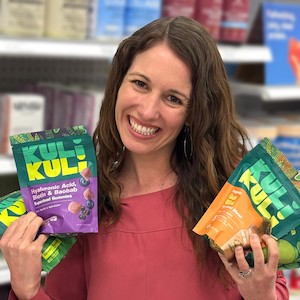
[00:00:08] Ray Latif: Hello, friends, I'm Ray Latif, and you're tuned into Taste Radio, the leading podcast for entrepreneurs and innovators in the food and beverage industry. In this episode, we're joined by Lisa Curtis, the founder and CEO of Kuli Kuli, who reflects on the brand's evolution from a moringa-based startup to a mainstream superfood brand. What do TikTok, Walmart, and African superfoods have in common? They've all played a role in the remarkable resurgence of Kuli Kuli, the pioneering superfood brand founded in 2014 that introduced Moringa to the U.S. market and is now carried in over 11,000 retail stores nationwide. Once known primarily for its Moringa products, Kuli Kuli has since expanded its portfolio and reintroduced itself with vibrant new packaging, a broader superfood lineup, and a renewed focus on flavor and accessibility. Now found on shelves at Walmart, Target, and other major retailers, Kuli Kuli has traded in-store demos for a digital-first marketing strategy, including leveraging Moringa's surprise moment of virality on TikTok. In this episode, founder and CEO Lisa Curtis shares the behind-the-scenes story of Kuli Kuli's evolution, from navigating pandemic-era disruptions to spearheading a bold brand refresh that helped the company redefine its mission and identity. She also unpacks what it took to guide the brand to profitability, why shedding the Moringa-only label was crucial, and what she sees as the ultimate key to long-term success in the crowded wellness space. Hey folks, it's Ray with Taste Radio. Right now, I am honored to be sitting down with Lisa Curtis, who is the founder and CEO of Kuli Kuli. Lisa, it's great to see you again.
[00:02:12] Lisa Curtis: Great to see you.
[00:02:13] Ray Latif: So we missed each other at Expo West, but I heard it was a fantastic event for you. And I didn't get to see your booth, but the photos that I saw were amazing. And they featured the brand spanking new look for Kuli Kuli, which is awesome. It feels very vibrant, bright, exciting. It feels like a lifestyle brand so much more than it did in the past. And what you had in the past was great. This definitely feels like it is made for the modern consumer, especially at mainstream retailers.
[00:02:47] Lisa Curtis: Yes, I will admit as a founder, I was dragged into this kicking and screaming. I loved our old logo. I loved our old packaging. I was like, I don't want to change a thing. And then we went down this rebrand process and I was like, oh, this, this is better. Okay. I love this. Let's do this. And it has turned out so well. So big, big shout out to our designers. Faven did a great job.
[00:03:12] Ray Latif: Well, you've been at this for 10 years and it's hard to, as they say in our industry, kill your darlings. Certainly there are things about your brand that you want to hold on to as long as you can, but change is necessary sometimes. What did you feel like? What did your designers feel like you really needed to communicate on that front of pack and on the back as well?
[00:03:31] Lisa Curtis: Yeah, so we've been hearing for years that people talk about our products in the sense of like, oh, I love that Moringa powder. I love those pink gummies. I love that like blue blend and never did they say I love the Kuli Kuli Moringa powder. Kuli Kuli blend, Kuli Kuli gummies. And we also knew that they really thought of us, you know, when, if they thought of us at all as the Moringa company. And we are now at a place where half of our products don't have Moringa in them, but in fact feature other sustainable superfoods that really meet our mission of climate smart community grown crops that we think are where our world should be headed. The rebrand was really about bringing our brand to life and making it clear that we were more than Moringa and really this sustainable superfood brand.
[00:04:30] Ray Latif: It probably helps to have a look like yours now when you're in Walmart. And when we last sat down for Taste Radio was in July of 2019. And the title of that episode was How I Got Into My Dream Retailer. And at the time you were talking about Walmart and how you made your way into that mass chain. You've since gotten into another one that is, I would say just as big, which is?
[00:04:56] Lisa Curtis: Target.
[00:04:57] Ray Latif: Target. Congratulations. Yeah. Why is Target so important to you?
[00:05:01] Lisa Curtis: You know, I've been trying to get in Target for like, as long as Kuli Kuli has been around, because I just see the way that Target has made so many brands in our space. Like if you look at Ollie, if you look at Bloom, in many respects, like a lot of health and wellness, you know, supplement brands get their real first big break and target. And I think a lot of our customers shop there and being on that shelf next to bloom, next to grooms, next to some like really key players in the industry, just like show that, yeah, we are a brand that is a cornerstone of health and wellness for superfood consumers.
[00:05:43] Ray Latif: Yeah, I would agree. You used to be next to Energy Shots. Yes. When I first was introduced to Kuli Kuli, you were selling shots of Moringa, those two ounce shots that were powered by Moringa. And a lot's changed since. Well, a lot's changed for the brand, a lot's changed for you. And you've been doing this for 10 years. And I mentioned, you know, typically I ask this question at the end of the episodes. I feel like it's appropriate to ask you toward the beginning of this episode. How have you maintained? Have you managed? How have you evolved? Has the brand, you know, lived up to what your vision was for it at the outset? Starting a CPG company is challenging for a year. Doing it for 10 years, I can't imagine what that's like, but talk about your experience. Talk about your journey.
[00:06:33] Lisa Curtis: It is a roller coaster. You know, I have to be completely honest, like we, we came out of the gate really hard. Like we had a lot of momentum when we first launched in 2014. And then we entered COVID and our revenue got cut in half. And it took us literally three years to recover. There were a lot of moments where I was like, I don't know if we're going to make it. Like, I don't know if I'm going to be doing this a year from now. And that's like such a hard thing to be thinking. And it, it really just came down to like, you know, me and my co founder believing that this business should exist, that we have a purpose that is, is greater than just selling products that we really owed it to our small farmers and our supply chain to like keep going despite all odds. And you know, I joke that we're like now a 10 year overnight success in the sense that we're projected to double in revenue this year. So it's, it's been an exciting ride. It's also been a super challenging ride.
[00:07:36] Ray Latif: Are you happy?
[00:07:38] Lisa Curtis: I am I'm so happy. I mean, I love learning and growing. And like, I think the really cool thing about growth is that it, it just pushes you in new ways. Like, I feel like I'm being pushed so much as a leader to like, okay, we built this company up to, you know, 10 million-ish in revenue and now we're nearly doubling that. What does that look like from a team perspective? What does that look like from a leadership perspective? What do I need to do to set us up for success? And I think these are important things for me to learn and they're also really exciting opportunities for me to grow as the company grows.
[00:08:18] Ray Latif: Yeah, I think that's the thing that would make me excited if I were an entrepreneur, which is the potential for growth, the potential to lead more people, to employ more people, to help the farmers that you were talking about, to expand access to Moringa or for Moringa to more people. I think it's also in some ways nerve wracking and can be frustrating in a lot of ways as well. How do you stay even keel? Do you have to, is it important to stay even keel in your business?
[00:08:45] Lisa Curtis: Oh, it's so important. I mean, it's a marathon, not a sprint, right? Like we are not a we are not a like, snap your fingers, put out some product and the world comes to us like that's never been the coolie coolie story. Like we have worked so hard for every win that we've gotten. And I find that I really spend a lot of time like ensuring that I have taken care of myself first so that I'm in a place where I can take care of everything else. So I very adamant my eight hours of sleep, I run every single morning, I eat really, really well, like even when I'm traveling, I like travel with like, you know, a bunch of superfood powders and really intense about not just eating junk food, not trying to work till midnight and then wake up at 5 a.m. I need to be in a position where I have the resiliency to take whatever the world throws at me.
[00:09:37] Ray Latif: Some people might say, well, that doesn't sound like a lot of fun. I'm not saying that. I'm just saying the cynics out there who are listening might say that. Do you have fun as you're doing this? I have so much fun.
[00:09:46] Lisa Curtis: And you know, one of the things that my co-founder and I did a couple of years ago when we were in that really hard moment of like, we're stagnating, we're not growing, this is not fun. We really kind of went back to the basics and we're like, what makes this fun for us? What do we enjoy doing about this business? And for both of us, we're adventure lovers and we love traveling and we love learning about other cultures. And we specifically love that Cooley Pooley is so connected to these amazing farmers on the other side of the globe. So we spend three weeks out of the year traveling and visiting with them and just like, having a great time understanding, like, what it, you know, what does it look like to like, live in Zimbabwe and harvest baobab? And what, you know, we're at the end of this end of May, we're going to Mozambique and spending a while there on the ground. And like, that's the stuff that makes me come alive. And I think for both of us, it's like, find the things that make you come alive and like, go do more of that so that you can continue to do all of the other stuff.
[00:10:50] Ray Latif: I love that. Find the things that make you feel alive and do more of it. That's a great piece of advice. And people don't do it enough. I think you tend to find ways to avoid the things that you love sometimes because other things get in the way. But, you know, life throws a lot of curveballs at everyone and it's just, how do you manage it? And sometimes those curveballs are good things. Like when Moringa starts trending on TikTok. And in a really strange way, when you reached out, please tell our audience all about why Moringa started trending and how it really blew up on that platform.
[00:11:24] Lisa Curtis: Yeah. So it started last year, actually, where we started to notice that our Amazon sales had spiked 70%.
[00:11:36] Ray Latif: Wow.
[00:11:36] Lisa Curtis: Yeah, I know. And then we noticed that our Whole Foods sales were up 40 to 50%. And then we started to see our Walmart sales also up. And it like literally, our team was like, what is happening? Like, what is going on? And what we figured out is that there's a company from China that had started to sell Moringa capsules online and they were creating AI generated TikTok videos using various like wellness practitioners like using their likeness without their permission to talk about Moringa and to talk about the benefits of Moringa and those videos were like hitting millions and millions of views. Some of them, I think, got like 4 million views. And so it was like ricocheting across the internet. And then people were looking for Moringa. And we're 70% of the US market for Moringa. So when they look for Moringa, they find Kuli Kuli. And so it was this weird moment where we were like, we would never release these videos. We don't actually agree with the claims that they are making in these videos, but we feel good about these customers coming to us. And we feel good about Moringa being more prominent. So it has been kind of a wild thing where, and then like they turned them off for a little bit. Like I think maybe they got some of them shut down. And then right after the election in November, where I think there was just like a general signal of, hey, you can make any claims, put any marketing stuff you want on the internet, nobody's gonna stop you. Then it turned up again in a really dramatic way. And so we saw our Moringa sales turn up pretty strongly. And so there's been like this interesting kind of like Maha intersection with Moringa that has been fascinating to watch.
[00:13:28] Ray Latif: How much of that Maha can you embrace?
[00:13:33] Lisa Curtis: I embrace anyone who wants to live healthier. I think it is great for all of us to see food as medicine and to pay attention to what we put in our bodies. I think when it starts to get down the road of like questioning vaccines and questioning medications that's where I stop at the road. So I think you know embracing Moringa as like an amazing supplement that like for so many people is a real game changer in their health is awesome. And I think what we really tried to do was like seeing what was going on in the internet and then making TikTok response videos. So I feel very proud. One of our scientific advisors is a guy named Jed Fahey at Johns Hopkins University. This guy's in his 60s, never made a TikTok video in his life. And we're like, Jed, we need to get you on the internet. Like we need you to speak to this. And we worked with him and made a video that got hundreds of thousands of views really kind of responding of like, here's what we know about Moringa, here's what the science says, here's what we don't know yet, here's what we see, you know, from the various cultures around the globe, and here's what has clinical trials. And so that was a really cool way for us to kind of respond. And then the other thing we did is we actually funded a clinical study with Moringa and diabetes. So that was one of the claims that we saw was getting made a lot, and there actually hadn't been a U.S. study on it. There have been a few international, and so we actually just released the results of that last week, and there's some really promising stuff from people wearing the CGM monitors, monitoring the blood glucose levels, baseline study, and then adding in moringa powder, and that actually helping to really reduce markers of inflammation and also blood sugar levels.
[00:15:27] Ray Latif: Did you feel like there might have been a bit of risk in not necessarily countering the claims that were out there, but doing a side-by-side or sort of myth versus reality or common misperceptions because there was so much excitement and you didn't want to You know what I'm saying. You didn't want to stop that flow. You didn't want to make it seem like Moringa was a bit more esoteric than what was already out there. You just wanted people to know more about it. So I guess, how do you balance this desire to put more education out there while maintaining the momentum that Moringa already had?
[00:16:01] Lisa Curtis: It's a tricky balance. It is definitely a tricky balance. I think for us, what we kind of determined is like, we don't want people coming to Moringa thinking that it's gonna fix all of their health problems. Like, I don't really want anybody going to any supplement thinking that it's gonna fix all of their health problems. It's not the way our bodies work. And I think that like, us taking a bit of a stand and you know we did like the the tic-tac response videos where you sort of play the video that's gone viral and then you give your response to it was like a nice sort of gentle counterpoint of like yeah there actually are some great studies on moringa there's actually some really amazing ways that it's used around the world and here's where we still need to do more research.
[00:16:50] Ray Latif: As I mentioned, you originally sold shots or my first introduction to the brand was via shots. You have a whole different kind of product lineup today. When it comes to your innovation strategy, how has that evolved? How have you tested, learned, and finally come to a place where you feel really strongly about this is the best way for folks to consume Moringa and other superfoods?
[00:17:15] Lisa Curtis: Yeah, it's a really good question. I think we have failed our way forward for 10 years and I think we're finally in place where I feel good about our innovation strategy. I think if I've learned anything is that we need to kill products faster. So we were 1 of the 1st to market with. wellness shots, like before a lot of the brands that you see on shelf today, we started selling them in 2016. And I think we were too early. I think we were a non-refrigerated product in a set that like fundamentally people look for in the refrigerated section. And I think we didn't taste as good as we should have. And we kind of knew all of these things like three to six months into that launch, like we kind of knew that it wasn't working. And we didn't kill it. We decided to reformulate, which was the wrong answer. I think similarly, you know, bars were actually the very first product that we launched in the market. And we held on to those until last year. We finally killed the bars. Similarly, we did a superfood chocolate bark, something that we launched and it performed super well when it was on discount. And that discount was at a number where we couldn't actually make any money on it. And we had sort of like this hope and dream of economies of scale that never materialized and took too long to kill it. you know, I'll tell you about our innovation strategy today. So last year, I launched eight new products onto the market. And just last month, we killed two of them. So we are trying to be really fast and focused in putting our energy behind the things that are working and killing the things that are not.
[00:18:58] Ray Latif: I love the Bark, by the way. I'm sad to see that go, because that was a really good product. But it seems like what fits, the question is what fits into modern consumers' lifestyles? And the lattes in particular, I feel like are a really easy way for people to incorporate Kuli Kuli into their daily lives. And the other part of it that seems pretty intuitive is how to use it. Because there are others, other brands, that, some that you mentioned, that have done some of the work for you. And I think that helps a lot too.
[00:19:31] Lisa Curtis: Yeah, totally. I think it's been interesting to see sort of like how the health and wellness consumer has changed and sort of new entrance into the market. I think during COVID, we saw a lot of people come into this like wellness superfood supplement space saying like, I need to take something. I don't know what it is, but I'm gonna like try all these things. And then a lot of them, you know, kind of post COVID were like, oh, maybe I don't need these things. And then they actually like, oh, wait, I feel a difference. in my life and in my body when I take these, I'm going to hold on to these things. But a lot of those same customers aren't the like super holistic, I make a green smoothie every morning, they're more on the like, yeah, I want some greens gummies. And maybe I want like a matcha latte that's like super powered by moringa and mushrooms, but I'm not willing to like, work that hard to create something from scratch. And that resonates with me, you know, like I work a lot. I have two kids. I like don't have time to be super creative in the mornings or really ever. And so I want I want my superfoods fast and easy and delicious. And I think that's the way that our product line has evolved. And it's been really exciting to see the way that that has resonated.
[00:20:49] Ray Latif: I was listening to your interview with Monica Watrous, who's our editor for Nosh at Expo West. And it was interesting because you had talked about how Kuli Kuli was known as the Moringa brand, and it was almost synonymous with Moringa, but that it has evolved, the brand that is, to a point where it encompasses more than just that. It's a superfood brand. Is that something that has been a little bit more challenging for you to let people know that you do compete with or that you can be on the same shelf as a variety of brands? I mean, so as an example, when people think about Four Sigmatic, they think, oh, mushrooms, mushrooms, mushrooms. Whereas with Kuli Kuli, it doesn't need to be just that one thing anymore. How has that transition worked for you?
[00:21:37] Lisa Curtis: Yeah, it's been interesting. I think when we tell people that half our product line doesn't have moringa in it, their first reaction is like, well, what does it have in it? Which is actually a great question, because then we get to talk about all the other ingredients that we're super excited about. Like baobab, I am obsessed. obsessed with. For those who are listening who have not heard of Baobab, Google it. It is so cool. You've seen it in The Lion King. It's the tree that Rafiki hangs out in. And it is literally this fruit that is amazing for gut health, amazing for skin health. And 95% of the world's Baobab is grown in sub-Saharan Africa where it just rots on the ground. So when you think of like an amazing superfood that has so much potential to transform the lives of sub-Saharan African women, and provide a really cool new superfood here to the U.S. I'm leaning in hard. So most of those products that don't have moringa in them have baobab in them. They also have leucuma, which is a really cool plant from Peru that helps to protect the rainforest. They have hibiscus, which I think is an amazing flower. Who doesn't want to eat flowers? So it gives me an opportunity to like gush about all the other plans out there that are so, so great for your health, so great for the small farmers who grow them, grown, you know, all regenerative practices. And I think the interesting thing that like, if you look at our packaging, we have kind of evolved, not just the brand obviously being front and center, but also really trying to lead more with function, both in the naming and in like the beautiful photography on it. So Marine Glow, for example, is our sea-sourced blend with Blue Spirulina and Baobab. And we really try to showcase this like, oh, it's a beautiful blue drink that supports skin health and is in the name of Marine Glow. It's marine stuff and it gives you a nice glow. And so we have a lot of products like that where I think people are seeing the benefit and then feeling it for themselves and kind of caring a little bit less about like, is there Moringa in it or not?
[00:23:45] Ray Latif: Well, in the name of our podcast, taste is something we've talked about quite a bit on this show. And sometimes I give founders or just the industry as a whole, a little bit of grief because I think taste is one of those things gets overlooked so often, whether it actually be the taste of the products or in the marketing of them. Totally. How do you talk about taste when you are presenting Kuli Kuli or introducing Kuli Kuli to customers for the first time?
[00:24:14] Lisa Curtis: We talk about how all of our products are designed to either be delicious immediately or to be easily incorporated into something that is delicious. So, Moringa Powder doesn't taste good. I'm just gonna put that out there. Like, it is a earthy green. If you can imagine, like, you know, powdering kale or powdering arugula. Like it's a super concentrated green that has so many amazing nutritional medicinal benefits, but like, it's not a donut. It tastes earthy. It tastes bitter. It tastes spicy. But we have found that there are so many ways that you can make it taste great, that you can add it to your smoothie. You add a little cinnamon, you add a little peanut butter, like it's delicious. And a lot of our like hardcore Moringa consumers, they love the taste. They like literally, they're like, I love that it tastes green because it makes me feel good. That being said, a lot of our newer products, like our blends, like you can just mix most of those with water and they actually taste good. Our gummies taste delicious. The biggest question we get with our gummies is like, can I eat the whole bag? My answer is like, yeah, if you want to eat a $25 bag of gummies, go for it. That feels great for me. There's nothing in there that's going to hurt you. It's all amazing, sustainable superfoods. It's probably more than you meant to spend on your shopping spree, but that's fine. And then our lattes are really designed for like, you can just add water, froth, go, and they taste like an amazing caffeine-free latte that, you know, has real functional benefits behind them. So we've gotten better. We've gotten better at taste. I think we, you know, probably like a lot of the brands you're referring to started out being like, we're a wellness brand. Like we just need to have like nutrition that makes people feel good. It doesn't have to taste good. And then we sort of realized like, no, it has to also taste good.
[00:26:09] Ray Latif: Well, yeah, for sure. And that's why I love the bark so much because it was so delicious. I mean, it's mostly chocolate, but I mean, exactly.
[00:26:16] Lisa Curtis: I'm like, if I could have made money on it, I would have kept the bark.
[00:26:20] Ray Latif: But when you are thinking about that traditional retail and figuring out your demo strategy and getting gummies or lattes or marine glow into people's mouths, what's the strategy? Especially when you're thinking about a Target and a Walmart where the whole foods consumer might be a little bit more educated, might know the word Moringa, might embrace superfoods more than those customers. What's been the best strategy for getting liquid to lips or gummy to gums?
[00:26:50] Lisa Curtis: Yeah, the strategy has changed a lot over the years. I mean, if you would ask me this in 2019, I would have said we are in the stores. We did 400 demos in Whole Foods alone in 2019, let alone Sprouts, all the others. And we have changed quite a bit where we are now a lot more digital forward. It's a lot more like how do we use online marketing tools to drive people to stores? So we're doing quite a bit with target.com, walmart.com. Like I think a lot of these retailers have leaned into e-commerce in a pretty powerful way. And when you look at the category data on like of their most affluent folks who like buy the most wellness products, a lot of them order online, pick up in store, or a lot of them haven't delivered, you know, it's like, and so really trying to play where the customers play has been a big focus for us. And then certainly, you know, social media, like having, having influencers, I think we're less on the like, big, huge influencers are more like on the like, everyday, you know, mom or a nutritionist or like somebody people can relate to who like, takes shop with me at Target. Look at this amazing product. Let me show you how I make my morning smoothie with it. Let me show you how I make this matcha latte." That really resonates with folks. And so doing that kind of both close to the point of sale and then the general brand awareness. And then we're actually, for the first time ever, investing in TV ads, which feels kind of crazy. I'm like, are we there yet? But yeah, we're doing CTV, connected TV, ads on streaming that I think will be really interesting to see how that plays out.
[00:28:31] Ray Latif: Yeah, it's funny you say that because I've seen a lot more of those streaming ads in really strange places sometimes, but they resonate because you don't expect them. You're like, wow, that's there. That's interesting. And you have that captive audience. So yeah, I think TV could be a really good option. I think about podcast advertising, of course, podcast advertising, everyone should spend their money on podcasts. But I think when it comes to consumer podcasts, that can be kind of a slippery slope. If you think about, you know, some of the ones that are a little out there, I won't mention any podcast names, but you have to figure out which ones you want to be associated with, even though it might have the same consumer base or the audience might have a consumer base that is, that fits right into the Kuli Kuli wheelhouse. I think that also might be kind of a tricky decision when it comes to spending as well.
[00:29:18] Lisa Curtis: Yes, it is tricky and, you know, we're also still pretty scrappy. Like we've grown a ton, but we're still like really pushing for profitability. Last year was our first profitable year on the market.
[00:29:32] Ray Latif: Congratulations.
[00:29:34] Lisa Curtis: It is possible. It's just, you know, it takes 10 years. But we want to do this in a way that is sustainable in every sense of the world. I don't want to fundraise again. I'm going to say that on this podcast, where I'm sure a lot of our investors are listening. I don't want to fundraise again. I want this business to be profitable. And if we raise money, most likely it's going to be debt. And we want to kind of ride this as hard and as far as we can possibly take it.
[00:30:05] Ray Latif: I like it. And I think you are the first person to say, I don't want to fundraise again, but in a way that's, look, I think we're in a good place to grow from where we have a good foundation, as opposed to, I hate this. I don't want to fundraise anymore. I'm not, I'm sick of asking for money.
[00:30:20] Lisa Curtis: like fundraising, that's kind of the ironic thing is like, I enjoy it, because I see it as a little bit of a game. And I love games. And I love winning. And so it's like, can I build a list of 400 people? Like, how quickly can I get to a no, because that, in my mind is like, the number one step is like, I don't want to be dragged on with people who aren't worth my time. So like, how quickly can I get a no? And then for the ones who are like a maybe or a yes, like how much of that can I convert? The other piece that I will just drop in there because I know a lot of founders spend a lot of time thinking about fundraising is build a list of all your nos and keep them updated every quarter. So I literally have a list. I think it's like 500 people now who like I've met at various pitch events, networking, et cetera. You know, especially when I was in fundraising mode, hardcore, like, very much trying to meet a lot of potential investors. And I call the spreadsheet my future investor list, and I keep them updated every quarter. And I say, here's what's going well. Here's what's challenging. I had one person on that list who told me he was a tech investor only. This was like, I met him probably 2016. I was like, you know, I don't do CBG, but like, I like you. I'm interested in, you know, keep me updated. Everybody says that, right? Everybody says, keep me updated. It's very rare that people actually do update them. So I had this guy on my list from 2017 until we raised our Series B in 2019, sent him an update every quarter. He didn't respond to a single one. Then right before we were about to close our Series B, he sends me an email and says like, hey, I still don't want to invest in CBG, but I'm really impressed at your level of persistence and the progress you've made. And I want to put $2 million into this round. And that closed that around.
[00:32:09] Ray Latif: You were just telling him exactly what's going on with your business. You mentioned the challenges, but also the progress you've made. And I think people respect the truth, investors in particular. I think, I can't imagine a single investor to want you to lie to them or stretch the truth in any kind of way. They want to know exactly what's going on, especially if you've already, if they've already invested money in your brand, for sure.
[00:32:30] Lisa Curtis: Yeah, and I think they like hearing that you've had challenges and overcome them. And they also like hearing that you're still in business. There's something to be said for still being at it after five, 10 years, where I think people are like, oh, wow, okay, this person's got grit. I mean, I am a big believer in startups don't fail, founders quit. And if you can just keep yourself from quitting, you can go a long way.
[00:32:59] Ray Latif: Lisa, it is always so incredible speaking with you because you are such an amazing entrepreneur in every sense of the word. And you have introduced this incredible superfood that has improved the lives of millions of Americans. You've learned so much about what works for your brand, what hasn't worked. And throughout it, you've persevered and found a way to move forward, which I think is the essence of an entrepreneur. You've got to find a way. and get through the tough times so you can get to the good ones. So thank you so much for joining us once again on Taste Radio. I would say good luck going forward, but I think luck has touched you in a lot of really good ways already. But I'll say it anyway. Good luck with everything going forward.
[00:33:42] Lisa Curtis: Thank you.
[00:33:43] Ray Latif: Please stay in touch. And I have a feeling we'll be talking again soon.
[00:33:46] Lisa Curtis: Can't wait. Fourth time's a charm.
[00:33:49] Ray Latif: Yes, indeed. That brings us to the end of this episode of Taste Radio. Thank you so much for listening. Taste Radio is a production of BevNET.com, Incorporated. Our audio engineer for Taste Radio is Joe Cracci. Our technical director is Joshua Pratt, and our video editor is Ryan Galang. Our social marketing manager is Amanda Smerlinski, and our designer is Amanda Huang. Just a reminder, if you like what you hear on Taste Radio, please share the podcast with friends and colleagues. And of course, we would love it if you could review us on the Apple Podcasts app or your listening platform of choice. Check us out on Instagram. Our handle is bevnettasteradio. As always, for questions, comments, ideas for future podcasts, please send us an email to ask at Taste Radio.com. On behalf of the entire Taste Radio team, thank you for listening, and we'll talk to you next time. you