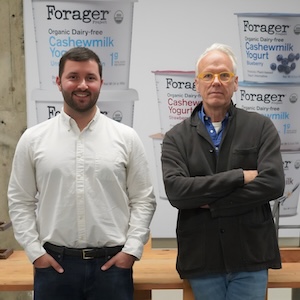
[00:00:10] Ray Latif: Hey folks, I'm Ray Latif and you're tuned in to Taste Radio, the leading podcast for entrepreneurs, makers, and innovators in the food and beverage industry. What kind of a founder drives a U-Haul full of perishable product through the desert at 3 a.m. and calls it progress? That's the kind of relentless, purpose-driven hustle behind Forager Project, the plant-based food and beverage company reshaping what dairy-free can taste and feel like. In this episode, co-founders Stephen Williamson and J.C. Hanley open up about the mission-fueled and occasionally messy Evolution Fresh their brand, from cold-pressed juice to cashew-based yogurts and creamers that compete head-on with dairy. They discuss what it really takes to build a standout CPG brand in saturated categories, why project is still part of their name, and how lessons from prior businesses and discontinued product lines have shaped their approach. They also explain why they walked away from juice, how they knew yogurt was the future, what it means to innovate with both a moral compass and a culinary one, and how they define success. Hey folks, it's Ray with Taste Radio. Right now, I am supremely honored to be standing with Stephen Williamson and J.C. Hanley, who are the co-founders of Forager Project. Stephen, it's great to see you.
[00:01:38] Stephen Williamson: Nice to see you, Ray, in our office, no less.
[00:01:41] Ray Latif: I know. Here in San Francisco. JC, how are you? I'm great. Great to see you, Ray. Yeah, it's been a while. I don't think I've seen you good. Maybe at an Expo West, we've run into each other and bumped elbows and whatnot. But it's really good to be here in your office. And we are in a room where we're literally surrounded by bottles and cups of all different brands, shapes and sizes. Obviously, quite a bit of Forager Project, but there's other there's other brands around here as well. I assume this is about inspiration and understanding history as much as it is anything else, right?
[00:02:12] Stephen Williamson: You need to know the shelf, right? It all happens on the shelf. Even in the digital age, it still happens on the shelf. So you look like how you stand out, understanding what the competitors are doing. It's a library where you can come in and see our history from our first bottle to where we are today. And there's what we think are significant competitors and things we can learn. I mean, obviously your competitors are a great place to learn.
[00:02:36] Ray Latif: Yeah, I love doing store checks. It's where you can identify new products and new brands. You want to see what's working on shelf. You can also get a sense of what's moving in terms of categories and what consumers seem to be interested in as it relates to new ingredients or new formulations. And, you know, finger on the pulse means being in those stores. And JC, you've been in those stores since, I don't know, how long have you been in this industry?
[00:03:04] J.C. Hanley: I guess it's been 17 years.
[00:03:08] Ray Latif: 17 years. You still look like you're 32. So I don't know. Did you start when you were 15?
[00:03:14] J.C. Hanley: Right out of college. Yeah. Yeah. Wore a couple different hats. First, I was in New York investing in consumer products companies, moved to LA, a little more entrepreneurial beverage focused companies at First Beverage and Stephen and I started Forager together in 2013. It was initially a side project that was a reflection of what we believe in food and what we wanted to eat. So, yeah, it's been a fun, fun ride.
[00:03:47] Ray Latif: Yeah. I first met you when you were with First Beverage Group. And at the time it was, and it still is in a lot of ways, one of the premier investors in the beverage industry. I just feel like it's been such a ride, such a journey for you, especially now with Forager Project. But I want to touch on something that you mentioned. Side project in the name of the brand is Forager Project. Stephen, why is project still in the name? You know, why is it still an apt term for your brand?
[00:04:15] Stephen Williamson: I'm going to argue with John Charles and say I never went into this as a side project. If you're if you're crazy, you got to be crazy and just start from something from scratch. I think you by definition are crazy because it requires everything and the reason why we named it Forager and the reason why we named it Project, it's pretty straightforward. We really appreciate that to build a business from nothing you are going to wander and you are going to, I don't like the word pivot, but you are going to go down avenues and say, well, that's not big enough or that's not working or, and you're going to forage. And so forage was absolutely part of the concept. We knew we were going to start out of the roots of Odwalla. making juice, but where it would lead, I had no clue. And I knew that it was going to be a project. It's not just all fun and games. There are going to be times where you're going, it's three in the morning. Why am I driving? I'm 52 years old or 54 years old. I'm driving a U-Haul truck in the middle of the desert. What am I doing?
[00:05:18] Ray Latif: It's a project. It's a fair question to ask what you're doing the middle of the desert with I'm assuming cold chain products, too It was a bit of a reflection on the life of John DeLorean, you know that that desert financing More relevant breaking bad, okay I don't know, you're digging a hole and I don't have a shovel here. I can't help you. But yeah, it's still called Project. And I think there was, wasn't there a time when you were considering dropping the project from Forager and just calling it Forager, JC?
[00:05:54] J.C. Hanley: I mean, Project is such a reflection of this constant pursuit of improvement and better and nothing is ever finished. We're always, you know, a lot of companies might try to take costs out of their product. We tend to try to be better and sometimes put costs into the product. We'll get to that. And it's this pursuit of, you know, striving to achieve that maybe never achievable state of taste amazing.
[00:06:29] Ray Latif: Yeah, striving is a great word. If you are perfect, well, what's the pursuit? What's the fun anymore? I think it just becomes about distribution and money. And you guys are so plugged into the innovation side of the CPG industry. What can be better? What can be done? You've tried a lot of products, some have worked, some haven't. And everything you've made, I think, has been to the highest quality possible. The standards are really, really high for Forager Project. And when we spoke last, you both talked about this sense of urgency in launching Forager. Why did you feel like there was an urgent need for a brand like this?
[00:07:09] Stephen Williamson: That's a tough question. I don't know if I would use the word urgent. I just felt like there was a opportunity to go after what I believe in, which is be straightforward, be minimal, process as little as possible. And if there's an opportunity in that line, go for it. So really the inspiration for the first round of Forager Project came from me continuing to look at Blueprint Juice based out of New York. At that point, it wasn't yet owned by Hain Celestial.
[00:07:44] Ray Latif: Yeah, Hain Celestial. Just for context, Blueprint was the ultra, ultra premium juice brand that came out.
[00:07:50] Stephen Williamson: It was a very, very nicely done brand. I mean, I thought the founders were talented, but I thought the price was ridiculous. The price was $10.99. Yeah. I looked at this and said, hey, we can do this for less, and we can make just as great quality. Ted Lehman, one of our co-founders who was head of manufacturing for me at my Odwalla days, Bar Hogan, who was one of our formulators in Odwalla days, John Charles, another woman, Jill Savini, who's done a lot of work for me on art, we got together and said, let's try it. And the inspiration was, we're not going to BS. We're not going to call it spinach celery juice when it's actually apple juice with a little bit of vegetable. Be straight up. be clear and go. And so we did that.
[00:08:39] Ray Latif: I think that's something that people may not know is that Forger started out as a juice company. And obviously you've pivoted and done quite a bit differently since. We forged, right? Yeah, we forged. You forged. But juice was the path to market. It was the initial path to market. When did you realize that juice wasn't necessarily going to be the only category that you'd be involved in, JC?
[00:09:03] J.C. Hanley: It's hard to remember the exact moment. I mean, we, I guess our first foray out of beverage was vegetable chips and that was 2015? Yeah, 2015.
[00:09:16] Ray Latif: And that was, were you using the pulp from the cold pressing?
[00:09:21] Stephen Williamson: I mean, it was, it was simple. We were buying high quality organic vegetables, getting a 67% yield or whatever the yield was. But obviously, you want every ounce of juice you can get out of them. So the dryness of the pulp is pretty important. But we had this pulp that was 30% of our costs, and we were throwing it away. And it seemed like that was ridiculous. This is organic pulp. We can do something with this. went down the rabbit hole of drying it and then figuring out how to make chips from it, which wasn't straightforward. Ray's turning around to look at our wall. I see you looking at it. Yeah, well, we went through a lot of it and we would never have gone into chips if we didn't have the waste stream. So, you know, fast forward a couple years later when we did leave Juice, and the reason why we left juice was pretty straightforward. I think if you're trying to build a business, at least this is my philosophy, not everyone agrees, a moat, something where you have a point of difference where you can better control your destiny or have maybe some slight barrier to entry, is helpful and what we realized pretty quickly on juice was there was really very little barrier to entry because HPP was there at that by that time ubiquitous and so all you really needed to do was press juice or press fruit and vegetables and go to HPP and I go How are we going to build out of this?
[00:10:46] Ray Latif: There was a glut of new brands that came to market.
[00:10:51] J.C. Hanley: Suja. Every market had a local juice brand.
[00:10:54] Ray Latif: I mean, it feels like the prebiotic, probiotic sodas of today where, you know, everyone's coming out with a new one or maybe even non-alcoholic cocktails as a good example. Because, I mean, in our office, we probably get, I don't know, two, three new brands that come to the office every two weeks. But I remember those days of HPP Juice. And of course, Bevanit was the place to come to and people would send us stuff left and right. And I don't know, they were spending an arm and a leg because to ship that stuff cold across the country was not cheap. There were no affordable options back then, as far as I know.
[00:11:28] Stephen Williamson: So you understand why we looked at this and said, this is not going to be enough of a business. There's no barrier to entry. They're big competitors. It's not, forget it.
[00:11:38] Ray Latif: But it seemed like there was a positive financial outcome for some of the brands. I mean, Evolution Fresh sold, not for a ton, but Starbucks. Coke eventually acquired Suja. Suja is now independently owned and we'll get into that. But it seemed like there was some interest from strategics.
[00:11:54] Stephen Williamson: Yeah, but I don't think any of those businesses, I mean, really ended up being much in that space. I actually think there's a chance for a revival of high quality juice again.
[00:12:03] Ray Latif: You want to share anything with us on the podcast?
[00:12:05] Stephen Williamson: We're not going after that, but I think that minimally processed, high quality, creative blends have a spot. I mean, John Charles and I at our ranch goof around from the vegetable garden all the time. if we mix Asian pear with ginger and watermelon, what's it gonna taste like? Oh, let's add some carrots. I mean, we'd go through and play all the time. Juice is wonderful. It is obviously what got me into this space. So I'm a big fan of it. But in building this business, given that we were foraging, it wasn't gonna be enough. So we took my learnings from Odwalla and said, let's mess around with nuts and see where that goes. And we started the logical course, almonds, and said too expensive, too water-intensive. From my days of eating in vegan restaurants up here in the Bay Area, I kept coming back to cashews, because cashews are the vegan nut from my perspective. For turning a nut into a cream, there's nothing better. That brought us to that. I think in business, it's so important to remember your friends and treat people well and respectful and stay in some type of contact with people. So when we were messing around with nut juices, I reached out to Gary Hirshberg and said, Gary, I'm really curious whether I can make a yogurt out of this.
[00:13:32] Ray Latif: The founder of Stonyfield Farm.
[00:13:34] Stephen Williamson: Yeah. And so Gary. was incredibly helpful, and he ended up investing in the company and being on the board for quite a while. But he was important to getting us, encouraging us to learn about fermentation of nuts. And really, from my perspective, the business found its footing when we started fermenting.
[00:13:55] Ray Latif: How many years was it between when you launched Forge Your Project and you launched the Cashew products? About three. Three years. So I'm not saying this was an option, but it was a potential outcome that you could have said just didn't work. Forge Your Project as a juice company didn't work. As a chip company, you know, maybe that's not going to work either. Why don't we just shut it down? What kept you going? We're crazy.
[00:14:21] Stephen Williamson: No, I tell you, look, I mean, you can laugh at me, but I kind of- I apologize for laughing. No, no, no, no. It's just the way you said it. There is required craziness, I would say, because there are lots of disappointments. And we could have easily shut it down then. But I looked at this and said, well, I've already put, and at that point I was funding it myself. I don't know what I had, a million and a half, two million, three, I don't know. It was several million dollars in here. Why do I want to walk away from that? I think we've actually created a good brand. I think we have an operating platform. It may not be profitable, it may not be sustainable, but it is a place I can, it's a lily pad, so let's keep pushing. And I also view, and rightly or wrongly, this is just my own MO, I kind of felt like I was going up Half Dome with no rope. I don't think you see many free climbers going down. So I was like, we just got to keep going. Yeah, going back to the roots of the company's name, Forager Project, we were foraging and to this day, I will tell you from my perspective, Ray, we're still foraging. We're not where we want to be. There's still a ton of work to do to get us to what I think is a sustainable position that'll allow us to really permeate our larger goal, which is to help cows retire. I mean, plant-based dairy is, time is now. Cows are inefficient. Cows aren't great for the environment. And the flip of the script is coming. One day it'll be 85% plant-based and 15% cow, not the other way around.
[00:15:53] Ray Latif: Well, if you have a vision like that, it is hard to walk away from the business that you created, especially when you believe so deeply in it, that plant-based eating, vegan eating can be of many benefits to the world. One of the great things about making mistakes is that you can learn from those mistakes. And you can look back and say, here's where we fell short. Here's where we tripped up and we should not have tripped up. And when we move to the next phase of our business, we won't trip up again, hopefully. JC, what did you learn from the early bumps and bruises? What did you learn from the juice business that you were able to apply to the next stage for your project?
[00:16:33] J.C. Hanley: Well, we certainly continued to make mistakes. I think we tried not to make the same ones twice. With yogurt, we were kind of reinventing ourselves within the same food principles, but in a very different category and had to kind of learn food, which is slightly different than beverage.
[00:16:55] Ray Latif: Did it feel like you almost started a new business because you were in different parts of the store using different ingredients than, say, juice?
[00:17:01] J.C. Hanley: I mean, the distribution is very different. The type of sales support is very different. I mean, it was production is incredibly different. It was sort of like two ships moving at different speeds under one roof. And yeah, that was a big period of change. I mean, we could tell very quickly that yogurt was the future. We watch our numbers very closely every day and how things are turning at the store. It was an interesting time. I mean, in some ways we're reinventing ourselves again with our Greek style yogurt and our creamers, all clean ingredients and really trying to push. further on clean ingredients, tasting amazing, you know, consumers not sacrificing versus dairy, nutritionally with protein in the Greek. So there are similarities with 2016, that kind of era and us today.
[00:18:02] Ray Latif: But how do you know if something works? We talked about the yogurts as perhaps one of the first product lines that really had a lot of runway, had legs behind it or underneath it. If I turn around to this wall of Forager Project, we're probably talking about at least eight, ten categories that you guys have played in. Some just within the non-animal dairy or the plant-based realm of dairy, but they are different products. I mean, is it just about velocity? How do you know when you've got something, JC?
[00:18:39] J.C. Hanley: I guess you never really know the scale of it, but it's every data point you can get. So consumer feedback, people calling us or emailing us or commenting and saying, you know, we love this. This is the first Greek style yogurt we've ever had that tastes great. You sort of get enough of those. data points and you think, okay, well, that's, that's pretty positive. It's turning really well. It's, you know, retailers are receptive to it. It's in a unique position in the market. So we certainly have a lot of work to do, but we feel like we're on the right track.
[00:19:21] Ray Latif: Yeah. I mean, I would say so based on the new products that I've seen come to market, it feels like there's a lot of consumer demand behind it. Will the demand translate to sales? Will they translate to significant sales, I think is the question. But you got to take that first step and you got to test and learn. What are the key metrics of that testing philosophy of your testing strategy? What do you need to know about how the product performs on the market before you can say, we're going to make a significant investment in terms of production or marketing and dollars behind the launch or product line?
[00:19:58] Stephen Williamson: You know, I go back to my Udwala days on product because we had handhelds and we placed our own product. And you could see, here's your cooler where average turns are X and you put a new product in and it beats that out in the first week, you got a winner. And we always just took the, we never did any market research. We just made a product, stuck it out there and see if it worked. It's a little harder to do that today because the gamble is a little bit bigger. But I think that between Whole Foods and Sprouts and a few other retailers and looking at your turns on the shelf, you know, you know, very quickly, if you've got good placement on the shelf and you are in the top quartile, you've got a shot. We have tried to learn and continue to develop what is our food philosophy. And I go back to that because I think it's important. We will not produce out of our food philosophy. And our food philosophy is eat organic, mostly vegetables, nuts, seeds, ancient grains and fruits, limited to no animal products, minimal amount of of saturated fat, no fake sweeteners, limit your sugar. And if you eat that way and enjoy the food you eat, I think you're making good choices. And as a food manufacturer, that's the way we manufacture. We made an incredibly rich, rich yogurt. We pulled away from it because the saturated fat levels were higher than than we're comfortable with. We don't think you should get 100% of your recommended saturated fat in one cup of yogurt. That's not healthy. And so we didn't do it. We're committed to try to learn more and more about food and what's the right thing. And again, I go back to our, it's a project and we're still foraging, Ray.
[00:21:48] Ray Latif: How much does competition affect your innovation strategy, your desire to create new products or get into new categories? Again, we're surrounded, the back wall here is surrounded, it's all Forager Project. You have some Forager Project stereo here, which we will hold off on that for now. But the other three sides of the room, I mean, it's, I don't know. A lot of competitors. There are a lot of different brands here and brands who have created and been in, say, the plant-based creamer space for some time, which is a relatively new product line for you guys. Was it just an opportunity to create something that was better than what was out there? Or did you see that, you know, the competition needed a new player like Forager Project? How did you analyze that opportunity to get into the plant-based creamer space?
[00:22:39] Stephen Williamson: On one level, at least in product development, I don't think we look at it that way. I think we look at it as like, let's make good food and then we'll figure out what to do with it or not do anything with it. And so I think that was the philosophy that kind of led us, when John Charles jumps into the creamer story, that led us to creamers. Because remember, we make, we're very good at sourcing cashews and coconuts. And we're very good at grinding, blending, heating, and packaging. So lean into those strengths and what happens will happen. And hence the story.
[00:23:13] Ray Latif: Yeah, that's the Sony philosophy. It used to be where Sony would create these amazing products, really innovative concepts, and they would bring them to the marketing team and say, hey, do something with this. Sometimes it worked, sometimes it didn't. But anyway, JC.
[00:23:26] J.C. Hanley: It definitely does start in the kitchen. And actually, my sister Daisy and Melissa on our product development team were pretty integral in the development of our creamers. And it started from our heritage in milk and clean milks that we love and we use every day when we make coffee. I think when our creativity is best expressed is in products that are more value-added than commodity in nature. So the cinnamon vanilla creamer is just a phenomenal product. It just starts with, is this taste amazing? Do we love it? Is it? kind of addictive. And it turned a lot of coffee drinkers in our office from using milk, cashew milk or oat milk that we make to using creamers. And it has really flowed out of that spirit of like make an amazing product in the kitchen and then figure out the rest later. But at the time, some of these competitors that are also doing products like that, they weren't in the market either. So we've tried to make really great tasting products at a price that is, you know, premium, but attainable and adheres to our food values.
[00:24:51] Ray Latif: I imagine that you're sourcing your coconuts from somewhere other than the United States. Are you sourcing your cashews from somewhere outside the United States? I get them all in Washington, D.C. Washington, D.C. OK. Big, big, big amount of farms there. Did not realize that's the cashew capital of the world there. Now, where are your cashews from?
[00:25:09] J.C. Hanley: Mostly in Cote d'Ivoire, West Africa.
[00:25:12] Ray Latif: Okay. You know, I've heard of this, this term, it's called tariffs. There's a word called tariff. Tarif, isn't it? Tarif. Tarif. It's an Arabic word. Tarif, yes. Where, you know, it's just, you've gone through every challenge you could possibly go through as the founder, as co-founders. And then someone throws this huge brick through your window and says, Hey, Pay more. How do you deal with things like that? How do you deal with these unexpected challenges? I mean, you've dealt with them, but how do you deal with an even more challenging problem that you have zero control over?
[00:25:46] Stephen Williamson: Drugs.
[00:25:47] Ray Latif: Drugs. Okay. Craziness. Drugs. You're a rock star, Stephen. You ever thought about starting a band? If only I could sing. You look good with that mic in your hand.
[00:26:01] Stephen Williamson: Ah. Well, you are where you are, Ray. I mean, what do you do? You've got to face the challenger in front of you and crying doesn't get you anywhere. So yeah, this has been a challenging year. You as a business owner know that certainty is helpful when it comes to planning. And when you don't have any certainty, it's very, very difficult. So yeah, I've wiped out our income statement this year pretty much. And I'm sure that anyone who's buying coconuts from Sri Lanka or Thailand or wherever, and anyone who's buying ingredients from where we buy ingredients for cashews is facing the same thing. It's rough, it's uncertain, it's ugly, and we are where we are.
[00:26:44] Ray Latif: It's unfortunate is what it is. because it's limiting, I think, the ability for companies like yours to get better food into Americans' hands, into their refrigerators, into their pantries. And I think at the end of the day, we're talking about Maha, and I'm sitting on a soapbox here. If you want to make people healthy, we'll help them get better food, help companies, help producers make better food. And in some ways, I think tariffs are not doing that. And it's an unfortunate reality that we live in right now.
[00:27:16] J.C. Hanley: Going back to the fact that we're kind of a little bit crazy, entrepreneurs have to have a ridiculous amount of grit to power through the muck and get to where they're trying to go. And you have to have this unrelenting drive to achieve your goals. And I don't think, I mean, our goals are quite big, so I think we're gonna be striving for them for a while, but it's a journey.
[00:27:47] Stephen Williamson: You know, I think it's interesting when John Charles talks about the drive, that insane drive. I think you need that, but I also think you need You know, outside of this door, Ray, when you walk out of this conference room, you'll see there's on the on the wall is a piece of art I did that one side of the corner is an exclamation mark and the other side is a question mark. And I think you need to balance both of them because you can be insanely driven, but you better make sure you're on the right track. So if we had been insanely driven and just said we're going to do HPP and I don't care, that's where it is. That uncertainty, that questioning was what got us out of juice and got us into yogurt. And so I always think you need to understand, unfortunately, there is no magic button you can press and say, time to be certain, time to be questioning, but you need to embrace both wholeheartedly in your DNA if you're going to work.
[00:28:43] J.C. Hanley: You don't want to be insanely driven right off a cliff.
[00:28:47] Stephen Williamson: Well, unless, of course, you have a parachute and you're selling the parachutes or you can fly. Yeah.
[00:28:53] Ray Latif: Or you can fly. Well, I've said something that I think some people would define as success, which is that you build a company and eventually you sell it. You exit that company, hopefully make some money along the way. Is that your definition of success? No. How do you define success?
[00:29:12] Stephen Williamson: I don't know if I do define success. That's a super hard question. I think I'd have to take some mushrooms and sit in the field and come back and tell you, Ray, exactly what success is. But I think part of it is trying every day to be a good soul, to do the best you can and work. to do what you do well and treat people kindly and the chips are going to fall where they fall. And if you drive all of your definition of success by an outside achievement, I don't know how much that's going to make your life great when invariably it's not going to happen. Either you're going to shoot low or it's going to be higher. I think you better find joy every day, even in the crap of building a business, because if you don't, you're going to get burnt out. So I look forward to the conversations I have with our plant, our plant engineers, our product development team, those things I enjoy every day. And I like, I love the design and that stuff. I go into that and I think I define success. by the daily grind and routine. I'm not a, it's gonna be successful if we get this to over 200 million in sales type dude. I don't know, it's a really good question. You caught me off guard, success.
[00:30:30] Ray Latif: Well, I apologize. I didn't know we were gonna talk about, I should have brought some mushrooms is what I'm saying. I know we're not in a field, we're in a conference room, but still. JC, how would you define success?
[00:30:43] J.C. Hanley: I think it goes back to, I'm very much in the moment and try to be present. And so it's the relationships that people have met along the way. I mean, it's, this is a great industry. Like I've made a lot of friends. who started other companies who I think all help each other a lot in this industry. But at Forager, I mean, we like to have fun. We like to laugh. We like to joke around. We like to go on long early morning hikes at off sites and cook food together and eat meals together. And that is like pure enjoyment. I think that's the human connection. So yeah, if the desire was just some amount of money at the end of a tunnel, I don't think that that type of objective leads to a meaningful company anyway. Life is, you know, it's not a straight line. And so you have to enjoy the opportunities you have. Like I get to work with family. And so I feel very lucky that we get to do this together. My sisters have worked here, my mom has been involved, their dog is on our pouches. It's a family affair and I feel super, super lucky that we get to sort of experience life in a different way working together.
[00:32:10] Ray Latif: Stephen, JC, I can't thank you enough for taking the time, having me here in your office in San Francisco. It's been a ride, hasn't it? And I've been privy to that ride, watching you guys for the last 12 years and just kudos to what you've made and created and given to the United States and given to American consumers who need better products. It's important what you're doing.
[00:32:34] Stephen Williamson: It really is.
[00:32:35] Ray Latif: And thank you so much.
[00:32:36] Stephen Williamson: Oh, it's nice to talk to you, Ray.
[00:32:38] Ray Latif: Yeah. Thank you, Ray. Thank you guys. That brings us to the end of this episode of Taste Radio. Thank you so much for listening. Taste Radio is a production of BevNET.com Incorporated. Our audio engineer for Taste Radio is Joe Cracci. Our technical director is Joshua Pratt, and our video editor is Ryan Galang. Our social marketing manager is Amanda Smerlinski, and our designer is Amanda Huang. Just a reminder, if you like what you hear on Taste Radio, please share the podcast with friends and colleagues. And of course, we would love it if you could review us on the Apple Podcasts app or your listening platform of choice. Check us out on Instagram. Our handle is bevnettasteradio. As always, for questions, comments, ideas for future podcasts, please send us an email to ask at Taste Radio.com. On behalf of the entire Taste Radio team, thank you for listening, and we'll talk to you next time.
[00:33:32] SPEAKER_01: you