[00:00:10] Ray Latif: Hello, and thanks for tuning in to Taste Radio, the number one podcast for the food and beverage industry. I'm Ray Latif, the editor and producer of Taste Radio, and I'm with my co-host for this episode, John Craven, Jacqui Brugliera, and Mike Schneider. And with this is a special guest for the podcast, Melissa Traverse, BevNET's Director of Community. In this episode, we are joined by Dave Colina, the founder and CEO of O2 Hydration, who discussed the brand's recent repositioning and how the company overcame a funding round gone wrong. This is a podcast gone wrong, so it fits. People don't hear the flubs, John. They just don't hear me screw it up.
[00:00:51] Dave Colina: They didn't hear you say recent repositioning. Jeez. In his Bugs Bunny voice.
[00:00:56] SPEAKER_??: Yeah.
[00:00:56] Ray Latif: Anyhoo, well, let's say it was great to see you in New York City again after bev net live back for the fancy Food Show Yeah, it's almost like we never left New York at all. Although Bennett live feels like it was like I don't know two months ago Feels like it was a long time ago. Really? Yeah, I don't know. I feel like I still have I feel like I'm still in it Always in it to win it Anyhoo, it was good to see you Melissa like I hope you had a Food Show fancy Food Show that is I
[00:01:23] John Craven: It was fantastic. Saw a lot of really great products. Everyone seemed to be in a pretty good mood. I thoroughly enjoyed it. How about you guys?
[00:01:31] Dave Colina: Melissa, you spent three days there. That is remarkable.
[00:01:34] John Craven: That's insane. That might have been overkill, I'll say, but I definitely feel like I saw just about everything.
[00:01:42] Ray Latif: I will say this, though, out of everyone on the team who went, your name was brought up most when I talked to attendees and exhibitors.
[00:01:50] Dave Colina: That's because she talked to every single attendee. She was able to have 10 minute conversations with everyone.
[00:01:56] Ray Latif: Everyone was like, oh, I met someone else from your team. It was Melissa. And I'm like, of course it was Melissa. And that was a common theme throughout the show. I met Melissa. I met Melissa.
[00:02:06] John Craven: I met Melissa. And the same thing with you. I think we were probably following each other on the floor because I would hear that they had just spoken with you, Ray.
[00:02:14] Dave Colina: I would hear, when can we meet Ray? And, oh, good to meet you, John. Not you, Mike. Where's Ray?
[00:02:23] Ray Latif: By the way, what do you guys do for the company? I'm the CEO and founder. I'm the CMO. Oh, okay. Yeah, where's Ray? I just tell people that I book meetings for Ray.
[00:02:33] Dave Colina: Oh, thank you. Where's Melissa? Where's Ray?
[00:02:36] Ray Latif: Where's Jacqui? We get a lot of where's Jacqui? Where was Jacqui?
[00:02:40] Jacqui Brugliera: I was missing.
[00:02:42] Ray Latif: I did hear from a bunch of folks, including Rifle Hughes from JPG, about our recent social video that talks about Love Life, that brand Love Life. People really, really like that reel.
[00:02:57] Dave Colina: I was a little nervous to share that one.
[00:02:59] Jacqui Brugliera: Yeah, it felt it felt a little weird to share that one It was weird, but it was super fun and Jacqui was the star Yeah, it was funny cuz you could tell in the video that you're all so uncomfortable. I was talking about Major cringe it was amazing.
[00:03:14] Ray Latif: Mike wasn't uncomfortable at all amazing
[00:03:19] Dave Colina: Does the trick Seem like a time to Better off keeping my mouth shut well.
[00:03:25] Ray Latif: Yeah, you did keep your mouth shut, but you had the best facial reactions I could add I'm sorry. I was like trying to talk about it without talking about it Yes, when you said open up the blood vessels Leave the room Anywho if you haven't seen the real check it out on Instagram so you can find what we're talking about great Melissa once again you know I think a lot of people have been watching Community Call your show and I think it was brought up a lot on the show floor at fancy Food Show Can you talk about some of the recent episodes? You know some of the folks that you've been featuring and some of the ones that are coming up
[00:04:03] John Craven: Absolutely, thanks so much. It really has been such a pleasure chatting with the folks that we host as guest experts on the call. There are so many smart people in this industry who've been doing what they do for so long. Some of the recent episodes include a chat with the Partake Foods operations team talking about demand planning. And I know that that's not exactly the most glamorous part of CPG, but it's such an important piece of business. And it obviously can affect so many different things. So that was a real pleasure. Having Mary Lee and Katie Geyer from C4 on talk about event planning was fantastic. They have really figured out some specific processes to help them get the most out of their events. And what I appreciated is that they talked about things that even emerging brands can do in order to participate in events, no matter how much funding you have. So that's been a real pleasure. And we just had a great chat with Jeremy Smith about Costco. Costco can be can be sort of a tricky retailer for folks who don't know the ins and outs of how they work. So we talked about their review process, pack sizes, regionality. And I think, you know, perhaps the most important piece of that was when. So when's the right time for brands to launch with Costco? Because sometimes, you know, you have an opportunity, but it might not be the right time for you. So that's been fantastic. And then coming up, we've got some great shows, of course, this summer as well. We're going to be chatting with Rind about line extensions. They're going to talk about the great collabs they've been doing with Lesser Evil. They're using their fruit powders, also their remix snack mix line extensions. That's going to be fantastic. Coming up in August, we'll be chatting with Sarah Brooks. Sarah Brooks, as many of our audience members might know, she's the founder of Covet PR, most recently co-founder of Goldilocks. She'll be telling all of the secrets that she's learned about pitching and earning consumer PR. And then coming up in August, we've also got some great investor calls lined up. We've got Maxi Kozler-Koven talking about the practicalities that brands can use to stay funded, and a bunch more. So stay tuned and join us, please.
[00:06:24] Dave Colina: Well, so you also recently flipped the script a bit too, and had a brand come on who had some questions, and then we had those sort of flow into the Slack community. We also have a Slack community we should probably talk about, huh?
[00:06:35] John Craven: I mean, I feel like maybe we should talk about the Slack community. We launched the Slack Community Call little while ago, and it's been so nice to see our audience joining us. As a matter of fact, we had a chance to see Yoni from Fresh Fizz Sodas at BevNET Live.
[00:06:53] Dave Colina: With this killer new rebrand.
[00:06:55] John Craven: Yeah, great new rebrand, great product. So he's a great member of our Slack community. So many other folks, but it's been a great way for us to stay connected with people in between our events. And then of course, folks have questions that we're able to kind of loop in our partners into and help solve those as well. So slack.BevNET.com is where you should go to join Slack. And then folks can head over to BevNET.com slash Community Call to check out past episodes and then sign up for future shows. So please everybody join us. It's a great time.
[00:07:31] Ray Latif: I love that the conversations are starting with Community Call and then continuing on the Slack channel in the Slack Community Call the things that you talked about, Melissa, demand planning, event planning, Costco and how to get into and when is the right time to get into the retailer, talking to investors, trying to figure out your public relations strategy. All these things are really top of mind for entrepreneurs and they all need to be done in a, intelligent and thoughtful way. And how do you learn about how to do those in an intelligent, thoughtful way? You do it by watching Community Call, engaging with the folks that are on the call, and then talking to people on Slack. And again, I think what you've done since you came back with us is incredible because you are really uniting the community in a way that people need and want. So thank you.
[00:08:20] John Craven: Thanks, Ray, so much. Yeah, I appreciate that. For the actual calls themselves, of course, any of the audience members can throw in any questions or thoughts they have, which has been great. And then for folks who maybe didn't have a chance to ask their questions or watch it afterwards, they can always hop on Slack and continue it that way. And the idea behind this is there are so many one-off conversations that happen at Fancy Foods and BevNET Live and all of the shows that we go to. But if we can have one conversation and have a lot of people benefit from it, then that's what we're hoping for.
[00:08:54] Ray Latif: Absolutely. I know you have a lot more planning to do for Community Call and future episodes of said show. So if you need to hop off, you can hurt my feelings, but I understand.
[00:09:07] John Craven: Although I would love to stay, there are miles to go before I sleep. So I will take that invitation. It was great to see you all.
[00:09:14] Ray Latif: This is Melissa, Robert Frost, Trevor signing off.
[00:09:21] Mike Schneider: Bye guys.
[00:09:23] Ray Latif: Good stuff. Always great to see Melissa. And, uh, you know, I think I only bumped into her once on the show floor though.
[00:09:28] Dave Colina: Zero times for us.
[00:09:29] Jacqui Brugliera: I think we were going opposite directions.
[00:09:32] Ray Latif: Yes. I think she saw us coming. She was running right turntail. That happened to me. I saw you guys coming and I tried to turn around, but it was too late. It was way too late.
[00:09:41] Jacqui Brugliera: Once you make eye contact, it's done.
[00:09:43] Ray Latif: But I did encourage you guys to go see the, well, I think they called it the new now next part of the show, which they used to call Incubator Village or Incubator Alley.
[00:09:53] Dave Colina: The even more new products area.
[00:09:56] Ray Latif: But that was my favorite part of Fancy Food Show because you could see so many new emerging and innovative brands in one section. So the Incubator Alley for folks who are not familiar or that Incubator Village, which is now rebranded to something else. brought together incubators, regional ones, and commercial kitchens from around the country, and then highlighted a number of their brands that they worked with. Usually it was about five or six per incubator or kitchen. And so you had folks from like the Hatchery in Chicago, Commonwealth Kitchen in Boston, the Oregon State, I'm always going to screw this up, OSU Food Incubation Lab, I think is what it's called. And just really enjoyed meeting some of these, you know, early stage folks who are, who are doing some really interesting things. I mean, some of the ones that I loved and we've, you know, this is a brand that we've actually talked about on the show is Lentiful. Ben Bacon is the founder and CEO was there. He expressed that he had a really great show, talked to a lot of folks, including a bunch of retailers. You're coming out with a new pineapple chorizo variety, which tastes a lot like chili with just a hint of sweetness. It was just phenomenal. Did you see he quoted Taste Radio on his sales sheet?
[00:11:09] Dave Colina: I did not see that. He did. Not sure that's a winning strategy, but appreciated nonetheless. We're going to cut that part.
[00:11:16] Ray Latif: Come on now.
[00:11:17] Dave Colina: It tickles me endlessly that a guy named Benjamin Bacon is talking about plant-based food. I love it.
[00:11:23] Ray Latif: Yeah. And if you're still not familiar with Lentiful, even though we've talked about the brand a number of times in the podcast, check out our video interview with Ben, which is part of our 10 Seconds with Taste Radio series on Instagram and TikTok coming out soon. Also, did you guys get to see Sunday Supper? That was a brand of frozen plant-based entrees that was part of the Future Food Co booth at the show. Sunday Supper makes, they started out with an Italian sausage lasagna. that is made for, I think it was like 40 ounces. So it was made for like six to eight people. It's all plant-based. I didn't get to try it, but their branding is outstanding. It is exceptional. And they've since come out after the Italian sausage variety, they've since come out with a whole bunch of other products, including cheese ravioli, including mushroom ravioli. And it's all plant-based and just stunning packaging, once again.
[00:12:17] Dave Colina: Did you get to meet with the founders of Amazing Graze? It's a brand of lower sugar granola and nut mixes. I spent some time talking with co-founder Amy Jung, who grew up in Malaysia and just felt like she could bring the oomph of Malaysian flavors to granola and have it be lower sugar too. And it did a great job. I mean, I definitely want to try that product again.
[00:12:42] Ray Latif: Where does the Graze come into play?
[00:12:45] Dave Colina: Uh, the graze comes into play. It's granola and it's nuts. Gray-nola? Yeah. Gray-nola, I suppose.
[00:12:52] Jacqui Brugliera: Grazing.
[00:12:53] Dave Colina: I think you're thinking of it like cows, right? Grazing. Oh, Amazing Graze. Graze. G-R-A-Z-E. Oh, I thought it was amazing.
[00:13:00] Ray Latif: G-R-A-Y-S. No, no. G-R-A-Z-E. So like a field. Versus Always on top of this even though she's in San Diego, and we're here Newton. I still don't understand.
[00:13:13] Dave Colina: She's got it Good John has another oh well. I was gonna talk about this. We don't know samples of it yet, hopefully. These Weta Tunisian Foods shakshuka kits.
[00:13:29] Ray Latif: Oh yeah.
[00:13:30] Dave Colina: That looked incredible.
[00:13:31] Ray Latif: No sampling.
[00:13:32] Dave Colina: I was like, what's up with this? And they said it was their first trade show and they weren't sure kind of how to sample shakshuka because obviously you can't just have like a vat of like eggs sitting out. Right. Right. I think he's just sample the sauce. That would give you the vibe, you know, and that gives you the idea there. But I also wondered because I was talking to a new Gottlieb about this because she was raving about that brand on Instagram. And I was like, do we really need Shakshuka starter? It's pretty easy to make, but it looks like they've got variants there. So I'm down to try it. I mean, that's like me saying, do we need frozen pizza, you know? I can just go whip one up at home, you know? You're like Shakshuka master, but... I do like to make Shakshuka. The other one we got from that area, which I actually got a bottle of. Oh God, that's so good. The Miladi non-alcoholic botanical spirits. This is the classic. They also have one called Fresh. Pretty neat stuff. I think we had a chance to sample this, uh, was it at Expo West? We met the founder, Lauren Winnata at Expo West. Uh, she was, she was doing the, the bag, uh, sampling, the gorilla sampling. Yep. And this time she had a booth. And so we got to try all of the different varieties. She had a fresh expression, the classic, the bottle looks great.
[00:14:53] Ray Latif: It actually looks like a spirit. It does. Yeah, have you tasted it? Yes. It's outstanding.
[00:14:58] Dave Colina: Yeah, it's really great And she told us so stay tuned to my Instagram I suppose because when she told us how to make an espresso martini So we're gonna try that Did you guys get to try yeas I haven't gotten to try that yet, but Vanessa Du introduced me to the founder via email and I'm really excited to try it.
[00:15:19] Ray Latif: So Yey's is spelled Y-A-Y apostrophe S and they make thin, crispy, light beef crisps. These are artisanal beef crisps. The branding is phenomenal. It comes in these, the food comes in this 1.7 ounce pouch. There's images of the product on the front, feels playful, whimsical, really approachable. And it has in the corner, it says Grandma's Original Recipe, and then it has a picture of Marlon, the founder on the back, and his grandmother, Ye, as well.
[00:15:47] Dave Colina: This brand is like following me around right now because he's done this really cool Instagram piece on what's an iconic brand.
[00:15:54] Ray Latif: Are you sure you're not following them around?
[00:15:55] Dave Colina: Maybe it's me, maybe it's me. They're doing this really cool Instagram piece on what makes an iconic brand and is Ye's an iconic brand. And obviously it's not yet because to be an iconic brand, you have to have been around for a while and people have to define you as such. But I think they're on the right track here. It's super simple. It definitely calls out to you when you see it. And yeah, from what I've heard, the product is excellent. I'm drooling because Ray's holding it.
[00:16:19] Ray Latif: Well, I'm going to give you a second, but two things. I mean, I feel like, you know, there's a lot of new beef jerky products that come to market. And they all might have a slightly different flavor, slightly different packaging, etc. This is the first time I've seen a beef jerky product that is really differentiated in that this feels like a crunchy snack more than it does a beef jerky. Okay. And I will now pass it over to Mike, so you can start crunching away. Meat snack! Do you want a hand sanitizer? Yes, please. I got the BevNET branded hand sanitizer. You see that?
[00:16:46] Jacqui Brugliera: Yeah, baby, yeah.
[00:16:47] Dave Colina: I come correct.
[00:16:48] Jacqui Brugliera: Come packing.
[00:16:49] Dave Colina: Are these like beef chicharrones? Is that what they're trying to make?
[00:16:53] Jacqui Brugliera: We'll find out. Just like a potato chip. Kind of like.
[00:16:56] Dave Colina: It has more of a consistency. Potato chips made from beef.
[00:16:59] Jacqui Brugliera: Well, it has that kind of consistency.
[00:17:01] Ray Latif: Well, it's not, yeah. It's not like the brand like Y-L-W-I-L-D-E.
[00:17:06] Jacqui Brugliera: It's just straight meat.
[00:17:07] Ray Latif: It's straight meat. It's just been dried to a point where... Just straight meat.
[00:17:13] Dave Colina: That's a great name for a meat snack company. We did have to pause there because straight meat is interesting. Oh, what the... Look at that.
[00:17:22] Ray Latif: That's amazing.
[00:17:23] Jacqui Brugliera: That's a big chip.
[00:17:25] Dave Colina: What are those things on it?
[00:17:26] Ray Latif: I know what you're about to say anyway.
[00:17:30] Dave Colina: They're chili seeds.
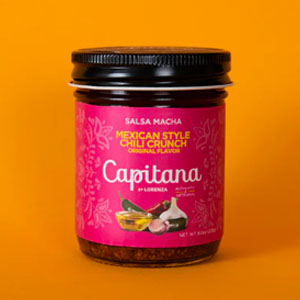
[00:17:31] Ray Latif: Oh, okay. See how crunchy it is Mike you can hear it right on the microphone. Oh, yeah, I can hear the crunch Yeah, anyway hmm that is next level isn't it good with NLS, baby not too far from the yeas booth was a brand called Coppa Tana and Coppa Tana of NLS of what they call that they describe as Mexican style chili crunch but for those in the know and they even described as this it's salsa matcha and Now Salsa Matcha has been, I don't know, you start to see a lot more of it lately, from Tia Lupita, to Somos, to Capitana, and there was another brand there, I'm sorry for forgetting the name, and Capitanas however, and I haven't tried Somos' and I love Tia Lupita's, but Capitanas, was my goodness. I put it on Instagram.
[00:18:19] Mike Schneider: That stuff's so good.
[00:18:19] Ray Latif: Yeah, super tasty. I told everyone, I was just like, run, run, run to this booth because it is really, really good. We need some jars of that stat. We do. The founder is actually a producer and has been making Mexican-inspired foods for some time, including guacamole. And this is brand extension. They have three varieties. They have the original, the one made with figs, and one made with cherries. My mouth is just completely watering.
[00:18:44] Dave Colina: The cherry is so amazing. And so is the fig.
[00:18:46] Ray Latif: Yeah, exactly. And I was like, is it traditional to put figs or cherries into salsa matcha? And she said, no, but I just thought the flavors would be awesome.
[00:18:54] Jacqui Brugliera: And they were so cool. Yeah, I've never had anything like with sweet, sweet salsa matcha.
[00:18:59] Ray Latif: Yeah, it was just unbelievable. And they're also making it so they would put on a tortilla chip a little bit of guacamole and then the salsa matcha.
[00:19:08] Dave Colina: You guys, I can't stop eating.
[00:19:10] Ray Latif: He just ate the whole bag.
[00:19:11] Dave Colina: I'm going to eat the whole bag, Jacqui. I think it's one serving, isn't it? If you decide to take a break and eat meat and have a little meat snack, this is the one.
[00:19:23] Ray Latif: Let's get back to some beverages here. I have in my hand a bottle of Annie's Ginger Elixir.
[00:19:28] Dave Colina: What do they do, Ray?
[00:19:30] Ray Latif: All right.
[00:19:31] Dave Colina: They make maple syrup.
[00:19:32] Ray Latif: They're a maker of shots and multi-serve bottles of their Ginger Elixir. All of them are shelf-stable. I actually encountered this brand when I was in Vail earlier this year. Their shots are packaged in these long test two glass bottles, and this is the first time I've seen their multi-serve, and Annie was so kind as to share one with me, so now I'm sharing it with you. Not you, Jacqui, I'm sorry. I'll send you a bottle when I can. But I have these shot glasses here.
[00:20:01] Jacqui Brugliera: So what's in the elixir?
[00:20:03] Ray Latif: That is a very good. It's described as supercharged ginger tea. And what's in there is ginger, lemon, honey, hibiscus, and berry. And the berries are elderberries, currants, black currants, cranberries, blueberry. And the last ingredient is actually tea.
[00:20:18] Dave Colina: I definitely, I think I bought this. I'm going to go with Erewhon maybe.
[00:20:22] Ray Latif: Okay.
[00:20:23] Dave Colina: Definitely. I've had this before.
[00:20:25] Ray Latif: Mike, would you like some?
[00:20:26] Dave Colina: Yes, please.
[00:20:27] Ray Latif: Okay, I just want to spill this on my laptop because it's not my laptop. Or is it? Do I own this now? Does the company own it?
[00:20:35] Dave Colina: Kathy?
[00:20:35] Ray Latif: Kathy? Okay, we'll ask Kathy. But yeah, I was really, I was really pleased when I saw this brand on the show planner.
[00:20:43] Dave Colina: Oh my goodness. That's nice. I like it.
[00:20:47] Ray Latif: I was not expecting the kick. Yes. Thank you.
[00:20:50] Dave Colina: Wow. It's awesome. The berry flavor is really thoughtful. This is super well done. Non-alcoholic. I guess they have kind of a line of RTDs and some that are positioned as wine replacements. This one's their latest Rose City fizz. So good. That's so tasty. Just really thoughtful products in terms of, like, the complexity of the flavor. They had a smoky one. I can't remember what the name of it was, but man, that stuff was... The Saskatoon. Was it the Saskatoon?
[00:21:40] John Craven: No, no, it wasn't the Saskatoon. No, you're right. The Saskatoon was another good one. They're all really good.
[00:21:43] Dave Colina: That one had the Douglas fir tips. Yeah, and they have their spritz. I think it's Ella's Spritz or something like that, but they're... I mean, definitely some of the better like spritz style products that I've seen, you know, great like alcohol replacements. And yeah, nice people too. Absolutely.
[00:22:00] Jacqui Brugliera: Yeah, I think the category also has evolved so much. And in the past, I think people were trying to figure out like the flavor and how do you create like a really quality product and now like the packaging has come a long way as well.
[00:22:15] Dave Colina: Yeah, my thought exactly on that and it's also interesting. You don't see a lot of brands that use the word like worse in their brand, right? Yeah. So, um, but yeah, no, it's, it's cool. I really like this stuff. Totally.
[00:22:29] Ray Latif: Now, while we were in New York city, Jacqui, you were in San Francisco, which I haven't been to San Fran in a while. How's San Fran doing?
[00:22:39] Jacqui Brugliera: It's all right. I was staying in downtown. I was staying in downtown and I don't know, it's definitely a little rough, but you know, not anything, not that much different than what we've seen in the past, but I didn't spend much time downtown. I was on Treasure Island playing some Gaelic football and Komogi. And then I was in Dolores Park for pride. So I was all over the city.
[00:23:05] Ray Latif: Very cool. Komogi, was your entire team there? Or were you just doing a pickup game?
[00:23:12] Jacqui Brugliera: It was a like challenge match. And there was 26 of us out of 40. So it was almost it was more than half the team. But I have a funny story. The day before I did 23 and me and I got my results.
[00:23:27] Ray Latif: And I always thought that stuff goes right to the government. Don't you know?
[00:23:33] Jacqui Brugliera: I gave them my DNA. I always thought that I was, you know, Italian, grew up with Italian traditions. When people asked me if I was Irish, I said, no way. And I am Irish. I am like 60 percent Irish.
[00:23:49] Dave Colina: Wait, so you're not even Italian?
[00:23:51] Jacqui Brugliera: I'm 30% Italian, but the majority is Irish.
[00:23:56] Dave Colina: What's the rest? Just out of curiosity.
[00:23:57] Jacqui Brugliera: Like Lithuanian and a little bit of other European. Huh.
[00:24:02] Ray Latif: You've got like the same DNA, Jacqui. That's weird. Now that I'm I'm seeing a lot of Irish.
[00:24:07] Jacqui Brugliera: Everything makes just so much more sense. The freckles.
[00:24:11] Ray Latif: I want to have red hair.
[00:24:12] Jacqui Brugliera: I've been trying to connect with my roots without even knowing it.
[00:24:17] Ray Latif: The fact that you're a fantastic basketball player. I mean, Irish, Irish people, everyone knows. You got the Gaelic football in there, though.
[00:24:25] Jacqui Brugliera: Yeah. So that's me just tapping into Irish culture without knowing it.
[00:24:30] Ray Latif: You also like corned beef and cabbage She's gonna start talking with the fake Italian food is universally loved so yes, yeah Well any any good did you get there as the whole food still closed in San Francisco the one downtown? They just reopen it right now It's
[00:24:52] Jacqui Brugliera: So I did have a question because I have Vegan Rob's here and this is our cheddar puffs, but I saw that they had some new products.
[00:24:59] Ray Latif: Ray's favorite new product.
[00:25:01] Jacqui Brugliera: And I think one of them had whale sperm in it.
[00:25:04] Ray Latif: Is that correct? Yes. Yes, this is true. OK, so this is a real product. Is it real? It is real. So Rob Eherlich, the founder of Pirate's Booty and of Vegan Rob's, is known for having sort of an eccentric approach to innovation. He's gone next level. Yes. But he actually hadn't been to any of these shows for a while. He was sailing around the world throughout COVID. And I guess we're still in COVID, but I don't know how to describe where we are right now. Anyway, it doesn't, doesn't matter. He was at the show at his first trade show in like four years and his signature products, even though they wasn't available for sampling, was whale sperm tortilla. And, uh, It was described as vegan, made with vegan whale sperm.
[00:25:49] Dave Colina: What the hell does that even mean?
[00:25:51] Ray Latif: Vegan whale sperm? Oh, come on. I don't know. I didn't, like I said, I didn't get to sample it. I recall him telling me the ingredients, but I forgot which ones, but he said he's going to send the samples to the office.
[00:26:03] Jacqui Brugliera: Do we know what the functional benefit of whale sperm is?
[00:26:07] Ray Latif: I don't know if we should be answering that question right now. This is bordering on Love Life 2.0.
[00:26:15] Dave Colina: Say it's protein. I was like knowing Rob or like he'll probably say it's like THC combined with functional mushrooms I Mean this can't be a real thing.
[00:26:27] Ray Latif: It's not a real thing When I came through with he's like this is the product that everyone here is talking about it fancy Food Show. I'm like alright I'll help this along with Where's the strive milk and that's the one everyone was talking about I do have to say, I got a lot of engagement on my Instagram posts, but this one is the one I got the most engagement on. Shocking.
[00:26:47] Dave Colina: Yeah, I mean, come on. I mean, even if we get this product, first of all, Mike's going to try it first.
[00:26:53] Ray Latif: I know, I was going to say, I know he's going to try it.
[00:26:55] Dave Colina: Damn it. Even if it says it contains well sperm, I'm not going to believe it. Well, it doesn't because it's vegan.
[00:27:01] Ray Latif: Right.
[00:27:01] Dave Colina: This makes no sense. So what is even... It's an analog. This is the newest stuff. Yeah, but you can't put that on a product package. No one's gonna buy that. I feel like this has been done, like, by Liquid Death when they made the vegan, uh, human meat. And you could get it at Postmates. See, that's... that's... you've... Could be a vegan cannibal. That was amazing. Anyway.
[00:27:22] Ray Latif: Anywho. A brand that I did understand and a brand that I really loved is a new one called Datefix. We met the founder of Datefix first at the MENA meetup at Expo West. His name is Alan Skolnick. And Datefix is a maker of natural energy snacks that are in pouches. I have one here. I might just take the table to mess. Sorry. So it's like, you know, it's an on-the-go energy snack, but there are four varieties and each of the four varieties has either two or three ingredients. Their original has just pureed dates and orange blossom water. So you rip open the top and you just squeeze out the pureed dates and it gives you a great energy boost in a really natural way. Again, only two ingredients. Turmeric variety has only 80 calories. And yes, you know, there's some sugar in here, but it's all natural because it's coming from dates. Outstanding branding. I mean, I think this branding really stood out. I think even though Alan and Datefix, you know, they were in a booth that was a little darker for areas of the show, this one really popped. I saw tons of people going there. I saw a lot of people talking about this brand, and we did record a 10 seconds with Taste Radio segment with Alan, so stay tuned for that.
[00:28:33] Dave Colina: What say you John Craven you say so say so yeah, yeah, so this is the new packaging for say so basically I had described this as a teabag that allows you to make an infused cocktail so you kind of steep this in water and then mix it with the Alcohol this one's for an old-fashioned. I don't know kind of looked like a Negroni to me cuz it's like bright red I'm just thrown off by the teabag Yeah, well, it's just kind of, you know, there's a big sort of trend in like infusing alcohol, right? So I think with this, you know, they have like a margarita and some other kind of cocktails, but this one in particular, it's like, you know, just another way to have like a cool old fashioned. Tastes pretty good again like the upgraded packaging used to be in a box, but now it's in this pouch And there's no like you know packaging of the actual like bags anymore It's just like the bag, but yeah really good product kind of you know with all the focus on non-alcohol stuff kind of cool to see one that's focused on alcohol so
[00:29:37] Ray Latif: Okay, Mike, you know, you're talking about how people came and were like, hey, where's Ray? Where's Ray? But when I visited the Kola Goodies booth, they were like, where's BevNET Mike?
[00:29:49] Dave Colina: They're so nice.
[00:29:51] Ray Latif: Okay, so Kola Goodies is a maker of Sri Lankan milk tea lattes. All you have to do is add hot water. I have a pouch in my hand. It's a 1.1 ounce pouch. And it was interesting because I was visiting the Capitana booth and the Kola Goodies was right across from it. And they were like, hey, would you like to sample some? And I was like, eh, okay. And then I tried it and I was like, The Sri Lankan milky so super good so good so good.
[00:30:17] Dave Colina: I'm not gonna give you this packet, but you can thank you Yeah, we've been talking on Instagram and sent us some samples And it was just good to meet them IRL and talk to them about sort of their journey to get there, and they're you know upstart brand who I'd say is punching above their weight in terms of just the age of the brand and how long they've been working on this. They've DIYed their booth. They have a really great story about it on Instagram about how they're bootstrapping their brand and bringing it to market. And that's how I found them.
[00:30:49] Ray Latif: She was like Mike Mike and there was a big hug. It was very nice.
[00:30:53] Dave Colina: I may have been hugging there may have been hugging it's very different than when we were in the Italian Pavilion and Mike Got I got scolded. Yeah He took too many samples, I mean classic I did but
[00:31:12] Ray Latif: Was it like just prosciutto you were eating off a tray? No, they were cookies.
[00:31:15] Dave Colina: They were these high-end cookies, and they had a basket of these cookies out, and a colleague of mine, who will go nameless, comes by and just grabs a handful, puts it in his bag, and runs. And I'm just like, oh, I'm looking at them, and I start putting them one by one in my bag, and the woman's like, After she saw the carnage that had just happened and the damage that had been done, she's like, sir, uh, one, please limit yourself to one sample. I was like, but I just had these others. She's like, I saw you take two.
[00:31:46] Ray Latif: And I came over and I'm like, yeah, you jackasses. I'm shoving more in my bag. And then on the way out, she started cursing at you in Italian.
[00:31:54] Dave Colina: I was like the shrapnel of John taking samples got me.
[00:31:59] Ray Latif: It was amazing.
[00:32:00] Dave Colina: I'm taking a Parmigiano-Reggiano full wheel. I see him across the room just waving to me, laughing. You know, I have to say that the Italian pavilion is like the most civilized Section it is they're in suits. I mean, they're all so nicely dressed. They're eating cured meats cheeses drinking red wine and they have these like $20,000 espresso machines. Yeah fancy espresso machines in the back of the booth There's like a big table and everyone's sitting down having wine just closing deals. You know, it's like I
[00:32:31] Jacqui Brugliera: Yeah, it's very classy.
[00:32:33] Dave Colina: Why don't we roll that way? I roll that way. All right, fair enough. I don't think they'd allow me to roll that way. At least one of us. There would be no hugging for sure. I like the hugging. As someone's yelling security to get Mike Got of the show. That's the dr. Squatch guy like for a guy whose first day at BevNET was at Expo West back in 2016 17 whatever no better you think you'd know better. I mean You would say weakness. I was like cookies I Got almost went to cook actually comfortable. Yeah, I don't even know if those cookies were good. Oh, they were they were definitely worth getting scolded Yeah You haven't even tried them yet? You have, well, you have enough for a month, so.
[00:33:20] Ray Latif: Well, in addition to meeting a lot of great brands there, it was great to meet some of the founders behind these brands that I have not yet, I've met them virtually, but only just got to meet them in real life, including Ashley Nicholson from BTR Nation, formerly BTR Bar. They've since expanded from protein bars to chocolates as well. So they have these truffle, well, I call them chocolates, but they're actually described as superfood truffle cups. And Ashley just has built a fantastic brand. I first met her as part of Elevator Talk, and we just made an announcement, or she announced, via Nosh, that they had just completed, the brand that is, a pretty good-sized seed round. So congratulations to Ashley and her team. Also, great to meet for the first time, I don't think I've actually had a conversation with him before, but Tom Colicchio, formerly of the Jersey Tomato Company, rebranded now as the Colicchio Kitchen.
[00:34:16] Dave Colina: I've had a few of my favorite meals at Tom Colicchio's restaurants. I was expecting you to say, I haven't seen him since we were out at the Hamptons together. Since we had a drink at Dead Rabbit together. Since we closed down Morton's together. I'm sure Tom Colicchio wouldn't be caught dead in a Morton's, but you and Adam Stern would.
[00:34:35] Ray Latif: He was really great to speak with. A future episode of Taste Rated will be featuring an interview with Tom Colicchio. Also got to sit down with the CEO and the CMO of Magnolia Bakery. They recently introduced a new CPG line of banana pudding cookies. And we talked a bit about that as well, going from bakery to direct-to-consumer to CPG and that process. So interesting stuff for sure. We didn't just scratch the surface, but we did talk quite a bit about some of the things that we saw and some of the folks that we saw at Fancy Food Show. More to come in a week's time. Stay tuned for that. Alright, before we get to our featured interview, I'd like to thank our presenting sponsor for this episode. That's Applied Food Sciences, which is the leader in innovation for functional organic ingredients in the natural products industry and is built on the belief that quality is transparent from seed to label through organic farming, ethical sourcing, and sustainability. Learn more at AppliedFoods.com. As I mentioned at the top of the show, Dave Colina is the founder and CEO of O2 Hydration, a sports drink brand that uses oxygen instead of carbon dioxide as a way to enhance faster muscle recovery. The brand is the official sports drink of the CrossFit Games and is currently sold in thousands of gyms and retailers across the country. Formerly known as O2 Recovery, the company's recent repositioning and package revamp followed the collapse of a major funding round, the proceeds of which would have been used to significantly increase distribution and retail presence. In the following interview, Dave spoke about how he navigated the shock and resulting challenges caused by the failed round, his decision to keep operating the business versus shutting it down, the research that went into the rebrand, and how he weighed data and gut instinct when making a final determination about the new branding and design. Hey folks, it's Ray with Taste Radio. Right now, I'm honored to be sitting down with Dave Colina, the founder and CEO of O2 Hydration. Dave, great to see you. You too, Ray. It's been a while. It has been a while. I don't know when the last time we saw each other in person was, but I know the last time we saw each other on screen, as it were, was about two years ago when we chatted for Taste Radio. A lot's been going on with O2. And as I mentioned, the name of the brand is O2 Hydration. It has changed from O2 Recovery. And that's just the tip of the iceberg in terms of things that have changed with the brand. Just give our audience a brief overview of where you are as compared to where you were.
[00:37:22] Summer Fancy: Yeah, I think the last time that we talked was mid-pandemic in 2020. And we were in the midst of a campaign that we developed to help a few thousand of our gym clients that sell O2 and were shut down due to the pandemic. And that ended up being hugely successful. We generated almost a quarter of a million dollars in profits to donate to about 2,000 gyms and came up with a program to help them retain members as they were shut down, you know, which benefited everybody involved. And I believe that that campaign, that's the one that won BevNET's best marketing campaign of 2020, which I still have that trophy downstairs in my office, which is pretty cool.
[00:38:07] Ray Latif: You know, interesting that we described it as a marketing campaign because what you did was far in a way and amazingly above marketing. You really helped keep a lot of folks in business and their businesses alive in so many ways. So kudos to you and your team.
[00:38:24] Summer Fancy: So 2020 was a pretty intense year for us and every other brand that I know. We ended up coming out of that year much stronger than we went into it. 2021 and 2022 were the opposite. Those years just crushed us. We were hot off of some really significant growth in 2020, set out to raise our first institutional fundraise, which ended up taking a really long time to find the right lead investor. And we thought we had the right lead. and signed a term sheet in June of 2022 that we were really excited about, did all of our due diligence with that institutional, went through all the papering process and all the legal fees that go alongside an eight-figure fundraise, only to see it fall apart literally the week that it was supposed to close, the week that the money was supposed to hit the bank. So, as you can imagine, that really took a toll on the business and on me personally, professionally. That was a really, really low moment because we had staffed up for the fundraise. We had been operating the business based on the lead investors, verbal and really written promises that the fundraiser was going to close. So we hired a few people. We started spending money on marketing that we were counting on coming back to us once the fundraise closed and just really saw all of that fall apart unexpectedly. And so when that happened, you know, we had to reevaluate what we wanted to do with this business, how we were going to do it, because we were, you know, we were now on a path that was completely different than the one that we thought we would be on, which is part of what led to, you know, something of a rationalization of the business and of our business model. A lot of focus came out of that, both in our channel strategy and our brand positioning, which I think is part of what we're going to talk about today.
[00:40:30] Ray Latif: Yeah. Let's, let's back up for a second. Let's talk about the decision to raise as much money as you're attempting to raise. I often ask folks when they are entering that phase of their business, their growth phase, that is, why they think they need a certain amount of money.
[00:40:46] Summer Fancy: Yeah. You know, honestly, in retrospect, there's a lot of things I would do differently. And one of the things that I would do differently if I were doing this all over again is not get this business in a position where we needed to raise money at all, whether it's six figures, seven figures, or eight figures. That's really, really hard to do in beverage, as you know, because it's expensive, it's costly to ship, it's costly to build a brand. But, you know, one epiphany that I had in the moments of reevaluating where we go from here with the brand and with the business is raising money sucks.
[00:41:26] Ray Latif: I'm sorry to laugh. I've heard that a number of times from a number of entrepreneurs.
[00:41:32] Summer Fancy: Yeah, it's terrible. And I don't know a single founder or CEO that enjoys the process. And the thing that I really dislike most about it is that your fate is no longer in your hands. You know, you're relying on somebody else's money and somebody else's decisions to give you that money. And a lot of what we do at O2 revolves around us focusing on the things that we can control with the belief that if we control those things, the score, the outcome will take care of itself. Whereas if you're raising money and in a position where you need to raise money, your business's outcomes are totally dependent on the decision-making whims of somebody who doesn't work inside the business. So the decision to go forth and raise $10 million in an institutional round was really one of those things where you do because that's what most other brands do. And it wasn't done out of much more than that, unfortunately. And so I think that we did a lot of things that most brands do, which is spend money on social media marketing, spend money on sponsorships, staff up. We did a lot of those things very cost-conservatively as well, and we had set out to raise a round of that size because we wanted that to be the last time we raised money. But now we're on a different path where, you know, we're, we're almost profitable and will be profitable in about a quarter. And that feels really good because at that point we won't have to rely on somebody else's money to keep growing our business. We can just keep doing our own thing and you know, our actions will speak for themselves.
[00:43:12] Ray Latif: Had you been able to raise that money, do you think that you would still be going or you still would have gone through this process of rebranding and repositioning the brand?
[00:43:20] Summer Fancy: I do. I think that there are a lot of things that we would have still done. And, you know, I can't say whether or not, you know, it'd be For Bitter or For Worse. But I think that, you know, had we closed that round, we would still be playing the game that everybody else seems to play. which is hyperspend on marketing and sales, hyperspend on staff, probably spend more than you need on all of the above without really focusing as much as I believe you need to focus at this stage anyway to bring yourself to the next level versus have investor dollars bring it to the next level. So I do think that we would have been operating the business much differently. Our staff would probably be three times the size it is now. You'd still see plenty of social media marketing from O2. You might see more campaigns like the ones that we did in 2020. But I also think that many things would be different. And one of those things that would be different is our level of focus. But you had asked about the, you know, the rebrand. We went through an exercise at some point in 2021, where we started to think pretty thoughtfully about what our brand and positioning meant to our target consumers. And we found that most of our customers didn't really think of O2 as a recovery drink. They thought of O2 as a hydration drink. So a lot of them said, yeah, I just drink it because it tastes great. And it's, you know, only got one gram of sugar and it doesn't have, you know, any artificial ingredients like Gatorade or Powerade or Body Armor. It's just healthier. It's a healthier version of these, these sports drinks, so to speak. So, you know, after we learned that our positioning on our can wasn't really the same, I guess, mental real estate that we were occupying in the minds of our customers, we thought, well, shit, that's a pretty big disconnect. Because if our own customers don't think of our product the way that we think of our product, what hope do we have with target consumers that don't yet drink O2? Can I ask you, Dave, what that brand exercise looked like? All of it was done by me and one of my other team members. And I wanted to be, you know, in the room sometimes leading the conversation, sometimes just kind of taking notes and observing because I felt it was that important that we get this, you know, really right. And so we held somewhere around 30 to 40 one-on-one conversations. with, you know, our existing customers, some of our best existing customers. And I think we may have done like a roundtable or two where we had five to 10 in the same Zoom room, basically. But it was, you know, it was very informal. I think we just asked the right questions and set the stage with people that, hey, there is no right or wrong answer. We just want to know what you think about, you know, how we describe O2 versus how you describe it.
[00:46:30] Ray Latif: Did you have a survey consultant come in or?
[00:46:33] Summer Fancy: No, we just did it ourselves. Yeah. And I, you know, prior to launching O2, I worked in marketing for a large financial services company for a few years. And, you know, I've seen everything from really expensive moderators and focus groups to, you know, just super informal, casual one-on-one conversations. And I think that. Success of each different approach is 100% reliant on the questions you're asking. I don't think there has to be a expensive moderator asking those questions, or, you know, a super expensive research consultancy. telling you which questions to ask. It's as simple as just thinking thoughtfully about what are the five to ten things I really wish I could hear my consumer state truthfully to me and how do I ask those in a way that makes them feel comfortable telling me the truth. So we had a series of those conversations and afterward it just became clear that, you know, that disconnect existed and it was on us to address it.
[00:47:33] Ray Latif: When you decided to make that shift from recovery to hydration, it feels like that change needed to be reflected on the package, perhaps even a change of the package itself. You know, how you communicated the brand via your label design. So was the shift going from recovery to hydration your starting point or was it, you know, the thought that you needed a new label design, that you needed a new package? I guess, where did it all originate?
[00:48:02] Summer Fancy: Yeah, I think that, you know, fundamentally the starting point was, well, if I were doing this all over again from scratch, knowing what I know now, what would I do differently?
[00:48:13] Ray Latif: Now, most entrepreneurs would say they wouldn't do it.
[00:48:17] Summer Fancy: That's, that's, that's probably fair. Well, if I was stuck doing a drink called 02, right, what would I do differently? And, and to that point, you know, I did have an opportunity, I guess, to ask myself that question. Do I want to keep doing this when the fundraise fell apart? Because I feel like. nine out of 10 entrepreneurs in that position would have been pretty tempted to just call it. And nobody would, I don't think, judge that individual negatively for doing so, because that's a perfectly reasonable excuse to be like, This, you know, didn't work out, wasn't for me, wasn't in the cards, whatever. On to the next thing. So I did have to ask myself that same question of, do I want to keep doing this? Because this is a perfectly reasonable excuse to stop if I wanted to move on to the next thing.
[00:49:10] Ray Latif: How many employees did you have at the time when the fundraise fell apart? 12 to 15 is my guess. I got to think that there's some weight on your shoulders about trying to keep those folks employed and part of the team as well.
[00:49:24] Summer Fancy: Oh, totally. But I'll tell you, you know, as soon as the fundraisers fell apart, we had to go through some pretty intensive layoffs, at least intensive for us. And that's a fun feeling. And I knew that more stuff like that, you know, would be in the cards if I decided to keep doing this. And so that's a, you know, that's a pretty gut wrenching question to ask yourself is, do I want to keep doing this after I've put so much of my time and energy into it and after I have built such a remarkable team? And the answer for me came down to yes, because I think we have such a great product with such an opportunity to get that product in the more hands of more people with just some very simple adjustments to the packaging and a rationalization of the business to get it back on track, to be more closer aligned with what I set out to do when I started the business, which was never to, you know, raise a $10 million fundraise. It was always to provide the best tasting hydration to people who care about what's what they put inside the bodies. So I did obviously decide to move forward with the business. And part of that was finishing the rebrand, as we talked about. But I think it's a pretty healthy exercise, whether you do it when a fundraise falls apart, or you do it, you know, in the middle of a year where things aren't going your way, or you do it when things are going your way, to ask yourself, if I were doing this all over again, what would I do differently knowing what I know now? And that was really what started the rebrand process for O2 and what led us down a 14-month process of going from O2 sports recovery drink to O2 hydration and completely changing the aesthetics of the brand.
[00:51:05] Ray Latif: One thing that didn't change, it feels like to me, is the fact that you are still targeting as your primary consumer athletes and people who go to gyms on a regular basis. You know, there are a lot of products that already cater to those types of consumers. A lot of those products already exist in gyms. How did you feel like O2 could fit differently into that cooler, could fit differently into those folks' lives?
[00:51:31] Summer Fancy: Yeah, I think that unbelievably it's the same opportunity that existed nine years ago when I started this business, which is. Every sports strength that targets athletes is made in a way that really has no business being in an athlete's hand. And what's on the shelf today isn't that different from what was on the shelf nine years ago, which isn't that different from what was on the shelf 20, 25 years ago, you know. So the opportunity that presents itself with O2 is our drink is twice as effective as far as the hydration and electrolytes go as Gatorade, but only has one gram of sugar versus the 30 in Body Armor or the 40 in Gatorade and no artificial ingredients. And it tastes great. So you still, it seems like for most sports drinks, and for most people who consume sports drinks, there's still a mental compromise that they have to make, which is, I'm either going to go for taste and sacrifice low sugar, or I'm going to go for low sugar and sacrifice taste. And so O2 is made for people who you know, want the taste and want the efficacy. And oh, by the way, we're packaged in aluminum cans because single-use plastic sucks. And we believe that that's going by the wayside as well within the sports drink and other categories is single-use plastic. So there's still a huge opportunity.
[00:53:04] Ray Latif: The sports drink category is highly competitive and highly challenging to new entrants. It seems like there've been a lot of brands that have attempted to get into the sports drink business and just never really made any kind of impact or dent, unless you're a body armor and have Mike Rapoli steering the ship at first anyway. Why do you feel like sports drink was something that you wanted to use as a phrase on the front of the can and in your marketing, including your website?
[00:53:36] Summer Fancy: Yeah, I mean, it's calling the product what it is. The challenges of the sports drink category that you mentioned certainly aren't a secret and aren't foreign to me and the rest of my team, but we decided to, I guess, take that challenge head on, I suppose, by calling the product what it is, because frankly, not to do it wouldn't be in alignment with our values of honesty, humility, and hustle. So we're positioning O2 as a new class of sports drink. which really does, I think, represent what the product fundamentally is. It's the answer, I think, to the question that I pose with my own business in the category, which is, well, if somebody were designing a sports drink for today, what would it look like? And it would look like something that tastes great. It would look like something that, you know, has very low amounts of sugar, and it would look like something that doesn't have any artificial ingredients while at the same time, you know, having a high amount of electrolytes. So We said, all right, screw it. You know, we know the sports drink has a difficult category reputation, but that's what the product is in the mind of our consumers and our customers. And to not call it that seems like it wouldn't be, you know, it would be just sort of skirting the issue. So positioning O2 as a new class of sports drink is something we've had a lot of success with. And thankfully, we're not the only ones that find it kind of crazy that sports drinks haven't really evolved. And so people immediately get that this is a sports drink for today's market and today's athlete versus a sports drink that was created 50 years ago with just a ton of sugar.
[00:55:16] Ray Latif: It's interesting you bring this up because I recently did an interview with the founders of a brand called Poppy, P-O-P-P-I, and they had been a little hesitant to use the word soda in describing what the brand was all about, what their products were. And when they made that shift, they were pretty amazed at the resonance of that word to everyday consumers. It's a simple word, it's easily understood, it means flavor, carbonation, and sort of a lifestyle beverage that you can have at different occasions during the day, different day part uses. And so I understand what you're saying in that, you know, calling it what it is, is perhaps the best way for a consumer to easily understand what you're marketing. That being said, why hydration then? Why not just call it O2?
[00:56:04] Summer Fancy: So we also wanted to give the brand Name Rang little bit more context and meaning as well. You know, O2, our product, O2, the brand, means something to a lot of people in the CrossFit segment in the CrossFit world. You know, O2 is the official sports drink of CrossFit. We have been for a year or two now. We will be for another year or two at least. So a lot of people within that segment of the population They know what 02 is, because, you know, they see it at the CrossFit Games, or they see it in their CrossFit gym, whatever. But most people don't know what 02 is. And 02, similar to poppy, is something that doesn't have a ton of meaning outside of the context. So when we were going through the repositioning exercise of switching from O2 recovery to O2 hydration, we decided to elevate the definition of what the brand really is, which is a hydration product, so much so that we're attaching it to O2, which historically was the shorthand for the brand. And so O2 hydration is now the brand, O2 recovery is no more. And the abbreviation for the brand is just O2 can still live on with people who are familiar with it. But our intention is that for people who aren't familiar with it, O2 hydration is how they're introduced to the brand so that they know what the product really is.
[00:57:26] Ray Latif: Dave, when you're going through the process of rebranding and repositioning and you have all this data and you have a professional design firm and you have all these options that you can choose from in terms of what will be the final looking, what will be the ultimate product, an ultimate design for O2. How much do you rely on your own instincts, your own gut feeling about the brand versus all the data, research, and other insights, shared insights that you have at your disposal?
[00:57:59] Summer Fancy: Yeah, I think that the subjective can get you probably 80% of the way there is my own personal experience. So I'd say that if we spent four months in the design phase, three of those four months, the first three months would be just subjectively going back and forth in the design process. to get to a few different options that we subjectively felt aligned with the objectives of the rebrand and with the brand values and with our, you know, the things that our customers love about O2. So it's gonna get you most of the way there, but I don't think it can get you all the way there. And so we decided to put our, you know, top handful of designs into an objective quantitative consumer study to take the subjectivity out of it at the end of the process and to really get the rebrand over the finish line in a way that we knew we could feel confident about based on an objective quantitative study. So I think it'll get you most of the way there, but not all the way there. I think that some level of objective quantitative survey needs to be included to get you past the finish line in the design phase.
[00:59:15] Ray Latif: Was there something specific about the quantitative analysis that really helped you fully understand where you needed to be?
[00:59:21] Summer Fancy: There was a reaffirmation that came out of the quantitative study that we were on the right track. I mean, when we found that quantitatively, our new packaging tested twice as high on purchase intent as our old packaging and higher than the leading competitor, we felt that we were not only on the right track, but we really could continue to put significant amounts of time and energy into the rebrand, knowing that it would pay off, not hoping that it would pay off. So that's something that was a big benefit coming out of the study, was we could breathe a big sigh of relief that it had been time and money well spent, and that we should continue down the path of a full-scale rebrand with a lot of confidence.
[01:00:11] Ray Latif: Did anything about the responses give you pause about launching the new look? You know, were there any people saying, you know, well, you know, I kind of like this version better. I kind of like the old version better. I mean, how much does that factor into your, you know, belief that you're on the right track?
[01:00:31] Summer Fancy: I think you've got to look for patterns, especially when you're talking to people subjectively. There were a handful of advisors and a handful of longtime O2 customers that really didn't see the need for a change. It's like, this is a product I love. This is a brand I love. It's great. It's perfect as it is. Why would you change it? And I suppose it might be easy to listen to those folks, because it means there's less work to be done. You can just continue to go down the current path that you're on. But I also feel like that's a trap to just listen to the good things, so to speak, and not listen to the bad things. And most of what I heard in our conversations with customers was, yeah, I love this product, it's great, and I don't use it at all as prescribed. Meaning like, I use it as a cleaner, healthier Gatorade versus a drink that helps me recover from an intensive workout. Sure, plenty of people did that, but it certainly wasn't the only reason that they drank O2. And so when we identified that discrepancy in how people thought of O2 and what we were saying the product was, it became pretty clear that something had to change. And then if you're going to change something, why not ask yourself the question of, well, if I'm going to make a change, what would this look like if I were doing it all over again from scratch, knowing what I know now? And for me, the answer to that question was it would look a whole lot different than it does today. And it would certainly do the liquid inside the can a lot more justice on the outside of the can, which is what we went through with the packaging redesign.
[01:02:10] Ray Latif: I will say it is a fabulous rebrand. It's a great story. The repositioning and the effort that you undertook to get to where you are today is fantastic. And I'm so glad you took the time to sit down with me and share this story with our audience. Really appreciate it, Dave.
[01:02:26] Summer Fancy: My pleasure, man. It was great talking with you.
[01:02:28] Ray Latif: You as well. And I hope to see you again IRL whenever we can.
[01:02:32] Summer Fancy: I hope so, man. Fingers crossed.
[01:02:34] Ray Latif: For sure. That brings us to the end of this episode of Taste Radio. Thank you so much for listening. Taste Radio is a production of BevNET.com, Incorporated. Our audio engineer for Taste Radio is Joe Cracci. Our technical director is Joshua Pratt, and our video editor is Ryan Galang. Our social marketing manager is Amanda Smerlinski, and our designer is Amanda Huang. Just a reminder, if you like what you hear on Taste Radio, please share the podcast with friends and colleagues. And of course, we would love it if you could review us on the Apple Podcasts app or your listening platform of choice. Check us out on Instagram. Our handle is BevNetTasteRadio. As always, for questions, comments, ideas for future podcasts, please send us an email to ask at Taste Radio.com. On behalf of the entire Taste Radio team, thank you for listening, and we'll talk to you next time.
[01:03:28] Mike Schneider: you