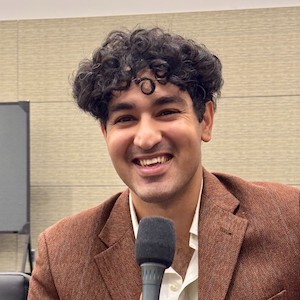
[00:00:08] Ray Latif: Hello, friends. I'm Ray Latif, and you're listening to the number one podcast for anyone building a business in food or beverage, Taste Radio. In this episode, we're joined by Saif Khawaja, the founder and CEO of Ceremony, a startup that's reinventing the seafood industry from the ground up. How do you build a globally scaled seafood company rooted in ancient Japanese techniques, humane animal treatment, and radical transparency, all before the age of 26? Meet Saif Khawaja, the founder and CEO of Ceremony. Launched in 2024, Ceremony Fish a vertically integrated company setting a new benchmark for quality and ethics in seafood by merging time-honored Japanese craft with cutting-edge technology. To bring his vision to life, Saif assembled a dream team, engineers from SpaceX, veterans from premium seafood brands, and small-scale fishermen from across the globe. His mission? To build a new kind of supply chain, one powered by empathy, precision engineering, and economic equity, and to make Michelin-quality seafood accessible to everyone. In this episode, Saif shares how a Wharton thesis and a philosophical reckoning ignited his radical idea. He walks us through the early days of grit and experimentation, the challenges of leading teams twice his age, and why he believes that world-changing companies are often born from deep moral conviction, not spreadsheets.
[00:01:46] Saif Khawaja: Hey folks, it's Ray with Taste Radio. Right now, I am honored to be sitting down with Saif Khawaja, who is the founder and president of Ceremony Fish. Saif, great to see you. Yeah, thank you for having me, Ray. I should say great to meet you because we just met like 15 minutes ago. Yeah. And I feel like I am intrigued by what you're doing. Just talk about high level, what you guys do and why you wanted to start a company like this.
[00:02:10] Ceremony Fish: For sure. Yeah. Ceremony Fish a new philosophy and standard for the very best fish. Ceremony grade seafood is really about scaling up the artisanal supply chains used for high-end fish production in Japan. It's everything from the gear selection for how the fish are caught, to the handling on the deck of the boat, all the way through to the cold storage, logistics, and of course the branding and education. So I started the company almost right out of college, around the time I was thinking about all these different types of projects I'd like to work on. And there was this essay in the newspaper by Peter Singer, this vegan activist. And just for context, how many years ago was this?
[00:02:50] Saif Khawaja: A little over three years now. Oh, okay.
[00:02:51] Ceremony Fish: Wow.
[00:02:52] Saif Khawaja: I mean, this is incredible. So you're what, 25? 26.
[00:02:55] Ceremony Fish: 26. Oh my goodness.
[00:02:56] Saif Khawaja: And you have a global company right now. I guess, yes. Yeah, we're a team of 30 rapidly growing. It's exciting. OK, so listeners who are 26 and under, you can do it, too. I mean, Saif just from the moment I sat down with you, I can tell you're a brilliant and ambitious person. So thank you. But, you know, starting a company at 26 and trying to achieve what you're achieving within a very old school industry like seafood, I'm sure is a daunting task, but you're doing it.
[00:03:24] Ceremony Fish: I appreciate the kind words. I started the company basically in context of reading the article. So the essay was really about the phenomenology of pain If Fish. You know, it's called If Fish Could Scream. And it's all about how because fish don't have vocal cords, we ascribe less empathy to them than we do to terrestrial animals like cows and chickens. So when you walk into most mass market retailers today, most of the fish you're buying basically are brought onto the deck of the boat. and almost no matter the gear type, are left to suffocate. They're flopping around, it'll take them anywhere from a few seconds to sometimes over an hour to lose consciousness. That's horrible to think about, and I never thought about that before. Right, right. So in that time, they're stressed out, and they're releasing stress hormones, lactic acid, you know, adrenaline, cortisol analogs, all these things that make the meat more acidic, and in turn, rapidly speed decomposition and dampen meat quality. Right. And so I was just thinking about the problem and I actually was first trying to think about, you know, is there a way for us to convert the stress signals into like a human scream, you know, put on a speaker, a little more of a crazy art project. But during my research, I found the techniques that, you know, we basically are scaling up today. In Japan, they have this analog to kosher or halal slaughter for cows, where basically instead of letting the fish flop around, they spike the fish in the brain, so it stops experiencing stress. And so it does not produce those stress hormones. So it's like an instant kill. Exactly, right. And then they cut the gills, which is an analog to cutting the neck of the cow. And so the heart, even though the brain isn't active, the heart will still pump. It's almost like a reflex action. And so when you expose the gills, you're exposing the major artery. And so in turn, the heart will pump the blood out. And so what happens is, you know, all this stagnant water with nutrition that is traditionally feeding the bacteria is in turn removed from the blood. And so you basically starve out, you know, a portion of the bacteria or at least slow decomposition, right, from slowing down their growth. And so if you want to have fish like this, you're basically here in the US, you know, going to these really high end omakase restaurants where they are flying in the fish from, you know, an auction house in Japan, or like there are artisanal fishermen doing the technique here. we are basically as part of the ceremony grade handling we basically are inventing fairly sophisticated tools you know like automation and things like that for fishermen to be able to help scale those techniques so that basically eventually you can take home Michelin quality fish from your grocer.
[00:05:49] Saif Khawaja: This is an incredible concept because on the one hand you are treating the fish more humanely than they've ever been treated before, at least for humans who are planning to consume this fish. And on the other hand, you're creating a much more flavorful product for the end consumer. So I think this is kind of holy grail kind of stuff for the food industry, right? Is sustainability, humane methods of sourcing and processing food. And at the end, the most important thing I think for the consumer is that it tastes great. It tastes better than what you've had before.
[00:06:29] Ceremony Fish: I think it's an easy story to tell, right? Yeah. I mean, there's also many other benefits that are not necessarily consumer facing, but actually come from the supply chain that we run. So for example, depending on the species and fish, you can basically have twice the thrice the shelf life. Because again, like I mentioned, the decomposition is so much slower. when you freeze the meat and then you thaw it, because the animal is not in a stressed state and the muscles aren't elongated, traditionally when you freeze the muscles, the water in the cells expands, it tells the cell membranes, and so when you thaw stressed out fish, there's a lot of water weight that's lost. And you can retain the muscle weight, so in turn that just again is like additional waste that would happen and also dampen the texture and quality for frozen fish. And so there's a lot of like small secondary tertiary benefits to handling fish in a more humane way that end up compounding and in turn create almost like a different supply chain or like class of product, which like I mentioned, we termed ceremony grade.
[00:07:24] Saif Khawaja: Did you start out writing a thesis project for this?
[00:07:27] Ceremony Fish: I actually did. Okay. Okay. I was going to say, did you start with a thesis project or did you start with a business plan? No, no, I started with a thesis. I mean, I've always been very philosophical around how I think about my life in general. And I think Ceremony Fish our parent company, Shinkai, is a really a manifestation of that. It's really about like, how do you scale these artisanal supply chains in a way that is meaningful for everybody, right? You know, when I think of way back when with mass with immigration in the US relative to like a very traditional and close border country like Japan, you know, if you look at how this manifests today, you have significantly better like nutrition, soil density in Japan relative to the US you have like. a fraction of the population, but the same number of centennials, you know, in Japan, longer life expectancy, higher IQ on average, you know, all of these things that like, you know, are not like wholly to do with the food supply chains, but really come from the understanding of like, how do you feed one person really effectively and scale that rather than, you know, bottoms up approach rather than top down where, you know, you're just figuring out X number of people, Y number of calories, it means Z volume of food production. So I actually, in the full context, you know, I'd been doing this research project over summer and then, you know, I went back and I started thinking about the problem in more detail. I wrote a thesis while I was at Wharton basically about, you know, how fish quality and fish prices are ascertained, you know, and so here in the U.S. fish are only graded on size because in turn that affects the yield from how much meat you get when you break down the fish, but in the U.S.
[00:08:52] Saif Khawaja: This is insane. You're blowing my mind here. Wait, fish are measured only by the size of?
[00:08:58] Ceremony Fish: their bodies. and sensory type of grading systems. Nothing has taken off here in the US and I'm not too familiar whether it has reached some scale in Europe or not, but there are ways that exist. You know, you can look at like how cloudy the fish eyes are, the color of the gills, the texture, you know, like when you have a fillet and you push your finger on, does it bounce back or do you live like a fingerprint
[00:09:33] Saif Khawaja: So there's some objectivity, but in essence, it is a subjective way. I think when you hear about chefs going to the fish market and choosing their seafood, a lot of it is just based on experience. Is this good or is this not so good?
[00:09:44] Ceremony Fish: Yeah, but it is, at the end of the day, something quantitative, just like your biological intuition is there, right? A lot of people have fish trauma when they're young, right? Where they have like a really rotten piece If Fish, or even honestly, frankly, I was in a restaurant two days ago in Boston and I had dinner and I almost like, almost threw up. Oh dear.
[00:10:00] Saif Khawaja: That doesn't speak well.
[00:10:02] Ceremony Fish: I mean, it's just, you never know. And like, frankly, like you can have, you can buy, you know, two pieces If Fish from the exact same guy and you won't know like how fresh it is. There's no way to ascertain that right now because, you know, the technology, the systems have not really been scaled up, but they are fundamentally all quantitative. It's just your biology is doing that on the background. And so that's, you know, more downstream projects that we want to work on, you know. For example, like, how can you effectively, like, figure out the shelf life on a per fish basis, right? Like, how can you figure out the quality in a per fish basis, right? How can you start tracking fish? You know, traditional fish logistics is done lot by lot, right? How can you figure out a way to route based on shelf life, right? Like, all those type of logistics things that people try to do when they are doing the grading by hand, but again, it is very qualitative. And if we can figure out quantitative ways, you can use those quantitative measures to continue the artistry in a way that's much more scalable, that everybody gets the benefits for.
[00:10:58] Saif Khawaja: If I had this idea, and I'm not an entrepreneur, but if I had this idea, I might think, well, look, I have conceptually created something that could change the way that restaurateurs, food service operators, and end consumers think about and consume fish. Right. And I might take this information to a large seafood processor and say, hey, this could dramatically change part of your business or create a whole new revenue stream for your business. You decided to start a company. Why?
[00:11:31] Ceremony Fish: I believe that if I was not going to work on this, no one else would. And I believe that this should exist in the world and it would be a waste of an opportunity not to actualize it.
[00:11:43] Saif Khawaja: But do you have an entrepreneurial spirit at heart? I'm actually a ninth generation entrepreneur.
[00:11:47] Ceremony Fish: Oh, okay. Well, there you go. Yeah. I mean, I am the black sheep of the family. Like I was a scientist and, you know, likely a business person, but I didn't really have intentions of starting a startup. You know, and I actually feel like when I talk to fellow founders, the best companies are really starting from a philosophical point of view, better than actualized through a company. You know, entrepreneurship, I do believe is like one of the highest forms of creativity because you're amalgamating, you know, you're concentrating talent and then directing it towards something you want to actualize, which is no different from concentrating drops of paint onto your brush and then painting on a canvas. I love the way you put that. I'm going to keep that. I'm going to use that.
[00:12:26] Saif Khawaja: I might use it for myself and then I'll humbly kind of shrink here and be like, actually, it was the one who said that. When you start a business, at least in CPG, you gotta prove out the concept, you gotta prove out the idea. And typically, you get into a few stores, you develop some velocity, you show that people actually want your product, that you can actually market it, and that you can scale it to a certain degree. In your business, I think proving out the concept certainly was not that at first. I think it was very much, and I'm making an assumption here. You've got to convince A, the sourcing end of what you're doing, the fishermen, that is. You've got to convince the food service operators, the chefs. You've got to convince the money people to invest in you. You've got to do a lot of stuff before you can do a single thing. So where do you start in terms of proving what you're trying to do could actually work? Yeah, right.
[00:13:22] Ceremony Fish: I mean, there's layers to it. I'll firstly say, if it was easy, everybody would do it. I'll secondly say, if I knew how hard it was going to be, I don't know if I would have done it.
[00:13:33] Saif Khawaja: If I had a nickel for every time I spoke to a founder who said that on this podcast, I would be a millionaire for sure.
[00:13:40] Ceremony Fish: Right, right, right. So I think that there It's fundamental biological data that we have to collect for the thesis to be sound. And I think the most important thing for us was to prove that data. But I always believe that if this business was to work at scale, it'd be actualized in this way of a vertically integrated robotics company that was commercializing the democratization of what it is scaling up, right? you know, in that context, we started with working with small fishermen. I actually worked as a commercial fisherman for some time, even before that, to like learn these things by hand. What was that experience like? Oh, it was insane. I can't imagine. But it was, it was intense, but honestly it gave me a lot more of appreciation for the craft. There is a little bit of artistry to fishing as well that I think, you know, we keep in our mind, you know, my mom is an artist and I think like I have appreciation for the passion that one needs to have. And oftentimes like, look, these are like, you know, with inflation and like rising gas prices and like deflating fish prices, you know, the margins are getting razor thin for fishermen and they still choose to get up, you know, at 2 a.m., 3 a.m. every single day to go out and watch the sunrise while they're pulling If Fish, you know, and it's a dangerous job. You know, there's 25 knot winds. The boats are rocking like huge, like 10 foot swells. And like fishermen are waking up every day to be able to shoulder all that pressure, just be able to, you know, do what they love. So, you know, in the context of proving out the biological basis, we started with small mom-pop fishermen, we started with small fish farms, and we were able to basically show some side-by-side improvement on the quality. I mean, you can literally look at two fillets. I'll pull up one right now just so you can see and everyone can hear your audible reaction. But, I mean, you don't need an expert to prove out why this is better. And, you know, I think like we mentioned, there's a lot of like shelf life benefits. I don't know if you can see this here, but you'll see it. Oh yeah, for sure. You can see blood in the mead, gaping. You don't need to be an expert to like have your biology react.
[00:15:38] Saif Khawaja: It looks like one has been beat up and the other is fresh. Exactly. Yeah. Completely fresh. And this is, you know, almost a week out of water.
[00:15:46] Ceremony Fish: Right. Okay. Wow. Yeah. And so it's very tangible. It's real. It's been documented in the like seventies and eighties and nineties in Japan, but no one's really continuing to do the collection here. Once the thesis was proven, the benefit to fishermen is very direct, right? We manufacture these machines, assemble them, install them, maintain them, all at our own risk. We pay you more to put fish into it. And then you basically have a zero risk way to increase your take home margins. And sometimes we can double those, right? Because you can sell a higher price for better fish. Exactly. Yeah. So we pay them more in turn. So distributors, processors, you know, the retailers and chefs that we work with all can kind of understand that. If we wanted to take an approach where we are more of a technology provider, we would have to do the same amount of work because there's all this consumer education that needs to happen because it really trickles down from there. Right. And so if we're going to do all that work, which you have to be relentless and basically like, you know, exert your will in reality, it's a little bit of reality distortion at the end of the day. Right. And, you know, actualize that into existence. we might as well capture most of the value that we're creating. And so that's why we decided to be vertically integrated. The value of what we do accrues the further down the supply chain you go. Longer shelf life is more meaningful to a retailer than it is to a fisherman. Better quality, better flavor is more meaningful to a chef than it is to a fish farm.
[00:17:11] Saif Khawaja: Talking to restaurateurs, chefs, food service providers, food service operators, that is, and getting them to buy the fish, was it as simple as that side-by-side comparison that you just showed me? I mean, certainly getting them to taste the product, I'm sure they notice the difference there as well. But was there anything else that got them on board and got them wanting to promote what you're doing?
[00:17:35] Ceremony Fish: So when we go to chefs, one of our sales reps was actually a sushi chef for almost 30 years. So he just cuts up the fish. We pull out the filet. And to be honest, like we don't really get much pushback after that. There are other reasons as to why the chefs care. I think a lot of it is around the context that we're paying fishermen who are local more. We're using local species because a lot of the local species aren't handled very well. There's a really great opportunity to show all these traditionally low margin, low value products. in a really new light by being handled with a really high-end care that we take care of them. And so Chefs resonate with that, Chefs resonate with the humane story. And then of course, the team that we've built around us is really phenomenal. Michael, who's the CEO of Ceremony, built the OraKing Salmon brand. I'm not sure if you're familiar, but it's basically one of, if not the highest King Salmon, farm King Salmon brands, naturally. Lasha, who's our vice president of marketing, was the second hire to Lululemon. The marketing team grew to manage over, I think it's like 200 people. She was the first outside family hire at Erawan before joining Uishi, this high-end strawberry brand that was then scaled up to, you know, Unicorn.
[00:18:40] Saif Khawaja: Yeah, I would say so. It's crazy what both those companies have done for premium and high-end produce and goods, just dry goods as well. this all costs money to build a company like this. What was your strategy when it came to fundraising?
[00:18:59] Ceremony Fish: Fundraising is hard, especially if you're not extremely well-connected or you don't have a track record. And coming out of college, pitching a vertically-integrated robotics business in industrials. I'm sorry. No, it was painful. I have tons of gray hair, I'm sure you can see from the side. Yes, hang in there. No, I know. It was tough. And I feel like the first two years of running the company was extremely painful, but it forged me into the leader that I think a very difficult business like this needs. And because of that, I don't think we would have been able to reach the scale to which we're starting to have an impact. In terms of advice to entrepreneurs before I jump in, like I mentioned, it's gonna be very hard, it's gonna be very difficult, it's gonna be painful. It's like dating, but like everybody's telling you in writing why they don't like you. And so it's very tough. That being said, I think finding the right partners to work with really early is very vital. Cantos, who led our seed round, have been really phenomenal at that, where they're very high touch, very thoughtful, give us the flexibility. It took a long time before I found a partner who just got it. And I think very similar to dating, you can go on a hundred dates and just because you go on a hundred dates and you get either a hundred rejections from you to them or them to you, does not mean that, you know, there's anything wrong with either of you. It just means it's not the right fit. And so I think if you're an entrepreneur who really believes in what you're doing, and there's identified value add, market need, or similar, then you really just need to figure out about who are the right people to be supporting you, who are the partners you want to be working with, and finding those people and just sticking with them. And honestly, if they're the right partners, they can keep putting in three SPVs, more and more money, and you don't need to have anyone else. So, not easy, takes some time, but if you're playing the long game, it's significantly more worthwhile.
[00:20:53] Saif Khawaja: And I think particularly early on, you want to have that BHAG, the big hairy audacious goal. You want to have that really, really resonate with that investor to the point where they're not only interested, it's like they can't walk away from that deal. Your BHAG. before he hopped the mics was for a ceremony to become the vital farms of seafood. And I think that's a brilliant concept and target because at the end of the day, Why not democratize access to better food for all? Why limit it, say, to the high-end retailers of the world, to just the Michelin-starred restaurants? Yes, you can certainly do a good business there. But if people can eat better seafood, it goes back to your original point of why do Japanese people live a healthier lifestyle? Why do we have more hundred-year-old people than they do in this, or just as many hundred-year-old people in their country as they do in our country, even the vast difference in population. So do they, I mean, to make a long story short, when you're talking to those investors, how much of that BHAG is the reason why they're investing versus your connections being as buttoned up as you are in your business strategy? Does that make sense? I think, you know, I think that the vision for me is why I might buy into a company more than, and buying into you, Saif, you know, but believing in you as the founder more than like, wow, that he has this business strategy. It's like a hundred pages, whatever, you know? So.
[00:22:29] Ceremony Fish: Frankly, I'll say from my experience, talking to investors and any angel checks that I've written, Most of the reasons people say no is because they don't believe in you. Because fundamentally ideas are going to change a hundred times before they are really actualized at scale. And so the question that the VC is asking is, do I really want to go on the journey of this person? Do they have the intellectual horsepower to make it? Do they have the emotional relentlessness to like go through the pain? Do they have the charisma to be able to pull in all this amazing talent around them? You know, do they really have the reality distortion field to really just walk into a room and convince people to rally around their vision. And frankly, everything is derivative of that, you know, and I think especially for the best investors. So I don't often like to say it because I think it's hard to hear when you're just going through the fundraise process and you're getting all these rejections, but the reality is that you just either haven't sold a compelling enough vision or you haven't found the right person who would believe in the world that you want to bring in.
[00:23:28] Saif Khawaja: You said something there about charisma and having a founder who's charismatic enough to bring in the best people on his or her team. I think that's a huge part of this. Huge part of the business is aligning with folks that can help you actualize your vision. The company you build is the team you build. Absolutely. Doing it while you're really young though and talking to people who might be 20 years older than you. Yeah, I've managed people who are twice my age. And how does that work? How do you get them to believe in your vision and treat you on the same level, treat you as a colleague and perhaps even the boss? Most founders don't like to present themselves as the boss, right?
[00:24:12] Ceremony Fish: Yeah.
[00:24:14] Saif Khawaja: But I mean, this person reports to you, even though they probably have 30 years of experience and they're twice your age. So, you know, how does that dynamic work with your team? Great question. I don't question it. And I think because I don't question it, they don't question it. I think that's a great answer. It is what it is. We already had built for poor in the hiring process, I'm sure.
[00:24:36] Ceremony Fish: And there are people who are very disrespectful to me during my time running the company because of my age. Disrespectful? Disrespectful. Not employees of mine, but partners. And, you know, whenever that would happen, I just think to myself, they do what I've done. Otherwise they would have done it. You know, and it really comes from that self-confidence, but you know, that is byproduct of all the pain and suffering that I had to go through when the company started. And so I don't think most people have had to experience that or would have to experience that in the context of running a business, you know? And yeah, you know, we have 30 people who rely on me and my co-founder that I brought on later to the company to put food on the table. And so that's a lot of responsibility. And that also makes you grow up pretty fast.
[00:25:19] Saif Khawaja: Say if when your team reached out to me and suggested that we sit down and have a conversation, I honestly didn't know what I was walking into. Because it's such a different company, such a different kind of idea than what I'm typically used to. I am used to talking to founders who build a traditional consumer brand. Maybe the ingredients or the package type or the go-to-market strategy is a little different. This is a company ceremony, you as our founder, Safer, both very, very non-traditional for what we do. And I'm so, so glad that we had this opportunity to sit down and chat.
[00:26:01] Ceremony Fish: No, for sure. I'm very thankful for you asking all these great questions. I don't normally, not normally ask them.
[00:26:05] Saif Khawaja: Oh, well, I mean, it helps when you have a really intriguing concept in company. And I think there's, an incredible runway for your brand. I'm certain that we will run into each other again. Yes, I'd love to. When Ceremony Fish at a completely different stage of its journey, and it'll be so exciting to have that conversation then. For sure.
[00:26:27] Ceremony Fish: Yeah, again, very, very thankful for the time, for the questions, and the thoughtfulness, and I appreciate you having me. I really appreciate you being here. Thanks again.
[00:26:34] SPEAKER_??: Cheers.
[00:26:37] Saif Khawaja: That brings us to the end of this episode of Taste Radio. Thank you so much for listening. Taste Radio is a production of BevNET.com, Incorporated. Our audio engineer for Taste Radio is Joe Cracci. Our technical director is Joshua Pratt, and our video editor is Ryan Galang. Our social marketing manager is Amanda Smerlinski, and our designer is Amanda Huang. Just a reminder, if you like what you hear on Taste Radio, please share the podcast with friends and colleagues. And of course, we would love it if you could review us on the Apple Podcasts app or your listening platform of choice. Check us out on Instagram. Our handle is bevnettasteradio. As always, for questions, comments, ideas for future podcasts, please send us an email to ask at Taste Radio.com. On behalf of the entire Taste Radio team, thank you for listening, and we'll talk to you next time.
[00:27:27] Meet Saif: you