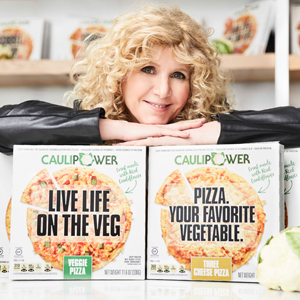
[00:00:10] Super Bowl: Hello and thanks for tuning into Taste Radio, the number one podcast for the food and beverage industry. I'm editor and producer Ray Latif, and you're listening to episode 196, which features an interview with Gail Becker, the founder and CEO of Caulipower, who discusses the swift rise of her vegetable-centric frozen food brand and the keys to its success. Tune in on Friday, January 17th for episode 68 of our Taste Radio Insider Podcast, when we're joined by three-time Super Bowl winner Matt Light and Bill Dessel, the co-founders of innovative spirit brand Kiehl Vodka. Just a reminder, if you like what you hear on Taste Radio, please share the podcast with friends and colleagues. And of course, we'd love it if you could review us on the Apple Podcasts app or your listening platform of choice. It's remarkable to think that Caulipower made its market debut just three years ago. Since that time, the brand, which is best known for its gluten-free cauliflower crust pizzas, has become one of the fastest growing food companies in recent memory. Caulipower, which also markets cauliflower-based tortillas and cauliflower-crusted chicken tenders, generated $45 million in revenue in 2018 and was on track to pull in an estimated $100 million last year. Despite no experience in the food industry prior to launching the company, Gail Becker has led Caulipower to its status as the fastest growing frozen pizza brand in America, one that's available in over 25,000 retailers and 5,000 restaurants across the U.S. and Canada. In the following interview, Nosh editor Carol Ortenberg sat down with Gail for a conversation about the origins of the brand and why she felt compelled to leave behind a well-paying and successful career to start the company. She also discusses the value of risks in entrepreneurship, how she identified and partnered with early-stage investors, and why being humble is critical for success. Later she explains why Walmart was the right fit for Caulipower early into its development and why she believes in the power of food to unite disparate communities.
[00:02:16] Matt Light: Hi, everyone. I am here in rainy California, surprisingly rainy, at the world headquarters of Caulipower. And I'm joined by the CEO and founder of Caulipower, Gail Becker. Gail, thanks so much for taking some time to chat with me today. Thanks so much for having me. I love having you here. So what is Caulipower? It's one of my favorite foods, but for some of our listeners who maybe don't know what the brand is, tell us more about it.
[00:02:43] Bill Dessel: Caulipower brings Meal Hacks to life. We make food healthier, more convenient, and most importantly, great tasting. We don't believe that you have to sacrifice any of those. And in doing so, we help bring people's ideas and Meal Hacks to life. And what are some of the products that you have in the market? So we have, we started with our four pizzas SKUs, which is what the brand launched with. Today we have more pizzas. We have our sweet potatoes, which is sliced sweet potato, used as a bread replacement. We have tortillas, both original and grain-free, and we have our newly launched chicken tenders, which is a serious category buster. You can eat the whole bag for 490 calories.
[00:03:33] Matt Light: Now, last year you launched Sweet Potatoes, which are your first non cauliflower product, and you kind of created this platform brand. Walk us through what you decided to do and why.
[00:03:45] Bill Dessel: So when we launched the four pizzas, we never really imagined going beyond that. I never knew that Caulipower would be what it is today. And I think a big reason for that is because our consumers and our customers were asking us for more. And slowly over time, we earned permission to do other things, including using other vegetables. Cauliflower was really never about cauliflower. It was about doing magical things with vegetables. So what was going to be our parent, our mother brand, if you will, but Vegilutionary Foods, which is so simple because what do we do? We are revolutionizing vegetables and the magical things that they can do. It's a brand that actually You know, a lot of people try and hide vegetables in food. We don't believe in that. We believe in celebrating what vegetables can do, because how are you really going to teach future generations about the importance of healthy eating if you hide all those wonderful ingredients?
[00:04:51] Matt Light: And how has launching this platform brand been? Do you wish you had kind of started there and started with a brand persona and hierarchy that had more room now looking back? Or do you think this was kind of the way to go about that plan if you could if you could have a do over?
[00:05:09] Bill Dessel: You know, it's a really interesting question, Carol. And it's one that I don't often get asked. And I would say when we first launched Sweet Potato Toast, we were nervous. I'll be really honest with you. I was nervous. I didn't know how retailers would react if there was going to be confusion. And so we launched that brand underneath Vegilutionary Foods, not underneath Cauliflower. And what I began to realize and hear from our customers and hear even from the retailers, they all said, no, no, we want Cauliflower bigger. make Caulipower bigger on the back. We don't want to hear about Vegilutionary Foods. We want Caulipower. And that's when I realized that we had that permission and that Caulipower was just more about the power of vegetables, full stop, not about what cauliflower can do. And so we moved everything under the Caulipower brand. Vegilutionary Foods is really just our parent brand, but it's not as consumer facing.
[00:06:04] Matt Light: Very interesting. Now, speaking about never imagining the company would grow to this size, let's talk about how did the company come about?
[00:06:13] Bill Dessel: The company came about because I think like a lot of other founders, I got frustrated by what I saw. I'm the mom of two boys with celiac. They were diagnosed at a really young age before gluten free food was really a thing in stores. In fact, if I were really smart, Carol, I could have been Udi, because it was before Udi was launched. And I just began to notice all the junk that people were putting in gluten-free food. You know, the thing is, when the industry evolved, the food didn't have to taste good, and it certainly didn't have to be good for you. It only needed to tick the box of being gluten-free. And so at that point, I sort of waited around for someone to do something about it, and no one ever did. So I think it's really fair to say that Caulipower was born out of a frustration of waiting. I was also very frustrated in my job in corporate America. I was looking for something more meaningful. My father had passed away. So I sort of put all of those things in a blender. And what I came out with was I know I'm going to quit my job, enter an industry that I knew nothing about. And I think I'm going to start that company called Caulipower.
[00:07:25] Matt Light: Not knowing anything about the industry, how did you quickly ramp up and get up to speed?
[00:07:32] Bill Dessel: So the great thing about this country is that you can hire people, consultants, to help you with just about anything. And so I hired consultants who help young companies start in the food business. And they taught me everything. I asked lots of questions. I learned every day. I still learn every day. And that's how I did it.
[00:07:52] Matt Light: I remember meeting you when you were just starting out. And one thing that struck me was how incredibly humble you were. And you mentioned asking lots of questions. Even now, you're very humble. And is that come naturally to you? That's something that not all CEOs possess that skill.
[00:08:13] Bill Dessel: I think one of the biggest mistakes that a lot of entrepreneurs make is that they're afraid to admit what they don't know. And when you do that, you lose out on so much. I'm a big believer in hiring people smarter than I am, experts in their field, and listening and learning to what they have to say. There are some things I brought to the table. Obviously, I worked in marketing, and I ran a lot of businesses, so I knew that end of it. But I didn't know anything about food. And so I think it's really important to admit what you don't know and hire around it. And I'm a big believer in saying that I learn every day because I do. I'm a big believer in saying as great as cauliflower is, it's never easy. And I sort of hate when I look at Instagram and everything looks so wonderful and so easy. And as all your listeners and anyone in the food industry knows, it's hard every day. It is hard every single day. Worth it, but really hard.
[00:09:13] Matt Light: Now, you did bring a lot, you're right, to the business. You had a background in marketing and PR. How do you think that benefited you starting out?
[00:09:22] Bill Dessel: two things that actually really helped. So one, I had worked in marketing for many years. I actually, and working at an agency was really interesting because it was my job to counsel other companies. And there were so many occasions when you'd go into a company and you'd say, well, we think you should do this or you think I should do it. And half the time they'd listen to you and half the time they wouldn't. Well, the great thing about Calling Power is I get to take my own advice. It's not always the right advice, of course, but I do get to listen to my own advice and it's worked out well and we get to take risks. And I think that's one of the greatest things about being a young company that's growing quickly is you do get to take risks. And you should take risks. And they're not always going to work out. But it's really what defines this industry. I mean, this industry has evolved because big food hasn't brought what people were asking for. So it's really up to this industry to listen to people and take the necessary risks in order to bring those things to market.
[00:10:25] Matt Light: You do have investors, you have a board of directors. What happens when you take these risks and they don't pay off?
[00:10:33] Bill Dessel: You know, it's interesting. I have to say, I, I haven't done everything right, but one thing I have done very right is I picked the best partners. I am super fortunate to have fantastic partners in Boulder Food Group and they've been supportive of of the risks I've taken, you know, luck, fortunately, most of them have paid off. And on the rare occasions when it didn't, I never hear anything negative. It's sort of like, you know, who was it, Margaret Thatcher used to say, if you stand in the middle of the road, you stand for nothing. I want Caulipower to stand for something. I want people to know that, you know, we are always going to innovate and you cannot innovate if you do not take risks.
[00:11:14] Matt Light: When you picked your investment partners, how did you go about picking the ones that you felt like would support you? Because I go to these trade shows now and the Caulipower booth just has investors and investment bankers kind of floating all around it a lot of the time. So I'm sure you had many different options of where you could take capital from.
[00:11:32] Bill Dessel: Well, it's funny that you say that, because I actually didn't. There were a lot of people who turned me down, or didn't necessarily turn me down, but who wanted more data. So I talked to probably 20 different investors. I tried to stick with folks who knew about food. I did have offers of money from people who were outside the industry, but I wanted smart money. I didn't just want money. So because we grew so fast, some of the investors wanted more months of data. And I was out of money. I didn't have it. And Boulder Food Group was really one of very few who said, you know, we don't need to see any more numbers. We're going to bet on you just as you are. And fortunately for me, they did. And fortunately for them, it worked out well. So when it came time to raising the second round, A lot of the people who didn't take the bet the first time around did want to throw their hat in the ring. But I have to say I was very loyal to Boulder Food Group because in this entrepreneurial world, timing is everything. And the earlier someone supports you, the more that you remember it. And I think that early support should be rewarded.
[00:12:55] Kiehl Vodka: Guessing your margins? That's risky. Belay Financial gives CPG brands the clarity to scale smarter, faster, stronger. Get your free inventory ebook by texting TASTE to 55123 and start making data work for you.
[00:13:15] Gail Becker: Tune in at the end of this episode for an exclusive interview with Matt Lynn of Belay Solutions. He sits down with Melissa Traverse to break down the biggest inventory and accounting mistakes CPG founders often make. You'll learn how to bring clarity to your numbers so you can scale with confidence.
[00:13:34] Matt Light: Melissa Traverse Gail, I really appreciate everything you're saying. supports what I think a lot of the industry thinks about you, which is that you are one of the nicest founders at trade shows. You always have a smile for people. You're always chatting. You have infinite amount of time for people who come up and just say, I just, I love your product. You know, I've watched you talk to fans for, for a long time. I I've said this before. I even looked on Instagram and I saw you doing demos and Costco talking to customers. Why are you so nice? Do you think niceness is an important part of the business? Because there are a lot of founders who don't necessarily prioritize that. Uh, I feel like
[00:14:18] Bill Dessel: the most grateful, unfortunate person on earth. And being in this position and having a company that actually makes people's lives a little bit better, that is a privilege with a capital P. And that is not one I take for granted. And to be able to help other people in any way, that does way more for me than it does for them. And the fact that people are even asking me those questions and what do I think about their brand, it's tremendous. And I just feel so fortunate. And I think all of us should just be working really hard to make sure that we do everything we can to help other people and make sure that this special privilege never goes away.
[00:15:05] Matt Light: Now, you were one of our judges in the Nosh Live Pitch Slam yesterday. What was it like being on the other side of the table and being the one to give advice kind of in a formal setting? There were parts of it that were excruciating.
[00:15:20] Bill Dessel: I'm not going to lie. Most of it was great. I loved it. I loved it way more. Ringing endorsement of being a judge at the Nosh Live Pitch Slam.
[00:15:28] Matt Light: No, no, no.
[00:15:28] Bill Dessel: I have to say, the pitch part, I loved. First of all, they were all fantastic. They all had great products. And I loved hearing their story and I loved seeing their passion. So that part was great. The hard part came into trying to decide because, you know, I am them. I'm no different than them. It wasn't that long ago when I was there asking for help and asking for advice and counsel and doing everything I can to help my brand succeed. And so I really felt for them. I wanted to pick everybody. I felt like I had to say something nice to everybody, but I really meant it. Because I know how hard they worked and I know what winning that means to someone. And I just wanted to make sure that everybody felt like they have a bright future ahead.
[00:16:21] Matt Light: I thought it was really exciting to see so many female founders in the Pitch Slam. And just in the room in general, we hear from a lot of female CEOs that it's not always easy.
[00:16:32] Bill Dessel: It's funny, being an outsider a couple years ago, I thought, oh, this is great. I'm going to leave corporate world, and I'm going to enter the food industry where there's going to be lots and lots of women all over the place. Of course there are, because it's food. It's true in some areas, like the founders, I find that there's a lot. But in retail, very few. The brokerage, very few. I mean, you know, like so many other industries, a lot of the decision makers, it would be nice to see more women take over those roles. The female entrepreneur role is interesting. I've had a lot of people say to me, Oh, did you and your husband start the company together? Uh, no. Why would you say that? When I used to stand with my sales guy, my very first, like literally my, one of my first hires, Oh, did you two start the company together? No, I mean, it's kind of extraordinary. And I have lots and lots of examples, but it's just an ecosystem not too dissimilar from life. It's getting better. It really is getting better. And I've had a lot of people cheer me on as a result, too. So sometimes it's really worked in my favor. There's been a lot of retailers Kroger, for instance, they really want more female-owned brands, so they offer elements to help female-owned brands. And that's fantastic, and the industry is really doing what it can. But it's not easy.
[00:18:12] Matt Light: You mentioned your husband. You do make this a family affair at times. I've gone to a trade show booth and there's your son cutting up pizza. Your husband works here full time. Is that hard? What's it like having it be a family business at times?
[00:18:27] Bill Dessel: I've even had my ex-husband work at the booth too, just to go full circle. Yeah, you know, it's funny because, you know, oftentimes you hear, oh, how do you balance work and life? And my answer is always you intermingle it. And I have brought, you know, my sons are the reasons I started this company. And I have engaged them every step of the way. They are my summer interns. They are my taste testers. They are my booth workers. They are my Instagram checkers. They are everything you want them to be. And I think people see that. you know, some of the letters I get from people are extraordinary because they say, dear Gail, and they say, I have sons like you do. You know, it's just, they can really relate to this being a family business. And I love that part. I love that part. And by the way, having a business is like having another child. I always say I sort of have three children. I have my two sons and then I have Kali power, which, you know, It's a lot harder than raising my two boys, but not nearly as important.
[00:19:42] Matt Light: Well, hopefully the pizzas don't talk back at me.
[00:19:44] Bill Dessel: Yeah, well, sometimes they do, but yeah. Depends on how tired you are at Expo West. Exactly, exactly.
[00:19:50] Matt Light: The idea of mixing work and family is a rule that a lot of people would say, oh, you should never break that rule. But breaking rules is kind of your MO. What are some of the rules you've broken along the way?
[00:20:02] Bill Dessel: Well, I don't know how much time you have allotted in this podcast, but So some of the rules I broke. One is I think I broke a rule on the packaging. I would say, you know, I think we broke a lot of rules with our packaging. You know, don't put big black letters on the front, you know, keep it clean. And I think that going into Walmart very early for us was something that I was really counseled against, but decided to do. Moving out of pizza. I think was something that a lot of people said, you shouldn't do that. You know, just make pizza 16 different ways and don't do anything else. I didn't listen to that. By the way, I did listen to a lot of advice. I listened to more advice that I didn't listen to. But there were some things that I just followed my gut. I'm not a young entrepreneur. And I think one of the things about starting a business later in life is that you have a bit more confidence to, you know, follow your instinct and do something differently. And for me, if I was going to give up what I had in corporate America, and I had a very nice existence there, but if I was going to give all that up, it was going to be for something pretty meaningful. And in order to be something meaningful, you have to do what your heart tells you to do. And that's all I've ever done in building Caulipower.
[00:21:32] Matt Light: Let's talk about Walmart and your distribution. You went pretty big, pretty fast. And yes, that is to the product's credit because you have to get a yes in order to get it on shelf. But a lot of brands say, oh, I'm going to go slow and steady, go a mile deep inch wide before going a mile wide. A lot of brands would say, I'm just going to go into one retailer. I'm going to build it slowly, region by region. What made you decide on this distribution strategy?
[00:22:03] Bill Dessel: Not knowing any better? No. I would say two things. One, I had first to market advantage and I wanted to take advantage of that. And I knew if early signs were going to be credible, I knew that this could be something, and so I knew I had to get it out as quickly as possible, because really, to have that first-to-market advantage is everything. But second, I wanted to make this a product that was going to be accessible to as many people as possible. Everything about the brand is accessibility. Accessible in the way it looks and tastes and the stores that it's sold in and the price that it's sold for. And the fact that we give a percentage of sales to help build teaching gardens and underserved schools across the country. And so what better way to do that than to be in a retailer like Walmart? I mean, but I have to say, here's a funny Walmart story. When I sold it in our first meeting, when I, and they took us very early on, we left the meeting. I was so new to the industry and there were so many acronyms that I didn't know what the heck it meant. We left the meeting and I had to turn to my sales guy and say, did we just get that? Cause I was so like, I wasn't sure. He's like, yeah, you did. I'm like, I think people are happy. Right. Um, but it was great. And it w it's been a great relationship with Walmart because they took a chance on me and I took a chance going into, you know, such big distribution so early on. And I think it's worked out for both of us. And I love that mutual benefit.
[00:23:37] Matt Light: I think the concern brands sometimes have is that this will cause pricing rifts or issues with other retailers. How have you navigated some of these challenges that maybe brands have when entering broad distribution really quickly?
[00:23:51] Bill Dessel: By the way, all that stuff does happen for sure. But you know, I think you have to build a brand and a product that customers want. And if you can show that consumer demand, then the retailers will support you. It's not always easy, but we always try and do the right thing. And you know, we've pissed off some people, but very few, which isn't to say that I haven't said no. I did say yes to a lot of people, but we also said no to some retailers very early on just because we didn't have the bandwidth. Here's the thing. Everybody has to have their own strategy. It worked out for Kali power. It may not work out for someone else but if that's your mission
[00:24:32] Gail Becker: Do you want more repeat buyers on Amazon? Well, this free resource in collaboration with Straight Up Growth will help your brand turn first-time buyers into long-term subscribers. Download Winning the Repeat Purchase Game on Amazon now at Taste Radio.com slash SUG. That's Taste Radio.com slash S-U-G to start building retention-driven growth for your brand on Amazon. Scaling a beverage brand into major retail comes down to operational readiness. From packaging lead times to co-manufacturing strategy, the details can make or break a launch. In a new ebook in collaboration with Octopi and Asahi Beer USA, industry leaders share what they've learned in helping brands scale. Download it now at Taste Radio.com slash octopi. Do you need to scale your team faster without compromising on talent? Join Oceans for a live webinar on April 20th and learn how leading companies are hiring top global professionals who are ready to grow with your business. Register for the webinar now at Taste Radio.com slash oceans. That's Taste Radio.com slash oceans.
[00:25:42] Bill Dessel: And then you should go for it.
[00:25:47] Matt Light: With the first mover advantage, there's a lot of cauliflower or vegetable based products now in the market. I think like half of Trader Joe's frozen aisle now is cauliflower based. How do you handle all the competition now?
[00:26:02] Bill Dessel: Well, I'm a strong believer in the old adage that if you're running a marathon and you look back, you really don't do anything except trip. So I try not to look back so much. We do have 96% of the cauliflower crust pizza market. So that's obviously great. We've obviously seen a lot of competitors out there. I never in a million years thought that it would be, you know, me versus Oprah Winfrey. But sure, why not?
[00:26:31] Matt Light: Is this why when you get in shows, you hand out coupons and you're like, you get a pizza, you get a pizza.
[00:26:36] Bill Dessel: Everybody gets a pizza. No, I do that because I've never had a job in my life where I got to give out free pizza. And the great thing is no matter who you are or how much money you have, everybody loves free pizza. That's my big takeaway from building Caulipower. You know, What I really don't like is I don't like when people rush things to market in a me-too way and the quality is not there. Because it's good for us in the sense that, you know, it drives more people to look for something better, but it also drives a lot of people away from the category. I can't tell you how many people have said, oh, no, I don't want to try Cauliflower Krispies. I tried so-and-so's and it wasn't good and so I don't like it. And then we say, no, no, but you have to try ours. It is an interesting phenomenon. Sometimes it's, you know, frustrating, but you know, you just, you got to play your own game.
[00:27:29] Matt Light: And how do you get those customers back? How do you convince them to take a chance with you?
[00:27:34] Bill Dessel: We know that when we give people pizza to try, that they'll be a customer, or whatever our products are. So our goal is to get Boulder Food in as many mouths as possible. If we have to open a pop-up store in the middle of Manhattan, which we did. If we have to send trucks around the country, which we did. If we have to give out free coupons, which we do. All of those things are meant to drive trial. We are so confident in our products, and we see that when we drive trial, people become a customer. But it's a lot of mouths to get your food into, and it's really hard to do, particularly when you're a frozen product.
[00:28:11] Matt Light: Along with getting product into people's mouths and having them try it, you've also kind of created this community and really brought people together around the concept of family meals or eating together or just enjoying food that you stopped eating because it wasn't good for you. How have you gone about creating this bond between your consumers?
[00:28:35] Bill Dessel: I think that was really built on an insight that I had as my boys were really young and they were growing up. And they would have friends come over on a Saturday and I would make frozen pizzas for everyone, right? As we often do, because it's easy and quick. And my sons were very insistent, Mom, don't give the gluten-free pizzas to our friends. Just give them the regular pizzas. Just give the gluten-free ones to us. And they did that because they were embarrassed. And they were embarrassed by the way that they looked and they tasted. And it was an insight that was sort of ingrained in me, which I never pulled upon until starting Caulipower. And that is, wouldn't it be great if we can all just share from the same plate? Wouldn't it be great if we could all eat the same thing, even if we had entirely different reasons for eating it? So in a world that is divided by so many things today, and in a food universe where there are so many foods that are, don't eat this, or don't eat this, or this is free of X, Y, and Z, How about if we just put the food on the table and all eat it and not, not feel separated, but feel united. I love that about food. It's funny. Sometimes people ask if I'm a foodie and you know what? I'm not really a foodie, but I love meals. I love cooking. I love feeding people. My parents were both children of war. They had no food. And even when I was growing up, and even when times were tough, the one thing they would never skimp on was food. Because that is how you showed someone you love them, is you cooked for them. And of course, you saved all the leftovers and put them in the freezer, because you would never want to throw those away. So I think I was destined to be in the frozen food.
[00:30:31] Matt Light: You're throwing that away? Exactly.
[00:30:32] Bill Dessel: It's just a tiny cup. Oh, that's lunch tomorrow. I wish my mother could have known that I entered the frozen food business. She'd be very proud. That's what it's about. It's about how food can bring people together. And that is what I love about this industry. And that is what I love about the people in this industry. And that is why I love being a part of this and helping people in some tiny, tiny little way.
[00:31:03] Matt Light: Speaking of a divided world, one thing you don't do at Caulipower is tell consumers they're doing it wrong. I don't see in your marketing you saying, stop eating regular pizza. You just kind of offer them an alternative. How did you settle on that path of messaging?
[00:31:17] Bill Dessel: I think that's one of the nicest comments I've ever received. So thank you, because that is an absolute goal of ours. We don't food shame. There's no such thing as food shaming. I hate it. I hate when people feel bad about what they're eating. You can eat whatever you want. And if you make a better choice one day or two days a week, that's great. If you make it every day of the week, that's great, too. It's all about that communal feeling of sharing the same meal or sharing from the same plate. And if you don't want to, that's great, too. You know, we have comments. Hey, your product's not for us. Fantastic. Fantastic. Here's a free coupon. Try something else. We're sorry that didn't work out for you. The customer is always, always right. And nothing that they do is wrong. Even when they're wrong, they're right. That's what my father taught me when he owned a store in San Francisco. And I used to work on the cash register every Saturday for $20 plus lunch. And when I sat at the cash register, I saw him build relationships with all of the people who could have gone to a thousand different stores in San Francisco and they went to his store. And that's what he taught me. And everything I learned about this business, I learned sitting on that little stool in front of that cash register, starting at five years old.
[00:32:39] Matt Light: That's a wonderful lesson that I think more people in this industry, in the world, need to embrace so that we can come together as a community, as a country. But I want to end by talking about one thing that perhaps your dad gave you fashion lessons, maybe not. But whenever I see you, you're wearing green. We have to talk about your signature color. How did you come to identify that green was where you wanted to go? Because I'm sitting in your office, and you have green cubicles and green walls. And I look over at your purse, and there's a green makeup bag inside, and you have a green laptop cover. And for those of you who don't know, green is the Caulipower color. But how did you really decide to own this?
[00:33:27] Bill Dessel: Everything you said is true, except one thing. That is not my makeup bag. That is the bag I use to hold all my free coupons. But the point is well taken. You know, in a very crowded and noisy world, when you're building a Brad Avery ounce of space is usable, including what you wear on your body. And We should be living our brands in every sense of the word. I try and live every day to what Caulipower represents, the fact of community, the fact of helping people, the fact of uniting people, the fact of helping people lead healthier and easier lives. And when I wear green, it reminds me of what I'm trying to do. you know, think that I'm wearing it because, you know, I'm, I'm want to talk about and remind people of Kali power. And, and yeah, of course that's true, but I want to remind myself what I'm trying to build every single freaking day. And I want to live my brand in, in every sense of the word. And I assume all the other founders do as well.
[00:34:43] Matt Light: Well, it's very clear. You're very passionate about the brand and the community that you're building. And thank you so much for taking time to speak with me today and being part of our community.
[00:34:51] Bill Dessel: Thank you for welcoming me in three and a half years ago. I didn't know anyone and you were very nice to me and I don't forget that. And it's a privilege. So thank you for having me.
[00:35:07] Super Bowl: That brings us to the end of episode 196. Thank you so much for listening. And thanks for our guest, Gail Becker. You can catch both Taste Radio and Taste Radio Insider on Taste Radio.com, the Apple podcast app, Stitcher, Google Play, SoundCloud, and Spotify. As always, for questions, comments, ideas for future podcasts, please send us an email to askatasteradio.com. On behalf of the entire Taste Radio team, thank you for listening. And we'll talk to you next time.
[00:35:46] Bill Dessel: Hello, I am Melissa Traverse here for the Taste Radio podcast, talking about some of the biggest tension points that CPG brands and founders face when they're scaling a brand, and those are financial accounting and inventory management. I am joined by Matt Lynn, inventory accounting guru from Belay Solutions, and he is going to shed some light on all of this that is going to help everybody out quite a bit. Matt, thank you so much for joining us today.
[00:36:17] Carol Ortenberg: Thank you for having us, Melissa. It's great to be out here at Expo West and it's great to sit down and be able to chat this because it's kind of a passion project of ours, working mainly with CPG brands and hoping to help them scale.
[00:36:28] Bill Dessel: It's been such a pleasure chatting with you and the team and learning all about what you do over there at Belay Solutions. Can you tell us a little bit about yourself and what your role is and the kinds of solutions that Belay gives to CPG brands and founders?
[00:36:44] Carol Ortenberg: Yeah, absolutely. My role with Belay, I'm actually our inventory accounting manager. I run our inventory department. So we work with CPG brands, taking them from spreadsheets, putting them on inventory management systems, and really helping connect their tech stack between their sales, online marketplaces to that inventory management system, even down to their financial systems like QuickBooks. Belay overall is kind of an outsourced accounting firm. And with that, we're helping teams. We have different levels with bookkeeping, controller level work, even high level into CFO type items. So we really help those brands in any way that they need financially. And then I just have a subset of a department where we're really just laser focused on inventory.
[00:37:27] Bill Dessel: It's certainly a complex topic and there are plenty of places to go wrong. Let's start by going right and start super simple. Can you tell us what some of the biggest red flags are that would help a founder understand or, you know, the person running a brand understand that it really is time to get some help with some of these areas?
[00:37:47] Carol Ortenberg: WKYT. They have a lot of transactions that don't get coded or they just put them into placeholders to just get rid of it so it's not an eyesore. They'll notice they have revenue but no cash or they notice that they have a good amount of cash but their blind spot is really seeing the vendor invoices that are sitting there just needing to be paid and so they just lack that clarity that's going to really be around the corner.
[00:38:24] Bill Dessel: You know, you were talking about one of the red flags that comes up that I think makes so much sense. When somebody asks you what your numbers are and you can't come up with the right number, that's a big problem because that's something that you really should be able to share with decision makers who you're ideally looking to do business with. What should you be able to call up at a moment's notice?
[00:38:49] Carol Ortenberg: really at any time you should be able to know an accurate margin. It's amazing how many founders we end up talking to that they can tell you their revenue numbers, they can tell you their selling price, and then the minute you start talking about cost or their cost of goods sold, they just get a deer in headlights look. So really it's very hard to tell, am I even making money? Or if you don't know your entire landed cost. Maybe you know what the freight cost is, the duties separately, but you're not really getting that as part of your unit cost. So it's really hard to tell. Am I even making money or am I losing money from the very beginning?
[00:39:22] Bill Dessel: And do you recommend that founders are able to call up a margin by channel?
[00:39:27] Carol Ortenberg: Absolutely. And depending on the number of products and channels, you kind of want to know what are your best sellers, which ones are making the most and which ones maybe you're not making as much. But especially if you're branching out and you're doing D to C with B to B, absolutely want to know that.
[00:39:43] Bill Dessel: Gotcha. You mentioned that when things feel really chaotic, that's probably a red flag. I would say that it probably almost always feels chaotic if you're running a CBD brand. And I know this may be hard to quantify, but is there a revenue number? Is there a number of doors number that would help a brand understand whether or not it makes sense to bring on a partner like Belay? Understanding that so many brands are bootstrapped or they might be tight for cash. What is that friction point?
[00:40:14] Carol Ortenberg: 3 3 3 3 3 But as you're growing, as you're getting to those six-figure revenue numbers, and especially as you're approaching seven, you want to make sure you've got good financials. Because as you scale to that point, most likely you're going to be looking to raise capital. And investors, the first thing they're going to look at is your books. And are they clean? And do they show a clear picture of your business?
[00:40:46] Bill Dessel: You know, another area that folks might look to to organize some of the chaos are their systems. So many folks stick with Excel spreadsheets for a good amount of time. How do you know that you need to outsource some of your accounting to an organization like Belay Solutions versus maybe signing on to a Synth7 or NetSuite or something like that?
[00:41:09] Carol Ortenberg: Well, that's actually something we really help with when it comes to that cost question. That's something that trips people up. And sometimes if you just have a turnkey business, you buy and sell a finished good, you can maintain with spreadsheets. And we've had clients with million dollar revenue that can do that. But we see so many brands nowadays are using contract manufacturers. and they're just sourcing certain parts of their product. So when you start talking cost, they have no idea exactly what their unit cost is. So that's where we come in and we kind of understand, we'll speak with the customers and the clients and get their needs. And then if we think they're ready for a system, then we'll help put them on that system so they can get some of that clarity. And it's not something we force on anybody. There are plenty of times where founders come to us and we'll tell them bluntly, you're not ready for it right now, but we'll let you know when we think you are.
[00:41:55] Bill Dessel: That sounds like excellent advice. What should a founder or somebody running a brand look for in an outsourced accounting partner? Are there certain checklist items that they should make sure that their partner be able to execute or be able to help them understand?
[00:42:12] Carol Ortenberg: Absolutely. I think one of the keys, there's, there's a lot of outsourced accounting firms out there. Some focus on service-based SaaS companies, but if you're a CPG founder, you really want to make sure that your accounting firm has CPG experience. I would ask them, you know, what kind of brands have they worked with and even beyond that industry specific, because there's so many subsets of CPG. And that's something that I think is great about what we do with Belay is that we kind of run the gamut. It's kind of like the insurance commercial. We know a thing or two because we've seen a thing or two across a broad spectrum.
[00:42:42] Bill Dessel: Probably getting references is always helpful, right? Absolutely. All right. So this all sounds great. I think we have a really good understanding of would it make sense to hire an outsourced partner? You know, what some of the things you should be looking for are. What does offloading this kind of work mean for the brand? What can this do for lightening the load of a founder or lightening the load of a brand operator? Like, how does that help them in their everyday business?
[00:43:11] Carol Ortenberg: It just tries to really help quiet the chaos. So what we're looking to do is just take some of the weight off that founder's shoulder, let them focus on building the brand, building the business, getting that exposure. If you don't have sales, you really don't have anything. So we want them to be able to focus on that while we take care of your back end office work. And we can just present that to you on a monthly basis, you can help make decisions, you can take that to investors. And really, you can just focus on growing your business.
[00:43:37] Bill Dessel: I feel like I felt founders and the folks who are running brands collectively sigh. Breath of relief just hearing that. How can people learn more about Belay Solutions?
[00:43:48] Carol Ortenberg: So people can text TASTE to 55123 for their free inventory guide to get started.
[00:43:53] Bill Dessel: Matlin, inventory accounting guru at Belay Solutions. Thank you so much for joining me here at Expo West. It's been such a pleasure to chat with you and learn about what you all do over there to help founders and brands with their financial accounting and inventory management. For everybody else out there, thank you for listening to the Taste Radio podcast. I am Melissa Traverse and we'll see you next time.