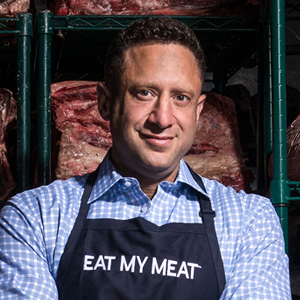
[00:00:10] Ray Latif: Hello, and thanks for tuning into Taste Radio, the number one podcast for the food and beverage industry. I'm editor and producer Ray Latif, and you're listening to episode 211, which features an interview with Pat LaFrieda, the CEO of Pat LaFrieda Meat Purveyors. Just a reminder, if you like what you hear on Taste Radio, please share the podcast with friends and colleagues. And of course, we'd love it if you could review us on the Apple Podcasts app or your listening platform of choice. Pat LaFrieda wasn't supposed to be in this position. His father, Patrick Sr., forbade him from joining the family's 100-year-old meatpacking business and wanted for his son to be anything but a butcher. LaFrieda eventually convinced his elder to join the company in 1994, and since taking the reins as CEO, he's built it into a sprawling $200 million empire that supplies meat to some of the country's finest restaurants and chains, including Shake Shack, whose burger patty was developed by LaFrieda himself. The company has also developed fast-growing retail and e-commerce businesses, each of which has helped to weather a massive downturn in the restaurant industry caused by the COVID-19 crisis. In the following interview, I spoke with LaFrieda about how he turned a small business with 5 employees and 40 customers into the first name in meat, one that boasts over a thousand food service and retail customers. As part of our conversation, he also explained his definition for quality and how it fit into the company's evolution, why relationships are everything in business, his vision for the future of Pat LaFrieda, and his opinion about plant-based meat products, one that's rather unexpected. Hey, folks, it's Ray with Taste Radio. I'm going to call right now with Pat LaFrieda, the CEO of Pat LaFrieda Meat Purveyors. Pat, how are you? Good. How you doing, Ray? Thanks for having me. Thank you so much for being with me. How are things in your neck of the woods?
[00:02:00] Pat LaFrieda: These are very odd times, Ray. Very odd times. We thought we've seen just about every type of obstacle and struggle, and then Here we are in the middle of a pandemic, but we're still in the fight. We're still working every day and supplying meat. People still need to eat.
[00:02:18] Ray Latif: And you've been supplying meat and helping people to eat meat for many, many years now. When did the company start? When did you launch?
[00:02:27] Pat LaFrieda: Well, my grandfather started LaFrieda Meat Purveyors in 1922. So nearly a hundred years of serving restaurants with meat. And he got into the business from a transition he did from retail to wholesale, meaning from selling in a retail butcher shop to supplying restaurants in New York City with meat. And he did that during an amazing union strike, which was basically a walkout of all the butchers in the 14th Street meat market. And back then, if you had a restaurant and you wanted meat, you had to get it from the 14th Street meat market. There was no other place that you could get it from. It was a very controlled business. And if there was a union strike, that's it. They walked out and restaurants didn't have meat. So my grandfather found that as an opportunity. He went to New Jersey to small farms. He was able to obtain beef and then bring it back to New York City, portion it and sell it to restaurants.
[00:03:29] Ray Latif: When did you get involved with the company? I know your dad had some reservations about you joining. I mean, how did you convince him to be part of the family business and what were you doing before that?
[00:03:41] Pat LaFrieda: It really starts with how hard this business is and how much harder it was. My dad and my grandfather had really experienced this industry probably in its worst time ever. So having to bring an entire animals and having to sell, if you sold two top rounds of beef, you had to sell two flats. If you sold two flats, you had to sell the two strips. It's very different than it is now, but the environment that they were in and the dilapidated buildings of the 14th Street meat market really made it a depressed career. And my father didn't have a choice. My father was forced to be into the meat business because Italian American families then really, the sons followed what their fathers did. When it came to me, I'm Pat LaFrieda III. I was the generation that was supposed to go off to college, learn how to do something bigger and better. And my father forbid me to be in the media industry. And he forbid me to join the family business. Although I had worked every day off from high school, every day off from junior high school. And before that, since I'm 10 years old, I worked with my dad on the weekends and on vacations. It was the best job I ever had in my life. It made sense. There was a demand for meat. We were Meat Purveyors. We sourced it and we supplied it. It made complete sense. I got to go in the trucks, make deliveries with the drivers, get to go into the kitchens and speak to the chefs. Everyone just treated me so well on the chef side. It's the only thing that ever made sense to me. So I went off to college. I got a finance degree. I joined a brokerage house on Wall Street called Hibbard Brown, and I was there for not even a year. I got my Series 7, my 63 from the SEC. I was fully licensed, and I despised it. I found myself selling intangibles to strangers over the telephone. And within a year, I begged my dad to get off Wall Street and to join a family business and that I would be the one that would help grow the company. And it took some convincing. And my aunt, my father's sister, Lisa Lafrida, she was partners with my dad, and she was just retiring. And she was, my father's the lover out of the two, and she's the fighter. So she really wanted our company to survive another generation. And in talking with her and she talking to my dad, we both convinced my dad that I could join the family business. And I just followed in my father's footsteps exactly his work ethic, except with a little bit more of an education in marketing. My dad's born and raised in the streets of Brooklyn, as I was, but You know, high school is as high of an education as he went. And he really saved all of his money for his four kids to go to private schools and to college. And he spent all of his money on our education. So in a way, I felt that I could use that education in helping our company grow. And as he soon saw it, it worked.
[00:07:06] Ray Latif: It sounds like your dad is quite the man. Is he still alive?
[00:07:09] Pat LaFrieda: My dad is 73. He comes here every morning at 2.30 a.m. because he's always started at 2.30 a.m. And as our business grew, I just pushed back to start time all the way to the point where we're 24 hours a day, six days a week. And I backed up my start time. But my dad, out of respect, I never changed his hours. I mean, how could I? Ultimately, he's the boss, right? So he always comes at 2.30. But to see him at 2.30, gives me a sense of security. I've worked all night with my crew, sometimes in the afternoon before, but it's not until he steps into the building do I feel like a bit of calm comes over me. That's what he was missing when my grandfather passed away years before I joined the family business. I could see that he didn't feel that anymore. And now with me there, sometimes he comes to work at 2.30 and as soon as the trucks leave, I'll begin talking to him and I can see him start to fall asleep again because he now feels at peace, that security of me being here.
[00:08:17] Ray Latif: When a business is passed on from one generation to the next, that sense of continuity is so important. And one of the cornerstones of Pat LaFrieda, the business, has been quality, your commitment to quality. The word though has different tiers and different meanings to different people. What does quality mean to you guys?
[00:08:44] Pat LaFrieda: Well, we are Meat Purveyors and our job is to provide our customers with what they need and what they demand of us. So quality can mean so many different things now as opposed to in my dad's era. So now quality can mean anything from meat that is grass-fed, where the perception is that it's better for the environment, to grain-fed, where it's better for the community, where you have growers of beef next to huge corn farmers, and that entire process there is very special in itself, and that's really what beef quality meant for many, many years. But now, There's a sustainability complexity to this, whereas some can afford to buy meat that's either organic or all-natural at the very least. And we see that's where the trend is going, towards all-natural. So it's a never, ever program where no antibiotics and no growth hormones have been ever introduced to the animal at all. And it's been raised and grazed in the United States, because contrary to many beliefs, a lot of beef is born south of the border. and then brought north of the border to finish off and is deemed to be American beef or domestic beef. That's why ours, we specify that it's raised and grazed in the United States from birth to harvest. We see that as a form of quality. And then there's the grading. Grading only 4% at the most of American beef that's produced is a prime grade. So there's a constant battle as to what meat producers like myself are going to get part of that 4%. And, you know, it takes many years of being solid and sustainable as a company, which translates into you pay your bills in seven days to the growers on a constant basis in order to earn that respect of getting a huge amount of that 4% of the prime. So prime beef has to do with the intramuscular fat that's inside the protein itself. The more intramuscular fat, those are the white specks that we see at the cross section of beef, the higher the grade is. So one step below prime would be the top one third of choice. And we have a huge demand for that. It's a completely different price bracket. And there's a lot more access to that product. And when, as I said, different restaurants will demand different tiers of pricing, different grades of quality. So our job is to make sure no matter what category we're selling, we are sourcing the best beef in that category.
[00:11:34] Shake Shack: Guessing your margins? That's risky. Belay Financial gives CPG brands the clarity to scale smarter, faster, stronger. Get your free inventory ebook by texting TASTE to 55123 and start making data work for you.
[00:11:54] Meat Purveyors: Tune in at the end of this episode for an exclusive interview with Matt Lin of Belay Solutions. He sits down with Melissa Traverse to break down the biggest inventory and accounting mistakes CPG founders often make. You'll learn how to bring clarity to your numbers so you can scale with confidence.
[00:12:12] Ray Latif: What I'm hearing is that a lot of it depends on your customer partners, your restaurant partners, as to what their customers are looking for on the plate, despite it being the same grade of meat, right? I mean, the way you prepare and process protein is just, it's pretty unique. Could you tell us a little bit about what you do that is so special?
[00:12:35] Pat LaFrieda: One of the very many things that we do differently at the Freedom Eats is we don't freeze anything. So our beef comes in fresh. And one of the reasons that we work 24 hours a day is because restaurants normally order when their service is done. So that could be 10, 11, almost midnight at sometimes. They place their orders in and they want their meat delivery the very next morning. So we're talking about maybe seven hours later, they want the delivery in front of the door. In order to make that happen, we cut everything to order, everything fresh. We have to be here all night in order for that to happen. So we're really fighting the clock the other way. Whereas most are hoping that the clock turns quickly so they're done with work, we're all hoping that the clock goes the other way so we can get the orders out on time. Because if you don't have that delivery at 7, 8, 9 a.m. in the morning at the restaurant, the phone calls start coming in.
[00:13:34] Ray Latif: It's clear you've helped a lot of chefs in a lot of restaurants with very high quality, very high Beyond Meat. One of your largest partners is Shake Shack. I'm kind of blown away that everything that you provide to your restaurant partners and your retail partners is all fresh, not frozen, because Shake Shack is one of the fastest growing restaurant chains in America. I think with a valuation of over a billion dollars at this point, you helped create the blend that they use, the hamburger meat blend that they use in their restaurants. I did create it, yes. You created it. You didn't help create it. You were the creator of the Shake Shack Burger.
[00:14:10] Pat LaFrieda: Yes, well, it took a few blends to work right on the flat top grill that they had in the park at that time. But it's truly an amazing story to have seen what it was. I mean, it was a little hot dog stand in the park, and for it to turn into a publicly traded burger restaurant that's internationally accepted, known and demanded. It's amazing. And I remember trying to explain to my dad, he didn't really understand what I was telling him. And I said, there were long lines of people that were waiting for the burger. And I actually took him to the park. And I said, Dad, you see this line? He said, no, this can't be for Shake Shack. I'm like, Dad, this is for Shake Shack. This line here of 250 people are all people waiting to get a Shake Shack burger. I think that was one of the proudest moments that I've shared with my dad. You know, for him to see that really came full circle because we've always been known for our burger meat. And it was usually the Louviere's and the Danielle's of the world would stop by our place for let's say like grilling season, 4th of July, Memorial Day, Labor Day weekend, but they weren't buying meat from us for their restaurant the rest of the year. So I knew that was one of the things that I really needed to promote was how great our burger meat was. Our meat is chopped, it's not ground.
[00:15:37] Ray Latif: And- Can we pause there? And I want to ask you, why is your meat chopped instead of ground?
[00:15:42] Pat LaFrieda: Well, because we use whole muscle. So we only use whole cuts of beef to make our chopped beef. And again, it's one of the reasons that keeps our burger much different in quality and flavor than any other producer of burgers. Most burger producers use imported trimmings, mechanically deboned beef, and then they'll add some small fraction of beef in on top of that. We only use whole muscles, so whole cuts of beef, chucks, beef clods, briskets, boneless short ribs. And in that manner, we're able to control the flavor always. When you bring in trimmings from other countries, you really don't know what's in that. All they'll tell you is the fat to lean ratio. That's not as important as knowing what cuts of beef go into our Lafrida original blend. And to make Shake Shack's blend, I had to take our original blend and tweak it somewhat mostly with the brisket, adding brisket to it. But for it to cook right on that flat top, it took a little ingenuity and reverse thinking on what's best for that cooking device. So we all learned a lot of lessons from that. And they've since changed that from that flat top to a different one. But that was the first time that we know of where a butcher actually tweaked their blend according to what the chef's kitchen equipment was, and the size of the burger had to be a certain width to match the size of the bun. That kind of thinking never happened before, so that the burger was a half inch wider than the bun, so that when it cooks, it matches the bun. And, you know, those kind of attention to detail points really made Shake Shack and their consistency and training really made Shake Shack stand out from everyone else.
[00:17:42] Ray Latif: I don't remember seeing this when I've been to Shake Shack. Does Shake Shack advertise that they're using Pat LaFrieda beef on their menus?
[00:17:51] Pat LaFrieda: Does Shake Shack advertise using LaFrieda beef? They do locally, I believe, on their website. And they do mention us a lot. And they do credit us with their blend in their Shake Shack book. But to be a national and international brand, I don't think there are many people in Saudi Arabia that can assimilate our name with a burger. So it doesn't really work in a universal way. But when they went public, they kind of had to be a little independent on that side. But that's fine by us. We were never the type that pushed for our name to be on the menu or to take credit for anything. We are the meat supplier. We're the purveyor. So our job is to supply them with beef and to make sure that their blend is consistent and their blend is supplied to them every day fresh.
[00:18:44] Ray Latif: I have seen your name on other menus though, you know, if I'm going out to a local restaurant, I'll see on a menu, you know, we use Pat LaFrieda meat for our burgers or for our steaks. And it's interesting because going back to this point about quality, your name is in many ways synonymous with high quality meat. And I know you said you've never asked or you don't ask restaurants to add the brand to their menus, but it certainly helped, right? I mean, it certainly helped get your, get the name out there to consumers who weren't necessarily familiar with your company prior to it appearing on restaurant menus.
[00:19:25] Pat LaFrieda: Yes. So our name being on restaurant menus really helped our exposure to the general public. And I'll tell you with Boston, Boston's been a great market for us. And when we first went to Boston, we were asked by the Red Sox to actually do our cheesesteak there and actually cook it there. And I warned my crew, I'm like, look, they're going to associate us with the Yankees. I don't know what's, you know, we may get roughed up, up here. I don't know what's going to happen. And I got to say, I think in the first half hour, someone walked by and said, Hey, Paolo Frida's got a steak sandwich here, Paolo Frida's... And we just were so honored. And our business in Boston has grown ever since. So Eataly opened there and the newest, I think the biggest project I've seen in Boston in a long time is the Encore. Encore opened in Boston and it is huge. And if there's a place that needed hotel rooms, it's Boston. Just staying there for the games while we were there for a few months. I mean, it was expensive. It was even hard to find hotel rooms in Boston. So yeah, the Encore has been huge for us there. And so now we have three trucks that go to Boston every day.
[00:20:45] Ray Latif: Wait, you guys are Yankees fans? I'm just, I'm not, I'm done with Pat LaFrieda's beef. I'm never, no, I'm just, obviously I'm kidding.
[00:20:54] Pat LaFrieda: We do have more Mets fans here than Yankees fans, but being a New Yorker, both teams have done well and done poorly. And I think it's great to have like an alternate team. So the Yankees weren't doing well. All right, we're Mets fans now and vice versa. Now, not very many people like that, but we always like both teams, to be honest with you. And we work with both teams. We supply a lot of meat to the Mets and we work with the Yankees as well.
[00:21:22] Ray Latif: You know, you mentioned Eataly in Boston and I actually bought some burgers from Eataly the other day and specifically bought them because they were Pat LaFrieda brand and they were fantastic. Having your name on restaurant menus certainly seems to have helped your retail division as well. Is that a growing part of your business? I assume it is now, you know, in our current circumstances where obviously nearly every restaurant in America is closed. Obviously, they're still doing takeout, but people buying meat at grocery stores is, you know, through the roof.
[00:21:55] Pat LaFrieda: Yes, the demand for our product in retail has really risen to the point where we've turned down the last few grocery store chains that have asked for our product, because we've always had the mentality of We're going to serve our customers that are with us 52 weeks a year. And just because product is short doesn't mean we're going to sell it to someone else for more money. We never do that. It's kind of the legacy of why we don't serve Peter Lugars as much beef as we could. Earlier, I spoke about the 4% of beef in America is prime. Well, we're going to make sure our customers that buy from us every week get the first dibs on that product. But as far as retail goes, retail has been growing tremendously for us. And yes, restaurants are closed now, but they will reopen and things will come back to normal. I'm very optimistic about that. It's going to take a little bit longer than I had hoped, but it will come back. But if we hadn't had such a great retail demand, we would be very lost right now, because with all restaurants being closed and open for maybe curbside delivery or delivery, It's about 10% of the business that we did with restaurants. Our retail has risen about 500%. Actually, the packaging for retail is very time-consuming because each item has to be portioned exact weights and labeled as such. It takes a lot more time to produce all of the retail demand that we have. Our butchers are working still the same amount of hours as they were before this crisis. If you think about it, our restaurants helped us get a retail name. And during this time, the retail business has helped us survive through this crisis, only to be here for when our restaurants reopen. And I mean, it's part of being a Meat Purveyors who's open 24 hours a day. And I speak to chefs all night long. and whether I'm consulting on their menu or I am counseling them to get off their couch and get back into the restaurant. And even though they won't be doing a lot of business, it feels a heck of a lot better to be doing something. Yeah, I'm always going to see the glass half full. I'm always going to be optimistic because what other choice do we have? And we often say, oh, we've never lived through anything like this before. No, we have. We've lived through stuff like this before. It looked differently. It didn't last as long. But we have lived through things like this before. I was at the base of the Twin Towers when they fell. We were here during Hurricane Sandy, which was nothing but some rain and no electric for a week. Snowstorms in the city that gave us blackouts for weeks on end, especially down in the 14th Street Meat Market. We've seen disaster before, and we've always come back, and we'll come back from this. And I think that all of the different obstacles that we faced prior to this has really geared us up to being able to handle this. It's going to take everything that we have to get our restaurant industry back to where it was. So not just me counseling them at night, but it's going to take support, and it's going to take some time, but it's going to happen.
[00:25:18] Meat Purveyors: Do you want more repeat buyers on Amazon? Well, this free resource in collaboration with Straight Up Growth will help your brand turn first-time buyers into long-term subscribers. Download Winning the Repeat Purchase Game on Amazon now at Taste Radio slash SUG. That's Taste Radio slash S-U-G to start building retention-driven growth for your brand on Amazon. Scaling a beverage brand into major retail comes down to operational readiness. From packaging lead times to co-manufacturing strategy, the details can make or break a launch. In a new ebook in collaboration with Octopi and Asahi Beer USA, industry leaders share what they've learned in helping brands scale. Download it now at Taste Radio slash octopi. Do you need to scale your team faster without compromising on talent? Join Oceans for a live webinar on April 20th and learn how leading companies are hiring top global professionals who are ready to grow with your business. Register for the webinar now at Taste Radio slash oceans. That's Taste Radio slash oceans.
[00:26:29] Ray Latif: You know, I love your perspective of optimism and positivity. It is what we need. You know, you can get really down at any given point in the day and it's relationships that really help, you know, folks that you can lean on, friends, colleagues, mentors, et cetera. It sounds like you've had relationships with chefs and restaurant owners for years, if not decades, and it's been a boon to your business and theirs. You know, we chatted before our interview and you talked about how these types of relationships take a lifetime and it's not something you can fake or buy. What's been the most important aspects of building relationships, building long lasting relationships?
[00:27:09] Pat LaFrieda: Number one is accessibility. Customers want to be able to pick up a phone and call someone who could make the call and change their day. So if they're short an item or if they forgot to order an item, at that point it doesn't really matter. The fact that they're able to pick up a phone and get someone that can make a difference in their day and save them from a small catastrophe of not having product and having 86 an item for the night is really key. All that has to do with being reliable and sustainable ourselves. The fact that we're always open, we're always accessible, we always have product on hand to supply our restaurants. When I said you can't fake it, you can't fake a relationship because relationships are only built between two parties that respect each other. And to gain the respect of a chef, you have to be very reliable for a decent amount of time, like decades sometimes, to prove to someone that you're always going to be there for them. And like I had said earlier, our best friends are our customers. I mean, we spend so much time working with our customers. They have become our best friends on our free time. That's who we spend our time with. That's who we go away with sometimes when we have the chance. And that's who we have a lot of fun with. So yeah, it's a lifetime of dedication in that relationship to build it. But if you're reliable, if you're accessible, and if you can make the changes that will help that customer, that customer, we won't call them a customer for very long. They'll soon become your friend. And that relationship is priceless. Now, that has to be backed up with quality of product. It has to be backed up with pricing that is equal or reasonable to what is available in the market. You know, there's a lot of aspects that come into play. You can be friends with someone all you want, but business is business. So a relationship is one aspect, but it has to be backed up with the right product, the right expertise, at the right pricing and the right service.
[00:29:21] Ray Latif: You know, some people think the long game for the meat industry includes plant-based and lab-grown meat. And, you know, in our industry, in our focus at BevNET Nosh, we look at a lot of trends that are related to better-for-you products, natural organic products, and a lot of people associate plant-based meat and lab-grown meat as quote-unquote better for you. I'm curious as to your perspective on those types of products and their impact on the future of the meat industry.
[00:29:57] Pat LaFrieda: Well, I don't think they have any impact on the future of the meat industry. I think that the meat industry will always be here, it'll always be efficient, it'll always be solid, and there'll always be demand for real meat. But I have supported the plant-based protein idea from its inception. So as soon as Impossible Burger was available, I met with them, and we were their first distributor on the East Coast. So the reason I was so enthused at it is there's already a protein shortage in our country and in the world. So any other alternative forms of protein, to me, it's just a plus. It keeps beef prices at bay, and it supplies protein where we wouldn't be able to get it otherwise. When I ask consumers what they like about, first of all, very many people are surprised that I would support such a project, right? I mean, I'm the meat guy and I'm selling plant-based protein, but I see nothing wrong with that. It's another form of protein. I think it's a great idea. But when I ask consumers what it is about it that they like, they can't really answer me other than it's better for the environment, which they don't really know that it's not completely better for the environment. I think it will get there. I think, like anything else, it will only improve in flavor, in consistency, in texture, which all three of those I don't like. I'm not a big fan of eating any plant-based protein if it's the center of the plate, like a burger. I like it as something else in the dish. David Chang at Mama Fugo made me all of his dishes using plant-based protein, and they were delicious dishes. And I didn't know that I wasn't eating real beef. It really tasted like any other dish that he had because of the flavors. But when you put that in a burger, and no matter what you put on that burger, you're going to get to the center, right? It doesn't have the texture, nor will it, nor should it. I never thought that if you wanted an alternative source of protein, why would you want it to make it look like it bled? Why would you want to fake yourself into eating beef when you really don't want to eat beef? So that's the way I feel about it. But I'm all for it. I think that the product will only get better. And I've been distributing it for three and a half years. So last year when Beyond Meat became public, I wondered where everyone was for three years before that. I was distributing it. It seemed like there was only a real big buzz and demand for it when the advertising and the word of mouth and the social media really took it to a level that it hadn't been in a couple of years. For something that's been available to go from steady sales to a huge jump because of the publicity, To me, that means that it's going to plateau and come down a bit. And, you know, I don't know what the future is for plant-based protein, but I can tell you the future for meat is a good one.
[00:33:14] Ray Latif: The future of the meat industry looks bright. How do you feel about the future of Pat LaFrieda's? I mean, what challenges do you see going forward? What are your most compelling hurdles? What are the most, what were the biggest hurdles for the company to grow from your generation to the next one?
[00:33:32] Pat LaFrieda: Well, I think the biggest hurdle for right now, for the next good 10 years, for the next decade, is going to be to rebuild the restaurant industry that was torn apart in a matter of days. The majority of our food source are restaurants, and we need to support those restaurants. And those restaurants are predominantly small businesses. Small businesses are the engine to our economy. And we often hear about small businesses, we need to help them. But this is the perfect example of how this will hit home. Because we now have seen what life is without restaurants. I would say that everyone wants them back. So in order to get them back, we really need to support them however we can. And restaurants need to innovate. This is something to learn from. This is the time when you do need to pivot, change your business plan, and change how you conduct business. There will be a lot of opportunities right now for those that can't figure out those solutions, and we need to be there to support that.
[00:34:38] Ray Latif: You know, at the top of our conversation, you mentioned that your father and your grandfather wanted to keep you away from the business. They had seen the hard times in the meat industry. We're going through a hard time right now. Has that changed your perspective as to your children getting involved in the family business?
[00:34:57] Pat LaFrieda: My perspective for my children. So I have a son who was Patrick the fourth and the daughter Juliana. And I would say that she's more like my aunt. She's the fighter and he's the lover. and she's nine and he's 15. But my perspective for my children is that I send them to good schools and I want them to be something bigger and better. Yet my father is telling me, no, my kids have to take over and be the next generation and this company needs to survive the next generation. I'm like, dad, what happened to me? You didn't want me here. It's like, ah, don't pay attention to that. So I guess that's his way of saying he's very happy with our growth. And he would really like to see our company last another generation. I mean, it's his legacy. And I think when he sees how well our company is doing, he's constantly mentioning his father and how proud his father would be. And I'm the oldest of four. I always felt like it was my My job to make sure, it was my responsibility to make sure that our company lasted another generation because it's really what our family is.
[00:36:12] Ray Latif: I agree. I mean, I would absolutely love to see the Pat LaFrieda brand and company be independently owned for the rest of my life. And I think it really means something when it is truly family owned. Pat, I can't thank you enough for taking the time to be with me. These are definitely trying times and, you know, I commend you and your team and your family for taking this leadership role. in providing the country with the highest quality food, giving your employees and your colleagues the kind of motivation and optimism that we need at this time. So thank you again.
[00:36:50] Pat LaFrieda: All right. Thank you for having me. And thank you for listening. You really are someone that cares. And that's the only way that we're going to make it out of here is to get the word out. Indeed. Thanks again. Thank you, pal.
[00:37:04] Ray Latif: That brings us to the end of Episode 211. Thank you so much for listening. And thanks to our guest, Pat LaFrieda. You can catch both Taste Radio and Taste Radio Insider on Taste Radio, the Apple Podcasts app, Stitcher, Google Podcasts, and Spotify. As always, for questions, comments, ideas for future podcasts, please send us an email to askattasteradio.com. On behalf of the entire Taste Radio team, thank you for listening, and we'll talk to you next time.
[00:37:42] Taste Radio: Hello, I am Melissa Traverse here for the Taste Radio podcast, talking about some of the biggest tension points that CPG brands and founders face when they're scaling a brand, and those are financial accounting and inventory management. I am joined by Matt Lynn, inventory accounting guru from Belay Solutions, and he is going to shed some light on all of this that is going to help everybody out quite a bit. Matt, thank you so much for joining us today.
[00:38:12] Shake Shack: Thank you for having us, Melissa. It's great to be out here at Expo West and it's great to sit down and be able to chat this because it's kind of a passion project of ours, working mainly with CPG brands and hoping to help them scale.
[00:38:24] Taste Radio: It's been such a pleasure chatting with you and the team and learning all about what you do over there at Belay Solutions. Can you tell us a little bit about yourself and what your role is and the kinds of solutions that Belay gives to CPG brands and founders?
[00:38:40] Shake Shack: Yeah, absolutely. My role with Belay, I'm actually our inventory accounting manager. I run our inventory department, so we work with CPG brands, taking them from spreadsheets, putting them on inventory management systems, and really helping connect their tech stack between their sales online marketplaces to that inventory management system, even down to their financial systems like QuickBooks. Belay overall is kind of an outsourced accounting firm. And with that, we're helping teams. We have different levels with bookkeeping, controller level work, even high level into CFO type items. So we really help those brands in any way that they need financially. And then I just have a subset of a department where we're really just laser focused on inventory.
[00:39:22] Taste Radio: It's certainly a complex topic and there are plenty of places to go wrong. Let's start by going right and start super simple. Can you tell us what some of the biggest red flags are that would help a founder understand or, you know, the person running a brand understand that it really is time to get some help with some of these areas?
[00:39:43] Shake Shack: Yeah, absolutely. I think some of the early red flags is just everything is chaos. So when they're looking in their financial software, maybe they don't really have an accounting background, and they're kind of just piecing it together and doing their best. And what they'll see is that reconciliations take forever, if they even happen. They have a lot of transactions that don't get coded, or they just put them into placeholders to just get rid of it so it's not an eyesore. they'll notice they have revenue but no cash or they notice that they have a good amount of cash but their blind spot is really seeing the vendor invoices that are sitting there just needing to be paid and so they just lack that clarity that's going to really be around the corner.
[00:40:20] Taste Radio: You know, you were talking about one of the red flags that comes up that I think makes so much sense. When somebody asks you what your numbers are and you can't come up with the right number, that's a big problem because that's something that you really should be able to share with decision makers who, you know, you're ideally looking to do business with. What should you be able to call up at a moment's notice?
[00:40:45] Shake Shack: really at any time, you should be able to know an accurate margin. It's amazing how many founders we end up talking to that they can tell you their revenue numbers, they can tell you their selling price, and then the minute you start talking about cost or their cost of goods sold, they just get a deer in headlights look. So really it's very hard to tell, am I even making money? or if you don't know your entire landed cost. Maybe you know what the freight cost is, the duties separately, but you're not really getting that as part of your unit cost. So it's really hard to tell. Am I even making money or am I losing money from the very beginning?
[00:41:18] Taste Radio: And do you recommend that founders are able to call up a margin by channel?
[00:41:22] Shake Shack: Absolutely. And depending on the number of products and channels, you kind of want to know what are your best sellers, which ones are making the most and which ones maybe you're not making as much. But especially if you're branching out and you're doing D to C with B to B, absolutely want to know that.
[00:41:39] Taste Radio: Gotcha. You mentioned that when things feel really chaotic, that's probably a red flag. I would say that it probably almost always feels chaotic if you're running a CVG brand. And I know this may be hard to quantify, but is there a revenue number? Is there a number of doors number that would help a brand understand whether or not it makes sense to bring on a partner like Belay? Understanding that so many brands are bootstrapped or they might be tight for cash. What is that friction point?
[00:42:09] Shake Shack: 3 3 3 3 But as you're growing, as you're getting to those six-figure revenue numbers, and especially as you're approaching seven, you want to make sure you've got good financials. Because as you scale to that point, most likely you're going to be looking to raise capital. And investors, the first thing they're going to look at is your books. And are they clean? And do they show a clear picture of your business?
[00:42:42] Taste Radio: You know, another area that folks might look to to organize some of the chaos are their systems. So many folks stick with Excel spreadsheets for a good amount of time. How do you know that you need to outsource some of your accounting to an organization like Belay Solutions versus maybe signing on to a Synth7 or NetSuite or something like that?
[00:43:05] Shake Shack: Well, that's actually something we really help with when it comes to that cost question. That's something that trips people up. And sometimes if you just have a turnkey business, you buy and sell a finished good, you can maintain with spreadsheets. And we've had clients with million dollar revenue that can do that. But we see so many brands nowadays are using contract manufacturers. and they're just sourcing certain parts of their product. So when you start talking costs, they have no idea exactly what their unit cost is. So that's where we come in and we kind of understand, we'll speak with the customers and the clients and get their needs. And then if we think they're ready for a system, then we'll help put them on that system so they can get some of that clarity. And it's not something we force on anybody. There are plenty of times where founders come to us and we'll tell them bluntly, you're not ready for it right now, but we'll let you know when we think you are.
[00:43:51] Taste Radio: That sounds like excellent advice. What should a founder or somebody running a brand look for in an outsourced accounting partner? Are there certain checklist items that they should make sure that their partner be able to execute or be able to help them understand?
[00:44:08] Shake Shack: Absolutely. I think one of the keys, there's, there's a lot of outsourced accounting firms out there. Some focus on service-based SaaS companies, but if you're a CPG founder, you really want to make sure that your accounting firm has CPG experience. I would ask them, you know, what kind of brands have they worked with and even Beyond Meat industry specific, because there's so many subsets of CPG. And that's something that I think is great about what we do with Belay is that we kind of run the gamut. It's kind of like the insurance commercial. We know a thing or two because we've seen a thing or two across a broad spectrum.
[00:44:38] Taste Radio: Probably getting references is always helpful, right? Absolutely. All right. So this all sounds great. I think we have a really good understanding of would it make sense to hire an outsourced partner? You know, what some of the things you should be looking for are. What does offloading this kind of work mean for the brand? What can this do for lightening the load of a founder or lightening the load of a brand operator? Like, how does that help them in their everyday business?
[00:45:07] Shake Shack: It just tries to really help quiet the chaos. So what we're looking to do is just take some of the weight off that founder's shoulder, let them focus on building the brand, building the business, getting that exposure. If you don't have sales, you really don't have anything. So we want them to be able to focus on that while we take care of your back end office work. And we can just present that to you on a monthly basis, you can help make decisions, you can take that to investors. And really, you can just focus on growing your business.
[00:45:32] Taste Radio: I feel like I felt founders and the folks who are running brands collectively sigh a breath of relief just hearing that. How can people learn more about Belay Solutions?
[00:45:44] Shake Shack: So people can text TASTE to 55123 for their free inventory guide to get started.
[00:45:49] Taste Radio: Matt Lin, inventory accounting guru at Belay Solutions. Thank you so much for joining me here at Expo West. It's been such a pleasure to chat with you and learn about what you all do over there to help founders and brands with their financial accounting and inventory management. For everybody else out there, thank you for listening to the Taste Radio podcast. I am Melissa Traverse and we'll see you next time.