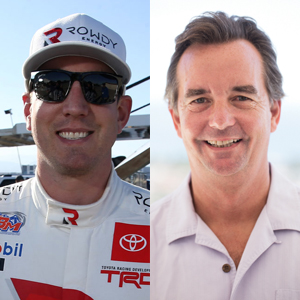
[00:00:10] Ray Latif: Hey, folks, thanks for tuning into Taste Radio, the number one podcast for the food and beverage industry. I'm editor and producer Ray Latif, and you're listening to episode 212, which features an interview with NASCAR champion Kyle Busch and Suja co-founder Jeff Church, the entrepreneurs behind upstart brand Rowdy Energy. Just a reminder, if you like what you hear on Taste Radio, please share the podcast with friends and colleagues. And of course, we'd love it if you could review us on the Apple Podcasts app or your listening platform of choice. Individually, Kyle Busch and Jeff Church have highly accomplished resumes in their respective industries. Kyle is a two-time winner of the coveted NASCAR Cup Championship and has been one of the top drivers in the sport for the past 17 years. Jeff is a seasoned business executive and beverage entrepreneur, best known for his work as the co-founder and former CEO of cold-press juice leader Suja. Together, they comprise a formidable team as the founders of Rowdy Energy, an energy drink brand formulated with natural ingredients that launched earlier this year. Named after Kyle Sobrequet, Rowdy is attempting to capitalize on a thriving, albeit consolidated, market for energy drinks and consumer demand for better-for-you options. In the following interview, I spoke with Kyle and Jeff about their decision to launch a challenger brand and the timing of Rowdy's debut, leveraging Kyle's fame and fan base in a way that's authentic to the brand and its positioning, managing conflict in their personalities and ways of doing business, and how Jeff is incorporating lessons from the Suja playbook into Rowdy's business strategy. Hey folks, it's Ray with Taste Radio. I'm going to call right now with Kyle Busch and Jeff Church, the founders of Rowdy Energy. Kyle, how are you? Doing well. How are you? Fantastic. Jeff, how are you doing? Doing great, Ray. How are you doing? I'm good. I'm good. I kind of wish I were in San Diego where you're based, Jeff. Kyle, you were born in Las Vegas. Is that where you're currently based as well?
[00:02:08] Kyle Busch: Actually, no, I'm in Charlotte, North Carolina. That's where I live now being close to the race shops and everything out here just kind of makes more sense to be with, um, within vicinity of the team in order for our team meetings and stuff that we have weekly on that respect.
[00:02:22] Ray Latif: Yeah. You've been racing for a very long time. When did you start racing? I started when I was 13, actually.
[00:02:28] Kyle Busch: And I started in Las Vegas and I was racing legends cars and late models and such at the amateur level. And I was doing pretty well at that, that was able to get a call from a professional team that they kind of led me into the truck series. and was able to race in some truck series races and then continued my rise up the ladder and into NASCAR from there. So it's been a quick ride to the top. It only took me like five years, six years, I think, in my driving career to make it to the NASCAR Cup Series, the top echelon of sports and racing in America. So that was really, really cool for me and I've been there ever since.
[00:03:06] Ray Latif: Very cool. You know, I'm curious about the daily routine of a professional race car driver. How do you mentally and physically prepare for that on a daily basis? And how has that preparation changed amid the current crisis?
[00:03:20] Kyle Busch: Well, as far as normal, when everything is normal, um, my daily routine is just to basically wake up in the morning, eat breakfast, workout, get some training in Mondays. We always have our team meetings at, uh, Kyle Busch motor sports, which is a truck series team that I own and operate here in North Carolina. And then Tuesdays, we have our team meetings at Joe Gibbs racing, which is who I race for and drive for in the NASCAR Cup Series. You know, Wednesdays is typically an off day and then Thursday would be a day in which I do much of my studying and film preparation and things like that and watching and getting ready for the upcoming race weekend at whichever track or venue that we're going to. And then typically Thursday nights is the night that we travel out and go to that particular venue because we will have practice on Fridays, we'll have qualifying on Saturdays, and then we typically race on Sundays. So a lot kind of goes, that's a week, you know, and it's a full week at that. But every day, you know, you try to get to the gym as much as you can and get as much in as you can, just to make sure that you're in tip top shape for the season. Cause our season's really long. Our season goes from, February, which is around Valentine's Day, our first race of the year, to the finale, which is the week before Thanksgiving. So we have a really long season.
[00:04:40] Ray Latif: Into the gym. That's something I think a lot of people don't know about NASCAR drivers or race car drivers in general, is that you have to be physically fit to do what you do, which is interesting because most people think, okay, you're in a car. All you're doing is just, you know, moving your foot back and forth or moving your hands on the, on the steering wheel. You know, what do you have to do to, to physically prepare for every race?
[00:05:01] Kyle Busch: I mean, typically it's just staying in shape. I do some HIIT training. I do some workouts where I'm lifting weights but yet doing them fast enough with enough repetitions and enough sets that I'm keeping my heart rate going and I'm basically doing it as a cardio workout as well. I rarely do a whole lot of cardio. I may go out and go for a run here or there, do an elliptical or do a bike ride or something like that, but it's not on the norm, you know, maybe two, three times a month at that. So that's typical as to what I do just to keep the strength going and to keep the workout going as not a whole lot of rest, because as you know, when we're in our race cars and we're running around there at, you know, 200 miles an hour at some of these places at four hours at a time, there's not much time for a break. So you're pretty much working the entirety of that race.
[00:05:50] Ray Latif: I can imagine it helps to have an energy drink on hand to help you get through the day and to get through these races as well. You've had longstanding ties to the energy drink category, first as a brand ambassador for Monster, and then later with NOS. NOS was the primary sponsor of your race car for a couple of years, and they also had a fruit punch flavor called Rowdy. that sponsorship ended in 2018. And that opened the door to you launching your own brand, Rowdy Energy, right? Yeah, that's that's kind of how it went down.
[00:06:18] Kyle Busch: There's obviously a lot more to that. But the simple way of discussing it, that's that's kind of how it went down. So, you know, me being in the energy space for a long time over a decade is has been quite interesting to me. I've tried to learn a lot. And and understand a lot about the business, not only just drinking the drinks and being sponsored by a company, but also being a part of the space as well, too. I'm an energy drink drinker. I have one a day. I get up in the morning. I work out. I can make it through my workout. And then when it's time for lunch, I have an energy drink with my lunch in order to get me through the rest of the day and keep me motivated and keep me going while also rehydrating at the same time through my workouts, because I do tend to sweat a lot. So that was kind of the emphasis with Rowdy Energy and getting on board with Jeff Church and having an opportunity here to make a drink that is not only healthier for you and better for you, but has benefits for you as well, too, in your everyday life.
[00:07:14] Ray Latif: Now, again, you know, having known and having worked with energy drink brands in the past, Monster, Nos, I assume you know that it's a very challenging category with a handful of brands that dominate the space. We've seen literally hundreds of upstart energy drink brands launch and fail. So knowing all that, why'd you get into the space? You know, what really motivated you to get involved in a category that is just so difficult to break into and even more difficult to scale and be successful in?
[00:07:44] Kyle Busch: Well, I think the number one reason for me was to obviously think about my timeframe and where I'm at in my career and understanding that I have probably about 10, 12 more years left in me to be able to go and understanding a little bit more about the drink properties of some of these drinks that are out there. It wasn't probably the best thing for you. And so I wanted to team up with somebody that was able to help me with the formulation of a drink that could be better for you, you know, less chemicals, more natural, you know, have a source of hydration that could help you whether you're in the car or whether you're working out. And keep me going into my Tom Brady years, if you will. So that was kind of the premise of it. But obviously, yeah, understanding that it's a it's a category that is oversaturated. You know, I just felt it though, that if we could have something better for you and better on the market, that people would get an understanding of that and to be able to purchase and buy and consume and enjoy and, and like that as well too, that it would eventually be able to grow into something special.
[00:08:48] Ray Latif: Getting into your Tom Brady years, I like that. I wonder if you'll ever see Rowdy Energy as part of his TB12 platform. Hey, you never know.
[00:08:56] Kyle Busch: You never know. I've become friends with the Kraft family, so maybe there's a tie there. We'll work on that, although he's out of New England now.
[00:09:04] Ray Latif: He is out of New England, which left a lot of people shaking their heads here in my neck of the woods. Jeff, as Kyle mentioned, he was looking for a partner to help him develop and scale Rowdy. You've been in the beverage industry for nearly a decade, most notably with Suja. What drew you to partner with Kyle and what drew you to the energy drink category?
[00:09:27] Jeff Church: I mean, one of the things I always look for or try to look for in new ventures or new businesses is a way to kind of create a playing field that's slightly uneven. In Vegas, what is it, 52% you have to win to create big buildings and everything? The probability is it's not that big of a percentage. In emerging brands, it's a little bit the same way too. You want to tilt that field to your advantage a little bit, and that can be through distribution, that can be through relationships, through product, through celebrity. Kyle does that. Kyle helps us create an uneven playing field. I think the combination of my talents and his talents, and then some of the other talents of the team members we have, including Kyle's wife, Samantha. We've got this really incredible team that I think is really set for to be able to scale the growth but in terms of you know in terms of what drew me into the space with Kyle was you know, we had a conversation early on about Kyle wanted to create and Samantha wanted to create this energy drink line and we talked about disruption and the importance of that and we were Completely aligned and that if we're gonna do something here the world doesn't need another 55 gram sugar energy drink right and for me I just started to do a bunch of studying on the space. And I had thought that with carbonated soft drinks dropping, I thought they were really kind of going to kombucha and things like that. But in reality, some was going there, but most of it was going to energy drinks. And if you look at it, it is a crowded space and kind of interesting. I probably mentioned it to half a dozen people that I respect that you would know as well, Ray, during the early process. And every one of them said it was a stupid idea. And now that we've got it launched and we're seeing the reaction, it's really validating what our hypotheses were. And a couple of those were that it is a crowded space. There's a lot of people. There's a lot of blood in the water. But there's a couple of unique things about it. First of all, it's a $13 billion category growing at 8% to 10% a year. That's a big category in a big grocery. You've got two brands that make up 80% of the category and one of them is at a price per ounce at a ridiculous price per ounce compared to the rest of the market and then you've got this whole thing situation in Rockstar and There's a lot of stuff happening So there's a lot of change happening in the industry and then on top of that you've got this dysfunctional ingredients that are Becoming more mainstream and you can do more with them now So from a development standpoint now, we're able to use ingredients that you weren't able to use before for example, we're using a rare sugar called allulose that has 80% of the sweetness of white cane sugar, but zero glycemic index. So it's safe for people with diabetes. Well that allowed us to you know, create a drink that became the first keto approved energy drink to launch in the market So, you know you have to look for you know different things and different reasons that you can grow your business And I feel like a lot of its perspective. I think most people would say we're probably the eighth inning of the energy drink game I'd say we're probably in the second inning maybe third inning of the energy drink game I think the whole next game is going to be about bringing functionality to the table because there's no reason you need to have 55 grams of sugar in your product.
[00:12:29] Cup Series: Guessing your margins? That's risky. Belay Financial gives CPG brands the clarity to scale smarter, faster, stronger. Get your free inventory e-book by texting TASTE to 55123 and start making data work for you.
[00:12:49] Kyle Busch: Tune in at the end of this episode for an exclusive interview with Matt Lin of Belay Solutions. He sits down with Melissa Traverse to break down the biggest inventory and accounting mistakes CPG founders often make. You'll learn how to bring clarity to your numbers so you can scale with confidence.
[00:13:07] Ray Latif: It is a multi-billion dollar category. There does seem to be some room for a better for you option. But as you mentioned, Jeff, it is relatively late in the game, you know, whether it's the fifth inning or the eighth inning, it's pretty difficult. to move the needle as a new brand. How do you see Rowdy as breaking into a game that is already saturated with very well-known brands that have outstanding distribution and the kind of resources that I'm assuming you don't have at this point?
[00:13:41] Jeff Church: Yeah, it's a good question, Ray. I mean, there's a couple of plays that I'm trying to pull out of the Shuja playbook that were effective. One of them is this concept of collaborative retailer relationship. So they really do work. And most of the time, people say, here's my widget, buy my widget. And the retailer says, well, I want the widget, but I kind of don't want the corner like that. I want it to look like this, or I want it to be something different. And it's also about understanding what they want. providing that to them. And I think what we can bring is to retailers is incrementality. And if we're just another brand coming in and we're just going to cannibalize somebody else's sales retailers don't care about that. But we've been able to really present a really compelling story to the retailers that we We've been pitching so far that we really are incremental or going to be incremental because we can see online our Female to our female percentage is much higher as a percentage in the industry average So the way we design the product is in fact kind of addressing the mark we want to bring in so we want to really bring in the female demographic and really bring in the millennial demographic as well as maintain our core demographic
[00:14:45] Ray Latif: Jeff, you touched on this earlier. There are a lot of brands that would love to have a celebrity or athlete promoting their products. You know, in Rowdy's case, the founder is a celebrity. Kyle, you know, how do you think about using your fame or leveraging your fame in a way that's going to be authentic to promoting and selling Rowdy?
[00:15:04] Kyle Busch: I think the biggest thing is something that you do that you give everything you have. Besides my racing, obviously, this is my next best endeavor that I'm going after right now. Everything that I've done, I've always done it to the best of my ability and to the best that I know how to do, and I've done it to win. I feel like Rowdy Energy is no different from that. And with the opportunity to work with Jeff Church and his success that he's had at Suja and in the beverage space for that matter, it gives us a unique opportunity to bring an enhanced energy formula to the market, as he mentioned. And so I think with us, you know, we have high spirits of opportunity to go out there and succeed.
[00:15:46] Ray Latif: Can I ask you about your personal fan base, Kyle? You know, Jeff had mentioned that Rowdy has the opportunity to appeal to a lot of female and millennial consumers. You know, I have an assumption about who your fans are, but I could be wrong. Who are your fans and do they represent Rowdy Energy fans as well?
[00:16:04] Kyle Busch: Absolutely. So, you know, NASCAR fans are out there in the millions and Rowdy Nation fans are out there in abundance as well too. And they're a huge part of what we do each and every weekend that we go to the racetrack, whether they're at home tuning in on television or whether they're there firsthand coming to the racetrack, sitting in the stands, coming in the garage area, shaking my hand or asking for an autograph. There's a huge opportunity there with the Rowdy Nation fans. So it's really fun, you know, and our first way of making it to market was e-commerce and selling it online at Rowdy Energy and being able to tap into the Rowdy Nation fans and those that support me and about everything I do. There's hundreds of those people and they've been amazing at being able to take into this and we've had plenty of them tell us about how good it is or or how great it is and how this is their new drink and blah blah blah. And so it just spreads by word of mouth after that. And there's plenty of them that are asking for opportunities in retail stores that they want it. They want it to be at stores so they could have an opportunity of an easier time being able to go to market not only for us but of course for them to be able to buy it and get it to their home.
[00:17:12] Jeff Church: Kind of a funny side story to that, Ray, is that we're launching our first multi-outlet retailer, Hy-Vee, as we speak, in the Midwest. And we looked at our online sales, and one consumer had bought five or six times in our short period of three months that we've had the brand on the market online. And we reached out for him and asked him if he'd go in and take some pics of the new set, and he was ecstatic. So what we're gonna what we're gonna do is we're really gonna create our own ambassador program through Kyle's fan base and really tap into that group because there are evangelists and if you have time to look at Facebook or the Facebook interview feed that the Kyle and Samantha did I watched it and as you're watching it you see all these feeds going people talking about the flavors what they like about him what they what they'd like to see is additional flavors there's new flavors looks like it's a great learning lab for us to be able to work with his base of people that are really Evangelical already about Kyle
[00:18:06] Ray Latif: You know, we've seen athletes and celebrities with equity and food and beverage brands support marketing and business initiatives in a variety of ways, including ad campaigns. I think about Kobe Bryant with Body Armor. getting involved in producing and the creative mind behind some of the ads. We've also seen celebrities even get involved in retailer distribution meetings, notably Puff Daddy and Mark Wahlberg, when they were involved with aqua hydrate as investors. Jeff, what do you see as the best use of Kyle's time and resources, given that you've seen the spectrum of how celebrities can be involved in a food or beverage brand?
[00:18:51] Jeff Church: I mean, so I wanted to address the other question you mentioned too, which was the authenticity, which kind of relates to it. And, you know, there is no issue with authenticity. I mean, both Kyle and Samantha are, they are the business. They are, they are actively driving the business every single day. So for me, him being involved at whatever level he wants to drive at is awesome. The things that he's particularly great at are his connections. As you know, with NASCAR, it's, it's very tied into CPG and a lot of the brands that advertise in the CPG world. So he's usually has a direct connection. There's one degree away from getting pretty much anybody we want to get to. So that's super helpful. And then secondly, his meticulousness of design is really excellent. I'm really impressed with his ability to see things and obsess over things that I might not obsess over quite as much. And I think it's been good to get that. But I mean, I think the biggest thing is he's a winner. And the winning attitude that he has, that he takes on the car track, I actually thought I would never really meet a more competitive person than myself. And I actually think I have in Kyle. And when you get somebody that's committed, this isn't Jeff created Rowdy and then brought Kyle and Samantha in as influencers or ambassadors. This is Kyle created this brand and brought Jeff in as a co-founder. So that's a real difference. And it's funny when people say, oh, well, do you think Kyle, will Kyle hear about this? Will he know about this? I mean, Kyle's involved with, I mean, he goes to retailer meetings, he goes to distributor meetings, and whatever he can within his schedule, he'll go to. So, I mean, I've always thought that Celebrity's done great, like some of the ones you referenced, or even Jennifer Gardner on Once Upon a Farm in the natural space is great, but Celebrity's done poorly or awfully. It's just awful, you know, and I think we're really fortunate.
[00:20:35] Ray Latif: Kyle, you're a competitive guy? This is news to me. I've never heard of it. Well, I mean, that leads to another question, which we chatted about this in our pre-interview about the notion of success and failure. And the beverage industry is a really difficult business. I think the failure rate in the first year is about nine out of 10 brands don't make it. And Kyle, I know you told me that failure just isn't an option for Rowdy and it isn't an option for you personally. Do you ever think about the risks that you're taking in launching this kind of a brand? How do you mitigate those risks?
[00:21:17] Kyle Busch: Well, from the beginning, there were definitely a lot of people and a lot of skeptics that told me that this is never gonna work, it's never gonna go, it's gonna take a ton of money, it's gonna bleed you dry, all that sort of stuff. And they're not wrong. It does take a lot of money, it does take a lot of work, it does take a lot of effort. You do have to have a lot of smart people around you and those that have done it before in the beverage space. I feel as though a lot of those people that were discouraging me from do it were ones that didn't know of Jeff Church that I was going to have somebody that actually had some expertise within the space and that they thought we were just going to do it on our own, myself and my wife. But, you know, we wanted to go out there and get smart people that were able to operate it on the daily because I'm just not going to be able to do that. And so with my time that I have that I can give to it, I try to give it everything I got, as Jeff mentioned. But, you know, we look at it as though it is an expense. It is expensive. people don't come cheap and the greater the ones, the more you got to pay and give them what they're worth. So it's been interesting for sure, but we're working through all that. And that's going to be a growing pain for a couple of years until we get to more retail, until we get to a part in which we can become a profitable brand. And then once we're there, I feel like The opportunities are endless and we can continue to strive and grow up the ladder and be a top three, four, five brand and get ourselves in a good position in the next five years. Do you want more repeat buyers on Amazon? Well, this free resource in collaboration with Straight Up Growth will help your brand turn first-time buyers into long-term subscribers. Download Winning the Repeat Purchase Game on Amazon now at Taste Radio slash SUG. That's Taste Radio slash S-U-G to start building retention-driven growth for your brand on Amazon. Scaling a beverage brand into major retail comes down to operational readiness. From packaging lead times to co-manufacturing strategy, the details can make or break a launch. In a new e-book in collaboration with Octopi and Asahi Beer USA, industry leaders share what they've learned in helping brands scale. Download it now at Taste Radio slash octopi. Do you need to scale your team faster without compromising on talent? Join Oceans for a live webinar on April 20th and learn how leading companies are hiring top global professionals who are ready to grow with your business. Register for the webinar now at Taste Radio slash oceans. That's Taste Radio slash oceans.
[00:23:52] Ray Latif: You do have a highly regarded co-founder in Jeff Church. You know, we've talked about Suja. The way you guys operate, though, is a little different. Jeff, you talked about, especially when you were building Suja, not letting great get in the way of good. But Kyle, great is all you know. You have to be, you are great or nothing. At least that's my perspective on how you race and how you operate as a race car driver. That would seem to create a conflict into how you see the brand developing. How do you guys manage that?
[00:24:26] Kyle Busch: I think from my vantage point is Jeff is very smart in the space and he's done this before and I have not grown a business like this before. And obviously I lean on him a tremendous amount and I give him the opportunity and the leeway to run it and to do what he feels like is right and to go down the path in which he feels we need to be going down. But there are times that I'm going to push. And in our world, in the racing world, we always have this analogy where it's easier to pull a rope than it is to push one. And sometimes, you know, when there's a race car driver that's too fast and he's doing too much and he's whatever, you can pull on that rope and kind of pull him back a little bit if he's crashing too much or whatever, if he's racing over his head. But if you have a race car driver that's under performing and not doing as good. You can't push that rope. It ain't going anywhere. You know? So I feel like Jeff is the guy that sometimes he'll pull, he'll pull me back and he'll be like, all right, man, like let's come back to reality a little bit. We can't quite go there. We can't quite do that yet or whatever. So I feel like there's a good balance there. Cause I like to push, push, push. And there are times where I go to Jeff or I go to, David or I go to Samantha or I go to Ryan whoever's on our team And I'm gonna ask them to do certain things and go about it a certain way and push them a little bit But then I'm also gonna say but check with Jeff. You know what? I mean? So I do let let Jeff have His leadership and his opportunity to run this thing, too
[00:25:53] Ray Latif: Again, it's a lot different than, you know, the natural space which you were involved in for many years. What are some of the pain points shifting from a business like Suju where, you know, you were built in Whole Foods to the energy drink category where I'm assuming you're certainly not starting out in Whole Foods.
[00:26:14] Jeff Church: Now, I think that the difference between Suja starting up and Rowdy starting up, they're really, really different. As you can imagine, Suja was the number three cold-pressed juice brand that ultimately really built the cold-pressed juice category, although in total, the cold-pressed juice category is significantly smaller than the energy drink space. Rowdy is very different. Rowdy is later, arguably, whatever you want to call it, but it is It is later. It's more mature. You've got big companies that have big distribution agreements as you mentioned So we have to do it smart We have to do it really smart just like the product is we call smart clean energy You know, we have to we have to build the business smart and in a clean way Now it's really about not not doing what suja did because they're really fundamentally different businesses But picking the things that we did well at suja and kind of pulling those out and one of the things that i've talked about before Ray is the concept of health without the punishment You know, we all want to we all want to do it. We're not all, but let's say 90% of us all want to do it a little bit, eat or drink a little bit healthier. But we all come into that point of that curve at different at different points and and we don't want to be penalized You know with with bad taste if by going into it or most of us won't repeat So we created this concept that's too difficult health without the punishment So you're not being punished, you know by trying the product and I think when you try rowdy One of the really unique things about it is the product just tastes really good. You know, we we created a really clean clean way. It's all natural. There's no preservatives. It's really, it's a product that can easily be sold on the Whole Foods shelves, as well as, you know, every gas station in the country can compete against, you know, head to head with, with Monster. I feel like we've done it really smart. We've got a really good base with the team that we've got, and then we've got the connections through Kyle to be able to get to the places we want to get to, and then through myself as well. Again, it's kind of, it's about putting, it's about tilting that field slightly, you know, to your advantage.
[00:28:11] Ray Latif: Liquid to lips, it's really important in the beverage industry, getting people to try the product. I know it was helpful for Suja. Certainly, it seems like it'd be helpful for Audi Energy. Given the current circumstances, field marketing, sampling events, much more difficult, if not impossible, in certain parts of the country, which is why branding becomes so important. And one of the reasons that Suja became the category leader in cold press juice is its ability to resonate with consumers on a brand level. What are some of the lessons, the branding lessons and elements that you plan to incorporate into Rowdy?
[00:28:46] Jeff Church: Although we are creating at Rowdy, And the ethos of it is Kyle, and the racing component is the denominator, if you will. As we build it out, we want to build it out as a lifestyle brand, because we've really seen the value of what Asuja can be as a lifestyle brand. But also, as you look at these two or three large brands that are in the space, they've become media conglomerates. And they're going after the extreme athletes and stuff like that. We want to go after the everyday athlete, the weekend warrior. which is the vast majority of the people, and they've kind of been left out. You're either at the fitness, the super fitness type folks, or you're the media folks, and you're not really being talked to from just the general health and wellness of consumers.
[00:29:35] Ray Latif: Looking at the brand itself, looking at the packaging, white can, a big R on the front, Rowdy Energy. On the bottom is a black strip that says 60% less sugar and lists green tea, caffeine, endurance and focus, enhanced energy. The one thing I don't see on the front of the can is its affiliation or the brand's affiliation with Kyle.
[00:30:00] Kyle Busch: Yeah, so with what we've done with Rowdy Energy, obviously it's my nickname and I've kind of built this persona, if you will, in the NASCAR space and in the world I work in, I live in. But we wanted this brand to be able to stand out on its own and not have me need to be associated with it in order to be successful. So this is something that'll go on down the line, past me being in racing, hopefully, that it can be successful and can continue to be. its own company and stand on its own two feet and not need me to carry it along the way. So that's why there's not more insignia on the can for it being tied to me is that it should be able to be its own brand.
[00:30:43] Ray Latif: You know, I asked this question to a lot of entrepreneurs that I speak with, and it's about success. How do you define success? What is your vision for success? In racing, Kyle, winning a race, seems to be a pretty definitive way to determine whether you're successful or not. Winning the NASCAR Cup Series, very definitive way to determine that you are a champion among your peers. How will you determine whether or not Rowdy Energy is a successful brand?
[00:31:12] Kyle Busch: I think in my eyes, as long as we're continuing to gain percentage of the market, gain sales, gain stores, continue to work our way up the ladder and be successful, then to me that is a success. Whether it's 2%, you'd like it to not be 2%, you'd like to grow somewheres in the 30s probably to uh... fifties at least for a year or two and then obviously we've seen other brands that are really shot shot up and skyrocketed uh... in the one hundreds to two hundreds percent so i mean if we can do that then we're definitely doing something right and those are added obviously numbers that we can shoot and strive for but to be realistic and and set relative goals you know growing at a thirty percent rate would certainly be uh... successful to me and continuing that way up for years to come you know i mean i think that once it's developed into a top five brand, I would take that as success. Like you said, you know, when you're in racing, you work towards winning and being number one and being a champion and everything else. But in this world, I feel like it's entirely different. There are the top two guys that have been the top two guys in this space for the entirety of the the energy space being in existence. And I don't really foresee them changing from those top two guys, but we can certainly compete with them and be within the same market space as them.
[00:32:33] Ray Latif: You know, and Jeff, you've created a highly successful brand with Suja. Not easy, obviously, as we talked about the beverage industry, a very challenging one. You know, what are the key elements of success in your mind?
[00:32:46] Jeff Church: Yeah, I mean, to me, when we can see meaningful new consumers coming into the brand, are coming into the category. That to me is one measure of success because that really is about incrementality. We're not going to get into a just fight with monster at a commodity price level. We have expensive ingredients. We're pricing our product competitively, but No, we need to be, we need to get a decent price for our product. So bringing new consumers into the space is success to me. Success in a minute is a little bit tongue-in-cheek, but Kyle turns, Kyle turns 35 soon. And we've put together a five-year plan that puts Rowdy at a billion dollars, a billion dollar brand. When he turns 40 in five years, so we have a five-year plan that we've it's loose for sure But we you know, it all hinges of course on a proof of concept working Well, first of all getting product on this on the shelf and again, I guess that earlier I've been pleased with the success we've had so far with that but then secondly is getting getting the product off the shelf and getting it off the shelf in a manner that you can make a profit at and So again, it's about these different milestones, you know, we've got some milestones of building out a certain number of doors You know by the end of this year a certain number of doors by the end of next year, you know some different channels And then just building out our team, you know as a startup here in the early stages. Everything's pretty virtual So, you know, you've got to be pretty variable in virtual virtual Otherwise you end up spending a ton of money as we start getting on the shelf now. We've got a we're now we're doing merchandising we are doing We're not doing field marketing in person necessarily, but we're doing digital field marketing. So we're kind of adapting to the times with that. But it's just these important milestones along the way. There are certain growth numbers, but I think oftentimes on Entrepreneurs get I know I did in the beginning with Suja but get don't really understand the difference in in distribution growth and velocity growth and someone a long time ago told me that I would I would understand that eventually and I did and Distribution growth is a lot easier to get than then being able to sustain and remain on the shelf So that's where the brand building, you know stuff really comes in because you've got to be able to lean on that But we've got you know a half a million avid Avid people that you know that want this to work. So to me, that's like that's an incredible wind wind beneath our wings Yeah for sure on the distribution front.
[00:35:08] Ray Latif: You can certainly get into every 7-eleven in the country If you have enough money to support the brand, but then again, even if you do support the brand Getting people to buy it and buy it on a regular basis ie velocity That's a little bit more challenging
[00:35:22] Jeff Church: But it's about it's about, you know, for that, it's about the experience. It's about creating that emotional connection, you know, with the consumer. And Samantha, Kyle's wife, does a lot of fitness, kids, fitness related stuff. And, you know, she's really active in Instagram. In fact, she, she responds to all of our social media related stuff. So again, I mean, having those people involved and engaged is just it's so important. It makes such a difference.
[00:35:47] Ray Latif: Definitely. Well, this has been great. Thank you guys for taking the time to speak with me. I really appreciate it. Uh, Kyle, I'm looking forward to seeing you back behind the wheel of a race car. Do you have any sense of when that might be?
[00:36:00] Kyle Busch: Uh, not yet. No, I mean, uh, we certainly hope soon and, and getting back to the racetrack for all of our sanities, if you will, but you know, they haven't set out any announcements quite yet, but I would assume we're looking towards somewhere end of may, hopefully, uh, and June time.
[00:36:15] Ray Latif: Well, you know, it sounds like you've got plenty of time to work on your brand in the meantime. Oh, I'm working on it. The next one's going to be Rowdy's painting service coming to you.
[00:36:24] Jeff Church: Indeed.
[00:36:27] Ray Latif: Once again, Kyle, Jeff, thank you so much. Good luck with everything going forward with Rowdy. It sounds like you've got a great team in place and that's as important as anything.
[00:36:37] Kyle Busch: Right on, man. Appreciate it very much. Thank you.
[00:36:43] Ray Latif: That brings us to the end of episode 212. Thank you so much for listening, and thanks to our guests, Kyle Busch and Suja Church. You can catch both Taste Radio and Taste Radio Insider on Taste Radio, the Apple Podcasts app, Stitcher, Google Podcasts, and Spotify. As always, for questions, comments, ideas for future podcasts, please send us an email to ask at Taste Radio. On behalf of the entire Taste Radio team, thank you for listening, and we'll talk to you next time.
[00:37:21] Rowdy Energy: Hello, I am Melissa Traverse here for the Taste Radio podcast, talking about some of the biggest tension points that CPG brands and founders face when they're scaling a brand, and those are financial accounting and inventory management. I am joined by Matt Lynn, inventory accounting guru from Belay Solutions, and he is going to shed some light on all of this that is going to help everybody out quite a bit. Matt, thank you so much for joining us today.
[00:37:51] Taste Radio: Thank you for having us, Melissa. It's great to be out here at Expo West and it's great to sit down and be able to chat this because it's kind of a passion project of ours, working mainly with CPG brands and hoping to help them scale.
[00:38:03] Rowdy Energy: It's been such a pleasure chatting with you and the team and learning all about what you do over there at Belay Solutions. Can you tell us a little bit about yourself and what your role is and the kinds of solutions that Belay gives to CPG brands and founders?
[00:38:18] Taste Radio: Yeah, absolutely. My role with Belay, I'm actually our inventory accounting manager. I run our inventory department, so we work with CPG brands, taking them from spreadsheets, putting them on inventory management systems, and really helping connect their tech stack between their sales online marketplaces to that inventory management system, even down to their financial systems like QuickBooks. Belay overall is kind of an outsourced accounting firm. And with that, we're helping teams. We have different levels with bookkeeping, controller level work, even high level into CFO type items. So we really help those brands in any way that they need financially. And then I just have a subset of a department where we're really just laser focused on inventory.
[00:39:01] Rowdy Energy: It's certainly a complex topic and there are plenty of places to go wrong. Let's start by going right and start super simple. Can you tell us what some of the biggest red flags are that would help a founder understand or, you know, the person running a brand understand that it really is time to get some help with some of these areas?
[00:39:22] Taste Radio: 3 3 3 3 3 They have a lot of transactions that don't get coded or they just put them into placeholders to just get rid of it so it's not an eyesore. They'll notice they have revenue but no cash or they notice that they have a good amount of cash but their blind spot is really seeing the vendor invoices that are sitting there just needing to be paid and so they just lack that clarity that's going to really be around the corner.
[00:39:59] Rowdy Energy: You know, you were talking about one of the red flags that comes up that I think makes so much sense. When somebody asks you what your numbers are and you can't come up with the right number, that's a big problem because that's something that you really should be able to share with decision makers who, you know, you're ideally looking to do business with. What should you be able to call up at a moment's notice?
[00:40:23] Taste Radio: Really at any time, you should be able to know an accurate margin. It's amazing how many founders we end up talking to that they can tell you their revenue numbers, they can tell you their selling price, and then the minute you start talking about cost or their cost of goods sold, they just get a deer in headlights look. So really it's very hard to tell, am I even making money? or if you don't know your entire landed cost. Maybe you know what the freight cost is, the duties separately, but you're not really getting that as part of your unit cost. So it's really hard to tell. Am I even making money or am I losing money from the very beginning?
[00:40:57] Rowdy Energy: And do you recommend that founders are able to call up a margin by channel?
[00:41:01] Taste Radio: Absolutely. And depending on the number of products and channels, you kind of want to know what are your best sellers, which ones are making the most and which ones maybe you're not making as much. But especially if you're branching out and you're doing D to C with B to B, absolutely want to know that.
[00:41:18] Rowdy Energy: Gotcha. You mentioned that when things feel really chaotic, that's probably a red flag. I would say that it probably almost always feels chaotic if you're running a CBD brand. And I know this may be hard to quantify, but is there a revenue number? Is there a number of doors number that would help a brand understand whether or not it makes sense to bring on a partner like Belay? Understanding that so many brands are bootstrapped or they might be tight for cash. What is that friction point?
[00:41:48] Taste Radio: 3 3 3 3 3 But as you're growing, as you're getting to those six-figure revenue numbers, and especially as you're approaching seven, you want to make sure you've got good financials. Because as you scale to that point, most likely you're going to be looking to raise capital. And investors, the first thing they're going to look at is your books. And are they clean? And do they show a clear picture of your business?
[00:42:21] Rowdy Energy: You know, another area that folks might look to to organize some of the chaos are their systems. So many folks stick with Excel spreadsheets for a good amount of time. How do you know that you need to outsource some of your accounting to an organization like Belay Solutions versus maybe signing on to a Synth7 or NetSuite or something like that?
[00:42:44] Taste Radio: Well, that's actually something we really help with when it comes to that cost question. That's something that trips people up. And sometimes if you just have a turnkey business, you buy and sell a finished good, you can maintain with spreadsheets. And we've had clients with million dollar revenue that can do that. But we see so many brands nowadays are using contract manufacturers. and they're just sourcing certain parts of their product. So when you start talking costs, they have no idea exactly what their unit cost is. So that's where we come in and we kind of understand, we'll speak with the customers and the clients and get their needs. And then if we think they're ready for a system, then we'll help put them on that system so they can get some of that clarity. And it's not something we force on anybody. There are plenty of times where founders come to us and we'll tell them bluntly, you're not ready for it right now, but we'll let you know when we think you are.
[00:43:30] Rowdy Energy: That sounds like excellent advice. What should a founder or somebody running a brand look for in an outsourced accounting partner? Are there certain checklist items that they should make sure that their partner be able to execute or be able to help them understand?
[00:43:47] Taste Radio: Absolutely. I think one of the keys there's, there's a lot of outsourced accounting firms out there. Some focus on service-based SaaS companies, but if you're a CPG founder, you really want to make sure that your accounting firm has CPG experience. I would ask them, you know, what kind of brands have they worked with and even beyond that industry specific, because there's so many subsets of CPG. And that's something that I think is great about what we do with Belay is that we kind of run the gamut. It's kind of like the insurance commercial. We know a thing or two because we've seen a thing or two across a broad spectrum.
[00:44:16] Rowdy Energy: Probably getting references is always helpful, right? Absolutely. All right. So this all sounds great. I think we have a really good understanding of would it make sense to hire an outsourced partner? You know, what some of the things you should be looking for are. What does offloading this kind of work mean for the brand? What can this do for lightening the load of a founder or lightening the load of a brand operator? Like, how does that help them in their everyday business?
[00:44:46] Taste Radio: It just tries to really help quiet the chaos. So what we're looking to do is just take some of the weight off that founder's shoulder, let them focus on building the brand, building the business, getting that exposure. If you don't have sales, you really don't have anything. So we want them to be able to focus on that while we take care of your back end office work. And we can just present that to you on a monthly basis, you can help make decisions, you can take that to investors. And really, you can just focus on growing your business.
[00:45:11] Rowdy Energy: I feel like I felt founders and the folks who are running brands collectively sigh. A breath of relief just hearing that. How can people learn more about Belay Solutions?
[00:45:22] Taste Radio: So people can text TASTE to 55123 for their free inventory guide to get started.
[00:45:28] Rowdy Energy: Matt Lynn, Inventory Accounting Guru at Belay Solutions. Thank you so much for joining me here at Expo West. It's been such a pleasure to chat with you and learn about what you all do over there to help founders and brands with their financial accounting and inventory management. For everybody else out there, thank you for listening to the Taste Radio podcast. I am Melissa Traverse and we'll see you next time.