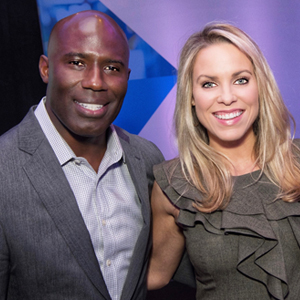
[00:00:10] Ray Latif: Hello, and thanks for tuning in to Taste Radio, the number one podcast for the food and beverage industry. I'm producer and host Ray Latif, and you're listening to episode 218, which features an interview with NFL Hall of Famer Terrell Davis and Megan Bushell, the co-founders of Defy, a brand of CBD-infused beverages. Just a reminder, if you like what you hear on Taste Radio, please share the podcast with friends and colleagues. And of course, we'd love it if you could review us on the Apple Podcasts app or your listening platform of choice. One of the most dominant running backs of his generation, Terrell Davis helped lead the NFL's Denver Broncos to Super Bowl championships in 1998 and 1999, and was elected into the Pro Football Hall of Famer in 2017. Following a career cut short by injuries, Terrell Davis a lifelong sufferer of migraines, spent years searching for natural remedies, and exploration that led him to CBD. In 2018, he, along with business partners Bo Wehrle and Megan Bushell, co-founded Defy, a zero-THC, CBD-infused performance drink promoted to eliminate aches and pains for consumers during and post workouts. In the following interview, I spoke with Wehrle and Megan about their foray into the CBD business and how their respective paths led them to create Defy. They also discussed how the company is navigating a murky environment for CBD, the brand's communication and consumer education strategies, and how Terrell Davis advising current NFL players about incorporating hemp and cannabis-based ingredients into their diets. Hey, folks, it's Ray with Taste Radio. I'm going to call right now with Terrell Davis and Megan Bushell, the co-founders of DeFi. Megan, Terrell, how are you?
[00:01:53] Terrell Davis: Doing great.
[00:01:54] Ray Latif: How's it going?
[00:01:55] Megan Bushell: Great. Thanks for having us.
[00:01:57] Ray Latif: Thank you so much for joining me and it's going well, Terrell. How are things with you? Where are you based? I think you told me you're in LA?
[00:02:04] Terrell Davis: Yeah, I'm in the Northern part of LA. If you're from California or Los Angeles, you may not think that I live in LA because I'm on the outside of LA, a place called Calabasas. And so LA people don't think it's LA. I'm like, yes, it's LA County, man. I pay the same LA tax that you pay. So I'm in LA.
[00:02:24] Ray Latif: If you pay the same taxes, you're definitely in LA. Exactly. Well, I think a lot of our audience might think that you're based in Denver, given your career with the Denver Broncos. A lot to take away from your playing time. One of the things I consistently remember about you is your appearances as an ambassador for Campbell's Soup. I hope that doesn't offend you. Oh, no. I feel like, is Defy the first food or drink brand that you've been aligned with since Campbell?
[00:02:53] Terrell Davis: Well, I had a little barbecue sauce, a little Terrell Davis, my highest little barbecue sauce that we started by 2010. And it was primarily for raising funds for the Food Bank of the Rockies and for charities. And so we extended it. It was only supposed to be about a year program. And we still have it, but it's kind of phasing out. So But as far as big brands, yes, this is the first big brand that I've been associated with since Campbell's Soup. Campbell's was good, by the way. It was, you know, when you made it to Campbell's Soup, that was kind of the moment where you said, you know, I made it. You know, there was a few things you look for to kind of give you that moment where you say, okay, now I'm up there with the big boys. It was Campbell's Soup. It was being on a cover of a video game. I didn't get on the cover of Madden, but I was on the cover of PlayStation had their little game. And so I was on the cover of that two years. So there's little milestones you look at to determine where you stand and how good you think you are. So that was a good one.
[00:03:58] Ray Latif: Well, it's probably better that you didn't appear on Madden. I wonder if folks have heard of the Madden curse. Exactly. You know, you appear on the cover of Madden and then next year you break your ankle or you throw out your back or something like that.
[00:04:10] Terrell Davis: Didn't Patrick Mahomes? He was just on it. So, you know, hey, my man just won a Super Bowl and it was MVP. So I think the curse has been reversed.
[00:04:19] Ray Latif: Well, he's been breaking a lot of rules of late. That's true. In a good way. I think I can safely say that the current brand you represent, Defy, that you're the co-founder of, is probably on the healthier side as compared to Campbell's soup and barbecue sauce. And since retiring from the NFL, I wonder, how has your health and nutrition regimen evolved?
[00:04:41] Terrell Davis: Yeah, well, initially when I retired, I didn't do much because when you work out so many years and you're constantly grinding and putting in a lot of work, you kind of need a break from it. And it was really needing a break from it. But I think secondly, I just physically I wasn't capable of working out anymore, at least not to the level that I would have liked to. And part of that was you know, totally body just was beat up, inflamed, joints had constant chronic pain, and it just wasn't enjoyable to work out. And so from about 2003 till roughly 2017 is when You know, I was just kind of existing, man. I wasn't, you know, I kind of felt like that was the way my body was going to feel for the rest of my life. And I kind of accepted that as, OK, this is the new normal. This is the new body. Until we obviously, start our company up with with Defy and started to Really perfect our product and use the CBD and it's really changed my life It's giving me a second really a second chance a second lease of you know a lease on life and it's really been Incredible man that the way I look I don't know if you see me lately, but you know, I'm down man I'm that I haven't been this been this weight since high school and I'm 198 pounds, and from 2002 or 2003 to 2017, I was about 220, high 220s, low 230s. And so, man, I feel much better. I'm working out every day. I feel like I can play. I'm waiting for the phone call to see if my teammates are running back to call me up. You know, my joints are feeling better. I have more flexibility. You know, I tell people right now, I am literally the product of the product. And I feel like that it has saved my life and I know what it can do for other people. And that's why we're really passionate about what we're doing.
[00:06:48] Ray Latif: Well, you know, Mike Tyson's getting back in the ring, so never say never when it comes to getting back in your professional sport.
[00:06:54] Terrell Davis: I don't know if he's going to actually get back in the ring. I know he's been, he's been working out. Maybe I think he's doing what I do. He works out thinking he's going to box again. And it just, you play, you play mind tricks on yourself and it just helps you work out and stay alive. I think that's what he's doing. I don't think he's going to fight.
[00:07:09] Ray Latif: I'd love to hear about how you first encountered CBD and how you educated yourself about the ingredient.
[00:07:16] Terrell Davis: Well, thanks to our co-founder, Megan, and Bo, they were the ones that kind of got me up to speed on it. They were looking at it, and I'll let Megan Bushell you more about how she got into it, and Bo, who is the CFO and Megan the CEO, or CEO. They were looking at it, and I guess people were approaching them about CBD and looking at the whole cannabis industry. I think they were on it for a while and they brought it to my attention that, hey, maybe this is something you might want to look at because we know what you've been experiencing physically and this could probably help. And at first I was a little apprehensive about doing it because my whole life as an athlete, that was forbidden. You couldn't do that. You couldn't mess with the plant. And I associated anything that came from the plant as being part of it. And so I wasn't educated about it. I was ignorant about the entire industry. And when they came to me, I opened my mind up and said, all right, let me just take a look at it. So I took a look at it and got caught up to speed really quickly. They helped educate me on things that I didn't know. They were really knowledgeable about the industry and the topics. And real quickly, I got caught up to speed. And it was clear to me that this was something that I needed to try. And so I tried it. And, you know, about a three week period, I started to notice something. And I started to notice that when I would work out previous to that, I would have to not work out for two or three days because my knees would just, like, they would swell up like a basketball. They would get so big. And so I would have to wait for that to go down, ice it, and then I could work out again. Some days later, well, when I was taking the CBD, I'd work out and I'd come home and I'd look for it. And I was like, wait a minute, my knees aren't swelling up and I'd feel good enough to where I can go work out again. So I would go back to the gym and work out again. And I was doing this day after day after day. And slowly but surely, even some of the old inflammation in my knee and swelling started to go away. And the pain wasn't there. That started to subside. So it really became like, wow, I started to feel very youthful. I was recovering faster. I was working out a little harder. I was pushing it more and more. And so it became clear that this was what I needed in my life. And then that's when we decided that, hey, I want to be able to share this with players that I've played with. and people who are like me who don't know about CBD, I want to be able to share this with them. But there was a problem is that there wasn't nothing out there that we can say, hey, that I can say, you need to go and try this. So the thought was, listen, if we can create a brand, that was first class that was you know the gold standard backed by research and science. I mean really check in the box on everything that we felt we had. We had a chance to not only be able to share that with people but there was an opportunity for us as a business.
[00:10:23] Denver Broncos: Guessing your margins? That's risky. Belay Financial gives CPG brands the clarity to scale smarter, faster, stronger. Get your free inventory ebook by texting TASTE to 55123 and start making data work for you.
[00:10:43] Ray Latif: Tune in at the end of this episode for an exclusive interview with Matt Lin of Belay Solutions. He sits down with Melissa Traverse to break down the biggest inventory and accounting mistakes CPG founders often make. You'll learn how to bring clarity to your numbers so you can scale with confidence. Megan Trill mentioned this, you know, you were investigating different ways, different forms of how to consume CBD. Can you talk a bit about your background and your foray into this space?
[00:11:13] Megan Bushell: Sure. And you know, it's kind of funny. My background is, is relatively eclectic. And if you would have told me five years ago, 10 years ago, that I'd be partners with Toronto Davis and running a CBD performance line out of Denver, I would have told you, you were crazy. It's been an incredible journey and I'm thrilled to be here. Prior to partnering up with Charles Davis and Bo Worley and launching Defy, I was actually running a startup company that I'd been with for about seven years based in Southern California that was providing Basically, it was a video sports app for professional sporting teams. And we provided video content to fans that they could download onto their desktop, laptop, or pretty much any device, game console, etc. And so that's how I essentially entered into the sports arena and worked with professional sports teams pretty much in every major sports league across the country. And through that venture, I became friends with Bo Worley, who was our CEO and founding partner. And Bo and TD were brothers from another mother. They'd gone way back. They were very close friends and had been for years. And so that's how I got to know TD as well. And fast forward, as we became friends, we started learning, Bo and I had started learning about the CBD hemp-based industry. And I wasn't a cannabis consumer, and so I didn't know much, but I'm kind of that person who goes down the wiki hole in terms of really diving into research and understanding the details around things. And so the more I read and the more I learned, the more fascinated I became. And this was back in 2016, 2017, before there was the wealth of knowledge and testimonials and research that there is now. You know, so I had to dig pretty deep and started reading World Health Organization reports and early studies and findings and finding out the U.S. government had a patent on CBD that dated back many, many years. And so I realized, you know what, there's something here. And if we can, if this isn't snake oil, if this is something that can legitimately help people, then we have the opportunity to really transform people's lives and make a huge impact.
[00:13:17] Ray Latif: You know, as you mentioned, there's a lot more information about CBD out there than there had been in years past. It seems like there's hundreds, if not thousands, of CBD products on the market today in a variety of ways to consume it. Food, beverage, topical. Why was beverage the best method of consumption, in your opinion?
[00:13:35] Megan Bushell: We really bandied about a lot of different product form factors and opportunities. And after a lot of evaluation, testing, and internal discussion, beverage just seemed to be just kind of the no-brainer for us. It made the most sense. It was the most universal form factor. Everyone drinks, whether it's water, whether it's tea, whether it's soda, whether it's kombucha, you know, or sports drink, everyone always has a drink in their hands. I've got two drinks sitting here on my desk while I talk to you. So I would venture a bet that you guys have drinks on your desk as well. So everyone drinks and it was an opportunity that just that's a very easy form factor for people to adopt when it comes to trying a CBD product. Whereas I'm a huge fan personally of the tinctures, the CBD oil drops, but that's a more medicinal form factor that the average consumer isn't accustomed to, isn't used to, and it takes a lot of education and understanding to give that form factor a try. Whereas the beverage is just the easiest to adopt and it's very user-friendly. We figured that it's also a lot more economical for a consumer who's never tried CBD before. So rather than going out and dropping $50, $80, $120 on a tincture for a product that they've never tried before, they can try to five for $4.99. And if CBD really works for them, then they can decide to make a larger investment into different form factors. But it's a much smaller hurdle for people to get over if they want to try the product for the first time.
[00:15:04] Ray Latif: For sure. I mean, I have on my desk a bottle of CBD oil. I think this retails for about $75. And then I have a CBD wellness shot that has about 25 milligrams or has 25 milligrams. I don't know how much this retails for. Neither seems like a very mainstream type product, whereas a beverage like Defy seems like something that a lot of people could pick up and understand pretty quickly. I want to talk about the brand itself. You described Defy as a performance drink for athletes. Is that the target consumer? How did you come up with athletes and performance as the way to market this brand?
[00:15:46] Terrell Davis: From my standpoint, I mean, I'm an athlete. I mean, it was a natural fit for us. When I played, I would have loved to have had this in my locker room, something that is anti-inflammatory. Again, it helps with pain, and you don't have to worry about the side effects that comes with some of these other things that we were taking, as far as the opioids and stuff like that. That's really why it became kind of a no-brainer that we wanted to be in that space.
[00:16:20] Ray Latif: Megan, I'm wondering, is it a product, is it a brand that's specific to adult athletes, given the key ingredient, CBD? And if so, how do you walk that line while promoting the products as safe?
[00:16:35] Megan Bushell: Yes, absolutely. This product is intended for people at the age of 18 and older. And that is because we are, we have a commitment to being a responsible brand, being responsible in how we communicate the benefits of CBD and other minor cannabinoids to consumers, being responsible in how we run this company and in every step of due diligence that we do. And so when it comes to walking that line, it's a hard line for us. You know, there's other companies and even Epidiolex out there that are approved for younger audiences, but we believe that until the FDA comes out with clear guidelines around CBD in food and beverage when it comes to usage, dosages, et cetera, that the most responsible thing for us to do is to maintain that this is for people of the age of 18 and older and that we're not marketing this to younger audiences.
[00:17:22] Ray Latif: Well, you touched on the FDA, Megan, and as far as I know, CBD is still an unapproved ingredient for food and beverage, according to the FDA. How do you take that into consideration when you're planning your short-term and your long-term strategies?
[00:17:35] Megan Bushell: You know, we started this venture back in, essentially, we started the research in 2017 and really started in earnest on forming the company in 2018. And so we made our bet before the 2018 Farm Bill passed. And that was because after all of the research that we'd been able to do, we believed that this was truly a product that should be federally legal and legal in every state. And it was only a matter of time before that was going to happen. And so we recognized the opportunity. Consumers were already using this product or using CBD as a compound, but they were doing so in potentially a damaging manner because of all of the fraudulent product and the bad actors in the space. And so we recognized a desperate need out there for a company that was committed to transparency, to premium quality, to following FDA, CGMP production guidelines. And so we saw the need and established that standard as the gold standard. And with respect to navigating the space, you know, it's the Wild West. You know, you can believe that the FDA is going to do something based upon how Congress passed legislation and what the intent of Congress was behind that legislation. And then the FDA drags its feet. And so, you know, we are huge proponents and supporters of the FDA, and we love to work hand in hand with them and help them establish those guidelines. But we do believe that they are coming down the pipeline. It's just a matter of time. And obviously, they have their hands full right now in the middle of a pandemic. So we're happy to work with them and navigate that process in tandem.
[00:19:03] Ray Latif: I've been on your website and I've looked at your packaging. As far as I can tell, you don't make any functional benefit claims about the beverage, do you? And do you have any concerns about doing so?
[00:19:15] Megan Bushell: We're very cautious about making any sort of claims. We do have, in addition to 20 milligrams of performance spectrum hemp extract in there that has detectable levels of CBD, CBG, CBN, CBC, you know, a whole range of minor cannabinoids that can contribute to different health benefits, there's also coconut water in there and electrolytes and potassium and zinc and a whole host of other ingredients in there that make these truly functional performance beverages. However, given the dynamic of the situation, you know, we're just very cautious about making any sort of blatant claims because we want to make sure that we're always in compliance with regulations.
[00:19:55] Denver Broncos: Do you want more repeat buyers on Amazon? Well, this free resource in collaboration with Straight Up Growth will help your brand turn first-time buyers into long-term subscribers. Download Winning the Repeat Purchase Game on Amazon now at Taste Radio slash SUG.
[00:20:12] Ray Latif: That's Taste Radio slash S-U-G to start building retention-driven growth for your brand on Amazon. Scaling a beverage brand into major retail comes down to operational readiness. From packaging lead times to co-manufacturing strategy, the details can make or break a launch. In a new ebook in collaboration with Octopi and Asahi Beer USA, industry leaders share what they've learned in helping brands scale. Download it now at Taste Radio slash octopi. Do you need to scale your team faster without compromising on talent? Join Oceans for a live webinar on April 20th and learn how leading companies are hiring top global professionals who are ready to grow with your business. Register for the webinar now at Taste Radio slash oceans. That's Taste Radio slash oceans. One thing that the beverage doesn't have any trace amounts of, or at least that's the way you promote it, market it, is THC. You make it pretty clear that the drinks contain 0% THC.
[00:21:18] Megan Bushell: Absolutely.
[00:21:18] Ray Latif: How do you ensure that that's consistent and true?
[00:21:21] Megan Bushell: That was a hard line for us from the beginning, you know, as we were internally discussing and per TD's personal story before, you know, we were all very sensitive. We were not cannabis users and we learned and understood the difference between cannabis and hemp. However, THC can still be active and found in hemp derived products. And so after a lot of internal discussion and review and research, we decided that we just needed to draw a hard line in the sand and make sure that we had no THC in our products because this was a health and wellness play. This was almost the anti-drug campaign to us. We're putting out a health and wellness product in the midst of our nation's opioid epidemic. If CBD has the potential to deliver the benefits that a lot of people have reported that it can, then it could help a lot of people and potentially help reduce the challenges that we face in our country in that regard. we just drew a hard line in the sand about having 0% THC. And so we vetted dozens and dozens of companies over the period of about a year and a half, traversing the country to find the right supplier, which was no easy task. But we finally found one that was able to deliver on the promise of 0% THC, that actually has a patented process that the that the extraction goes through to remove 100% of the THC. And it's been vetted and tested at multiple levels. There's 0.00% THC that shows up on the parts per million basis, and that's in the actual extract itself before it ever goes into our product. And so once it's in our product, then you're looking at parts per trillion, and so it's entirely undetectable, and that's been vetted and tested by a multitude of accredited third-party labs. We've even gone through the WADA range of testing by working with the LGC labs, and they've put it through the WADA battery of tests for performance-enhancing drugs and banned substances, and we are in compliance with all WADA regulations in that regard as well.
[00:23:14] Ray Latif: Despite the fact that you say you have 0% THC in your products, I think there's still some misinformation and confusion about the two ingredients. How do you explain the difference between the two? And are consumers, are your consumers coming around to the fact that they are two distinct ingredients?
[00:23:32] Megan Bushell: I think in the industry at large, education is critical. And even for myself, when I first started learning about CBD and the differences between cannabis and hemp back in 2016 and 2017, I had no idea. I didn't understand the differences. You know TV even talked about how he was also personally confused and had prejudices against the products as well because of that same reason being very cautious about consuming any product that might have traces of THC in it. So I think working with the media and as well as working with every marketing platform that the brands have and organizations out there in the industry as well to drive education and awareness about the differences between the two and the fact that THC is the one that people are more familiar with, that they have the stereotypes around, that has the psychoactive effects, whereas CBD is more on the health and wellness side that doesn't generate those psychoactive effects, is of critical importance for the industry at large and for every brand involved in the industry to drive consumer awareness and adoption.
[00:24:29] Ray Latif: It certainly helps when you have trusted voices represent your brand and represent what CBD is and what it isn't. Terrell, you're one of those trusted voices. And I assume that it would be helpful to have some other professional athletes support your brand and support education about CBD. From your perspective though, what's the level of interest and use in CBD among professional athletes?
[00:24:55] Terrell Davis: Oh, it's huge. It's bigger than I thought. And back to Megan's point about doing, you know, the research and looking at the landscape of this industry, like I was actually shocked the amount of players not only doing it now, but were doing it when they were playing. And because, you know, they've come out and said, I've approached a few guys like, hey, you know, I'll let them know about the company and what we're doing. And I'll get response from a lot of guys, yeah, I've been taking CBD for 12 years. I'm like, what? So a lot of these guys have been on this stuff for a long time. It really goes back to me, too, of thinking about the guys who I played with and the amount of guys who were actually smoking marijuana at the time. And I didn't understand why they would do it. And I'm like, that's stupid. Why would you do that when you know you're being tested? Some guys were being suspended. And it clearly gave me a better appreciation or understanding of why they were doing it. And most guys would tell you it's not because they wanted to just, you know, just to do it to get high. It was because they had some issues, whether it was sleeping, whether they had pain, whether they were dealing with some anxiety issues. And there was more for the medicinal part of using marijuana. And so, The response that I get really is that it's most, a lot of, I don't know most, because most people that I've spoken to have either been on it or they are well aware of the effects of CBD. So it's not like, it's not a whole lot of educating I have to do to get them up to speed. They're pretty up to speed on what it does for them. You know, I really believe that this is something we all talk about. You know, I was with some buddies the other day. We were talking about, you know, when we played and the same topic we were discussing about CBD and using the, you know, the creams and using the tinctures and the oil. You know, again, we always feel like if we had that back then it would be a different story. The goal with any athlete is trying to get back to a level where you exhaust yourself and then your recovery is important to get back as fast as you can so that the next week you're able to play at the same level that you're accustomed to playing. And for me, again, this has really been impactful in my life just from the times that I've been working on using it the last three years.
[00:27:24] Ray Latif: Darrell, you brought up marijuana usage in the NFL, and this is something where we've seen some players advocate for the acceptance of marijuana as a recovery product, and for as many people who swear by CBD, it seems like there's just as many, well, maybe not just as many, but there's quite a few folks that will say the same thing about smoking marijuana or using THC in some other format. So given that, How would you talk to a colleague or current professional athlete that says, you know what, how do I decide between taking THC and CBD? Because I'm hearing about the benefits of both. What would you say to that person?
[00:28:10] Terrell Davis: I'd tell them to take CBD. Obviously. Go CBD. Because right now, listen, we know we, you know, federally CBD is legal. So to me, I'm going to stare you in a way where do the right thing. If the laws change down the road, then you can venture that way. A few reasons why I would say CBD. Number one, I know CBD. I've tried it. I understand how it works in my body and how effective it is. I've never tried THC, so I can't speak to that. That said, number two, from a legal standpoint, I know in some states, marijuana, the recreational, is legal. But if in your profession or your job, it's still not legal, then I would just stay away from it. It's not worth the risk. of trying something if your job's going to test you for it. So for those two reasons is why I would say CBD.
[00:29:02] Ray Latif: You know, the distribution part of the beverage industry is often the most difficult part. How are you thinking about getting Defy into the hands and into the mouths of mainstream consumers?
[00:29:15] Megan Bushell: That's a great question. And to your point, because of the industry that we find ourselves in and the evolution of this particular industry, it does take a multi-pronged approach when it comes to distribution and how we go to market. So we do have a heavy focus on direct-to-consumer and e-commerce. And that has proved extremely beneficial in the pandemic that we found ourselves in and the consumer behavior patterns shifting towards more purchases online. However, absolutely, we designed this to be a mainstream product to reach all consumers and to be found on your traditional grocery store shelves, convenience shelves, pharmacy chains, etc. Now, because of the nature of the industry and the fact that we are still in a lot of ways waiting on the FDA to put out clarity with respect to distribution of food and beverage, it's a matter of working with the brands that are more early stage adopters in this particular category and industry and that are willing to distribute products while at the same time managing and developing those relationships with the more mainstream audiences that are a bit more risk averse and are waiting for that clear guidance. And so it's a bit of an art and a science and how we approach that. You know we're currently working with distributors Here in Colorado, in Denver, which is our home base and our headquarters, we work with New Age Beverage, as well as another distributor that supports Sprouts here. We have distribution down in Texas and throughout the Midwest and the South. We're in the process of rolling out with distribution in California, as well as distribution on the East Coast with Hudson Distributors. It is an evolving strategy based upon the timeline of what we see happening with the industry at large and as more mainstream distributors and mainstream grocery chains and retailers become more comfortable with the category, that opens up a lot more channels. We actually just celebrated our one-year anniversary, so we're super thrilled about that.
[00:31:10] Terrell Davis: Yes, we're one years old.
[00:31:11] Megan Bushell: We've come a long way in a year and accomplished a lot, but it's a constant adventure and journey. When we launched last year, May 21st, we actually were the first CBV season sponsor in really in major professional sports, but specifically in IndyCar history. And we sponsored the Aero SBM team last year, working with two drivers throughout the season, which was absolutely incredible. And we were really proud to be able to achieve that sponsorship and that partnership with the team because this went through the team level, the league level, it went through the television network level to get approved because of the challenges around the industry and wanting to make sure that we had done all of the due diligence and checked every box and that they felt comfortable aligning themselves with this category. So the fact that we were able to accomplish that, I feel like really made major steps for the industry at large in terms of driving that awareness and adoption and acceptance as a healthy alternative and ingredient.
[00:32:05] Ray Latif: You know, this has been so great speaking with you Wehrle and Megan. Defy is a great looking brand and it sounds like based on what we discussed today, it's got a great road ahead. Good luck with everything going forward. And once again, thank you so much for joining us on Taste Radio.
[00:32:18] Terrell Davis: Thanks Ray, appreciate it.
[00:32:19] Megan Bushell: Thanks for having us.
[00:32:24] Ray Latif: That brings us to the end of episode 218. Thank you for listening, and thanks to our guests, Terrell Davis and Megan Bushell. You can catch both Taste Radio and Taste Radio Insider on Taste Radio, the Apple Podcasts app, Stitcher, Google Podcasts, and Spotify. As always, for questions, comments, ideas for future podcasts, please send us an email to ask at Taste Radio. On behalf of the entire Taste Radio team, thank you for listening, and we'll talk to you next time.
[00:33:02] Super Bowl: Hello, I am Melissa Traverse here for the Taste Radio podcast, talking about some of the biggest tension points that CPG brands and founders face when they're scaling a brand, and those are financial accounting and inventory management. I am joined by Matt Lynn, inventory accounting guru from Belay Solutions, and he is going to shed some light on all of this that is going to help everybody out quite a bit. Matt, thank you so much for joining us today.
[00:33:32] Pro Football: Thank you for having us, Melissa. It's great to be out here at Expo West and it's great to sit down and be able to chat this because it's kind of a passion project of ours, working mainly with CPG brands and hoping to help them scale.
[00:33:43] Super Bowl: It's been such a pleasure chatting with you and the team and learning all about what you do over there at Belay Solutions. Can you tell us a little bit about yourself and what your role is and the kinds of solutions that Belay gives to CPG brands and founders?
[00:33:59] Pro Football: Yeah, absolutely. My role with Belay, I'm actually our inventory accounting manager. I run our inventory department, so we work with CPG brands, taking them from spreadsheets, putting them on inventory management systems, and really helping connect their tech stack between their sales online marketplaces to that inventory management system, even down to their financial systems like QuickBooks. Belay overall is kind of an outsourced accounting firm. And with that, we're helping teams. We have different levels with bookkeeping, controller level work, even high level into CFO type items. So we really help those brands in any way that they need financially. And then I just have a subset of a department where we're really just laser focused on inventory.
[00:34:42] Super Bowl: It's certainly a complex topic and there are plenty of places to go wrong. Let's start by going right and start super simple. Can you tell us what some of the biggest red flags are that would help a founder understand or, you know, the person running a brand understand that it really is time to get some help with some of these areas?
[00:35:03] Pro Football: Yeah, absolutely. I think some of the early red flags is just everything is chaos. So when they're looking in their financial software, maybe they don't really have an accounting background and they're kind of just piecing it together and doing their best. And what they'll see is that reconciliations take forever, if they even happen. They have a lot of transactions that don't get coded or they just put them into placeholders to just get rid of it so it's not an eyesore. they'll notice they have revenue but no cash or they notice that they have a good amount of cash but their blind spot is really seeing the vendor invoices that are sitting there just needing to be paid and so they just lack that clarity that's going to really be around the corner.
[00:35:40] Super Bowl: You know, you were talking about one of the red flags that comes up that I think makes so much sense. When somebody asks you what your numbers are and you can't come up with the right number, that's a big problem because that's something that you really should be able to share with decision makers who, you know, you're ideally looking to do business with. What should you be able to call up at a moment's notice?
[00:36:04] Pro Football: Really at any time, you should be able to know an accurate margin. It's amazing how many founders we end up talking to that they can tell you their revenue numbers, they can tell you their selling price, and then the minute you start talking about cost or their cost of goods sold, they just get a deer in headlights look. So really it's very hard to tell, am I even making money? Or if you don't know your entire landed cost. Maybe you know what the freight cost is, the duties separately, but you're not really getting that as part of your unit cost. So it's really hard to tell. Am I even making money or am I losing money from the very beginning?
[00:36:37] Super Bowl: And do you recommend that founders are able to call up a margin by channel?
[00:36:42] Pro Football: Absolutely. And depending on the number of products and channels, you kind of want to know what are your best sellers, which ones are making the most and which ones maybe you're not making as much. But especially if you're branching out and you're doing D to C with B to B, absolutely want to know that.
[00:36:59] Super Bowl: Gotcha. You mentioned that when things feel really chaotic, that's probably a red flag. I would say that it probably almost always feels chaotic if you're running a CVG brand. And I know this may be hard to quantify, but is there a revenue number? Is there a number of doors number that would help a brand understand whether or not it makes sense to bring on a partner like Belait? Understanding that so many brands are bootstrapped or they might be tight for cash. What is that friction point?
[00:37:29] Pro Football: 3 3 3 3 3 But as you're growing, as you're getting to those six-figure revenue numbers, and especially as you're approaching seven, you want to make sure you've got good financials. Because as you scale to that point, most likely you're going to be looking to raise capital. And investors, the first thing they're going to look at is your books. And are they clean? And do they show a clear picture of your business?
[00:38:02] Super Bowl: You know, another area that folks might look to to organize some of the chaos are their systems. So many folks stick with Excel spreadsheets for a good amount of time. How do you know that you need to outsource some of your accounting to an organization like Belay Solutions versus maybe signing on to a Synth7 or NetSuite or something like that?
[00:38:24] Pro Football: Well, that's actually something we really help with when it comes to that cost question. That's something that trips people up. And sometimes if you just have a turnkey business, you buy and sell a finished good, you can maintain with spreadsheets. And we've had clients with million dollar revenue that can do that. But we see so many brands nowadays are using contract manufacturers. and they're just sourcing certain parts of their product. So when you start talking cost, they have no idea exactly what their unit cost is. So that's where we come in and we kind of understand, we'll speak with the customers and the clients and get their needs. And then if we think they're ready for a system, then we'll help put them on that system so they can get some of that clarity. And it's not something we force on anybody. There are plenty of times where founders come to us and we'll tell them bluntly, you're not ready for it right now, but we'll let you know when we think you are.
[00:39:10] Super Bowl: That sounds like excellent advice. What should a founder or somebody running a brand look for in an outsourced accounting partner? Are there certain checklist items that they should make sure that their partner be able to execute or be able to help them understand?
[00:39:27] Pro Football: Absolutely. I think one of the keys, there's, there's a lot of outsourced accounting firms out there. Some focus on service-based SaaS companies, but if you're a CPG founder, you really want to make sure that your accounting firm has CPG experience. I would ask them, you know, what kind of brands have they worked with and even beyond that industry specific, because there's so many subsets of CPG. And that's something that I think is great about what we do with Belay is that we kind of run the gamut. It's kind of like the insurance commercial. We know a thing or two because we've seen a thing or two across a broad spectrum.
[00:39:57] Super Bowl: Probably getting references is always helpful, right? Absolutely. All right. So this all sounds great. I think we have a really good understanding of would it make sense to hire an outsource partner? You know, what some of the things you should be looking for are. What does offloading this kind of work mean for the brand? What can this do for lightening the load of a founder or lightening the load of a brand operator? Like, how does that help them in their everyday business?
[00:40:26] Pro Football: It just tries to really help quiet the chaos. So what we're looking to do is just take some of the weight off that founder's shoulder, let them focus on building the brand, building the business, getting that exposure. If you don't have sales, you really don't have anything. So we want them to be able to focus on that while we take care of your back end office work. And we can just present that to you on a monthly basis, you can help make decisions, you can take that to investors. And really, you can just focus on growing your business.
[00:40:52] Super Bowl: I feel like I felt founders and the folks who are running brands collectively sigh a breath of relief just hearing that. How can people learn more about Belay Solutions?
[00:41:03] Pro Football: So people can text TASTE to 55123 for their free inventory guide to get started.
[00:41:08] Super Bowl: Matt Lynn, inventory accounting guru at Belay Solutions. Thank you so much for joining me here at Expo West. It's been such a pleasure to chat with you and learn about what you all do over there to help founders and brands with their financial accounting and inventory management. For everybody else out there, thank you for listening to the Taste Radio podcast. I am Melissa Traverse and we'll see you next time.