[00:00:04] Ray Latif: Hello, and thanks for tuning in to Taste Radio Insider. I'm Ray Latif, the editor and producer of Taste Radio, and you're listening to episode 63 of the podcast. I'm with my BevNET and Nosh colleagues, Mike Schneider, John Craven, and Jon Landis, and we're recording from the Taste Radio studio at Nosh Live Winter 2019 here in Santa Monica, California. In this episode, we're joined by Zoe Feldman, the director of the influential Chobani Incubator, who discusses the value of diversity in business. Yay. If you like what you hear on Taste Radio Insider, please share the podcast with friends and colleagues. And of course, we'd love it if you could review us on the Apple Podcasts app or your listening platform of choice. Didn't mean to touch you there, Mike. My heel just rubbed up against Mike's shin there because we're uber close. Yeah, we're uber close. We're tight, tight, tight in this room. Are you going to say we're close, like as if we were in a football match and your team was winning? My team did win. Yeah, I know. Manchester United. At least they beat Spurs. All right. Landis is back. Landis is back. He just shot me with a rubber band. It's like I'm your little brother back in the room. Was that your rubber band? Was that in your hair? Was it your ponytail?
[00:01:06] Zoe Feldman: No, I found it on the ground.
[00:01:08] Ray Latif: I don't know where it came from. I have a real hair tie for my hair. It was intermittently down and then in a ponytail. When is it going into a ponytail? When I'm sweating profusely. OK, let's not talk about that anymore. John Craven, how you doing? Delightful, Ray. Thanks for asking. I think every time I ask you how you're doing at these events, you always say delightful. Do I? Okay, well, then I'll say amazing, Ray. Amazing. Just amazing. We've been running two events concurrently. That's Nosh Live, and we're here at the Lowe's Santa Monica Beach Hotel for this conference. And then about a half mile down the street is Brewbound Live. Brewbound Live at Le Meridien, where you hosted the Pitch Slam. The Brewbound Live Winter 2019 Pitch Slam, which is a lot of fun. which had 15 semifinalists 15 semifinalists. They had 90 seconds to give their best elevator pitch and got two minutes of immediate feedback. We did it in 60 minutes. It was finished on the dot. Well done. Yes. You're going to be wink Martindale yet. I got to say there was tomorrow. There were there were a number of compliments from the attendees on how just on schedule The Crew down today and I'll benefit of having done how many pitch competition.
[00:02:19] Chobani Incubator: Yeah, I know. Right.
[00:02:20] Ray Latif: Well, it's funny because like rebound used to be always way over time. Like we'd say, OK, we're going to end at five and The Crew like six thirties like this thing ever going to happen. on time. They operate on their own schedule sometimes. It's true. Yeah. Unfortunately, I didn't get to spend a lot of time here at Nosh. Uh, John, you were holding it down here. How was it? Yeah, well, I was largely in this. Maybe I should call it this is the Taste Radio studio. We're in like the command center, which is kind of weird watching the events. Well, both live and brew down live on live stream on TV when like ones across the way there. So but yeah, no, I think it was a great day one and lots of good energy and I don't know just a great time. So Some of the people that I talk to who are like veterans of, you know, our conferences, you know, I think for this particular Nosh, you know, where we've got a, you know, whatever, almost 400 people here and. certainly have no shortage of good brands and investors. Feedback was definitely just how great it is to be able to have a lot of meetings with people in one space. It's not like the big trade show where you have to walk the whole show floor or, I don't know, normal life where you've got to travel from point A to B to C to do all that. I didn't realize how it was going to be, you know, when we, when we actually got here, we talked about having over 30 investment companies, over 45 people from investment companies here at the show. And you just, you can't even move without seeing one or getting an opinion from one, which is really great. You get a lot of great perspective, not only on things like packaging and product, but also on like where they think things fit in the market and, and where they think they are in terms of the life cycle and whether, you know, it's a product that's going to make it or not. It's been really great to talk to them. I was visiting the Sampling Experience Expo, which is a highlight. Let me guess, you were visiting with Sebastian. Sebastian Dreher of Dohler Ventures.
[00:04:17] Chobani Incubator: That's right.
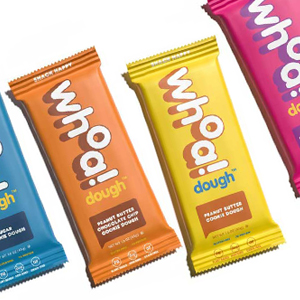
[00:04:17] Ray Latif: I did see him there, a chill dude. One of the chillest dudes in this business. I saw this product. This actually really caught my eye. Whoa Dough. W H o a exclamation point dough. Sprinkle sugar cookie dough. It's looks like a cookie dough bar. This looks really interesting. It's basically you're just you're basically just eating cookie dough. It's better for you cookie dough. And better for you cook. I know it's pretty tasty. And it doesn't taste like it's good for you, which I think is a good thing when it comes to cookie dough. That's a really good point. It shouldn't taste like it's good for you, but if it is good for you, that's a winning product.
[00:04:51] Zoe Feldman: Exactly. Exactly.
[00:04:52] Ray Latif: Well, he said better for you. That's true. Better for you.
[00:04:57] Zoe Feldman: Right.
[00:04:57] Ray Latif: Good point. Less bad. Yes. Well, whatever they did, I mean. There's been a lot of buzz around this brand on the floor, and a lot of people were talking, you know, the founder was talking to, you know, agencies about his package. He's talking to investors. I mean, there's a lot of people, you know, who are pretty intrigued by what's going on with them, and they're pretty early stage. A lot of what you're saying about, I mean, I wish I was here at Nosh, honestly, I regret a little bit not being here. I was here in the morning and then I had to go and do things at Brewbound and I tried to free myself to come back over, but it was like an hour window and I was like, I'll never be back in an hour. When I send you the siren over and over and over and over and over again, you need to come back. Yeah. But you know, a lot of what you're saying of the people getting the value out of attending here at Nosh, I've been seeing it at Brewbound and what someone said to me today at Brewbound Live feel like it's true here as well. They said, I was here for three hours and I've already made, you know, half a dozen really important connections. Like, when do you get an opportunity to do that in such a short period of time in a really, really effective way? Jon Landis, I'll tell you where.
[00:06:08] Zoe Feldman: BevNET Live. Oh, BevNET Live Winter 2019.
[00:06:12] Ray Latif: Good one, Ray. Good call. Yes, good call. No, in all seriousness. I mean, if you're listening to this fresh, you know, a freshy listen, you still have time to get tickets to BevNET Live. That's for damn sure. Come on down. Hey, you know what? Even if you're not listening to it fresh, you probably still have time to get tickets to a BevNET Live. Yep.
[00:06:28] Carol Ortenberg: I mean, it's true. I'm mind blown right there.
[00:06:31] Ray Latif: I know there's always, there's always a bed on the horizon. It's always coming. I mean, one of the coolest things about that net Live Winter 2019 is that we've taken over the entire Santa Monica beach hotel. I mean, low Santa Monica beach hotel, that is. And it offers these opportunities to have these intimate conversations, these meetings all over the hotel. Because if you're a registered attendee, you can kind of do that. You can. And you know what? You can get your ticket right now because you know who's standing by? Who? Jon Landis. Hi. All right. Hello. Landis is standing by. That's me. Yes, he is. All right, I think it's time we get to our interview with Zoe Feldman, who, as I mentioned at the top of the show, is the director of the Chobani Incubator. The Incubator's mission is to help small food and beverage startups bring better food to more people. Pretty simple. In an interview with Nosh editor Carol Ortenberg, Zoe spoke about how prior roles as an executive at PepsiCo and in venture capital shaped her perspective on the importance of diversity in business and why in her words, representation is hugely critical to the future of our industry.
[00:07:35] The Crew: Hi everyone, Carol here. I'm joined by Zoe Feldman, who's the Director of New Ventures and the incubator at Chobani. Thanks so much for joining me today. Hi, Carol. You've had a really interesting background in the industry. Talk to me about what your career has kind of looked like and got you to Chobani.
[00:07:56] Zoe Feldman: Well, Carol, as we sit in these chairs in a ballroom lobby in a hotel in downtown Denver, I can tell you that I certainly did not think that this would be a part of my life when I was studying liberal arts as a wee undergraduate at Smith College in Northampton, Massachusetts. I've definitely had a very interesting career path. It was a trajectory that in many ways makes the most sense for me, but in other ways I think is really surprising. I never saw myself in business. I went to grad school and You know, I was on the PhD track to go into academia and teach because I'm a big nerd who likes all the things including reading, writing, math, all the subjects really. And I was getting, I was on the PhD track and I really thought I'd be going into academia, becoming a professor and sort of this kind of legacy story now where I met my first boss at a market research event because I was so broke in graduate school that I was promised $200 in cash in an envelope by my Smith friend, Drew, who was working at the Hartman Group at the time in Seattle, and they were doing a trend research study around snacking or something. I don't even remember. I went because Drew was working at the Hartman Group, and this was the fall of 2007 in my second year of my graduate program at Columbia. And very long story short, that was my first job working for Dr. Derek Yock at PepsiCo in their newly formed nutrition and public health function. And I would say since then, the past 12 years of my career have been largely about figuring out sort of how to juxtapose nutrition, nutritional epidemiology, food policy, business, strategy. So really interesting, unusual career path, but that one for me makes sense because I still get to be kind of deeply rooted in research and learning, but also simultaneously take that and really create tangible outcomes.
[00:09:54] The Crew: You spent some time on the venture side of things. Talk to me about how you got into that part of the CPG world and what you kind of learned from that experience.
[00:10:09] Zoe Feldman: Yeah, so I got into that because I started working on what was essentially new ventures. It was like Pepsi's equivalent of what was Coke's Ventures and Emerging Brands Group. in 2010, so it was the Skunk Works project where I worked for Indra for like five years basically with a very small cross-functional team and we were funded to work on what was basically going to be the second kind of strategic corporate venturing group in the industry. That's also sort of a funny fabled story now, but essentially it was given complete autonomy and told to just basically go out and do it verbatim by Indra, which was both amazing and also now it's kind of shocking when I think back about that opportunity. Sort of right place, right time, right situation. And so we created what was supposed to be kind of the parallel to VEB. And again, at the time, there were no other strategic CPGs with funds, so that's how I got into it. And then I decided to go to business school, which I will say, as I have said repeatedly publicly, was the worst decision I've ever made. It was a huge mistake. I don't advocate for it. Come talk to me if you have any questions. But that is probably the one thing in my career slash life that I actually have regret over. You know, for me, it just didn't make any sense. But at the time, I thought in order to learn business, I had to go get another degree. And that was absolutely not true. So I learned about VC by being around really smart people who'd done VC and other industries like biotech and pharma. And then basically, I had our CFO at the time, who I'm still very close with, Richard Goodman, teach me about corporate finance and FP&A and a little bit about investing. And I just learned by doing and learning from other folks who'd done it in other industries. And then when I left Pepsi in June 2015, I went and joined Don Thompson as he was forming his own family office VC fund in Chicago called Cleveland Avenue. And that's when I really got into the details of doing diligence. And again, it made sense for me. I like big picture strategy as much as I like details. I like getting my hands dirty as much as I like, you know, digging into Excel. I sort of like all of those things. So it made a lot of sense for me to be, to enjoy doing diligence and kind of be able to bring a different perspective into venture.
[00:12:18] The Crew: Let's fast forward a little bit. What is your role at Chobani and how did you wind up joining the company?
[00:12:26] Zoe Feldman: So I was in VC for about four, four and a half years, you know, double that if you count all the work I did at Pepsi prior, but actually doing diligence and investing in companies and doing deals for about four years. And I had decided for a variety of reasons, I wanted to leave VC. I think I thought it was going to be something different than it really was when I kind of ended up doing my own thing in a fund in New York. And it just really wasn't for me for a variety of reasons that at some point, you know, we can get into. But I think what I realized is I really miss being part of a team. Venture is actually very lonely and people don't talk about that, but you can raise $100 million fund, you know, and you typically only have three or four people with whom you work. And when you look at a thousand deals a year, everything starts kind of looking the same. And it's not fun anymore. You don't really feel optimistic. I mean, I'm a very pragmatic person and I got to be a real pessimist, which was a big fucking bummer. I just wanted some more joy in my life. And I feel like Chobani, it's the white whale of the industry in the sense that everybody wants to work there. There are very few corporate jobs available. You know, Hamdi's obviously legendary, and I can tell you from the bottom of my heart, unlike, you know, the other roles that I've had in my life, he is exactly who he is privately, is who, you know, PR says he is publicly. The mission, the vision of the company are just It's true. It's all true. I've been there actually. Today is my one year anniversary. Congrats. Thank you so much. So I've been there for a year and it feels like it's flown by. I feel like I've been there forever and it's the perfect place for me. So shout to Jackie Miller, my predecessor, because she was the one who took me out last August for dinner in my neighborhood and was like, hey, I'm going to be leaving my job at the incubator. I really think this would be a good fit for you. And I wasn't entirely sure, but it turned out it was absolutely beyond a shadow of the doubt the right fit. And what do you do at Chobani? What is the incubator? So the Chobani Incubator is the only, I'd say, purely altruistic incubator program in the entire industry, probably because we are privately held. And it's born from Hamdi being a true founders founder and an entrepreneur and really just wanting to give back to the entrepreneurial ecosystem. So It's a four-month program in which we take early-stage CPG businesses between $250,000 and $3 million in revenue, and we give them everything from a very small $25,000 no-strings-attached grant, so equity-free, to four months of mentorship programming, one-on-one audits. I mean, we've really made it much more operationally focused during my tenure for the past year. It's highly competitive, which is totally something that I try not to comprehend because it's very overwhelming, but we accept six to eight companies and we typically get between 650 and 700 applications. And, you know, the purpose of it is that you want to grow your business and you have some kind of mission or vision that aligns with Chobani's in terms of giving back and having DNNA, which is delicious, nutritious, natural and affordable or accessible. So those are really the tenets of the types of businesses we're looking for.
[00:15:34] The Crew: How has the incubator evolved since founding to now, how have things changed?
[00:15:42] Zoe Feldman: I bring a different perspective into the incubator program. I think, you know, being somebody who worked in CPG for my whole career, then came from the investing side. So I had both an operational and a finance and a strategy background. So I've only ever worked in the industry, know the industry, love the industry for the most part, and was able to bring in some more discipline and then some networks that hadn't really been brought in before. In addition to that, I also bring a different perspective in terms of focusing on diversity, which I think is incredibly important. I think it's critical for all businesses to understand why that's incredibly important. And diversity is, it means a lot of things to a lot of people, and I'm not here to define it for anybody other than myself and my own beliefs around what diversity is. But I thought it was really critical. I mean, you know, look, I've been in rooms where it was all people who looked exactly the same. That doesn't mean they weren't diverse in other ways, but I think it's my vision and my mission for The Incubator, and I have full support from Hamdi and Peter, which has been incredible, to be able to give folks a seat at the table. People who wouldn't have been able to have the opportunity otherwise to interact with consumer investors or, you know, be in a program like The Incubator. That's my singular focus for this incubator was for 2019 and we were super successful and it is for 2020 and beyond.
[00:17:01] Ray Latif: It's a guessing your margins. That's risky. Belay financial gives CPG brands the clarity to scale smarter, faster, stronger. Get your free inventory ebook by texting taste to 55123 and start making data work for you.
[00:17:21] The Crew: Lofty. Tune in at the end of this episode for an exclusive interview with Matt Lin of Belay Solutions. He sits down with Melissa Traverse to break down the biggest inventory and accounting mistakes CPG founders often make. You'll learn how to bring clarity to your numbers so you can scale with confidence.
[00:17:40] The Crew: So when you think about tackling that, how do you even, you know, bite off a chunk and try to go after that one small part of it?
[00:17:50] Zoe Feldman: Well, it has to start somewhere, right? And somebody gave me a chance once and offered me an opportunity and offered me access. And I view my role now as a person who is part of a marginalized community, as an LGBT person, to sort of say, you know, look, I understand how it feels to be viewed as the other. And I also understand what it is to be a woman in a room full of men, which was certainly the majority of my career in VC, I understand how it feels to be viewed as the other and how people really make assumptions about you before they even talk to you. There were a lot of times at Pepsi when somebody thought I was someone's intern. Sometimes people thought I was someone's child. I mean, I was like, I'm literally a person in my 20s with a master from Columbia walking around and people are looking at me like, do you belong here child? And I was like, I get it. I look young and maybe someday in the future, I'll appreciate this. But I mean, that's a silly example. And I think a more serious one is, you know, there are no LGBT. I can't say none. There are very few LGBT founders that I know of that are actively out. Right. I can literally count them on one hand. and the LGBT percentage of the population is much bigger than, you know, the number of people I can count on one hand. So a question I've been asking myself a lot in the past year is why is this suddenly important to me? Why do I suddenly care? I was never the person who cared about offering my own perspective on diversity or why it mattered. And the truth is what happened was I got an email about a year ago, right before I started this job, from a young woman who I had taught as part of a summer program through Johns Hopkins has a program for nerdy teens like I was called the Center for Talented Youth. When I was in graduate school in the summer of 07, I taught in their epidemiology six-week program down in Princeton. That's like the most like, I can't believe I just said that sentence. I hate myself right now, but it's all true. That's all factual. Let me just throw out Hopkins and Princeton and Columbia like complete asshole. Sorry, you can bleep that out. No, but I mean, look, again, that brings up a lot of questions about class, but I taught this young woman. I was about 22, she was about 14. I suspected that she might be queer and she had this best friend and he was actively out. I think it was a bit easier for him at the time. She sent me an e-mail last summer and it was a really long e-mail about how, She always knew that she was queer, but she never had met a person in her life until she met me. And I had a girlfriend at the time who would, you know, come down to Princeton from New York City and come hang out with me and come hang out with these students. And she had basically said, I never saw like a gay person living a normal life before you. And I burst into tears when I got this email because I felt the same way when I was her age. There was a woman at my high school who was also like 22, 23, who had a partner who was female, and they were the first lesbian couple that I ever knew. I looked at them and I thought, I want to be like them. It made me feel like I could somehow have a future and a life and be happy. Because I'm 35, so there was no Internet, there were like AOL chat rooms, but I didn't know where to go, I didn't know what to do. I got this e-mail from this young woman last summer and I just thought, I've always said being gay was just a part of who I am, which it is, but it wasn't all of who I am. I never felt the need to wear it as a badge like a lot of people in my life, but it just struck me like somebody did that for me, I did that for her, I need to start paying it forward and owning up to the fact that being different in this way is important and its representation matters. It's hugely critical. And every time I walked into a room of all men in VC, I got, you know, I went to a women's college. I got this little kind of chill down my spine where I was just thinking, y'all are going to fund the companies who are founded by the people who look exactly like you. That's confirmation bias. What's my role in this? And I realized now it's about speaking out and speaking up. And it's about making people understand that diversity is not just race or ethnicity or gender identity or sexual orientation. It's a lot. It means a lot of things. Political, you know, opinion and religious background and, you know, were you raised in this country? Did you go to college? Did you not have the ability to go to college? I mean, a lot of it's about class. It's very intersectional, which is my favorite word, because I really feel like it's true. I mean, everything is dependent on other things. And this is a long way of saying, I just had a realization last summer and I just thought, oh shit, I've been really selfish. I've kind of kept this all inside and I could actually be helpful to other people. the way when I saw a lesbian couple when I was 15 and this young woman saw me when she was 15, I can be that for other people in some sense and show them that you can be part of a marginalized group and get in a center of power and help people in centers of power make decisions to understand why diversity matters, why representation matters, and why it's important.
[00:22:33] The Crew: Thinking about myself and when I've wanted to change a behavior in myself, whether that's being more proactive or vocal about something or not, it's hard to flip that switch overnight. So what did that progression look like for you?
[00:22:52] Zoe Feldman: Yeah, I mean, I started, you know, accepting invitations to speak at conferences, which is generally something that I hate to do. I started, you know, being more vocal on platforms like LinkedIn, which I don't think I'd like ever posted on prior to taking this role. And this role is also very public facing. I think I just felt more like a duty and an obligation and a responsibility, not just to the LGBT community, but to all of my friends and people in my life, you know, colleagues who identify as diverse, it looked more like me looking deep inside myself and saying, OK, a little bit of that self-hatred that you have, which I do from, you know, being kind of part of the other. you have to get past that and get over it. You have to work through that. It's really important for the next generation. And that sounds kind of like lofty and kind of like pie in the sky. And I don't mean to sound that way. It's a kind of a pretty privileged statement. But I think I just realized, you know, like there are people every day fighting for, I mean, look, we still look at what happened in the Supreme Court last week. Like LGBT people are still discriminated against in almost half the states in the US. I can be fired for being gay in a lot of places in states where I regularly visit. I mean, that's wrong. So how can I, you know, use my Crew and The platform that I have, which is very public facing for a highly respected business, where the founder, CEO, and all the executive leadership team and my colleagues, not only support me, they encourage me actively to be who I am in the world and would never dream of ever asking me to be any other way. So it's not, it's active support. It's not just like, oh, you know, you're gay and want to talk about diversity like that's cool. It's like, no, no, no, we support you and, you know, going to conferences and speaking on panels and going on podcasts and just getting the word out that this is important for you and it's important to Chobani as a business as well.
[00:24:38] The Crew: Why is this important to Chobani? They were a successful company. They could have kept along the path they were. So what made this something they really wanted to look at and improve upon?
[00:24:51] Zoe Feldman: Hamdi is an amazing human being and he's got his own personal story and he's obviously a very unique individual and diverse and founder, CEO, lore, especially in this industry. I think he has a singular mission and goal which is to make better food for more people, but to make the world better than it was before we all came into it, right? Peter also shares in that vision and that goal. So I think for the two of them, it's sort of a no brainer. I mean, all the statistics and research led by McKinsey that's been done has been all around, you know, supporting diversity. It has higher positive correlation with return on investment. I mean, it literally actually makes a company more profitable. They've done all the research. They've run all the numbers. And I think aside from that, Hamdi and Peter just believe it's the right thing to do. It's good for business. It's good for the world. It's supportive of humanity. And that's really what drives these initiatives and these efforts. I think it's actually very straightforward.
[00:25:50] The Crew: What's your advice to listeners who, you know, aren't working at Chobani, don't have a hum to Ina Peter? How can you have an impact? And at times it can feel a little scary to approach your leadership and talk about these things.
[00:26:04] Zoe Feldman: Yeah, I didn't for a long time, you know, I didn't have support. and that was really, really hard. I felt like I was living in a vacuum and screaming into the void, which I feel like would be a good title for my eventual memoir, just screaming into the void. I didn't, and that's the truth. I worked at a Fortune 500 company that really didn't have any good policies or ERGs that were truly supportive of diversity, regardless of whatever you read, I can tell you that for a fact. At least I didn't feel that way, and a lot of my friends didn't feel that way either. I think we're lucky because now's the time when our generation is really pushing back on the generation above us and the generation above them to just say, look, we need to be more inclusive. And that means a lot of different things to a lot of different people. So I know that it's scary, but I just keep coming back to this notion that I know it's really hard to feel like you don't belong and to feel like you're the other. But if you don't live your life authentically, whatever that means to you and kind of speak your truth, like nothing will ever change. ever, ever, ever. There were people who were fighting for my rights since, you know, the 1950s, right? And you have to recognize the people who have come before you. I mean, think about women in our industry or just women in business in general. Glass ceilings have been broken for a long time and you almost never hear about the quiet trailblazers. It's a lot of people who don't necessarily get recognized or get a public platform who are working together collaboratively to make change. You don't hear about them all the time. Sometimes the stories come out 20 or 30 years later, but I think it's about elevating your own voice in whatever way feels comfortable and authentic to you.
[00:27:39] The Crew: What's your advice to figure out if you are in a place where you can make a change or do you have to say, it's time for me to find something new where I can be my true self?
[00:27:52] Zoe Feldman: Well, I banged my head against a wall for 10 years at a Fortune 500 company, so I would not recommend that to any of our listeners for emotional, psychological, or mental well-being. I think you know your own limitations, and if you don't, you'll figure it out. You know, you'll find your people, and that was something I learned at Pepsi. A lot of those people were not my people, but The people that were my people, they're still my people. Over 10 years later, they're still my people. You have to find your tribe, your crew, your people, your community, whatever it's called. If they support you in this and you're able to have these conversations with them freely, then maybe it is the right place for you. I think alternatively, you know, the good news is 2019, almost 2020, there's a lot of companies out there that are pretty progressive in how they think about diversity and how they support diverse employees and initiatives and, you know, how they want to be in the world, whether it's with the social mission and vision, or they want to make some kind of impact. It's not just about, you know, profitability or the bottom line, you have to figure out what's important to you. and then use that information. And I would just say more than ever, like talk to the people in your community and not just like your, you know, one degree of separation, like go to events, you know, go to the little micro community events and just talk to other folks and see what it's like to work at other companies, not just in our industry, but in other industries as well. I think changing century old businesses takes probably another century.
[00:29:16] The Crew: So you're trying to make these changes. in our industry, walk me through what you're doing in the incubator to make that difference.
[00:29:27] Zoe Feldman: Yeah, it's a good question, because I think a lot of people, you know, there are a lot of chief diversity officers now, and I always just wonder, like, what are you actually doing that's tangible, that's making a difference besides, like, having sort of this, this title that sort of makes you the scion of all things diversity and inclusion. So when I started last fall, I really looked at my team and I said, you know, I want to do a couple of things really differently. First, we have to focus on diversity, which means in the next cohort, I want us to have founders and businesses that really run the gamut. I don't want, I mean, you know, no offense to the town that we're currently in, but the Denver, Boulder, San Francisco, New York City, Austin, kind of same crowd. repeatedly because I feel like the folks in those communities get every opportunity in the world. I really want us to focus on giving other people a chance. And so I said I'd like to over-index on diversity, which means a lot of different things. Again, not necessarily race, gender, ethnicity, sexual orientation. But other factors as well. Were you first in your family to go to college? Did you serve in the military? Do you live in a rural area? I mean, these are all... Look, everybody's diverse, right? No two people are the same. But really bringing different opinions and perspectives, I think is absolutely invaluable. I couldn't even put any type of value on it. I think it's... beyond invaluable. So I said to them, look, I want to over index on diversity, which is a very broad definition for our cohort for 2019. And the second thing I said was, you know, I'm cutting any budget that we had for marketing, no digital marketing, no advertising about the incubator on Facebook or Instagram, you know, we're going to appear in one newsletter, we're not paying anybody else, we are going to do word of mouth, because I have done this for over 10 years. and there's no better way than to learn about the constituency than getting your butt on an airplane or on a train or in a car and getting out into a community and meeting people. So the thing I'm most proud of other than over-indexing for diversity and making sure that we led by example for this 2019 cohort has been making sure that my team and myself got out into the U.S. and did our, I call it our, you know, tour across America at TM. It's not really a trademark. Sorry, Kathy Liu. Our tour across America, where I said, you know, we're going to go out in these different communities. Like, they honestly hadn't traveled to a lot of these places before, and I had. I was like, I've spent over 10 years as like a road warrior. And I really want you to see, I think it's very important that you to see for your own development and knowledge and understanding like that these communities exist outside of these big urban areas. So I am very proud that we will have gone to 20 different communities by the end of this year and met over 1100 founders and entrepreneurs in the food and beverage industry. Yeah, it's pretty kick-ass. Like, we've been to New Orleans, you know, your hometown, Burlington, Vermont, Seattle. We just did Charlotte and Raleigh-Durham, Charleston, doing Vegas tomorrow. Like, we're doing places where there are sort of more unexpected communities, but the nicest thing about it has been that these communities, not only do they exist, they're really supportive and they've just really needed somebody to kind of come in and bring them all together. And that has been our role is bringing together these micro communities of founders who quite frankly didn't even know that one another existed. And it's been our pleasure because that's truly the goal of the incubators to create an altruistic ecosystem of entrepreneurs and founders in the CPG food and beverage industry.
[00:32:55] The Crew: So what happens after Chobani comes in?
[00:32:58] The Crew: Do you want more repeat buyers on Amazon? Well, this free resource in collaboration with Straight Up Growth will help your brand turn first-time buyers into long-term subscribers. Download Winning the Repeat Purchase Game on Amazon now at Taste Radio.com slash SUG. That's Taste Radio.com slash S-U-G to start building retention-driven growth for your brand on Amazon. Scaling a beverage brand into major retail comes down to operational readiness. From packaging lead times to co-manufacturing strategy, the details can make or break a launch. In a new ebook in collaboration with Octopi and Asahi Beer USA, industry leaders share what they've learned in helping brands scale. Download it now at Taste Radio.com slash octopi. Do you need to scale your team faster without compromising on talent? Join Oceans for a Live Winter on April 20th and learn how leading companies are hiring top global professionals who are ready to grow with your business. Register for the webinar now at Taste Radio.com slash oceans. That's Taste Radio.com slash oceans.
[00:34:08] The Crew: Do you help nurture these communities so that they can come back together even if, you know, one of their members is not in the incubator at all?
[00:34:16] Zoe Feldman: Yeah, so we have actually created these small micro communities in these new cities and towns. And, you know, we've encouraged people to continue to meet up. I know for a fact that several of the meetups that we put together for these happy hours over the past year have turned into more regular meetups between either individual founders or as a larger group. People needed access. They needed access to each other. They needed a reason to get together. And I'm super proud that we could be facilitating that. That's incredibly important and really, really valuable.
[00:34:47] The Crew: The efforts that you're doing are really impressive. One thing I'm concerned about in the industry is for other companies, How do you make sure this doesn't just become a marketing buzzword or an advertising campaign and is actually something that people are working to change?
[00:35:10] Zoe Feldman: Welcome to the bane of my existence. It's hard. I mean, look, I struggle a lot with tokenism, right? Like if you are viewed as the other from a diversity perspective, it's really easy to fall into the notion of tokenism, which is essentially that you are the representative for your whole self-identifying group. So it's like I'm the stand-in LGBT person who asked to be put into the diversity videos. I mean, it's funny. Yeah, I'm just like, how do you avoid this? I think the truth is you can't and you have to be willing to take a little bit of that tokenism, at least for me. I mean, I can't speak for anybody but myself and my own lived experience. I've been willing to do it and it's never made me uncomfortable because I think the broader, mission and value of that, it goes away further than just me being like, oh, you know, I'll be the stand in gay for the moment. Like, I don't know, it's funny, but it's true. I've definitely felt that way sometimes. I think with larger companies, look, it's the McKinsey workspace for itself. It shows very clearly there's a strong positive correlation between return on investment and investing in diversity in your employees, like full stop. And we all know you can't argue with McKinsey. Because they charge so much money.
[00:36:26] The Crew: I can't argue with that at least. Me neither. You're right. There are lots of studies that show it's just good business. It doesn't mean it's easy to have these conversations. And it doesn't mean it's easy to start these programs or efforts. Why do you think it's so hard to talk about this sometimes in our industry?
[00:36:50] Zoe Feldman: I think, I don't think, I know for a fact it's hard in every industry. It's hard for everyone to have this conversation. It's uncomfortable. People don't want to say the wrong thing, especially people who identify as progressive. People are afraid that they're going to use the wrong words or they don't have the right language. And I completely understand that. And I have a tremendous amount of empathy. But part of me is also like, well, Just get your shit together and, you know, figure it out. I mean, it's not that difficult. You just have to have some empathy and realize that different people get treated in different ways in different circumstances, like full stop. And that's why I think looking at things from an intersectional lens, which just means, you know, there's a lot of different factors. There's a multitude of factors that all rely on one another and basically we've been living in this sort of oppressed system for a long time, like things are not equal. Things are not equal from a gender perspective, a sexual identity perspective, a rural versus urban perspective, race ethnicity perspective, like things are not equal. We all know that. And that makes people very uncomfortable, even though I think people fundamentally understand that. So to your earlier question, like where do we even start? I think trying to educate folks and have those conversations internally in your organizations, just start with that. You have to start somewhere or nothing will ever change. If we keep doing the thing that we've always been doing, nothing will ever change. So it has to start somewhere. And I really do believe it just starts with one individual or collective group of Entities, friends, like within organizations standing up and saying this cacophony of voices saying we want things to be different and this is why. And not just because it's a good financial ROI, because it's very healthy to have a diversity of perspectives and opinions. Hugely healthy. I mean, you know, put me in a room all day every day with somebody who's different political beliefs than me. put me in a room all day every day with somebody who believes that, you know, the way I live my life is a sin. I mean, seriously, I want to understand that. I think that that's actually critical.
[00:38:57] The Crew: I agree. I think it's certainly critical for brands because if you only have consumers that think the way you do, there's only so big you can grow.
[00:39:06] Zoe Feldman: This is a very diverse country. I think a lot of people forget that. It's over 300 million people and we're hugely diverse. I mean, even within states, sometimes, I've been saying this forever, like, even you go into, you know, New York State, upstate is very different than, you know, New York City, which is very different than the Catskills, which is very different than the Berkshires, which is very different than up by Ithaca, like, every state is almost its own sub state that has like its own separate nation states. This is a very unique and interesting country. There's a lot of really amazing people. And you're right, there's a lot of consumers and no two people are really alike in that way. So I think in order to understand your consumers, if you're a startup, for example, it's just put yourself out in the world, have some empathy, you know, try and understand what it is like to live kind of as the other. And that will go a really long way. That's where I sort of, I guess, saw in my own experience working at a huge gazillion dollar fortune, you know, whatever business was that there was a bit of a lack of empathy there because I think people really just didn't understand how anyone other than themselves lived. And I saw what that did and that was, it was not good.
[00:40:18] The Crew: Well, thank you so much for having this conversation with me. I think we could continue for another, as you said, 17 hours. But unfortunately, we'll have to wrap it up for now. I'm looking forward to continuing it in the future, though.
[00:40:29] Zoe Feldman: Thanks, Carol.
[00:40:35] Ray Latif: That brings us to the end of episode 63 of Taste Radio Insider. Thank you so much for listening, and thanks for our guest, Zoe Feldman. Please subscribe to Taste Radio on the Apple Podcasts app, Spotify, Stitcher, SoundCloud, or Google Play. As always, for questions, comments, ideas for future podcasts, please send us an email to askatasteradio.com. On behalf of the entire Taste Radio team, thank you for listening, and we'll talk to you next time.
[00:41:03] Zoe Feldman: you
[00:41:09] Carol Ortenberg: Hello, I am Melissa Traverse here for the Taste Radio podcast, talking about some of the biggest tension points that CPG brands and founders face when they're scaling a brand, and those are financial accounting and inventory management. I am joined by Matt Lynn, inventory accounting guru from Belay Solutions, and he is going to shed some light on all of this that is going to help everybody out quite a bit. Matt, thank you so much for joining us today.
[00:41:39] Chobani Incubator: Thank you for having us, Melissa. It's great to be out here at Expo West and it's great to sit down and be able to chat this because it's kind of a passion project of ours, working mainly with CPG brands and hoping to help them scale.
[00:41:51] Carol Ortenberg: It's been such a pleasure chatting with you and the team and learning all about what you do over there at Belay Solutions. Can you tell us a little bit about yourself and what your role is and the kinds of solutions that Belay gives to CPG brands and founders?
[00:42:06] Chobani Incubator: Yeah, absolutely. My role with Belay, I'm actually our inventory accounting manager. I run our inventory department, so we work with CPG brands, taking them from spreadsheets, putting them on inventory management systems, and really helping connect their tech stack between their sales online marketplaces to that inventory management system, even down to their financial systems like QuickBooks. Belay overall is kind of an outsourced accounting firm. And with that, we're helping teams. We have different levels with bookkeeping, controller level work, even high level into CFO type items. So we really help those brands in any way that they need financially. And then I just have a subset of a department where we're really just laser focused on inventory.
[00:42:49] Carol Ortenberg: It's certainly a complex topic and there are plenty of places to go wrong. Let's start by going right and start super simple. Can you tell us what some of the biggest red flags are that would help a founder understand or, you know, the person running a brand understand that it really is time to get some help with some of these areas?
[00:43:10] Chobani Incubator: 3 3 3 3 They have a lot of transactions that don't get coded or they just put them into placeholders to just get rid of it so it's not an eyesore. They'll notice they have revenue but no cash or they notice that they have a good amount of cash but their blind spot is really seeing the vendor invoices that are sitting there just needing to be paid and so they just lack that clarity that's going to really be around the corner.
[00:43:47] Carol Ortenberg: You know, you were talking about one of The Crew flags that comes up that I think makes so much sense. When somebody asks you what your numbers are and you can't come up with the right number, that's a big problem because that's something that you really should be able to share with decision makers who, you know, you're ideally looking to do business with. What should you be able to call up at a moment's notice?
[00:44:11] Chobani Incubator: really at any time you should be able to know an accurate margin. It's amazing how many founders we end up talking to that they can tell you their revenue numbers, they can tell you their selling price, and then the minute you start talking about cost or their cost of goods sold, they just get a deer in headlights look. So really it's very hard to tell, am I even making money? or if you don't know your entire landed cost. Maybe you know what the freight cost is, the duties separately, but you're not really getting that as part of your unit cost. So it's really hard to tell. Am I even making money or am I losing money from the very beginning?
[00:44:45] Carol Ortenberg: And do you recommend that founders are able to call up a margin by channel?
[00:44:49] Chobani Incubator: Absolutely. And depending on the number of products and channels, you kind of want to know what are your best sellers, which ones are making the most and which ones maybe you're not making as much. But especially if you're branching out and you're doing D to C with B to B, absolutely want to know that.
[00:45:06] Carol Ortenberg: Gotcha. You mentioned that when things feel really chaotic, that's probably a red flag. I would say that it probably almost always feels chaotic if you're running a CVG brand. And I know this may be hard to quantify, but is there a revenue number? Is there a number of doors number that would help a brand understand whether or not it makes sense to bring on a partner like Belay? Understanding that so many brands are bootstrapped or they might be tight for cash. What is that friction point?
[00:45:36] Chobani Incubator: 3 3 3 3 3 But as you're growing, as you're getting to those six-figure revenue numbers, and especially as you're approaching seven, you want to make sure you've got good financials. Because as you scale to that point, most likely you're going to be looking to raise capital. And investors, the first thing they're going to look at is your books. And are they clean? And do they show a clear picture of your business?
[00:46:09] Carol Ortenberg: You know, another area that folks might look to to organize some of the chaos are their systems. So many folks stick with Excel spreadsheets for a good amount of time. How do you know that you need to outsource some of your accounting to an organization like Belay Solutions versus maybe signing on to a Synth7 or NetSuite or something like that?
[00:46:32] Chobani Incubator: Well, that's actually something we really help with when it comes to that cost question. That's something that trips people up. And sometimes if you just have a turnkey business, you buy and sell a finished good, you can maintain with spreadsheets. And we've had clients with million dollar revenue that can do that. But we see so many brands nowadays are using contract manufacturers. and they're just sourcing certain parts of their product. So when you start talking costs, they have no idea exactly what their unit cost is. So that's where we come in and we kind of understand, we'll speak with the customers and the clients and get their needs. And then if we think they're ready for a system, then we'll help put them on that system so they can get some of that clarity. And it's not something we force on anybody. There are plenty of times where founders come to us and we'll tell them bluntly, you're not ready for it right now, but we'll let you know when we think you are.
[00:47:18] Carol Ortenberg: That sounds like excellent advice. What should a founder or somebody running a brand look for in an outsourced accounting partner? Are there certain checklist items that they should make sure that their partner be able to execute or be able to help them understand?
[00:47:35] Chobani Incubator: Absolutely. I think one of the keys there's, there's a lot of outsourced accounting firms out there. Some focus on service-based SaaS companies, but if you're a CPG founder, you really want to make sure that your accounting firm has Sampling Experience. I would ask them, you know, what kind of brands have they worked with? And even beyond that industry specific, because there's so many subsets of CPG. And that's something that I think is great about what we do with Belay is that we kind of run the gamut. It's kind of like the insurance commercial. We know a thing or two because we've seen a thing or two across a broad spectrum.
[00:48:04] Carol Ortenberg: Probably getting references is always helpful, right? Absolutely. All right. So this all sounds great. I think we have a really good understanding of would it make sense to hire an outsourced partner? You know, what some of the things you should be looking for are. What does offloading this kind of work mean for the brand? What can this do for lightening the load of a founder or lightening the load of a brand operator? Like, how does that help them in their everyday business?
[00:48:34] Chobani Incubator: It just tries to really help quiet the chaos. So what we're looking to do is just take some of the weight off that founder's shoulder, let them focus on building the brand, building the business, getting that exposure. If you don't have sales, you really don't have anything. So we want them to be able to focus on that while we take care of your back end office work. And we can just present that to you on a monthly basis, you can help make decisions, you can take that to investors. And really, you can just focus on growing your business.
[00:48:59] Carol Ortenberg: I feel like I felt founders and the folks who are running brands collectively sigh a breath of relief just hearing that. How can people learn more about Belay Solutions?
[00:49:10] Chobani Incubator: So people can text TASTE to 55123 for their free inventory guide to get started.
[00:49:16] Carol Ortenberg: Matt Lin, inventory accounting guru at Belay Solutions. Thank you so much for joining me here at Expo West. It's been such a pleasure to chat with you and learn about what you all do over there to help founders and brands with their financial accounting and inventory management. For everybody else out there, thank you for listening to the Taste Radio podcast. I am Melissa Traverse and we'll see you next time.