[00:00:05] Mike Schneider: Landis, we've been hosting BevNET Live at the Lowe's Santa Monica Beach Hotel for almost a decade now. Yeah, Mike, I think I know where you're going with this. Oh, I am. For the first time ever, we have a full buyout of the entire hotel.
[00:00:15] Martín Caballero: And this is a complete game changer. It's going to be like the Lowe's is closed for a private event and BevNET Live is going to be everywhere, inside and out.
[00:00:22] Mike Schneider: And with all this flexibility, we're looking at some exciting new sponsorship opportunities, private meeting rooms, brand activations.
[00:00:28] Martín Caballero: Mark your calendars, December 9th and 10th.
[00:00:30] Mike Schneider: This winter will be epic. If you wanna be part of the biggest BevNET Live ever, email sponsor at BevNET.com and someone will be in touch immediately to discuss options.
[00:00:41] Martín Caballero: And now, Taste Radio Insider.
[00:00:48] Mike Schneider: Hello, and thanks for tuning in to episode 42 of Taste Radio Insider. I'm Mike Schneider, filling in for Ray Latif, who's on vacation this week. I'm here with my BevNET and Nosh colleagues, Martín Caballero and Carol Ortenberg, and we're recording from the Taste Radio studio at BevNET HQ in Watertown, Massachusetts. In this episode, we feature an interview with Rick Field, the founder and CEO of pioneering pickle brand, Rick's Picks. Just a reminder, if you like what you hear on Taste Radio Insider, please share the podcast with friends and colleagues. And of course, we'd love if you could rate us on the Apple Podcasts app or your listening platform of choice. Carol and Marty, thanks for joining.
[00:01:25] Carol Ortenberg: Thanks for having us.
[00:01:25] Mike Schneider: So Mike, how are you? Living the dream. Just got back from a quick trip to New York. Okay. What's up in New York? All kinds of stuff happening in New York. Went to do some strategy sessions. Got to meet with David Carr of Guayaquil. So he's going to be in an upcoming episode of Taste Radio. Nice. Talk about business models. I mean, their business model is fascinating.
[00:01:47] Carol Ortenberg: Well, don't give away the whole podcast, Mike.
[00:01:49] Mike Schneider: I'm foreshadowing.
[00:01:50] Carol Ortenberg: Just tease it.
[00:01:50] Mike Schneider: I'm foreshadowing. I mean, we were talking before, before the show about some interesting business models, Marty. You were talking a lot about sustainability really popping lately.
[00:01:58] Ray Latif: Yes, sustainability is popping, as you say, Mike, as the kids are saying.
[00:02:02] Carol Ortenberg: Mike, have you been on Instagram too much?
[00:02:04] Mike Schneider: Should I say sustainability's flames? Should I?
[00:02:07] Ray Latif: Should I go there?
[00:02:08] Mike Schneider: So many flame emojis.
[00:02:09] Ray Latif: Yeah, it's fire. No, I mean, it's just been sort of noticeable. I think sustainability is certainly a topic that people have been talking about for a while. It's not necessarily a new thing, but I think in the past several months, I guess, and maybe in this first six months of this year, there seems to be a couple just notable I guess maybe more activity from some of the larger companies. I'm thinking about Nestle. I'm thinking about Vitacoco with the launch of Ever and Ever. There have been sort of multiple smaller plays as well. Liquid Death, another one that certainly got a lot of love on BevNET and LinkedIn and social media and all that kind of stuff. You know, it just seems like there's definitely a lot of momentum either for finding a totally recyclable package like an aluminum can or, you know, sort of that getting these larger companies to make greater commitments to using 100% recycled PET materials by a certain year. You know, just basically trying to move away from that virgin plastic that just seems to be at the forefront of everyone's mind. I don't think I'm giving anyone a super hot take here with sustainability being a trend, but it certainly seems to be a lot of stuff going on.
[00:03:13] Mike Schneider: But you're seeing a lot of action.
[00:03:15] Ray Latif: You're seeing a lot of... Yeah, yeah, for sure. And I think time will tell, you know, what the kind of impact these things will have. You know, a lot of times it's hard to sort of gauge these things until we sort of see the long term to see if this was... the right kind of strategy move, or if something may be more drastic was needed. I'm not quite sure. Certainly want to watch, but, but it's pretty cool. I mean, I think just in the, you know, as I said, in the past couple of weeks seems to be a lot of activity around that. So good for these companies pay attention to that.
[00:03:40] Mike Schneider: Do you think this is catch up for the big players or do you think this is true innovation?
[00:03:43] Ray Latif: I mean, I don't think an aluminum can can really be called a true innovation as much as they'd probably like to convince themselves that. But no, I mean, I think it's sort of, I think it's a good thing in general. Again, time will tell if this is actually something that makes the impact that I think that they hope it does, but you know. Good for them. Easier to recycle. How can you argue with that? Easier to throw in your bag, you know?
[00:04:05] Carol Ortenberg: Come on. I mean, you do have to give them credit for a big company. It takes a while to make that switch over from plastic to recycled materials. But at the same time, it's interesting. At Fancy Foods, one gelato company told me that they were in plastic, recycled plastic, and they're moving to paper because of the issues towns are having in recycling their products, that much of this recycling is just going to landfills anyway, even though It's made out of recycled products and could be recycled. It's just too expensive to do that. I think we'll continue to have to see this evolve. We're already seeing some efforts on reusable packaging that you mail back and they refill and send it back or, you know, certainly in personal care. Can that come over to food and beverage? I don't know yet.
[00:04:45] Ray Latif: Yeah, I think that's a good point because, you know, as you know, we're talking about sort of maybe some of the bigger players are paying more attention to that. At the same time, there was an article a couple of days ago, maybe last week, that was sort of highlighting the fact that even though these corporations are really pushing that sustainability message, the actions that they have taken sort of behind the scenes, especially in state legislatures with regards to bottle bills. So basically, you know, the deposit that you get money back every time you recycle a bottle. encouraging people to recycle, basically, giving them some motivation. They've actually been sort of fighting that on a state level in terms of trying to keep those laws from being enacted. So there's a little bit of a gap. I mean, you have to watch both hands, you know what I mean? One hand is doing one thing, another may be sort of doing something else. So I think, you know, that's why I caution to sort of let's see what happens over the long term and see what really can happen here.
[00:05:35] Carol Ortenberg: But it all comes down to transparency, right? With the internet and social media, it's a lot easier to look beyond just the messaging and advertisements and say, what are they really doing? What are they putting their dollars behind? And what are they lobbying behind?
[00:05:49] Mike Schneider: Yeah, interesting stuff from the big companies. On the little company front, Good Mylk Company sent us milk last week and they sent it in a very interesting way. Was it delivered by a milk man? It was not delivered by a milk man. That's old school, right? But it is sort of that similar paradigm where they sent us glass bottles and then frozen hemp milk and nut milk concentrate essentially that you make yourself.
[00:06:17] Ray Latif: Okay, so that's a concentrate that you mix with water?
[00:06:23] Mike Schneider: It's a concentrate that you mix with water, so you get to pick the kind of water that you use. If you want to use alkaline water, you can use alkaline water. If you want to use regular beat-down tap water, you use regular beat-down tap water. The thing about it that I thought was kind of an eyebrow razor, no emulsifiers in it. It's good and thick and tasty and it holds up The nut milk held up really well. The almond milk held up really well in a latte. The hemp milk kind of not so much, but it separates. So you have to shake it every time. So you can see in the bottle that it's separated. And I wonder how consumers will feel about that.
[00:06:59] Ray Latif: Well, what problem would you say that's solving?
[00:07:01] Carol Ortenberg: There's been a couple of these nut milk concentrates launching, Modest Mylk launched. There's another brand that was food service that's now launching direct to consumer. And the idea is why are you paying to ship water around the country? So if you ship a concentrate, less weight, less carbon footprint. Now, granted, Good Mylk is frozen. Yeah, but it's frozen, right? It's frozen. These other ones are shelf-stable. I know Good Mylk is looking into how do they make more shelf-stable items. I think to a certain extent, this is almost like the cauliflower trend. Making your own nut milk, really popular on social media, on Pinterest, and now you're seeing, you know, cauliflower pizza. How do I take this and make it frozen and simplify it for consumers? Same thing. Lots of recipes around making your own nut milk. I don't know if you guys have tried making your own nut milks before. It's a really long process. It involves a lot of steps, a blender. A nut milk bag. A nut milk bag, yeah. This is taking exactly what people were doing online and saying, how do we make this easier and more convenient for consumers?
[00:08:05] Mike Schneider: I like the output. I think that the experience was kind of interesting. You go to the freezer, you have to thaw it first and then you put the mix, try to get all the mix into the bottle and then you add the water and you shake it up and you've got nut milk. So that part was really interesting. For me, it was more, are people going to be... kind of bogged out when they go to the fridge, open it and it's all separated and they have to shake it again. Are people going to continue to want to have that experience? Now, the good thing of it is the ingredient panel is super simple. No emulsifiers in the ingredient panel.
[00:08:41] SPEAKER_??: Okay.
[00:08:41] Carol Ortenberg: I think where I found it to be really helpful is with the shelf stable concentrates. I can just keep a jar in my fridge and when I make my morning smoothie, I'm pulling out the blender anyways, just scoop a teaspoon of that in and some water and you basically have nut milk in your smoothie really easily well done. So I'm also interested to see how smoothie companies like Daily Harvest start integrating this into their smoothie blends. So instead of saying add almond milk, you can literally just say add top water and blend and you're good to go.
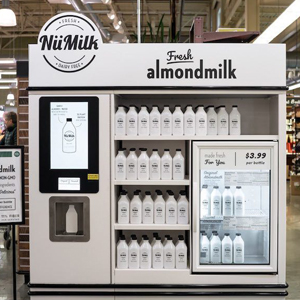
[00:09:09] Mike Schneider: And I think the hemp milk was a pretty interesting compliment to greens because it's got that already grassy taste to it. So if you like the green taste, the hemp milk really kicks that up versus sort of counteracting that with a nutty flavor. So as I was walking through Brooklyn yesterday, I was in Williamsburg and I went to the Whole Foods and you walk in and you go downstairs and it's a giant Whole Foods. It's like bigger than the ones in Newton. And I was like, jealous, of course. But I finally came across the new milk machine, which is basically you make your own nut milk. And they had almond varieties and oat milk varieties. And I didn't have time to stop and try it. which I was bummed about, so I'm gonna have to go back, but I really wish I had stopped to try that. What do you think of that? Like, it's a machine in the middle of Whole Foods that you just walk up to and, you know, decide how much milk you wanna make and make your milk right there.
[00:10:01] Carol Ortenberg: Sounds pretty cool.
[00:10:03] Mike Schneider: We both should try it. I might try it. Sure.
[00:10:05] Carol Ortenberg: The question is, right, like, it's really cool. I want to try it. But what's going to make you swap from buying your almond milk out of the case when your kid's in the car crying or you want to get through the grocery store as fast as possible?
[00:10:18] Ray Latif: How many purchases, beverage purchases, do you guys make from a tap, sort of fill up, make your own in-store situation?
[00:10:25] Mike Schneider: Yeah, I'm not the guy who's still in the Apple Friday growler or anything like that, so.
[00:10:28] Ray Latif: So you, no? No.
[00:10:30] Carol Ortenberg: Not so much. Sometimes some kombucha out of a tap, yeah.
[00:10:33] Ray Latif: Have you maybe done that once or twice?
[00:10:35] Carol Ortenberg: Yeah.
[00:10:36] Ray Latif: That's what I fear for these kinds of things. I think they're the kind of things that you may try once or twice and they're kind of cool to have in the store. And I'm sure a lot of innovation goes into it, but I just wonder about the sort of repeat customer loyalty that you're going to get with those kinds of things where maybe, you know, one out of every five times you're going to want to do that.
[00:10:54] Mike Schneider: Because we're a damn society of convenience, right? I mean, where you're not necessarily remembering to bring the growler with you each time you want to go and get more kombucha, you forget it. And so what do you do? You just buy a single serve.
[00:11:05] Ray Latif: I also think that maybe you want some variety. There's a lot of good kombuchas on the shelf. Maybe you want to try one of this flavor, one of that flavor, different brands. You don't want to necessarily be locked into one thing that you're going to be filling up consistently. I think that's a tricky thing to balance.
[00:11:20] Carol Ortenberg: You also have to think about the retail side of things, right? It's a pretty big machine. So they're constantly going to be evaluating the amount of money they could be making by putting a cooler of grab-and-go beverages or any other product in that space. If you can't meet that dollar threshold, they're going to pull that machine out of there because it's really large. It's not just the size of a keg. Now, at the same time, you go into a retailer like Whole Foods, they really want that experiential Yeah, they want that experiential, interactive event for their consumers. Walter Robb talked at Nosh about how people will go into retail for these experiences. So that does give you some leeway. I think it just might not be a fit for every retailer.
[00:12:05] Ray Latif: I think it also maybe raises the bar on quality. I mean, maybe that's not a bad thing, but if you're asking people to go through all these extra steps, I think when they get the final product, they're going to expect something that should be significantly better than what they'd grab out of the cooler in two seconds. So yeah, that's another thing to think about.
[00:12:20] Carol Ortenberg: Or significantly more likes on Instagram when they post that that's what they're drinking. Speaking of alt milks, Mike, come on. How excited are you? Running a story on Nosh today, Oatly launching ice cream. I feel like we're gonna like find you surrounded by empty pints one of these days.
[00:12:38] Mike Schneider: Like Honey Mama style, like in a corner, dripping from my face.
[00:12:41] Carol Ortenberg: Mike, what if you melt some Honey Mama on top of Oatly ice cream and top it with some Belgian Boys cookies. Come on. He's silent. We've actually stunned Mike into silence.
[00:12:52] Mike Schneider: I'm stunned. He's got this grin on his face. We could put the Oatly ice cream on top of a lava cake with Honey Mama's drizzle.
[00:13:01] Carol Ortenberg: There you go.
[00:13:02] Mike Schneider: That's got to happen.
[00:13:03] Ray Latif: That's got to happen. That should be like a dessert special with your name on it somewhere.
[00:13:07] Carol Ortenberg: Sold in Cambridge Naturals.
[00:13:09] Mike Schneider: Yeah, I think so. Oh my God. When is this coming out? Where is this going to be available? What, what, what?
[00:13:14] Carol Ortenberg: Hitting stores this summer. If you're in California, they've been roaming the streets with a secret Oatly ice cream truck.
[00:13:24] Mike Schneider: I think our own Jessica Infante might've gotten her hands on some of that already.
[00:13:27] Carol Ortenberg: She did, I was pretty jealous.
[00:13:28] Mike Schneider: I was too.
[00:13:30] Carol Ortenberg: Hopefully we'll see it popping up in Boston soon. I believe it'll be hitting some national retailers.
[00:13:34] Mike Schneider: Speaking of Belgian Boys, I got a nice tour of the Belgian Boys office from a new Gottlieb. And then, you know, a little, we, we walked around Brooklyn a bit to just to see all the innovation that's going on in the Williamsburg area, new park, new, you know, new stuff popping up everywhere. I haven't heard of this place. What goes on there? I know, right? One of your favorites, Marty. Love it. Love it. BK all day. Marty, before I take off, what are you working on that you're excited about?
[00:14:01] Ray Latif: Well, earlier this week, we published a story taking a look at Kings Brew, which I think is a really cool New England coffee company. They launched last year just in cans in a single nitro black SKU. A lot of caffeine. If you read the story, you know, there's sort of the background with the James Beard award-winning chef, sort of a lot of research and development going into that. But basically, it's really interesting what they've done in sort of expanding their lineup of flavors. I think one of the most interesting ones that I'm curious to hear how people respond to is a SKU they collaborated on with Drink Simple using their maple water, organic maple water. Ooh. I'm drinking it now. You got it right there. Um, so it's a zero sugar black coffee, but, uh, it is sweetened with maple water. So it does have a little bit of a sweetness, very subtle, very nicely sort of balanced with the strong coffee flavor. So it's definitely something that if you're, um, you know, if you're a coffee centric kind of person and maybe you're used to drinking black, uh, it's sweetened, but it's not something that's going to throw you off. So you say it's sparkling. It is not sparkling.
[00:15:07] Mike Schneider: So not like, not like Vivec.
[00:15:08] Ray Latif: False. Correct. Gotcha, gotcha. Different company doing a totally different thing. Anyway, so yeah, they're doing a bunch of interesting new stuff. So, you know, check out the story on the website. I'd be very curious to hear what our listeners think of what they're doing. If they're gonna be in a store near you, check them out. How about you, Carol? What's going on at Nosh?
[00:15:25] Carol Ortenberg: I'm excited. We've been seeing a lot of brands evolve who they are, you know, this week covering how Farmhouse Culture is kind of relaunching V2 of that fermented foods brand. Like I mentioned, Oatly is launching oat milk. We even had Good Belly entering some new categories. And I think we're continuing to see brands really push the bounds of innovation, push where they're going. Personally, I'm just really excited because every time I walk into Whole Foods, they've reset a new category and there's all these brands I know and love that are popping up on shelves. So we're getting lots of great distribution updates about new brands going into more retail. And you know, pretty soon it's Expo East and we've got so much news there. If you're listening to this and you've got some news at Expo East, feel free to reach out now. Tell us you've got something coming. We can keep it under wraps, but the sooner we can start talking to you, the better.
[00:16:17] Mike Schneider: News at Nosh.com.
[00:16:18] Carol Ortenberg: Yeah, news at bevnot.com too. I'm sure Marty would love to hear from you as well.
[00:16:21] Mike Schneider: All right, let's get to our interview with Rick Field, who, as I mentioned at the top of the show, is the founder and CEO of Rick's Picks, an innovative brand that helped usher in a super premium tier for the pickle category. In a conversation with Ray Latif, Rick discussed the origins of his brand and how he identified white space in a legacy category. He's also explained why he describes the Rick's Picks journey as champagne on a beer budget, the dangers of hitting an entrepreneurial plateau, and how innovation spurred a renewed interest in his work.
[00:16:51] Rick Field: Hey, folks, it's Ray with Taste Radio. I'm at the 2019 Summer Fancy Food Show. Sitting with me right now is Rick Field, the founder, CEO, and chief... Pickler. Chief pickler of Rick's Picks. Thanks so much for being with me. Thank you, Ray, for having me. It's a pleasure. You brought a veritable cornucopia of your product line here sitting on the table. We've got snacking pickles, we've got snacking veggies, we've got your new Pee Wee's product, we've got the People's Pickle, we've got some okra. Thank you so much for bringing all this. Well, I wanted to bring the house so you could get the full perspective. I'm certainly getting that right now. You've been at this for a while. You've been doing this since 2004? That's correct. 15 years. 15 years. That's amazing. I think a lot of folks listening might know you from Shake Shack because you supply Shake Shack with some pickles and relish. Right?
[00:17:43] Thoughts On: Yeah, that's right. So I started my business at the Farmer's Market at Union Square in New York. And I was able to do that because I had some connections within the Farmer's Market network that got me this slot, which was pretty hard to come by. I was very lucky to start my business at the Farmer's Market because it's a great platform to get out a message about a new food product. You've got the most discriminating shoppers, the most engaged buyers, the most sophisticated chefs all coming through. each week, not as a sort of chance occurrence, but as part of their regular course of business. So I was able to get in front of a lot of people very quickly through this platform of the farmer's market. And one of the most important early adopters was, as you mentioned, Shake Shack. Shake Shack has been a great partner for Rick's Picks. We supply relish to them domestically. We also provide pickles, sliced and whole, to them internationally. It's been a tremendous partnership and those guys really don't only know how to run restaurants, but how to treat their vendors.
[00:18:44] Rick Field: That's really nice to hear. And, you know, it seems like a great pairing for the longest time. Pickles were the perfect accoutrement to a hamburger, you know, relish certainly for hot dogs. But when you came out, you sort of presented pickles as more than just that. There was an opportunity for an elevated pickle, so to speak. Let's talk about this. Let's unpack that a little bit. How did you sense that there was an opportunity for a super premium pickle brand? And for context, your products are priced, at least the ones in the jars, are priced between $7 and $9.
[00:19:18] Thoughts On: Sure. Well, I didn't set out to start a pickle company initially or a premium pickle company. I had a hobby making pickles that I had learned at the knee of my mom and dad when I was a child in New England growing up. We spent the summer in Vermont and I learned how to make very traditional home canning style pickles there. Later in life, when I was working in television, I picked up the hobby again. The hobby became an obsession. And then I famously turned 40, broke up with my girlfriend, lost my TV job, and won a pickle contest in a very short period of time. So the gods were telling me to start Rick's Picks. And the products that I brought to the market were the ones that I'd been making religiously just for fun for several years. And so when I took a look at how many I could make at a time, which was initially not that many, I looked at what was going into them, which was the best local produce, premium spices, and a lot of handwork, meaning a lot of detail that could only be done by human hands as opposed to machines. The price point needed to be where it needed to be in order for the business to be viable. So that was sort of how it became a thing initially. It wasn't like I set out to premiumize a category. Once I got there though, I liked the view from the top of that mountain because a lot of the people in the conventional commodity part of the space were doing things that I just felt like really weren't that interesting. And that was before I had kids. So now it's like, do I really want sodium benzoate and polysorbate 80? coursing through my children's bloodstreams. I think you answered your own question there. Yeah. So that was a big part of it, a clean ingredient deck. The other part of it, though, was to really sort of push and differentiate in terms of flavor profiles. I'll give you one really good example. So we have pickled okra called smokra. It's one gold medal, which is called a sophie at the Summer Fancy Food Show twice. And when I knew The okra was gonna be my next new product. I saw what was going on in the market already. There's a company called Talk of Texas that does a great job with spicy and mild pickled okra. So I said to myself, there's no point in just doubling down on what the market leader is already doing and just doing a small batch version of that. And I had the insight that smoked paprika, which is a really engaging aromatic spice, could be a great flavor driver. and rolled up five different spices into a blend, which resulted in the fuel, if you will, for Smokra. And it's been a very successful product for us. So what we've tried to do on the vegetable side of our offerings is to do extreme differentiation from our competitors and really push the needle on flavor and also do it with an eye to making the pickles something that can be used throughout the meal, throughout the day, that don't just ghettoize the pickles as something on the edge of a sandwich plate. And then on the cucumber side of the category, the offerings that we put into the market are generally premium versions of things which the average consumer would expect to find in that particular pickle, whether it's a sour pickle or a spicy pickle or a garlic dough pickle. It's important to remember that the word pickle is both a noun and a verb as we use it. When you use it as a noun, most people will think of a cucumber. And so we offer premium versions of products for customers who kind of think of a pickle as just that.
[00:22:53] Rick Field: So you said you didn't set out to create a super premium pickle brand. But that's where you are now. When did you start to realize that there was traction, that there was an opportunity for a brand like yours? And where did that traction come from?
[00:23:09] Thoughts On: The farmer's market was a very powerful platform to get the message out. Being there led to a New York Times article when we had only been in business for about four months. And the next day after that article, I got a call from the Whole Foods grocery buyer. At that point, Whole Foods had a combined Northeast and North Atlantic presence, meaning Boston and New York were one region. And she said she wanted to meet me. So we met, ironically, on the loading dock at the Chelsea store. And she said, OK, talk. And I said to myself, well, it looks like the fate of my pickle universe is about to be decided, or at least seriously influenced. The way it went for me with Whole Foods, I think, is a very good lesson for other entrepreneurs who might be thinking about engaging with this retailer, who is so important for so many of us, started out with one store in one region and went with an arithmetic progression, whereby through sampling, I went store to store and grew one store at a time incrementally until I had enough traction to go into the region and then repeated the same process, having conquered New York, in Boston, down to D.C., out to San Francisco, and then Los Angeles. And then at that point, the national grocery buyer at the time, Errol Schweitzer, made us a national brand. But that process that I just described took five years.
[00:24:32] Rick Field: Did you identify Whole Foods as the right place for Rick's Picks because their customer base was willing to pay those price points?
[00:24:42] Thoughts On: Well, I think that, yes, the Whole Foods customer is conditioned to understand that There's been a curation process to bring the best of the best into the stores and that those customers generally, because of that, are willing to accept a higher price point. And it's certainly fair to say that where we do have challenges, it's generally around price. comment, you know, this amount of money for a jar of pickles. I don't know. And they know of elastic. No, no. Well, I mean, what, what, what, what has happened? And it's interesting because this evolution is as basically mirrored the timeline of Rick's picks is a lot of grocery chains that started out, let's say 15 years ago as a purely conventional play where they would have mass market offerings at a lower price point, saw the opportunity to partially premium eyes, their sets and bring in lines like ours, but their customer base wasn't always attuned to that timing that the stores recognized. So, there have been a few cases where, you know, we got in somewhere that we thought was going to be a very progressive move for us, and we ended up being a little bit ahead of our time. So, we try to monitor what else is going on in the store and other categories and get our timing right.
[00:26:01] Rick Field: Because there is such a thing as being ahead of your time, believe it or not.
[00:26:20] Thoughts On: cherish the traditions of home canning, and delight in the innovative spirit of the food world today. Now that's going to probably sound like a line that I wrote, and you know what it is. It was the first line I ever wrote when we were designing the labels for our brand, and I like that sentiment because it really speaks to the duality that we represent. On the one hand, we hearken back to time-honored traditions and techniques, which, you know, I was a part of as a kid growing up, that resonate a lot with a lot of different kind of people. You know, it's really interesting, the pickle category, everybody has, you know, either a pickle from wherever they came from, or a family member who made them in a previous generation. This is not true with a lot of other food categories or grocery items. But there's a nostalgic component of pickles, a heritage component of pickles, that's deeply resonant, whether you're from Poland, Japan, or Louisiana, that a lot of people bring with them. to their experience. And so to the degree that we can, you know, attach ourselves to those feelings in a credible, authentic way, I think is very meaningful. So that's the leaning back piece. And then the leaning forward piece has to do with, you know, the culinary applications of pickles. Again, how you can use them in, you know, dynamic ways throughout the meal. In soups, appetizer plates, combinations, salads, cocktails, mixology, all of these things we try to embrace. And our retailers love it. As an example, we have a pickled beet called the Fat Beet. It sits beautifully on a crostini with goat cheese topped with blueberries and our fat beets. Well, guess what? That looks beautiful. It's red, white, and blue for 4th of July, so we call it the 4th of July Happy Appy. And the retailer just put four items in the basket, so we've quadrupled the retailer's basket size. And so that makes us a good partner. We've equipped the home chef with a fun way to make something that they can excel at, and it's good for everybody.
[00:28:25] Rick Field: You've mentioned the snacking pickles a couple times. When did you launch that product? Snacking pickles hit the market in March. In March, okay. We talk often about innovation and product development and how brand owners and entrepreneurs go about extending their lines. It seems like it would be a little challenging to innovate with pickles. How do Nu Take into consideration people's snacking habits?
[00:28:50] Thoughts On: Well, the first thing we take into consideration is the things that we can't accomplish with a premium glass retail jar, okay? That you can't accomplish. Correct. So, number one, the container. This glass jar can break. It's heavy to ship. The pouch can't break.
[00:29:11] Rick Field: It's really easy to ship. And to be clear, the snacking pickles are, for listeners at home who are not familiar, they're in a 2.2-ounce pouch.
[00:29:21] Thoughts On: Same size as a retail beef jerky pouch. And that is no accident either, because we want to make a connection between this type of offering and a retail beef jerky experience. Obviously, jerky is also exploding right now. And in fact, we have plans to do a paleo pack with one of our jerky friends next year, where a customer would get a pack of snacking pickles and a beef jerky pack as a twofer. But anyway, so the container is, A big thing, the price point, you're going from $7 to $9 down to $249 for the pouch. The pouch also can be taken anywhere, in a lunchbox, in a purse, on a plane. has a shelf life of 18 months, which is really remarkable, considering that it has very little brine. I was able to partner up with a company from Canada called Markitus on this, and they've been a tremendous asset. Markitus had the IP for this pouch technology, and I brought the brand and the retailer connections. And so, you know, it's really, it's something that I couldn't have done on my own.
[00:30:28] Rick Field: Before we hop to the mics, you said something interesting about an entrepreneur being an army of one. Talk to me a little bit more about this concept of an army of one and why it has come to represent you.
[00:30:39] Thoughts On: Being an entrepreneur is a fairly lonely pursuit at times. There's no doubt about it. A lot of people have been very kind and gave me advice on the way in, so I'm always eager to help anyone who comes to see me and answer questions about what they are thinking of doing. One of the things you have to recognize is that if you're going to really do this, It's not a half-step and part-time endeavor. So I say to people, are you prepared to jump off a cliff and see what happens? Because that's really what you're doing. You have to do that. The other thing, too, is that a lot of people imagine that their incredibly intimate, incredibly delightful experience in their home kitchen making stuff that they share with their family and friends is what they're going to be doing when they bring it into the market. And so generally I start all discussions with people who are thinking about starting a business with one simple question and I say, I'm gonna ask you a question. If you answer it yes, we can talk for an hour. If you answer it no, the interview's over and you'll know why. You know what the question is? I don't. Do you love paperwork? Because if you don't love paperwork, you're not going to make it in the grocery industry. And I'm dead serious. It's a very, very sobering thing to realize that a lot of the sort of fantasy elements that people associate with their culinary lifestyle and their experience give way to a really difficult business that's filled with, frankly, a lot of people who could care less about your fate. You're just a data input, you know, in a spreadsheet. So you have to resign yourself to that. I mean, I'm not trying to come off like a bummer. It's just a fact. So once you make your peace with that, you can really flourish.
[00:32:18] Rick Field: I have never been an entrepreneur and certainly not in the grocery business. Certainly, I don't know the ins and outs of being in the grocery business, but the paperwork doesn't sound like a very nice part of what you do, yet you deal with it. Going back to this concept of an army of one, is part of the reason that you've been able to do this on your own for so long, is it because trusting other people is difficult, or is it just that you can't find the right people to manage some of the things that you can do on your own and do well?
[00:32:50] Thoughts On: Well, yeah, I mean, you know, now you're getting into the psychology part of it, Dr. Wray.
[00:32:57] Rick Field: No one would ever mistake me with a doctor, right? But I appreciate you saying that.
[00:33:01] Thoughts On: Yeah, I mean, you know, part of it is like, you know, your obsessive need to control things, which is oftentimes a very healthy characteristic for an entrepreneur. But, you know, I've had to be actively talked out of things by people who are either working with me, investing in me, or looking out for me. A classic one being the farmer's market. We started this interview talking about how important it was as a linchpin for getting things going. Eventually, once our products started to get into broad distribution, it was a pure marketing vehicle. And we were actually losing money there because my stuff was available in so many other places. So at a certain moment, I had to set the farmer's market aside. And that was hard and sad, but necessary for the evolution of the business. You know, I think that for me, there was a second period, a second wave, once we were established as a national brand where we kind of hit a little bit of a plateau, and I knew that there was something more exciting out there. And I had seen, you know, what was in the marketplace for pickles and pouches and felt like there were opportunities to differentiate from that in ways that were similar to the ways that I originally differentiated with the glass jars, but didn't have the wherewithal for a variety of reasons to do it. And until I met, you know, these folks up in Toronto, marketists, and, and, you know, they kind of had one half and I had the other half. And that It really changed things. How many people work for your company? We only have three people in the main office. We only have three people in the main office, so we're super lean. But when you add up the brokers and the people on the floor at the production, it's a bigger number. But the core team in the office is very small. Is that intentional or is it just because... No, it's just the way it's worked out.
[00:34:52] Rick Field: It sounds like being an entrepreneur can beat you down sometimes. What's been a point during your career that you were in a pretty bad place and how'd you get out of it?
[00:35:04] Thoughts On: The Rixpix journey has been... a champagne on a beer budget type of journey pretty much all the way through. So I've always had to be very adept at making do with less in terms of capital resources. And, you know, I'm not going to say that that's a small thing. It's a big thing. But I think, you know, the bigger thing that happened for me was that once I felt like I was established with the glass retail jars, I think that In some way that I'm only now understanding years later, psychologically, I had a little bit of an entrepreneurial plateau. And I wanted to kind of break out of this format or expand upon what we were doing in Glass Jars. What do you mean by entrepreneurial plateau? Well, what I mean by that is I got a little stale in my thinking. I wasn't questing to push and push and push. We stopped introducing new glass jar products into the market in 2012 or 13 and actually went through what was a pretty good haircut on our own product line. and shrunk from 16 SKUs down to eight. But even that process, there was nothing incipient, there was nothing that was launching, there was nothing that was on the come at that point. So that's kind of the sort of plateau sentiment that I was describing earlier.
[00:36:28] Rick Field: Was it that you were comfortable with where you were and was that the reason that the company wasn't really innovating or changing in a way that you wanted it to?
[00:36:39] Thoughts On: It's a great question. I'm not sure if it was that I was comfortable I think it was more that I was stuck. Creatively stuck. I was kind of like just a little hamstrung on where to go next. And, you know, like I said, I could see some of the other categories adjacent to Pickles moving in the direction of flexible packaging and, you know, things of this nature. I just, it took me a while to figure out, you know, how to do it right.
[00:37:08] Rick Field: Well, it seems like you're evolving in a way that's making you a little bit more content with being an entrepreneur. And the snacking pickles and the snacking veggies are really interesting. I find them to be quite innovative and I wish you a great amount of success going forward with both product lines and then obviously with the flagship line too. I started eating Rick's Picks many years ago and it's always been one of my favorite pickle brands for sure. We appreciate your support, Ray. All right, Rick. Great talking to you. Thanks so much and enjoy the rest of the show. Thanks, man. Talk soon.
[00:37:45] Mike Schneider: All right. This brings us to the end of episode 42 of Taste Radio Insider. Thank you so much for listening. Thanks to our guest, Rick Field, and my BevNET and Nosh colleagues, Martín Caballero and Carol Ortenberg. Please subscribe to Taste Radio Insider on the Apple Podcasts app, Spotify, Stitcher, SoundCloud, and Google Play. As always, for questions, comments, ridicule, and ideas for future podcasts, please send us an email to ask at Taste Radio. On behalf of the entire Taste Radio team, thanks for listening, and we'll see you next time.
[00:38:20] SPEAKER_??: you