[00:00:04] Ray Latif: Hello, and thanks for tuning in to Taste Radio Insider. I'm Ray Latif, the editor and producer of Taste Radio, and you're listening to episode 71 of the podcast. I'm with my BevNET and Nosh colleagues, John Craven, Mike Schneider, and Jeffrey Klineman, and we're recording from the Taste Radio studio at BevNET headquarters in Watertown, Mass. In this episode, we're joined by Nona Lim, the founder and CEO of eponymous brand Nona Lim, which makes Asian inspired comfort foods, including soups and ramen noodles. Our conversation focuses on funding tools for early stage brands and how Nona scaled her business using a combination of loans, credit lines, and debt capital prior to accepting venture capital. Just a reminder, if you like what you hear on Taste Radio, please share the podcast with friends and colleagues. And of course, we'd love it if you could review us on the Apple Podcasts app or your listening platform of choice. Just a quick reminder, we're phasing out SoundCloud as a listening platform for Taste Radio and Taste Radio Insider on February 10th. If you're listening near the date of publication, that's not too far from now. Plenty of other ways to consume the podcast. There's Apple Podcasts, Spotify, Stitcher, among others. Also, don't forget, February 17th, our West Coast team will be hosting a meetup at our new office in San Diego. If you reside in or will be traveling to the area and would like to attend, rsvp at Taste Radio slash San Diego. How many people do you think are coming to this, John Craven?
[00:01:21] Nona Lim: I have heard there's like 70 people signed up. Right now?
[00:01:25] Ray Latif: Yeah, it's a little scary. Can the office fit that many people? Sure. It's like, I don't know, 3,500 square feet. It'll be a bit of a clown car, but Uh, no, it's good in there. I guess there's outdoor space there at San Diego, right? It'll probably be like 80 degrees and sunny. No, that would be nice. It'd be nice. Free booze and food. You know, it's hard to beat. I hear there will be food there. We talked about this last week. Yeah. Uh, someone told me we have a budget for it, which I guess maybe that's good that if you're hosting a party, you should have a budget. Well, if you are attending or planning to attend, you can bring your own food. That is your food that you make as part of your brand. Don't forget your beverage. Don't bring like chocolate chip cookies from your house or anything else like that. Can you bring a picnic set to set up outside on the San Diego sun? Yes, bring your demo truck and all that stuff. Are you going to be mixing up some cocktails, John Craven? I think it's at like, what time is it at? Four to six. Four to six. That seems a little early for me, but I don't know. We'll see. Never say never. You didn't get to try any of the cocktails that we had last week when we had a visit from Bobby Romano from Black Button Distilling. Did you? No, I went home sick that day. Ah, that's right. Somebody made Negronis. Yeah, Mike made some amazing Negronis with their gin, Black Button's gin. Thanks for saving me some, guys. There's some gin on the table. You can have some of that right now. I'm happy to whip some up for you at any moment, but I think you're the expert. I drank some of that gin straight and it was not bad. There you go. That's their citrus forward gin. Black Button is a craft distillery based in Rochester, New York. We didn't have any oranges around or lemons or anything for a garnish. And I felt like that kind of made up for it, having the citrus in the gin. It was great. Yeah. Did you try the bourbon or the bespoke bourbon cream? We have some of that on the table too. I tried them both straight. Right from the bottle? Right from the bottle. Well, you're supposed to drink the bourbon cream straight, right? I would assume so, right? You know what I like about it is that it's in, it's made in an old button factory, so. I will say it was kind of weird. I went home sick and then the next morning I come into the office briefly and there's like what looks like 200 nips of bourbon cream, excuse me, bespoke bourbon cream. Yes. Sitting around in our kitchen kind of wondering what the hell went on. It was a good time. Very good time. Glad to hear.
[00:03:45] The Nona: Yeah.
[00:03:45] Ray Latif: Me and Bobby closed out the office. They turned out the lights on. Last call. Yeah. Perfect. They actually bathed in bourbon cream. We're going to cut that because we can't say things like that in the broadcast. Jeez.
[00:03:57] Whole Foods: I'm sorry.
[00:03:58] Ray Latif: My, my pod-ketiquette. You're just going to be wearing one long like beep the whole time.
[00:04:03] Whole Foods: That's fine.
[00:04:04] Ray Latif: Beep. Yes. John Craven, what were you just chewing on? Some Atigbar? What is that? That is a chickpea bar. That is a buffalo flavored chickpea snack bar. It's called TIG. I can't see from this far. Yeah, TIG. I mean, I have to say, I would kind of like this better as like a cracker than a bar personally, but I think I'm maybe just a little late to the Savory Bars thing, at least my palate is. But there's a lot of flavor in this thing, definitely. Like the buffalo flavor. I think it's kind of hard to get your head around because it looks a lot like a kind bar. And when you bite into it, if you don't know it's a Savory Bars, you might get jarred. But I think it, I think it tastes good. Probably don't need the chicken wing images on here. Chicken wing bar. That would be my only constructive feedback. I think people understand what buffalo flavoring is at this point. Also, if there's no chicken in there, then there shouldn't be a chicken wing on there. I don't know, maybe there is chicken in there. Let's check. no chicken no chicken it's just buffalo one of the things that i find interesting is that it's been hard to get the Savory Bars category off the ground i mean i know mediterra for a long time was growing and they they almost got to a deal but things kind of fell apart and then they fell apart for one of the founders in a big way in that uh Telemach Levitas, who was one of the founders, is now in prison tied to an international insider trading scandal. And I don't know if he's able to maintain a Mediterranean diet in prison, but I imagine that Tig might want to avoid a similar fate. I'm sure this is exactly what collapsed the entire Savory Bars market. There were unsavory dealings. Savory Bars market. It's a new market, new category. But no, the Savory Bars category, as Jeff said, has had its challenges, but this is a quality offering. Are the pork rinds, the vegan pork rinds next to you, Jeff, are they considered Savory Bars savory snack? Unless they're sweet. Could you, why don't you open those up and pass them around?
[00:06:18] The Nona: Chocolate-covered pork rinds?
[00:06:19] Ray Latif: Just please don't cough on them, or anyone, please don't cough on them. We've had some bouts of illness in this office. I'm gonna cough directly in the bag. Yes, whoop, whoop, cough right into the bag. I see these come with a designer notch for easy opening. Now the name of the brand is... It's Pig Out, which is a sort of funny play on the fact that they don't have pig in them. Maybe the TIG bar should be called Chicken Out. Yeah, now they're certainly vegan.
[00:06:49] Nona Lim: I was gonna say, these are vegan, right? It's just nacho cheese, but it's... Should be cheese with the Z, I think.
[00:06:54] Ray Latif: Vegan pork rinds. Who else is doing one of those? Beanfields. Beanfields, yeah. Yeah, Beanfields has one out. I think there are a couple other companies that are doing this kind of thing. And the verdict on the nacho cheese vegan pork rinds? Yum. I don't think I would connect these with pork rinds.
[00:07:16] Nona Lim: Why? What's that? Right. Yeah. Well, I guess I also really don't eat pork rinds, so I suppose that's... No, what is Beanfields calling theirs?
[00:07:26] Ray Latif: Are they calling them Cracklins or Snacklins?
[00:07:28] Nona Lim: The Cracklins, yeah.
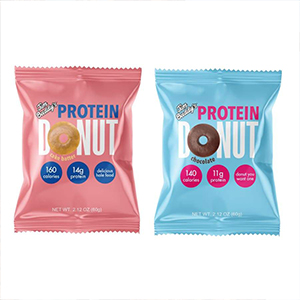
[00:07:29] Ray Latif: Right. Cracklins. Snacklins is another brand of vegan pork rind. This is the closest to a pork rind. because it's got the bacon-y goodness. I mean, I do enjoy all things rind. So no, Ray, you're not going to have any. I think they're whole 30. I try not to, um, I try not to chew on stuff during the podcasts. I'd leave that to you guys. I think there's a question of whether the world needs a vegan pork rind. There is no question about whether the world needs a protein donut, right? I think, The world definitely needs protein doughnuts. It's called Gym Buddy. Gym Buddy's protein doughnuts. Yes. I'm holding one in my hand. This one is cake batter flavor, 160 calories, 14 grams of protein, delicious H-O-L-E, Whole Foods, delicious Whole Foods. I like that. There's all sorts of plays on words on that package. Yeah. I, uh, I posted a pic of this on Instagram and people were asking me how it tasted. I have yet to taste this. And as I mentioned, that is a curious taste. It's definitely a donut, but it's heavy. It's also, it is heavy. It's dense. It's cakey. It leaves you wanting a little more sweetness, I think, but it's not bad. A nice job on the packaging, I think, too. Yeah, the packaging is great. I guess the question for me is, and this is the question for a lot of these protein infused foods, is do I need protein in my donuts? That's the big question, right? Exactly. Does a donut need to be a healthy snack? I think the answer is no. Who the hell is Jim Buddy? Jeff doesn't understand. You're not a gym guy. And where did gym buddy come up with the tagline donut you want one? Jeff, there's these places that you go in the morning or the afternoon or even at night to do these things called workouts. And there's often called the gym. And if you go with a friend, that's your gym buddy. You know, we haven't had much CBD beverage talk on the podcast in a bit. So we're just going to transition. I think we've got enough. It's been at least half an episode since we discussed CBD. But John Craven next year, I got to stop calling you John Craven because Landis isn't on the podcast anymore. And that was always how I would differentiate between people.
[00:09:45] Nona Lim: It'll just be my new first name. Okay, there you go. Guessing your margins? That's risky. Belay Financial gives CPG brands the clarity to scale smarter, faster, stronger. Get your free inventory ebook by texting TASTE to 55123 and start making data work for you.
[00:10:08] Whole Foods: Tune in at the end of this episode for an exclusive interview with Matt Lynn of Belay Solutions. He sits down with Melissa Traverse to break down the biggest inventory and accounting mistakes CPG founders often make. You'll learn how to bring clarity to your numbers so you can scale with confidence.
[00:10:26] Ray Latif: What is that you have in your hand? That's the hemp infused world. I guess you pronounce this Onu. Onu? O-N-U. It's a tea? Peaceful peach hemp infused tea with 20 milligrams of hemp extract. It's a video game beverage. They're going to own you, bro. It's like a heavy glass bottle. This thing's... Is it a painted bottle? No, it's like a shrink sleeve. Yeah. Is that Onu or Onu? That's what I'm saying. Which one is it?
[00:10:51] Nona Lim: I think it's Onu.
[00:10:52] Ray Latif: I would say Onu or Onu. Onu technically is correct because the U, it's O-N-U. So the U makes the O long. Remember back in the day, there was a, not back in the day, but the New River Showdown a few years ago, there was a brand called Raw that won it, Rau Chocolate. We've had a couple. We've had a good old, what was that one called, Sonu? Wasn't that another? That didn't win. Wasn't that S-O-N-U?
[00:11:16] Nona Lim: Yeah, but that that made sense. See that that sounded like two words. Yeah, this sounds like two sounds.
[00:11:28] Ray Latif: Rau Chocolate, right? But Rau Chocolate, the founder, wanted it to be pronounced as RAU, R-A-U, but everyone was spelling it, everyone was pronouncing it RAU. So eventually I talked to him, I think it was last year. He's like, yeah, I just call it RAU now because everyone else does. That's a comment on branding right there, because you are not the only owner of your brand. It's a function of your product. and your culture and then also the audience. The audience owns a piece of your brand and they help determine it. And yeah, it goes back to the like Howard Schultz thing where he didn't start, you know, Starbucks to make a latte. And they just kept calling for him. But he made a lot of money. Jeez, the dad jokes today are just vicious. We need one of those like drum... Where the crickets and tumbleweeds. We got an all dad lineup here today. Yeah, this is some fine work. I mean, I don't know what else to say. Mike, did we talk about Poppy? I think we've talked about Poppy.
[00:12:33] The Nona: We've talked about Poppy, yeah.
[00:12:34] Ray Latif: Another New Beverage Showdown winner. that used to be called Mother Beverage, but you've got their rebranded product, Poppy, in your hand. I do. It's a very eye-catching can. I mean, look, it's on brand. The can does have some pop to it, which it should. And it also inside is a soda, which is also a... Pop. Ah, I see. Yeah, but we've seen a few brands that have done the change pretty quick, pretty early on lately. So Mother did it, you know. Well, there's Cineva, Super Coffee, turned into Q2. But I mean, people know that brand as Super Coffee, not necessarily as Q2 or Cineva. Exactly. And so, you know, I think a lot of founders, you know, they're like, Oh, well, I've been at it for two, three years. You know, everyone's gonna, no one's gonna stick with me.
[00:13:19] Nona Lim: Well, yeah, I think that's always the dilemma for change. It's like, you know, you've got a base of, I don't know, X number of consumers and you want a way bigger, you know, X times 10. And you're just worried about losing that existing base relative to taking the risk to go bigger. Yeah.
[00:13:37] Ray Latif: And, you know, we've we've seen brands that have tried that and it it has lost them their base and not gain them. And yeah, I think a key to like
[00:13:46] Nona Lim: It seems pretty clear that, you know, they didn't lose their base and they gained.
[00:13:50] Ray Latif: I think as Mike was saying earlier, you know, if people like your product, they'll stick with you through that kind of change. My point was that a lot of entrepreneurs, I think, are so wedded to something that could be holding them back because of their concern about that audience that they need to think a little longer term. And the DeChico brothers would be the first ones to tell you, you know, they, they made a lot of things up as they went along and maybe they would have Googled Suniva to find that there was a, you know, a cannabis company using that word before they made it their brand. And, you know, it's all worked out really well for them. It seems so. I mean, you know, it's interesting, the can that you're holding of poppy received investment on Shark Tank from Rohan Oza while it was still called Mother Beverage, but somehow Rohan and the Sharks passed on Super Coffee, which is now a pretty remarkable brand, one of the fastest growing beverage brands that we've seen in recent memory. I wonder if they regret that decision. Well, Rohan's an investor in Bulletproof. I don't know that he could have invested in Cineva as well, but. Nobody on Shark Tank went for it. Yeah, no one invested in the company. Side note, I don't even know if that was a Rohan episode, was it? I'm pretty sure it was, yeah. It was? I think the question, I think one of the things that was brought up was like, he didn't like the flavor and that's when the bros came back and said, well, it's not for you. This is for millennials. That was a classic pitch. Yeah, yeah. That was classic. Alright, I think it's time to get to our featured interview for this episode, which as I mentioned at the top of the show is The Nona Lim. Nona launched her namesake brand, which was spun off her ahead-of-its-time meal kit company in 2014. Beginning with a line of fresh soups, The Nona Lim brand has evolved into a platform for healthy and convenient Asian-inspired foods. The products are sold nationally at Whole Foods and select Walmart locations, along with hundreds of independent retail and chain stores. Our interview explores the variety of ways The Nona funded her upstart brand without giving up equity in the company, and why she advises early-stage entrepreneurs to hire an accountant. She also discusses how she negotiates favorable terms with suppliers, what it means to be fiscally disciplined, and why she describes venture capital as a double-edged sword. Hey folks, it's Ray with Taste Radio. I'm here at the 2020 Winter Fancy Food Show in San Francisco, California. Sitting with me right now is Nona Lim, the founder and CEO of Nona Lim. How are you?
[00:16:21] The Nona: Fantastic. Thank you for having me.
[00:16:23] Ray Latif: Thank you so much for being with me. I didn't know that you're on the board of the Specialty Food Association, but it's great to see it. You have the gold name tag with you right there. You don't even have to have the badge that everyone else has.
[00:16:34] The Nona: Yes, it is a privilege that I'm grateful for. It's nice to be on the board and to be able to give back to the community and actually to learn a lot of things along the way. And I wanted to join the board to just provide more diversity as well, since, you know, the food industry is very diverse and I think there needs to be diversity represented at all levels.
[00:16:54] Ray Latif: 100% agree. I think you're the first entrepreneur that I've ever spoken with that was a professional fencer. How do you go from professional fencing to entrepreneurship?
[00:17:04] The Nona: actually is quite related, which is, you know, I was fencing competitively in the Bay Area and felt that it's hard to get food that would nourish me and fuel me and improve my performance quickly. And so I decided to create a business on the side to test an idea, to create, you know, healthy, convenient meal kits that you could cook at home and nourish you. So it was just an idea that I decided to experiment with.
[00:17:29] Ray Latif: When did you launch the company?
[00:17:30] The Nona: I launched my first business in 2006. So that's way before, you know, the rise of Blue Apron and the rest. I was a little bit ahead of my time.
[00:17:39] Ray Latif: I would say so. What happened with the company?
[00:17:42] The Nona: I shut it down back in 2014, right when it was actually very trendy to have a meal kit company. I did it for many years while I was still fencing competitively, so you could say that I wasn't fully focused on it. But along the way, I've learned a lot. Number one is that the business model, It's difficult to scale effectively. The customer acquisition cost is really high. The churn rate can be high as well. And the cost is really high. We have the packaging cost, the logistics and everything behind it. And so I did all of that while on a shoestring budget without actually raising money, which is also not the right thing to do for that kind of business. So having learned all of that, I actually shut that down and decided to launch a CPG business instead.
[00:18:22] Ray Latif: I'm not sure which is tougher to run, a meal kit company or a CPG company, a food brand. It seems like it would be the latter, but I'm not sure. You would know better than I would.
[00:18:30] The Nona: You know, I think that with a CPG brand, it feels like, because it's an industry that is quite old, has precedent. When I started a meal kit business, I was the only one doing it. I created a category, so there was no precedent as to what would work and what wouldn't work. Facebook didn't even exist then, so social media didn't exist. So how would you go about acquiring customers? There's just so much unknown, whereas with CPG there seems to be a few different playbooks out there, there's certain things that you have to look at, you have to look at distribution, you have to look at velocity, so they're very kind of cleaner, easier metrics. And you know, soups was actually really easy to make when you have versus a meal kit with 200 different recipes that you have to keep changing throughout the year. So by comparison, it was actually a lot simpler.
[00:19:16] Ray Latif: Interesting. So The Nona Lim brand was born out of the meal kit company, and you decided to start with soup as the lead product. Why?
[00:19:29] The Nona: actually for very practical reasons, because it had the best shelf life. So my meal kits were things like wild Alaskan salmon with a miso dressing and bok choy and soba noodles. that doesn't last for more than two or three days, especially if you have raw salmon and things like that. But the soups actually had really good shelf life. So pragmatically, those were the ones that we decided to test it out then. Having said that, I think that the principles that I've always held as my North Star philosophy from the beginning have totally stayed with me even in the current CPG business that I'm in. You know, they sound kind of cliche, but it's actually really hard to do together, right? Which is number one, how do you create food that tastes fantastic? Taste is everything. And number two, how do you make it actually better, healthier, better for you, right? So I was doing that before clean labor even existed as a term. And number three goes back to convenience, which is, you know, all of us would love to be growing our own vegetables and cooking everything from scratch. but most of us don't have the time. So is it possible to create something that you would feel nourished, that you would enjoy, and that it would be easy to do? So I've taken that and brought that to the company, the CPG company that I created back in 2014, and also decided to lean in with, I would say, my ethnic sensibilities. Since I grew up in Singapore, you know, I love all different kinds of... Singapore is a melting pot of cultures, right? With lots of different kinds of Asian cuisine. And so I wanted to bring that palette to Whole Foods that I create. And I think soup was the first place I started from.
[00:21:04] Ray Latif: Do you feel like you were better prepared to launch a new company, to launch a new brand, than you had been with Meal Kit? I mean, how much preparation, how much business planning did you do with Meal Kit? And then how much business planning did you do The Nona Lim, the brand?
[00:21:17] The Nona: You know, when I started the meal kit company, it was literally a project on the side because for about six years of that business, I was still fencing competitively, which meant that I was training, you know, four or five times a week and I was going overseas every two or three weeks. I'll be gone for like a week or two. Oh, wow. Yeah. So, you know, that meant that the business kind of grew in fits and starts. And so, I don't think I had that much business planning behind it because I was just testing an idea and seeing if it worked and just go flowing with it. I learned a lot of things along the way, right? Actually, a lot around manufacturing, around food science, around product development. And it was easy to take a lot of that and put that into CPG. But still, CPG, I think it's a different industry. So I did have to spend the first couple of years learning the industry itself, right? Everything down to trade management, and how do you manage different distributors? And, you know, how wide should you go? How deep should you go? You know, what kind of channels should you focus on? Learning about merchandising strategy and channel strategy and product strategy. and pricing architecture. So those are all things that actually you don't learn when you're running a meal kit business. So there was definitely a little bit of a learning curve there. But certainly, you know, just generally understanding P&L, understanding Cox, all of those, you could bring it over to the CPG business. And I definitely did a little bit more planning. But even then, you know, there were things that I had to learn while doing it. But I certainly learned to slow down the pace of innovation if that was one big takeaway. from my meal kit business is to not be too innovative and to really understand if the market is able to adopt, right? So it's kind of that innovation curve, right? Sometimes I'm too disruptive and if you're too early on the adoption of that trend, it can cost a lot more money.
[00:22:57] Ray Latif: For sure. Let's talk about money for a second because, you know, one of the things that really struck me about you and Nona Lim is that you scaled using traditional methods of financing that it seems like a lot of other folks in the industry haven't used. Loans, for example. I mean, loans are just a basic way of getting financing. Talk about how you funded the business initially and how you funded it during its development.
[00:23:21] The Nona: Sure. You know, when I was doing the MailKit business, it was really a one-woman show. The amount of money to fund was very little if you weren't spending it on customer acquisition. And so, some of that, you know, I used it to fund the CPG business because we're sharing, you know, it's the same facility, the same team of people making the products. I wasn't working with a co-packer, so you don't really need to buy those high minimum runs. Right? And I was mostly selling in the Bay Area. And so there weren't high slotting fees because we're focusing on the natural channel. And initially when I first launched the CPG side of the business, you know, I took a loan from Working Solutions. So there are microloans that you can get from all those non-profit organisations, which would give you a loan even if you don't have, let's say, a positive EBITDA. Right? It's not a lot, you know, there's 25 or 50 grand, but it's something to get you started. You know, at the same time, there are a lot of equipment leases. available out there that you could use to finance the purchase of equipment. And those are all ways to just fund the business a little bit. I think where it gets a little bit tricky is when you want to start funding the business or get cash into the business in order to pay for trade or pay for slotting, then it's much harder because those are much bigger sums. But other things that could be done that we are still doing today is even, you know, having good relationships with our suppliers to negotiate slightly longer terms. right, to be able to have them even store, let's say packaging, so that you can pull down on it and they charge you only when you pull down on it. So there are things that you could do to really try and manage working capital. I think I was very good at it and then I kind of regrew the team a little bit and maybe didn't get as tight on it but we're coming back to really making sure that we're managing that now. And finally, for businesses that have a little bit more history, there's also AR lending. There are companies out there that you could work with who would lend you money against your AR or against your inventory. So those are all ways to be able to finance the business.
[00:25:18] Ray Latif: I have a bunch of questions here. One of the things you mentioned was establishing or negotiating better terms with your suppliers. I'm sure everyone would want to do that. How do you put yourself in a position where you can negotiate in a way that is advantageous to you and to your company?
[00:25:35] The Nona: I think that relationship is a big part of that. Making sure that the supplier sees the potential in you. You know, you might still be a small startup but see that there is a growth potential and believes in what you're doing. As much as you want investors to believe in your vision, you want suppliers to be excited and to believe in your business too, right? And so with that in mind, that could help you extend terms a little bit or give you better pricing. That's one way to do it. Another way to do it is to quantitatively be able to give them forecasts, annual forecasts of what you think the volume would be. And so if they have a sense of what your annual volume could be, they would be more likely to give you a lower price versus one-off orders. The third thing you could do as well is to regularly do multiple quotes. So you can always go back to your existing supplier and say, hey, I got a quote that's cheaper elsewhere but I really want to keep working with you because I value the partnership, could you match that? And then finally, you could, if you have the bandwidth, is to run, you know, more formal RFPs, right? Like with logistics providers or maybe, you know, with packaging suppliers. And running RFPs can also yield you cost savings as well or better terms, but that obviously is a little bit more time intensive.
[00:26:49] Ray Latif: Did it help that you ran your own manufacturing for a time and you really understood what it costs to create a product from start to finish?
[00:26:57] The Nona: Yes, I think that did. It helped a little bit because we control our own manufacturing and so we have the different components that we could negotiate with. Having said that, I think there are a lot of brands who work with co-packers but still, you know, are responsible for the raw materials or the packaging. So they could still negotiate at that level as well, right? So I think that there are many different ways of looking at it.
[00:27:22] Ray Latif: I want to go back to loans. You mentioned you got a loan from a company called Working Solutions, a micro lender. What's that process like? Is it complex?
[00:27:31] The Nona: It was really easy for us to work with Working Solutions and they're always looking for more companies that they can give loans to. It actually didn't take more than a month. But of course you need to make sure that your books are in order. So they do want to look at, as do all traditional bankers and all investment banks, not investment banks, like VCs anyway, which is you do have to have your books in order. If you have your books in order and you have a financial model and a business plan, then it's very fast. It could only take a couple of weeks because the amount is not really big either. And I know that there are other brands who have other ingenious ways of getting money, like FDA grants, you know, so there are other things as well. Another interesting source is WUSATA. That's the Western States, I can't remember what it stands for exactly, but you know, we're based in California, and so, you know, they would actually give you subsidies to, let's say, Fancy Food Show or Expo West. So different parts of the country, you can apply to different state departments for those grants as well. And those could be anywhere from $10,000, $25,000, $40,000, depending on what your marketing budget is. So there are ways to also get subsidies out there. And incubators. Lots of incubators are giving, like the Chobani Incubator. We were part of the Chobani Incubator and they gave us $25,000, no strings attached. And I think there are probably one or two other incubators that might do that as well. And some people, they like to take parts in competitions and get prize monies for it. I don't have the bandwidth for that, so that's not my cup of tea, but you know, it all depends on what you have bandwidth for.
[00:29:04] Ray Latif: Going back to when you said that you have to have your books in order, there's a lot of folks who aren't familiar with how to get their books in order. Did you have an outside accountant or is that just something that you inherently were good at?
[00:29:16] The Nona: That was one of the things that I outsourced immediately when I first started the business. So I hired a bookkeeper, right? It didn't cost very much. It was a junior bookkeeper at the very least, right? Just to get the books done. And then I did hire a, like, more like a financial consultant to help me to build a complex three-year model, you know, so that I could update it if I had to. So everything was linked together, including your three-year balance sheet and your cash flow and your P&L. Just because I didn't have the time to do it either, and someone else would do it faster than I would. But you still need to make sure you understand all the assumptions. Because even if you hire a consultant, they can help you build the model technically, but they will not understand your business, and they cannot help you with the assumptions. Basically, it's business strategy but put into numbers.
[00:30:02] Whole Foods: Do you want more repeat buyers on Amazon? Well, this free resource in collaboration with Straight Up Growth will help your brand turn first-time buyers into long-term subscribers. Download Winning the Repeat Purchase Game on Amazon now at Taste Radio slash SUG. That's Taste Radio slash S-U-G to start building retention-driven growth for your brand on Amazon. Scaling a beverage brand into major retail comes down to operational readiness. From packaging lead times to co-manufacturing strategy, the details can make or break a launch. In a new e-book in collaboration with Octopi and Asahi Beer USA, industry leaders share what they've learned in helping brands scale. Download it now at Taste Radio slash octopi. Do you need to scale your team faster without compromising on talent? Join Oceans for a live webinar on April 20th and learn how leading companies are hiring top global professionals who are ready to grow with your business. Register for the webinar now at Taste Radio slash oceans. That's Taste Radio slash oceans.
[00:31:13] Ray Latif: It's interesting to talk about this because so often we talk about innovation, leadership, trends, things like that. And when it comes down to it, the nuts and bolts of running a business and building a brand are things like understanding your finances, understanding your P&L. What's the most important part of that P&L sheet though?
[00:31:32] The Nona: You know, I think the easiest one to understand is at least just basic P&L, right? So you're understanding what your cost of goods is, understanding what your gross margin is, and then understanding what your operating expenses are. So those are easy things to understand. The other thing that is harder to forecast and manage is working capital. And even then, it still took me a few years to really get on top of it. Because you could be profitable, but if you don't manage your working capital, you would run out of cash. So an example is that you have to be buying, even if you are contract manufacturing, you have to be buying all of your products in advance. And let's say if you have to buy six months worth of inventory, you have to finance that and then you have to sell it to a distributor before you get paid for it. And all of a sudden, you know, if there's a lot of deductions that come back because you've done a whole bunch of free fills, you know, you end up having very little money, right? And next thing you know, while you might look profitable on paper, you might not have the cash in the bank. So I think that that is the part that is sometimes overlooked.
[00:32:36] Ray Latif: So I was reading something about you and you were talking about VC money and you called it a double-edged sword. Why did you call it that?
[00:32:42] The Nona: I think we've all been told that growth needs cash, and so fast growth needs even more cash, right? I think VCs offer that source of capital, which can be extremely helpful to entrepreneurs. But at the same time, when there's so much cash in the market, and if you're in the category that is really, you know, trending, all of that cash creates a lot of competition, right? So, if you don't take cash, you could be left behind.
[00:33:08] Ray Latif: For example, you know... Were you afraid of being left behind? I mean, it felt like you had a pretty...
[00:33:12] The Nona: You know, I think that's a good question. Was I afraid of being left behind? I think for me, honestly, back in 2016, 2017, there were a lot of, even 2015, right? I think 2015 to 2018 is where you're seeing a lot of new VCs on the scene. A lot of them are flush with cash. A lot of strategics also set up their own VCs. And so it felt like there was a lot of cash. And so I was definitely being approached at trade shows, you know, pretty frequently with VCs asking whether I was looking for money. And so, you know, at that point in time, Did I have full clarity that I was totally ready to take cash? I don't think so. But I think I was also thinking to myself, right? Like I was playing around with the meal kit business for quite a long time as an experiment on the side while I was fencing competitively. And now I want to give this CPG business a real goal. I had quit fencing by then to focus entirely on this business. I want to make sure that it had enough cash to grow. But at the same time, why I call it double-edged sword is that I think that many entrepreneurs don't always think about it from, let's say, a VC's perspective, which is at the end of the day, many VCs maybe not family offices, but many VCs, they had to raise their fund, right? So in order to raise their fund, they had to promise their investors a return. So whether it is maybe, you know, an IRR of whatever, 35%, over five years, right, that's kind of common, and I'm sure there are some variations of that. But in order for them to be able to generate those returns, they need to make sure that their investment in you, can realize a certain return for them. And then at the same time, the entrepreneur on the other hand, in order to attract VC money, has to have a pretty attractive proposition. You know, whether it is an attractive growth rate, etc., built into the financial model. And I think some of the times, all of those are aligned and everyone is really happy. But, you know, if you have some sort of merchandising friction, or if competition changes in the marketplace, or if you're still working through some channel friction and so on and so forth, and you don't achieve the growth that you're looking for, for a variety of different reasons, now you're under pressure, right? You're under pressure to chase that top line. And so then that could lead you to making decisions that might be different if you didn't have all of that pressure. And so, you know, it couldn't be a double-edged sword in that sense, right? So then at some point in time, you may find that, oh, you know, you're not being capital efficient because you were chasing capital because it was premature to spend all of that money. So those are things that, you know, I've seen. And I would say that with some other brands, you know, I've learned some of those lessons myself in the last few years. And that's why I call it a double-edged sword, you know.
[00:35:47] Ray Latif: So in hindsight, if you knew all this, but when was the right time for you to take VC money?
[00:35:55] The Nona: It's funny, I would say that there's three different factors to look at when taking VC money. Again, this is 2020, on hindsight, pun pun.
[00:36:05] Ray Latif: That was very good. I like that. Well done.
[00:36:08] The Nona: And one is, you know, where the business is at. Is it the right time for the business, right? Are we at the position where we have a clear strategy where we can, you know, replicate it and quickly take that money and grow rapidly? Have we taken away, you know, all the different friction that might exist for that, right? And what is also the VC climate, the industry climate, right? You know, is money shrink? Is money going to disappear soon? If so, maybe you need to take money out now, right? And where's the economy going, right? Are we going to go through a recession? So I think that you have to consider all those different things to figure out what is the right time to take money. But I think who to take money from is also important.
[00:36:44] Ray Latif: That was my next question. How did you vet these investment partners, these potential investment partners? Because you said, I'm sure you met a bunch of them at these trade shows and had their business cards. How did you decide on the partners that you ended up with?
[00:36:58] The Nona: I think it's definitely still a learning process for me over the years. I think when I first started, I started off with really alignment and strategy and values. I think that those are still really important to make sure that there's clear alignment in vision, mission, strategy and values. Once you have that in place, I think you also want to consider what is the value add that they bring to the table, because likely they want to have more seats. Are they bringing mostly capital, or would they be able to bring other sorts of expertise? Those are things that you want to consider as well. And then finally, actual terms, right? It is one thing to, you know, for an investor to be really effusive and supportive in every way, shape or form, and then you get a set of term sheets that could be different, right? And so I feel that all those things need to align. And sometimes you have to go with your gut as well. You know, I think it's kind of like, Getting married, or it's worse than getting married.
[00:38:01] Ray Latif: It's worse than getting married.
[00:38:02] The Nona: It is worse than getting married. Because you know, if you go into a marriage, you don't like it, you get a divorce. Right? I think with an investor, if you don't like it, it's not easy to get a divorce, or the divorce could cost you a lot.
[00:38:17] Ray Latif: Yeah, totally. Would you say you have to be friends with your investors?
[00:38:22] The Nona: You know, I think that's a good question. Like, do you have to be friends with all your employees? Right? So I feel that if you're going to be spending a lot of time with them, I think at the very least, it would be good if you enjoy working with them. Should you be friends with all your employees? I don't know, right? That's a very personal question. I think different entrepreneurs have different styles, but you need to like working with them. The thing that I think about, you know, at a company that I worked for previously, kind of the bottom line question that they ask, if you're stranded on the island for three days with this person, you know, How would you like that? Does that work for you? I think that's a good question to sometimes to ask when you think about bringing an employee or an investor.
[00:39:05] Ray Latif: That's an excellent question. That's interesting. It's interesting to think about. But going back to your investors, I mean, do you have a personal relationship with them that goes beyond the business relationship?
[00:39:16] The Nona: I do, not with every one of them because we do have some angel investors that we're not close to because they came in maybe from referrers. But I would say that definitely for a number of our key investors, you know, we have relationships that go outside of the investment. But it's interesting, right? It's kind of like, It's kind of like fair-weather friends. That could be fair-weather friends that you guys could hang out and have a great time partying together, but when beep hits the fan, are they going to be there for you? Or how would they be there for you? Or how would they show up when things go badly? And sometimes you don't know, right? And how would they show up could go above and beyond just how they provide emotional, mental, whatever support, but also financial support. So those are things that sometimes you don't know when you first take the money and you have to, you know, maybe those are small things you have to trust your gut or those are the things that you have to think about. And sometimes, you know, you may not be in a position to think about if you desperately need the money.
[00:40:28] Ray Latif: And you don't want to be in a position to desperately need the money. Hence, cash flow and profitability, right?
[00:40:34] The Nona: Absolutely. You know, absolutely. I think for us, Specialty Food this year, absolutely. It's getting to, you know, having that fiscal discipline, right? Being able to manage trade really well, get good growth margins, positive EBITDA, these are all very important.
[00:40:49] Ray Latif: When people are talking about profitability, I mean, it's one of those words that seems foreign to a lot of brands and entrepreneurs. Do you have a path to profitability? Are you guys currently profitable?
[00:41:01] The Nona: We will be, well, if everything goes according to budget, we will be this year. Let's put it that way.
[00:41:05] Ray Latif: Well, congratulations on that. That's great. How did you get there? I know you said financial discipline, but did you have a plan to get here by 2020? I mean, what was that process like?
[00:41:16] The Nona: Oh, yeah. I would say that it depends on how quickly you want to do it. If you want to do it very quickly, then, you know, the process is a little bit tougher, right? So it means what kind of resources? Do you have the luxury to have a full team or not? right? What are the things that you can outsource? What other things can you do more with less? And how do you get better? How do you improve your costs, right? From either better term negotiations, actual better negotiations with supplier, better efficiencies, you know, and actually getting rid of non-working trade, you know, and even working trade, you know, really understanding your I would say in a contribution margin by channel or by account and saying no to business that's actually not going to give you the minimum gross margins target that you have set. Saying no to retailers that ask for too much because you can't afford it. It takes a lot of that, but having a lot of clarity about what is the strategy, what is the focus, what are the gut reels? I think those are some first steps that we had to put in place and then executing according to those and being willing to say no. saying no to top line growth that do not help with profitability or who are not in line with our profitability requirements.
[00:42:34] Ray Latif: So coming full circle, it sounds like what you're saying is it's good to be lean, but not too, too lean.
[00:42:42] The Nona: It's good to be lean. I think I've been told in the past by a lot of my investors that I'm probably one of the cheapest and scrappiest entrepreneurs that they've ever met. And I should take pride in that. But it's easy to move away from that, right? raised a lot of money and there's an expectation that you need to spend it on growth or do certain things or bring in senior resources. I think we're going to go back to a lot of first principles, right? And just really be on top of our financials. I think that we are excited about where we are today. We have a great market opportunity. We are a fresh Asian platform. And there's no one really in our space. There's a lot of white space out there. Not only are we a fresh Asian platform, but there's clean labor, modern, something that I'm proud to say both Asians and non-Asians love because of the taste of the products that we bring to the table. So we know that there's a huge opportunity out there, but it's about how do we approach the opportunity in a way that is sensible and not get ahead of ourselves, especially not get over our skis. And that's the strategy that we have in place to get us to positively bitter.
[00:43:53] Ray Latif: Well, as you mentioned at the top of our conversation, having a great tasting product is key and you have some phenomenal tasting products. I remember I think it was at this show last year or maybe it was at another one of the trade shows. I just wanted some warm soup. I think I felt like I was coming down with something and I tasted yours and I'm like, oh my gosh. This is incredible. You have some really outstanding flavors in your product line. So congratulations on that. And congratulations on hopefully getting to profitability this year.
[00:44:24] The Nona: Yeah. One thing to not do in order to improve margins is to not degrade the quality of your product, right? So what we are looking at is all about efficiencies in labor, lower cost in packaging, so on and so forth. But we're holding really close and staying true to the quality of our product. I think that sometimes there are brands that feel that they have to improve their gross margins, and the quality of the product suffers. And so for us, that is not our strategy. Our strategy is about managing trade more efficiently and things like that, but not actually compromising the quality of the products.
[00:45:02] Ray Latif: Nona, this has been fantastic. Thank you so much for taking the time to speak with me. Just a wealth of information, and I know our audience is going to love it. Be prepared for a lot of them to reach out to you. Is it OK for people to reach out to you on LinkedIn?
[00:45:14] The Nona: Sure, absolutely.
[00:45:15] Ray Latif: Fantastic. What's your LinkedIn profile? Is it just LinkedIn?
[00:45:19] The Nona: If you search Nona Lim, you can. Or if you want to email me, it's really easy. It's nona at nonalim.com.
[00:45:24] Ray Latif: Outstanding. Thank you so much again for the time and good luck going forward with the business.
[00:45:28] The Nona: Thank you so much.
[00:45:29] Ray Latif: All right. That brings us to the end of Episode 71 of Taste Radio Insider. Thank you so much for listening, and thanks to our guest Nona Lim. Please subscribe to Taste Radio on the Apple Podcasts app, Spotify, Stitcher, or Google Play. As always, for questions, comments, ideas for future podcasts, please send us an email to ask at Taste Radio. On behalf of the entire Taste Radio team, thank you for listening, and we'll talk to you next time.
[00:46:00] SPEAKER_??: you
[00:46:06] Buttoned Up: Hello, I am Melissa Traverse here for the Taste Radio podcast, talking about some of the biggest tension points that CPG brands and founders face when they're scaling a brand, and those are financial accounting and inventory management. I am joined by Matt Lynn, inventory accounting guru from Belay Solutions, and he is going to shed some light on all of this that is going to help everybody out quite a bit. Matt, thank you so much for joining us today.
[00:46:36] Savory Bars: Thank you for having us, Melissa. It's great to be out here at Expo West and it's great to sit down and be able to chat this because it's kind of a passion project of ours, working mainly with CPG brands and hoping to help them scale.
[00:46:48] Buttoned Up: It's been such a pleasure chatting with you and the team and learning all about what you do over there at Belay Solutions. Can you tell us a little bit about yourself and what your role is and the kinds of solutions that Belay gives to CPG brands and founders?
[00:47:03] Savory Bars: Yeah, absolutely. My role with Belay, I'm actually our inventory accounting manager. I run our inventory department, so we work with CPG brands, taking them from spreadsheets, putting The Nona inventory management systems, and really helping connect their tech stack between their sales online marketplaces to that inventory management system, even down to their financial systems like QuickBooks. Belay overall is kind of an outsourced accounting firm. And with that, we're helping teams. We have different levels with bookkeeping, controller level work, even high level into CFO type items. So we really help those brands in any way that they need financially. And then I just have a subset of a department where we're really just laser focused on inventory.
[00:47:46] Buttoned Up: It's certainly a complex topic and there are plenty of places to go wrong. Let's start by going right and start super simple. Can you tell us what some of the biggest red flags are that would help a founder understand or, you know, the person running a brand understand that it really is time to get some help with some of these areas?
[00:48:07] Savory Bars: Yeah, absolutely. I think some of the early red flags is just everything is chaos. So when they're looking in their financial software, maybe they don't really have an accounting background, and they're kind of just piecing it together and doing their best. And what they'll see is that reconciliations take forever, if they even happen. They have a lot of transactions that don't get coded, or they just put them into placeholders to just get rid of it so it's not an eyesore. they'll notice they have revenue but no cash or they notice that they have a good amount of cash but their blind spot is really seeing the vendor invoices that are sitting there just needing to be paid and so they just lack that clarity that's going to really be around the corner.
[00:48:44] Buttoned Up: You know, you were talking about one of the red flags that comes up that I think makes so much sense. When somebody asks you what your numbers are and you can't come up with the right number, that's a big problem because that's something that you really should be able to share with decision makers who you're ideally looking to do business with. What should you be able to call up at a moment's notice?
[00:49:08] Savory Bars: Really, at any time, you should be able to know an accurate margin. It's amazing how many founders we end up talking to that they can tell you their revenue numbers, they can tell you their selling price, and then the minute you start talking about cost or their cost of goods sold, they just get a deer in headlights look. So really, it's very hard to tell, am I even making money? Or if you don't know your entire landed cost. Maybe you know what the freight cost is, the duties separately, but you're not really getting that as part of your unit cost. So it's really hard to tell. Am I even making money or am I losing money from the very beginning?
[00:49:41] Buttoned Up: And do you recommend that founders are able to call up a margin by channel?
[00:49:46] Savory Bars: Absolutely. And depending on the number of products and channels, you kind of want to know what are your best sellers, which ones are making the most and which ones maybe you're not making as much. But especially if you're branching out and you're doing D to C with B to B, absolutely want to know that.
[00:50:03] Buttoned Up: Gotcha. You mentioned that when things feel really chaotic, that's probably a red flag. I would say that it probably almost always feels chaotic if you're running a CBD brand. And I know this may be hard to quantify, but is there a revenue number? Is there a number of doors number that would help a brand understand whether or not it makes sense to bring on a partner like Belay? Understanding that so many brands are bootstrapped or they might be tight for cash. What is that friction point?
[00:50:33] Savory Bars: 3 3 3 3 3 But as you're growing, as you're getting to those six-figure revenue numbers, and especially as you're approaching seven, you want to make sure you've got good financials. Because as you scale to that point, most likely you're going to be looking to raise capital. And investors, the first thing they're going to look at is your books. And are they clean? And do they show a clear picture of your business?
[00:51:06] Buttoned Up: You know, another area that folks might look to to organize some of the chaos are their systems. So many folks stick with Excel spreadsheets for a good amount of time. How do you know that you need to outsource some of your accounting to an organization like Belay Solutions versus maybe signing on to a Synth7 or a NetSuite or something like that?
[00:51:28] Savory Bars: Well, that's actually something we really help with when it comes to that cost question. That's something that trips people up. And sometimes if you just have a turnkey business, you buy and sell a finished good, you can maintain with spreadsheets. And we've had clients with million dollar revenue that can do that. But we see so many brands nowadays are using contract manufacturers. and they're just sourcing certain parts of their product. So when you start talking cost, they have no idea exactly what their unit cost is. So that's where we come in and we kind of understand, we'll speak with the customers and the clients and get their needs. And then if we think they're ready for a system, then we'll help put The Nona that system so they can get some of that clarity. And it's not something we force on anybody. There are plenty of times where founders come to us and we'll tell them bluntly, you're not ready for it right now, but we'll let you know when we think you are.
[00:52:15] Buttoned Up: That sounds like excellent advice. What should a founder or somebody running a brand look for in an outsourced accounting partner? Are there certain checklist items that they should make sure that their partner be able to execute or be able to help them understand?
[00:52:32] Savory Bars: Absolutely. I think one of the keys, there's, there's a lot of outsourced accounting firms out there. Some focus on service-based SaaS companies, but if you're a CPG founder, you really want to make sure that your accounting firm has CPG experience. I would ask them, you know, what kind of brands have they worked with? And even beyond that industry specific, because there's so many subsets of CPG. And that's something that I think is great about what we do with Belay is that we kind of run the gamut. It's kind of like the insurance commercial. We know a thing or two because we've seen a thing or two across a broad spectrum.
[00:53:01] Buttoned Up: Probably getting references is always helpful, right? Absolutely. All right, so this all sounds great. I think we have a really good understanding of would it make sense to hire an outsourced partner? You know, what some of the things you should be looking for are. What does offloading this kind of work mean for the brand? What can this do for lightening the load of a founder or lightening the load of a brand operator? Like, how does that help them in their everyday business?
[00:53:31] Savory Bars: It just tries to really help quiet the chaos. So what we're looking to do is just take some of the weight off that founder's shoulder, let them focus on building the brand, building the business, getting that exposure. If you don't have sales, you really don't have anything. So we want them to be able to focus on that while we take care of your back end office work. And we can just present that to you on a monthly basis, you can help make decisions, you can take that to investors. And really, you can just focus on growing your business.
[00:53:56] Buttoned Up: I feel like I felt founders and the folks who are running brands collectively sigh. A breath of relief just hearing that. How can people learn more about Belay Solutions?
[00:54:07] Savory Bars: So people can text TASTE to 55123 for their free inventory guide to get started.
[00:54:13] Buttoned Up: Matlin, inventory accounting guru at Belay Solutions. Thank you so much for joining me here at Expo West. It's been such a pleasure to chat with you and learn about what you all do over there to help founders and brands with their financial accounting and inventory management. For everybody else out there, thank you for listening to the Taste Radio podcast. I am Melissa Traverse, and we'll see you next time.