[00:00:04] Ray Latif: Hello, and thanks for tuning into episode 97 of Taste Radio Insider. I'm Ray Latif, the editor and producer of Taste Radio, and I'm with my BevNET and Nosh colleagues, John Craven, Mike Schneider, and Melissa Traverse. In this episode, we're joined by Dave Colina, the founder and CEO of O2, fast-growing brand of sports recovery drinks, who discussed the reasons behind the company's remarkable performance amid the pandemic. Just a reminder, if you like what you hear on Taste Radio, please share the podcast with friends and colleagues. And of course, we'd love it if you could review us on the Apple Podcasts app or your listening platform of choice. You know what else we would love? Product samples. I know it's kind of a shameless plug here, but we love receiving new food and beverages at the office. Speaking of the office, We have a new office, which I think we mentioned a couple episodes back. We're now based in Newton, Massachusetts, just down the road from our old headquarters in Watertown. Our new address is 65 Chapel St, Newton, Mass, 02458. Please update your records or address books. Do people still use address books? I don't use them. I still drive to the old office, Ray. I mean, I'm kind of programmed and I have actually driven to the old office a couple of times. Remember when you didn't have a parking spot, Mike, when you first joined BevNET? I know, I used to take yours and you'd be like, oh, Mike. I know it was your car the first day because it had all these Arsenal stickers all over it. I was like, oh man, have this thing towed immediately. I was going to say, you just threw a brick through the windshield, right?
[00:01:43] Dave Colina: It's a good way to deal with that. Hey, did you get those new Manchester United Zebra pajamas yet?
[00:01:50] Ray Latif: Okay, quick tangent here, because I know John Craven's head is about to explode. I'm going to throw a brick through both of your windshields. Problem solved. So soccer teams, European soccer teams, have a home jersey and an away jersey. And then sometimes they have a third away jersey. And Manchester United's third away jersey looks like a zebra uniform. It's very strange.
[00:02:15] Melissa Traverse: Wait, why do they have a third jersey? That sounds so confusing.
[00:02:19] Dave Colina: It's obviously so they can sell more jerseys, Melissa, because they have to pay for a lot of expensive players.
[00:02:26] Melissa Traverse: And I suppose you have to do laundry at some point.
[00:02:30] Dave Colina: Imagine if brands had three different packages, like if Brew Doctor decided to just have a third package or something like that. I mean, they have seasonal packaging. I guess that's kind of similar.
[00:02:41] Melissa Traverse: That would also be confusing.
[00:02:44] Ray Latif: So confusing. It would be confusing if I had a third jersey, a third away jersey. So like I have my blue shirt and jeans, which I wear every day. And then we have the events. It's usually a gray blazer or a navy blue blazer. Now, if I went to say something like a Merlot colored blazer, people would like freak out. They wouldn't know what to do with themselves.
[00:03:04] Melissa Traverse: Or better yet, a zebra-patterned overcoat. I think that's the move.
[00:03:09] Dave Colina: Well, now Ray has zebra pajamas, so that'll go willingly with the rest of his uniform. I mean, I think they... Manchester United said, hey, Arsenal's got that bruised banana, so we should have something similar to that. Then they just, I don't know, they just don't like Manchester United. Anyway, let's get on to food and beverage.
[00:03:25] Ray Latif: Oh, boy. There you go. There you go. Yeah, it was great. This past week, we aired our first episodes of our new Category Closeup and Product Showcase series. I loved working on both the Category Closeup video series brings together BevNET and Nosh editors, along with a group of experts from across the industry to take a deep dive into the market trends and overall business climate that's shaping a major food or beverage category. This past week, we focused on one of the most dynamic beverage types across all retail channels, that's ready to drink coffee. You're right, Ray, and we're going to continue to have Category Closeup and Product Showcase on both BevNET and Nosh. You can check out our content calendar to learn more about what's coming up. The next one is plant-based meat. Yeah, that's taking place on September 22nd and 23rd. I didn't go into what the Product Showcase is all about, but it follows every new episode of the Category Closeup series. Over about 60 minutes, I sit down with a BevNET or Nosh editor and chat with entrepreneurs representing category brands about product strategy, innovation, and new products related to their respective companies. With Ready to Drink Coffee, we spoke with everyone from Kidulife Super Coffee to Rise Brewing Company to Slingshot. It was a really great conversation hearing from these folks. Just really great to see what they've been up to over the past six months.
[00:04:48] Melissa Traverse: And how can our brand partners get involved with these Category Closeup?
[00:04:55] Ray Latif: Well, the video series are exclusive to subscribers of BevNET or Nosh. So if you would like to participate, the best way to start out is to become a subscriber and then reach out to someone from our brand sales team, like a Melissa Traverse.
[00:05:11] Melissa Traverse: And you can do that by emailing sales at BevNET.com or mtraverse at BevNET.com and we will hook you up with a subscription.
[00:05:20] Ray Latif: And as Mike mentioned, the content calendar is available on Bevan & Nosh. It's also available on Taste Radio. Just go to Taste Radio slash content calendar. Now we're coming off the beautiful Labor Day weekend that we had here in the Northeast. John Craven, you're back from the Long Island area. I saw some beautiful pictures on your Instagram. You see anything interesting product-wise, new product-wise, food or beverage?
[00:05:43] Dave Colina: Well, I only made a few trips into grocery stores and such, but I did notice just a plethora of CBD beverages, brands like Recess and Daytrip, among others. You know, I guess that was just something I hadn't honestly thought about a ton in a while from pandemic lockdown and such. Not out doing store checks as much as I used to, I suppose, but I'm not sure anyone is. You know, as far as local stuff, I think kind of the only thing that stood out was just the brand Montauk Tea, which is, you know, a small kind of regional player out there making iced tea. Otherwise, of course, enjoyed some local beers and cocktails and whatnot, as one would expect.
[00:06:34] Ray Latif: As one would expect, indeed. When you mentioned that you hadn't seen a lot of new beverages out there, it reminded me that you did see a lot of new beverages when you went and visited the beverage whisperer himself, Ken Sadowski. I saw a table that was just packed with beverages that I think were sent to him directly, right? Jeez, that sounded like you were going to say packed with people, but no, yes.
[00:06:58] Dave Colina: We sampled a lot of beverages. I think, you know, that was a few weeks ago right after we did move our office. So I didn't really have anything to contribute to that tasting. But yeah, he had a ton of stuff. And yes, people seem to send him plenty of samples.
[00:07:16] We Get: And I don't know if there were any that stood out. That's kind of a blur a couple weeks ago. But yeah, lots of stuff.
[00:07:24] Melissa Traverse: I also saw that post and I haven't seen a table that packed with beverages since BevNET Live.
[00:07:30] Dave Colina: There were just beverages everywhere. It's kind of what, I don't know, I'd never been inside Ken's house and he probably wouldn't like that I'm talking about it on this podcast here, but it was like there were beverages tucked in every corner, which, you know, it's the bachelor pad. I couldn't get away with that. But beverages in the dining room, living room, entryway.
[00:07:50] Closeup On: I mean, if you're the beverage whisperer, you should be able to just reach out and grab the beverage at any time.
[00:07:55] Dave Colina: Yeah. And by the way, he has an old school, he has like this home gym that's just ridiculous. I kind of want to buy a membership there when that's okay again. But yeah, he had like an old school vitamin water cooler in there loaded with things like Vita Coco and Essentia Water and some of the other companies that he's involved with. But yeah, definite beverage envy over there.
[00:08:19] Ray Latif: Melissa, you just got back from a nice little trip over Labor Day weekend as well, right?
[00:08:24] Melissa Traverse: I sure did. I spent a couple of days in Littleton, New Hampshire. And one of my favorite things to do is check out local co-ops when we're traveling. And so the Littleton food co-op, I think is now one of my favorite co-ops of all time. In addition to getting four jars of mustard, they had an incredible mustard selection. So I stocked up on French mustard, but I also grabbed some of Bitter Love's beverage that they have. They have the tart cherry and peppered grapefruit drinking bitters and I mean I had tried them before and I liked them. I don't know if it was that they kind of counteracted all of the pizza and beer that we consumed, but I completely fell in love and It's not sweetened by anything except for juice, so true to its name, it is very bitter. I'm curious to know what kind of legs it has because I'm wondering how consumable it is for a mass audience.
[00:09:21] Dave Colina: You went really fast from mustard to bitter. Is there mustard in the bitters? I'm not sure I quite understood that.
[00:09:27] Melissa Traverse: Yeah, I mean, I think I was so impressed by the mustard that I couldn't not talk about it, but I was also very impressed by Bitter Love.
[00:09:35] Dave Colina: I don't, four different mustards, I wouldn't even see them. I'm just like, I'm looking for, I'm laser focused on finding Sir Kensignton's, which is almost impossible to find near me right now. It's always like there's one left in the back if I'm lucky.
[00:09:48] Melissa Traverse: I mean, they had Sir Kensignton's, but they also had some insane French mustard. So they had pommery mustard, they had tarragon mustard, horseradish mustard, all French, all insane.
[00:10:02] Co-Ops And: Guessing your margins? That's risky. Belay Financial gives CPG brands the clarity to scale smarter, faster, stronger. Get your free inventory ebook by texting TASTE to 55123 and start making data work for you.
[00:10:22] Closeup On: Tune in at the end of this episode for an exclusive interview with Matt Lynn of Belay Solutions. He sits down with Melissa Traverse to break down the biggest inventory and accounting mistakes CPG founders often make. You'll learn how to bring clarity to your numbers so you can scale with confidence.
[00:10:40] Ray Latif: Well, I got to say, I am a big fan of Bitter Love and what that brand is doing. Sparkling bitters infused with adaptogenic ingredients, and as you mentioned, some fruit juice as an added flavor and sweetener. You know, when I think of that brand, I do think of those small independent grocery stores. That's where I found my first bottle of Bitter Love. But as you mentioned, Melissa, I wonder, if it is something that could have a broad audience, you know, the name itself sounds like it would turn off a lot of people. It has love, which is a great part of any brand name, but bitter, I'm sure that I'm sure that's gonna, it's gonna give people some pause.
[00:11:20] Dave Colina: Well, I think it kind of depends on what type of retailer it's at. I think, you know, one thing that you had asked earlier about were beverages that I saw in Long Island. And, you know, one thing that's now coming back to memory now that we're talking about this is, you know, I saw at a small little like kind of craft liquor store, had a large display of Hella Cocktail products and the hella bitters. I think in that sort of situation where it's being presented against alcohol as something that sort of fits in, I think that makes sense. Can those types of products sell really well in, I don't know, a grocery store, a convenience store, a co-op? I'm sure they can somewhere and somehow it just seems like it might be a little more challenging.
[00:12:13] Melissa Traverse: So listed on the ingredient panel of the Bitter Love beverages are the bitters included. So they have artichoke extract, wormwood, and I was pretty excited to see gentian root because I was a huge moxie fan. Are you all moxie lovers by any means?
[00:12:32] Co-Ops And: I lived in... I was going to say, oh, so you're the one that's the moxie fan.
[00:12:39] Melissa Traverse: I lived in Maine, and I went to the Moxie Festival, and they had a huge pile of wet sawdust that kids were diving in to grab pennies, and I fell in love with Moxie there. And Gentian Root was the main ingredient in Moxie, from what I could tell. So I was happy to continue my love for Gentian Root in a slightly different format.
[00:12:59] Ray Latif: Chevy, we're retiring your nickname, and now you have a new one. It's Moxie.
[00:13:03] Melissa Traverse: Yes, I love it.
[00:13:04] Ray Latif: Moxie Traverse. We could, I think, talk all day about this Moxie Festival that you went to.
[00:13:11] Closeup On: We could.
[00:13:11] Ray Latif: With kids jumping into wet sawdust. Yeah, okay. I have no idea what you're talking about, but it sounds pretty amazing.
[00:13:19] Melissa Traverse: We can save that for another show, but if you ever have a chance to go to Lisbon, Maine, then go to the Moxie Festival. I highly recommend it.
[00:13:26] Ray Latif: Post-pandemic, maybe?
[00:13:28] Melissa Traverse: Post-pandemic. We did not have it this year, sadly.
[00:13:32] Ray Latif: That is sad. Well, I haven't seen this brand in stores, but I did see them in a recent episode of Elevator Talk. It's called Pure Batch, and it is a mother-daughter team who founded this company in 2015. They make refrigerated sweet treats, including things like Cookie Dough truffles, cacao chip cookies, and they are all much better for you than, I guess, your average truffle or cookie. They're made with... a healthy amount of protein, fiber, fat, and low-glycemic sugar. Really interesting and really great to speak with Angela Millen, who is one of the co-founders, the daughter in the mother-daughter team on Elevator Tuck a couple of weeks ago. They've done such a good job with this brand. It looks beautiful. It tastes amazing. And it's really timely, I think, as we start to see this refrigerated snack category expand. I don't see many brands like this. You see a lot of refrigerated protein bars and sort of better for you, I guess, snacks.
[00:14:38] Melissa Traverse: And Ray, I think to your point, certainly the Pure Batch has lots of really great functional ingredients, better for you, but like you say, they taste really good, which is so important. We see so many bites and bars come through the office, but I totally agree with you. In my mind, these stood out, not just for the ingredient profile, but also because they taste really good.
[00:15:02] Dave Colina: Must be why I never got to taste them.
[00:15:05] Melissa Traverse: We ate them all up, Mike.
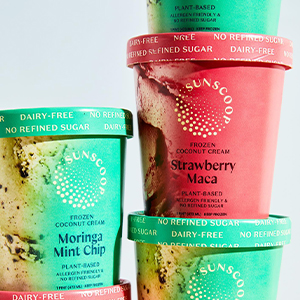
[00:15:07] Ray Latif: You took them all. This is like Cookie Monster-ing the whole thing. Dude, I'll admit, they were sent to me directly, but I'll bring some to the office for sure. Also sent to me recently was SunScoop, which is a brand of non-dairy ice cream. They are made with coconut cream as a base. Interesting stuff, really good stuff, actually. Melissa, you've tried this too, right?
[00:15:30] Melissa Traverse: I sure did. The Moringa Mint and the Strawberry Maca, I think, were two of my favorites. And they have a lot of really cool ingredients in their ice creams as well. Like, for example, the Moringa Mint has blue spirulina, spinach powder, coconut oil, but it's really tough to achieve the consistency of ice cream when you're dealing with a whole different set of ingredients, which I think is often the challenge, not only with ice creams, but, you know, like any food products in general.
[00:15:59] Ray Latif: The interesting thing for me with Sunscoop was that they had a moringa mint flavor that you mentioned. And this is one of the things I think we've talked about in the podcast a number of times, which is how brands attempt to strike that balance between healthy, tasty, and approachable. And certainly Moringa, a healthy ingredient, a better for you functional ingredient. Mint, a familiar flavor in ice cream. Certainly taste, as you mentioned, Melissa, is really, really important. But how do you make it all work together? That's the secret sauce, so to speak. It's tricky. I think one brand that has had some success in doing that recently is Pito's. Pito's is a brand of snack foods that are made from, you guessed it, peas, and they make no bones about going after so-called junk food. Their name is, well, I want to be careful here, but clearly their name is a play on Cheetos. And they've made no bones about going after brands like that in terms of their ingredient profile versus the others. And they recently raised $7 million in funding a story that was reported on by Beth Kizerman on September 2nd. If you haven't had a chance to read it, please do so. But yeah, I really think this brand has frankly done better than I thought it would, given that I didn't think many people would be interested in eating pea-based snacks.
[00:17:30] Dave Colina: It's a simple idea where they've taken, like you said, Ray, the flavor of Cheetos and the look and feel of Cheetos and Doritos, and just made very simple tweaks to make the ingredient panel better for you, and then also tried to get as close to those flavors as possible.
[00:17:49] Melissa Traverse: And certainly any of the controversy that's come up with them going after Frito-Lay has not hurt their PR or their branding.
[00:17:59] Dave Colina: No, that was on purpose. I mean, they're definitely of the philosophy that any PR is good PR and they were very smart about how they did that.
[00:18:09] Ray Latif: I think one of the other things they did was a brand revamp that made the products look a little bit more like quote-unquote junk food. The original packaging, again, you can see this in the article, had a, it looks like a tiger made out of pitot snacks on the front. And then the new iteration looks very much like an approachable snack food bag that you'd see at any grocery store or convenience store. I think it was supposed to look like a guy that rhymes with Kesterkita. Yeah, there you go.
[00:18:42] Melissa Traverse: That article also pointed out that while in natural channels, they are placed in the snack food aisle, in conventional grocery, they're placed on the perimeter, often in the produce aisle, which I think is pretty interesting as a way to not directly compete with Frito-Lay on price.
[00:18:59] Ray Latif: All right, it's time to get to our featured interview for this episode. That's with Dave Colina, the founder and CEO of O2. A brand of natural sports recovery drinks formulated with oxygenated water and electrolytes, O2 debuted in 2014 and emphasized a patient growth strategy during its first few years on the market. In recent months, however, O2, guided by a philanthropic mission to financially support independent gym owners affected by COVID-19, generated record revenue via direct consumer sales, along with those at retail partners, including Sprouts, Kroger, and Publix. Dave will say that the company has been preparing for five years to meet the challenges and opportunities derived from the last five months. And in a following interview, I spoke with him about what that preparation entailed, including how he overcame formulation issues while continuing to incubate the brand, why he is supremely confident in the ability of his team during unpredictable times, and why he believes that entrepreneurship is as much about personal growth as it is building a successful brand. Hey folks, it's Ray with Taste Radio. I'm going to call right now with Dave Colina, the founder and CEO of O2. Dave, how are you? I'm great, man. How are you doing? I'm doing terrific. Great to see your face. It's been a while, but you and I have known each other for about three or so years, and you just dropped a bomb on me. I know, it was huge. Yes. Your last name is pronounced Kalina, and all this time I've been pronouncing it Kalina. It's true. It sounds like it's something that a lot of people have done.
[00:20:34] Dave Colina: It's happened once or twice. And so most times I don't even mention it. But for this, I was like, well, I ought to at least mention it.
[00:20:41] Ray Latif: And congratulations on your engagement. Oh, thank you. Yes, I saw the pictures of you proposing in France, which was really beautiful. Yeah. What's that like planning for a wedding while running your business? Oh, in the middle of a pandemic too.
[00:20:57] Dave Colina: Well, so the engagement planning started last year. So thankfully, I didn't have to worry about the pandemic component of that. But one of the nice things about entrepreneurship is that I read a quote recently, something along the lines of entrepreneurship is just another word for personal growth accelerator and I've found that to be very very true and so a lot of the skills that you sort of develop on the job can can translate quite well into you know personal stuff like planning a kind of secret engagement in Paris to be caught on camera by by a photographer that leaves the cool photos like what you saw. So that was good. To answer your question, the wedding planning during a pandemic came to a screeching halt as soon as the pandemic arose. And we actually, we were scheduled to have our engagement party, I think it was March 15th. And so we canceled, we ended up canceling it because of COVID about a week out. And I think that was for sure the right move in retrospect. It was still, you know, kind of a tough time to be predicting the future, but it was crazy, man.
[00:22:03] Ray Latif: everything is crazy these days and I'm sorry to hear that but you know hopefully we'll get back on track. Well at some point.
[00:22:12] Dave Colina: I don't know if you guys have seen this. We've certainly seen it. I mean the more I go along this journey of building a brand or building a business or or just doing something special the more I see opportunity and chaos and the more I see opportunity and conflict and the more I see opportunity and just stuff that at its face value may not look that great. And COVID has been absolutely terrifying, I think, for everybody. We can probably get into this later, but I think that there's a lot of opportunity for brands and people to come out of this a lot better and a lot stronger than they went into it. And so our approach with that is going to try to do everything that we can to find it.
[00:22:57] Ray Latif: Totally. One of the opportunities that has arisen as a result of having to do these virtual calls is the fact that I'm able to talk to you without having to travel and with pretty high quality audio and do it in a way that's easy and comfortable for both of us. Totally. You know, on my end, I think I'd prefer to see you in person, but the fact that we're able to do this anytime and we don't have to wait for a particular trade show or, you know, me going to see you or you coming to see me, you know, it's been a nice little benefit.
[00:23:32] Dave Colina: Dude, I think it's been great. I mean, you know, there was a time last year I was on a plane at least once a month, and that takes its toll, and it's time-consuming. You know, you got to drive to the airport and then catch the plane and then get on, get off and, you know, settle in. That takes a lot of time. And I think for most anyone, certainly those listening, time is a really, really scarce thing, you know? And so by being grounded, I think, you know, we've we've been able to squeeze a lot more out of our time doing stuff like this. You know, I tend to be more introverted in general, but I actually like the no travel, it's a lot, lot, lot less costly and a lot more time efficient, you know, it's like, hey, we can give a virtual high five pretty easily on Google Hangouts.
[00:24:17] Ray Latif: So 100%, you know, it's interesting that you mentioned that there's opportunity in chaos, because I feel like For you, who I see as a very sort of structured person and someone who has not a rigid, but a regimented lifestyle, chaos can be very, very unnerving. And I'd love to talk about how, you know, you cut your teeth in business and how your career sort of led to the development of O2, because, you know, again, it seems like you could have had a life and a career in the corporate world.
[00:24:50] Dave Colina: There are two things that come to mind here. One is sort of the principle of focusing on what you can control, right? I am a pretty regimented person when it comes to the things that I can control, but there's a lot of stuff I can't control, right? Things like, you know, what's happening now with COVID and the economy and everything else. And I think by focusing can maintain that semblance of order in terms of how you run your own life and how you might be able to, you know, kind of run your business while at the same time looking for the opportunities that present themselves and what you can't control. That's taken me a long time to kind of realize that. And going back to how I got started with O2, you know, I had a more, probably a more traditional corporate background. I was in corporate strategy for about five years coming out of college. That was a great experience. It was a really high-profile job. I was working at a Fortune 100 company, and I got to present to all these C-level executives all the time. But it wasn't something that I found myself to be super passionate about. The skills that I acquired on the job were great, but it was at an insurance company, and ultimately selling insurance wasn't something I was super, super crazy about. And so I cut my entrepreneurial teeth. as a founding member of a charter non-profit high school in Columbus called Cristo Rey. And so that's when I really kind of was able to get that thrill that you get out of seeing something materialize from nothing. You know, seeing something come from an idea that you have into an actual thing.
[00:26:26] Ray Latif: Did you feel like it was a leap of faith in getting into entrepreneurship and launching your own business? Or did you really have to prepare yourself mentally for the reality that is The chaos of entrepreneurship.
[00:26:42] Dave Colina: I don't think I did nearly enough mental preparation. So I think that's kind of in line with my personality and probably a lot of entrepreneurs' personalities. Like you just go head into it, you know, figure it out as you go. But I think I dramatically underestimated the mental tax. and the emotional turbulence that entrepreneurship entails in any field, not just food and beverage. But I'm sure anyone building something from nothing, it's a rollercoaster, man. And so I went headfirst into it for sure. I was able to do that. I was young. I was in my mid-20s. I had a decent savings account built up, but I significantly underestimated the mental turmoil that was in front of me.
[00:27:24] Ray Latif: That's a common thing I hear is that Entrepreneurs who are young and without obligations are much better suited to get into the food and beverage industry in particular than ones who have established lives, mortgages, kids, et cetera. And it's also probably something where you didn't have to leave your day job to start your business, right?
[00:27:51] Dave Colina: I was able to gradually exit my day job, which I think was the right move for sure. I was fortunate to be able to do that. I could test the waters without putting it all on the line right away. I think there are two sides to that coin of young and without. I mean, one, yes, you don't have a ton to risk. So I, you know, the only mouth that I was feeding at the time was, was my dogs. And so I could afford to take that. You weren't eating? Well, I guess I was eating too, just not, not as much. Ramen noodles for me and good kibble for him. But on the flip side of that, I've had the experience since then of, you know, most of my team, we're all very, very entrepreneurial. I mean, everybody has to be entrepreneurial to work at a company our size and to work at a company that's, you know, kind of fast growing and, and doing a lot of building. And most of them have kids. And I think that that, you know, that benefits them and that benefits the brand, and it could potentially be a benefit to entrepreneurs because you got more on the line. You can't afford to lose. You can't afford to make as many mistakes. So there are two sides to that that you could probably make an argument for. Yeah, the right time is when you're young and pretty flexible without much obligation, but there's a lot that you learn as you progress through life, and having it all on the line, including your family's income and everything that goes alongside that, you could probably make a case for that too.
[00:29:21] Ray Latif: Well, one thing you also can't afford to have is a bad-tasting product as you take a swig of your good-tasting O2 beverage.
[00:29:27] Dave Colina: Oh, man, that was a great transition.
[00:29:29] Ray Latif: I love that. We've talked about this, and I don't think it's any secret. You're not hiding the fact that O2 didn't taste great at the beginning, at the outset. Oh, for sure. It's horrible. No lies here. You know, when you start out, how do you get over that? Because it's hard to overcome. you know, that first sip that you hand to a buyer or customer, and they're like, I want nothing to do with your brand now or ever. Right.
[00:29:58] Dave Colina: Well, you know, the approach that I took was was the right approach for where I was as a first time entrepreneur, which was just get out in the market with a minimum viable product and see what people think and do it without spending a bunch of money and wasting a bunch of people's time, you know. And so when I left my day job, I'd partnered with a physician make a healthier alternative to all the Gatorade and Red Bull that he and I were drinking.
[00:30:53] Closeup On: Scaling a beverage brand into major retail comes down to operational readiness. From packaging lead times to co-manufacturing strategy, the details can make or break a launch. In a new e-book in collaboration with Octopi and Asahi Beer USA, industry leaders share what they've learned in helping brands scale. Download it now at Taste Radio slash octopi. Do you need to scale your team faster without compromising on talent? Join Oceans for a live webinar on April 20th and learn how leading companies are hiring top global professionals who are ready to grow with your business. Register for the webinar now at Taste Radio slash Oceans. That's Taste Radio slash Oceans.
[00:31:39] Ray Latif: Can I ask you why you chose a physician versus, say, a beverage formulator or a dietician? I mean, why a physician?
[00:31:46] Dave Colina: He was was and is a good buddy and he was readily available in terms of in terms of partnering up Taking what I could get but this is another good point, you know It didn't really occur to he or I until it hit us in the face That he didn't know what he was doing in terms of product formulation, you know, he's not a food scientist He's not somebody who can make things taste good, you know He's a medical doctor for God's sake. But going into it, we were both like, yeah, okay, We Get the entrepreneur, We Get the MD, what more could we need? Oh, about a million dollars. Yeah, exactly, exactly. No, we'll just pony up $5,000 each, it'll be perfect. We'll be profitable in no time too. So We Get out clearly not knowing what we were doing, right? And the one thing I think that We Get right at that stage was to make sure we weren't spending a bunch of money, not that we had it to spend, but we were gonna do everything on the cheap and just kind of learn and iterate as we go. And I think that that was largely out of necessity too, because he and I you know neither of us came it's not like we came from a bunch of money personally we didn't have a ton of cash to invest we weren't you know super well networked we certainly weren't you know financially backed by anyone other than ourselves and so looking at it we wanted to make sure that you know before we broached those subjects with the types of people who had the cash to invest. We had a good idea of what we were doing first. And the other thing too that that forced us into that position is you know we were initially trying to make a a healthier combination of Gatorade and Red Bull. And then Dan, the medical doctor, came across all this medical research that illustrated the accelerating effects of ingested oxygen on the liver's metabolism of toxins and recovery time. And so that's when O2 became O2 as we know it today. Well, no Copacker in his right mind is going to talk to two first-time entrepreneurs who don't know what they're doing, who are trying to make an oxygenated drink. Because every Copacker in America America knows that most of the time they're trying to keep oxygen out, right? And here we are saying, put it in. And so we're very much in a position of we have to test the waters ourselves with a minimum viable product, the first batch of which we literally made in a fish tank. And once we kind of can get a proof of concept out there, we can go from there. You literally made the first batch in a fish tank? We literally made the first batch in a fish tank, yes.
[00:34:18] Ray Latif: That's incredible. That's the first time I've ever heard that.
[00:34:20] Dave Colina: Yeah, that's a little known fact that's now, I guess, out in the wild. But we did, once we quickly realized that he nor I knew how to formulate a drink or make it taste good, we hired a food science professor from Ohio State. Dan was working at Ohio State's hospital at the time. I'm a Buckeye, he's a Buckeye. And so we brought this guy on board. And he had some experience from, I think it as Campbell's or Nestle. So he was able to formulate the first batch, but he had no idea how to oxygenate it. And so the three of us were brainstorming and talking about, well, how the hell do we, you know, how do we make an oxygenated drink, right? And then I think it was the food scientist's idea, Kyle. He was like, well, you know, they inject oxygen into aquariums to oxygenate the water in fish tanks. Maybe we should just kind of get that set up. And so we did. And it worked. And so we bought some ingredients on Amazon and mixed it all together in this big fish tank with a little oxygen machine and We Get our first proof of concept. But that first year, you know, once We Get the first batch that we made in the fish tank, we're like, OK, well, you know, we've got a minimum viable product here, but we need to we need to be able to do something to scale this. And so we we ended up renting space in a small commercial kitchen in the short north part of Columbus. And we bought a used bar gun from a restaurant supply store. And We Get more ingredients on Amazon. And if anyone's familiar with bar guns, generally they're attached to a tank of CO2. And we swapped out that tank of CO2 with the tank of O2. And we effectively had a little bottling operation. And so we would improve as we could and iterate as we could with this product that we were still making ourselves. And we probably got it, you know, to be the best that we could get it still didn't taste great, but it worked. Right. And we could get it out into stores and we could get it out into the wild. And I think that was really, really important because, you know, for us, It's not enough to have your friends and your family try what you're doing. They're going to tell you what they think you want to hear. So we wanted to see what would real life customers, is there anyone who doesn't know us personally who's willing to spend money on this thing? And so We Get the product into about 20 different stores, mainly convenience stores and bars, actually. And we found that people were coming back. We were getting repeat sales. We had a few loyal customers at each store.
[00:36:55] Ray Latif: Can I ask about bars? Bars don't seem like the, I guess, ideal retailer for your products. Why bars?
[00:37:04] Dave Colina: That's such a nice way of saying what the hell were you thinking with bars? Well, the nice thing about bars is they're usually independently owned and they can make independent fast decisions, right? And so we didn't have a distributor. We didn't have a price sheet. I don't even know if we had, you know, skews that were set up correctly or barcodes. And so we had a very a very low bar that we needed people buying from us to hold and maintain. And so bars were a good outlet because they could just agree to put the product behind the bar or make some drinks with it or whatever. And the same with independent convenience stores. You know, We Get about 20 or so of them on board, and we're still doing very, very small batches at this time, you know, 20, 50 cases a weekend or so. And so we looked at the repeats, and when We Get the repeats, that's when I knew.
[00:37:54] Ray Latif: You launched the brand in 2011, or at least you left your day job in 2011. When did you really feel like you had a business model that you were comfortable with, a business plan that you were comfortable with going forward? I mean, how long did that take? It seems like it was quite a while.
[00:38:12] Dave Colina: Yeah, it took a few years. I mean, I left my day job in 2011. I started coaching first Krav Maga and then CrossFit in 2012 and 2013. That was how I was making ends meet. Then I would say we wrapped up the initial pilot with that minimum viable product in either 2012 or 2013, but it wasn't until 2013 where I went all in on what ultimately became O2. I needed to test the waters, I think, and I needed to see for myself that people would be into this besides years or so to really truly do and to do the extent that I needed to see it. But I remember I invested the rest of my life savings into hiring the Flavor House and getting the first production run off the ground. And that that all took place in 2013. So I think that would be the year where I said OK you know this is the thing now.
[00:39:10] Ray Latif: And it's obviously 2020 now. So seven years is a long time to keep iterating and incubating a brand. I'm assuming there were some moments where you're like, screw this, this is not, this is not going to work out. I mean, how do you keep going in the face of what appears to be failure?
[00:39:27] Dave Colina: Yeah, I mean, I would say, there was never a moment where I said, screw this, I'm out. There was never a moment where that thought crossed my mind. And I'm not just saying that, like I, I committed to do this, and I committed to see it through. And I made that commitment to myself and to others, and arguably, More importantly to others who have invested in O2 in 2014 when we launched. And so the thought of quitting has never crossed my mind. I mean I've known from the start this is going to be successful. It's just a matter of when and not if. There have been several moments where it's been oh shit. Like I may not be able to get us out of this for sure. There was a production crisis in 2014, the first year. There was another one in 2017. So there have been a couple of oh shit moments without a doubt. But there hasn't been a moment of where the thought of quitting has crossed my mind. The approach that we took from the outset is really the approach that I took once the Product Showcase canned and manufactured at scale and what I would consider to be kind of our official launch. So after the 2014 production run that we did for our first time, it was not in an aquarium or a commercial kitchen, it was done at a 7UP plant. That's when O2 really truly launched as the finished product. And it was the product, that was the one thing at the outset that We Get right when we launched O2 was actually the taste. The taste is incredible. I mean, anyone who tries O2 is like, damn, this actually tastes really, really good. And it's remained highly, highly functional. And so We Get the product right in 2014, when we launched, everything else has changed. And it was kind of the same approach, you know, okay, it's just me for the first year and a half so I was doing all the deliveries it was doing all the sales I was doing everything it was literally and figuratively out of the back of my car from 2014 through you know up to 2016 and that's not a fast build you know that's a that's a grind but there was a lot that I learned personally coming into this space as a first-time entrepreneur and you know not having a CPG background that I think I needed to learn on that time frame and at that scale. You know I didn't waste a significant amount of money and I didn't waste a significant amount of other people's time. And so once we really truly got to the point where It's like, all right, got the brand name, right? We've got the packaging, right? We've got to go to market that doesn't involve me driving around in my Prius to everywhere to drop product off. Once We Get to that point, it became more about, you know, really going for it. And I'd say that that only, you know, that only occurred three or four years into the business. You know, that was 2017, 2018.
[00:42:17] Ray Latif: What was more important, looking back, was it your own personal growth as a human being and as an entrepreneur, or was it the growth of the brand? I mean, I think the easy answer, obviously, is to say both. It sounds like you can't have one without the other, but one is usually a little bit more important than the other, I would assume.
[00:42:37] Dave Colina: Yeah. I mean, O2's growth from the outset, at least up until six months ago, was fairly linear. We were about doubling every year, which was good. I wouldn't say that we saw that fabled hockey stick until earlier this year, but I had to get to a point last year where I reconciled that level of growth with my own personal ambition. That's when I anchored myself in the notion of this is a vehicle for a lot of things, but for me to keep giving it my all and for me to keep investing every part of my career, all my time and all my resources, I have to make this more about a personal growth vehicle for me. than what the revenue figures are. And ironically, once I did that and made that conscious decision, it wasn't six months later, probably, that we started to see that hockey stick growth.
[00:43:36] Ray Latif: One of the interesting things that you said to me when we talked last was that the last five years have been about getting the last five months right. And as you mentioned, you started to see some really exponential growth over the past six months, five, six months. Why? It doesn't make a lot of sense, frankly, that in the midst of this pandemic that we were just talking about, chaos, uncertainty, et cetera, that O2 would be growing as fast as it has been.
[00:44:07] Dave Colina: Leading up to COVID, we had developed a culture of excellence and a culture of discipline and a culture rooted in the values of doing the right thing. so that it felt like we had been practicing for this moment the last five years, you know? Nothing has been given to Odoo. Everything has been earned. We were never a brand that grew from being in the right time at the right place or having the ability to spend a ton of venture cash on paid social, especially when the cost of that stuff was dirt cheap, we have had to fight for every inch of what we've gotten. And part of that fight has led to what's clearly become a common denominator among the team of people who have their shit together and are scrappy and know how to hustle. And so when we were hit like everybody else with COVID, which felt to us like everybody else, a terrifying thing that, you know, it's not like we had planned for in our five-year planning sessions, what would happen? How would we respond to a global pandemic, right? We were hit with this, but it felt like we had everything that we needed to handle it and to do it in the right way. It felt like I've been practicing for this for the last five years, you know, and I could say the same with every person who was on the team. We were all of the same mindset, which is, all right, we're just going to band together and we're going to put in the work and we're going to do the right thing. And we're going to lean into this.
[00:45:53] Ray Latif: In your case, key partners in the development of O2 have been independent gyms, which have been just decimated by the pandemic. You and your team at O2 have taken an incredible leadership position in trying to support gyms during this period. Can you talk a bit about the genesis of the idea behind these charitable initiatives that you've launched and how, because of the authentic nature of them, they have benefited your business in a really positive way?
[00:46:31] Dave Colina: Yeah. When COVID really started to come into the US, we were in a position where we had over 50% of our revenue, most of which was recurring revenue, coming from gyms, namely CrossFit gyms, yoga studios, independent high-end boutique fitness. And that business, that was a really strong, really healthy business for us. I mean, that business alone was a seven-figure business for us. And so going into January, we were really doubling down on strengthening that business because it's also how we acquire customers too. And it feeds our growth at grocery and it feeds our growth online. And I started to watch COVID pretty closely, December, January, and started to get concerned in February and started to get really concerned early March. I mentioned we canceled our engagement party and everything else. And part of that was because how much of our business was reliant on gyms. We've evolved a lot over the years, and we've done a lot of things differently over the years, just through iteration. But one thing that we've always stuck to are those values, honesty, humility, and hustle. We've always done the right thing. We've always prioritized our customers. This is not new to O2. And so that's another thing where it didn't seem like that really mattered until it really mattered. And in March, it started to really matter. And my position as CEO was really amplified among the team because everybody was like, what do we do? You know, this is a global pandemic. What are we supposed to do in this situation? And so having our business rooted in those values made the decision really easy. For us, it wasn't about, okay, We Get to start hoarding cash, We Get to cut some people, and we start to look at our benefits. For us, it was about, well, how can we help? What can we do to help our customers? What can we do to help this situation? And when we looked at it through that context, it became very apparent that we had to help. There wasn't a question of whether or not we'd be leaning into this and whether or not we'd be doing something. It's just, what can we do to have the most impact? So we saw our first gym customer shut down, I think, Either the second or the third week of March, mandatory shutdown, then the second one, and then it was exponentially after that. I mean, I can't remember how quickly it unfolded, but it became really clear really quickly that almost all of our gym customers were going to be forced to shut down. And these are people who have also invested their lives, their hearts, their souls, their dollars into their businesses. It was not a lifeline for a lot of them. And it felt so unfair that they'd done so to help people get fit and healthy to battle stuff just like this. And now this was shutting them down across the country and they couldn't do a damn thing about it. You know, and so we looked at the situation from that position of what can we do to help and said, okay, well, while this channel may be shutting down our gym channel, we still have two fully operational channels. We've got a direct consumer channel, and we've got our grocery channel. And so we can do something on the direct to consumer channel that can benefit our gym channel if We Get creative about it, because we can control that channel, we can control DTC. And so we looked and said, okay, what if we were able to develop some type of program that would allow for the gym owners to get some cut of retail income that they would normally be getting from their members? buying O2, but their members can't buy O2 at the gym now, so they're going to have to buy it from us. But what if we develop a program that can give them a cut of that revenue? That's what we launched, and we launched it March 18th. It was called the 50-50 initiative. And we said, for every purchase of O2 on DrinkO2.com that's done by a gym member, we're going to share the profits from that purchase, 50%, with that gym member's gym owner. And so we developed a simple tracking mechanism that anyone could use, first for all gyms or all clients, and then we subsequently extended that to about 7,000 other gyms. And we saw more sales online in the first three days of that initiative than we had in our best month prior to that.
[00:51:03] Ray Latif: That's amazing. I wonder, did your CFO, if you have one, or your accountant or your bookkeeper advise you against this initiative? I mean, it sounds like you're probably going to take a little bit of a bath giving up such a big chunk of your revenue.
[00:51:22] Dave Colina: I think any CFO in his right mind probably would have advised against that, but thankfully, I don't have one. I'll give myself a little plug. We just put up a job posting for director of finance and accounting. Even if I was advised against that, I still would have done it because it was the right thing to do. Yes, it was certainly a gamble. It was a bet for sure. And I wasn't sure how it would pan out. I wasn't sure how long we'd be doing it. I wasn't sure what the response would be. But the response was so, so positive that we ended up acquiring more new customers completely organically in March and April, just the month of April, actually, than we did all of 2019 combined. And the impact that that had, thankfully, we were sitting on a lot of inventory at the time. But the impact that we had, ironically, on cash was incredibly positive, even though we were giving half of our profits away, because we were acquiring so many new customers, and so many people were buying in bulk too. You know, our product is a shelf-stable hydration product. And if you think back to March and April, shelf-stable hydration products were very much in demand. And so we had a lot of people buying a lot of O2 and a lot of people showing up to support their gym owner. we were and are in a better position as a result of that than anyone probably could have forecasted. And forecasts in this environment really don't mean much, you know, but I think what means something in this environment especially is doing the right thing. And so we did the right thing and people recognize that.
[00:53:00] Ray Latif: You know, Dave, I want to go back to a point you made earlier about your team. And in so many ways, you are not just taking care of that person, you're taking care of their families. It makes it seem like for as much as you're supporting them, they're supporting you. Without a doubt. Yeah. And I guess I never really thought about it that way. You know, the entrepreneur, him or herself, needs the support of their team as much or even more so than the other way around?
[00:53:30] Dave Colina: Dude, totally. I would say, I can't speak for everyone, but I can say that my own personal health and happiness and stress level has actually gone down pretty significantly. Yeah, happiness has gone up, stress has gone down as the team has grown stronger and has gotten better. And that's because I know that I have people I can rely on. I don't have to do everything myself anymore. I don't have to lose sleep over whether or not somebody is going to do what they said, because I know that if somebody commits to something at O2, they're going to do it. It's going to get done. And having that level of support coming from everyone on the team, is really, really impactful to me personally, because it allows me to actually think through what the next six months look like, where we want to be in three years, how we're going to get there, and know that I have the team that can execute it and do so at a high level. And if there's a problem, they'll tell me. But I've grown enormously as a result of this team, because they've allowed me to do that. That makes Monday mornings a lot more fun.
[00:54:37] Ray Latif: I'm running into Monday morning, man. I can't wait. That's the best. Well, I'm really happy to hear that you're happy, Dave. You deserve it. And I'm ecstatic that we were able to take this time and chat. Looking forward to the next time we can chat. Absolutely. In person, maybe. Perhaps there will be some really incredible stories going forward and I'm looking forward to hearing them. I can't wait, man. Thanks for having me on. It's been awesome. Indeed it has. Thanks so much. That brings us to the end of episode 97 of Taste Radio Insider. Thank you so much for listening, and thanks to our guest, Dave Colina. Please subscribe to Taste Radio on the Apple Podcasts app, Spotify, Stitcher, or Google Podcasts. As always, for questions, comments, ideas for future podcasts, please send us an email to askatasteradio.com. On behalf of the entire Taste Radio team, thank you for listening, and we'll talk to you next time.
[00:55:37] SPEAKER_??: you
[00:55:42] Melissa Traverse: Hello, I am Melissa Traverse here for the Taste Radio podcast, talking about some of the biggest tension points that CPG brands and founders face when they're scaling a brand, and those are financial accounting and inventory management. I am joined by Matt Lynn, inventory accounting guru from Belay Solutions, and he is going to shed some light on all of this that is going to help everybody out quite a bit. Matt, thank you so much for joining us today.
[00:56:13] We Get: Thank you for having us, Melissa. It's great to be out here at Expo West and it's great to sit down and be able to chat this because it's kind of a passion project of ours, working mainly with CPG brands and hoping to help them scale.
[00:56:24] Melissa Traverse: It's been such a pleasure chatting with you and the team and learning all about what you do over there at Belay Solutions. Can you tell us a little bit about yourself and what your role is and the kinds of solutions that Belay gives to CPG brands and founders?
[00:56:40] We Get: Yeah, absolutely. My role with Belay, I'm actually our inventory accounting manager. I run our inventory department, so we work with CPG brands, taking them from spreadsheets, putting them on inventory management systems, and really helping connect their tech stack between their sales online marketplaces to that inventory management system, even down to their financial systems like QuickBooks. Belay overall is kind of an outsourced accounting firm. And with that, we're helping teams. We have different levels with bookkeeping, controller level work, even high level into CFO type items. So we really help those brands in any way that they need financially. And then I just have a subset of a department where we're really just laser focused on inventory.
[00:57:23] Melissa Traverse: It's certainly a complex topic and there are plenty of places to go wrong. Let's start by going right and start super simple. Can you tell us what some of the biggest red flags are that would help a founder understand or, you know, the person running a brand understand that it really is time to get some help with some of these areas?
[00:57:43] We Get: Yeah, absolutely. I think some of the early red flags is just everything is chaos. So when they're looking in their financial software, maybe they don't really have an accounting background, and they're kind of just piecing it together and doing their best. And what they'll see is that reconciliations take forever, if they even happen. They have a lot of transactions that don't get coded, or they just put them into placeholders to just get rid of it so it's not an eyesore. they'll notice they have revenue but no cash or they notice that they have a good amount of cash but their blind spot is really seeing the vendor invoices that are sitting there just needing to be paid and so they just lack that clarity that's going to really be around the corner.
[00:58:20] Melissa Traverse: You know, you were talking about one of the red flags that comes up that I think makes so much sense. When somebody asks you what your numbers are and you can't come up with the right number, that's a big problem because that's something that you really should be able to share with decision makers who, you know, you're ideally looking to do business with. What should you be able to call up at a moment's notice?
[00:58:45] We Get: really at any time you should be able to know an accurate margin. It's amazing how many founders we end up talking to that they can tell you their revenue numbers, they can tell you their selling price, and then the minute you start talking about cost or their cost of goods sold, they just get a deer in headlights look. So really it's very hard to tell, am I even making money? or if you don't know your entire landed cost. Maybe you know what the freight cost is, the duties separately, but you're not really getting that as part of your unit cost. So it's really hard to tell. Am I even making money or am I losing money from the very beginning?
[00:59:18] Melissa Traverse: And do you recommend that founders are able to call up a margin by channel?
[00:59:23] We Get: Absolutely. And depending on the number of products and channels, you kind of want to know what are your best sellers, which ones are making the most and which ones maybe you're not making as much. But especially if you're branching out and you're doing D to C with B to B, absolutely want to know that.
[00:59:39] Melissa Traverse: Gotcha. You mentioned that when things feel really chaotic, that's probably a red flag. I would say that it probably almost always feels chaotic if you're running a CVG brand. And I know this may be hard to quantify, but is there a revenue number? Is there a number of doors number that would help a brand understand whether or not it makes sense to bring on a partner like Belay? Understanding that so many brands are bootstrapped or they might be tight for cash. What is that friction point?
[01:00:09] We Get: 3 3 3 3 But as you're growing, as you're getting to those six-figure revenue numbers, and especially as you're approaching seven, you want to make sure you've got good financials. Because as you scale to that point, most likely you're going to be looking to raise capital. And investors, the first thing they're going to look at is your books. And are they clean? And do they show a clear picture of your business?
[01:00:42] Melissa Traverse: You know, another area that folks might look to to organize some of the chaos are their systems. So many folks stick with Excel spreadsheets for a good amount of time. How do you know that you need to outsource some of your accounting to an organization like Belay Solutions versus maybe signing on to a Synth7 or NetSuite or something like that?
[01:01:05] We Get: Well, that's actually something we really help with when it comes to that cost question. That's something that trips people up. And sometimes if you just have a turnkey business, you buy and sell a finished good, you can maintain with spreadsheets. And we've had clients with million dollar revenue that can do that. But we see so many brands nowadays are using contract manufacturers. and they're just sourcing certain parts of their product. So when you start talking costs, they have no idea exactly what their unit cost is. So that's where we come in and we kind of understand, we'll speak with the customers and the clients and get their needs. And then if we think they're ready for a system, then we'll help put them on that system so they can get some of that clarity. And it's not something we force on anybody. There are plenty of times where founders come to us and we'll tell them bluntly, you're not ready for it right now, but we'll let you know when we think you are.
[01:01:51] Melissa Traverse: That sounds like excellent advice. What should a founder or somebody running a brand look for in an outsourced accounting partner? Are there certain checklist items that they should make sure that their partner be able to execute or be able to help them understand?
[01:02:08] We Get: Absolutely. I think one of the keys, there's, there's a lot of outsourced accounting firms out there. Some focus on service-based SaaS companies, but if you're a CPG founder, you really want to make sure that your accounting firm has CPG experience. I would ask them, you know, what kind of brands have they worked with and even beyond that industry specific, because there's so many subsets of CPG. And that's something that I think is great about what we do with Belay is that we kind of run the gamut. It's kind of like the insurance commercial. We know a thing or two because we've seen a thing or two across a broad spectrum.
[01:02:38] Melissa Traverse: Probably getting references is always helpful, right? Absolutely. All right. So this all sounds great. I think we have a really good understanding of would it make sense to hire an outsourced partner? You know, what some of the things you should be looking for are. What does offloading this kind of work mean for the brand? What can this do for lightening the load of a founder or lightening the load of a brand operator? Like, how does that help them in their everyday business?
[01:03:07] We Get: It just tries to really help quiet the chaos. So what we're looking to do is just take some of the weight off that founder's shoulder, let them focus on building the brand, building the business, getting that exposure. If you don't have sales, you really don't have anything. So we want them to be able to focus on that while we take care of your back end office work. And we can just present that to you on a monthly basis, you can help make decisions, you can take that to investors. And really, you can just focus on growing your business.
[01:03:32] Melissa Traverse: I feel like I felt founders and the folks who are running brands collectively sigh a breath of relief just hearing that. How can people learn more about Belay Solutions?
[01:03:44] We Get: So people can text TASTE to 55123 for their free inventory guide to get started.
[01:03:49] Melissa Traverse: Matlin, inventory accounting guru at Belay Solutions. Thank you so much for joining me here at Expo West. It's been such a pleasure to chat with you and learn about what you all do over there to help founders and brands with their financial accounting and inventory management. For everybody else out there, thank you for listening to the Taste Radio podcast. I am Melissa Traverse and we'll see you next time.