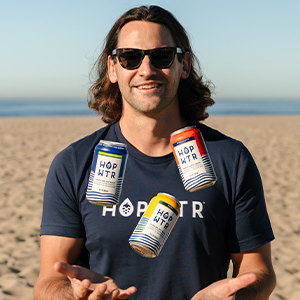
[00:00:10] Ray Latif: Hey everyone, I'm Ray Latif, and you're listening to the Top Podcast for the food and beverage industry, Taste Radio. This is episode 240, which features an interview with Nick Taranto, who helped pioneer the business of meal kits as the co-founder of Plated, and is aiming for similar success as the founder of Hop Water, a brand of non-alcoholic, hop-infused sparkling drinks. Just a reminder to our listeners, if you like what you hear on Taste Radio, please share the podcast with friends and colleagues. Of course, we'd love it if you could review us on the Apple Podcasts app or your listening platform of choice. Laid back and long-haired, Nick is a few years removed from his service as an officer in the Marine Corps. Yet, his military experience radiates in conversation. Nick comes across as a natural leader and creative thinker, someone who could excel on both the battlefield and in the boardroom, although you get the sense that he might spell the latter B-O-R-E-D room. Post-Marines, Nick turned to entrepreneurship and the creation of meal kit company Plated, which he co-founded in 2012 and sold to grocery chain Albertsons for $300 million just five years later. He'll note that part of his success as an entrepreneur is derived from his ability to connect and communicate with investors, retailers, and consumers. It's an important skill set, one that he carries into his latest venture, Hop Water, a brand of non-alcoholic beverages made with hops, adaptogens, and nootropics. It's a timely entry into the budding business of beer alternatives, and one that, like many entrepreneurial companies, carries a personal meaning for Nick. We delve into his life and career in the following interview, including his reason for entering the military after graduating from Harvard, managing Plated's very complex business model, how to assess timing and opportunity, why storytelling is the key to any successful company. Hey, folks, it's Ray with Taste Radio. Right now, I'm going to call with Nick Taranto, who is the co-founder of Plated and Hop Water. Nick, how are you?
[00:02:17] Nick Taranto: I'm doing great. Good to be on with you, Ray.
[00:02:19] Ray Latif: Good to have you on. Where are you calling from today? I see a plant behind you, but I can't really discern much more of your location beyond that.
[00:02:28] Nick Taranto: I'm in a dark chamber in an unrevealed location. I'm in Santa Monica, where I live.
[00:02:35] Ray Latif: Right on, right on. I wish we were in Santa Monica. We're in there once a year to host our BevNET Live and Notch Live conferences. And unfortunately, we had to miss that this past December due to the current circumstances, but hopefully we'll be back this December.
[00:02:50] Nick Taranto: Yeah, I really hope so. I'm a big fan of the conference and hope to be there in IRL this December for sure.
[00:02:57] Ray Latif: Definitely. Definitely. This is going to be kind of a weird segue, but I'm going to try it anyway. Can I ask you about Bitcoin? Because you've tweeted quite a bit about the cryptocurrency. And I wonder if our listeners would benefit from hearing your take.
[00:03:10] Nick Taranto: Oh, man. Well, we might spend the whole conversation. So bring me back in. Yeah, I mean, I fell down the Bitcoin rabbit hole in 2017. And, you know, at the highest level, I think what's happening in the world of blockchain and crypto and Bitcoin is that we're moving to this decentralized future where you see everywhere in the world, but especially in the US over the last decade post-global financial crisis, There's just been this erosion of trust in institutions, whether it be government, the Fed, corporations, social media. What Bitcoin represents is what I believe is the next evolution in the internet, but also really humanity to a place where we're moving beyond nation states to where sovereign individuals have the ability to transport their money and not have it be devalued by anyone at any time. The US government printed almost 40% of all dollars in circulation last year alone. If you were holding on to cash, your US dollars are now worth 40% less than they were a year ago. Just at an asset level. I think Bitcoin is fascinating as a as a hedge against inflation and devaluation of the dollar but then more broadly as this trend towards decentralized trust and the next evolution of how You know humanity transacts in a digital world. It's fascinating and I think it's only just getting started and
[00:04:44] Ray Latif: Well, we certainly could go down a rabbit hole. That was pretty impressive. I think some folks might have been expecting to hear, oh, well, it seems to be a great currency if you want to make a lot of money in a short amount of time, if you're just looking at recent history. But you're looking at this from a sort of holistic standpoint.
[00:05:07] Nick Taranto: Absolutely. I think it's the next evolution in how we operate and transact as a civilization.
[00:05:14] Ray Latif: Okay, so some people might be surprised by what you just said. They might be even more surprised hearing that you got your BA at Dartmouth, got your MBA and MA from Harvard, from Harvard Business School and Harvard's Kennedy School of Government, and then joined the Marines, which is clearly a career path that most people take these days. Obviously not. I wonder what your thought process was when you were even thinking about going to the military, you know, why the Marines?
[00:05:49] Nick Taranto: Yeah, I got to rewind it a little bit. I grew up in New York, and I was in New York City on 9-11. And I had friends whose parents died, and it was an incredibly traumatic day, like it was for so many. And that's when I first started thinking about serving in uniform. And I grew up Jewish in the suburbs of New York, so I literally knew no one who had served in the military. I really didn't understand how to connect the dots as a 17-year-old. But then I went to college and went to Dartmouth and didn't really think ROTC was for me. I had long hippie hair, even longer than I have now during college. But this nagging idea of I need to go serve just was lodged in my brain. And I got to my mid-20s and finished my grad school. And it was certainly not the logical thing to do, to go become an infantry officer in the Marine Corps. with six figures in grad school debt and two shiny new degrees from Harvard. What just logically made sense to me was it was an now or never proposition. I like Jeff Bezos' regret minimization framework thinking, which basically Encourages you to fast forward to when you're 80 85, you know Essentially old and on the way out and think about you know What decisions you could have made that you regret and I knew that if I didn't pull the proverbial trigger and go serve in the Marines I would always regret it and why the Marine Corps over any other branch. I mean, I've always been an athlete. I've always been an outdoorsman. And I just love the idea of the Spartan culture that is Marine Corps culture, living in the dirt, doing hard things. I just loved that and felt like it was really lacking in American society and wanted that exposure and also wanted to learn leadership from the best. And it was an incredible experience. I wouldn't trade my Marine Corps experience for anything.
[00:07:49] Ray Latif: You know, you can learn leadership skills at Harvard Business School, and you can learn leadership skills in the Marine Corps. Can you talk about the difference between the two, or are they similar in any kind of way?
[00:08:00] Nick Taranto: Yeah, in some ways, you know, there's the Armed Forces Club at HBS has these t-shirts they print that says the West Point of capitalism, you know, it's a joking moniker for what HBS is, but you know, I was there when I started HBS when the global financial crisis was happening. So we were, you know, watching the world change and in many ways implode before our eyes and all the textbooks had to get rewritten in real time. The HBS education was mostly academic. Sitting in a classroom, even using the Socratic method, the case study method, which is great. I think it's the best way to learn in a classroom. Just getting challenged and living through a case with real protagonists and being put in their shoes is fantastic. But that's a very different experience from, you know, getting shot at or, you know, spending two nights without sleep and in the cold, you know, sharing a sleeping bag with your buddy and then having to get up in the morning and lead 30 or 40 people. And if I equate that to entrepreneurship and starting something from scratch, birthing something into reality is just incredibly hard. And there's a lot of uncertainty. And a big part of that is getting people to follow your dream and go do things that most people don't think is possible and to hopefully make it fun. risk mitigated as possible along the way for both employees and investors and partners. That idea of taking a risk or going and facing a risk and trying to make it as de-risked as possible for everyone who's trusting you to be their leader, getting exposed to that principle of high-risk leadership early on where the risks are truly life or death, it's just a fantastic trial by fire.
[00:09:57] Ray Latif: In what situations were you really facing life or death? Were you in war zones? Were you placed in war zones during your time in the Marines?
[00:10:06] Nick Taranto: I didn't deploy. I came very close to going over to Afghanistan. I was doing a workup with a unit based in Memphis to go, and then the mission was canceled. And that was actually one of the hardest periods of my life in that I'd gone through years of training, and I tried my best to deploy and get overseas. Because when you've spent that much time training, and especially for a young man, there's this built-up sense that going and seeing combat is almost this mythical line in the sand of becoming a man, which might sound crazy to some listeners, but when you drink the Kool-Aid and go through years of training, you come out the other side really wanting to see if you can do it. when I wasn't able to go pursue that opportunity, it really shook me. And in many ways, that's what led me to go into entrepreneurship, because I couldn't pursue a deployment. So everything has worked out very well, I would say, in retrospect. But that was one of the more challenging times in my life, when I couldn't make that happen. So to answer your original question, Ray, you know, my, uh, all of my experience was in training. So I never actually got shot at by the enemy. But, uh, a lot of the training you go through is simulating that experience and putting you through very high stress situations where, you know, you're getting as close as possible to simulating what that might feel like without actually getting, you know, getting blown up.
[00:11:34] Ray Latif: Overseeing or commanding 40 guys who all are holding M16 rifles and all they need to do is pull their right index finger one way, that is always going to be life and death, no matter whether you're in a combat zone or not. Going back to this notion of entrepreneurship, and how it relates to the military. I mean, I remember when we saw commercials for the army, when they would promote the saying, an army of one. But it seems like the military would not be so conducive to an entrepreneurial mindset. When you and I talked last, you talked about this notion of OFP. For folks who are not in the military or not familiar with the military, I'm sure they have no idea what I'm talking about. What is OFP?
[00:12:19] Nick Taranto: Yeah, so in the military more broadly, but especially in Marine Corps culture, there's a large emphasis put on following the program. If you're not following the program, if you're going off kilter and asking a lot of questions, you're pursuing your own path, you're said to be OFP, which stands for own fucking program, own effing program. I've certainly been a pretty independent thinker since I was very young, always asking a lot of questions, probably to my parents' annoyance. But that sort of mentality can clash with OFP culture in the Marine Corps. So I had an amazing experience in the Marines, but realized that that was not where I wanted to spend my career. And again, we touched on this briefly, but that's when I started really exploring what was the next version of leadership, adventure, responsibility, mission. And that's how I got into early stage entrepreneurship.
[00:13:20] Ray Latif: I thought you were going to say that's how you got into Goldman Sachs, but, uh, which you did, but, uh, that was not fulfilling from what I understand.
[00:13:30] Nick Taranto: Yeah. So I, I went to Goldman and worked a sales job there and that was at the same time. So I transitioned off of active duty to the reserve side and that's when I was working with the Memphis unit for a workup to go to Afghanistan. So every month I would fly from New York down to Memphis for four, five, six days, and we'd work up together. And simultaneously, I was working a sales job at Goldman. And the contrast between those two was incredibly stark, where I'd go from living in the woods with a bunch of knuckle draggers. We knew we were going to go fight. And then I'd fly back to New York and show up Monday morning at the desk. Where the you know, the mission was making money right and big believer in making money, but it's quite a different mission And when our mission to afghanistan was canceled I found myself coming into work. Just saying what what am I doing with my life? and uh fell into a big depression and um, you know, I was I was only at goldman for about six months before you know I realized I have to go do something else with my life. This might actually kill me So yeah, I mean that was that was a wild phase of just trying to figure out who I wanted to be when when I grew up
[00:14:47] Ray Latif: Well, you grew up to become an entrepreneur, if we're using those terms.
[00:15:13] Marine Corps: Vibrant Ingredients is the natural ingredient partner powering food and beverage innovation, delivering flavor, function, and protection through a science-backed portfolio. Vibrant delivers purpose-driven solutions that help brands create extraordinary experiences. Discover what's possible with Vibrant today. Visit vibrantingredients.com.
[00:15:40] Ray Latif: Was the idea for Plated your first idea for a business or were you thinking about other potential opportunities to start your own company?
[00:15:48] Nick Taranto: Yeah, it's a good question. So I teamed up with a good friend of mine from business school and we actually started first with the team. We knew we wanted to work together. We didn't know exactly what we wanted to work on. And when I left Goldman, Josh, this is his name, Josh and I actually spent six months rapidly testing and iterating through over a half dozen different ideas. And we took this lean startup approach of hypothesize, test, iterate, and if it's going to work, figure that out quickly. If it's going to fail, figure that out even faster. So we failed a lot. It was an interesting time, because we had this safety net of good degrees, and we knew we could go get jobs if we had to. But simultaneously, we were burning through personal savings, had negative net worth. I had recently been married, and we were sprinting to figure something out. We weren't sure what the destination was. And we were basically on our last fumes, where we knew savings were essentially depleted. and if we didn't figure something out it was to go back and get corporate jobs and that's when we started working on what would become plated in June of 2012 And unlike our other ideas that we've been working on, this one started gaining traction and market fit very early on, unlike the other stuff that we were messing around on, which didn't. What we didn't really know going into starting America's first meal kit business was just how Complex the business model would be and while the consumer demand was clearly there, you know not being food people We had to go figure out everything on on the back end to make that business work and the business model for those who aren't You know where the category our competitors were blue apron. Hello fresh and over 150 competitors entered in the 18 months after we we started plated Harvard Business model there. It's a meal kit. So we put recipes online. It's e-commerce The user comes to the website selects the meals they want and then on the back end in our fulfillment centers We package up all of the pre-portioned ingredients and send those Directly to the consumers door along with a recipe card to make it as easy as possible to make a delicious just meal at home in about 30 minutes for about 10 bucks. And it just caught fire. It was an incredible five-year journey building out that business where we went from Josh and me on my couch on West 14th Street in Manhattan We raised almost $100 million in venture capital. We got the business from zero to over $150 million in revenue at peak. We sold the business to Albertsons, a big grocery retailer in 2017. We made our early investors over 20 times their money in under five years. For a lot of us around the table, it was a life-changing financial event. and just learned two or three careers worth of stuff in the span of five years. And you had many, many sleepless nights where we were quite literally hours away from missing payroll and having to shut the thing down and all kinds of other entrepreneurial war stories that we can, happy to share. But it was an amazing education in how to go from ideation to product development, to product market fit, to scaling, to really building a category and defending it, and then ultimately getting to a strategic acquisition in a very compressed timeframe.
[00:19:40] Ray Latif: It sounds like it was, and when you're mapping all this out, I assume you're leaning on your business education, but from what I understand from everyone I've talked to, academic education is very different than on-the-job training. But if you don't have any on-the-job training, if you're just kind of building a category that's never been built before, that's never existed before, Where do you start and how do you look at yourself? I mean, were you a tech entrepreneur? Were you a food entrepreneur? Were you something else? How did you see your role as the co-founder of this company?
[00:20:16] Nick Taranto: What Josh and I identified back in 2011, 2012, was this opportunity to leverage technology and bring it into an industry, you know, in Plated's case being food, that really hadn't had too much technology applied to it yet. That was incredibly exciting. I am a technologist at heart. I believe that technology is humanity's biggest differentiator from any other species. It's what allows us to keep progressing. While there's certainly many downsides that we're seeing to some of our modern forms of technology, I ultimately do think technology is a force for good and can be harnessed to create a ton of value and wealth very quickly, but to also have just an enormously outsized impact relative to trying to do something that does not leverage cutting edge tech. So yeah, I do like to think about myself as a technology entrepreneur, although I tend to gravitate to businesses that have a analog or industrial base to apply those technologies to.
[00:21:23] Ray Latif: Raising a lot of money is part of the game for, seems like any of the industries we talked about, whether it be food, beverage, tech, and raising a lot of money often lends itself to an exit so that, as you mentioned, your investors can get a return on their investment. That being said, I've talked to so many folks who will say, you know, we were never building this company to sell. We were always building it for a purpose, for a reason. And if you're building a company for a purpose, for a reason, for long-term impact, you've still got to turn a profit. But I wonder, were you guys ever thinking about turning a profit? Was profitability part of the game? Or were you really looking at this as, okay, there is an exit strategy here. There is a light at the end of the tunnel that's not a long-term involvement in this brand.
[00:22:21] Nick Taranto: Yeah, it's a great question. I mean, if you look at companies like Amazon or Tesla more recently, those companies invested billions and billions of dollars over decades in order to build a moat and get to the other side. And any business needs to make some upfront investments before getting to break even or cash flow positive. But to take a multi-decade approach of negative cash flow before crossing the chasm is something that's only really become possible in capitalism in the last 20 years. And it really changes the game. Because if you are an entrepreneur who can tell a compelling multi-billion dollar market story and Raise the money to finance that story for many years or you know again in some cases decades That's an incredible competitive advantage versus someone who has to you know play the more traditional game of Getting to cash flow positive as quickly as possible. It just means the growth potential is is constrained relative to someone who can invest and invest and invest for growth. And certainly, the pendulum swings back and forth in the capital markets from favoring growth and narrative to favoring cash flow. And particularly where we are right now in February 2021, we are certainly at one extreme of favoring narrative and growth over cash flow fundamentals. But I think it's an amazing part of American capitalism and technology driven capitalism in particular, that if you can convince the capital markets to buy your story and to invest in you, you can just do incredible things incredibly quickly and create tons of value. And yes, it's stressful. And I know Elon Musk and Tesla in particular went through some very, very dark days on the way to getting to profitability. And their journey is certainly not done. And there probably is an equity markets correction coming for Tesla at some point. But now they've got a massive balance sheet that they can use and access to capital where they can go and do things that their competitors just can't do. So at Plated, we were certainly not in the realm of Tesla, but we knew we were going into a category that could potentially be tens of billions of dollars. And if we started optimizing for cash flow too soon, we'd be giving ground to competitors who, in some cases, were behaving you could say irrationally, spending $1,000 to acquire a customer whose lifetime value was only $500 or $600. When you see that in the market, it gets pretty scary, to be honest, because if you want to maintain market share and keep growing market share, you're forced to behave irrationally as well. And playing that game can get dangerous from a cash burn perspective. But as long as your investors are aligned with strategy and the market dynamics, it is a form of the game to be played.
[00:25:31] Ray Latif: Investors can certainly be aligned with strategy and market dynamics. Numbers help quite a bit. Research helps quite a bit. Charisma, I think you were alluding to, helps out a lot. And When you are meeting with investors, when you had been and when you're currently meeting with investors, how much of you, how much of your tone sets them up to be investors in your company?
[00:25:59] Nick Taranto: Well you said charisma Ray but I think it's a little bit more than that. It's that as as humans we're all narrative driven creatures. We are genetically programmed to want to hear stories and believe in stories and live our lives in narrative arcs. Right. And at this point where we are right now in American culture and global culture, people need stories that they can believe in. People want to follow stories that they can believe in. And if you're the kind of leader that can say, hey, look, this is where the trends are going. This is where we need to go as a business. And you can get people on board for that, people being both employees, partners, customers, investors. That's how you can create these outsized returns very quickly. people want to believe that there's more to life than just getting up in the morning and putting on your socks, going through your day and putting your head on your pillow. We want to believe that our lives have significance and that we're making a dent on the world somehow. And if you can create a company and tell a story that people believe in, one, it's an incredibly exciting thing to be a part of. And your day-to-day existence is revitalized. And two, back to the investing in the future conversation, if you can say, look, here's where we think the world is going to be in five years, and we need to deploy capital to get there, that's a very investable narrative, even though there's not profit on the near-term horizon.
[00:27:36] Ray Latif: But there's a difference, right, between someone who can tell a story about market trends and economics, right? An analyst can do that, but an analyst might not be a great storyteller. Did you become a better storyteller? Did you become a better communicator as you grew into the business, as you grew as an entrepreneur?
[00:27:58] Nick Taranto: Certainly. My whole life I've been really interested in stories and writing stories, reading stories, but all these experiences that I've had continue to reinforce for me this idea that storytelling is vital. And whether it be for employees or investors, or again, customers, the better the story you can tell, the farther you can go. And the more fun people will have along the way as well So, you know, I think I've got a lot of work to do to improve my ability to tell stories You know, there are people out there that do it much better than me, but people want a story in their lives They want their lives to make sense. They want to believe that they're Going somewhere that they understand and that it's gonna matter and if you can provide that to people It's it's a not just a you know, financial good. I think it's a very impactful social good, too. I
[00:28:51] Ray Latif: It's a big part of the reason why we do what we do on Taste Radio is, you know, this medium of audio and as we're doing video right now allows us to do long form storytelling content that we hadn't done in the past. And it's been really well received by our audience. I mean, along with lessons, it is empowering to speak with someone on a sort of, you know, solidarity kind of level. It's knowing that they are in the trenches that you were once in. When you did sell the company, it was five years and going from zero to 100, I think you said $150 million in revenue? in five years is pretty remarkable. When you initially mapped out the business plan, was that the timeline? Was it five years? Or was the exit accelerated by the fact that there were suitors out there and that there was the opportunity to sell at the peak of Plato's value?
[00:29:47] Nick Taranto: Well I mean here Josh and I were excited about building a standalone institution that could be around for a long long time. And part of what drew us to play it as a business model was that if we did our jobs the right way it could be a publicly traded multibillion dollar very large independent company. And there are now competitors in the market. HelloFresh is publicly traded and is worth billions of dollars. During our early days of conceiving that model, we thought there was a big market there, but it was very hard to size and even do any sort of financial modeling because it was a brand new category. Food e-commerce a decade ago was still very nascent. Amazon Fresh didn't really exist yet. There were a couple of regional players, but it was just a completely different universe. So thinking about modeling what the business would look like at scale was really more of drawing some numbers on a cocktail napkin and then translating that into Excel versus having real analysts, Wall Street, sell-side driven research to lean on. As we got into the market and validated that there was a big market opportunity with millions of potential customers, we saw this billions of dollars flow into the market. It felt like we saw this wave, to use a surfing analogy, we felt like we were bobbing out on the water and saw this big wave moving towards us on the horizon and just started paddling as hard as we could early and caught the wave because we were paddling early and managed to ride through that amazing huge giant and get out the other side alive. We saw many, many competitors implode, explode, disappear over our five-year journey. When we got to the spring of 2017, Amazon came out and announced their purchase of Whole Foods, which shook up the food market. Publicly traded grocery stores saw their share prices, their market capitalizations cut by a third in a matter of a week. It was incredibly tumultuous. And on top of that, our closest competitor, Blue Apron, went public and went on to have one of the worst performing IPOs in history. So there were these dynamics at play that spring and summer that catalyzed a lot of interest in our business from strategic partners and acquirers that quite honestly didn't exist prior to those two events. And we got together with our board, our investors, and came to the conclusion that, look, we could go out and raise hundreds of millions of additional dollars and keep competing. again, into a market where some players were behaving irrationally, or we could make a deal happen where we could continue to increase the value of the company and realize synergies with Albertsons who has 3,500 doors and hundreds of thousands of employees and 30 million customers walking through their stores every week and just thought it was the right move for us and the next chapter for the business.
[00:33:07] Harvard Business: Do you want more repeat buyers on Amazon? Well, this free resource in collaboration with Straight Up Growth will help your brand turn first-time buyers into long-term subscribers. Download Winning the Repeat Purchase Game on Amazon now at Taste Radio slash SUG. That's Taste Radio slash S-U-G to start building retention-driven growth for your brand on Amazon. Scaling a beverage brand into major retail comes down to operational readiness. From packaging lead times to co-manufacturing strategy, the details can make or break a launch. In a new e-book in collaboration with Octopi and Asahi Beer USA, industry leaders share what they've learned in helping brands scale. Download it now at Taste Radio slash octopi.
[00:33:57] Ray Latif: I get the sense that as an entrepreneur, you constantly think big, very, very big. And please don't take this the wrong way, but I think you more than anyone I've ever interviewed has said the word billion more times in a conversation than anyone I could recall. In your opinion, do entrepreneurs need to think really, really big? Do they need to think above and beyond what their initial dream was for their brand?
[00:34:23] Nick Taranto: No, there's no, there's no value judgment or anything along those lines from my side. You know, I was exposed to death at a pretty young age. I had a family, friends that passed away and my parents adopted my best friend at the time and his siblings. So when I was 14, I basically saw like, wow, you know, life is short. Right. And that's really fueled a lot of how I live. I just like to think bigger and think about how I can live as much life as quickly as possible, given that it could all be gone tomorrow. What I've also found, I've been involved with a bunch of businesses over the years, and It takes about the same amount of effort to work on a very big problem as it does to work on a smaller problem. All the ingredients and components are essentially the same. You need people. You need money. You need strategy. And to my mind, you know building something from scratch is incredibly challenging no matter what it is how big it is how fast you're moving so if the Delta if the difference between Working on something really big that has you know the potential to be worth billions of dollars and to transform millions of people's lives if the difference between that and working on something That is, you know several orders of magnitude different in scale if the difference between you know your input How much stress you go through how much work you have to put in how much risk you have to take is not that great Then why not? You know dream bigger and swing harder
[00:36:02] Ray Latif: And is that the same perspective you have with hop water? The beverage industry has only a handful, if that, of sort of game-changing, culture-changing products or brands. And for the most part, it's been pretty stable in terms of what consumers drink and what consumers want from packaged beverages. It hasn't changed really that much. in the history of packaged beverages. So how can you make that kind of impact? Is that the kind of impact you want to make when you're looking at the beverage industry?
[00:36:35] Nick Taranto: Yeah, I mean, so my origin story here with hot water is that about almost two years ago now, we moved out to Southern California. And quite honestly, I found myself just drinking way too much beer. I was having two or three big IPAs a day. I've always been an athlete, marine, and I put on over 20 pounds and I was just not setting a very good example for my kids. And I realized, okay, I got to change something. It's not a good habit. And I looked out at the market And I had never really tried any non-alcoholic beers before, but when I went out and sampled pretty much everything that was out there, I just came away shocked at how bad the offerings were. And even the products that tasted good were still 80 to 100 calories per can, 16, 17 grams of carbs, and there was no functional benefit to any of them. And the entrepreneurial siren started going off in my brain. And I realized like, wow, OK, it seems like there's a big opportunity to do this much better. And when we started doing real market research and saw that some industry analysts were indicating that the non-alcoholic beer market could be $25 billion over the next decade, and that the functional water market was projected to be almost $20 billion came to the conclusion like, wow, OK, we could build a next generation non-alcoholic beverage brand here that could be worth billions of dollars if we execute the right way. So we started building and working on our product, spent the first part of 2020 getting our liquid dialed in. And we love the idea of leaning on the history of hops, which is obviously one of the key ingredients in beer, brewing that and adding adaptogens and nootropics into the mix to add a de-stressing and unwinding aspect to the product. So worked on the brand, ran a bunch of, you know, Facebook testing and consumer research and doing customer discovery and just got more and more bullish as, as we went through that customer discovery process, that there was just an enormous hole in the market with unmet demand, raised a bit of money from angels and a couple investors, institutional investors and launched in September. And, you know, it's just been, it's been off to the races. want to share any numbers, but just feeling really, really positive about everything we're seeing, traction in the market, and just still how underpenetrated the non-alcoholic space is. While you see beer sales in many segments declining year over year, malt liquor sales are down 11% last year, and red ale sales are down 6%. Meanwhile, non-alcoholic sales are up 23% year over year so the consumer is definitely shifting more towards a non-alc world and we feel like we can build this engine here, which You know hypothesizes innovative products and goes and builds them tests them and gets them into the market faster than anyone else out there And we're just incredibly excited about but what we can go and do here how much stock do you put into timing because
[00:40:10] Ray Latif: At the time you launched, there were already a few hop-infused waters out there, a lot more interest in non-alcohol beers, particularly among strategics, which started getting involved in that business more significantly than they had in the past. As you mentioned, the category seems to be thriving, but this all happened prior to you launching. So some people might say, okay, well, it's too late for you. You might've missed the boat. How do you think about timing and the timing of your brand's launch?
[00:40:40] Nick Taranto: I mean, timing is super, super important in any business, right? In many ways, it's the most important factor. And from everything we're seeing here, these are trends that are only getting started. These are secular mega trends across society. Younger millennials and Gen Z folks are like barely drinking alcohol at all. And they're just becoming consumers. And we're really building our brand for a younger demographic. You know, most beer drinkers in the country tend to be older. So we think we can build something that has that same use case and occasion, but appeals to very different demographic. And as a startup, as a relative to many players out there, we are, we are just a flea on the back of the elephant, right? So the only advantage that we have there are two advantages. One is we can take risks that they can't, right? You know, we can push the brand, we can push marketing, we can just test and learn and do things. And if it doesn't work, or if it pisses someone off, we have, you know, apologize and course correct. And the second advantage is speed, we can just do things without having to you know, go through multiple approval layers to make it happen. We don't need to pitch the agency and have the agency do a pre-meeting for the meeting to have the board meeting to then do the review of the board meeting and then the review of the review of the review, right? You know, we can just do that in a day. If we're seeing something that doesn't feel right or look right and the data supports it, just put something out, test it and move on it. So taking that approach, I think is how we win. It's how we build something that's really valuable here. And the consumers Love it and consumers give us their feedback and we hear from a consumer on sunday that something's not working By monday, we can have a data validated new approach instead of taking, you know quarters or years to run a market test and Conduct a consumer panel and spend tens of millions of dollars on you know research we can just do that in real time so The wave is certainly starting here, certainly has not reached max force yet. I think we're super well positioned to be, hopefully, I think we have the opportunity to be the market leader in this non-ALP revolution that's happening.
[00:43:01] Ray Latif: Timing is one thing, positioning is another thing. You know, when I Googled hop water, the first thing that came up was an ad that said, hop water, drinking too much, question mark. And it wasn't about refreshment. It wasn't about the flavor of hops. It wasn't about the functional ingredients that are included. It was about this notion of, Sober living for lack of a better term. Is that the primary message you're trying to get across or is that just one part of it that just happened to be the ad that I saw?
[00:43:33] Nick Taranto: Yeah, great question. Speaking from personal experience, since we started this business, I'm drinking 90% less alcohol and I just feel much better, sleeping better, more energy. I'm leaner and fitter than I've been in a long time. And I think that idea that you don't have to cut it all out, and 90% is obviously very, very aggressive, but just cutting back a little bit can lead to big transformations. When we started running research, we launched this business in the midst of COVID. And when we were running research, we surveyed 1,000 people across the country. And over half of them came back and said that they had stopped work early to have an alcoholic drink during COVID. I think 2020, COVID started and I was certainly guilty of this also. We started with a Manhattan a day because we thought this thing was going to be around a couple of weeks, and then turned into months and now you're counting this in terms of years. my drinking behavior spiked hard in 2020. And 2021 is a hard reset for me into a different approach. And we saw that marketing opportunity. And dry January this year for us was just bonkers, just insane. We did four times the revenue than we were doing the month prior. So I think there is this, you know, there's this secular mega trend of people drinking less, but then also coming off of COVID, people are looking for that reset. That's not the extent of our marketing, right? You know, drinking too much is one play, and that certainly works for a segment of the market. We certainly have a big, large segment of customers who do not drink at all. But the majority of our customers do drink alcohol. They just use hot water on certain occasions when they want to have that beer-type feel, but they don't want the alcohol, they don't want the calories, they don't want the carbs. So we're, yeah, again, just very excited about building this brand. It's a really, really fun brand to build. And just the trends and the timing around building it are really, really solid.
[00:45:45] Ray Latif: Where do functional ingredients come into play? The broad opportunity, the mainstream consumer may not know about or care about the fact that you have a functional component to your beverage. You know, the Air Ones of the world, Whole Foods for sure, you're going to find some people that say, okay, well, not only does this beverage taste good, it's doing good for me. So I guess, where do you find that balance between refreshment and functionality when it comes to the mainstream opportunity?
[00:46:13] Nick Taranto: We see it coming loud and clear. Right. I mean the better for you movement has touched every category you know whether it be tortilla chips or mac and cheese or or milk. It just hasn't touched beer yet. So we want to be the better for you beer market leader, you know, hop water is the healthy alternative to beer. And part of that is having, you know, functional benefits, along with lower calorie profile, zero out profile, ultra low carb profile. So yeah, we think it's it's a big trend. And it's only growing over the next few years.
[00:46:52] Ray Latif: I just hope I can get out to California soon so that I can grab a can of hot water, head to Wahoo's, grab a fish taco and make that my day. I just sit there for three, four hours.
[00:47:03] Nick Taranto: Can I join you? That sounds like a good day.
[00:47:07] Ray Latif: Well, yes, absolutely. How about this? You bring the hot water, I'll provide the tacos. I'll flip the bill for that for sure.
[00:47:14] Nick Taranto: Dude, it's a deal. It's a deal. Outstanding.
[00:47:17] Ray Latif: Well, Nick, it's been a pleasure really meeting you and even more of a pleasure speaking with you. Thank you so much for taking the time. I wish you all the luck and success with Hotwater. And I really hope we can meet in person sometime this year.
[00:47:29] Nick Taranto: I do too, Ray. Yeah, thanks. Thanks for your time. And yeah, hope to meet in real life pretty soon here.
[00:47:35] Ray Latif: Fantastic. All right. Thanks so much again.
[00:47:37] Nick Taranto: Thanks, Ray.
[00:47:42] Ray Latif: That brings us to the end of episode 240. Thank you so much for listening, and thanks to our guest, Nick Taranto. As always, for questions, comments, ideas for future podcasts, please send us an email to ask at Taste Radio. On behalf of the entire Taste Radio team, thank you for listening, and we'll talk to you next time.