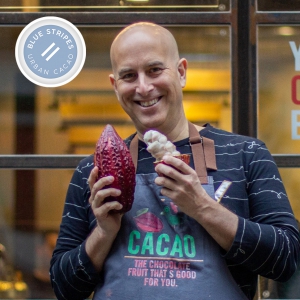
[00:00:10] Ray Latif: Hey everyone, I'm Ray Latif and you're listening to the Top Podcast for the food and beverage industry, Taste Radio. This episode features an interview with Oded Brenner, the founder of groundbreaking chocolate-themed restaurant chain Max Brenner, and Blue Stripes Urban Cacao, a unique brand of food and beverages made from upcycled cacao fruit. Just a reminder to our listeners, if you like what you hear on Taste Radio, please share the podcast with friends and colleagues. Of course, we'd love it if you could review us on the Apple Podcasts app or your listening platform of choice. Oded Brenner often praises traditional business principles. His career, however, has been defined by resisting them. A self-described businessman-artist, Oded cut his teeth as an entrepreneur in 1996 as the co-founder of Max Brenner, an international chain of upscale, coffee-centric cafes. At its peak, the company was thriving, yet Oded will point out that Max Brenner's genesis had little to do with business planning and market research, and instead was born out of his passion for indulgent and comforting desserts. The same is true for its latest venture, Blue Stripes Urban Cacao, which markets a range of wellness-focused consumer drinks and snacks made from upcycled cacao fruit, including the shell and beans. Oded will admit that, on the surface, Blue Stripes appears to be a niche opportunity. But then again, so was Max Brenner. In the following interview, I spoke with Oded about his unconventional approach to entrepreneurship, why he believes that there's a place for any business if, quote, you do it with all your heart. He also discussed his unfortunate breakup from Max Brenner, his position that corporations and independent business owners can never work together, embracing ideas that would commonly be perceived as mistakes, and the ultimate form of success. Hey folks, it's Ray with Taste Radio. Right now I'm on a call with Oded Brenner, who is the founder of Blue Stripes Urban Cacao and Max Brenner. Oded, how are you? I'm good. Great. I'm great as well. And it's because your team sent me a bunch of your Blue Stripes products, but they also sent me an actual cacao fruit that I have in my hand, which is pretty amazing.
[00:02:23] Oded Brenner: One of the things we say a lot is that cacao is the most unknown fruit behind the most known food. A lot of foods, we know where they come from, but for some reason, cacao, although we consume it so much, like every day in different applications of cookies, ice cream, beverages, whatever,
[00:02:44] Ray Latif: some of us don't know that it comes from a fruit and even the ones that know that it comes from a fruit probably never seen it let alone tasted it probably i'm not sure you've ever seen it or held it in your no i i am shockingly unfamiliar with the cacao fruit if you're watching on video you can see what it looks like if you're not it is an oval shaped fruit football Yeah, about a football shape, maybe about nine inches long. It's got the texture, the rind has the texture and the look of like a pumpkin. It's orangish, brown, yellow. It very much looks like an autumn type gourd, but it's not that. And I don't know how to open this. Oded, what's the best way to open this?
[00:03:30] Oded Brenner: so i'm going to teach you the the traditional original way the way they do it in the farms but you have to trust me i have a knife here i have my knife my account you're not going to be able to do it with the not with the way i teach you so you'll do it with the knife but the way to do it is hold it in one hand On the other hand, you're going to smash it to the palm of your hand here. Don't be afraid. It looks a little hard, but just smash it. It's not that hard. When you smash it, it will crack in the middle.
[00:04:01] Ray Latif: right? I haven't been to a dry cleaner in a while, so I'm a little worried about this, but let's try it. Okay, here we go. Okay. No, it's wrong. Nope. No, stronger. Oh, stronger. Okay.
[00:04:10] Oded Brenner: In the middle, in the middle, in the middle, in the middle. And don't be afraid.
[00:04:14] Ray Latif: It's not that it doesn't hurt folks at home. I hope you can hear this. And I hope you don't hear a bone breaking in my hand. Let's try this. Okay. Nope. I think I got it. I got it. I got it.
[00:04:26] Oded Brenner: There we go. Now, that's the way they crack it in the farms, in the cacao farms. Oh, goodness.
[00:04:33] Ray Latif: Yep. There it is. It's on the inside is something that frankly doesn't look too appetizing. It looks like lima beans that are covered in a very wet tapioca.
[00:04:46] Oded Brenner: so you can taste it. Don't bite it, just suck on this bean, a little bit this pulp. Yeah, exactly like that. But when you get it fresh in the farm, it's full of this pulp around it. But the cacao is a very sensitive fruit. So the second you take it off the tree and this traveled for a week from Ecuador, then the pulp slowly, slowly disappears. But usually when you open it, it has a lot of pulp in it that today we are wasting. And the flavors are phenomenal. It tastes like, to me, it has like a little bit of lemon with vanilla and a little bit of lychee. kind of like a tropical nuance to it. And again, it's harder for you to taste it now because the pulp is not that rich now on top of it, but usually it's full of it.
[00:05:39] Ray Latif: Well, it's absolutely delicious. I think you described the flavor perfectly. The question I have, and I think the question most folks would have is, how does chocolate come out of this?
[00:05:49] Oded Brenner: All right. So three parts to the fruit, the shell or the husk, then inside there is the fruit, this white pulp, and then inside the pulp, and if you want, bite it to the middle. It's bitter, but bite it and take it out. Just bite it in the middle. I want to show the inside. The inside is purple. That's the bean. And chocolate comes from the bean. How do we make chocolate? Hard to believe, but farmers are taking the fruit, breaking it in half, usually with machete, take it, yeah, exactly. And you can look inside, it has a purple color, not that brown. So what they do, they take out the beans in big, big baskets, then they put it in bags or sacks, usually like plastic sacks, and they let it ferment. Fermentation is a very important part in making great chocolate, the same as it is in wine, the same as it is in many other foods. Fermentation is what creates the sugars and the flavors and all the unique things we love so much in chocolate. So it's being fermented, then washed clean, dried, and then what you do, you take the dried fruit, roast it, almost like we roast coffee, and then you grind it. You grind it to a very, very fine paste that you can't actually feel the particles. So it's basically like a paste. This paste is what we call cocoa liquor, and cocoa liquor is the base for chocolate. Now we add sugar to this, That's how we make dark chocolate. The percentage you always see, like 70%, 80%, meaning 80% of cocoa solids and 20% sugar or 30% sugar, et cetera. When we make milk chocolate, we add to this cocoa liquor milk powder and sugar, and this is milk chocolate. And if we want to make white chocolate, we extract the fat, which is the cocoa butter. from the beans. You get like an ivory type of fat. This is the magical part of cacao because cocoa butter is very unique. It's solid in room temperature and it melts in our body temperature. That's why we love chocolate so much. It really melts into us. In order to make white chocolate, you just take the cocoa butter, cacao butter, you add milk powder and sugar to this. That's how you have white chocolate. And this is how to make chocolate in 60 seconds.
[00:08:31] Ray Latif: Well, thank you very much for that. Because again, I think at a glance, you wouldn't know that a cacao fruit, you know, just by looking at it and just by cracking it open is the basis for chocolate. But then as you mentioned at the, at the outside, if you break open one of the seeds, it looks like the inside of the seed is, is almost a chocolate chip itself. Of course it's not, it goes through quite a bit of a process, but yeah, amazing. Really incredible.
[00:08:56] Oded Brenner: I don't know if you heard recently and one of the very special innovations in the last two years in chocolate was a chocolate that Calibo, the big Belgian chocolate manufacturer, created a chocolate that is called Ruby chocolate. The ruby chocolate is pink by nature, no color added to this, and the way they do it, they take the bean that you just opened, that has this purple color, and instead of drying it and roasting it, they leave it like this, and they grind it into a paste, and that's how you get this ruby color. And that's why also when you taste it, you have this fruitiness, because it's not dried and roasted. That's another secret that I don't know if Calibre wanted me to tell, but that's the way it is.
[00:09:45] Ray Latif: Well, we've got it now, and I appreciate you sharing it with us. You mentioned that a big part, maybe the biggest part of Blue Stripes as a brand is using, upcycling the parts of the cacao fruit that had been wasted for seems like centuries. But let's back up a second. What drove your initial interest in chocolate? I can't imagine that you picked up a cacao fruit one day and said, hey, I'm gonna have a career in the chocolate business. But what was your initial foray into chocolate?
[00:10:19] Oded Brenner: I like to quote a very beautiful quote by John Lennon, life happens to you while you're busy planning other things. I didn't come from a culinary background or I never looked at my watch my grandma making chocolate cakes. And I said to myself, I'm going to be a chocolate maker. I, I actually wanted to become a writer. I was really attracted to writing stories. I'm Israeli in origin. And, um, When I finished all the obligations in Israel, it's also three years of military service, I said, now I'm going to start writing seriously. And there are courses in Israel, very basic ones, that the government is encouraging people to take, and they pay you some social security money if you do it. One of them was pastry. And to me, I didn't care what it is. I just wanted to go there, take the money, and go home and write. So I did pastry. I did it for several months. And then being romantic and thinking of writing career, I started to travel in Europe, thinking all the time about writing, but working with people who made very unique, sweet art from people that blow sugar. I worked with somebody that blows sugar. I worked for Sean in Paris, this very famous house of pastries and cakes. Eventually worked in Paris for two years with a guy that makes chocolate. So I came back to Israel and I decided I'm going to start my own little chocolate workshop and write. But I didn't write. I started a small workshop, which was just a small chocolate store. And this chocolate store became extremely famous in Israel. This was the beginning of Max Brenner. And then from the store, I turned it into this crazy chocolate Willy Wonka restaurants. That's how I started chocolate. I mean, this was the beginning. It happened two times. When I started Mark's Banner, it was never planned. Like I said, life happens to you while you're busy planning other things. But also when I started Blue Stripes two years ago, it was not planned. It came from a passion that grew.
[00:12:34] Ray Latif: And it's really strange too, to me anyway, because the idea of a chocolate restaurant, the idea of a chain of chocolate restaurants. It doesn't make sense. It doesn't sound like the most profitable business that's ever been conceived is all I can say. But what made it work? I mean, what resonated with people? Why did, why did Max Brenner resonate with people?
[00:12:57] Oded Brenner: So I think it's two things. I think when you're really going all the way, and I'm not saying this is a recipe for success, but I think a lot of the times when your passion is so epidemic, like when you're like all the way, I think a lot of the things that people are doing all the way are like magnificent. I mean, people are attracted to this. It's like over the top. And again, like we spoke also last time, it was not planned. I didn't check a market. I didn't do any research. I didn't ask anything. I didn't check. I just took it more and more and pushed and pushed. But we have to remember, I mean, people love chocolate. in that thing. I didn't invent it. I didn't invent a product that was not there. The product was there. People love chocolate. But I was also surprised how much people love chocolate and how many people are willing to eat chocolate, I don't know, once a week, twice a week. They're coming there and it's becoming a habit. It was not just, okay, we come there once a year for a birthday. This was never planned and it was a pleasant surprise. It was never like, let's do it for that or this. It was totally like I told you. For me, it was a path for creation. And I just kept on going, kept on creating and creating and creating. And I was lucky enough to, I mean, I don't know if luck is the right word for this. I think when somebody, I think usually when somebody goes so strong on something and so passionate, in the world where we live today, that there are so many people, there will always be a place for the niche. And the niche is not always so small. In that regard, it was not small at all, but there is a place for everything if you do it with all your heart.
[00:14:48] Ray Latif: It's interesting you say, you know, that niche can be big. And the idea of scaling niche is a really interesting one. Doing something that no one else is doing or doing something that few people are doing or capable of doing. But it's one thing to have, say, a cafe that's focused on chocolate. It's another thing to say, I'm going to have like a 10,000 square foot restaurant that sells chocolate and an entire menu of chocolate, which is what I saw when I saw Max Brenner open up in the Back Bay neighborhood in Boston. It took over a very large space that a restaurant had left behind. When I saw it, and no offense, it did, but I was like, this has got to be some sort of passion play by a very well financed entrepreneur, but the doors are going to close in this place in a year. And they certainly did not. And it was a very successful restaurant in Boston, no longer there, but for many years it was.
[00:15:45] Oded Brenner: So again, it was an evolution because it started, I had this idea of what I call the chocolate bar, which was the chocolate store where we sell the retail products. And then in the same space, I wanted to have a place where you can eat and drink chocolate, but actually relatively small. like a Starbucks footprint. We started this in Australia. It worked very well. Again, business is about opportunities, especially for entrepreneurs. So I met a guy that was an amazing young guy with tons of energy who wanted to do it there. I'd never done it before. I just had the idea. We started it there, went very well. We came back actually to Israel with the concept and we wanted to open it there because this is where I started. we thought that nothing like this can work in Israel without food, and we started to add some food to it. Very basic cafe type of food, but a sit down, because in Israel there is not too much quick serve, you know, like just self-service, and it was very successful. Then we decided we want to do it in New York, so we came to New York with this concept And in New York, I was like, you know, influenced by New York and I wanted to create like a chocolate theater. And when we opened this big thing with the menu that we had, people looked at us and said, like, I mean, we're New Yorkers. We come to a place like this. If you have all the theater, give us food, give us this, give it. And that's how it started to grow and grow and grow. I'm not sure it was the right thing, but it was just it just happened naturally. It grew and grew, and the menu grew, and there were more and more things. And yes, it did work, because don't forget this restaurant in New York was doing $12 million a year from chocolate with an average check of $18, which is relatively small. Same in Boston, it was doing close to $8 million with a very relative small average check.
[00:17:46] Ray Latif: It helps that you had a big partner to help you scale the business. Ultimately, that big partner turned out to be, let's call it what it is, an enemy.
[00:17:58] Oded Brenner: Monster.
[00:18:01] Ray Latif: Do you regret aligning with Strauss Group?
[00:18:05] Oded Brenner: No. I don't know for the good or for the bad. For me, life is not just about business. I am, in a way, an artist and I look at things as an adventure. And I got a lot of things from not only like for my personal creation, but eventually I could exactly what you said. I couldn't do all this without them. I couldn't do all this creation, big places, all this without them. And I don't know, we'll see where it ends. But eventually, I think it helped me to tell the story. It helped me even to achieve what I'm achieving today. It helped me to achieve the status, the recognition and all these things. And no, I don't regret it. To what I'm doing, it was a very helpful, helpful partnership.
[00:18:53] Ray Latif: What did you learn from the experience of battling with Strauss? Because you fought with him for about five years, right?
[00:18:59] Oded Brenner: The first thing, I'll tell you the opposite from what I said right now. I don't think entrepreneurs and corporates can really work together. It's, I mean, everybody told me this when I did this partnership. It's almost impossible for an entrepreneur to marry a corporate. The people there are different, they think differently, they have different goals, they come to work. An entrepreneur doesn't come to work, he comes to a I don't know, to Alice in Wonderland. You know, he's coming to a place like this and it just can't work. I mean, it really can't work. And it's a honey trap. You know, you come there, you're like, you get all these things that we were just mentioning, that impossible to do it without it. But on the other hand, it's, it's not going to lead to anywhere good. And at some point, and I'm not talking about, and we can talk about it, I'm not talking about the end result, but I'm even talking the last several years there, I was a very frustrated person. It was a very frustrating experience.
[00:20:09] Ray Latif: If I'm putting words in your mouth, I might say this is the ends justifying the means, but with a big asterisk there.
[00:20:15] Oded Brenner: Yes, on one hand the finance, the money helped me to fulfill a lot of dreams that I couldn't do. Talking about relief, if you look at the details, like creating all these crazy utensils, ideas, trying all kinds of things, taking these amazing locations like what you described in Boston and all this, but eventually I was very frustrated there because you cannot really, and I compare it to what I'm doing now, At some point, you're an entrepreneur, you're a dreamer, you're pushing and this. And with a corporate, it's not the same and you're not the decision maker anymore. There's a lot of frustration there. I have to say that in the last few years at Max Brenner, I really didn't want to go there. I didn't really want to go to the restaurants. I didn't want to go to the office. I just didn't want to be there.
[00:21:04] Ray Latif: I hear that a lot from entrepreneurs as the reason for why they launch their own businesses is they want to be able to control their own destiny. They want to be the decision makers in their lives. At the same time, I mean, entrepreneurs are beholden to a lot of different people and you're not necessarily always making your own decisions, whether it be because of investment, outside investment, because of your employees that you are responsible for, et cetera. I guess, how do you become a better decision maker for yourself?
[00:21:33] Oded Brenner: need to be some balance there. In my case with Strauss, there was no balance. I was a very small shareholder. They were a huge corporate. They were also not the right corporate in that regard, I can tell you. So maybe this is also the reason for the experience. They don't come from retail. They never had stores. They're Israelis. They never really operated in the United States. So all these things caused a lot of issues, and a lot of insecurities from their perspective. They were not sure how to open, what to do in this. So in that regard, I don't know if I would partner with Starbucks, maybe it would be different because they know how to open stores and they feel more comfortable. But when I'm saying balance, I think that it's very important that the entrepreneur will keep majority, and if not the majority in equity, at least in the decision making, he should be the leader. And if not, maybe it can work, but the percentage are starting to decrease. If he's not in the board of the company or whatever, at least 50%, I don't know, then chances are probably a couple of years after he'll find himself out, not because he'll be pushed out, this is also most probably, but most probably just because he's not gonna like it.
[00:22:54] Ray Latif: Was there any point that you thought you wanted to get out of the chocolate business because you'd had kind of that negative experience, at least toward the end? Or was the idea of Blue Stripes and upcycling food waste always in the back of your mind and you were just sort of waiting for the opportunity to launch this brand?
[00:23:12] Oded Brenner: Like I told you, I'm a... I'm an entrepreneur in transition. It's never a goal that I don't see so far. The biggest thing that motivates me is I want to create. And this is almost like, I don't control it. It just comes in like to create, to create, to do. I don't sleep much. My head is like all the time thinking, pushing, this is an idea, this is an idea. And then one thing leads to another. Then there comes a point, where you start to see far. But I can't tell you that when I started Blue Stripes, I saw that far. I just knew that I want to do something else. It's like a magic. I mean, you open a door and then you see something that leads to something that leads to something. I don't think it's a coincidence. I don't think it's luck. I think it's because the way I'm behaving, acting, that's why another door and another door and another door opens. And then at some point you have the vision. But I can't tell you, I thought of leaving the chocolate business because it would be for me to almost stop creating. My creation is very much connected also because of just the time. I'm doing it for so many years. I know so many things about this. My knowledge, my inspiration, my history, my emotions are all connected to this. This is my field of creation. And again, as you know, it's not a culinary creation. It's a story. I'm more like a cacao storyteller. So it was always like this. In Max Brenner, it was chocolate storytelling. It was never about, let's make the best chocolate cake in the world, or let's make the best hot chocolate. It's about, let's make the best hot chocolate experience. let's make the best chocolate cake experience part of it is taste but big part of it is also the story and the experience of how you eat it what it's telling and how it's like engaging you into this holistic experience of trying it. And it's not words. That's how I create. I never just think, OK, let's create a recipe. It's let's think what this thing means to me and then tell the entire story. And you can see it from the packaging we do. I can give an example. When I did the Hug Mug at the time of Max Brenner, it was, OK, I close my eyes, What's drinking hot chocolate? So for me, it's a snowy day, under the blanket, falling in love, hugging a mug. So I created a mug that fits in your hands. And then I said, but I need to give it a title that a conversation will start between the consumer and the mug. And then came the idea of hug mug. And I think when somebody holds the mug like this, and he's looking at it and it says hug mug, now he's falling into his own association, but of what is drinking hot chocolate. Snowy day, under the blanket, falling in love, hugging a mug of hot chocolate.
[00:26:23] Ray Latif: Well, what it certainly seems like is that you're a storyteller, but there's no way you could have, say, just written a book about cacao or the experience of consuming cacao and chocolate. You had to create a tangible product. to share with people. And in my hand right now is a bottle of your Blue Stripes Urban Cacao Cacao Water. This is the Just Cacao variety. Antioxidants is the big word addressing the benefits of drinking this beverage. It's in this incredibly beautiful bottle that is shaped like a cacao with the sort of rind bubbled, I guess, around the top or the shape of the rind bubbled along the top of the bottle. You know, it's interesting to me, though, I think when I'm talking to a lot of entrepreneurs today, they're looking for a solution to a problem. They're looking to create a business that addresses a solution to a problem that exists. And you talk to investors, they love that. They're saying, I love when entrepreneurs bring me a product that can fill a hole in the market, that can address white space.
[00:27:34] Oded Brenner: I couldn't agree more.
[00:27:36] Ray Latif: i think that's the perfect thing to do but that's not me yeah exactly exactly it's a good idea but it doesn't represent you except that you are addressing the problem of food waste but that didn't seem to be the primary motivation to launch Blue Stripes no it just happens to be a secondary benefit to eating and drinking indulgent, delicious products. And your cacao water is delicious. I have had this before. It is incredibly unique in terms of its flavor profile. It's guzzlable, gullible, if you want to use that word, if either are real words. The only question I have is I would pick this up. I would pick this bottle up because it is a unique looking bottle. It's cute. It fits in the palm of your hand. And even though it says antioxidants, I don't know how it fits in my life. I don't know how cacao fits in my life. So within that experience that you're talking about, there still has to be a reason for you to consume, right? So what is the reason for people to consume? What is the reason you're giving people to consume your products?
[00:28:40] Oded Brenner: First, I tell you, I'm very jealous in all these entrepreneurs and this. I always look at it and I say, why the hell? I can't follow this path of finding a hole in the market and then building a solution. But it's not me. Again, I'm trapped in this storytelling thing. I just like it and that's it. The same was with this bottle. I walk in the cacao farm in Ecuador, which I love it so much. I go there quite a lot. I love this stuff where I go to the tree, I pick a pod like the one you saw, it's fresh, I crack it, I eat it, and then I said, I have to create a drink with this that will resemble to the same experience. You'll go to the shelf, you'll pick the pod from the shelf, you'll crack it open, and you'll drink it. That's what I do. Then I start to think, who is going to consume it and why? I first do, I get so excited, I get so high on my own supply, you know,
[00:29:39] Ray Latif: That's something else they tell you not to do, Oded.
[00:29:42] Oded Brenner: I love it. I see the bottle. I push like crazy to get the bottle. And you can imagine, it's not easy. You need to create a mold and this. It's a lot of investment. All this investing without checking the market, knowing who's going to drink it. No, not thinking about it. Not even knowing how we're going to produce it. Just push and push and push for the dream. Then when I have it in my hand, I start to usually think, okay, what is it when I look at it and drink it? Specifically here, it was very simple for me because I said cacao water is the new coconut water. That's what I said. I felt, I said, like, why do people drink coconut water? That's the reason they will drink cacao water. It's the same thing. There is sugar to it, but it's natural sugar. I'm not trying to create a which a lot of the people today zero sugar beverage or five grams or this. This is like natural. It's the natural sugar like coconut water. It's hydrating, different than coconut water. It has a lot of antioxidants because that's what's unique in the cacao superfood. That's it. Why do people drink coconut water? I don't know, but they drink it. I mean, there is a market there. So I think it's $3 billion or something like this. So if there is a market of $3 billion, cacao water should be at least that. Just also because I think it's more, it has a problem because people never Urban Cacao water, don't know what is cacao water and coconut water. They know when they go to the Caribbean, somebody is cutting for them coconut and they drink it, so they know it. But once people will taste it, I think also the entry level for cacao water will be easier because the taste is much more... I mean, when I give it to kids, they love it. It's sweet. It's like a tropical lemonade or with a little bit of vanilla to it or something like this. It's very pleasant to drink. So I think it will be much easier for moms to give to kids and stuff like this. And why not if it's so healthy? So that's the path.
[00:31:50] Ray Latif: Now we're talking just about the cacao water, which I love and I would consume and I would buy this product just because of the taste. The functional benefits sound great and the upcycling aspect is great. On the side of the bottle it says, the chocolate industry waste 70% of the cacao, whole cacao consumption, shell, fruit, and beans is good for you, the farmer, and the planet. Certainly one of the reasons I would buy this product. But you have a variety of products. Blue Stripes markets a variety of products.
[00:32:17] Oded Brenner: another mistake. Another thing that exactly the opposite from what you should do. By the way, and I believe in this also, it's not that I think and I'm like saying, no, do like, people tell you focus. And they're right in every way that you need to focus. Why? Because it's expensive to make a lot of products. How can you tell a story of so many products? Doesn't make any sense. Doesn't make any sense to make so many products. But I can't do differently. I like, I get this burst of creation. Then I justified. I justified to my investors who say, why do you do so many products? Cut back, you don't need all these products. I say, no, look, we have such a big vision, and the vision is to tell the story of cacao. We focus on cacao, don't look at the products. We focus on cacao. We don't do any other product. We do cacao. That's our focus. But we do all these products. Why? Because we want to tell a crazy story. Because we want people, when they go to Blue Stripes website, they go to the mecca of cacao. They'll get a cacao experience that they never had in their life. And that's it. Financially, business-wise, doesn't make sense. But can I do different? I can't. Just now, before we spoke, I had a couple of other ideas that I added there, and I said they're making the story even stronger. Let's do it. When we have enough, we don't need to do more.
[00:33:48] Ray Latif: I love speaking with you, Oded. I can imagine that your investors might find you kind of frustrating at times, but you know, how do you, how do you get them on your side? I mean, it's one thing to say we have this grand vision, but at some point that's, I think they want to see a return on their investment, right?
[00:34:04] Oded Brenner: I think I will give them return on the investment. And the type of investors that go with me are not, I don't know, maybe like the more, I don't want to call them... Less traditional? Yeah, no, but I also don't want to know, but they're also I don't want to call their gamblers, but that one that are intrigued. There is a part of gambling you like saying, let's go with this because the guy is seeing so far that he believes that he's going to create something so big in chocolate. that was never done before. And he also did it in the past. So he did something that is in a scale. And these type of investors, I think they get in love with the passion. I think at some point, they're kind of I'm like a magician on them. They're also all into this big dream, and I think it will prove right. I really think so. I think we are creating a revolution in the cacao industry. I just read yesterday an extremely interesting article that Nestle, Calibo, Lindt, Ritter, all the chocolate companies are creating now chocolate sweetened with the cacao pulp instead of sugar. This was not here half a year ago. And I can tell you that all these companies are looking, I just know from my Instagram and I know from them making orders, they are looking at what Blue Stripes is doing. So I think the industry is going there. And you can already see, if I would tell this half a year ago that these big chocolate companies are going to create chocolate that is sweetened with the pulp, nobody would believe. But it's happening. And there's no doubt that this thing will be bigger and bigger. It's a specific type of investors that believe in it, and I hope I'm not going to disappoint them. I don't think so.
[00:35:52] Ray Latif: A cacao revolution is a fun idea. It might even be a great idea. But a business, to be called successful, has to reach certain metrics. And I think that's something that is non-negotiable. I mean, for you to say this business was successful, it made this much money, it exited, it's in this many retailers, distributors, etc. Do you have metrics for success at this point with Reusurps? It's still a relatively young company.
[00:36:17] Oded Brenner: When we will see in the market more and more companies doing cacao water, more and more company using the shell of the fruit to make pastry and bread mixes, when we'll see people using the whole cacao in many other products, First, I will know that probably Blue Stripes is already very big because we created this market, and if people are copying it or following it or creating for it, it means that we already did something big. It's a matter of if we'll be in a lot of retailers and selling there and this, then it's a success. I mean, it's simple as that. I mean, if cacao water that started now in Whole Foods and Erawan and all these places in the South Pacific region will be in a few months in Whole Foods Global and then in Wegmans and then in Kroger, then you understand that there is a market to this, that people want to drink it and we are growing.
[00:37:16] Ray Latif: I guess it sounds like happiness is a big part of what you would describe as success for your company. If you're happy, then you're on the right track, right? What do you mean? Well, if you're unhappy, but you're successful, you know, are you a successful entrepreneur?
[00:37:39] Oded Brenner: No, and you can see it in my history. I mean, when I stopped being happy in Max Brenner, one, the company went down, so it almost doesn't exist now anymore, unfortunately, because this concept is still a great concept and very unique and could have been extremely successful. But when the spirit was not there, and yes, I was unhappy, and I didn't grow it to be big enough that maybe already doesn't matter. I mean, eventually, I don't know, you know, Steve Jobs is not in Apple, but still Apple is an amazing company. And there is many entrepreneurs like this, because the company is already at such a big size. But yes, if I'll be unhappy, yeah, it's not a successful entrepreneurship. It should be something that you are so happy and you love so much. And then eventually, if you sell it, you sell it. But then it's already it has a life of its own. And it's still far from there to have a life of its own.
[00:38:36] Ray Latif: And who knows, it might be your brand again or might be your company again, as happened with Zico, you know, now famous story of Zico being acquired by the Coca-Cola company. And then one of the primary investors in its buyback from the Coca-Cola company was, of course, its founder, Mark Rampolla. Yeah, for sure. Oded, this has been such a great conversation. It's remarkable to speak to someone like you who, you know, passion comes first and foremost. I think this is a great episode in that it's a very, very different story than we typically tell. So thank you so much for sharing your story, for sharing your perspective as an entrepreneur. I wish you all the luck and success and hey, you have a fantastic product. So congratulations on that.
[00:39:21] Oded Brenner: Thank you. And I really hope it will encourage some people that think like me, that are not pure businessmen who think about see something that is missing and then a solution, but just like want to do something and they do it. And then it also becomes an amazing business. So I hope it will give some kind of inspiration to some people, at least. I think it will.
[00:39:47] Ray Latif: Oded, thank you so much again.
[00:39:48] Oded Brenner: Thank you. Thank you very much. All right.
[00:39:55] Ray Latif: That brings us to the end of this episode. Thank you so much for listening, and thanks to our guest Oded Brenner. As always, for questions, comments, ideas for future podcasts, please send us an email to askatasteradio.com. On behalf of the entire Taste Radio team, thank you for listening, and we'll talk to you next time.