[00:00:10] Ray Latif: Hello, and thanks for tuning in to Taste Radio, the number one podcast for the food and beverage industry. I'm Ray Latif, the editor and producer of Taste Radio, and with my co-host for this episode, John Craven, Jacqui Brugliera, and Mike Schneider. This episode features an interview with Mike and Janell Bass, the co-founders of Ponyboy Slings, a brand of ready-to-drink craft bourbon cocktails, who shared insights and advice on how to prepare for and win a Pitch Slam competition. I'm shocked that no one has mentioned my hat. I have a new hat on. I like it. It's brew-bound. It's the brew-bound hat. I forgot my usual hat at home. We're in the midst of a bit of a snowstorm here in the Boston area. And I was rushing out the door after cleaning my car. And as I was in the car, I started punching my steering wheel because I didn't have my regular hat. And people aren't going to know who I am, you know, without that hat. So this is probably swag from your meeting of the Top Industry Podcasts underground group, right? No, no. You know what that hat is? The logo on my traditional, my usual hat is?
[00:01:13] John Craven: Looks like Harry Potter to me.
[00:01:15] Ray Latif: It does look like Harry Potter. I get that a lot. It's just for numpty. No It's it's actually heaven's Door Spirits Which is a brand that is I believe backed by or at least inspired by Bob Dylan Hmm.
[00:01:30] John Craven: Why is it your favorite hat?
[00:01:32] Ray Latif: It's black, it fits relatively well, and it was a relatively easy transition for my Man U hat, which is just beat to heck. And, uh. Just like the team. Oh, I just made. All you. It's not an all you, it's an all you. Whatever, dude You said that twice in the podcast one time.
[00:01:52] Jacqui Brugliera: No, we say it on Long Island, okay? This is from never not favorite favorite sports skate skates get ball. Okay? That's a wall not skate.
[00:02:02] Ray Latif: John's moved on to skate ball We should get the definitive answer from the one person who actually plays basketball Jackie is it all you per alley-oop definitely alley-oop. I've never There you go
[00:02:14] Jacqui Brugliera: Yeah, Alipop, we call it.
[00:02:17] Ray Latif: We should get into that, actually, because I do want to talk about brand names and trademarks a little later on. But first we got to talk about Drizzly. What the heck? Out of nowhere, out of the blue. Drizzly, the platform that allows you to buy spirits online and have them delivered to your home, usually in under an hour. Is done. They shut it down. Uber that day shut it down.
[00:02:41] Jacqui Brugliera: They didn't shut it down yet.
[00:02:42] Ray Latif: It's the end of March.
[00:02:43] Jacqui Brugliera: End of March they're shutting it down.
[00:02:44] Ray Latif: End of March. Okay, fine.
[00:02:45] Jacqui Brugliera: So it's not done. You get to order some drizzlies, whatever.
[00:02:49] Ray Latif: But pretty shocking to hear that this happened. Uber bought the company about three years ago.
[00:02:54] Jacqui Brugliera: Just for some pocket change.
[00:02:56] Ray Latif: Pocket change. Just a 1.1 billion. 1.1 billion dollars is what Uber paid for it. And three years later, they made the decision to shut it down. Now, I guess this is something that is allowing Uber to focus on its core Uber Eats strategy, at least that's what they're saying here. This is something that happens in the tech industry.
[00:03:19] Jacqui Brugliera: So, you know, you buy a company because they have a great team, they have great technology, they have a distribution system or whatever it is you need. We saw it with Facebook bought Instagram. Do you remember that? Of course, for a billion dollars. They bought Instagram for a billion dollars, and they continue to run Instagram, but you could have seen a scenario there where they shut down the Instagram brand and rolled it into Facebook. That was random, but I like it.
[00:03:41] Ray Latif: But they're not really absorbing Drizzly into the Uber Eats platform.
[00:03:46] Jacqui Brugliera: Uber Eats already delivers alcohol. There's a key difference here, and I think something very different about Drizzly than Uber, which is that Drizzly does not actually have drivers, workers, the way that Uber and Uber Eats does, right? So thanks to, you know, our dear friend, the three-tier system, I think basically Drizzly was sort of a platform that took a piece of a transaction and the actual order, the charge, the worker that showed up was the actual licensed liquor store. So at a certain point I get it like this is very fundamentally different than the rest of Uber's core business. So I don't know, you know, it seems like there's a scalability type issue there as well with Drizzly relative to Uber Eats or any of the other ways that you could get alcohol delivered to your home, you know, Instacart, GoPuff, whatever, depending on what markets you're in.
[00:04:46] Ray Latif: Not to get too deep into the weeds of M&A, but why would you not know that this was not going to be part of your future plans to buy the company for a billion dollars?
[00:04:58] Jacqui Brugliera: I mean, you're talking about Uber here, right? I mean, their literal business was illegal when they started, right? So I don't know. You know, maybe it was just thinking that they would be able to change the system or, you know, I mean, geez, they acquired it in 2020. The world was pretty different then. Maybe it was a pandemic acquisition of sorts. Who knows? A new term, a pandemic acquisition. Yeah. And now it's kind of like that, uh, you know, that Peloton you've got collecting dust. You've got to set it free. I mean, you also don't know what the Drizzly team has done for Uber as well. So they could have come up with some net new idea that we don't know about yet. And they're like, well, we, in order to focus on that, see you Drizzly.
[00:05:42] John Craven: It was definitely a test for them into a new space and they had the capital to risk it and to try it out. And like Mike was saying, I think they probably are going to take certain pieces from the company and like help them build their core. So I think just moving forward, it'll be interesting to see like what they take from Drizzly and how that evolves Uber Eats.
[00:06:08] Ray Latif: From a brand perspective, is this a big loss, do you think?
[00:06:12] Jacqui Brugliera: I don't know. I mean, honestly, what I'm going to miss the most about it is I think they had some interesting industry data that they would share. That's true. That I suppose we will no longer see.
[00:06:22] Ray Latif: Well, for much more on this developing story, continue to read BevNET and Brewbound, where our reporters are on top of the news. And I'm sure there's going to be a lot more, I guess, fallout from this. I mean, it is a pretty shocking story. You know another, I guess you could call it a hot take, was Monica's posts in the Nosh newsletter yesterday in which she defended ultra-processed foods. Did you see that, Mike?
[00:06:55] Jacqui Brugliera: Monica defending ultra-processed foods?
[00:06:57] Ray Latif: Monica Watrous, who is the managing editor for Nosh. I think this was a little shocking, it was kind of a shocking headline. Is it because of the waffle? I don't know, I don't know. Jackie, did you see this? Did you see this in the newsletter yesterday?
[00:07:09] John Craven: Yeah, I did see it. I mean, she was pretty much saying that there's all of this humdrum around food and, you know, trying to put labels on things and trying to almost shame people for eating certain foods. And that, like, some things could be ultra processed and still technically be better for you than, say, like a tub of lard, which is not ultra processed. And she used that example. So it's not my example.
[00:07:36] Ray Latif: That is definitely a good point because the tabelard isn't ultra processed, but it's definitely not something that you want to consume. Wait, is there something I should know here?
[00:07:44] Jacqui Brugliera: Should I stop deep frying everything in lard?
[00:07:47] John Craven: So I think the concern is just labels and how they're used and not being hung up on the labels and more so looking at the food. allowing yourself to indulge every once in a while, too. There's so many like mental health issues around food and people struggle every day with their food choices. So I think there's a lot of things that people could take from that from her discussion in the daily briefing and not get hung up on some of these things.
[00:08:16] Ray Latif: If you are not subscribed to the Nosh newsletter, it's a very good idea for you to do so now. Pretty easy to subscribe. Head to Nosh.com slash newsletter to get yourself on that list. You'll hear much more from Monica and the team, including hot takes like her defense of ultra processed food, which reading through it, I'm kind of convinced, you know.
[00:08:38] Jacqui Brugliera: I'm going to find some blue food this year for you. We're going to see if we can convert you to the blue food.
[00:08:43] John Craven: You know, some things work for some people compared to others. You know, I might like blue raspberry. It's just not Ray's thing.
[00:08:50] Ray Latif: It's not, it's not. But I will be incorporating as much cognizant as I can possibly fit into my consumption habits.
[00:08:57] Jacqui Brugliera: You sure as hell need it.
[00:08:57] Ray Latif: Yeah, I do. Today I need it, especially today. Yeah, my little cloud-brained here. But if I had some Cognizant, and I will find some soon, I'd be very, very happy. And I want to thank Cognizant because they're the presenting sponsor for this episode of Taste Radio. Cognizant is a clinically tested nootropic ingredient that delivers a patented form of acetylcholine to supply your brain and those of your consumers with the energy it needs to stay sharp. Learn more at Cognizant.com. That's C-O-G-N-I-Z-I-N dot com. Get wicked, chap. No Cognizant and Deez Nuts. Chocolate bars and one of the flavors of chocolate bars that he has it's called D's nuts D easy and you TZ and so he was hit with a lawsuit by a gourmet peanut company based in Jacksonville called D's nuts as D e apostrophe s nuts and UTS we know D's nuts yes and He lost He lost. I think he should call him Was Deez Nuts or Deez Was Nuts.
[00:10:16] Jacqui Brugliera: Yes.
[00:10:17] Ray Latif: It turned out that a judge granted a permanent injunction against Feastables, effectively prohibiting the use of Deez Nuts on its products. This is probably why he buried himself alive for a week, too.
[00:10:27] Jacqui Brugliera: Oh, yeah, he did do that, didn't he? That's so weird. Well, he's still selling Deez Nuts bars on his website. So I don't know. There might be more to this that we're missing from, I don't know, an appeal settlement. Who the heck knows?
[00:10:41] Ray Latif: Yeah, it's interesting. I have not done the research on that one. Well, his lawyer, I'm sure, is quite happy to continue arguing this as long as possible. In an article on hypebeast.com, which details all the nuances of this lawsuit, the Feastables lawyer noted that millions of people on the internet have come to use the phrase, Deez Nuts, as an irreverent way to interject humor or sarcasm into or end a conversation. Oh my goodness. Well, it's good legal description.
[00:11:11] Jacqui Brugliera: That was a very good legal description This is the content that our audience showed up for pop culture Ray Latif, in fact, he's not blaming the use of Deez Nuts.
[00:11:21] John Craven: How many times have we said Deez Nuts?
[00:11:24] Ray Latif: We'll say it one more time On three. One, two, three. Deez Nuts. No. The lawyer continued by saying, in fact, Deez Nuts ultimately land in the urban dictionary is defined as a euphemism and slang term. So I don't know if he's going to be able to continue to use this again. I don't know how far they want to take this before it actually, you know, is worth their time or not worth their time. But it made me think about. brand names and trademarks in general. And the fact that a lot of people find themselves in this situation where they come up with a brand name or they come up with a flavor name and they have to change it. We recently saw something like this with Liquid Death, which called their iced tea and lemonade variety, Armless Palmer.
[00:12:13] Jacqui Brugliera: Sounds like a Garbage Pail Kid.
[00:12:15] Ray Latif: Yeah. And they rebranded it to Dead Billionaire. Good Lord. After a lawsuit. I was gonna say they should change it to Blasted Billy, but that would get in the same trouble. Arizona Beverages threatened a lawsuit if they didn't change the name, and well, they did. I don't know how much of this was a stunt versus their legal team just not looking at this very clearly, but it leads me to think that, you know, maybe this was more of a stunt than sort of an oversight, but I don't know. What isn't a stunt at Liquid Death?
[00:12:43] Jacqui Brugliera: Yeah. Well, all I will add on that is that I think a lot of this stuff is, you know, there's just the difference between thinking you're in the right and maybe you would be in the right if you fully pursued your trademark, you know, in court. And then there's just reality of someone pushing back on it and you deciding if it's worth it or not to continue.
[00:13:07] John Craven: Yeah.
[00:13:07] Jacqui Brugliera: I mean, that's I think how most of the trademark issues that We encounter, you know sort of play out and I think that goes on the flip side to things like Rise Brewing against You know Pepsi and the rise and do rice. Yeah, so I Don't know. It's never never easy. Not a simple like, you know thing to just figure out in advance You know, I think for Liquid Death They got some benefit out of it no matter what and free PR for sure dead billionaire is kind of funny It's kind of funnier than an armless bomber
[00:13:41] John Craven: I think with this, like these examples, also, it shows that it's a little bit tricky to try and capitalize on like pop culture or names that are already established, because there's like some nuance there, like Deez Nuts, that's something that is now I guess, in the Urban Dictionary. So it's probably more common that someone else is already trying to capitalize on that because it's a recognizable, you know, phrase. I don't know, you have to think about you know, if other people might be using it. And then also, is this something that's going to age well? Like, D's nuts. Who knows if that's going to be around in 10 years? It's been around for quite a while. It's been around at least 20, hasn't it?
[00:14:19] Ray Latif: It has.
[00:14:20] John Craven: It has.
[00:14:20] Ray Latif: Well, it's been around since the 1992 album, The Chronic by Dr. Dre. That's what Mr. B's legal team noted. Anyway, so it's been around for a while. I know what I'm listening to this afternoon. We mentioned Peloton earlier in the episode, and I remember there was a brand of Cascara beverages that participated in the New Beverage Showdown called Peloton. And so everyone was like, okay, is this brand associated with the lifestyle company, the bicycle company? And he was like, no, it's not. And the question was, well, why even name your brand that?
[00:14:55] Jacqui Brugliera: That's a whole other one. I mean, I think that was like a tremendously dumb move. I mean, the company's not around anymore. And it just consumed a lot of resources and focus for a one person company. That is completely foolish, you know, like that should have just been changed and moved on. And instead, that became the thing that I have to imagine had or was a contributing factor to why that brand didn't last. I believe there was a cease and desist from Peloton. I believe there was a second employee. So in any event, you know, I think it's, again, just one of those things where if you're considering this stuff, and this is not legal advice, just to be clear, like, there is sort of the practical side of it of like, you know, do you want to go down these paths? And I think for a lot of small companies, like, especially if it's some massive company that's on the other end, like you're just not going to win that battle. It's going to cost you on one end or the other. So you're going to get your PR hit, and then you're going to spend a lot of time on either putting together a legal defense and wasting your money on that, or you're going to spend time losing and changing your brand.
[00:16:10] Ray Latif: I think there is some benefit and a point of reference from using a well-known term or word. It's just how easily can you defend the use of that word, whether it be in a courtroom or a consumer.
[00:16:22] Jacqui Brugliera: Well, you can't, I mean, you just can't trademark some of those things, first of all. But I think also, like, There are certain brands that we deal with. I'm not going to name names, but you guys could think of some. Or if you Google it, Google thinks you literally want something else because the brand name is not something that Google knows is a beverage. Right.
[00:16:42] Ray Latif: Bottom line here is you should probably talk to a trademark attorney or get some legal advice if you are going to... Not from us. Not from us. From someone who is well-respected and established in our industry and knows trademarks inside and out, you should contact them before you name your product or name a flavor and think that maybe there will be an issue down the line. Because if maybe you think there's an issue down the line, there probably will be an issue down the line.
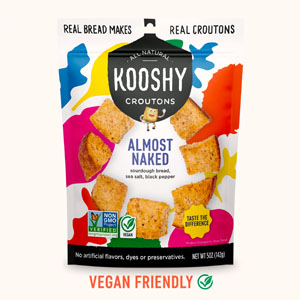
[00:17:10] Jacqui Brugliera: And I think there's also like plenty of real-world examples in CPG that have, you know, happened that you can and should research if you're Curious. Don't say it. I wasn't going to say it. I was just going to say maybe this is a good use of, you know, asking AI to do that instead of making an image. But that said, one of my muses is on the table over here, Ray. Yeah, I did the transition this time. Let's talk about some products. So one of my AI muses, as you know, I've been making collaborations on AI and with Hay Heyday Canning, because I think canning everything is hilarious. And posting them on Instagram. Posting them on Instagram. One of the brands has a really cool mascot. The brand is called Cushy. And they make croutons and they've got like the K-O-O-S-H-Y. And they've got a little, they've got a little crouton monster who's very happy and very fun to make AIF. So they've sent us a bunch of product here. We've got their Poco Picante, which is chili lime croutons. They've got Mambo Italiano, which is sourdough bread with sea salt, garlic, basil, Parmesan, French toast, sweet croutons, sourdough bread, maple sugar, and Saigon cinnamon, and Almost Naked.
[00:18:25] Ray Latif: Now, do these need to be put on salads or can you just snack on them? I think you can probably just pop them if you want to.
[00:18:31] John Craven: Yeah, they're snackable.
[00:18:32] Jacqui Brugliera: They're for salads, snoop. Have you tried them?
[00:18:34] John Craven: Yeah, I tried them at Expo and they're really tasty.
[00:18:39] Jacqui Brugliera: I'm really excited to dig into these. So thanks, Cushy, for sending us croutons.
[00:18:44] John Craven: It's cool that they have, um, both sweet and savory options too. And if you go to like the crouton section, I mean, you're not really seeing much innovation, so.
[00:18:54] Jacqui Brugliera: Dang, hater on the crouton section. I mean, this is definitely the most outstanding brand in the crouton section right now in terms of just fun.
[00:19:04] Mike Schneider: Mm-hmm.
[00:19:05] Jacqui Brugliera: How about these Julie's Date Pops?
[00:19:09] Ray Latif: Julie's is spelled J-O-L-L-I-E, and they're a brand of? Tell us, Ray.
[00:19:14] Jacqui Brugliera: Well, Dates and Date Snacks. Dates and Date Snacks. Well, now, yeah, Date Snacks. I mean, I love this classic playbook of add chocolate and make something super tasty. They're kind of like those little one-bite brownies, but like
[00:19:28] Ray Latif: Super micro sized and by they're kind of like the the in John statement there is their new line of date pops Yeah, yeah, I'm busy chewing. Yeah, which look like I think they use them I like the fact that they use the word pops because they could also be called date balls.
[00:19:47] Jacqui Brugliera: You know They were like cake pops. I thought they were gonna have a stick, but they don't I I would've gone with date bites. Date bites? Maybe, I don't know, maybe that's a trademark thing. Okay, maybe. But yeah, these are good. I mean, they basically taste like little brownies. You really cannot taste the dates in here. I think there's a little bit of it to the texture, but that's it. I mean, it tastes like a brownie and they've got a couple of other flavors. I just went straight for this one, so.
[00:20:11] Ray Latif: What do you think of the description as an energy bite? A date and nut energy bite, which is at the bottom of the front of the pack.
[00:20:17] Jacqui Brugliera: I don't know that people are going to go right for Energy Bite because the Hero is definitely the flavor callout and the pop itself. I think I'd put more than one on the front. But that said, I mean, I think- More than one pop on the front. Yeah, there's only one. And then next to it is like a flavor callout. There's peanut- I have peanut butter and jelly and lemon bar in my hand here. But I think to answer your question, though, I would almost rather like snacking bites than energy bites. They don't have any caffeine, as far as I know, so. Right. Give me a giant bag. Tell me they're for snacking. Isn't that what you want?
[00:20:49] John Craven: And is the energy coming from, I mean, the sugar of the date, right?
[00:20:54] Jacqui Brugliera: It appears to be, yes.
[00:20:57] Ray Latif: Yeah, I understand what you're doing, trying to add functionality to these snacks, but yeah, I think they probably don't necessarily need that.
[00:21:05] John Craven: Yeah, especially if it tastes great. I mean, people are going to come back for the taste, not the function.
[00:21:12] Ray Latif: That's a good point, Jackie.
[00:21:13] Jacqui Brugliera: Who's ready for a beverage? Lemon tastes really good. And I've had the peanut butter and jelly yesterday. I'm going to have another one. These are good. They taste like a peanut butter and jelly sandwich.
[00:21:24] John Craven: So over here on the West Coast, I finally received my snacks. All right. You all have tried, but I have not.
[00:21:31] Ray Latif: M-Y-N-A.
[00:21:33] John Craven: Yeah. M-Y-N-A. And this is midnight mini cookies. So they come in a four pack, but they're all the same flavor and they're delicious. They taste like Oreos. Tasty, tasty Oreos. And I'm not really an Oreo fan. So that's saying something. But I was catching up on all the drama because I guess Pokimane, the Twitch streamer who launched this brand, was calling out some broke boys because they didn't want to spend $7 a bag. She eventually apologized, but it's just funny.
[00:22:01] Jacqui Brugliera: They were trolling the heck out of her, though. They deserved it. They were just like, oh, they're all jealous because she is who she is and she does what she does and they can't. So they're just like trying to figure out ways to bring her down.
[00:22:10] John Craven: I mean, that's the online world. And that's like streamers. They're like, they're used to the trolls.
[00:22:16] Jacqui Brugliera: Yeah. Can we have a beverage now? Yeah, go ahead. So in honor of dry January, which I'm not and never will be doing, I have the latest from Santa Cristus, which is a phony espresso Negroni. Oh, yeah. So I'm going to pop this open here. Yeah, while you're popping that open.
[00:22:34] Ray Latif: All right vintage Bev net bottle opener merch Lincoln bio the phony mezcal Negroni was a winner Recipient of Bev nets best of 2023 awards.
[00:22:47] Jacqui Brugliera: Well. I would be willing to rescind that award and give it to this one Oh really okay? No, I mean they're they're different, but it's kind of interesting because this does not look like a coffee drink right now It looks like a Negroni that is outstanding It's really good. I, you know, I would drink this all the time, which I bought a case of it, so I guess I will.
[00:23:07] Ray Latif: Yeah, it's interesting because an espresso martini is typically very dark and viscous. This is carbonated and looks more like a soda.
[00:23:15] Jacqui Brugliera: Well, typically, if you make like a coffee Negroni, you infuse the vermouth with like coffee beans, which doesn't actually have the result of like an espresso martini. So to get into this, like, I kind of think that's what they were going for. Are they using coffee flavor? You know, well, one complaint, I have this microscopic nutrition facts panel, especially because it's we can't read it. It says 44 calories, but it's actually two servings. But outside of that, I don't know. Phenomenal products, even at 88 calories per bottle as like a non-alcoholic cocktail. This is pretty damn awesome. So I'm definitely not willing to have it overtake the phony Mezcal Negroni as top phony Negroni, but this one's pretty outstanding.
[00:23:59] Ray Latif: I sipped on a canned cocktail myself. This one is definitely not non-alcoholic. This product is called, or the brand is called Bad Idea. This is a lemonade mixed with premium vodka and barrel whiskey. In fact, that's exactly what it says on the side of the can and describes that formulation as a Bad Idea. On the back it says, crack open a Bad Idea, think of a good one, cbx.com. CBX apparently is a design agency that's based in New York City and Minneapolis. Would not have expected that.
[00:24:31] Jacqui Brugliera: Was it a Bad Idea that they launched a beverage then? I don't know, but probably the Bad Idea.
[00:24:35] Ray Latif: This is such a weird beverage because I tried some the other day and frankly, I didn't love it, but it's such a good beverage. I don't know. Does that make sense? Not really, but it's a very well formulated beverage. It just, it tastes right. If that makes any sense. It's just not for you.
[00:24:52] Jacqui Brugliera: It's just not for me. Gotcha. Yeah. Yeah.
[00:24:54] Ray Latif: I really like it, but I don't, I'm not going to drink it.
[00:24:58] Jacqui Brugliera: I have something else you might like, Ray. Oh, boy. So, you know, Ray, big fan of the Altoids and the Listerine strips at trade shows. Definitely not Altoids. No, Altoids will give you cavities. I said it there. I said it Okay, let's let's say breath mints and breath strips. Can we agree on that that you're a fan of those breast strips? Okay, it's the only it's the only blue like swear. You've got anything anyway something blue anyway, I found the new thing to freshen your breath, which is the Miller Lite beer mints Invite you all to try one the inside says it tastes like Miller Lite Like stale stale beer bro artificially flavored so you know on the spirit of ultra processed here Mike you should This is your chance to use your favorite word, bro
[00:25:47] John Craven: But does it make your breath smell like beer? You can't eat those while you're driving, you know?
[00:25:53] Ray Latif: Did you just crunch right into that? Yeah, I want to know what it tastes like. Okay, there's definitely a divide in terms of people who crunch immediately on breath mints and those who just suck on them.
[00:26:03] Jacqui Brugliera: Well, I mean, in this case, you kind of want to crunch on it because you got to get the full strength. I'm not a breath mint cruncher.
[00:26:09] Ray Latif: This is Pierce Will. Now, see, Jackie and I are actually... You could, like, break your teeth. Exactly. Yes, you could break your teeth.
[00:26:16] Jacqui Brugliera: I don't know what your teeth are made out of, but these are pretty soft mints, so... Mine are made out of... No one's breaking any teeth here. I've chipped the same material as Thor's hammer. That's messed up. There we go.
[00:26:26] John Craven: How is it?
[00:26:27] Ray Latif: It's swell.
[00:26:28] John Craven: It tastes like beer.
[00:26:29] Ray Latif: It's awful. I can see Mike now. Officer, it's a breath mint.
[00:26:35] John Craven: Exactly.
[00:26:36] Ray Latif: It doesn't even taste like a mint. What is that? That's horrible.
[00:26:40] Jacqui Brugliera: Well, I'm definitely keeping the tin as a souvenir. That's pretty comical.
[00:26:47] Ray Latif: All right, it's time to get to our featured interview for this episode. As I mentioned at the top of the show, Mike and Janell Bass are the founders of Ponyboy Slings, an upstart brand of bourbon-based canned cocktails that won BevNET's 2023 Cocktail Showdown. In the following conversation, I spoke with Mike and Janell about how they assessed the opportunity to participate in the competition, why aligning presentation and stage performance was critical to their victory, how creating a list of potential judges' questions was a key part of their preparation, and why they encouraged Pitch Slam contenders to practice their pitch while washing dishes. Hey folks, it's Ray with Taste Radio. Right now, once again, honored to be sitting down with Mike and Janell Bass, the co-founders of Pony Ponyboy Slings. Mike, Janelle, great to see you. See you too.
[00:27:43] Janell Bass: Good to see you. Thanks for having us.
[00:27:46] Ray Latif: I wish I were there with you recording live and in person because where you are right now, it looks like the coolest place I've ever seen.
[00:27:54] Janell Bass: Well, you know, who knew that a little bit of tinsel can make a basement, you know, really pop.
[00:28:01] Ray Latif: You turned your basement into a fully functional bar and a really amazing one at that.
[00:28:07] Janell Bass: Yes, thank you. I know we, from all the consulting that we've done, we've got a ton of booze and we were like, well, let's make our basement into a pony bar. So here we are, 70s lounge and pony bar.
[00:28:22] Ponyboy Slings: Full disco ball, dance floor with lights, DJ booth. So we are in operation.
[00:28:31] Ray Latif: Very on brand. I've never been to a bar that is 70s themed. Actually, I take that back. I think there's a bar in Manhattan called Ray's Bar, which is a bit of a dive bar, intentionally developed dive bar. It has sort of a 70s kind of vibe, but Ponyboy Slings as a brand is very much influenced by 70s trends. Why is that?
[00:28:51] Janell Bass: Yeah.
[00:28:51] Ponyboy Slings: I mean, I'm a product of the 70s, not to date myself.
[00:28:56] Janell Bass: You know, the 70s retro vibe that we chose to go with was really because when we were creating this brand, at the end of the day, we're bourbon in a can. So we were like, OK, we can't take ourselves super serious. We want to make this fun and relaxed and just give it that kind of free vibe. And so the 70s just really kind of hones that for us like this nostalgic, fun a spirit that's usually c
[00:29:35] Ray Latif: Yeah, I mean, well, your cocktails are very classy in that they taste amazing. We've talked about this, I don't know how many times in the podcast at this point. As I mentioned in the intro, Ponyboy Slings is the winner of our 2023 Cocktail Showdown. And that's one of the reasons I wanted to talk to you guys today was identifying this opportunity to be on stage at BevNET Live, preparing for that opportunity, and then ultimately executing on stage. And there's a lot that goes into it. I mean, a lot of people listening have had an opportunity to apply for a Pitch Slam competition. Sometimes they actually make it into that competition, sometimes they don't. But when they do, being on stage is great for awareness. Winning a competition is really great for a number of reasons. I want to break down your process for, number one, thinking about whether the opportunity and the timing was right to apply for this competition. What was that conversation like?
[00:30:37] Janell Bass: Yeah, I think for us, you know, we had really taken our time and so much time, you know, to formulate and to get it right. So when we hit the market, we were like, Okay, let's do this, you know, and then, because it was in July, and the competition was in December, we were like, Okay, are we too young is, you know, is this too early? But at the end of the day, what you guys highlight is new and emerging RTD brands. And I'm like, we're so proud of what we produced. We're in market. We're getting lots of feedback every single day. Let's just go into it and just do our best and hit the ground running. And we just keep making that choice as we've launched. We're not trying to hold back in a lot of ways. If an opportunity pops up, we're trying to say yes. And, you know, and continue down that road. So I think we're like, okay, let's just do it. Let's go all in. And when we made the decision to apply, we always joke, like, we've known you guys for a while now, you guys had no idea who we were. And so, you know, we were just like, let's, let's go for it. And when we got accepted, we were like, holy cow, oh my gosh, okay, we gotta get plane tickets! We gotta get plane tickets! And so that's kind of how, you know, it got to that point, I feel like, yeah.
[00:32:02] Ray Latif: I think there was something that you both said when we last spoke about this was your one shot. We knew we had one shot to get this right. And that can evoke fear and can evoke anxiety, but it can also be a reason to be buttoned up and as prepared as possible.
[00:32:23] Ponyboy Slings: My preparation was, you know, going back to and re-watching the showdowns, and listening to the judges' feedback again, and then kind of preparing, like, okay, let's have a preparation for any question that can come our way. And we pretty much came up with a list and just would stem from that and just have our answers and be able to have a quick reply to it and not get caught. Standing on the stage after a judge said something that may have rubbed you the wrong way, I mean, preparing ourselves for that. And if someone were to say something about the taste of our product and how not to take it to heart and just really take it for face value and as constructive criticism and just prepare for anything that could come our way.
[00:33:15] Ray Latif: So those lists of questions, was that list created in form before you created your presentation, your slides for the competition?
[00:33:24] Ponyboy Slings: I think I was kind of working on those while you were kind of dialing out an outline of how we were going to do this.
[00:33:32] Janell Bass: Yeah, I think it was around the same time because going back to what you said about how when we were talking before we talked about this one shot, I think you're exactly right that that can either cause anxiety or it can really like light a fire and truly it's a choice. I think at the end of the day for us when we're like okay we have one shot why wouldn't we do our very best, you know, go at this saying, guess what? We don't have to win, but we're going to go in there and we're going to make fans. We're going to make fans in that room. We're going to book the room. We don't have to book the job. Right. And so if you kind of go at it like that, it takes a little bit of that pressure off. And it allows you to just go be your, your best self so when Mike was making a list of all the questions and how we would answer that because we, you know, it is, it's always jarring when when you're on a stage. I think it was around the same time we were thinking about. No one knows who we are. And if we're going to make this presentation, how do we want to structure it? And a lot of times we see that people right out the gate will go, Hi, we are so on. So this is what we do. This is our background or this is what we want. This is, you know, our accolades. For us, we were like, no one cares about us yet, you know, but I'm going to tell you why we're here. Like, here's our drinks, you know, this is what it is, what we've created, you know, and then we can say, okay, why did we do that? How did we do that? And so it was just a matter of thinking about how we wanted to structure ourselves so that people would actually be interested and curious, I think, too.
[00:35:22] Ray Latif: I think, and this just came to me, I think one thing that really separated you both from your competition and in some ways from a lot of other brands and founders that I've seen on stage at the variety of our competitions is that the presentation was as much a performance as it was a presentation. How did you think about weighing and balancing the two, you know, giving as much information as you felt like was needed to explain what you were doing to the judges and the audience, but also making it entertaining and fun for people watching?
[00:35:59] Ponyboy Slings: Janelle comes from a background of performing in Hollywood. So we kind of chose her to take the lead on it.
[00:36:07] Janell Bass: Honestly, though, I will say, yeah, coming from a performance background, you know, and I did comedy for a while. So it's about getting people's attention and holding it because it's hard to do. So I think the performance aspect of a presentation, especially in the alcohol world, it's almost like, why not? We could kind of go in there and be a little more informational. But at the end of the day, we're making tanned bourbon cocktails. I rather you have fun watching it than you feel like you're sitting through a lecture. And so I think when you think of it in that type of way, you are presenting this to people, you are kind of trying to entertain a little bit, rather than inform, you can go on a website and get lots of information. But if you're going to watch me on a stage, you better believe I'm going to make it more fun and worthwhile. But that doesn't mean that people who haven't had that experience performing can't go up there and do it. I mean, I think a big thing with this and people don't do it is memorizing. I think a lot of people think, OK, well, I've got the slides. I talk about it all the time. This will be easy. I can just get up there and talk about my product. But at the end of the day, it's like you're on a stage with bright lights. There's a ton of people watching you. Everything changes. And I don't think people fully know. So, yeah, I mean, I could go on and on about it.
[00:37:39] Ponyboy Slings: Obviously, when during the presentation, it was like, okay, well, the memorizing part, I can memorize, but as soon as I get up there, I mean, I do get a little stage fright. So we just kind of nip that and we're like, let's just have our two strengths here and if I'm going to read off notes or resort to notes then just do it because it's a lot better than getting up there and try to memorize because you know how you kind of spiral out if all of a sudden you forget what you're talking about and then you're standing there. Janelle's you know she kind of kept reiterating that don't worry about the judge part just get up there and be yourself and talk about it so that's My joke kind of in the presentation was I'm more of a cue card kind of guy, so I'm going to stick to the notes and got a little laugh from that. And then it's like you get that comfort. OK, let's roll with that now.
[00:38:33] Janell Bass: Yeah. Playing to your strengths.
[00:38:35] Ray Latif: Absolutely. And play off each other well, which you did. You know, Janelle, you walked up and down and across the stage. Mike, you kind of stuck to the podium, but it was almost like, okay, Janelle, we're going to light up the room. Mike, we're going to talk about how we created this product. And you got great information from each of you. Again, but getting up on stage, you never know how you're going to do until you get up there. But it does help to be on the stage and to feel the podium and to touch the clicker and all these things. That was something, Janelle, that you brought up the last time we spoke, was that it's so important, however you get up there, to get up there before your actual presentation.
[00:39:14] Janell Bass: Yeah, that would be one of my tips and tricks to performing is stand on the stage beforehand. Get there a few hours before or whenever. They could be building the stage, but get both of your feet on that stage. Feel the light on you. Just feel that because it's shocking if you've never felt it and there's no way to necessarily prepare for it because every stage is different. but getting on the stage early. And then if you're going to be using a clicker or whatever you're using on stage, feel that in your hand and know how to know how to use it beforehand, especially if it's time, because it's, you know, that's a waste of time. If you're going, Oh, wait, what do I do? How do I click? And it's so easy to do that because you've never held it before. So if you can get on the stage, touch the things you're going to be touching a podium a clicker know that your judges are on the left side or the right side you know your screens here just getting your bearings down will help tremendously so when you do go up there it's not the first time it just instills a little more confidence and Even someone who's performed a bunch I still get nervous and any tip and trick I can share with people I'm happy to because at the end of the day, we all we all win by someone presenting well we were rooting for them in our seat.
[00:40:38] Ponyboy Slings: And make sure you ask the crew first. You're going to have eight to 10 different teams just all crowded up in there.
[00:40:46] Janell Bass: Yeah, yeah. Liability reason to ask the crew.
[00:40:50] Ray Latif: Yeah. Well, it definitely helps for practice. If you're on that stage and you can feel that clicker, you can feel the podium. the handheld microphone, which a lot of people aren't. Well, in our case, we had handheld microphones, which a lot of people aren't familiar with, or when they did their run-throughs, they might not have been holding something in their hand, whether it be, I don't know, you could hold a rolling pin in your hand, just to get a sense of like what it's going to feel like and how are you going to be able to holding it up to your mouth when you're speaking. But practice is really helpful and you have to practice quite a bit. What was your practice schedule? What was your routine like two weeks in and then, you know, even the night before and day of?
[00:41:26] Ponyboy Slings: I do my best work on a deadline. So I was more of going over, you know, the questions and all that. And I could hear Janelle for, you know, a week prior practicing while she was doing the dishes or whatnot. But yeah, that was her method.
[00:41:42] Ray Latif: Can I pause there for a second? While she was doing the dishes, that is, no, but I think that's important because like, I think some people will carve out time, you know, they'll say, okay, from, you know, in the morning or in the evening, I'm going to work on my presentation. But it seemed like working on your presentation all the time made it like just second nature.
[00:42:04] Janell Bass: Yes. And another huge tip, do it over and over and over. Even if you're a cue card guy and you want your notes, do it when you're doing other things so that those distractions that come up don't even matter. You've still got the flow. You're working that muscle. And so I would do it during the dishes. with the TV on holding my dog whiskey, you know, I do it driving. My best friend was like, come over. And while I was there, her three kids were eating their, you know, chicken nuggets. They had a movie going on. Her husband was doing the dishes. And she was like, Oh, do your do your pitch. And normally, I think people would be like, I'm not gonna do it right now. And I was like, thank you for asking. And I just did the whole thing. You know, while they're doing all this stuff, or three year olds running up with their arms up, and I picked her up, and I just didn't stop. I just kept going, even if I stuttered, because you want to also practice if you mess up, how you keep going. Don't start over. If you mess up, keep going. don't keep starting over from the beginning, because if you mess up on stage, that will throw you off. And if you know how to keep rolling with it, if you stutter, or you say a word wrong, or you switch something up, I mean, you will get on that stage and feel like a pro, because you'll be like, oh, I've done this a million times.
[00:43:28] Ray Latif: Absolutely.
[00:43:29] Ponyboy Slings: As much as you think they do, the audience and those you're speaking to usually don't notice. It's just all, a lot of it's in your own head.
[00:43:37] Ray Latif: Yeah. Yeah. Going back to you, Mike, your preparation and going over the questions that you might've expected to hear and being on a deadline or doing your best work on a deadline, was most of your practice, was most of your practice, did that happen, you know, the day before or did you feel like you were fully prepared even that before that, you know, that day and day of?
[00:44:00] Ponyboy Slings: I did because we were. We were practicing enough to where I was, we got, what was it, a few days prior, we started the time practicing for the five minutes. So then it was like, okay, we're doing this. How can I, I took all my bullet points basically and trimmed them down to how can I get all this information out there? And I think my slot that we had timed out was like two minutes. So Janelle came in for the first three, I did, A minute 50 and then she closed it out 10 seconds. So that was our those were our bookends that we had to get all the information in. So, basically, I was just coming up with notes and then timing those notes. I did a lot of it just reading in my head watch on my phone doing a timer. which by the way, everyone out there should know that when you time it on your phone and you're practicing, the timer on stage counts down. So if you're, you're counting forward, I'm like, okay, at the three minute mark, that's when I'm ready to roll, you know, and then all of a sudden we get up there and it's counting down and like, oh, shoot, there's the three minutes. It was actually. Yeah.
[00:45:12] Ray Latif: Did you prepare for potentially being over time or, you know, getting up to a point where you only had 20 seconds left but had three more slides and what you would do in that instance?
[00:45:23] Janell Bass: We did not.
[00:45:24] Ponyboy Slings: We did not, no.
[00:45:25] Janell Bass: Because we practiced so hard to get it at our times. But we didn't do a five-minute presentation. We did a four-minute and 50-second presentation. So we gave ourselves 10 seconds of leeway. And you could do that 10, 20 seconds, right? But we did it because I had done my part so many times. that I had it down pretty much right after three. And then since he was reading, it allowed him to have a little bit more leeway.
[00:45:55] Ray Latif: You can get up on stage, answer any questions, defend your brand and be proud of what you're presenting. You know, in terms of advice to folks listening who are thinking about a pitch lamp, but are not completely there as it relates to their product or branding. I mean, is this something where you're like, yeah, maybe wait, maybe wait a few months, maybe wait till the next cycle.
[00:46:17] Janell Bass: Oh yeah.
[00:46:18] Ponyboy Slings: I mean, a lot of that comes from us doing in-store tastings, I think, and just getting feedback that way. We're like, we're not really getting a lot of negative feedback. And the slight feedback we get sometimes is, you know, what the judges pointed out as far as two of our SKUs, the Cherry.
[00:46:38] Janell Bass: The labels.
[00:46:38] Ponyboy Slings: Yeah, the labels are sort of similar. But when you, in a bar, we were starting to notice that when we were I was doing a tasting with somebody in a room that had some low light. It was actually in a hotel lobby. And I'm like, man, with this lighting in here, in a bar situation, these look almost identical. And that was their feedback. So that was the feedback we were getting. And that's why when they said it on stage, we're like, we've heard this and we're working on it.
[00:47:06] Janell Bass: But yeah, I think that honestly, it goes back to the one shot. If you're going to get up there and you're going to talk about your brand, get to the point where you love your brand, you love your product, you love your labels, you love, you know, what you're doing with it, because that will show and it's infectious. And so to me, if you're not quite sure about your packaging yet, or you feel like you want to do a different iteration, as far as taste, wait till you feel really solid and then go for it and go all the way because that will help your confidence tenfold. That's why we took a year and a half, almost two years before we even hit market because I told Mike, I'm like, if I'm not craving this when we're not making it ourselves, we're not there yet. And if we can't stand as bartenders and have our bartending peers drink this and be excited for them to taste it, right? Or even get out into the social media world with our cans and our content. We're not ready yet. Because again, you get one shot to just go for it. You might as well prepare and get to a point that you feel awesome so that other people can feel confident and feel that awesomeness too. Because if you don't love your product, then you can't ask anybody else to love it, you know? So I think you have to definitely get to that point. you
[00:48:30] Ray Latif: That's a really good point. And you guys, I think in so many ways you're saying you got to go big in these competitions or go home. And you guys kind of did both. You, you went big and you went home, but you went home with a trophy and you went home with a title of 2023 BevNET Cocktail Showdown winners. And, uh, it's great. It's great. I mean, I've, I'm so happy for you guys and I'm so happy for the brand and I'm delighted and very appreciative that you took the time to sit down with me today. Thank you so much for sharing so much insight and advice and guidance for other brands and for founders and entrepreneurs who are considering a Pitch Slam competition. It's such helpful information, and I know people are going to enjoy hearing it.
[00:49:15] Janell Bass: Absolutely. Thank you so much for having us. And we're an open book. If anybody, you know, wants more tips and advice, please feel free to reach out to us.
[00:49:25] Ponyboy Slings: We will email you back.
[00:49:31] Ray Latif: That brings us to the end of this episode of Taste Radio. Thank you so much for listening. Taste Radio is a production of BevNET.com, Incorporated. Our audio engineer for Taste Radio is Joe Cracci. Our technical director is Joshua Pratt, and our video editor is Ryan Galang. Our social marketing manager is Amanda Smerlinski, and our designer is Amanda Huang. Just a reminder, if you like what you hear on Taste Radio, please share the podcast with friends and colleagues. And of course, we would love it if you could review us on the Apple Podcasts app or your listening platform of choice. Check us out on Instagram. Our handle is bevnettasteradio. As always, for questions, comments, ideas for future podcasts, please send us an email to ask at Taste Radio.com. On behalf of the entire Taste Radio team, thank you for listening, and we'll talk to you next time.
[00:50:21] Mike Schneider: you