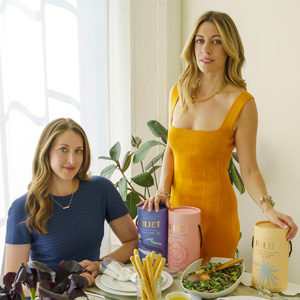
[00:00:10] Ray Latif: Hello, friends. I'm Ray Latif, and you're listening to the number one podcast for the food and beverage industry, Taste Radio. This episode features an interview with Allison Luvera and De Niro Pipher, the co-founders of innovative wine brand, Juliet. Juliet Wine the result of two entrepreneurs who literally thought outside the box. A first-to-market brand of multi-serve wine packaged in a cylindrical container, Juliet was founded by Allison Luvera and De Niro Pipher, who saw white space for a sustainable wine brand differentiated by quality, taste, and design. Juliet debuted in July 2022 and markets three varietals, Pinot Noir, Sauvignon Blanc and Dry Rose. Similar to boxed wine, the liquid is held in a plastic bladder with an attached spout, but is differentiated by its svelte round carton which comes with a black strap. The package was designed to evoke the style and sophistication of luxury fashion brands. In the following interview, I spoke with Allison and Lauren about how they assessed the opportunity to disrupt a legacy category, why developing a unique package was central to the planning process, and how they have positioned Juliet as a lifestyle brand. Hey, folks, it's Ray Latif with Taste Radio. Right now, I'm honored to be sitting down with the co-founders of Juliet Wine, Allison Luvera and De DeNiro-Pyfer. Lauren, Allison, great to see you.
[00:01:46] Juliet Wine: Great to see you, Ray. Thanks for having us. Yes, great to be here. Thank you.
[00:01:50] Ray Latif: I am very excited to speak with you both because Juliet has become one of my favorite brands of late. Just a remarkable wine brand, lifestyle company in so many ways. It's just a really, really cool thing that you've built. And when I think about boxed wine, and I'm sure when our audience thinks about boxed wine, they think about cheap, in some cases, almost undrinkable swill. And Juliet Wine the complete antithesis of that. First of all, it comes in a cylinder. So technically it's not even a boxed wine. Did you ever try to separate the association just in terms of nomenclature from, you know, boxed wine to what Juliet Wine?
[00:02:36] Juliet Wine: We did, yes. When we first created our Eco Magnum, which is what we call our cylindrical tube, we really didn't want to call it a box wine because we felt that what we had created really transcended the box wine category or the box wine name and so we were a little bit resistant at first to calling it boxed wine. But what we found in the early days of our company was that unless we said boxed wine, there wasn't that association that there was actually wine inside. People were looking at the Eco Magnum and not really understanding, okay, there's a pouch of wine in there. We were getting a lot of questions about, is there a bottle of wine in there? And so We felt like we had to really just embrace the name Boxed Wine in order to help consumers make that connection between what we're trying to do as a luxury version of this format that everybody kind of knows and recognizes.
[00:03:41] Ray Latif: The Ecomagnum is definitely a new term, I think. Is that a term that you guys have trademarked?
[00:03:47] Allison Luvera: It is.
[00:03:48] Ray Latif: Yeah. I mean, hopefully it'll catch on at some point, but I understand why at this point you do need to associate it with a known package. That being said, again, it is very, very different from what we've seen in the past. Lauren, when you were looking at wine as a potential business, as a potential business to launch a brand, what really piqued your interest first and foremost? And how did you see an opportunity to innovate and disrupt this segment of boxed wine?
[00:04:21] Allison Luvera: Yeah, well, Allison and I have known each other for 20 years and we've both been wine enthusiasts and shared a real passion for the category for the duration of our friendship. And we were having a conversation about some of the benefits of boxed wine and how it has these incredible attributes. It's long lasting, it's sustainable, it's portable, it's very convenient. And there wasn't a boxed wine on the market that either of us wanted to drink frankly. wasn't a version of this enough that either of us it in our refrigerator or a gift to someone else. So the category and realized true opportunity to create the first luxury boxed wine, the first boxed wine with an uncompromising commitment to quality and sustainability and design.
[00:05:19] Ray Latif: Now, certainly there have been premium and super premium versions of boxed wine prior to the debut of Juliet. And at that price point of $35 and up, I've had some good boxed wine, but I've never had a boxed wine that was as beautifully packaged and felt as luxurious, I would say, as what Juliet offers. So, when you're thinking about the opportunity Were you thinking about the liquid first? Were you thinking about the brand or the package? In my mind, it starts with a package, but Allison, where did you guys start?
[00:05:56] Juliet Wine: You're exactly right. We started with the packaging because we recognized very early on that in order to really achieve our goal of kind of transcending the category and being this truly luxury product, that we needed to create something that was unlike anything else on the market. And so we did focus on the packaging first, but hand in hand with that was the focus on the brand and in particular, the creative direction behind the brand. Because as you mentioned, there are some good box wines here or there, but none of them have this sort of commitment to design and this beautiful exterior like we do. And we didn't really see that combination out there of a box wine that had very high quality liquid, but then also had a really eye-catching, beautifully designed packaging. And so we knew that in order to kind of achieve our goal of crushing this stigma, this negative stigma against boxed wine, we had to nail the packaging first and in turn the brand and the creative design.
[00:07:03] Ray Latif: It's one thing to say, okay, we're going to create this different, disruptive, beautiful looking package and another thing to actually execute upon that. Lauren, I'm curious how many iterations you went through before you landed on what is now your package?
[00:07:19] Allison Luvera: Oh, many. You know, I'll be very honest, as we always will be. We started working with a design agency and we had some frustration there because we had really spent a lot of time developing a clear vision for the brand and really understood that we wanted this strong aesthetic of femininity, something that conveyed energy, elegance, something that was inspiring and something that transported the consumer to one of mine and Allison's favorite places in the world, which is the Mediterranean coastline. And we wanted to have this classic timelessness that was inspired by the south of Italy and France. And we also knew that the vessel itself needed to convey our position in the market, which is truly bridging the gap between boxed and bottled wines. So we did originally start with a design agency to help us to crystallize this vision into a reality. It ended up not working out. We very fortunately were introduced to two young female independent graphic designers in Los Angeles working together for many many late nights. They were able to take our ideas, our vision, and turn them into a reality. And we ended up with this beautiful cylindrical package design, and the aesthetic, and the color palette, and the art deco inspiration of the label is really exactly what we wanted. And I am very, very proud to say that I don't think we could have asked for more, honestly. And I think that's unusual, coming from a creative person, that someone actually managed to to bring your dream to fruition from a design perspective. And I think that we nailed it.
[00:09:04] Ray Latif: Yeah, you know, in CPG and particularly in food and beverage, it feels like coming out of the gate with a great package and a great label design is table stakes. You don't have time to get that second opportunity for a consumer to look at you and say, oh yeah, I remember now you have better packaging. You've got to have that great packaging to start with. But great packaging and hiring design agencies and finding the right people can be tedious and expensive. And it sounds like it didn't work out with your first design firm, but it worked out with the two women that you worked with in Los Angeles. That can be a tough call to say, okay, we've already paid all this money out to a design firm, but we don't accept anything that you're offering us at this point. And again, it can cost a lot of money. Did you feel like you were taking a leap of faith and saying, no, we're going to, you know, switch courses here. We're going to take a different tack. Lauren, I mean, again, you know, for early stage entrepreneurs where money isn't, you know, you don't have an unlimited budget. How tough of a decision was that to make?
[00:10:01] Allison Luvera: there was apprehension involved. It was I believe it was the first check that we had written as a company or one of the very first checks that we'd written. But we felt really strongly in the vision that we had for how we wanted this brand to turn out. And after providing clear direction and just not seeing that come to fruition on the page and renderings. Allison and I trust each other enough that We made the decision together and it was a pretty clear decision. And I think something else that we knew is we didn't need this package design and label design to follow the trends. We didn't need this to look like what the most popular other brands and especially other beverage and Bev Alk brands were doing today. We knew how we wanted this to turn out and we stuck with it. And I'm pleased that we did.
[00:10:52] Ray Latif: I've tasted some bad, bad food and beverages that have had just delightful packaging, and it's unfortunate. So getting the liquid right was just as important. What was that process like? Sourcing, wine? that you knew you wanted to be, again, reflective of this beautiful package, but also consistent enough so that you could have that customer understand what they were going to get from year to year. I know that's tough in wine because that's the whole vintage aspect of wine, but it seems like Juliet Wine set up to be something where there is some consistency in what consumers are getting from year to year.
[00:11:32] Juliet Wine: Yeah, we were just very specific about what we were looking for in winemaking partners and in the wine that we created. And I think that helped having different criteria in mind when we were really doing our outreach in the industry to look for partners to help us bring this to life. That was key to getting what we wanted out of it, which it sounds very simple, stupid, but you know, I don't always approach things that way. I think people don't sometimes. So we knew a couple of things. We knew that it was important that we worked with people that had sustainability certifications. So the winery that Julia is made at has a certified sustainable, is a certified sustainable winery. That was really important to us. We really were interested in the central coast of California. We like the style of wine coming out of that region as a whole. That's a generalization, but We like a lot of things that are going on there in terms of having a little bit of an eye to Europe with the winemaking style, having a low intervention winemaking style, producing wines that are fresh and bright and approachable, which is a style that works really well in boxed wine. And so we also knew which varietals we were interested in, and we knew that we wanted them to be reflective of place, so that we didn't have to use a lot of additives in order to get sort of a commercial style wine. So with all of that in mind, we kind of just went out to our network in the wine industry with sort of a winemaking brief, if you will, and worked our contacts and ended up meeting with a few different partners that could potentially help us with this. You know, we found somebody that was already making their own wines that were similar in style and price point and provenance to what we were looking for. And so we were fortunate enough to get into business with them.
[00:13:24] Ray Latif: I mean, we kind of skipped over your backgrounds, but it sounds like you did have some, if not quite a bit of experience in the wine business prior to launching Juliet.
[00:13:34] Juliet Wine: I have some. Yes, I spent about half my career in fashion and media and then the latter half of my career in wine and spirits. So I worked at Pernod Ricard for many years. I was working in their luxury division. So I worked on Paris Jouet Champagne. That's my primary wine experience. but both of us just as Lauren De think mentioned before have been very passionate about wine as consumers for a long long time and so if you are passionate about wine like that and you know you you get really into the different producers and you go visit the different regions you do tend to develop a network. And so the person that actually introduced us to what ended up being our winemaking team, funny enough, was somebody I knew because I'm a member of their wine club. So that was like totally unrelated to my career. I just happened to love their wines. I'd been up to their winery many times. I shot them an email just saying, hey, we're looking for X, Y, and Z to get a new wine brand off the ground. And he ended up introducing me to the people that we ended up working with.
[00:14:39] Ray Latif: I feel like having some experience prior to getting into entrepreneurship or some experience in a particular category industry prior to getting into entrepreneurship gives you a leg up. But then some entrepreneurs have said, you know, it was better to be naive about the category of the business that I was getting into. Lauren De it give you more confidence knowing that Allison had this experience?
[00:14:58] Allison Luvera: It absolutely gave me a lot more confidence getting into this endeavor alongside Allison, knowing that she had the experience that she did in Wine and Spirits. My background professionally is in luxury sales and design, so my wine knowledge is limited to the consumer perspective. I started traveling and visiting vineyards with my family when I was in my late teens. in California and Italy a I developed a passion an I was quite young, but my much more limited than Al that we've realized, you at the table, for example and we're going through t I find that it actually is beneficial that one of us has more technical knowledge of the process and the other one of us being me is coming at this from more of a consumer standpoint. Probably a slightly above average from an educational perspective on one consumer standpoint but still consumer. And so we're looking at the products and we're assessing them as we're blending. from different angles. And I think that that's going to continue to help us produce something that is both commercially viable to your normal average wine consumer, which I am, and also will pass the sniff test of a higher end sommelier.
[00:16:10] Ray Latif: So it sounds like you've got consumer insights down, you've got marketing, you've got the beverage alcohol experience as well. How'd you figure out operations and finance?
[00:16:20] Juliet Wine: It's funny, I knew I wanted to do something entrepreneurial years ago, essentially after I left Pernod Ricard. And coming off of a career that was, you know, a decade plus in marketing, I felt exactly that, that I had, you know, these gaps in my knowledge around operations and finance, which would be very critical to success of any startup. So I actually went and got my MBA. And so I think that helped us, you know, as a team, just have a more general understanding of all the facets of the business that we would need to succeed. And that's not to say that someone can't figure it out as they go, or learn on the fly. But I think it de-risked our launch process a bit to have this sort of baseline knowledge of all the different functions of the business. And I think it also, you know, we raise money. And I think when you're taking investor capital, that gives them a little bit of peace of mind as well, that we're not going to be learning on the job with with their capital, right. So I found that to be very valuable. I know, there's, you know, different perspectives on whether or not an MBA can be valuable. But for me, I thought that was key to our success.
[00:17:30] Ray Latif: I feel like it's also key for investors to hear that you are confident and have a sophisticated understanding of what you want the brand to be and what you want it to perceive and who your target customers are. And it feels like you know all those things intimately well. I think that the hard part about identifying a target consumer, however, is that your consumer might be different than what you expect. First of all, who was the target consumer that you identified early on? And is it that person that you thought it would be?
[00:18:04] Allison Luvera: So when we developed Julia and developed the brand and the target audience, we were imagining a female focused product and a demographic between 30 to 44 years old. And we are imagining two different splits within that group, professional who really a at the end of the day, po possibly with a friend or have to worry about openi of wine. And if you're on or two glasses that you down the drain because with box wine, one of the attributes of the packaging style is that it does keep the wine perfectly fresh for at least four weeks after opening. And that's pretty fantastic. So that was one sect of the target audience. The other being your does it all working mom in a suburban area. Perhaps she's in a relationship, perhaps not. Perhaps she's a mom. Perhaps she's just a working woman who's on the go and appreciates the convenience. sustainability is certainl important to our end use of juliet as being the mo And whether or not that's been the demographic that it's really resonated with, the answer is yes. And it's just gone broader in age. So we're seeing customers as young as 21 and as old as 65. Primarily female, yes. But as you know, females still do have the majority of the purchasing power in the United States as consumers. So we definitely anticipated that we would always focus on female. But even prior to launch we had some honest conversations about this is who we think that this is for but we might be wrong. And so let's let this naturally and organically get out into the market and let's really carefully listen and watch and see who this resonates with. because we may have become very popular with a different group than we originally anticipated. And if that was the case and we needed to shift messaging in any way, then we would have done so. This whole other universe for Juliet Wine the outdoor occasion. We have a convenient handle on the Magnum, which makes it very easy to bring with you. So if you're going to the beach, you're on a boat where glass bottles are often not welcome. a park picnic, you're golfing, you're hiking, almost any outdoor occasion where you might want to enjoy wine, and you have this durable material by the pool, for example, you're not worried about, you know, glass falling over and breaking, you don't need to bring a cork with you. And so we've had a real high amount of success and sales that are dedicated to people that are really utilizing Juliet Wine the outdoors.
[00:21:00] Ray Latif: That's really interesting to hear because I feel like the rise of single-serve wine has reflected that demand for portability and outdoor consumption. And in a multi-serve, it feels less portable. It feels like there's less of an opportunity. But from what I'm hearing and what you're saying, that type of consumer is not only comfortable with it, but demanding more wine for that outdoor occasion.
[00:21:30] Juliet Wine: Well, in all those outdoor occasions, yeah, you're not alone. So, you know, I think single serve is interesting for if you're like on a hike by yourself, that if you think about all the occasions Lauren just listed off, like you're generally with a group of people, you know, whether you're at the beach, or you're at a pool party, or we've had moms write it and say that they're bringing it to their kids soccer games, and like all the other mothers are loving it. So I think it's this very cool, sort of network effect we have going where somebody brings it to the outdoor occasion and shares it around with their friends. And there is this wow factor because a lot of people haven't seen it before. So there's a lot of questions like, Oh my gosh, what is that? Well, who brought that? That's so cool. Can I have some? And so I think that sort of sense of community is very wrapped up in a lot of those outdoor occasions and, and a large format really lends itself to that.
[00:22:21] Ray Latif: So much is talked about when it comes to influencer marketing. And when I'm looking through your Instagram page, I feel like the product, not anyone else, but the product and the package is front and center and top of mind first and foremost. That being said, does it even make sense? I mean, is it helpful for the brand to work with people to promote it when the package and the product does so much of the heavy lifting on its own?
[00:22:50] Juliet Wine: So, when we think about partnerships like that, we think about working with people that would authentically use Juliet. And having them really chronicle how they're using it in their daily life, whether it's at home to unwind after a long day at work, or taking it on the go somewhere. And so for us, like that's the only criteria we look at is would this influencer genuinely use this in their life? And, you know, even to expound beyond influencer, we're almost finding more success these days with UGC or user generated content. Like our customers are becoming our influencers because they're buying Juliet and they're posting with it when they get it. And we're reposting that and working with them for content. So I think for us, like, whether it's an influencer or a content creator or user generated content from one of our customers, the single most important thing is authenticity. And as long as that is there, it doesn't really matter if the packaging is front and center or if the occasion or the influencer is front and center, because it really fits into our world in a really seamless way that I think our viewers really like.
[00:24:06] Ray Latif: Juliet launched about a year ago. You have all this information, all these insights, data, sales data, and more. How are you aggregating the information that you've acquired to this point and utilizing it to sell the product into retail?
[00:24:23] Juliet Wine: So I think we have at this point, a lot of different ways that we can tell the story of the traction we have, not just with customers, but with, you know, accounts that we're with now. So, you know, from an online sales perspective, I mean, we've consistently seen triple digit growth in that channel. I think quarter over quarter, we're up 140% right now. And so, you know, showing and also showing the brea are that are ordering our to show to distributors an minded buyers because it a brand or a product that is just resonating in New York or LA where we're kind of you know based right now. This is something that you know there's demand for from like every state in the country and we can we can really show that through our online sales. So That's been really valuable to have that sort of data to take to the retail stakeholders and be able to say confidently, we know we have traction, we know we have repeat customers, we know we have demand nationally for what we're doing, and it's growing at a fast clip. So you want to be a part of that story. Similarly, from our online channel and also from our social media, we get a lot of incredible anecdotal data about what customers want. So one example is, you know, there's varietals that we don't currently have that we consistently get asked for over and over and over again. And so what we're able to do is just take that into consideration. And so in this fall, actually, we're launching a few new varietals that were chosen because we had customer after customer asking for them. And we have that direct dialogue with the customers, which I think is really special and an added benefit of having these online and social channels that we, you know, invest a lot of time and energy in. And then I think from a retail perspective, you know, Lauren De myself made the decision to take a conservative approach to retail in the first six to 12 months so that we could test and learn in a very focused number of accounts. There were a lot of question marks that we had to answer around our positioning, our pricing strategy, our channel strategy. We thought this initially would be an off-premise only play, but what we discovered fairly quickly is that there's actually quite a bit of demand for Juliet Wine luxury resorts in high-end restaurants and bars. If they have an outdoor area then there's definitely a place for Juliet and we've gotten a lot of inbound requests of that nature. You know we're currently in some Aubert's resort properties and the Belmond in Santa Barbara and some really high-end restaurants in the Hamptons in LA and that's something that we didn't expect and we didn't plan for but because we took this Very focused measured approach to retail we were able to. I guess internalize that knowledge and then adjust our plans moving forward as we're talking to distributors and with our retail sales, I think we're in about. 100 accounts now between New York and California. So that's a good number of accounts to be able to show there's interest here. These are the channels we're resonating in. This is the velocity. This is what customers are saying. And we can confidently say, because of this sort of test period that we've had, that this is something there's demand for. And that is a really helpful story to take to the chains of the world or the distributor, the bigger distributors out there, because they don't want to take a chance on a brand, especially one that is sort of untested. They want to know that there's demand there. And we're able to show that now.
[00:28:22] Ray Latif: Just from my experience in the past few years, it feels like retailers and retail buyers have been more interested in working with and supporting women-led brands. Now, I've been in the beverage industry, I've been covering the beverage industry for a long time, and this is relatively new because there's been a dearth of women-led brands, historically, in beverage. Have you found, Lauren, that things are changing or moving in the right direction for women-led brands when it comes to the industry as a whole, or are we still pretty far behind where we need to be?
[00:29:01] Allison Luvera: Yes, I feel the industry as a whole is absolutely has been embracing what we're building and very supportive of what we're doing. I've also found that the wine industry to generalize is one that is very sustainably minded. Winemakers and suppliers are very aware of the Sustainability benefits of the bag and box packaging style. So they've been very supportive of what we're doing from that standpoint. I think that the focus and the embrace on female founded beverages and alcoholic beverages is. I'm noticing it the most in the larger chain stores. Within the network of buyers that we've met with, I have personally seen more of an enthusiasm about female-led beverage brands from larger nationally-minded buyers than I have individual retailers. From an individual retail perspective, looking at specialty stores, there is no way to generalize. It just depends on the proprietor that I'm speaking with, the store that I'm speaking with. We're fortunate that there have been some really beautiful small boutique wine stores that only focus on selling female founded alcoholic brands, which I think is great. And then, you know, I've also been in stores where being very frank, I've had buyers look at me and I think perhaps they don't know how old I am or they think that I'm confused or they think that I'm just a young girl and I don't know what I'm talking about. And so there's been a resistance to what we're doing or they don't really want to hear from me because I don't look like all the other wine reps that are coming through the door. But in general, there's been a lot of support for what we're doing.
[00:30:44] Ray Latif: Well, Lauren, that's great to hear. And it's important for the industry to continue moving in the right direction. And it certainly helps when you have women-led brands that are on the right track and on their way to successful places and being a successful brand or building a successful brand, that is. And that's certainly where I think Juliet Wine right now. Even though the business is only about a year old, it feels like there's a ton of runway left. And what you've built and the foundation of the brand is really outstanding. Congratulations on everything you've built to this point. It's been so great speaking with you and thanks for creating such an amazing brand. As I mentioned, I'm a fan and I do still have some of your rosé in my fridge and can't wait to go home and have some.
[00:31:28] Juliet Wine: Thanks for having us, Ray.
[00:31:29] Allison Luvera: It was a pleasure. Yes, it's been so nice speaking with you and so happy to hear that you are enjoying Juliet at home.
[00:31:36] Ray Latif: Thank you so much again. That brings us to the end of this episode of Taste Radio. Thank you so much for listening, and thanks to our guests, Allison Luvera and De Niro Pipher. Taste Radio is a production of BevNET.com, Incorporated. Our audio engineer for Taste Radio is Joe Cracci. Our technical director is Joshua Pratt, and our video editor is Ryan Galang. Our social marketing manager is Amanda Smerlinski, and our designer is Amanda Huang. Just a reminder, if you like what you hear on Taste Radio, please share the podcast with friends and colleagues. And of course, we would love it if you could review us on the Apple Podcasts app or your listening platform of choice. Check us out on Instagram, our handle is bevnettasteradio. As always, for questions, comments, ideas for future podcasts, please send us an email to askatasteradio.com. On behalf of the entire Taste Radio team, thank you for listening, and we'll talk to you next time.