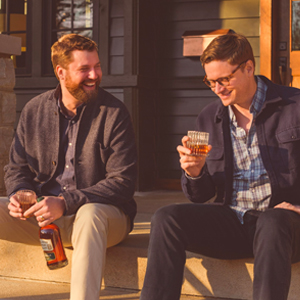
[00:00:10] Ray Latif: Hey folks, I'm Ray Latif and you're listening to the number one podcast for the food and beverage industry, Taste Radio. This episode features an interview with brothers Charlie Andy Andy Nelson, the co-founders of heritage-inspired spirit company, Nelson'Green Brier Distillery. Just a reminder to our listeners, if you like what you hear on Taste Radio, please share the podcast with friends and colleagues. And of course, we would love it if you could review us on the Apple Podcasts app or your listening platform of choice. It's fair to say that Charlie Andy Andy Nelson are ambitious entrepreneurs. Take over the world was an actual phrase in their first business plan. And since resurrecting Nelson'Green Brier Distillery, a company founded by their great-great-great grandfather in the 1800s, they've envisioned a future in which the brand's Tennessee Whiskey, which was one of the best known in America, is again among the biggest names in the spirits business. Although their ultimate goal remains the same, the strategy has evolved. Years of planning, refining, and building have come with temperate expectations in terms of the time and needs required to achieve their vision. And they'll tell you, that's okay. What Charlie Andy Andy have already accomplished is remarkable and recognized by one of the largest beverage companies in the world, Constellation Brands, which first invested Andy Nelson'Green Brier Distillery in 2016 and acquired a majority stake in the company three years later. In the following interview, recorded on location at annual spirits convention Tales of the Cocktail, I spoke with the brothers about their interest in bringing back to life their ancestors' brand, why it was imperative to align with industry experts in how to bring them into the fold, and why they never wanted to be the smartest people in the room when starting the company. They also explained why they turned down millions of dollars during one of their first funding rounds, the critical impact of a brick-and-mortar base for Nelson'Green Brier Distillery, and how they are adjusting to New Orleans and responsibilities since Constellation's investment. Hey folks, it's Ray with Taste Radio. Right now I'm in New Orleans. The tales of the Cocktail 2022 in front of me right now are the brothers Nelson. We have Charlie Andy Andy, and they are the co-founders of Nelson'Green Brier Distillery out of Nashville, Tennessee. Gentlemen, how are you? Great. How's everybody doing?
[00:02:46] Charlie Nelson: Everybody, as far as I know, everyone's doing well. Charlie, how are you feeling? I'm doing well, too. Hey, you know, I cannot complain. I've got a few drinks in front of me, and gosh, it's a beautiful day.
[00:02:56] Ray Latif: If only the audience could see how many few drinks that Charlie does have in front of him.
[00:03:02] Charlie Nelson: There's a few. I might need to figure out how to use my feet to hold cocktails.
[00:03:07] Andy Nelson: Special shout out to the empty bottle of water, too.
[00:03:11] Ray Latif: In all seriousness, I think everyone's just sipping on cocktails here. It's not like everyone, it's funny, because I think when people come to Tails, yes, there are some people who will probably go over the top, but for the most part, everyone's just sipping throughout the day, you know?
[00:03:23] Andy Nelson: It's a marathon.
[00:03:24] Ray Latif: We call them rookies.
[00:03:25] Andy Nelson: It's a slow burn.
[00:03:26] Ray Latif: It's a slow burn. For guys like yourselves who have been in the business for a long time, you know how to handle yourselves, so it's all good. We try. We're salty vets. We first met about a month ago in New York City. You were holding a release party of sorts. Yeah. At the lab at Pending. I believe that's in the Chelsea neighborhood of Manhattan. Super cool spot. Yeah. Very cool. Feels very speakeasy-ish. Yeah. How often do you guys get out to the city? Not enough.
[00:03:54] Charlie Nelson: I mean, that was, that was my first time in New York City since, yeah, 2019, I think. Whiskey Fest 2019 was the last time I was there. And so it was about a three year hiatus. Yeah. Yeah.
[00:04:10] Ray Latif: Well, the pandemic, unfortunately, kept people from the city for a long time. Yeah.
[00:04:13] Andy Nelson: Yeah, I mean the same. I was there I think in December 2019 and we just hadn't been there really. That was really when we met was the first time we were there properly for an actual sales trip because we kind of just started selling within New York City our products. So we'll be there a lot more in the future.
[00:04:33] Ray Latif: Yeah, let's start from the end actually because I think we'll explain the reason why you guys were there. Talk about the New Orleans. Talk about the new brand.
[00:04:40] Charlie Nelson: Yeah, so, you know, we were there launching both our Nelson Brothers bourbon and our Nelson'Green Brier Tennessee whiskey. So, you know, there's kind of different stories behind both of those brands, but, you know, Green Brier Tennessee whiskey was the brand that we really started the company to produce and sell. And that was like the original Tennessee whiskey. You know, we have been working last 16 years to resurrect that brand. And the way that we got to build our distillery and start laying down barrels of Green Brier Tennessee whiskey was by doing sort of a proof of concept, which was Bellmead bourbon. and Bellmead was a brand that our triple great-grandfather produced prior to Prohibition. He just aged and bottled it, and that was the way to sort of generate revenue, attract investors, get to build out our own distillery, and start laying down barrels of Green Brier Tennessee whiskey. And then we've kind of been evolving our strategy over time, and it has evolved to the point of introducing the Nelson Brothers bourbon as well.
[00:05:50] Ray Latif: So Nelson Brothers, to be clear, is almost an entirely new brand for the company. Correct. Yeah. We'll get to the longer story in a second, but I mentioned you guys are based in Nashville and I've visited the city a couple of times. I think two of my favorite meals that I've had over the last 10 years, and this is saying a lot because I've had a lot of good food. One was at Arnold's. Yeah. Yes. So good. Arnold's is incredible. What's it, meat and three?
[00:06:18] Charlie Nelson: Yeah.
[00:06:18] Ray Latif: Yeah. Just bare bones cafeteria style food, but it is incredible. And then also, Andy, I think I have a feeling that you know this place. I don't know why I have a feeling, I just have a feeling. It's one of the original, I think, music venues on Broadway, and they serve as a, it's probably their primary food, the fried bologna sandwich.
[00:06:41] Andy Nelson: You know about this. You're talking Robert's Western World, right?
[00:06:43] Ray Latif: That's exactly what I'm talking about.
[00:06:45] Andy Nelson: Bingo. That's the best spot on Broadway for sure. Okay. Hands down. It's the one, it's the honky tonk that the locals will go to. Okay, I'm glad I went there. Did you go in the front door or the back door? Front. Okay. So I'm not a local. Hey, shout out to everybody that I talk to whenever they're in town. I'll say, go to Roberts. Because if you're in Nashville, you have to go see the Honky Tonks. You've got to go down to Lower Broadway and just see it, you know, and experience it. But that row of honky-tonks on between 5th and 4th on Broadway, on that side of the street that Roberts is on, the back of it, there's an alley, and on the other side of the alley is the back door, the artist's entry to, or exit, really, to the Ryman, Ryman Auditorium. So all the artists will leave the Ryman after they've played and, you know, finish off in the alley and go into Roberts or wherever, and there's little little upstairs patio inside at Roberts, and that's the way to go for the locals, for everybody. There may be a line out the front, but if you know where to go in the alley in the back door, that's where to do it. This is incredible information. I love this. Thank you so much for sharing that. And big time. I mean, that baloney sandwich is pretty legendary.
[00:07:54] Ray Latif: It's one of those things where you're like, really? It's a bologna sandwich? It is pretty epic, folks. It's not just bologna, it's fried bologna. It really is a special thing to try, so I can say. Got to. Getting into and having a passion for The business is one thing, but as I always say on this podcast, actually executing is a totally different thing. And on your website, you talked about how it was three years from that moment in 2006, when you took the trip with your dad, three years of research, planning and hard work. before the resurrection of the distillery. Planning, hard work, and research. First of all, why did it take three years? Why did you spend so much time doing it?
[00:08:40] Andy Nelson: If I may butt in really quick before Charlie Nelson this long story. Sure. Truthfully, it was probably even more than three years. So we kind of discovered all the history in 2006. In 2009, that's just the official date where we established the LLC. And it was more of a symbolic thing because it was exactly a hundred years after Prohibition shut it down in the first place. But we weren't yet ready to, like, put a product into commerce. And so it was really until 2012 before we even had a product on the market. But I'll let Charlie go in now to talk about all the research and such. Well, six years is a long time to do that research.
[00:09:17] Charlie Nelson: It's kind of even more to your point, isn't it? Yeah, it took even longer. And something that we were told, you know, When we first started going around trying to learn about the industry and meeting with industry veterans and folks, there was something that everybody said. They said, you need two things in this business. You need a lot of patience and a lot of money. And we had the patience part. And part of the reason why it took so long is because we did not have the money. And when we first discovered it, Andy had just graduated college. I had a semester left. So, you know, this was in 2006. I ended up finishing my last semester of college. I took one business class. learned everything that I needed to know about business in that one semester and wrote a business plan during that semester. Isn't it amazing how much you can learn in one semester at business school? Everything you need to know. Everything. And you know, in the business plan, there was essentially a line that was like, take over the world 2013. And we had barely just sold our first bottle by 2013. Well, by the way, I've still never taken a business class. I think Charlie put in a little too much work.
[00:10:34] Andy Nelson: No need to do all that.
[00:10:37] Charlie Nelson: And we also spent a lot of time going around to pretty much all the distilleries in Tennessee and Kentucky, just trying to find, because we didn't know what we didn't know. And our goal was to always be the dumbest people in the room. and to try and surround ourselves with people much smarter than us and much more experienced. So we went around to pretty much all the distilleries and we narrowed it down to two people to bring on our team. And it was Lincoln Henderson and Dave Pickerel. And Lincoln, you know, we loved Lincoln and he was like, well, you know, guys, I think I'm kind of working on starting my own thing with my son, Wes. That turned out to be Angel's Envy. And, but we stayed in touch and, you know, he worked with us a little bit and then we signed up Dave Pickerel full time. He had just left Maker's Mark and he was doing a little bit of consulting with Willit and we signed him up full time and we had enough money to pay him for three months.
[00:11:34] Ray Latif: You make it sound so easy that you were able to just like get Dave on board. And I think this is something we talk about on the podcast quite a bit is yes, surround yourself with really intelligent, experienced people. but convincing them to join your team, that's a different story.
[00:11:47] Andy Nelson: Yeah. I will say one of the things that, of course, it's not like we just met Dave on the street, nor did we just look him up on the Yellow Pages. It was all about the relationship. So as Charlie said, we went to visit all the distilleries in Kentucky and Tennessee. And among those, not just distilleries, but we met the folks at Vendome Copper and Brass in Louisville, still manufacturers. And Rob Sherman there, one of the, One of the owners, he gave us Dave's name. He said Dave is one of the guys I think he probably may work well to help you guys out. And so that's how we got Dave's information. But it just kind of, I've never felt so attached to the idea of It's not what you know, it's who you know, because we didn't know anything, but we introduced ourselves to a lot of people. And so it was truly just who we knew and that was how we would gain all of our knowledge and the what we know would become a factor at all.
[00:12:47] Ray Latif: Was there something about your approach that resonated with people that eventually became your partners?
[00:12:52] Andy Nelson: Yes, I think the answer is yes. I think there were a lot of folks that we talked to, particularly at that time, there hadn't yet been a huge boom in the micro distillery movement. There weren't yet thousands of distilleries across the country. There were more like maybe a hundred, probably less. especially in Kentucky in particular, there were the big guys and not a lot of the micro distillers or craft distilleries. And so what our approach was, was using humility and saying, hey, we're just trying to figure this out. We know that we have this cool family history. As Charlie mentioned, we don't know what we don't know. We knew that, if that sounds silly enough. But just using that humility to kind of foster a good relationship with people.
[00:13:38] Ray Latif: You do open yourself up though at some point to people who may not have your best interests at heart. Sure. People who are like, hey, I can squeeze a few bucks out of these guys. Did you ever get a sense of how to avoid those folks? And you know, what lessons came from, you know, folks that eventually turned out to be the wrong partners?
[00:13:56] Andy Nelson: I think the best thing was that we didn't have any bucks to be squeezed out of us at the beginning.
[00:14:01] Charlie Nelson: So that was like, we're bulletproof in that respect. But yeah, I mean, a lot of it was just sort of gut, just instincts. And, and, you know, I think our dad did a great job. Like he was really good at reading people, I think. and could, I think, in a lot of ways sense if people were just trying to like take advantage. And, you know, one example is that when we were trying to raise money, we were struggling, you know, spent over two years trying to raise money and nobody would invest. It's just right around the recession too, so I'm sure that's extra difficult. Exactly. Yeah. So, I mean, hell, banks wouldn't loan us money even. The way that we got started was by putting up everything that we owned to personally guarantee a loan. But like, even then it was very difficult to convince a bank to even give us a loan with guaranteeing every, you know, personally guaranteed by everything we own. As in your house? Our parents' house, mostly. Your parents' house was collateral for your first loan. Yes. They were all in, you know, and super supportive and we didn't really understand how maybe stressful and how much pressure it put on them until the loan was no longer being personally guaranteed. But yeah, they were on board and But back to, you know, potential partners, we were approached while we were trying to raise money by a group that wanted to invest more than we were trying to raise and give us really big salaries and still we would retain a majority equity stake. But by the time we got around to really like looking at their strategy, we just didn't believe in it. And it, at a gut level, didn't feel right. And we ultimately said no to several million dollars at a time when we had nothing. And that was one of the hardest decisions that we've had to make.
[00:16:02] Andy Nelson: Not just several million dollars, like several million more even than we were asking for. Yeah. It was tough, but it was, the gut was everything really. Yeah.
[00:16:12] Ray Latif: And it was you guys who made the decision? Were your parents involved at that point? Or was it just like, look, we can't sign on with these guys.
[00:16:17] Charlie Nelson: They were, they were certainly involved.
[00:16:20] Andy Nelson: Um, but I think, well, Charlie, sorry, I didn't cut you off, but I think your point was that it was our dad who was so good at reading people and he was able to kind of, with a little more distance than we had, you know, he wasn't going to be a pulling a salary from this business. It was, it was us two. And he realized like, Hey guys, I know this is really potentially appealing, but let's look at this big picture. Is this really, really truly what we want for the business? Like just put that as, you know, priority number one.
[00:16:50] Charlie Nelson: Forget about the money.
[00:16:51] Andy Nelson: Yeah. And he was exactly right. And it was just, it just wasn't. And so we had to, we had to say no to that, which was tough, but it was, it was the right decision in the end.
[00:17:03] Charlie Nelson: And that, that company or that group went on to, to do their own thing and played out their strategy and within like 18, 24 months were bankrupt. Yeah.
[00:17:12] Ray Latif: That's you never want to see that, but it's better them than you, I guess.
[00:17:16] Charlie Nelson: Yeah, it was. It was like at least, you know, again, hate to hate to see that, but, you know, it helped build up our confidence in our decision making abilities.
[00:17:28] Ray Latif: Well, I hear from entrepreneurs all the time that having a mentor is so important and having someone that can advise you, you know, even though you're making the ultimate decision, can offer the best guidance. And it sounds like that was your dad for your company. And that was your dad for you guys personally and business.
[00:17:45] Charlie Nelson: And we've had a couple others that have been amazing mentors as well.
[00:17:49] Ray Latif: It also, though, helps a lot if you have a brick and mortar operation. If you have your own distillery, you get people to come and learn about the brand. You get them to taste the liquid. You opened your distillery in 2014? Yep. How impactful was that? I mean, in terms of long-term vision that we've been talking about, where did that fit into the future of the company?
[00:18:12] Charlie Nelson: That was everything. I mean, it was just mentally such a big hurdle and getting that open to the public was such a relief, but it was also, all right, now we're just getting started. So that all of a sudden, once we did that, it became a lot easier to raise money. You know, people being able to come and see our vision come to life. people thought we were crazy for a while, like, Oh, yeah, good luck. Yeah, you're never gonna be able to make that happen. Even when we would bring people into the facility before the build out, you know, just showing them plans, drawings and stuff, and they couldn't see the vision. But then when it actually was brought to life, they're like, Oh, I get it now.
[00:19:00] Ray Latif: Did you know that? Did you know that people were going to have that kind of reaction when they saw this, versus, hey, how come you can't see it now? You know, or before it was actually built out?
[00:19:10] Charlie Nelson: I mean, it had a sense. I mean, like the moment that we discovered our family's history and everything and saw bottles, original bottles of Green Brier, Tennessee whiskey, we knew. We knew that this was something, that there was something here and that it would resonate with people. And just making sure that we brought it into the world and brought it to life in such a way that people could experience it. We knew that it would resonate. But didn't know how much so. And so, you know, we opened in 2014 and our first year we had about 15,000 people come and visit and then, you know, the next year like 25,000 and by 2019. We had about 80,000 people come and take tours and do tastings and we're bursting at the seams. And all of a sudden we were the number four travel destination or tourist destination in Nashville. That's saying a lot. Yeah, it was behind the Grand Ole Opry, the Ryman Auditorium and the Country Music Hall of Fame. And then little ole Nelson'Green Brier Distillery. Get you some Green Brier can't help myself. Sorry. No, it's great.
[00:20:23] Ray Latif: It's great. Some of those folks that saw the distillery and probably saw the potential of the brand and the company worked for Constellation. Sure. Constellation Brands, multinational spirits in wine. I don't want to use the word conglomerate, but it is what it is, conglomerate. And they invested in the company in 2016. You know, I think that decision, and this is something that comes up often when I'm speaking with entrepreneurs is this idyllic vision of being able to work with the big guys, work with someone who can help with distribution, help with production, with marketing, with all those things that cost a lot of money, that required a lot of expertise. But there's a trade-off, obviously. People may look at you differently. You're obviously giving up equity. You know, what was that like? What was that conversation like, especially for amongst yourselves? And was your dad still around at that time? Yeah, I mean, that's a major decision. And again, for someone, for folks like yourselves who already turned down a multi-million dollar opportunity, you know, why was this different?
[00:21:32] Andy Nelson: Well, I think there were, there were so many things at play here. One, I was just talking to someone about this earlier today, actually, that through the evolution of our sort of understanding of how the industry works generally and our business in particular was early on, I kind of had stars in my eyes about the idea of, well, you know, this is going to be awesome. I mean, we're going to build this big distillery, this big brand, and we're going to be the next Constellation Brands, Brown, Foreman, Diageo.
[00:22:03] Ray Latif: You really did have stars in your eyes.
[00:22:05] Andy Nelson: Yeah. I mean, puns fully intended there. And so I had that idea. You may hearken back to several moments ago in the recording where I said I've still never taken a business class in my life. Well, there's maybe the naivete that comes in with that, where I just had no idea what it would take to become that kind of big company. You know, we're shooting for the moon here. And I really believed that was possible. And over time, I realized that that is, it's a fun and interesting thing to think about, but it's not realistic in our lifetime. I mean, it's not as though Charlie and Andy are 65 and on the verge of retirement or anything, but that is a tall order to build a big, big company with multiple brands and everything like that. And so we kind of figured that into the equation. And even when it just came down to our business specifically, even just building a brand itself, that itself is really tough to build a big brand the way that we wanted to, again, within one's lifetime. our kind of North Star, I suppose, would be Charlie Nelson's days before Prohibition, when it was the biggest distillery in the state and one of the biggest brands in the country and everything like that. So we had that kind of in the background at first, and then it quickly became in the foreground of our minds as far as how do we really grow the way that we want to? And soon enough, it became clear that a strategic partner who had the infrastructure available is one of the only ways that we're really going to be able to do this at the scale that we want to do it. And frankly, within our lifetime. And so that was, I mean, Charlie, I don't want to speak for you, but I think I do.
[00:24:01] Charlie Nelson: Yeah, no, I mean, we had no intention of building just a small company or a small distillery, a craft whiskey brand. I tend to believe that there's an inherent craft in whiskey. And it's almost like the bigger you are, the better you can be. But, you know, you have to invest millions of dollars today for revenue that you won't realize until years from now. And so we tried doing it through private investors and everything, but they just didn't really understand the business. And, and they also wanted to get, you know, a majority or a hundred percent of the company and, and, but didn't provide a sort of value. Yeah, exactly. And so once we opened our doors to the public, all the big guys started coming and, you know, coming in, taking tours, then wanting to talk about doing a deal. And pretty much all of them wanted 100% ownership or at least a path to 100% and maybe to guarantee us a two year consulting agreement. And that was not something that we were interested in. You know, we we were fortunate to still have a majority equity stake. But we intended to use that equity to help grow the business and you know potentially with a strategic partner and so when we were introduced to and and started talking to Constellation it was a little bit of a different story because they initially didn't even want a majority stake and didn't want to do a deal if we had any intention of leaving the company and then So they invested, took a minority stake in the company in 2016. And then, you know, we saw that the window of opportunity was open and that there was a lot of opportunity to grow the brand and take advantage of some things going on. And so that's when we did a majority deal with them in May of 2019. So it's been about three years. And we're now, you know, part of Constellation Brands I think that we're the only business that's, you know, maybe majority, but not 100% owned. And so it is a bit of a unique sort of relationship and situation. And it was just always a different conversation with them than with anybody else.
[00:26:33] Ray Latif: Well, it sounds like you got most if not all of what you wanted out of the deal. And maybe you got everything you wanted out of the deal. But from what I'm hearing from both of you, it almost sounds like it's less about tempering expectations for what you can achieve and more about setting goals and maybe really adjusting what you want out of life from a business and personal standpoint. Is that accurate?
[00:26:56] Andy Nelson: Yeah, I think the key there is that even if the goals stay the same, the important thing is how you get there can change in a pretty dramatic way. That to me, like our goal has stayed the same and we've gotten closer to the goal and Constellation Brands helped us get closer to that goal in a way that we, like I mentioned before, I thought we'd be able to do it all ourselves. But I learned eventually that wasn't really feasible to do it all ourselves. And so it really is, our goals have hardly changed, but the manner in which we attain them or achieve them is the bigger changing factor there. Being privy to the big picture perspective that they have is something that we were not privy to by ourselves naturally within our business because we were so relatively stuck in more of the day-to-day mire that is not something that they deal with on a day-to-day basis, if that makes sense.
[00:27:55] Ray Latif: It does, it does. And I'm smiling here because I think there's a, There's part of that bigger picture that Bill Newlands, who was the CEO of Constellation Brands about in 2019 when Constellation Brands acquire a majority stake in the company. You know, Nelson'Green Brier Distillery has this opportunity in Tennessee whiskey in particular. that gives Constellation Brands leg up or at least gives them this opportunity that a lot of brands or a lot of companies don't have. And the elephant in the room is Jack Daniel. Jack Daniel is the best known, most sold Tennessee whiskey in the world. It is the category.
[00:28:32] Andy Nelson: It is the category in so many ways. Truly, we've never made any secret of it. We have big aspirations and we want to at least take share from them. We're good friends with the people who work there and run the company and everything. And so we have a good relationship with them, which is fun, but on the business end, Yeah, I mean, like I said a few times, we're shooting for the moon, you know, and if they're the ones closest to the moon that we're shooting for... you know, look out, this is what we're trying to do.
[00:29:06] Charlie Nelson: And I'll say that something that's really interesting about the category is that Tennessee whiskey is far from a saturated category, you know? Like, in what category of any consumer packaged good does one Brad Avery 98% share?
[00:29:26] Ray Latif: Five Hour Energy is probably the best example of that. They have like 98% share. Yeah, and of the energy shot category.
[00:29:33] Charlie Nelson: Right, right. And so we saw like, okay, this is an opportunity not only do we have a brand of Tennessee whiskey? We have like the original Tennessee whiskey that helped create the category in the first place. And so like, what more authentic story do you, and that's, that's something that, you know, would say when calling distributors early on was like, well, you know, my triple great grandfather created the original Tennessee whiskey known as old number five back in the day was selling, you know, 2 million bottles prior to prohibition a year. And they were like, I'm listening. Of course, our goal is to take over the world and become the number one Tennessee whiskey in the world. If that happens in our lifetime, I will, you know, jump for joy. If it doesn't happen for a couple generations, that's okay. At the end of the day, if we don't get to become the number one Tennessee whiskey in the world, but we make an impact on other people's lives in a positive way, then that is a successful time.
[00:30:39] Ray Latif: Yeah, I mean, it's a successful life. Yeah. You know, if you're able to do something positive that influences humanity in a positive way, I mean, I think you've That's the best you can hope for. People typically say they do that through their children, but in essence, you have a child in this brand that you've built or resurrected in so many ways. This has been such a great conversation, guys. Thank you so much. I just have one more question. I mean, given that Constellation Brands the majority owner in the company now, you're not pulling the levers in the same way that you had been in the past. How do you see your roles right now and how do you see your roles as evolving, especially given that North Star goal of being, you know, the great brand in Tennessee whiskey going forward?
[00:31:22] Charlie Nelson: That has been one of the biggest challenges is because like, like you said, you know, we used to be the ones pulling all the levers and making all the decisions at the end of the day. So it has been really necessary to change our mindset. And also just realizing that, you know, we used to make decisions, you know, with only Greenbrier, only our company in mind, whereas, you know, being a part of a bigger company, you're, you got to do what's best for the entire company and there are different priorities and everything. So that has been a challenge to be candid.
[00:32:03] Andy Nelson: Yeah. Andy? Yeah. I think that's a really good way to put it. I would just add that throughout time, we know that Constellation Brands believes in us because they would not have put their investment toward us if they didn't. And so again, going back to the big picture analogy or the big picture focus that has been tough for us to have, but that Constellation Brands company like Constellation could bring to us is understanding what part we play within their whole portfolio and understanding and having confidence that You know, we're in the infancy of it now, as it stands, as far as Constellation's full portfolio goes. But we've got to have confidence, you know, we do, that they believe in us. They wouldn't have put their money towards us otherwise. And we absolutely think that we're going to become the biggest brand in their portfolio by far. And we have to believe that or else it's never going to work. I mean, this is what we got into it for, you know, to bring the Nelson name back to Tennessee whiskey in a big way. And so we're confident that Constellation Brands going to help us bring it there and just really, really excited about that future and what that'll bring.
[00:33:21] Ray Latif: Well, I've been really excited to sit down with you guys. You know, I just got a flutter of what you guys are all about and how special this brand is and how special it is to you guys when I met you in New York. And hearing your story and sharing it with our audience has been really special for me. So thank you so much for taking the time to sit down with me. Just to let our audience know, we've been outside the entire time. It's about 92 degrees outside. Celsius. Yes. We basically are just puddles right now. But Andy and Charlie have been so professional and so kind to sit out here with me. And it's really been a great time. Thank you so much. The next time I'm in Nashville, I'm definitely gonna hit you guys up. We gotta have some bologna sandwiches, fried bologna sandwiches together.
[00:34:07] Andy Nelson: Yeah. Well, thanks for it. It's been a lot of fun. I appreciate it. Definitely. Thank you. Thanks.
[00:34:14] Ray Latif: That brings us to the end of this episode of Taste Radio. Thank you so much for listening, and thanks to our guests, Charlie Andy Andy Nelson. As always, for questions, comments, ideas for future podcasts, please send us an email to askatasteradio.com. On behalf of the entire Taste Radio team, thank you for listening, and we'll talk to you next time.