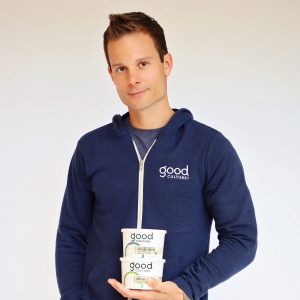
[00:00:10] Ray Latif: Hello, friends. I'm Ray Latif, and you're listening to the number one podcast for the food and beverage industry, Taste Radio. This episode features an interview with Jesse Merrill, the co-founder and CEO of better for you dairy brand, Good Culture. Ten years ago, few believed that an upstart brand could revolutionize the sleepy category of cottage cheese. Good Culture co-founder Jesse Merrill was one of those few, and his steadfast belief that consumers want better-for-you and better-tasting options in the dairy case defines his company, one that is being described as quote, the next Chobani. Launched in 2015, Good Culture markets a variety Good Culture dairy products, including its flagship line of certified organic, pasture-raised, stabilizer and additive-free cottage cheese, along with sour cream, cream cheese, and milk. A certified B Corporation and partner of 1% for the Planet, Good Culture products are sold nationally at Whole Foods, Target, Ralphs, Walmart, Sprouts and Kroger. In 2022, the company completed a $64 Million Series C funding round led by mission-driven private equity firm Manna Tree and included investment from actress Kristen Bell. At the time, Good Culture was generating $70 million in annual retail sales and targeting $100 million in sales for the fiscal year. In this interview, recorded amid Manna Tree's Leadership Summit in Vail, Colorado, Jesse spoke about how Good Culture aligns mission and values with business fundamentals, why proof of concept and velocity are keys to its growth strategy, being maniacal about delivering on the product's key attributes, how the best advice he ever received has benefited the company. Hey folks, it's Ray with Taste Radio. Right now I'm honored to be sitting down with Jesse Merrill, the co-founder and CEO of Good Culture. Jesse, great to see you. Hey Ray, great to see you. Thanks for having me. Isn't it amazing? We last spoke with you for Taste Radio about six years ago. The episode was posted in June of 2018. Lots changed for you and the brand in that time since. But I want to go back even further. to I want to say 2013 or so when I first met you, I believe. Actually, I had met you before that, but I first met you as the VP of marketing for a brand called Activate. I think about going from beverage to food. It seems like a bigger jump than people might realize, was it?
[00:02:51] Jesse Merrill: I would say going from shelf stable beverage with two years of shelf life to a refrigerated product with 45 days of shelf life is a pretty massive jump or pivot.
[00:03:03] Ray Latif: Yeah. Well, that's the thing, you know, when Good Culture launched in 2014, I described it to you earlier as a moonshot idea, reinventing cottage cheese for a modern consumer. I imagine there were a lot of chuckles at the time and a lot of people were like, okay, well, good for you if it works, but I just don't see it. When you are first getting out there and you do get those chuckles and you get the naysayers out there, I mean, how do you process that such that it doesn't bring you down?
[00:03:34] Jesse Merrill: Yeah, I think you have to look past it. That's just noise, right? You have to avoid the noise and just focus on what you're doing, focus on the mission, focus on the real consumer need or problem that you're trying to solve for. and do everything you can to execute, execute, execute, get the best possible product out there, get the best possible brand out there, launch it in a very thoughtful, strategic way, be prescriptive in terms of where you go from a distribution standpoint, make sure you're launching into accounts that overlap your consumer target, and test. Do a test and learn. Make sure that you are showing traction. Make sure that you are showing growth. And if you start to build that confidence, then that gives you the ability to move forward. And it gives you the confidence and the stamina to want to move forward. And then everything else that anyone else is saying about you, if they don't believe in you, like I said earlier, it's really just noise and ultimately bullshit. Because if you're growing, what they're saying doesn't really hold a lot of weight. So you have to just stay focused, stay confident. That said, If what they are saying proves out and it's not working, then you have to be willing to adapt. You have to be willing to change even if you were married or in love with your initial concept. If it's not proving out, then you 100% need to pivot and adapt. I think it's the The founders or CEOs that get too married to a specific concept and they don't change and they get stuck and they keep pushing and pushing and pushing. Those are the folks that really stall out and lose a lot of momentum. They say, what do they say? To change is to improve. To change often is to be perfect. That's a Winston Churchill quote, I believe. But I believe in that quite a bit. So you have to be willing to adapt. And I think we did that with Good Culture. Where we are today still ties to the original concept, but there's been a lot of tweaking, a lot of optimization, whether that's on the product side or go-to-market strategy, how we think about manufacturing, how we think about gross margins. There's been a lot of optimization work that's gone into it. but we've been able to kind of bob and weave and pivot and ultimately get to where we are today, which is a pretty solid place.
[00:05:40] Ray Latif: Let's go back to a word you used earlier, which is mission. You start out with a mission, you start out with a belief system as to why you created this product and who it's for. When you are trying to align mission and the reason for being with the reality of having to run a business and answer to shareholders in that business, How do you balance the two? I guess, how do you internally weigh those two things?
[00:06:07] Jesse Merrill: You have to do both, really. Because like I said earlier, you can't stray from your values, you can't stray from your mission. So, you know, sometimes you have to make hard choices that aren't necessarily the best decision from a P&L standpoint. But you have to look at the consumer, look at what they're looking for. And if you're meeting the consumer where they are, if you're solving a real consumer problem because of how you're leaning in on mission, ultimately that's going to ladder up to a successful business, to an enduring business. So yeah, it forces you to make tough decisions sometimes. but you have to do what's right from a mission value standpoint. Obviously, you can't make a decision that's so reckless that it would put the company down. So you have to find the right balance between managing mission and managing your P&L.
[00:06:49] Ray Latif: Well, how do you decide when to butt heads with key partners, retailers and investors and hold your ground and maybe when to back off a bit?
[00:07:02] Jesse Merrill: I certainly hold my ground when it comes to the ingredients that we use. In the last interview that we did years ago, I talked about my healing story. I had ulcerative colitis. I healed myself through food. That validated my belief in food as medicine. That experience, that journey really drove me to ensure that I never strayed from how I source my ingredients. and which ingredients I use, right? So I would never use any ingredients that are inflammatory. I don't use gums. I don't use additives. I don't use thickeners. I don't use stabilizers. All of our products are clean label. I would certainly hold my ground there regardless of who's asking me to change it, right? If I got pressure to pull cost out by adding these additives. I would draw a hard line there because that goes against our core proposition. It goes against our values. And that's just not something that I'm willing to do. And I firmly believe that the way we're building our products is truly what consumers are looking for, especially younger consumer segments.
[00:07:59] Ray Latif: You told me that you know who your consumers are and why they should be buying your products. You're building this brand for, and have been from the get-go, for people who want to live healthier lives, want to adopt more better-for-you brands in their homes. But as the consumer evolves and as mainstream awareness of better-for-you products and ingredients becomes more prevalent, it makes how you think about scale, I would imagine, a little challenging. when to press the gas on innovation, when to think about adding new distribution, and timing is tied to all this. So, you know, when you started out in 2014, It probably would be easy for everyone to say, Oh yeah, Good Culture. They should be at Whole Foods and should be at Sprouts. And you know, if you were at those, retailers still are. But how do I get into Costco? When should I get into Costco? So on and so forth. So as you grow, how do you think about the timing of the decisions for the brand? How do you, how do you think about when to say yes and when to say, no, this isn't the right time for us?
[00:09:06] Jesse Merrill: Yeah. So what you said about launching into Whole Foods and launching, you know, with Sprouts, that made a lot of sense for us. Doesn't make sense for every brand, but for us, their values overlapped our values. We knew that our consumer target, our shopper target overlapped, you know, their shopper, their consumer. So I am a big believer in testing and learning in the right places where your shopper is already shopping. So I fully support that approach. Launch in the natural channel, launch with the right customers that are really going to support you. Once you build traction there, once you have proof of concept, then you start to dip your toe in the water with conventional retail to make sure that you can compete with other mainstream brands. But don't go super wide. Pick, again, the right conventional retailers that are geographically situated in a strategic location that makes sense for you from a logistic standpoint, make sure you're picking the right retailers that also have strong consumer overlap. And again, same thinking, test and learn, make sure it's working. If it's working, then continue to go wider. As that's happening, you can start to take on mass, then you can start to take on club, right? It all kind of flows from there, but You don't want to go too wide, too fast if you don't have proof of concept. It's all about proof of concept. If you have the data to support that there's a real need that you're feeling and that the velocities are hitting the right thresholds, then start to, you know, bolt on from there. But, you know, if you're a new brand and you have a lot of buzz and a lot of excitement because the concept is sexy, that doesn't mean you should say yes to every retailer that knocks on your door. Because if you do that, most likely you don't have the funding to support it. You know, that's another huge consideration. If you don't have the right marketing dollars, the right trade dollars to go in and really effectively support that customer, then you're going to end up in a position where you're not hitting your velocity thresholds. And then you're putting a bad taste into the mouth of the retailer. You're going to end up, you know, falling off shelf, which is not great for the consumer. And then you have a black eye and then you got to try to rebuild. So that's, that's a lot harder to do. than being patient and disciplined initially and being really thoughtful and prescriptive in terms of how you grow. So the power of no to me is powerful.
[00:11:16] Ray Latif: The power of no is based in proof of concept. It's based in data. And you said velocities are the key metric. Are there any other key metrics in terms of how you evaluate proof of concept?
[00:11:30] Jesse Merrill: So velocity for me is by far and away the number one brand health metric. If your product is turning, that proves out that the consumer is clearly looking for what you're selling, your product, your concept is resonating with them. So to me, if that's working, then you know you have something special. You have something that has the ability to really break out and become meaningful.
[00:11:52] Ray Latif: Again, going back to this morning, someone had mentioned discounting and slotting fees and all the other things that go into being on shelf and getting on shelf as an impediment in so many ways to being successful. And discounting is great and promos are great for getting people aware of your brand. But once you are off promotion, how do you keep them interested?
[00:12:18] Jesse Merrill: How do you keep them excited? Yeah, so I think that's, A good point that you mentioned, because when I talk about velocities being the ultimate brand health metric, that's off promo velocities, right? If you're discounting constantly to get to kind of juice those velocity levels, then those aren't sustainable velocity levels. And that's not a true indicator of brand health, right? So you need to know that you are turning at a fast clip, even when you're off deal. And when you are on deal, make sure you're not going too deep, make sure you're maintaining your premium price point. your premium image. Obviously, there's always a need to promote, to stimulate more trial, to bring more people in, and you can do that, but if you're doing it responsibly and you're not going too deep, then that does give you the right opportunity to continue to build responsibly. Once you're off promo, we look for sustainable baseline lifts. Obviously, you hope to see the spike when you're on deal, but once you're off deal, you want to make sure that that baseline has increased meaningfully, and you want to hold that baseline lift. if you're seeing that you're spiking on promo and then you're falling right back to where you were pre-promo or below that, then it's not working, right? Then you're just subsidizing those purchases and that's not gonna lead to something meaningful or enduring.
[00:13:33] Ray Latif: So what keeps the customer coming back then? So maybe they'll test it out on a promo and say, hey, you know, I'll give this a try. Is it taste? Is it branding? Is it the desire to share it online with folks and be like, look how awesome I am, I'm in a Good Culture.
[00:13:47] Jesse Merrill: No, I mean, I think it's all of it, right? If they're coming back and they're buying it, then that means that you're checking a lot of the right boxes. You're checking the health box, you're checking the taste box, you're building a lifestyle or an emotional connection with the consumer that's really resonating. So you're creating that badge value. So it all comes together holistically to create a powerful brand. But yes, it has to taste good. It has to have the right health story. It has to make them feel good when they're using it. All those things matter. So they're gonna come back if you're checking those boxes. If they're buying on promo and they're not coming back afterwards, that means you're missing the mark, right? That means there was a miss in taste or the health story didn't necessarily deliver or your brand just wasn't strong enough or powerful enough in terms of your story to really connect on that emotional level that's gonna want them or that's gonna drive them to wanting to come back to buy more.
[00:14:40] Ray Latif: I imagine there was a hiccup at some point as it relates to those product attributes, taste, lifestyle aspect of the brand, perhaps even ingredients. Is that something you encountered and how did you fix the problem?
[00:14:54] Jesse Merrill: No, we've been perfect since day one. Of course, yes, there's been drift. I wouldn't say there's been drift from a health standpoint, because like I said earlier, that is a core value. We don't ever stray from that. So we have always been relentless in terms of ensuring that we're checking every box relative to health and mission. But we have certainly seen drifts on product quality, on taste, when there's been a manufacturing glitch, hiccup, etc. So yeah, when that happens, you have to become maniacal about it. When that does happen, do you just toss the product out? If that happens at the manufacturing plant, 100%, we block it. We don't let it go into the marketplace.
[00:15:37] Ray Latif: And so from a branding and lifestyle perspective, what have you learned about how the consumer perceives your brand and how they think about adopting it into their lives and in their homes?
[00:15:49] Jesse Merrill: Yeah, I think they've appreciated how we've shown up across the board. We are authentic in what we do. We walk the walk. We're certified B Corp. We're 1% for the planet. We're focused on transitioning conventional farms to regenerative farms. And we're posting the data when we have proof points on what we're doing there. So we've been very authentic, we've been very transparent, and the products taste great, and the health attributes are intact. So all those things have laddered up to a consumer experience that's been incredibly strong. And I think for that reason, we've been able to build a pretty loyal following with super high repeat.
[00:16:29] Ray Latif: But I imagine that there are a couple of things that rise to the top of the list for consumers these days, protein being one of them. It seems like protein is trending in a really significant way and obviously cottage cheese is high in protein and some of your other products also high in protein. Do you double down on consumer demand for an interest in those kinds of things as much as you do you know, being 1% for the planet, a certified B Corp, do you balance those two things? Or is it just like, look, the consumer loves us because we're a high protein, great tasting product. Should we emphasize our marketing in that way?
[00:17:08] Jesse Merrill: We look at it holistically, right? We don't separate those things. We know that consumers are looking for high protein, low sugar foods. So we check those boxes, right? We ensure that we're delivering there, but we also know that consumers are looking for brands that are focused on environment. They're focused on social responsibility. They're focused on people, planet, animals, et cetera. So we do all of those things well, and we don't water down one for the other. So we ensure that we are definitely showing up in a big way across all those things.
[00:17:37] Ray Latif: It might be hard to answer this question, but is it category specific? I mean, when people think about buying dairy, I imagine they think about farms and they think about the health and well-being of cows and they think about, you know, the way the milk is processed. Do you think that has helped you, given that you're in the dairy category?
[00:17:59] Jesse Merrill: Yeah, I mean, it certainly helped us in that we are doing it responsibly and that we have a real story that we can stand behind. And that certainly resonates with younger consumer segments who are looking for authentically mission led companies, especially in spaces like dairy that have had a bad rap. Obviously, there's been a lot of You know, news articles were in about how bad dairy is for the environment. And of course, the counter to that is if you're doing it responsibly, then it doesn't have to be. If you are sourcing from regenerative farms, you can actually sequester more carbon than you would with a plant-based analog. So there's a way to do it responsibly. And real food, real dairy over delivers in terms of nutrition. So that story is also really starting to resonate in a big way. Consumers want real food. They don't want ultra processed Analogues, they want real food that delivers real nutrition. And so dairy, you know, certainly checks that box. We deliver a complete protein, amino acids, other nutrients, our protein is super digestible, et cetera. So we deliver what we think is an overlooked superfood.
[00:19:04] Ray Latif: There was a story this morning that someone shared about Annie's. And during that transition between when Annie's was acquired by General Mills or when they were transitioning it into the General Mills portfolio, there was talk about innovation and the idea that maybe Annie should get into the yogurt business. And I heard that and I was just like, what? That doesn't make any sense at all. But to certain people, it made a ton of sense. And the point I'm trying to make here is, about innovation, about platforming and trying to figure out what's going to make sense for your brand, what's going to bring new consumers to your brand, what's going to, you know, stay on shelf and allow you to support it on shelf. You have built a pretty significant brand with multiple product categories, multiple product lines. When you're thinking about going beyond or when you originally thought about going beyond cottage cheese, how long was that conversation? How long did that conversation take place? And what were some of the factors in that decision?
[00:20:07] Jesse Merrill: Yeah, no, I think disrupting cottage cheese was the initial thesis, but we also knew that we wanted to build something bigger than just cottage cheese. We wanted to build a cultured dairy platform company that could extend, that could go into adjacencies. And so that was always something that we had thought about early on, but we waited until we had enough equity with our core business to do that. And even today, yes, we're in sour cream and yes, we're in cream cheese, but we're not going super wide with that. Right. And that goes back to what I was saying earlier. We don't have the resources to go really wide with cream cheese or to go really wide with sour cream. So we want to make sure that we're only putting it in places where we know that we can win. and putting it in places where we know we have the resources to fully support it. And as we do that and improve those out, then we will slowly go wider. But today the focus, you know, continues to be on the core business, scaling the core business, innovating within the core, and being really, really thoughtful in terms of, you know, where we go next as we look at other adjacent spaces. But we're not going to be, you know, throwing a bunch of stuff at the wall and hoping, you know, that it sticks. We're going to be super intentional and only go into other spaces when we feel that we have enough research to support why we would do that.
[00:21:17] Ray Latif: Well, you picked up a bunch of resources, financial resources, a couple of years ago. Monetary led a $64 million funding round that, as I'm reading from the Nosh article, that will support retail and product expansion this year. Product expansion. It seems like that was maybe pulled back on the reins a little bit.
[00:21:34] Jesse Merrill: Well, you know, we haven't said we're, we are no longer going to innovate. It's just, I think the way we innovate has evolved a bit. Like I said, we are now more hyper-focused on innovating within Cottage probably than we were thinking about, you know, a few years ago, but we still have an eye to adjacent spaces, but we just want to make sure we have the right tools in place, the right resources in place to do it well before we do it. But we're still certainly focused on extension and product innovation.
[00:22:02] Ray Latif: One of the other really big parts of that story on Nosh was that you had Good Culture that is targeting $100 million in sales in 2022, which is just really remarkable to think about when you are creating those annual targets and those annual goals. Financial targets, they can be all over the place. You can say, well, we want to do this and we want to do that. How do you create realistic goals while still thinking about the potential for the brand and being ambitious in trying to stay hungry for what this brand can do and where it can go?
[00:22:36] Jesse Merrill: We build a bottoms-up plan across the full company. Our sales team's involved, our marketing team's involved, our ops team, finance team, leadership team, et cetera. We go account by account, SKU by SKU, and it's a consumption-based plan. And so we don't just throw big numbers out there just to say we want to hit a big number. We try to ladder up to a realistic number that we feel we can truly hit. So if that number happens to be, you know, a hundred million, then the number is a hundred million. But we certainly don't look to create reckless plans that we can't really hit just to create big optics, right? We want to make sure that the numbers that we put out there are numbers that are truly attainable. And that doesn't mean we don't still put stretch into that. We know we want to always, you know, fight for more and ultimately get to the top of the mountain, but we still put plans in place that are attainable. And like I said, it's a bottoms up build.
[00:23:26] Ray Latif: Let's come full circle. What does the top of the mountain look like?
[00:23:29] Jesse Merrill: at least in your dreams? To build that enduring household name. What does that mean from a numbers standpoint? I don't know, but we want to ensure that we're continuing to scale at the same rate that we're scaling now. Our growth rates are impressive, high double digit growth year over year. We continue to go into more places, improve ourselves out in more places across different channels. There's a lot of you know, hope and energy behind continuing that trajectory. And if we can, you know, see ourselves in a couple of years from now or look back in a couple of years from now and, and look at what we've built as something that did endure and something that did become a household name, then we know we've, we've hit the top of the mountain. A couple of years, huh? three years, four years. Okay. I don't know. We don't, we don't have a set timeline. We really don't. Right. It's like, look, let's keep our head heads down and continue to grow at the, at the same rate that we're growing, prove out extension, prove that extendability and continue to, to really, you know, blow it out. We've proven that so far. So we just want to ensure that we can continue that, but we don't have like a ultimate finish line for us getting to the top of the mountain. Like I said, it's just building something that's truly special that resonates with the consumer in a meaningful way. And then the scale should hopefully follow.
[00:24:42] Ray Latif: Do you feel like you're hungrier and more excited about the brand than you were when you launched it?
[00:24:47] SPEAKER_??: No.
[00:24:48] Jesse Merrill: I mean, I would say I'm just as hungry and just as passionate as I was day one. From day one, I came out fighting really, really hard. I really believed in this thing. It certainly wasn't always easy, but I kept fighting, kept battling. I'm someone that has a lot of resilience. I'm very passionate about what I do. I fight pretty hard. So I've been doing that since day one and I'm continuing to do it now. What's the worst advice you ever got? To say yes to everything.
[00:25:17] Ray Latif: Who told you that?
[00:25:19] Jesse Merrill: Without naming names, I've received advice early on to like, hey, if you have the opportunity to, you know, launch with this large customer or that large customer, do it. Get your brand out there, get on the shelf. You know, that's how you're going to make a name for yourself. That's not good advice, right? I think it's a reckless approach to building a brand. It's a super risky bet. Could it work? Sure. But most of the time it does not work and you end up just burning a lot of cash and you're in a compromised position. So again, going back to what I was saying earlier, I think it's more about being disciplined and saying no versus saying yes to too soon.
[00:25:54] Ray Latif: I think you know where this is going. What's the best advice you ever got? But I'm going to contextualize best advice with best advice you ever got that you actually incorporated into your company.
[00:26:04] Jesse Merrill: And the best advice is more around the power of many and connecting with good people, not trying to do everything yourself. That's definitely a learning that I went through. When I first launched, I thought I could do it all, right? I wanted to do it all. I wanted to do operations and finance and sales and marketing. I certainly, you know, I hired people around me, but it was a very small team and I was trying to take on a lot. As I matured as a leader, I realized that I needed to surround myself with really smart people that complemented my skill set, that could help me accelerate and grow faster. And, you know, through that process, you become more humble, you become more vulnerable, you become more comfortable talking to the team about the things that you're not good at, about the things that you need help with. And once you start doing that and you feel comfortable doing that, it just creates such a healthier culture, right? Because everyone on your team trusts you, and with trust, you find much more breakthrough thinking, and with breakthrough thinking, you have change, and with change, you have growth. And so I think, you know, that was a big learning for me, but now I'm incredibly intentional about it, like I said. And so I continue to work on myself every day as a leader, but hope to continue to get better.
[00:27:16] Ray Latif: What's a role or a hire that you've made that you felt like really changed the trajectory of the company? One thing that you thought you could do, but handing the reins off to someone else really made a big difference.
[00:27:27] Jesse Merrill: CFO, COO was a big one. We did not have a CFO for a long time. And we ultimately found a really talented CFO slash COO that was able to come in and pull costs out of the system, streamline manufacturing, streamline supply chain. And that just helped so, so much, right? I was trying to do a lot of that on my own. And I did not have the skill set to do that. Right. So I was doing the best that I could. But once we brought that professional on, you just saw the growth accelerate exponentially. And we just hired a CGO who starts in February. I'm also really excited about that.
[00:28:05] Ray Latif: I saw in your eyes that I triggered a memory. You triggered a memory. talking about some of the things you tried to do on your own as a CFO. And you're like- I got some scars. Bad idea. Bad idea. Jesse, this was a great idea. Thank you so much for taking the time to be with me today. Really appreciate it. Thanks for sharing all the insights and advice with our audience. I know they really appreciate it and look forward to catching up again soon.
[00:28:25] Jesse Merrill: Awesome. Thanks for having me, Ray. I appreciate it.
[00:28:29] Ray Latif: That brings us to the end of this episode of Taste Radio. Thank you so much for listening. Taste Radio is a production of BevNET.com, Incorporated. Our Audio Engineer for Taste Radio is Joe Cracci, our Technical Director is Joshua Pratt, and our Video Editor is Ryan Galang. Our Social Marketing Manager is Amanda Smerlinski, and our Designer is Amanda Huang. Just a reminder, if you like what you hear on Taste Radio, please share the podcast with friends and colleagues. And, of course, we would love it if you could review us on the Apple Podcasts app or your listening platform of choice. Check us out on Instagram. Our handle is BevNetTasteRadio. As always, for questions, comments, ideas for future podcasts, please send us an email to ask at Taste Radio. On behalf of the entire Taste Radio team, thank you for listening. And we'll talk to you next time.