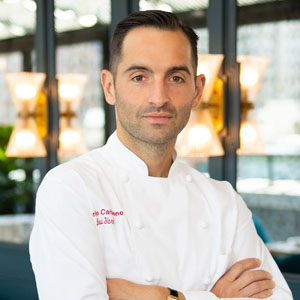
[00:00:10] Ray Latif: Hey folks, I'm Ray Latif and you're listening to the number one podcast for the food and beverage industry, Taste Radio. This episode features an interview with Chef Mario Carbone and Eric Skae, the co-founder and CEO respectively Mario Carbone Fine Food, the fast-growing consumer brand born from Mario's critically acclaimed restaurants. Get access to limited swag and exclusive content by becoming a Taste Radio VIP. It's easy for you to join that group of very important people. Just head to Taste Radio slash VIP and take one minute to sign up. If you're going to do something, be the best at it. That's quite literally the secret to Mario Carbone's sauce. The co-founder of globally renowned restaurant company Major Food Group, Mario is a native New York who learned his craft under the tutelage of some of the city's best-known and admired chefs, including Daniel Boulud and Wylie Dufresne. In 2011, Mario and business partners Rich Torrisi and Jeff Zalaznick launched Major Food Group, which currently operates 27 eateries across the world, anchored by his namesake Carbone Restaurants. Two years ago, Major Food Group launched Carbone Fine Food, a brand created to, quote, bring the taste of the iconic, beloved Carbone dining experience into consumers' homes. Helmed by CPG veteran and former Rao CEO, Eric Skae, the company markets a trio of pasta sauces and has rapidly developed into one of the most widely distributed and best-selling premium sauce brands in the US. In this interview, I spoke with Carbone and Eric about their shared vision for Carbone Fine Food, how they attempt to incorporate the flair and panache Mario Carbone restaurants into the brand, who they identify as the product's target consumer, their thoughtful pricing and promotional strategy, and why they're cautious and patient about introducing new products. Hey, folks, it's Ray with Taste Radio. Right now, I'm honored to be sitting down with Mario Carbone and Eric Skae Mario Carbone Fine Food. Gentlemen, how are you? Doing great. Fantastic. Thanks for having us. Thank you very much for joining me today. This is very exciting. Mario, you are, to the surprise of some folks, I would believe, based in Miami now. You were born in Queens, a New York guy through and through, but living in the FLA these days, what brought you to Miami?
[00:02:45] Mario Carbone: Uh, I mean, we, we made the move as a company. Uh, I was, you know, myself and my partner, Jeff, we sort of took team during COVID. We took the mentality that we were just not going to be stopped by this situation. And we still, we, we, we put our heads together. We figured out where can we continue to keep the wheels moving? How do we keep the business moving? How do we keep people employed? How do we keep the lights on? What do we have to do? And all roads immediately pointed to Miami and It was a big move for us, extending the company that way and creating what effectively became another main pillar of our corporation. And that was enough to move me as well. I mean, that was a big thing for us to do. And I wanted to be part of overseeing that. So yeah, I live in Miami most of the year now. I'm still in New York very, very frequently. I still have a home there as well. You know, who knows what the future holds, but for the foreseeable future, that's sort of my world.
[00:03:48] Ray Latif: Are you getting used to the weather there?
[00:03:50] Mario Carbone: It's not bad. It's not a bad perk.
[00:03:54] Ray Latif: It's kind of surprising because when I think about New York, I definitely think about Italian food. When I think about Miami, not necessarily, but has it become kind of a haven for Italian food since you guys have made it your home?
[00:04:06] Mario Carbone: I think people love food, right? I mean, I think good food, no matter what it is, is always going to have a place. So, you know, I don't think necessarily that it's better for one cuisine or another. I think it's just a booming place right now. And if you've got something to sell that's of any consequence, you've got a market here.
[00:04:26] Ray Latif: You have been in the restaurant and food business for a long time, Mario, and I think back to your days at Café Boulud and Wylie think some people might not know that you were a line cook with David Chang, who is really famous for Momofuku now, the Momofuku empire, as it were. And when he started Momofuku Goods, he had said the goal was for 50% of Momofuku's revenue to come from outside the four walls of the restaurant. Do you have a similar vision for Carbone Fine Food?
[00:04:59] Mario Carbone: Well, Dave has always been obsessed with consumer packaged goods. Ever since I've known him, he's always obsessed with that idea. You know, it found me and us as a company much later than it found Dave. That was a path that he knew was going to be for him and something that he's put a ton of time, energy and research into for years and years. And he's done a fantastic job with it. So that statement from him doesn't surprise me at all. Will that be the case for us? I'm not sure. We're sort of in the midst of this first product that we've launched, something that I would not have anticipated years ago. And it's been an amazing journey so far, getting to work with people like Eric who are stalwarts of the industry. And what will come from it, I'm not sure, but that's really exciting for me as well.
[00:05:54] Ray Latif: You brought in Eric as the CEO. Was it right around the launch or had you guys been talking for a while prior to launching the brand?
[00:06:02] Mario Carbone: No, I think we met right around the launch of it. I started inquiring who might be the right person to help us do this. Obviously, we're a restaurant company. We know that world. We have that skill set, but this is a very different beast. We'd be fools to try to tackle it on our own. Who's the right person to take us there? And immediately, all roads led to Eric.
[00:06:26] Ray Latif: Eric, you know a little bit about the consumer package goods space. You even know a little bit about the tomato sauce space as well. Talk a bit about how you met with and got to know the team at Major Food Group and Mario.
[00:06:41] Eric Skae: So, a private equity person initially introduced us that, you know, Jordan Gasper initially introduced us, Mario and I had a chat and it was very early on, you know, pre-pandemic. I was still at Popcornopolis. So, you know, really couldn't do anything. So, at that point, it was just conversation. Mario was thinking about it, and that's when Mario went out and started looking for people. And there's another person that I had consulted for in the past named Gary Davis that knew Mario and his team. And, you know, Gary ended up being a reference for me with the team as well. And then, you know, I met Mario, then I flew in to meet Jeff in New York, and it just kind of came together. I mean, when I looked at the the category, I knew that the super premium space needed something. Just having run, you know, a different one a few years prior, so, you know, running Raios. So, like, I knew there was an opportunity to go into the space and have a complementary brand. I think Raios is one of the most fantastic brands ever made. And I thought that it needed, you know, someone next to it. I think that helps drive categories, right? Competition helps drive categories. And I think that's where we're at now. I mean, we're head down and growing and I haven't pulled the Spins data lately in terms of comparing us to other brands. But last time I pulled it, we were the fastest growing consumer package good in conventional grocery. And that's all categories, right? Wow. You know, we've really grown this brand pretty quickly and it's because there was already a brand in place. Everything that Mario has done up until this point gave us what I call, what I tell my team is the Carbone Army, the people out there that know Carbone, that love Carbone Fine that will buy our products. So it was a nice base to start with.
[00:08:24] Ray Latif: The press release when Carbone Fine Food launched had mentioned that the brand was years in the making, and maybe that's referring to just the development of the brand as a whole. But why was 2021 the right year to launch a consumer brand?
[00:08:41] Mario Carbone: I don't think that the year had anything really to do with our rhyme or reasoning. Often for us, even at the size that we are today, it's still really just a gut instinct to do a project to not do a project to start something. And we had gotten to a place with, you know, at that time, four locations Mario Carbone worldwide, and a pretty substantial portfolio where we were looking to really continue to diversify. And we had started an internal conversation about wanting to explore the idea of consumer packaged goods and the Carbone brand living in a space that is beyond the walls, to Dave's comment, beyond the walls of the traditional restaurant. We thought that we were at a place where we had enough momentum enough recognition as a brand to really play in that arena. And that's a, that's a really exciting thing, but that, that took 10 years of hard work in the restaurant walls.
[00:09:41] Ray Latif: Now, the restaurants that you operate Mario Carbone pretty fantastic. I've only been to one that I can recall, and that's Contessa here in Boston, which is just a fabulous restaurant. Anyone who's visiting the area should check it out. There's a flair, there's a style, there's a panache to your restaurants. It's an experience for sure. Do you try to incorporate that experience into your sauces? And if so, how?
[00:10:07] Mario Carbone: I think that the sauces are a by-product of the experience, right? I don't know if you can bottle the experience, but you can give them a tool, which would be the sauce in this instance, to take that home and have that be the spark of something that they're creating on their own, right? For us, it's all theater, it's all storytelling. And in theater and in storytelling, every single piece and element and decision and textural moment counts. It all will lead up to the sum of its parts. So Mario Carbone, certainly the food and the kitchen and the ingredients and what we're producing there is an element of it. Can I bottle up the rest of it and give it to you? No, not really. But what I can do is give you a tool. I can give you the starter kit. You can take that home, put Frank on, drop the lights real low, throw some pasta in the water, and have yourself a night, right? Make your own movie.
[00:11:01] Carbone Fine: I was going to say, you can even jump on Spotify and get Mario's playlist if you want. Yes, you can. Yes, you can.
[00:11:06] Ray Latif: Well, I was just going to mention that to listeners who may not have caught the Frank reference. I assume you're talking about Mr. Sinatra himself.
[00:11:13] Mario Carbone: Are there any other Franks?
[00:11:17] Ray Latif: Not really. No, not, not in the, uh, not when it comes to Italian food. Just checking. Yeah. Vibrant Ingredients is the natural ingredient partner powering food and beverage innovation, delivering flavor, function, and protection through a science-backed portfolio. Vibrant delivers purpose-driven solutions that help brands create extraordinary experiences. Discover what's possible with Vibrant today. Visit VibrantIngredients.com. Eric, when you're talking to retail buyers and brokers about Carbone, how much does the experience, how much does that restaurant experience resonate with them in getting them interested in getting that palette wet, so to speak, so that they are willing and excited about bringing the brand and bringing the sauces into their stores?
[00:12:12] Eric Skae: Look, I mean, I've taken retailers to the restaurant because they wanted the experience, and I think there's nothing better. Like, if I take a retailer to the restaurant, they get it immediately. But I think the thing that retailers understood is just the massive following that Carbone had already, right? So I was able to take that and illustrate that we would get on the shelves and sell from the very beginning. And we really have. I mean, Ray, I've been fortunate to do a lot of fast growing brands in my life. And I always say this one feels like Arizona. I see to me, you know, where I, where I started my career where something just took off. Don't get me wrong. It's a lot of work. Um, I forgot how hard to start up was at the same time. I have a startup with a brand and this brand just turns, there's a certain segment of people out there to just know and get Carbone and Eric were able to portray that to the buyers.
[00:13:03] Ray Latif: Mario, your restaurants are super premium, ultra premium in some cases. Not everyone can afford to have a meal at one of your restaurants. And you know, that's just the business you're in. But when it comes to your sauces, it seems like they are a bit more accessible, even at a price point of $9 per jar. Who do you see as the target consumer for the sauces? Are they your patrons from your restaurants? Are they people that don't necessarily know about your restaurants but are very into, you know, premium sauces and a higher-end jar of tomato sauce?
[00:13:39] Mario Carbone: It's D, all of the above, right? I think that my patrons, although an avid carbon army, as Eric calls them, a large group of people, it's still, we're talking about nationwide and even a bit international at this point for the sauce. So it certainly has to be much, much bigger than that. Although I'd like to believe that the Carbone and Eric very strong recognition, I think that there's also a segment of people that don't know the brand yet. So I think that, yes, it's our consumers that are picking it up off the shelves. I think, yes, it's people that have not been to the restaurant but have heard of the brand and are curious about it or taking it off the shelves. And then there's maybe just somebody who's a food fan, a gourmand, an avid home cook who's looking to buy something that's maybe new to their market, but is obviously, you know, top quality ingredients. They care about what they're buying. They care about what they're serving. They care about what they're giving their children. And they're going to give us a shot. So I think, you know, the answer to your question is hopefully all of the above.
[00:14:38] Eric Skae: I did some panel data here on this because I wanted to really understand our consumer. Our consumer is 20 to 35, which is interesting because it's not the consumer for the rest of the category. So we're actually bringing new buyers into the pasta sauce segment that are younger, that are, call it pop culture savvy. And when I read about Parbon in the beginning, one of the lines that will always stick with me is mid-century elegance beats pop culture. And I think we get in that younger audience because of how well-known Carbone Fine in that pop culture world.
[00:15:13] Ray Latif: It also seems like millennial and Gen Z consumers are willing to pay more for better food. In this case, they're paying, again, a pretty significant premium for tomato sauce, but this is definitely not your grandfather's or even your mother's tomato sauce. This Mario Carbone. So how do you market, how do you explain that price point to a consumer who might like your labels, might know a little bit about Carbone, but is still questioning, you know, a price point that is hovering around $9 or $10?
[00:15:45] Eric Skae: Yeah, I think someone already charted the path for us, right? I think Ray has charted the path for a premium consumer. I mean, there's a couple of things going on, right? The category in general has been premiumizing for a long time. So it's no different than like, you know, the beer category where craft beer became a big thing, right? Same thing kind of happened here. And the category continues to just go more and more premium. And I think that's helping us because As they go premium, the consumer is looking for a new entry to the sauce market. It's funny, I always remember the stat back in the beverage business in the early days, back when I was at Arizona Tea, 75% of decisions were made at the cooler door. Sauce is more of a planned purchase, but it's still about 35% to 40% made at the shelf. I think our label jumps off the shelf. I think people are looking for a better option or looking for different options. And if they know carbone, they want to try it and they'll take a shot at nine bucks. You're going to take a shot, right? If it's 30 bucks, you might not take a shot at something at nine bucks to take a shot. And when you do take a shot, you come back because what we put in this jar, I believe is the best tasting jarred sauce on the market.
[00:16:55] Ray Latif: You know, I think the first time I had Rayo's tomato sauce, it was on promotion. It was on sale at Whole Foods. And it seems like it's pretty consistently on promotion whenever I buy it. And when I, when it is, I buy a lot of it. How does promotional pricing fit into your retail strategy?
[00:17:13] Eric Skae: Very important, particularly in an early brand because you have to create trial, right? So you have to have those trial driver tentpole events and around the time when families get together. So like Easter time, you know, that we just passed our reason that we just got through big time where families get together and you'll see a lot of sales to drive trial during that period of time. You know, once people try this brand, they come back, but it's a very, very important part of the business. When you have a premium item, it's very, very hard to just go EDLC and sit there. You've got to give a consumer that doesn't know carbon a reason to want to try it. So it's an important part of the business, but it should be at key times of the year and it should be for very short durations.
[00:17:54] Ray Latif: Mario, from what I've read about you, you're quite ambitious, as are your partners. And I think the first restaurant that you launched, at least the first Carbone, you had, you know, grand visions of an Italian restaurant that could be, you know, the biggest and the most recognized in America. You know, when you're thinking about the potential for your consumer line, Do you have the ambition for it to be, say, the number one premium sauce in America, or is it something that can just live as a great brand doing great business?
[00:18:28] Mario Carbone: I think if you're going to do something, you should try to be the very best at it, whatever that means. I've believed in that since I was a kid. That was instilled in me. You know, like I said earlier, had you told me a few years ago that this is what we were doing, That wasn't on our radar, but the fact that we're doing it and it's going so well doesn't surprise me at all. Once we commit to doing something, we are 100% all in on it and we want to make sure that we bring the same attention to detail, the same attention to it as we do anything else that we do. And if we do that, everything's going to work out. It's going to be okay because we believe in ourselves. And yes, so certainly the goal would be to be the best, to put out the best and to be the best. Absolutely.
[00:19:13] Eric Skae: When we were developing this product, Mario and his partner, Rich Torrisi, would get in a car at three in the morning in New York and meet me at our production facility three hours away. We would just Taste Radio Taste Radio taste. I can tell you for the first year, I tasted every single batch that was jarred before it went into the jar. Quality and doing something at a very, very high level and doing it the best is important. That attitude is ingrained in me as well. And that's the attitude that I expect the CFF team to have.
[00:19:46] Mario Carbone: Yeah. If we're working on something, a jar gets delivered to all of our homes. We get instructions of exactly what this batch is, how it was produced. We all taste it simultaneously. We all give each other our notes and we leave with an initiative and a directive on whatever that is.
[00:20:00] Ray Latif: Eric, when you're tasting, do you use a spoon, use some bread, dip it into the pot?
[00:20:06] Eric Skae: No, just a little bit of sauce. I don't need to taste a whole lot. And you don't want to have anything to change the taste. I need to taste just straight sauce. And what's funny about it is I've tasted tomato sauce so many times, and the fact that I'm still not sick of it, it tells you a lot.
[00:20:23] Ray Latif: Mario, this CPG business, the business of selling consumer products is challenging. It is a grind every single day, you know, as is the restaurant business, but there's some significant differences between the industry that you have long been a part of and the industry that you're currently in with consumer products. What's been the biggest learning curve? What's been the steepest hurdle when it comes to learning about how to market and sell a consumer brand?
[00:20:50] Mario Carbone: Marketing and selling are things that Eric spearheads, right? I mean, I think that I'm smart enough to know that I don't know those answers. And that's why we sought out the best in the business to be the person who's helping dictate a lot of those things. I think for me, what I learned or what I'm continuing to learn in development is that things don't necessarily happen at the pace that they do in the restaurant business, right? If I want to make a change to something, I want to tweak something, I want to create something, it's a slower process. It's moving a cruise ship and not a motorboat, right? So these things take time to develop, to get the right products in, to get them at scale, to make sure that all of the metrics that we're looking for in that jar or that product are hit. So the constant pace of development is something that we're still getting used to, but I think that we're starting to get into a rhythm with it.
[00:21:45] Major Food: Do you want more repeat buyers on Amazon? Well, this free resource in collaboration with Straight Up Growth will help your brand turn first-time buyers into long-term subscribers. Download Winning the Repeat Purchase Game on Amazon now at Taste Radio slash SUG. That's Taste Radio slash S-U-G to start building retention-driven growth for your brand on Amazon. Scaling a beverage brand into major retail comes down to operational readiness. From packaging lead times to co-manufacturing strategy, the details can make or break a launch. In a new ebook in collaboration with Octopi and Asahi Beer USA, industry leaders share what they've learned in helping brands scale. Download it now at Taste Radio slash octopi.
[00:22:35] Ray Latif: Eric, how much do you take consumer feedback into account when you are, you know, thinking about innovation or presenting something to Mario and the team or presenting maybe, you know, a tweak in terms of the formulation? I guess, how much do you take into account consumer feedback and that of your retailers?
[00:22:54] Eric Skae: I mean, I think it's important to listen to your retailers and listen to your consumers. So as we hear things, I definitely will look at them. I'll source them up to Mario, Richard, Jeff and say, hey, what do you guys think? Or even if we do a study like we have, we've done studies that tell us, okay, these are the next SKUs that you should go into. We talk about them as a team. We see if we can execute them at what we call a restaurant quality level. Like when we put something in the jar, we want something that you would expect to get in a restaurant. So, we've got to make sure that there's no obstacles to take it to that level. Because when we make this product, right, like, it's not like we're opening up 55-gallon drums. This process is the same exact process that's done in a restaurant, just in a little bit of a bigger pot. But it's still what I would call small batch.
[00:23:40] Ray Latif: At this point, Carbone Fine Food is a tomato sauce brand, but clearly it has potential to be a platform brand. Mario, in what other categories do you want this brand to play in? And, you know, there's some obvious ones, but, you know, what do you see as having the most potential when it comes to entering new categories?
[00:24:02] Mario Carbone: I think it's cultural. I think carbon as it continues to grow and as it continues to be recognized by a bigger and bigger audience, its potential is the entire culture of Italian and Italian-American food. So that's a really big category. But I do believe that we've made a huge amount of traction. And at first, the work that we did in the restaurants in the first 10 years, and now the noise that we're making in sauce, the options are really only limited to the culture as a whole.
[00:24:35] Ray Latif: So if I can ask more specifically, I mean, do you see an opportunity to go into say pasta versus frozen entrees, you know, olive oil versus olives? I mean, I guess, how do you weigh what makes sense for the brand? What will make sense for your consumers and, you know, what you believe as an entrepreneur?
[00:24:59] Mario Carbone: I'd say the reason I'm hesitant to give specific answers is because there's a lot of work for us to do still with tomato sauce. And we are not really allowing ourselves, although it's obvious that there's huge amounts of opportunity out there for us. We are not really allowing ourselves, Eric could tell you, to talk about it at all, because we want to stay hyper focused on continuing to pound away at making the best sauce in the world.
[00:25:23] Eric Skae: Eric has taught you well, Mario. I understand it better. We agreed right from the beginning. We were going to get sauced right, and we were going to get sauced right in a very big way before we went anywhere else, right? I mean, it's Mario's point. There's a ton of categories that you can go into in Italian. And if you want to break it down, you can take what's a three and a half billion dollar category in the United States being sauce. And if you take it to any category that could be Italian, you have a $70 billion addressable market with all the different categories that you can go into. Do I know every one of those categories? Yes, I know every one of those categories. Do I know the size of every one of those categories? Yes, I know the size of every one of those categories. Have I talked to Mario about any of them? No. We will at the appropriate time. I mean, at the appropriate time, we're going to sit down and say, OK, what makes sense next?
[00:26:12] Ray Latif: Well, I mean, the brand, as you mentioned, Eric, you know, is on fire. So I think some folks would say, well, if you're on fire as a brand, you should just, you know, keep the pedals to the metal and, you know, keep fueling that fire. But it also makes a lot of sense to stay ultra focused on what you're doing because you could be distracted and it could affect your growth strategy. All that being said, it does seem surprising. that a super premium tomato sauce brand is one of the fastest, if not the fastest growing in consumer products. And I know, Eric, you talked about the falling that Carbone has, but what are some of the other reasons that you see this happening? Why is it happening?
[00:26:56] Eric Skae: Look, I think we made a great product. I think we extended distribution maybe a little faster than I even wanted to, right? We're in 14,000 doors right now between the United States and Canada. The 683 pasta sauces that scans through spins last year, we are now number 20 in New York. We're number 7 to get those kind of numbers in 2 years, literally 2 years where our 1st bottles went on the shelf March 1st of 2021. The brand's growing, so to go back to your thing about expanding, why? Right now, we need to stay hyper-vigilant in that one section, calling on the same buyer. If I go to another category, now I'm diluting my sales team's focus, and I've seen too many people do that and fall down. It's very, very difficult. you could end up think about it, like you mentioned frozen. If you take your sales team and now they've got to call on a pasta sauce buyer and a frozen buyer, many cases you need different brokers, you might need different people, your programs are different, your slotting is different, and you need money for all of those categories in terms of slotting and all of those things. So hyper-focus is the way to go. We will stay there until we get to the point where we're all comfortable and say, okay, we think we've got this one right now. is the next categories to look at. And like I said, it's a very, very big list.
[00:28:16] Ray Latif: Eric, you also mentioned that a lot of purchasing decisions when it comes to tomato sauce happen right at the shelf, which makes the label so important. And, you know, when I'm looking and I have a jar in my hand here Mario Carbone Arrabiata sauce, and it's beautiful. And I particularly love that, you know, the quality of the sauce is really evident when you look at the back of the jar and you just see all those individual ingredients and my mouth is actually watering just looking at this and it just looks fresh. It looks delicious. It looks restaurant quality. The calorie count per serving, the nutritional value per serving are remarkably healthy, in my opinion. You know, it's 90 calories per serving. There's only five grams of added sugar. In terms of fat, it's only total fat is 9% of your daily recommended value. This feels like a much healthier or better for you sauce than a lot of others out there. How do you factor health and nutritional value into your restaurants and also into your sauces?
[00:29:20] Mario Carbone: I think it simply starts with premium, right? I think if you're immediately starting with premium ingredients, there's much less emphasis on the need to add things to it that are maybe not going to be so great for you to subsidize the flavor of it. We buy the very, very, very best possible ingredients. There's not a lot of need to start adding things to that to make it taste great on its own. I visited the fields where our tomatoes come from in Italy. I know what we're buying. I know the people that grow them. So great tomatoes, great olive oil. You could name the other handful of ingredients, that are present in all of our other competitor sauces. We just happen to buy the very best and we treat them very simply and we treat them as chefs.
[00:30:07] Ray Latif: And Eric, I mean, is the nutritional value or is this side panel that I'm looking at, I mean, how much does that impact? I would assume that it does in the kind of world we live in, but, you know, is that an impactful part of the reason that retailers and consumers are interested in and buying this brand?
[00:30:24] Eric Skae: Yeah, I believe it's very important. And not to correct you, but I don't believe there's any added sugar in that. I think it's sugar from the balance.
[00:30:32] Ray Latif: Yeah, it says total sugar with zero grams of added sugar, right?
[00:30:35] Eric Skae: Yeah, so there's zero added sugar. And the reality is, look, we're an indulgent brand. I mean, we're a restaurant. We're going to have indulgent skews at some point. There's no way around it, right? That said, we just, to Mario's point, we use the absolute best ingredients, fresh wherever possible. So if you went to our production facility, you will literally see people stripping basil off of stems.
[00:30:58] Mario Carbone: Or even harder, oregano. Basil's one thing to pick. Oregano is a very different thing to pick. And when we first started this journey, Rich and I were talking to Eric and the gentleman who ran the production facility, and we said, we don't use dry oregano, we use fresh oregano. And he was like, well, That's a very, it was like, it was almost like the blueberry conversation in casino. Just like, you know, you know how long it's going to take to put the same amount of blueberries in every muffin. It's like, yes, I know how long it's going to take, but we need to do it anyway. So just a little, little notation from the beginning of this process. And it don't.
[00:31:34] Ray Latif: Mario, Eric, really appreciate the time. Congratulations on everything that you've accomplished to this point with the Carbone and Eric excited to see where it goes from here.
[00:31:44] Mario Carbone: Appreciate it. Thank you for having us, Ray. Appreciate it.
[00:31:48] Ray Latif: Thank you. That brings us to the end of this episode of Taste Radio. Thank you so much for listening, and thanks to our guests, Mario Carbone and Eric Skae. Taste Radio is a production of BevNET.com, Incorporated. Our audio engineer for Taste Radio is Joe Cracci. Our technical director is Joshua Pratt, and our video editor is Ryan Galang. Our social marketing manager is Amanda Smerlinski, and our designer is Amanda Huang. Just a reminder, if you like what you hear on Taste Radio, please share the podcast with friends and colleagues. And of course, we would love it if you could review us on the Apple Podcasts app or your listening platform of choice. Check us out on Instagram. Our handle is bevnettasteradio. As always, for questions, comments, ideas for future podcasts, please send us an email to ask at Taste Radio. On behalf of the entire Taste Radio team, thank you for listening, and we'll talk to you next time.
[00:32:44] SPEAKER_??: you