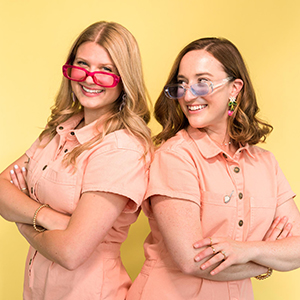
[00:00:10] Ray Latif: Hey, everyone, I'm Ray Latif, and you're listening to the number one podcast for the food and beverage industry, Taste Radio. This episode features an interview with Gwen Burlingame and Flannery Flannery, the co-founders of fast-growing, lactose-free ice cream brand, Beckin. Just a reminder to our listeners, if you like what you hear on Taste Radio, please share the podcast with friends and colleagues. And of course, we would love it if you could review us on the Apple Podcasts app or your listening platform of choice. When patented innovation meets addressable opportunity, the outcome is often positive. It's one of the reasons that the co-founders of Beckin and their retail partners continue to be highly optimistic about the future of their brand. Launched in 2015 by Gwen Burlingame and Flannery Flannery, Beckin markets lactose-free ice cream made via a proprietary process and using a base of six ingredients, including fresh milk and cream, and contain no gums, stabilizers, or artificial ingredients. Promoted as, quote, unbelievably delicious and surprisingly lactose-free, the products are sold in a variety of flavors and formats, including pints, quarts, and a new line of snack cups. Beckin is positioned to reach the one-quarter of Americans and growing who are lactose intolerant, a percentage that is three times that of the gluten intolerant population, according to the company. Carried nationally at Whole Foods and Sprouts, Beckin is now making inroads at conventional grocery store chains and preparing for a significant expansion in retail and distribution of its ice cream in 2022. While the current roadmap looks bright, a complex rebrand and a sustained lack of investment in female-owned CPG brands, among other challenges, have threatened to derail Beckin. As part of our conversation, Gwen and Katie discussed those pain points, along with the brand's origins and how they identified and sought to meet the needs of an underserved lactose-free community, why respect and humility were keys to a successful brand revamp, and why Gwen and Katie are encouraging industry professionals to get mad. You'll soon understand why. Hey folks, it's Ray with Taste Radio. Right now I'm on a call with Gwen Burlingame and Flannery Flannery, the co-founders of Beckon Ice Cream. Gwen, Katie, how are you?
[00:02:32] Gwen Burlingame: I'm great. Thanks for having us.
[00:02:34] Ray Latif: Thank you so much for joining me today. When I was getting ready for work this morning, that makes me sound like such an old person. I was getting ready for work this morning. For some reason, you remember that, that internet page that was bacon or beer can, and it was like this Jamaican guy was going bacon or bacon.
[00:02:50] Gwen Burlingame: Yes, I do remember that.
[00:02:51] Ray Latif: You do, yeah. It was either bacon or beer can, and you couldn't really tell. I think actually the website is bacon or beer can. And then I was thinking this morning, I was like going through, okay, bacon, bacon, bacon. And I was like, no, no, I can't do that. I'm not gonna, so.
[00:03:04] Gwen Burlingame: I love it.
[00:03:04] Katy Flannery: You got it right.
[00:03:05] Ray Latif: Yeah, that's how I get it. It's how I prepare for these things.
[00:03:08] Katy Flannery: Yeah, there you go. The only one that I know of is the Christian Bale, Christian Bale. Have you seen that one? Christian Bale, Christian Bale, Christian Bale. I've seen that one too. Yeah, we'll have to drop a link for everybody to watch it because it's like a original viral video, so.
[00:03:22] Ray Latif: Wait, what's the other one outside of Christian Bale? What is it?
[00:03:24] Katy Flannery: Kristen Bell.
[00:03:25] Ray Latif: Oh, Kristen Bell, Kristen Bell, Kristen Bell. OK, maybe. Yeah. All right.
[00:03:31] Gwen Burlingame: Wow, both of them. And then hopefully, you know, they'll start following taste review. Yeah, there you go.
[00:03:38] Ray Latif: That's a great idea. Well, Kristen Bell, I think an investor and a partner with this brand saves lives or this brand.
[00:03:45] Katy Flannery: Yes, yes. And Hello Bello, so which Hello Bello just became the first diaper manufacturing company to manufacture in the United States. So not that we've ever met Kristen Bell or I don't know why we're plugging this right now, but we love them and so we're very excited to share that. But yeah, here we go.
[00:04:03] Ray Latif: Well, in either case, Baylor or Bell, I think they would be a great partner or ambassador for Beckham. You'd be like Beckham, you know, and Bale or Beckham and Bell, you know, like there you go.
[00:04:15] Katy Flannery: Yeah, yeah, let's tag them in this. So maybe they will.
[00:04:19] Ray Latif: They will certainly be tagged. You know, Beckin is such an interesting brand. We followed you guys for some time. Obviously, Pitch Slam winner is the Nosh Pitch Slam winners for a few years ago. You've been at this for awhile and Katie, you had a career as a pediatric ICU nurse at Boston Children's Hospital prior to launching Beckin. I think about that job and I actually get like, I'm literally getting nervous thinking about it right now because I could never do such a thing. I don't particularly love being in hospitals. I've been to a children's hospital before. They are nerve wracking. That being said, you did it for a number of years and I'm wondering what is a tougher job, being an entrepreneur now or being a pediatric ICU nurse back then?
[00:05:04] Katy Flannery: I actually get asked this question a lot. And I think that it's a little bit hard to compare. However, being a pediatric ICU nurse, literally dealing with life and death. And so I will say first and foremost, we have the pleasure to be in the world of ice cream. We are not dealing with life and death every day, although it may feel that way sometimes. Um, and what I was doing as a nurse at Boston Children's is obviously incredibly rewarding. And when the kids got better, it was amazing. But to your point, it's everybody's worst nightmare to ever find themselves there. So for all of the challenges that we face as entrepreneurs, it is really nice to know that for the majority, Even though the work itself is hard, we are bringing joy to people's lives with ice cream. And also too, I mean, I get to do this job with my best friend Gwen. So it is not an easy ride. It's incredibly difficult. And sometimes I do actually ask myself, I'm like, what is harder? But then I remind myself that even though this is really, really tough, I'm very excited and privileged to be here and on this ride with Gwen and our team.
[00:06:11] Ray Latif: Do you ever get to bring back an ice cream back to Boston Children's?
[00:06:14] Katy Flannery: We have, and actually, so when we first started, so working full-time as a nurse when you're on a floor is usually three 12s. So I had a lot of days off to play with this dream and ice cream. And so I used to bring the like pints in, in just a white container with a Sharpie on top, put it in the break room and ask everybody to try it. And so it was a couple of years ago, I think it was after we went nationwide with Whole Foods, One of the nurses that I had previously worked with tagged us in a picture on Instagram and wrote that she remembered the days when I was bringing in those flavors in a white container and putting it in the break room. So yes, we have brought it back since it's been back in, but those were our earliest taste testers for sure on the floor so.
[00:07:00] Ray Latif: Yeah, well, I mean, even from the early days, it's interesting because I read a Medium article that you guys posted and in it, Gwen had this interesting quote about why entrepreneurs should begin with the end in mind. Yeah. That being said, what is Beckman's end? And why do you urge entrepreneurs to think that way? Gwen is so wise.
[00:07:26] Gwen Burlingame: I did not come up with that. I have to say one of our earliest mentors had told us. Always begin with the end in mind, because it will allow you to remain focused on your goal. Throughout our journey, we've had a lot of awesome opportunities. We've had a lot of sometimes unsolicited advice, sometimes very much solicited. And so you hear it, you get a lot thrown at you. And so beginning with the end in mind allows you to really look to the future and say, is this opportunity or this piece of advice or this deviation from the plan going to help us get there more efficiently or with a higher quality and kind of allows you to make decisions more quickly and with more confidence. And in terms of our end, so when we started the company, It started with katie because she's lactose intolerant, so this was kind of started from her need. And our goal was always to get beckon into the hands of as many consumers who needed it as possible, but lactose intolerant and their friends and family. And so that's kind of always been our end goal. And sometimes we say, you know, we hope to one day be a household name where no matter where a consumer shops, they can know about and find Beckett.
[00:08:52] Ray Latif: Gwen, you mentioned that Katie is lactose intolerant, and we have been seeing a large influx of dairy-free or plant-based ice creams come to market. And you guys told me an interesting stat when we first spoke, which is that tens of millions of the U.S. population are lactose intolerant, and the numbers are growing. That being said, I would think that the bigger opportunity is in dairy alternative products. But why do you see this runway for success in lactose-free products? Because you are dairy-based, but lactose-free.
[00:09:35] Katy Flannery: Yeah, so our journey into lactose free dairy truthfully came from my personal experience as a consumer. So about 15 years ago when I finally accepted that I was lactose intolerant, I had really tried to switch up my diet and I personally made the transition to take every dairy product that I was eating and switch it over to be dairy free. So actually first I tried the lactate pills and played Russian roulette with that when got a front row seat to that experience didn't really come out winning on that front, but then I switched everything over to dairy free, and I was finding that for my body for some reason. I was getting just as sick as I was when I was consuming dairy. And so it got me to thinking, you know, what is going on? Why is this making me not feel well? And what I found is that in a lot of the dairy free alternatives, there's gum stabilizers and additives to make the product exhibit the same kind of properties that you would expect from whatever the quote unquote real thing is. So once I figured that out, I kind of rerouted and switched everything back to lactose free dairy. And for my body, that worked really well. And so it just got me thinking that for anybody out there, there's going to be a specific diet that's going to work for your body and what it is that makes you feel your best. And so for me lactose free dairy is it and I felt that with 25% of the population being lactose intolerant, it was unlikely that I was alone. Additionally, you know, food is, is brings a sense of community and it has the opportunity to bring people together. A lot of our great memories, whether we consciously or subconsciously are aware of it, are tied to food and indulging with others. And I found that no matter what dairy-free alternative I brought to the table amongst my friends, my family, it was always viewed as lesser than. It was something where people would appease me, they would have a taste, but they wouldn't really get excited to indulge in it with me. And so I didn't want to live the rest of my life feeling like whatever I was eating just for myself or I was consuming with others was less than in any way, shape or form. And so as opposed to a lot of the other alternative categories, whether it's gluten free or dairy free, lactose free, you can have your cake and eat it too. You can have ice cream that is made with all of the same ingredients, including the fresh milk and cream, but it's just lactose free. So you're not going to feel sick. And so with a great tasting product and an awesome brand, we are able to, eliminate that stigma of our product being lesser than and that people can really be excited to indulge and to share together. And that's one of the biggest things that I was feeling as a customer and since being on this journey and the feedback that we get the handwritten letters that we get from consumers all across the country. That's the thing that just kind of like helps us get through the hard times and sticks the most because that's exactly what we wanted is that people could indulge and enjoy in the small moment in their day and to be a part of that and offer that to them is exactly why we're here.
[00:12:35] Whole Foods: guessing your margins, that's risky. Belay Financial gives CPG brands the clarity to scale smarter, faster, stronger. Get your free inventory ebook by texting TASTE to 55123 and start making data work for you. Vibrant Ingredients is the natural ingredient partner powering food and beverage innovation, delivering flavor, function, and protection through a science-backed portfolio. Vibrant delivers purpose-driven solutions that help brands create extraordinary experiences. Discover what's possible with Vibrant today. Visit VibrantIngredients.com.
[00:13:22] Ray Latif: Well, a lactose-free option may allow you to have your cake and eat it too. That cake is pretty darn complex to make and probably pretty expensive, no? At least to get it made in the first place. You guys have a proprietary formulation for Beckin. What did it take to get this idea off the ground from a formulation standpoint?
[00:13:45] Katy Flannery: So being a nurse, my background is in health science, and probably I think everyone around me would have, you know, now in hindsight, 2020, they're like, oh yeah, she was gonna make a career shift. I was daydreaming about food and recipes when I was in my like anatomy and biochem classes. So I utilize my background in health science to help create Becken's proprietary recipes. So there are molecular changes that happen when you take dairy, make it lactose free, and how that's gonna behave when it's freezing. And so I was just, I was making this for myself, like in my Cuisinart at home, and I was finding that there were certain parts that were not behaving the way that one would have expected in that freezing process. So, went to my kitchen to continue to experiment in what I called my think tanks. I used to walk around, which now they're bigger, but the little moleskin books, I called them my think tanks, and anytime I had an idea of how we could alter or shift, and I would just you know, have experiments in the way that we would have in a lab in school. And so what were my variables and how could I test it? And so that's how we started the process to create Beckins proprietary recipes. That being said, the end in mind is something that Gwen and I from the very inception have always thought of. And so I, after I had started working on the recipe, gotten it to where I felt like it was a good starting point, went to the Penn State ice cream short course, and saw what end manufacturing at large scale looked like. So I went back to my think tanks. I recreated the recipes and made some adjustments so that whether or not I was making it out of Cuisinart, a three-quart batch freezer, which we called ours humble when we finally were able to buy it, and then all the way now to contract manufacturing today, that we were able to scale this business. Food is expensive to make, especially when you're trying to make it with clean ingredients, clean labels, and with all of the values that we hear work very hard to uphold it back in. And even still, when the scaling process over the last five years, we've had so many different people say that we had to add in gums and stabilizers, and we have not. It's incredibly important that we have consistent product for our customers across the country. And obviously, a frozen supply chain is difficult. Yeah, we're excited to continue to do this and to push the boundaries of what is possible in the food industry.
[00:16:02] Ray Latif: You were convinced you could scale. You were convinced you had a scalable opportunity. That's part of the battle. But the bigger part of the battle, I would assume, is convincing others that this is a scalable opportunity. How has your pitch to retailers evolved? And, you know, what does it sound like at this point?
[00:16:18] Katy Flannery: Yeah, so we say V for velocity, V for victory. Gwen and I both went to Villanova. So a little shout out to our fellow cats. Evolved over time. So it really, it all starts with the story because again, 25% of the population being underserved in the grocery store right now with having high quality, great tasting products with a brand that people are super proud to put on the conveyor belt, not something that they're embarrassed by. You know, there's a lot of stigmatizing and medicinal options out there and so that first and foremost is where we started and what the dream was and the problem that we were trying to solve. As we've continued to grow, we're able to see that we're driving incremental dollars to this category because we're bringing back customers that have quite frankly been forgotten about and we're allowing them to come back to be reinvigorated in this aisle and increase their purchasing power by allowing them to have more occasions and more frequency with which it is that they're coming to purchase ice cream. And as we've continued to grow, obviously the data story has helped to support our claims, and it's something that we're excited to see come to fruition. But we know that we have a long way to go.
[00:17:29] Gwen Burlingame: Yeah, I think also when we started we were very specific about, you know, this is a lactose free product. That's what makes it so special. special, which is still our unique selling proposition when you look at the category. But from talking to consumers and getting lots of feedback over the years, the thing that sticks out most to them and that we get the most feedback on is how delicious it is and how the Taste Radio texture is exactly the same as regular ice cream, and you would never know the difference. that has been very impactful on the way that we talk about our product and the way that we think about it. Because yes, it's lactose free. And so that basically broadens the reach of this ice cream. But no matter what dietary restrictions you have, Taste Radio flavor is always the most important. And so, you know, recently we switched over our packaging a little bit, just made some updates and have now the tagline of unbelievably delicious, surprisingly lactose free. And that was directly from feedback that we had been getting from customers. So you can always find really, really special nuggets from the people who love your product.
[00:18:46] Katy Flannery: When we used to be in stores demoing a lot, or even in the early days when we started at the farmer's market, Sometimes you would get upfront haters, like saying that it would taste different. And I just would challenge people and say, I will pay you $20 if you can taste the difference. In six years of business, I have never paid $20. And I don't think that people are just appeasing me because I'm sure that some are. People are usually brutally honest and anybody who's ever owned a food company knows how honest people are with their feedback. So still today I challenge anybody that if they can taste the difference, I will pay up $20. Find me on Venmo, but I have yet to know.
[00:19:25] Ray Latif: There you go. A challenge to the audience. Buy a pint of Beckon Ice cream and a pint of your favorite or what had been your favorite ice cream. If you can taste the difference. Katie will send you 20 bucks. You know, picking and choosing the retailers that you want to be in or that you feel like you'll be most successful in is a critical part of your retail strategy. Methodical is a word that you guys have used in the past in terms of your retail strategy. What does methodical mean as it relates to how you approach buyers, how you're planning out your growth strategy?
[00:19:57] Katy Flannery: This is something actually that Gwen and I had to go against a lot of Sage advice and follow our guts on this. Oftentimes, general school of thought, and it's pretty common that you'll hear, win locally and then continue to expand. Become a hometown hero, grow your velocity in a region and continue to grow out. Gwen and I felt really early on that for Beckin, it was more important to be with the right retailers that had a higher critical mass of consumers that would be more likely to be our early adopters. But that took us far and wide geographically. So that was something that we had to continue to check in with each other and be like, we know that we're going against like the general wisdom here. We good, we good. All right, we're doing it. And so we just double down on our beliefs and are really happy that we did. It's been successful for us to date. That doesn't mean that it hasn't been without its challenges and also to our, A little bit of serendipitous, I guess, timing here is that at the time when we were really making that decision as to where to go next, we were authorized from one region of Whole Foods to all. So the validation essentially for our hypothesis there was validated by that buyer and that unlocked the distribution centers that were going to be able to give us critical mass on the retailers that we were going after across the country because Whole Foods was unlocking these distribution centers. We know that it's a very unique path. Brands typically don't go from one region of Whole Foods to all. I actually thought that initially it was a mistake when I got the email. I called Gwen and I was like, this would be so exciting. I think it's a mistake. You know, got this email. They must've been thinking about somebody else, but wouldn't this be so great? And then someone, I sent the email to one of our sales partners and they were like, Oh no, no, no, this is real. But then I thought we were just going to get four regions, which four regions in Whole Foods is amazing. And then, no, no, it was all 11. So it was an exciting and invigorating time. But again, going after the retailers and aligning with the retailers that shared in our vision, understood that this customer was underserved in their grocery stores, was willing to support us through this journey. That's been how we've grown to date, is we've worked very hard to partner in every way, shape, or form that we can with the retailers.
[00:22:16] Beckon Ice: that we are in. Scaling a beverage brand into major retail comes down to operational readiness. From packaging lead times to co-manufacturing strategy, the details can make or break a launch. In a new ebook in collaboration with Octopi and Asahi Beer USA, industry leaders share what they've learned in helping brands scale. Download it now at Taste Radio slash octopi.
[00:23:08] Ray Latif: Gwen, you mentioned you go through a lot of changes. you went through a major, major change with the rebrand from what was originally called Minus the Moo to Beckon. So many moving parts, so much complexity to that decision. What went into it and why did you ultimately decide to pull the trigger?
[00:23:31] Gwen Burlingame: So many sleepless nights over that one.
[00:23:34] Katy Flannery: I need to go officially on the record. Gwen was right. Gwen was right. We needed to change the brand. So I can admit that I was wrong. And yes, thank God for Gwen. And thank God we went through that change. So officially on the record, you have it, Katherine Flannery.
[00:23:52] Ray Latif: Well, great. I want to talk about that, because when two co-founders who are best friends go at it, and they're like, you are wrong. You are wrong. I'm right. I'm right. What do you do?
[00:24:01] Gwen Burlingame: Yeah. The thing that prompted it originally is really talking to consumers. So we started the brand at a farmer's market, we had a lot of face-to-face consumer time, and that in early stages of a brand is so valuable. Not only hearing what they say, but reading between the lines of body language and things of that nature. Because we had a lot of people who would come up and say, I love your name. It's so cute. It's great. But when you got to talking to them, we could tell that they didn't understand what the product was, you know, minus the moo does sound dairy free. And so that, especially as Dairy Free was growing, it was posing more and more of a problem in us connecting with the consumer and them really simply and easily knowing what we stood for. And so that was kind of what started it off. And it was a really hard decision. And I think that if I was telling an entrepreneur or talking to an entrepreneur who is considering a rebrand, I would certainly tell them, you know, I think in some cases, perfect can be the enemy of good. And it is really, really difficult to go through a rebrand, especially if you're already out in the world. However, I think it's very important to listen to your gut. And if you really feel that a rebrand is going to give you the strategic foundation to grow the brand long-term and that not doing the rebrand may hold you back in some sense, then I would say rip that bandaid off as early as possible. Definitely don't delay if you're that is telling you to do so. When we did our rebrand, we were already onboarded with one of our distributors. We had to go through an entire recode, which was so painful. I think the other thing I would say is that if you are going to do something like that, ensure that you have the support and the buy-in of your partners. Because without the support and buy-in of our retailers, of our distributors, it would have been even more painful and potentially super detrimental to the business.
[00:26:30] Katy Flannery: And being honest up front to let them know that this was coming, so we knew every single checkpoint, the paperwork that had to be filed, when it had to be filed, so that essentially we lost as few days on shelf as possible. Essentially, we got it down to the trucks leaving with Minus the Moo and beckon going in. pretty much within 48 hours. And so we could not have done that with, again, without the help of our distribution partner, understanding what we were trying to do without our retailers, knowing that this was coming and buying in on it. We also too worked with a great branding partner to accomplish this. And that also helped us to feel confident in where it was that we were heading. Any pain that we were experiencing would be short-lived and it would just be a blip on our timeline.
[00:27:14] Gwen Burlingame: You can see Katie's nursing background in her process oriented. She made sure that we were not going to have any empty shelves during that time.
[00:27:25] Katy Flannery: And I think Ray, one of your questions was about what do you do when you're on the opposite side of each other? In the beginning, Gwen and I are co-founders and co-CEOs. I can't tell you how many people told us not to do that.
[00:27:36] Ray Latif: Not to be co-CEOs?
[00:27:38] Katy Flannery: not to be co-CEOs because they felt like it would halt decision-making. But at the end of the day, whatever our title is, we're not going anywhere if Gwen and I are going there together. And so I think that Gwen and I very, very early on viewed this more as a marriage than we did as a friendship. Like our partnership is in sickness and in health, till death do us part. And so Being able to have difficult conversations is kind of the only way that you push boundaries and so I think that for any co founder any team, even for like you're with your employees, it's a certain level of respect you have to come to the table with you're going to rumble. many times over, over whatever big decision has to be made. And it doesn't mean that everybody is going to like very quickly get on the same page. But if you can respect each other, and I mean, I trust nobody more than I trust Gwen and vice versa. So if she's going to continue to raise this flag to me, I have to listen. And so I think that for other entrepreneurs, if they do have to face this decision, making sure that everybody is really listening and coming to a decision together as to what they feel collectively the best path forward is, is the only way to get there. And so I actually think that any challenges that Gwen and I have had have made our partnership stronger. And I mean, every business has been tested over the last 18 months. And I think without all of those early day experiences, It's been obviously a really hard road with everything that's gone on with COVID, but it's been made increasingly easier because I know that nobody has my back more than Gwen and vice versa.
[00:29:12] Ray Latif: Well, how are you ultimately convinced? What was the straw, so to speak, Katie? Because I think some people will say, oh, well, if I were in the scenario, someone would say, Ray, you have to humble yourself or Ray, you know, you have to really just listen because you're not listening. And, you know, they're probably true in both cases. I'm not easy to convince. I'm pretty stubborn. Yeah. But in like, in truly when you believe you're right, you know, it's hard when you are really stubborn. So, I mean, it sounds like you weren't necessarily willing to back down very much, Katie. So, you know, what got you to that point?
[00:29:42] Katy Flannery: same. I'm an Enneagram eight for all my aids out there. Roll call. It's not easy to convince us to do anything. Um, it's part of my strength and what makes me successful, but it can also be challenging. Right. And so at the end of the day, I respect Gwen. I mean, if she's going to continue to raise that concern to me and I can see how much it is how strongly she believes in something, she has my attention. And it took her to come back to me multiple times over. I did not make it easy. When I, in the process of humbling myself and truly kind of being vulnerable with my rationale, it was more because I was afraid. I was afraid that if we made this transition that it would set us back somehow, but fear is not a reason to make a decision. And so once I was really honest with Was it that I didn't think that she was right or was I afraid that she was? And coming to that conclusion that I was just afraid that she was right and I was afraid we were going to have to go down this path wasn't enough to stand in the way. And so quickly had to switch to be right by her side and go full speed ahead, arm in arm to go through this process. And we did. Again, I'm so grateful that we have done it. And there's been so many different things along our path that have you know, pushed us to make a decision and figure out how to walk forward together.
[00:31:03] Ray Latif: It sounds like from everything that we've talked about, that Beckin is on the right track, that things are going in the right direction. Now it's really about reaching the potential that I think you guys have set out for yourselves and that you see for Beckin. It costs money to do that. You guys need to raise funds to get bigger. It's just part of the food and beverage industry. Unfortunately, you're always looking for more money. And Katie, you shared with me a statistic that blew my mind, made me kind of angry, actually made me really angry. That said that less than 2% of female-founded companies make it to $1 million in revenue. That hasn't changed in 25 years. My head really did explode when you said that. How can we do better? I don't know. Do you guys have any suggestions? I know investors that listen to this podcast are going to be like, well, we're trying to do this and we're trying to do that. Yeah, but what really is going to move the needle here?
[00:32:03] Katy Flannery: Yeah, I mean, when I heard that statistic as well, I first immediately went to fact check it. I'm in the Tory Burch Fellowship program right now, and one of my fellow fellows stated that, and I was mind blown. And I went to fact check it across multiple sources. That's exactly what it says. And then within the next 24 hours, I actually heard that statistic again twice. Just was listening to a podcast, came up, was in a conversation, it came up. So it felt like this kind of pivotal shift of pay attention. and I was enraged. My husband, I was stomping around the house for 72 hours, and I was like, get mad, get mad. This is so messed up. Obviously, getting to a million dollars for anybody in revenue, it's a huge hurdle. It's a big accomplishment, and it's something that is there's a lot of blood, sweat and tears that goes into that. So, you know, again, I know that that's just that is just a milestone. But for women in particular, and for this statistic, there are many groups that are in, especially in the diverse populations that have, they have larger hurdles to get over that hump to be able to get there, as we've talked about before. And So for women in particular, one of the things that also too kind of enraged Gwen and I, and I think the first thing is that we have to just get out there and try. And the more women that are successful in this, we will inherently change the tide. We were told actually in one of the accelerators that we were in, that Gwen and I needed to bring on a male co-founder to become successful. Yeah. Who said that?
[00:33:35] Ray Latif: Let's call them out. Let's, let's put them on the podcast. Who said that?
[00:33:41] Gwen Burlingame: And I think it was specific to raising money as well, which I want to be mad at that person, but at the same time, that was their experience. Yeah. The statistics are there that it is harder for women to raise money.
[00:33:56] Katy Flannery: So Gwen and I just kind of huddled over it and we were like, look, this is actually not the first time that we've heard this. It's messed up, right? Messed up. Okay.
[00:34:04] Ray Latif: We're going to say- Very, very, very messed up. On my video, I was shaking my head, but I have to admit, it's very messed up.
[00:34:10] Katy Flannery: We're going to say, absolutely not. If we don't start to make this change, then who will? How are we going to really step into this role that no matter how successful we are, to be able to pave the way for others to do it? Beside us after us, so that other women can come forward and feel that they have a shot of being successful, less than 3% of venture capital dollars go to females. So part of the reason that also to that this kind of has a compounding issue is when we talk about CPG companies in particular. They're incredibly capital intensive. And a lot of actually the female funds focus on industries other than CPG, where the majority of women and I'm not I don't have like facts to back me up, but just in terms of like all the events that we've been to, this is qualitative. A lot of women who are founders are founders of CPG companies. So the dollar mismatch of flowing to these women who are trying to grow their business to then be able to get there and then return it and pay it forward to the next set of women or minority founders, it's just the deal flow. There's a mismatch, right? And so for us, Gwen and I hope that this will not be the last that you see of us, that we will be able to continue to shake this up and invest in women. And I think that And I'm not the first person to say this. We're hearing this a lot in conversations and people should and they should be mad about these statistics. And honestly, the best thing we can do now is get mad and talk about it so that we can incite change. But challenging that vision of success. Why did they say to Gwen and I that we had to take on a male co-founder? Why did someone inherently assume that we weren't enough? We're more than enough and sometimes I have to get up and convince myself that sometimes one does too but there's no reason why from out the gate, someone should look at us and think that we're starting a couple steps behind whatever their vision of successes. So I think that the more women and minority founders. And even, you know, white men like anybody who can just start to challenge that assumption will only help us move forward so we feel very passionately about this and sometimes also to not just for solving this problem for our customers. And for people like me, like Gwen and I talk about it, like we feel so charged with helping other women get there too, that it can feel suffocating for how much it is that we're trying to accomplish in a given day. And I have an executive coach that, you know, entrepreneurs need help too. Everybody vulnerable out there, go forth and get one. It's really nice to have a third party. But I was saying, you know, what if XYZ happens? What if we don't get to ABC goal? And she was like, what's wrong with where you've already gotten? And why do you think that you haven't paved the way for somebody yet? And that was kind of hard to hear, because I think that if we're always looking forward about where it is that we need to be, to be deemed successful so that somebody else will feel empowered to be successful, means that for everybody else who's maybe a little bit further behind than us, that we can try to help them as much as we can where we've already been. So we can start to incite change now and today, and not just in the future.
[00:37:12] Gwen Burlingame: And Ray, you asked about, you know, what could be done to help shift this. I feel like there is so much great work being done. Like we look at some of our retailers and our distributors and they have underrepresented founder programs and things of that nature. But I think one thing that could help expedite the process is certainly looking at the guardrails around some of those programs or benefits. So when you are a certified women owned business, it's not just that the female founders have to be female, but also the rest of the cap table. So that means that when, you know, we're looking for capital, we not only have to go through the normal process of getting out there, having to raise money, but we have to also ask ourselves where that capital is coming from. And the vast majority isn't necessarily coming from female investors. So the more that we can help propel women forward so that they can actually build wealth, become those investors, and then look back behind them and invest in more female companies, the faster that this will start to change. So I think that's one of the things that as an industry, we should look at the guardrails around some of those programs because in what they're setting out to do, they're so valuable. So making them available even more to the people who could take advantage of them. will really help all female founders forward.
[00:38:49] Katy Flannery: And I think when to your point about. the programs that are out there, are they actually enough to offset the challenges of raising capital? And really questioning, like, is this actually going to help keep this company here and propel them forward? That's a tough question. And it's not just one business's responsibility to change this for everybody. But if we're truly going to create a more diverse In a more diverse business landscape, I think questioning really hard as to how much this program is offering and opening up a door by lowering a barrier is important until the funding piece shifts.
[00:39:33] Ray Latif: Well, two things. Number one, I'm mad and I'm glad that you're encouraging me to be mad and continue to be mad. So I think that will help push the conversation forward. And two, it's quite clear that female founders can create great brands because I'm talking to two of them right now. Beckett is a great brand. You guys have done a really amazing job building it, and through a number of challenges and struggles, you're here now, and I congratulate you on that. And I thank you very much for joining me today on Taste Radio. Such a remarkable conversation, and I'm so excited for our audience to hear it.
[00:40:11] Gwen Burlingame: Thank you so much, Ray. We appreciate you having us.
[00:40:14] Ray Latif: Thank you. That brings us to the end of this episode of Taste Radio. Thank you so much for listening, and thanks to our guests, Gwen Burlingame and Flannery Flannery. As always, for questions, comments, ideas for future podcasts, please send us an email to askattasteradio.com. On behalf of the entire Taste Radio team, thank you for listening, and we'll talk to you next time.