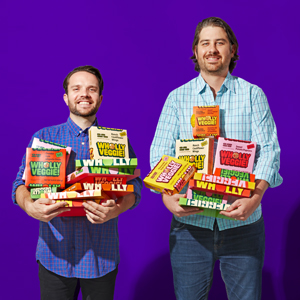
[00:00:10] Ray Latif: Hey folks, I'm Ray Latif and you're listening to the number one podcast for the food and beverage industry, Taste Radio. This episode features an interview with John Bonnell and David Gaucher, the co-founders of plant-centric frozen brand Wholly Veggie, whose dynamic and bold positioning is changing the way consumers consider vegan food. Just a reminder to our listeners, if you like what you hear on Taste Radio, please share the podcast with friends and colleagues. And of course, we would love it if you could review us on the Apple Podcasts app or your listening platform of choice. The proposed revamp of Wholly Veggie was so dramatic that it made co-founders John Bonnell and David Gaucher nervous and uncomfortable. And that's exactly how they needed to feel. A brand of vegan frozen entrees and snacks, including Thai curry, cauliflower wings, and mozzarella-style sticks, Wholly Veggie debuted in its home market of Canada in 2017. John and David envisioned the brand as one that could attract interest and democratize access to plant-based foods via familiar flavors and meals. Three years after its debut, Target began carrying Wholly Veggie at all of its U.S. stores, and the brand seemed on its way to becoming a household name. And yet, John and David sensed that it could just as easily turn into an also-ran in an increasingly saturated market for plant-based frozen meals. Wholly Veggie had to be bold, differentiated, and most importantly, stand for something beyond the food itself. In the following interview, I spoke with John and David about their process for creating a plant-based brand with broad appeal, their realization that Wholly Veggie' package design needed an overhaul, and how a thorough brand brief enabled them to better understand the product's value to retailers and consumers. They also discuss their adherence to business fundamentals, a challenging environment for private capital, and how the most commonly consumed ingredients factor into their innovation strategy. Hey folks, it's Ray with Taste Radio. Right now, I'm honored to be sitting down with David Gaucher and John Bonnell, the co-founders of Wholly Veggie. Gentlemen, great to see you. Thank you for having us. That's John. Very happy to be here, Ray. And that's David. And I'm very happy that you guys are here with me in our, well, I'm not going to call it a boudoir. That's what I call it. David called it a boudoir. Our cocktail lounge recording studio here at BevNET headquarters in Newton, Massachusetts. These fine folks came all the way down from Toronto, Canada. You don't even need to say Canada Toronto It's just Toronto.
[00:02:56] David Gaucher: I think now with with Drake's popularity and putting Toronto on the map You just see Toronto anywhere in the world. They know exactly where it is.
[00:03:03] Ray Latif: Well, is there another Toronto in the world?
[00:03:05] David Gaucher: I think there is there is I think there's one in the u.s. Actually.
[00:03:07] Ray Latif: Oh now I feel like an all-town Toronto It's like a Springfield. Yeah Springfield, okay, so Toronto now, I'm gonna look this up. Oh I'm gonna put this in the show notes. Yeah, the other Toronto. That's right. Yeah. Well. Thank you so much again for flying out You flew in this morning. That's right. Yeah, what time you have to leave to get to Boston?
[00:03:26] David Gaucher: Yeah, so Dave didn't get his Nexus yet, so yeah Is that like TSA pre TSA pre sort of yeah across the border? So we showed up at, uh, we got there at 530, 530 and, uh, no issues with flights this morning. I don't know if you're seeing this, but travel's been a pain in the butt the past year. It's getting better though. Yeah. It's getting better now. Got here, landed, first thing we did, straight to a grocery store. Went to Roach Bros, and then over to Whole Foods, and then on our way to here.
[00:03:57] Ray Latif: Store checks are so important. Darn right. Yeah. And how are the products performing at Roach Brothers and Whole Foods? Ooh, that's a loaded question.
[00:04:07] David Gaucher: That's a funny one because we were in Rochebros and then something happened with one of our distributors and we had to course correct. So we got out, but we're getting back in, in January. Beautiful store. And then with Whole Foods, I know Ray, you and I were talking a little bit earlier, which is Labor is a big issue across the board with any retailer. So we're finding some stores have all our products, some stores don't. So it's just going in there, checking on there. But our new entrees were in, which was fantastic.
[00:04:35] Ray Latif: And we brought some.
[00:04:38] David Gaucher: And our sweet potato popcorn was there, which apparently is confusing people with the name. So we're going to rename that product. So Ray, if you want to help us out here and brainstorm a new name for that, let's go for it.
[00:04:48] Ray Latif: Well, I'm holding a package of your sweet potato popcorn in my hand. What's so confusing about it?
[00:04:53] David Gaucher: It's popcorn. It's not popcorn.
[00:04:56] Ray Latif: Okay. So here's the thing. But I feel like it's like popcorn chicken, right? That was the insight. You nailed it.
[00:05:02] John Bonnell: That was the insight. People don't really get the concept of calling it popcorn.
[00:05:07] David Gaucher: No. Three second test. We failed the three second test. They're looking at it. They say, don't know what it is. And they keep moving. And so we're actually, I think we're right now the top two for that product in terms of the new names. are Nuggets and Bites. Bites is your default.
[00:05:25] John Bonnell: People love the item once they try it. That's what's really interesting about it. And we see the numbers week over week performance getting higher because people have sampled it. But you got to get the naming to where it's super obvious to the consumer. And that one, while we had the same insight that you did, you know, popcorn chicken or whatnot, and it just seems to be the wrong fit. So we're always course correcting. That's one of the things that we do here. You're always kind of pivoting and adjusting, and that's one of the products that we're going to do that little tweak with. Well, it may not be obvious to some.
[00:05:56] Ray Latif: I got it. So maybe I'm just, you know, on the same wavelength as you guys. More of you. More of you on your product restorers. Now, it's not intended to be obvious. that you guys are vegan. Correct. To kids. And I bring this up because you just launched a new campaign, at least a new video ad. We did. Called, Ha Ha, You Just Ate Vegetables. That's right. And this is pretty much the funniest ad I've seen in a long time. Thank you. And we're going to run the audio right now so people can hear it. I highly encourage people to watch the video, go to YouTube and watch the video. But here's the audio.
[00:06:34] Wholly Veggie: about wings! Yeah wings! Okay, so
[00:07:21] Ray Latif: This this ad is just too much I think You know you're not afraid of sort of making fun of the fact that like it's okay to fool kids that they are Eating something better than they realized or at least healthier than they realize better for you healthier however you want to put it
[00:07:41] David Gaucher: There's a couple powerful things in the HAHA campaign. And I think one of them is we're subtly giving parents the permission to do what they've always been wanting to do, which is just shove it. Just, here you go, kids. It's vegetables. We're giving them the permission to just say, yeah, we got you. It was vegetables. Because most parents don't get that opportunity. I think the other thing too with it is that this is a real challenge. that the person watching on the other end, if they have kids, connect with. Like Dave's got two kids at home. He's done a phenomenal job, I think, at just having the kids love vegetables. He's the anomaly. For most people at home, this is a daily challenge. And I think that's what people saw in the spot. And that's what we're trying to do. And we also, you know, one of the things about HaHa was that Look, we're not Coca-Cola. We don't have massive marketing budgets just to go and take over a Super Bowl spot. We knew with Haha that the creative had to work really, really hard, which meant we had to do the opposite of what everyone else was doing. If we came out with a, we're here to save the planet, go vegan, you're saving this much water and like there's no more cows in the land, we were going to fail big time. We'd fall flat. We knew we needed to be disruptive. We needed the creator to work really hard. We needed to get people laughing. And I think one of the big insights out of the HaHa, which we're carrying forward now, is we sit at the intersection of humor and vegetables. And so if we can tap into core insights that sit in that intersection, we can have a lot of fun as a brand.
[00:09:16] Ray Latif: We mentioned Liquid Death in the podcast, probably a little too much, but it is the brand of the moment. There was something very Liquid Death-ish about the ad.
[00:09:26] David Gaucher: Hmm. Dave, why do you think that was?
[00:09:30] John Bonnell: Yeah, look, I think to John's point, like, you know, we did something very relatable to consumers, that challenge of bringing vegetables into people's, especially kids' diets. And sometimes it's the husband, right? There's another video segment that's also out there where it's a couple and trying to sneak vegetables to the one guy who's never eaten vegetables. And we wanted to lean in with humor and something that was ownable for our brand identity, right? We want to be funny. We're trying to make vegetables fun and accessible. And we did a whole creative brief around trying to revamp the brand. And you saw in the packaging, and we'll go into that later. But, you know, as we looked at this sort of brand campaign, we looked at a few different partners and one of them was a company that had worked with Liquid Death. So to your point, we partnered with an agency in LA called Partyland. And what was really awesome about them was, you know, they kind of saw that we were willing to take a lot of risk. Just the packaging itself was kind of against the grain. Like John alluded to, we were trying to really break through the clutter and do things differently because we had no choice really to do it like that and try to stand out. So for them, you know, they always told us a lot of times you'll meet entrepreneurs and they say they want to push the envelope. But what happens is as you start doing that exercise, people, you know, sort of revert back to what they know and what they're comfortable with. And so the process of change gets diluted. And so with us, they could see that we were going to be willing to go hard. And we just love what they were doing. Like we thought, you know, this sort of dark humor type approach that they had with some of the other clients they had really fit for us. And to their credit, despite having been really successful, they were willing to work with our team and very receptive. And so while they were creatively, there was a lot of effort on our side internally. And John was kind of spearheading that with a lot of people in our company, just trying to make sure that our tone of voice, our opinion was heard. And I think that's where the magic happens.
[00:11:23] David Gaucher: But that wasn't easy though, which is, you know, and I would say it's, it's not just like, look, getting comfortable with being uncomfortable is a really hard thing to pull off. And for this, because we had tried two times before to update the brand identity. It had been gnawing at us for years on our look and feel. Cause we, we had the typical path that a lot of other food and beverage brands have, which is. when you create your initial brand identity, you know, you pull together a shoestring budget, you grab whatever freelancers you can, and you put together a bit of a hippogator. And what happens is as your brand begins to grow and you're launching new SKUs and you're creative, you have no brand book, you have no brand identity to pull from, your fonts aren't sorted out, and your brand literally changes on every product launch. And that's what was happening to us. Every product launch we did, we changed the brand. And I realized that I was too close in the process. And so we actually pulled in two advisors to kick off the whole rebrand project. So a former boss of ours, he used to work with Red Bull, and then a colleague of his that also does a lot of brand workshops for people. And they were the ones that kind of had to drag us along in the process to say, okay, guys, like, you know, what are you looking for? A tweak or a transformation? And every time we tried to change the brand before, we kept doing a tweak. And we kept feeling like we weren't happy. And so with this, we said, rip the band-aid off. Let's do a transformation. The only thing we're holding sacred is the name Wholly Veggie. Everything else is on the table, on the cutting room floor, just to be ripped up. That approach we took for the packaging, We also took for the campaign. It's honestly how we're even approaching everything from how do you sample your product now? How do you approach, you know, building awareness? We're approaching it differently because we just couldn't keep doing the thing we were always doing. And that's been a huge learning for us in the past 12 months. It's been terrifying, but also rewarding.
[00:13:22] Ray Latif: Yeah. I want to talk more about the revamp in a bit. Let's back up for a second because when you did start out, There was this excitement about plant-based food and analogs to animal-based proteins. And now I think it's a totally saturated market, to say the least. But, you know, when you started out, what did you see as the opportunity to be different than what had already been out there?
[00:13:51] David Gaucher: This kind of actually touches into our background. So Dave and I, we both met working for an organic meat company. So up in Canada, we work for a company that raises cattle and chicken and fish. And we basically, you know, being on the front lines of that industry, we saw something that was just tremendously unsustainable. And so what drove our original point of view in this category was to find a way to do the opposite of what we were doing. So we were very much, how can we find a way to address this issue of sustainability? And we kind of landed on vegetables as an area we wanted to go and play in. And back then, when we're working on the idea, the idea was concepted in 2016. And up in Canada, us lowly Canadians, we don't get any of these fun US-based products, right? So we had to drive to Wegmans in Buffalo to go pick up all the stuff. And when we looked at the category originally, we felt that everything was trying to emulate meat at the time. So Beyond hadn't launched in the refrigerator case, they're still frozen, but there was these brown analog soy and gluten-based meat products. And we were just astonished that nobody was finding a way to launch products that, you know, celebrated the vegetable, that looked like veggies, tasted like veggies, clean decks, simple, convenient. And our point of view in that we worked on the category was, you know, if we could launch a company that made it easier for people to eat more vegetables, we'd be able to have a long lasting company. And Dave was looking at some statistics about how big that frozen vegetable category is. And people keep forgetting how massive vegetables are. So our point of view was come in, be the opposite of the fake meat category, make it more convenient, more tasty, and more fun to eat vegetable based products. And we actually started originally in a refrigerated case. Not many people know this. I don't even know if you know this. We started with three plant-based patties. So we started in early 2017 with a burger that was a beet burger. So we had a Southwest beet, a green burger, that's a herby garlic green, and then a sweet curry carrot. They were refrigerated, little patties. They were a great product. But as we began to grow and we made the decision to come down to the U.S., You know, we realized that, you know, just being another burger on the market wasn't going to cut it. So that's when we made the pivot into frozen.
[00:16:21] Ray Latif: The big thing with plant-based and the big knock on plant-based foods, the stigma that still exists out there is that they don't taste good or they don't taste as good as, again, the real thing. And this is going back to the ad that you guys produced. Taste has to be king. Taste has to be first and foremost, the most important aspect of your product. And we talked about this upstairs before we hopped on the mics. David, how do you get the taste right? Cause your products taste amazing by the way. And I don't think there's any question about this. Chef Dave.
[00:16:49] John Bonnell: Thank you. Yeah. It's funny. Cause we were talking about this, how there's so many people who talk about that. And yet, you know, that mantra doesn't seem to stick with their innovation pipeline. People just want to bring products. There was a rush to get so many different things that were, you know, plant-based to the consumer with all the hype around it. You know, so many companies that had so much capital and trying to deploy it and show growth. And it's unfortunate because the way we look at it now is some of the consumers have maybe explored the category and now they've left it because they're just going like, man, that wasn't really good. I'm just not going to do that maybe for a little bit. So, you know, for us being a smaller company and we're all kind of foodies, We always like care deeply about, you know, does the food taste great? We have a lot of people try them. We have great people that work with us to help us with that. When we first started...
[00:17:39] Ray Latif: I'm sorry to interrupt. When you say you have a lot of people try them, I think this is the sticking point. This is the question I have is who are those people? And what do you mean by a lot?
[00:17:48] John Bonnell: Well, yeah, I mean, we're not a huge company, right? So we just have a diverse group of people that sample the items, but we also have people that consult with us that are very experienced launching products and commercializing them. And so, you know, through that process and combining their knowledge, it's been pretty good ever since we launched. I mean, people identify Wholly Veggie products with something that is tasty, something that has good mouthfeel, and that's always kind of resonated in delivering that to the consumers. Do you have kids try your products? Yeah. So funny story that the first products John was alluding to, you know, the insight that you're bringing here to this call, we actually went to the chef and he was a meat guy back then, you know, we were in the meat industry. I mean, I, I personally became vegan working there. And so I had a huge sort of mental shift, you know, my boss would be like, why are you still on this diet?
[00:18:37] David Gaucher: We had a great recruitment pitch for that chef too, because. Yeah, we ran into him at a chef battle happening in Toronto And we kind of cornered him when he's trying to leave and we said hey, we got this crazy idea But we have no money. Do you want to help us?
[00:18:51] Ray Latif: I also love that David called it his that person called it a why you're on this diet is that the idea of vegan being a diet and That's crazy diet of yours is vegan stuff
[00:19:00] John Bonnell: Yeah, but he, I mean, he was like, you go to his house and he's got like 30 smokers and barbecues and he's like self-declared meat king, right? So, but we had to win him over. Like the whole thing was, we never looked at the vegan consumers being the people we're focusing on because the mission we had, which was to make vegetables more accessible, like people, People forget how much of a problem it is still today. People don't eat one out of 10 of their daily servings of vegetables across North America. If you look at the Center for Disease Control, it's still a big issue. And so we wanted to help solve that. And vegetables is not for vegans, it's for everyone. And so we wanted a meat guy, like your hardcore 300 pound guy who's living on the sort of charcoal burner to love it. And so once you start setting that bar for taste, And you have to win over that consumer. Like I used to, like when we do demos at grocery stores, you'd have the, you know, don't want to generalize, but for the most part, you'd have the wife that would come in and be like, oh, this is interesting. Like, what is this? And, you know, the husband would walk by and be like, I don't want to try this stuff. It's like, no, no, no, dude, you're the guy that I want to see try this, right? And I'm going to like make you realize you're not going to die of protein deficiency and it's actually going to taste great.
[00:20:14] David Gaucher: He'd look at you and say, I don't do vegetables.
[00:20:17] John Bonnell: Yeah, exactly. But that was the guy we wanted to win over. But I mean, look, we all grew in the same environment and had the same sort of messaging that we grew up around. I think for us, being on the front lines of the industry is what really kind of changed our understanding. Like I was a hardcore, like, if it was steak, make it tartar. If it was sushi, bring on the sashimi. don't cut any corners, giving just the raw animal protein. So for me, obviously, just spending so many hours in slaughterhouses and just seeing the amount of land being used for organic, you know, sort of animal farming and just the way it works. And I had the benefit or the experience or benefit of living in China for a bit and just seeing how huge populations, the first thing they do when they have a bit of money is try to consume more animal protein. And I was just like running the math, just seeing how much land we were using for a very small client base. I was like, it doesn't work. What can we do differently? And so that's kind of a big part of how we partnered. John and I got a chance to work together, which was really interesting, because a lot of people ask, how is it to have co-founders and splitting roles and all that? I think sometimes it works, sometimes it doesn't. I think for us, having had that experience of working together made it a lot easier in that regard. bringing in partners, like our creative partners, their background was not in food. We actually brought in, as we were considering different people, food packaging sort of shops, people that did this for a living. And you could see that they kind of fell into doing things and approaching them the way you would normally approach food packaging. Whereas the other guys that we ended up partnering with, They didn't have that bias. They didn't have that sort of baggage of experience to draw upon. So they approached it with a very different and fresh lens. And I think that's where, again, that process kind of started moving around. But look, man, like before launching this, I was losing sleep. I was like, man, like people think I'm crazy about doing this. And to John said, it's like getting comfortable with being uncomfortable. And just that's where the magic can happen, where you're just there. And thankfully consumers and our retail partners and people have really gravitated towards this update. Some people have challenged us, you know.
[00:22:26] Ray Latif: Oh yeah. When you say they challenged you, what did they challenge you about the packaging? Because when I look at this again, I see that billboard effect. You see the brand in three different places on the front of the pack. I mean, it is billboardish. It is big.
[00:22:39] David Gaucher: 100%. Yeah. I think what happens is that, People always look for frames of reference. And you see this problem when I was in advertising, you know, we see this problem all the time, which is, you know, a client would send us their inspiration for what they wanted their creative work to be. And they would just be referencing stuff that makes them feel comfortable. And I think when we launched, even internally getting our whole team to buy in was tough because it was guys like, we're doing something, you know, we're really pushing it here. We're bringing completely different. And that was hard, but there's been some of our partners where they've challenged us on it. And the big thing for Dave and I was just to listen and say, okay, is, is there, is there a valid point here? Like, is, is like, should we be looking at some, some tweak alteration? And there's, there's actually the bottom right corner, we're adding a little bit more of the taste appeal in the photo, but. A lot of people, I remember I had one retailer tell me, I hate your packaging. I hate it. I hate the new stuff you're doing. And then I ran into him again and he was like, you know what? Sitting on me now and I like it and I think is that's like you got to get comfortable So just you just got to let it sit and eventually it comes around to you I think which is like okay like you get what we're trying to do here you get we're trying to push it you get we're not trying to be like everyone else because It's interesting exercise, which is you know, I challenge anyone to go in the grocery store grab their favorite products, you know, whether it be in pizza or whatever, and then cut out just the photo of the food and throw away the rest of the packaging, put it on the ground and tell me if you can recall the brand based off the food shot. And it blew our mind that, you know, 60 to 70% of all front of package real estate was being devoted to a food shot, yet there's no brand recall on a food shot. And everybody's doing the same thing. And to Dave's point earlier about us looking at different partners to help us in this exercise was that you could see it in some people's portfolios, which is just, it's like, there's certain styles they have when it comes to design and food, you see the same thing over and over again, which is it's the same food shot, it's the same this, it's got the nice background in there and they're using lots of whites and it's soft in tone. And it's like, okay, well, we're not gonna win. Dave and I knew, we were gonna lose. If we kept going the path we were going down, This was not going to be a long, lovely story for Wholly Veggie. We need to be- Can I swear on you, Ray? Of course. Kick some ass. right? We need to kick some ass. And if to do that, we had to go for it.
[00:25:16] John Bonnell: No, we had no choice. We had one distribution and nobody knew who the hell we were. Nobody had a clue what this was about. And we had no brand equity, especially here in some of these US retailers we were starting to work with. People liked the products, thankfully, but beyond that, it was like, how do you cut through the clutter? And we had to sort of You know, it's almost like swinging for the fences in a way, but it was very calculated. And again, there was a lot of rigor and hours and hours put into this to yield something that everybody kind of felt that tension between discomfort, but doing something that felt right, it was there. And that's, you know, that's kind of the experience is that if you're not totally sure, but it kind of feels right. you're probably onto something that, I mean, there's no guarantees in life, right? But, you know, for the most part, I think that that was a feeling that we all kind of felt and all kind of agreed was the right approach.
[00:26:07] Ray Latif: I'm thinking of this movie that I saw well I Saw it a while ago, and I remember was in this line when he was the main character was talking about the reason that he wanted to do something that was Scary for him at the time, and he says he said I'm gonna paraphrase here when it's scary to jump That is exactly when you should jump otherwise. You'll always be in the same place and
[00:26:32] John Bonnell: You know what, I feel like that is so true for this exercise, but most entrepreneurs will have to deal with that on an ongoing basis because there's always unknowns and there's always discomfort and there's always sort of a leap of faith, you know, whatever you're trying to do. John used to tell the team, right, it's like, You got to get on the boat and believe that there's land the other side, even though all you see is clouds right now, just got to follow us. We're going to get there. But a lot of it is built on belief and just, you know, obviously you go off of experiences and knowledge you have and understanding, but there's no guarantees.
[00:27:07] David Gaucher: I think the big thing with that though, is that you only get so many chances up a bat to do stuff like what we just did. Yeah. If you start doing really transformative stuff like this and it fails miserably. You know, when you go back to your investors from our cash, they're going to tell you to sit down. Yeah. Right. So I think one of the biggest differences we did this time around, and the way we've approached this is insight first. So let's do a proper brief. Let's understand our customer. Let's understand what's going on in the category and let's try to get to a point through like strategically discussing the brief. We feel we've got something that's really good because the best creative work, tension obviously is really important. Rules of the game are really important, but the best creative work, stem from a really rigorous brief. A design brief? Design brief. That's where the nuggets come from. That's where the insight comes from. And that's the spark that a creative team needs to really take this thing to another level. And I think That was the biggest difference, because when we tried this two times before, you know, the brief was verbal, it wasn't properly done. It was just, we were rehashing the same story.
[00:28:19] John Bonnell: We gave them the mandate of leading the exercise, whereas to John's point, the people who came in earlier, we really prepared this brief thoroughly. Like we'd spend hours upon hours, this was during COVID, so it was great to get on Zoom calls and do it for hours. That was what was being handed to the partners that were looking at helping you with design work or our colleagues who did the creative campaign that you heard earlier. They had substance to work off of to really start understanding what we were trying to do in terms of point of view. We were the ones who identified that we wanted to be the jester as a brand archetype. We wanted to be this fun sort of positioning and we could see how other brands kind of own different areas in the brand archetype sort of layout. Some were hero brands, like if you think of Beyond Meat, right, with the cape and the bull. So, you know, we were trying to own an area that was sort of white space in this whole category we're playing in and make that something that always felt right for us. It always felt like we like to be humorous. You know, we don't take ourselves seriously to be honest. So, and we didn't want the brand to be serious. Cause that's the thing about vegetables. When we were speaking to the guys at Partyland, they're like, we get it. Like you guys need to rebrand, but vegetables do. Vegetables are these things that people associate with their mom, you know, telling them to eat the Brussels sprout and kids screaming. And we had this funny video we posted about, you know, kids traumatized eating vegetables and stuff. And we like to play with that sort of, you know, issue around vegetables. And it's a very serious issue in terms of like, hey, people should be eating more of them. That's like a thing. It's actually important, but make it fun, make it resonate. So the whole position is something we came up with. And to John's point, that was sort of the foundation that a lot of these people that were really talented to sort of run with something, but having the insights drive the whole process.
[00:30:06] Ray Latif: Did you guys know how to create a design or brand brief ahead of time? Was that something you already had the knowledge of how to do or did you have mentors, advisors help you along the way?
[00:30:16] David Gaucher: A bit of both. You know, I would say I was a so-so strategist when I worked in advertising. He was good. He was good. He was great. You know, I, I understood the process. I knew what we needed, but I think like it's really tough to when you're, you You know, most of us in this sector are all running pretty lean teams and we're firefighting all day. We're doing so many different things and to be able to sit down and write a proper brief just wasn't realistic. So we brought in a friend of ours that, you know, does this all the time and was able to sit down with us on multiple occasions and just kind of coax this thing out of us. And then they took it and they put it to a final product that was great. And I think it's just our reality. Our reality is that time is our most precious currency for us, and we have to choose where we're going to go and put it. And I think for us, writing the brief ourselves was not realistic. And I'd actually say for anyone else that's thinking of going through this exercise, If you've got the time and you can write the brief, go for it. But if you feel like, you know, you need some help, 100% bring in someone who can help you get a really good brief because, you know, the work will all stem from that.
[00:31:28] John Bonnell: And where we got lucky with that, and there's luck in everything, right? Sure. Good or bad. But in this process, we got lucky in this, in a good way, was that this individual who's still working with us, Jim, like when he came in, He was a friend and like a lot of people you bring in, you hire people to help you out and you're always managing your money very closely when you're trying to build a business, right? And the default bias for somebody who's consulting is to do something in the least amount of time possible. And so normally that could lead to a successful outcome or it could not, but, you know, the incentives are sort of aligned that way. So it's hard. Whereas with Jim, it was sort of, hey man, like I'm going to obsess over this because I want this to succeed. I want this thing to work and I want to challenge you guys. And he took it very personally. And so to have somebody sort of in our corner trying to lead the exercise, but not sort of be on the take necessarily, just really trying to make it work. That was really key because it allows us to spend the hours and really just get the process done properly. And, you know, there's no short circuit. So that's my key message. I personally did not have that much background in this. Like I'm not a marketer by trade. So for me, like, you know, I would trust my intuition. I think, you know, as entrepreneurs, you got to feel what's right. And sometimes if your intuition is telling you something, you don't listen to it, you'll realize that maybe you should have. And the whole process felt right. And I enjoyed it because for me, like it was just like trying to unpack and solve for what we were trying to do and build. And it was a really fun exercise, like I said, but took a lot of time and we had the right people in our corner.
[00:33:05] Ray Latif: What was the most surprising part of the brief when you looked at the finished product? Was there something that stood out that made you realize what kind of brand you were versus what kind of brand you thought you were?
[00:33:15] John Bonnell: It was a lot clearer after we had done that. That's the key thing is that for me, we kind of were a lot of things in our mind. You know, we were trying to be a sustainable brand. We were trying to be a fun brand. We were trying to be a healthy brand. We were trying to do a lot of different things and It was sort of like, here's what we're going to hone, right? And here's our positioning. So for me, I think that was one of the key things.
[00:33:37] David Gaucher: Humor was the big takeaway from it.
[00:33:39] John Bonnell: Yeah.
[00:33:40] David Gaucher: I would say going into it, sometimes you feel like you're grasping at straws, you know, with, I've got to be a one-for-one company or I've got to, you know, go plant something for every product people purchased or, you know, you grasp at stuff. You really do sometimes. And I think that's where we were. And I think when we finished that brief, we walked away, we felt like we knew who we were. You know, we're out here to champion the vegetable. Nobody else is pulling this off. We're going to champion the vegetable and we're going to do this in a way that is frigging hilarious. And that feels good because before we didn't have that. And so I say those really helped crystallize, as Dave said, for us.
[00:34:28] Ray Latif: When you're thinking about the total addressable market for frozen vegetables and plant-based food, it feels like there's a much bigger opportunity than there had been. Yeah. Are you guys trying to reach that total addressable market or are you a little bit more focused on one particular consumer, one particular group of customers?
[00:34:48] David Gaucher: It's interesting because plant-based for the past, you know, a couple of years has been just strictly associated with anyone doing a meat alternative product. And I think that was an explosion of options in a retail store. And I think retailers were getting confused over what do you call this set? Is it the vegan set? Is it the plant-based set? Is it the meat alternative set? And then what defines within that? Is it protein that's the driver for what product should be in there? And so I think now people are pulling back a bit. And we're trying to not use words like plant-based quite a bit in what we're doing. We try to talk about vegetables, you know, veggie full, you know, like we, we try to use those words way more often when describing our company and what we do. And Dave will pull up a couple of stats here in a quick sec to explain, you know, the size of the market, but we're, we're really honing in specifically on, and when everybody will default to this, but millennials. So if you look at, you know, what transpired over the past 12 months, Millennials now represent 51% of all frozen food purchases. So they're now driving the majority of frozen food purchases. And what happened during the pandemic is that there was a ton of experimentation and trial of new products, whether it be DTC, whether it be retail, whether it be, you know, Uber Eats, and people started adopting frozen more and more in the home and the available options to people in frozen are getting elevated. Quality's better. Flavor's better. You're seeing more fusion now in frozen foods as well. Some other companies like, you know, your Birds Eye27;s and your Green Giant's and these are legacy brands. And I think sometimes people like to say, oh, you know, the big guys are too slow. Look, they're big for a reason. They have brand equity for a reason. You're not going to all of a sudden steal 20% of their market share overnight. But what you can do is focus on a consumer they're not winning with. And for us, the big guys, a lot of them are not winning with this millennial consumer. And what's happening right now, a lot of millennials are all having families. And healthy, convenient options in the home are very important for people with families. And most often or not, people are moving to larger homes, so the freezer is moving from your small 400 square foot condo with a tiny freezer and using Uber Eats to, now they've got a freezer, they can stock stuff, they can do meal planning, they can do prepping, and we're trying to win with that consumer. And that's where we're hyper focused right now. And we're still learning about how we can market our products, because the appetizers that we have right now, those are very comfort, vegetable focused products, whereas our entrees are more functional and healthy. And so the messaging kind of differs between the two between how is our consumer going to use them. But Dave, you were pulling some stats on the size of the market.
[00:37:39] John Bonnell: It is interesting. People are surprised by how much millennials have endorsed the freezer because it was kind of a category that wasn't growing like the other ones and pandemic really changed that. And I think people appreciate the quality now. So for us, obviously, you know, being innovators in the products we bring to market and making them really tasty, which we touched on earlier. those are really important. Like we have to bring stuff that is just really rocking it for that consumer and the branding, everything we've done is to speak to that consumer, right? So we're viewed as a more modern brand in that sense. Some of these brands you talked about, which have been extremely successful, launched with a different demographic and they've catered to it. And so for us, we see a real opportunity in this sort of frozen food category with millennials. And it's a big category, like despite all the noise, and narrative around fake or alternative meats, in 2021, that whole plant-based meat market worldwide had a market value in terms of sales of $6.7 billion.
[00:38:38] David Gaucher: Is that frozen, Dave, or is that overall?
[00:38:40] John Bonnell: That's just overall. So it's refrigerated as well, based on the stats that we pulled out. And then when you look at the vegetable market, which is much broader, it's $920 billion. But within that process and frozen vegetables, which is really where we sort of operate, it was $230 billion alone, right? And so that's 34 times larger than the entire plant-based meat category. Obviously, we try to stay away from highly commoditized products. We try to bring value at it, convenience-driven, innovative product.
[00:39:16] Wholly Veggie: We're not doing peas and corn in the bag right now.
[00:39:17] John Bonnell: No, we're not doing that. No. We were not gonna win there. But you can see that it is a big market. And originally, like John said, when we looked at this, we were intrigued by plant-based, sorry, fake meat or meat alternatives. And I thought they were cool, because I was like, hey, man, this is really interesting. They're bringing science and they're trying to educate people. the reason behind it, having had the life experience we had, we could acknowledge that this was something worthwhile to try and do, but we kind of got scared how processed it was. And the chef, the meat chef tried it and was like, why does it feel like I have a sock in my mouth? So he was like, you know, a lot of these products were not super tasty, and he was like, they're brown, and they kind of look sad, and vegetables are fun, they're bright, they're exciting, and so we just kind of felt, even back then, looking at the consumer research and how big of an issue it was, the under-consumption of vegetables. I think I told it earlier, only one in 10 in North America eat enough vegetables, which is five servings of vegetables, which is not that much. Most people in North America eat one and a half servings per day.
[00:40:16] David Gaucher: Here's a little, uh, pop quiz for you, Ray. Okay. So 50% of all vegetables consumed in America come from this one vegetable. Corn?
[00:40:30] Ray Latif: Potatoes. Potatoes? Why? People eat a lot of french fries. And chips.
[00:40:35] David Gaucher: And chips. Okay, now, here's number two. What's the second most consumed vegetable?
[00:40:42] Ray Latif: I'm gonna go back to corn, because vegetables are a fruit. I don't know. Tomatoes. Tomatoes, okay.
[00:40:48] SPEAKER_??: Why?
[00:40:48] Ray Latif: Because people leave a lot of ketchup.
[00:40:52] David Gaucher: So our whole thing is, look, we want to bring diversity back. There's a ton of amazing vegetables out there. Cauliflower has had its moment. It's still having its moment, but we've got some stuff up our sleeve. So, you know, we want to go across that category in Frozen and bring a lot of these diverse vegetables back onto people's plates and do it in a fun and tasty way.
[00:41:16] John Bonnell: Yeah, democratize vegetables. Like our newest entree lineup, one is a Thai curry. It's delicious. It's gotta be delicious, right? But we've got eggplant in there. People are a bit more coy about that type of vegetable. So for us, it's important that we allow people to experiment and get comfortable with. And I love potatoes and I love tomatoes. Don't get me wrong, I love them. But when you see those statistics, it is kind of scary to think there's that few people eating vegetables and that's really what the consumption is around, potatoes and ketchup.
[00:41:47] Ray Latif: Well, I mean, the products that you have taste amazing. I think they are, in some cases, for a more refined palate, for example. I mean, I think some of your entrees, for example, a Thai curry entree, for example, is delicious. Not everyone is going to appreciate the deliciousness of it. Correct. When I think about some of the products in the Wholly Veggie portfolio, things that really stand out and feel like they can be scale drivers if they're not already are the things like the mozzarella sticks. And the mozzarella sticks are entirely plant-based. And people who eat them are getting their daily nutritional value or their recommended value of vegetables. Yeah. So why is it really important to be innovative when you do have an opportunity to drive scale with say a single or two different products?
[00:42:40] David Gaucher: There's different schools of thoughts out there. You know, some people feel like you don't need to be first to market, and they keep saying, well, you know, Apple didn't invent the iPhone, and the Palm Pilot existed before that. You know, and blah, blah, blah, blah.
[00:42:55] Ray Latif: But here's the reality, which is... Look that up, folks. For people who are not familiar with the Palm Pilot, go ahead and Google that, and tell me that... Oops, did we just age ourselves here? No, no, but I mean, really, I mean, that was... Looking back, I mean, what a... What a lame device.
[00:43:10] David Gaucher: You know, I see all tech defaults back to Star Trek. I'll say that. But I would say that first to market matters a lot for us. And I'd say we look at innovation in three waves. So wave one, you launch that kind of hype curve is just beginning to come up. It's not mainstream yet, but the consumer is beginning to see it maybe in restaurants and they're hearing about it. And so when they go to retail, you're the only one offering that product. You're capturing the consumer. You don't have any competition. Wave two innovation for us is, if you got competition and it stinks, like it's a reality and it becomes a dogfight. So what generally speaking is, You know, your retail partners will bring in your competition because they want you guys to kind of fight it out on the shelf. And you may be going to be more aggressive in promotions because you want to be able to beat out your competition. And Wave 3 innovation is when private label hits. And I say, if you're launching at Wave 3, Oh boy. You got your work cut out for you because you're unknown on the shelf. You've got private label. That's going to be a buck 50 less than you. They're going to have better placement. They're going to be on promo when you're on promo because they have your promo calendar. That's really tough. So. I'd say there's two things. One is we try to launch first to market a lot of stuff. Number two is we like to have a plan for flavor and skew extensions pretty quickly after we launch. But within reason, you know, one of the mistakes we made in the past was. we launched too many things. So we launched too many things and we didn't want to be a business that was generating, you know, 15, 20, 25 million off of 15, 20, 25 SKUs. We wanted to be a business that was putting four and eight SKUs were driving that revenue for us because it allows us to have, you know, efficiencies in manufacturing. It makes our lives a heck of a lot easier with how we're setting up all of our cold storage and our logistics and our distribution. And it makes it easier for marketing because You know, we've had it in the past, back in the day, we're like, okay, at the end of this month, we're marketing pizza. Next month, we're launching, you know, marketing meals. Next month, we're launching. It's like, what are you telling your marketing team to focus on? You feel like you're constantly not doing enough. So for us, we've pared it down, but we think about, okay, within that category, flavor variation, because you can keep the consumers still understanding that product set. You're not having to shift the marketing to a completely different product set.
[00:45:32] Ray Latif: You have to talk to investors on a regular basis, unless you're already very, very well capitalized. Based on the past year, you guys have grown and changed and transformed in so many ways. Are those conversations, have they been significantly different? Not just based on how you've evolved, but on how the environment for investment has changed.
[00:45:56] John Bonnell: The biggest change has been, I mean, for us as entrepreneurs and, you know, fundamentals matter, right? I think fundamentals matter, but I think a couple of years ago, there was just a lot of noise around the category and a lot of capital being thrown at it and valuation numbers that, you know, probably weren't always justified. What you're seeing today is a much more sober, cautious investor. I think the issues that you talked about in terms of too many products coming out that probably weren't as good as they should have been, and the growth in this sort of overall category slowing a bit. makes it that people are pickier. Obviously, the conjecture we're in from a macroeconomic standpoint, which we can't control, but is also affecting the consumer behavior and is affecting investor sentiment, right? There's less of the animal spirits. It's funny with these investors, I like to say that they have two modes that they default to. It's either greed or fear, and they all tend to do it at the same time. So what you're seeing now is a much pickier, much more cautious, much more sober, investor base. And look, we think that's fair. I think for us, we want the right partners. That's the key. People who understand what we're trying to do, that like what we've been doing, understand that, you know, maybe this year we didn't have maybe the revenue growth we had before because there have been shifts in the environment. And because we made decisions like John alluded to, to get out of certain products that were driving revenue for us, because we know that less is more for us today. And we want to lean into products and categories that have a lot of runway for our brand. And so, It's okay to experiment as you're trying to, you know, really get an understanding of what you can own and dominate as a company. And so for us, that's kind of what we're in the process of, we're having talks with people. And, uh, yeah, I think the biggest... Always be raising. Always be raising. I mean, entrepreneurs in food and some of them, they may have the luxury of owning facilities and maybe some really, really strong IP or stuff. And, you know, they're well capitalized or they're generating cash flow day one, stuff like that. Or they've had really clever launches where they're just doing club, which, again, there's risk to that as well. you know, it's a cleaner business than just traditional retail. So there is no real truth, but I always tell John, like, if ever somebody asks you, are you looking for capital? I'd say, we're always looking for capital. And everybody's not telling you that it's probably, you know, a bit full of hot air. Because it's a capital intensive industry we're in. And we're up against big companies. You know, we're, we're trying to win and I'd say that the stack is sort of against you when you look at the private label that John talks about, that they want to go after you. The manufacturers that want to, you know, try to get as much as they can out of you. The retailer want to jam you with fees. What do we say Dave?
[00:48:41] David Gaucher: Our margin is everyone's opportunity. Yeah. To steal from business.
[00:48:46] SPEAKER_??: Yeah.
[00:48:46] David Gaucher: Yeah, absolutely. It's tough sledding out there right now, I think, for anyone. And people are having big questions, which is, do they take on debt right now? And use that to kind of delay the conversation, the hopes that say maybe in Q3, Q4 2023, the macroeconomic picture is a bit better and maybe investors are back at the table, the valuation ranges have changed. There's a lot of questions people are having right now, and it's definitely a tough environment. But, you know, I would say that one of the true ways to get a real sense for what your long-term plan was in the business is to like go through that exercise properly of raising capital from some of these VCs, some of these PEs, because Maybe if you had a sense of what you thought that margin expectations were and velocity expectations were and revenue growth, maybe you thought that was the right path. And then you have these like really sobering conversations where it's like, actually no, like you need to be way higher on margin, way higher on velocity, way higher on this and that. And that, that I think is, you know, for our conversations when we're talking to friends of ours in the space and hearing what's going on in their conversations, this stuff's all popping up now. And I think it's important to really go through that exercise. Cause I also think there's a lot of like myths in this industry too, which is like, Oh, you know, I'm going to RX bar this thing after five years. Okay. That's cool. And I can swim on top of a great white shark. You know, this is not a reality. Like, you know, operate in the assumption that no one's buying your business and do it. Cause you want to have fun and you believe in it, but if you think you're just going to go on. you know, flip this thing. Like, look, look what happened in the past two years where, you know, us Canadians like to be, uh, nice, nice and simple, but we also have these crazy, uh, financial markets where people can go public, you know, after buying their chewing gum. And there's a, there's a flood of companies that all went public and, and everyone's like, oh, I'll just go public. I'll make all my money and I'll buy my Ferrari. Like, no, stop. Everyone stop. You know? It's fundamentals. Yeah. Build a good business. You know, it's really hard, but try to get to some type of traction towards eventually hitting a breakeven point and grow with the accounts you can sustain.
[00:51:00] Ray Latif: I mean, I love that you said operate under the assumption that no one's going to buy your business. I love that because there are a million businesses out there that no one has any interest in buying for a variety of reasons, but can still be profitable and successful companies.
[00:51:15] John Bonnell: Look, when we started this, for me it was almost therapy because we were trying to launch this thing. And again, I'd become vegan working in a meat company. So, you know, that's interesting. Your diet, your diet. Yeah, my diet. But I had my two young daughters that I'd look at every day. you know, Wholly Veggie was launched with my second daughter the same week she was born. I was taking paternity leave, putting a request in for some sort of like government sponsored, like small business loan. So that's kind of how it started. And my wife will always remind me of that, by the way. God bless her. She's been very supportive. But you know, I think that passion of trying to show something that was going to try to do something positive and not, you know, do what I was doing, because Once you have kids, you really look at the world differently. You really do. It becomes more about other people than maybe you appreciate. So for us, I think that having something to lean on that is meaningful, there's gotta be a path towards having some sort of financial success to deal with all the craziness around being an entrepreneur. And you definitely would be lying. you're in it to make some money. But if you only have that, you're going to have a real challenge because it's not always easy. Like you said, some of the folks that have been on your show saying it can be lonely and dark. And that's true. Like there are really, really difficult moments where people are throwing you under the bus. And from one hour you're the hero, you're the greatest thing, you walk on water, an hour later, you know, you're a deadbeat and you're kicking on the curve. So you need to have something more. And, you know, for like, for me, that's what it was. It was just feeling that I was trying to do something I could show my daughters that they could be proud of and that could be meaningful. And at the end of the week, you have a nice bath and reset your mind.
[00:53:02] Ray Latif: Start again. I'm not an entrepreneur and I always point this out. I mean, as if it needs to be pointed out, but I mean, I think you put it beautifully, David, because I think you have to take the lumps, but also realize that you can do something great for yourself and for the world if that is your passion, if that is your vision, and it isn't just about money. I do, however, want to go back to money. Sorry. It's part of our industry, it's part of our business. And this question of, you know, what are investors looking for now? And John, you talked about how investors are moving the needle or moving the... The goalposts. The goalposts for margin, for velocity. Typically everyone says, okay, you got to have a minimum of 40% gross margin in this business. Where is it now?
[00:53:47] David Gaucher: I would say that everyone has a different definition of gross margin too.
[00:53:51] Ray Latif: This is, this is not good news for our younger, our early stage founders who are like, well, I was told gross margin is this, this and this.
[00:53:58] David Gaucher: It's just sales minus product cost. So there's, there's different definitions. So some people, you know, it'll just be, it'll be frayed in for gross margin. It won't be frayed out. They won't have a trade spin in there. What we're seeing right now is that people are honing in on two things, product margin and landed margin. And what we're seeing now is that product margin basically is around that 45 to 55 percent, sometimes even higher depending on your category. Like if there's some categories where the product margin is way higher. We're in frozen.
[00:54:32] John Bonnell: Frozen it's a bit different. Yeah. I think investors, if you look at some of the companies that are reporting, even reporting issuers, their margins were in the high 20s. And so that's not acceptable today. You gotta be north of the 40%, to your point.
[00:54:45] David Gaucher: Well, it's just the expectation on trade spend support now, and then you're incurring all these consultant fees because you're trying to figure things out, right? We like to say that the route to market is filled with booby traps, and those booby traps just are like vacuum cleaners for cash.
[00:55:02] Ray Latif: I know our listeners are going to get mad at me if I don't ask, what are some of the bigger booby traps that to avoid?
[00:55:08] David Gaucher: I would say that we know there's a couple of things in there. And we were talking about this earlier, which is your desire to go national. It's expensive. If you go national, so say, say, you know, let's use Unify as example. You open up Whole Foods, you get a national listing with Unify. You're high-fiving. We did, we were high-fiving. Yeah, so pumped. And then all of a sudden you get the, all these activation fees. So like every warehouse, there's an activation fee. And then there's a minimum required spend also to be working with Unify because they need this money to be able to support you as you're, you know, selling into all the independent retailers. And then you got to go to the shows and there's all these show costs as well. And then when you're at the shows, you got to get even bigger discount because Hey, you got these independence of the show and you got to be able to drive volume.
[00:55:51] Ray Latif: It's funny, I didn't see any of these fees or costs mentioned on LinkedIn when people say, hey, I'm at the UNFI show.
[00:55:57] David Gaucher: No, no, people don't.
[00:55:58] John Bonnell: You see that afterwards. But all those, yeah, they all creep up on you. And then there's all the other stuff, which he didn't budget for, which is deductions. I think that beyond trade spend, which you can always argue is an efficient use of capital, because if you're doing trade spend, especially for a brand like us that's growing, you want to be, you know, incentivizing trial. You want people to discover and you want to support new retail launches. And that's fair. But I think once you, you know, we've come out of two years of very complicated supply chains and You know, if retailers like Walmart and Target couldn't figure out how to get the logistics and the supply chains ironed out properly, then it's hard to expect growing emerging brands to do a better job than them. But that's the standard you're held against because. You still get fined for shorting orders, right? You still get orders that fall below your MOQs. I think some of these people will not respect some of the conventions they've given you. And so your freight costs can get sort of out of whack. The MOQ is always the funny one, which is, yeah. Which is, for the odd listeners, it's a minimum order quantity. So when you're when you're budgeting, you'll tell someone, hey, like order this amount of product so that I can make it somewhat efficient to get it to you. And then they'll pretend like that was never shared. Or if you're in the unfortunate situation where you get a shortened order, well, that's on you. So now you're shipping inefficiently. And so now the costs are getting higher and, you know, it was an inflationary environment. So those things were kind of compounding a bit. Things are normalizing, thankfully, more recently here on that front. And that's sort of something that we have a good handle on, but some people don't. And it's just a reality, like depending on how your supply chain is construed, it could be very exposed to all that. And entrepreneurs got to be very careful about holding people accountable. I think for us, the deductions and, you know, some of the fines and all that, I just kind of find it ridiculous because all the retailers have empty shelves. The bigger brands, they may be able to balk at it and be like, I'm not accepting that. And because they have clout and leverage, they can get away with it. But the smaller guys, I always say like, we're kind of like the middle class where you get pressure from both sides, whether it's the cost side or the revenue side, people are just trying to go after you. So it's just part of, it's part of reality. It's part of the puzzle. And like, for me, I'm an engineer. I love problem solving. So I always view the challenge like, Hey, it's a problem that can be solved and you just got to find that solution.
[00:58:27] Ray Latif: Well, we'll have to do another one of these where you guys talk about how to get your product from shelf into someone's cart Yeah, well, maybe maybe we'll just need a bunch of entrepreneurs in the room to talk about that yeah, we'll do that Maybe we'll do that at Expo West. I'll be fun.
[00:58:47] David Gaucher: Yeah, I'd be like amazing rumble of
[00:58:51] John Bonnell: It's like the Holy Grail in CBG, really.
[00:58:54] Ray Latif: Answer that question properly. You're in a good spot. Well, you guys have answered a lot of my questions amazingly. I'm so excited, like I said, for our audience to hear this. I'm so excited for the future of Wholly Veggie. Thank you guys so much for coming out here. It means a lot to me personally that you came out all the way from Toronto to Boston. I tell folks you're always welcome to come to our office and you guys actually did it.
[00:59:15] John Bonnell: So thank you. We're pumped enough with these Zoom calls and we're in the boudoir. We are in the boudoir.
[00:59:22] Ray Latif: This is amazing. Oh boy. You have to come check it out. We're going to have to get a neon sign that says raised boudoir and put it up over the TV. Now, John, David, thank you so much again. This has been fantastic and I can't wait to share it with our audience. Awesome. Thanks for having us. Thank you. That brings us to the end of this episode of Taste Radio. Thank you so much for listening, and thanks to our guests, John Bonnell and David Gaucher. Our audio engineer for Taste Radio is Joe Cracci, our technical director is Joshua Pratt, and our video editor is Ryan Galang. As always, for questions, comments, ideas for future podcasts, please send us an email to ask at Taste Radio. On behalf of the entire Taste Radio team, thank you for listening, and we'll talk to you next time.