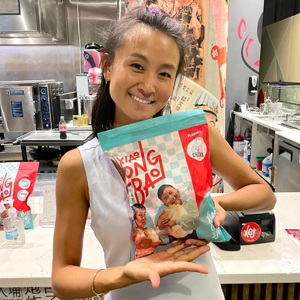
[00:00:10] Ray Latif: Hey folks, I'm Ray Latif and you're listening to the number one podcast for the food and beverage industry, Taste Radio. This episode features an interview with Jen Liao, the co-founder of fast-growing direct-to-consumer Chinese food brand XCJ. Just a reminder to our listeners, if you like what you hear on Taste Radio, please share the podcast with friends and colleagues. And of course, we would love it if you could review us on the Apple Podcasts app or your listening platform of choice. When Jen Liao and Caleb Wang saw their dream business in peril, they froze. The reaction, it turns out, was brilliant. Jen and Caleb are the founders of XCJ, a surging brand of frozen foods inspired by Chinese street cuisine. The former corporate executives and married couple launched XCJ as a Seattle-area restaurant in 2018. Known for its authentic soup dumplings, XCJ became a popular destination among local residents, yet its early momentum was threatened by the rise of COVID-19. At the outset of the pandemic, Jen and Caleb eschewed serving hot takeout meals and instead began freezing batches of their dumplings and making local deliveries for consumers to prepare at home. The dumplings quickly became a cult hit within the region, and within a matter of months, XCJ expanded distribution nationally. The company has since established a frozen logistics network with warehouses across the U.S. and shipped millions of its critically praised dumplings direct to consumers from coast to coast. XCJ also expanded its offerings to include lamb, beef, and chicken barbecue skewers, sauces, and recently introduced an ice cream line inspired by Chinese ingredients. In the following interview, I spoke with Jen about Caleb Wang her decision to enter the restaurant business despite no prior experience, how XCJ cultivated consumer interest in the frozen dumplings, the somewhat easy decision to open a manufacturing facility, and how they're managing multiple business divisions while continuing to grow and maintain quality standards. Hey folks, it's Ray with Taste Radio. Right now I'm honored to be sitting down with Jen Liao, who's the co-founder and president of XCJ. Jen, so great to see you.
[00:02:42] Jen Liao: Great to see you as well, and thanks for having me on.
[00:02:45] Ray Latif: Yeah, thank you so much again for joining us. I want to get this out of the way as soon as possible. I said the name of your company is XCJ. That's shorthand for a longer name. What is and how do you pronounce that name?
[00:02:57] Jen Liao: Yeah, so XCJ stands for 小吃街, which in English it translates to Street Food Avenue, and that's why we chose the name.
[00:03:08] Ray Latif: Yeah, street food avenue. That sounds all appropriate for what you guys do. It's interesting because I think street food is something that a lot of people have come to embrace as, you know, this delicious cultural kind of food that is not often seen in the United States. But the term street food has a connotation that I think still might be a little off or awkward for some people. Are you finding that? Are you finding that street food is something that people at this point, either really understand or are they still kind of, you know, getting up to speed on it?
[00:03:44] Jen Liao: Yeah, that's a good question. So actually, it could be street food or it could be tapas. There isn't really an equivalent of something that's used in the US to describe this type of dish. So I think it's both street food and it's tapas. It's basically, you know, small bites that you can take on the go. I think street food is pretty big in some of the bi-coastal cities like there are festivals in LA and New York. I think the rest of the U.S. doesn't quite do it as much but yeah we've seen pretty good reception.
[00:04:22] Ray Latif: Yeah, well, you guys have been at the forefront of this growing interest in street food. You have a restaurant in the Seattle area, which is where this all started. I'm actually heading to Seattle later this fall. Any recommendations on where to eat, obviously, aside from XTJ, which I will be visiting?
[00:04:41] Jen Liao: Perfect, yeah, I think a couple of my favorites. There is really good fat in Seattle and fallback is one of the classic ones that you can't go wrong there and that's based in Seattle and then a personal favorite is actually Lacoine. It's a French restaurant and it has a really cozy atmosphere so those would be my top two choices.
[00:05:06] Ray Latif: Fantastic. I love good pho. It's hard to find, but I'm going to go with your recommendation. If anyone knows anything about good food in Seattle, I assume it's you. You also know some good things about ice cream and meat skewers. I came to know XCJ through its dumplings, which are phenomenal. Folks, if you're listening, you haven't tried XCJ dumplings, do yourself a favor, hit pause, go to their website and go buy some, because they are phenomenal. You also make some, as I mentioned, ice cream and meat skewers that I have not tried yet, because they just launched within the past couple of months. The skewers actually got a really nice write-up in the New York Times about a month ago.
[00:05:45] Jen Liao: Yeah, that's right, so we launched skewers end of May ready for the summer season, so we actually have. lamb skewers, which is the traditional skewer meat type in China. And then we also have chicken and beef as different meat options. In the future, we hope to expand the line to also include some vegetarian options for this product line. And then for ice cream, we just launched that a couple of weeks ago. And we have jasmine green tea and rose lychee as our two flavors.
[00:06:17] Ray Latif: Are you shipping the ice cream as well to consumers? Or is that a little bit more local to where you guys are?
[00:06:22] Jen Liao: We are, we're shipping all of these nationwide. So we've spent a lot of time actually building out our backend frozen logistics, which is pretty unusual for an e-commerce C2C food company. But that's where we started off with because we had the frozen soup dumplings and one of the biggest challenges or investments that we've made. And because of that, we are able to ship other frozen items.
[00:06:46] Ray Latif: Well, we're going to get into all that logistics, planning, execution momentarily, but I want to talk about the restaurant again, which is where it all started. 2018 is when XCJ launched. As far as I can tell, this is based on a prior conversation with you and then having looked over your LinkedIn profile, you didn't have any experience in the restaurant industry prior to launching the restaurant. Can you talk about the decision to get into that business?
[00:07:14] Jen Liao: Yeah, definitely. So I actually come from a health tech background, and my husband and co founder comes from a finance background so you're right, we definitely didn't have any experience, other than, you know, working as servers or working in fast casual restaurants in high school, college. So a little bit of a different experience. But we also have a third partner who also runs a chain of poke restaurants. And that's how it kind of started. So Norman is his name. And he had opened one poke restaurant. And I'm actually allergic to fish. And I didn't have any restaurant experience so When Jen asked if I wanted to open that together with him, I politely declined, and then the second time things were going well he asked if I wanted to join in on expanding it. And, you know, my answer was the same at that point, but actually, our first item. or our anchor item in our physical location in Seattle or Bellevue is exactly where it is is something called the syndrome ball, which is a pan fried soup ball, which is about three times as big as a soup dumpling and as pan fried, and it's a very much a Shanghai street food. So that is Caleb, my husband. It's his favorite food. So I had asked Norman, why don't you start a restaurant that does this? We've never found a good one in the U.S. and we would love to eat it. We'll support you on your journey opening this restaurant. So that's how it started. Obviously, we got very involved along the way and we opened the restaurant together.
[00:08:51] Ray Latif: I got to ask about your fish allergy for a second, because I don't know too many people with a fish allergy. It sounds horrible. I'm sorry to hear this. Is it the mercury? Is that what causes you to be allergic to fish?
[00:09:02] Jen Liao: Yeah, it's a good question. I should probably dive into exactly which protein I'm allergic to because I can have shellfish, so I can't have fin fish or cephalopods. but I can have shellfish. So it's a very specific allergy. I've only met one other person with the same allergy, but it's okay. Shellfish is delicious as well.
[00:09:23] Ray Latif: That's very true. That's very true. Shrimp, lobster, all that. It's good stuff. You know, opening up a restaurant is very difficult. I think the failure rate for restaurants is pretty darn high. So just being open for four years to this point is pretty amazing. Obviously the pandemic played a key role in your decision to launch the Frozen line of products. But I assume there's a lot of learnings that you took from those first couple of years in business at the restaurant that you were able to incorporate into the Frozen line. What were they?
[00:09:55] Jen Liao: Yeah, so actually very different businesses, almost entirely different team organization, business setup, financial setup. So other than some of the culinary translation, I think there were very few learnings that actually translated from the restaurant over to the e-commerce side of the business. But obviously, having had the restaurant and starting there, we did have a foundation for making the food. So for the restaurant, as I mentioned, we had syndrome ball and actually this pan fried soup ball that I mentioned, you have to cook it in a really large cast iron pan, about 60 to 80 at one time, and then you have to sell it within 30 minutes. So When Jen had opened our first brick and mortar location, we had really limited the menu. So we had this and then we had one other item called the jimbing, which is kind of like an egg crepe filled with different savory toppings inside. So those were the only two items we launched with because we wanted to focus on really doing one item super well and making sure that we could sell out of that in the time frame that was necessary. So I think that was something that translated. So When Jen had started the e-commerce side, we also really focused on one item, which was the soup dumpling to go ahead with. And the soup dumpling is a cousin of the Sin Jimbal, which is why we had started with that one. It was a really good choice. I think a little bit of a lightning in the bottle situation with COVID. where people were at home and seeking at-home options, and the soup dumpling could be frozen. I think people have seen dumplings frozen, which is where we got the idea to freeze our soup dumplings and see how that would turn out. And I think a lot of Americans are familiar with soup dumplings or have heard of that, especially in the bigger cities. They may have gone to visit a restaurant that they've learned about this type of food. And I think usually in the US, there's a lot more American Asian food versus Asian food itself. And soup dumplings is up there in terms of a recognizable item. So we definitely got lucky with our choice that we started with.
[00:12:09] Ray Latif: As you mentioned, very different businesses, the restaurant business and the packaged food business. But in terms of parallels among consumer insights, what did you learn about why people liked your food? And how were you able to translate those insights or at least apply those insights into a packaged food brand?
[00:12:30] Jen Liao: Yeah, so our audience is also very, very different for the restaurant versus online. Oh, really?
[00:12:37] Ray Latif: Wow, that's really interesting. I would never have guessed that, honestly.
[00:12:40] Jen Liao: Yes, exactly. So I would say in the restaurant, very qualitatively, because we are in Bellevue, there's a lot more of an Asian population there, which is also why we had decided to start the brick and mortar in that location. There would just be more support and interest overall and people who are familiar with the item that we were bringing over. So actually the restaurant is maybe I would guess around 50% or more than 50% Asian population or Asian customers, and then online it's less than 12% Asian customers. So it's a very different audience who is purchasing, and I think who goes into a fast casual restaurant versus who purchases, you know, 100 soup dumplings online also looks fairly different. So that didn't really translate However, I think one philosophical pillar that we have maintained and carried over from the restaurant to the e-commerce side is just the quality of food. So the reason why we had started the restaurant was to bring over the best Sendren Bal that we've ever had in the US and have it in the US. So I would argue we're probably top three in the US, maybe top two or top one in terms of this particular food item. And that was really important for us going into it. So opening the restaurant, we wanted to taste what we have had growing up. And then we wanted to have the best quality and best item of that particular item available over here. And so When Jen had started the soup dumpling side, that was the same philosophy that we wanted to carry over was if we're going to do this, we want to be best in class. And so we spent a lot of time on the formula in terms of figuring out the dough, the filling, the gelatin, the ratios, how we can get it thinner and have it not crack, for example, and spent a lot of time on that R&D piece before we decided we were comfortable with expanding and scaling that particular product. So that was a philosophy that translated over and I think that served us well.
[00:14:46] Ray Latif: It seems like you were able to develop the line and market it pretty quickly, at the outset of the pandemic, that is. Was this in development? Was the frozen line in development prior to COVID hitting?
[00:14:58] Jen Liao: No, it wasn't. So we actually had not been testing out frozen at all. And the restaurant actually only shut down for three weeks or so. So it was a relatively short amount of time. We've always been fast casual. So we were able to get up and running on the restaurant side again for takeout and delivery orders for, you know, DoorDash, Uber, all of that. And we could do that pretty easily with the no contact in the beginning of COVID. And for the soup dumplings, we did that totally separately to experiment with the frozen soup dumplings itself. So we actually started very locally and regionally. We had reached out to folks on WeChat, which is a Chinese social media messaging platform. And we posted in a Facebook group, letting people know that we would have this item available. And we literally started out with Google Forms. Then Mo or PayPal and MapQuest and then we and other delivery drivers that we found online would just drive around in our car and drop off a brown paper bag on people's porches. And that was sufficient because everyone was obviously at home. So that made it a little bit easier to get started at that moment in terms of how we would deliver this item in an MVP way. So we actually had enough interest just from those groups to get us started and really crank up in terms of the soup dumpling. And they referred a lot of their friends and that expanded regionally. So first it was just in the first 10 miles, within the first 10 miles of the restaurant, And then we expanded to greater Seattle. And then actually this was where maybe an inflection point of our realization that we could capture other markets was there's an island off of Seattle called Bainbridge Island. And there aren't very many Asian food options there. And most people commute into Seattle for work. but because of COVID, they were no longer commuting. And they found out that we had soup dumplings. So they actually placed a large group order. And then we drove and took the ferry over to Bainbridge, went to a park and had people come to us and pick up the soup dumplings. And because they had an Asian food or Asian cuisine food option, people got very excited. It spread in all the Bainbridge Facebook groups. And at some point I believe we served maybe about 8% of the entire island population. So that was very exciting. And I think for us that was a aha moment of, oh, there are lots of places, even close to urban cities. that don't have great access to some of the food that we're offering. And after that, we just started expanding in terms of what we could set up logistic wise. So we did do, you know, the Pacific Northwest first. We had somebody who came to our restaurant to pick up a cooler of 50 bags of frozen soup dumplings to drive up to the airport and then fly to Alaska so that they could bring it to their friends and family there. So that was really fun. And then after Pacific Northwest, obviously West Coast, and then the East Coast, and then we had full coverage by November for nationwide. It wasn't super reliable at that point. I would say it was 2021, maybe May or June timeframe that we really set it up in a really good way of two-day ground coverage across the U.S., but November was When Jen were able to at least ship across the U.S.
[00:18:37] Ray Latif: I wonder if in those first few weeks, that island that's near Seattle, you could have just sent a drone out there and just dropped them in the middle of the park. That might've been a little bit more efficient, but I guess the story of just taking the ferry and serving 8% of the population on the island, that's a pretty amazing one for sure. You know, proper preparation of your soup dumplings is critical. When you guys sent me some samples, you also sent a bamboo steamer, which has been really, really helpful. Making sure that customers know how to prepare this food and prepare it well is so critical, because if not, they might blame you. They'll say, oh, well, this food isn't very good, and then give you poor reviews. Can you talk about the consumer education strategy as it relates to cooking your dumplings?
[00:19:25] Jen Liao: Yeah, so I would say it was less of a in advance thought out strategy and more of a reactionary strategy to make sure that people knew how to cook it properly. So we do have instructions on the back of the bag, which I would say are mostly sufficient. I would say maybe up to 70% sufficient, but obviously there are cases where that's not enough. So one very common thing that we see is people are not boiling the water before they actually place the steamer on, and that will very much vary the cook time and the result. Another one is for boiling the water, it's like a simmer versus a really really rolling boil and they leave it on for one minute extra and maybe they leave it on top like they turn off the heat but they leave the simmer on the pot and those extra minutes actually deflate the soup dumpling and then there's no longer soup in it. So we actually do see a lot of troubleshooting comments or questions. So we've really invested a lot in our customer service and making sure that we have a lot of coverage 24-7 and people are answering very quickly to anyone that has questions for these problems. And then we had, you know, a call line for anyone who wants to call in as well. So those are kind of the foundational things that we established was just making sure we had enough coverage, a large enough team across everywhere to be able to address these questions or concerns. And then I think it has really helped that on our social media. We also have you know cooking tips or we answer all of the comments on all of our ads. We also answer all of our comments directly in the ads as well and so people see what the troubleshooting tips are or see that other folks have maybe had some trouble with that and they know to reach out. And I think because we built up so many reviews, we have over 3,000 on our website, then people are also, you know, there are definitely still skeptics thinking, oh, are these fake or not? They're 100% all real reviews from our customers. But it does help us with the benefit of doubt, where people are saying, okay, I see these pictures that are posted everywhere. and they're turning out a different way than mine are. So it must be user error. I'm going to reach out and see what happens. So I'm sure there's maybe five to 10% that we're not addressing because they're not reaching out to us. And we'll start to get more educational materials out there to help with that.
[00:21:57] Ray Latif: It sounds like you're investing quite a bit, or you have invested quite a bit in customer service. 24-7 response to customer service inquiries. I'm assuming that's outsourced?
[00:22:07] Jen Liao: I mean, everyone is hired directly by the company. We do have people in different places. So some are onshore in the U.S., some are out of the U.S. as well.
[00:22:16] Ray Latif: How do you measure return on investment when it comes to customer service, when it comes to, you know, the amount of money that you spend on that part of your business?
[00:22:24] Jen Liao: That's a good question. So for us, we really are looking at that would relate to a repeat customer. So for us, we want to make sure that the first experience is really good. So obviously, there's the first time customer acquisition, which we focus a lot of time on as well to make sure that that whole funnel is very effective and efficient. And then For the dumplings because they are so expensive in terms of the shipping and the dumplings all together on a relative basis for what somebody might invest in on an online purchase. We want to make sure that that first experience is really great. So we have, for example, a melt free guarantee so If somebody's dumplings are melted and they let us know, we reship it, no questions asked. Or if we notice that it's longer than three days in transit, which we're automatically tracking, then we'll also reach out proactively and offer to reship the item in case it has melted. And for this situation of the customer service, they are dealing with those reship refund melt situations, or if something broke, for example, in transit, and then also I think being able to address these customer concerns, we can also see how repeat is affected or how we're able to maintain customers. And that's how we kind of look at it as an overall line item.
[00:23:48] Ray Latif: I have to think your customer acquisition costs at the outset of the Frozen line or the outset, the launch of the Frozen line were probably quite lower than they are now, given that people were coming to you. And the last time we chatted, you know, I asked you about how you addressed you know, this rabid demand for your products when you didn't really have, you know, a manufacturing facility or you didn't really have the capacity to meet the demand. I mean, how did you deal with that issue?
[00:24:19] Jen Liao: Yeah, so I think that first year, essentially until the middle of 2021, we didn't have the manufacturing facility. I think we started to feel the strain by let's say March of 2021. So we weren't able to ramp up more in terms of team. We definitely hustled and found empty spaces that we could have our machine or dough mixing or extra teams to kit and pack. And basically we were able to Jerry rig our manufacturing setup in the very beginning, up until that point, and then for manufacturing When Jen opened in July there still were a lot of components to be able to get it efficiently running and then ramp up in time. So very luckily, we did get that by the end of the year, kind of in time for the holiday demand. So for us, unfortunately, that just meant throttling our ad spend and just not spending as much, even though we knew that there was a much higher ceiling that we could have done at that point. But that's just how it is to balance the supply and demand.
[00:25:27] Ray Latif: Well, opening a manufacturing facility, whether you need to or not, is a major step. What were the considerations? What were some of the factors that you took into account before you opened the facility? And, you know, obviously part of this is, you know, why not look for a co-packer who could make your product?
[00:25:43] Jen Liao: We actually did look for a co-packer in the very beginning. So I would say Q3 of 2020, we did look for a co-packer co-manufacturer, but actually because we had set out with the philosophy of we want our product to be best in class. And we had formulated it that way and spent a lot of time on it. When Jen had gone out to explore co-packers, co-manufacturers to scale up a lot faster. A lot of them have constraints that. weren't able to really meet us where we were so it was either they already had lines that were going and they couldn't adjust their production lines to create the product that we would be satisfied with since they were a much larger scale and we were tiny at that time and so our volumes would not have kind of had them agreeing to creating a custom product for us, or it was the manufacturer facilities were set up in a way where they only do cooked products, for example, and you can't mix raw with cooked products. And so that kind of eliminated that option for us as well. And then outside of those that did dumplings specifically, we couldn't really go to American manufacturers because they and this is something that I've heard from lots of folks in the Asian food industry that have explored an e-commerce line. most of the manufacturers don't actually really understand the ingredients and supplies that need to go into manufacturing this item, nor are they going to really invest in learning and getting up to speed in it just because of the size that you have to start off with in the beginning. And so because of that, our closest option would have been to go with a co-packer or co-manufacturer that would deliver a subpar product. And that became a natural choice for us just to try it out and see how far we could get doing it ourselves. So we have talked a little bit about how we didn't hesitate too much because of this factor. And we just went straight into it. And that's why we did it. But now that we've been in the food industry longer, I think we've heard lots of comments from people like, wow, you just kind of jumped into manufacturing. That's really unusual. Most food brands just co-pack or co-manufacture. And we're like, yeah, I guess for how often this has come up, we should have thought about it more. But it just seemed a very natural thing because we wanted a very specific quality of product.
[00:28:14] Ray Latif: Well, I think the funding aspect of just jumping into it is another big question. I mean, how did you fund the facility?
[00:28:22] Jen Liao: Yeah, so it was mostly self funded for the beginning portions, I think, because of this lightning in a bottle situation that I mentioned, we were able to start off small and have an MVP and not. wait until we had this grand rollout plan and we just really started small and expanded and used whatever we were earning on the e-commerce side to invest back into expanding further. So that on top of, I think, our personal investments, that really got us fairly far for what we were looking to do. And then for the manufacturing facility, again, this is kind of a COVID thing. There were lots of folks who were unfortunately closing their facilities. And so it was more about can they find somebody to take over the lease versus can they, you know, like have you sign the lease and then do a build out and then pay for things on top of that. So we were just very good at finding really great facilities that we could very immediately take over that had most of the infrastructure we needed there already.
[00:29:30] Ray Latif: For newbies to the industry, MVP stands for Minimum Viable Products, which I'm sure most listeners know, but just in case folks don't. How much of an impact does domestic production of your dumplings in particular have on consumers' view of the brand and products?
[00:29:50] Jen Liao: Yeah, that's a good question. We haven't really quantified it necessarily, but we see comments all the time asking about where our ingredients come from. So I think most of them are not necessarily in a very nice way, or I would say coming from a well-intentioned place. So it's less of a hey, I'm researching, you know, the best products and where the ingredients come from that are consuming, and it's more along the lines of unfortunately racist comments of like, hey, is this produced in China did someone spit in this is their bat in it. And it's very unfortunate, but that's actually more where it comes from when people are asking about domestic versus imported products. And I think for us, this is less of a company strategy and more, this is just how food is efficient as well. So all of the local fresh ingredients like produce or meats, those are definitely going to be cheaper in the US than to have it shipped frozen across overseas and over here. Maybe at one point, it was okay to do that because the shipping times were much faster. But now that there's like a two-month supply chain delay in terms of getting anything overseas, that doesn't make any sense for us to do. So all of our produce and our meats are sourced locally and most of our spices ingredients are also from the U.S. and then things that are very specific in terms of the strain or the brand or the taste itself that needs to be imported for spices and base materials. we may import those. And that's just kind of how we built the business. So I think less from a baseline of us advertising, it's a US made product that makes an impact. And it's more because we engage with all of the folks that are on our Instagram, or on our ads. Our philosophy is just that we would like to include everybody and hopefully educate everyone on what the space looks like and maybe change some viewpoints. then we do answer those and we are able to say, oh, actually, by the way, they are made in the U.S., we're made in Seattle, it's local. And I think we're able to engage in more of a constructive discussion or thread versus something that just devolves into something not about food.
[00:32:17] Ray Latif: I think that's such a thoughtful and intelligent approach. I take a deep breath there because, you know, I have heard those stories about just racist comments on social media and just really sick people who have nothing better to do with their lives, I guess. Just, you know, a quick tangent here. How have you managed this? Because this, again, this is not the first time I've heard this about people just being outright and blatantly racist on social media to Asian entrepreneurs and, you know, about Asian inspired brands.
[00:32:48] Jen Liao: Yeah. So I think our role of them is If we can engage them in a constructive way, we will try to do that. So that just means basically answering in a way where, you know, you assume they're well-intentioned. And so we're answering in a very neutral way and just in an informative, factual way of whatever their comment is pertaining to. And usually we actually see the tone change quite a bit because You know they're obviously making the comments based off of assumptions, but if we're not hitting them back or insulting them or anything like that, it makes it much easier, I think, to walk back on your comment. And then it also does open the dialogue a little bit and other people can see how we are engaging or what the information is. and that's really what our hope is. Like that's kind of the point of our company is we would like everyone to try this and for the food to become no longer ethnic or foreign but something that is familiar and just in everyone's usual consumption of food. So I think that is what we're hoping to go towards and that's why we approach it that way. I do know a lot of other fellow Asian entrepreneurs And these are also correct approaches. They will maybe sometimes delete them or they will answer very strongly back, obviously like, hey, you can't answer this way. And sometimes they'll ignore them just because the mental load gets too much to answer. So I can't say we answer 100% of all of these that are happening, but When Jen have time and have the capacity to answer them, we do.
[00:34:28] Ray Latif: A lot to consider. You know, it's strange because it's a relatively, I think, new part of business is, you know, addressing hate on social media and addressing really negative reviews on the internet and things like that. It's a lot to consider, but it's part of the business. You already have a lot to consider. You have a restaurant. You have a packaged food brand. You have a manufacturing facility, about to be two, from what you've told me. You know, despite these all being food-centric businesses, they all come with distinct challenges and a different set of concerns and issues. How are you managing all these at once while continuing to grow and maintain the quality standards that you're known for?
[00:35:12] Jen Liao: Yeah, so I'll say the restaurant is a little bit more separate. That does run mostly independently. And the way that's set up is essentially, you know, we have a manager, we have a team, they're restaurant specific, and it doesn't really bleed into the e-commerce side too much. And then for what we manufacture as a product, we obviously can supply the restaurant. So there are a lot of synergies there. And that's really where most of the overlap starts and ends. So the restaurant is more of like a on its own run thing. So it doesn't take up as much mental bandwidth in terms of the overall company. Most of our business is on the e-commerce A to C side right now. And the packaged food and manufacturing are very closely linked for us in our, in our minds. It's the same thing because we had invested in vertical integration. So essentially then we are mostly balancing like, okay, what are we seeing demand wise? And what can we set up on the back end to be able to fulfill that? So for the packaged food and manufacturing, we do see that as like a singular team that it kind of bubbles up to.
[00:36:22] Ray Latif: You have different roles and responsibilities among the founders, right? This is something you told me last time. How do you split up those roles and decide who does what?
[00:36:33] Jen Liao: Yeah, that's a great question. I think some of this naturally happened in terms of our strengths and experience and some of it was also because we wanted to make the responsibilities a little bit more distinct, we did the responsibilities up. handles the supply chain, finance, and then he's a CEO. So everyone, you know, obviously reports to him in terms of all of the different teams and where the direction of the company is headed. I mainly look after product and I look after marketing as a whole. And then I'm involved on the business development partnership side of things. We have another person who is responsible for production. And then restaurant items that they do pop up, and then one other person who's responsible for sales and HR. So that's kind of how we've split up the functional responsibilities. And then Caleb, myself, and our two other partners, we discussed, you know, at a high level strategy perspective where the direction of the company is going, and so we put a lot of rigor behind what are our goals, OTRs, what's our, you know, North Star, and what are our pillars, and making sure that we're aligned on those, and all the decisions kind of stem down from there.
[00:37:52] Ray Latif: Let's say, though, there's some significant differences of opinion on, say, something that you're doing as it relates to business partnerships or development. How do you deal with those challenges? How do you deal with those issues, given that you're the one, I guess, in charge of that area?
[00:38:11] Jen Liao: Yeah, so for us it is still hierarchical in a way where the four that I mentioned we are leading specific functions and those functions also have leaders and then we are responsible for you know functional decisions and then if there are. cross-functional team decisions that maybe are not necessarily tied together, then Caleb Wang I would discuss those as a company-level strategy. Hopefully, it is not different than what we have already talked about altogether in terms of the direction of the company. So far, that hasn't really happened because we have been pretty, I think, good about revisiting when things are changing. Right now, obviously environment is changing in terms of the economy, et cetera. And that does change our decisions in terms of timing for the company, for things that maybe we had planned for later or planned for earlier. And so we just realign all together to make sure that it fits within what we had discussed. And if it doesn't, then that is a signal that we need to rediscuss it and get to alignment there. It does help that Kiela and I are married. So I think we understand each other pretty deeply. And there are very few situations where we can't come to some type of agreement or understanding of, you know, where we want to go.
[00:39:34] Ray Latif: That's good to hear that being married helps because I've interviewed other entrepreneurs who started companies as married couples or domestic partners, and it doesn't always work that well. In fact, I think in a couple of cases, a business psychiatrist is involved. It sounds like that hasn't happened for you guys, at least yet.
[00:39:55] Jen Liao: Yeah, I think for our relationship, we actually dated for four years long distance first in the beginning. And I think that was a forcing function for us to figure out correct or like what works for us communication wise. and how we wanted to do that between the two of us. And I think that was very helpful going into this and establishing that before doing the business together in terms of, you know, how do we obviously address difference in opinions or escalations or disagreements. And so we had a really strong foundation of communication before going into this of how we wanted to resolve things. And I think that has helped a lot. So because we feel, I mean, to speak for Caleb, he's not here, but we feel pretty complimentary in terms of what we're each interested in and what we're strong at, and where our backgrounds have been going into the business, and then also how we communicate with each other. I think somehow it's worked out really well.
[00:41:01] Ray Latif: So married couples listening, maybe one of you should move to like Australia for two or three years. Learn how to communicate virtually at least first, and then come back and you'll be a stronger couple as a result, or at least stronger partners in business. No, all joking aside, it's amazing. And congratulations to the both of you for making it work and work as well as you have. As I mentioned, you have a lot on your plate. That includes an upcoming rebrand. Can you talk about learnings over the past two years and how you're applying them to this rebrand?
[00:41:35] Jen Liao: Sure. So actually, I think in the very beginning, we asked, we were talking about the name, which is street food or tapas. And that was appropriate for our brick and mortar restaurant, where really the focus was specifically on street foods. For the broader company at large, that is a narrow portion of what we want to address. We do want to be, you know, the modern Chinese food brand. And you don't see a lot of Chinese food brands in grocery aisles and American grocery stores that are actually Asian owned, for example. So because we want to broaden that, then street food doesn't necessarily, that's not addressing everything that we will be doing. and also for the name that was started for the restaurant which works when it's a local place and most of your patrons are you know Asian or Chinese specific but online it is a little bit tough for people to I think pronounce and to remember And I think we're all for education in terms of how do you speak the language? How do you say it properly? But also considering it from a consumer online perspective, if people can't remember the name, then that makes it really tough to keep scaling it in the same way. So that was a lot of the decision that was driving our rename rebrand. So in terms of the look and feel, I think what we've been doing has been working really well. maintain a lot of the same elements and carry that over into the new brand.
[00:43:13] Ray Latif: Jen, you mentioned that there is growing interest in Asian-inspired brands. You know, we're seeing a lot more high-profile brands come to market, Fly By Jing, Omsom, Momofuku Goods. You know, I think a lot of what we're seeing is on the shelf-stable side, on the ambient side of the grocery store. You are very much focused on the frozen set. Are you finding it a little bit more challenging because there are fewer Asian-inspired brands in the frozen set, or is it really a bigger opportunity for you to stand out as an anchor for Asian-inspired frozen foods?
[00:43:49] Jen Liao: Yeah, that's a great question. I think it is both. I think it's more the latter than it is the former. We have seen a lot of interest from retail generally for carrying more of a Chinese brand that can do it well. I think the tough part of getting into retail is obviously compliance, regulations, volume, consistency, all of those pieces. And because we have scaled on the DDC side pretty Large that is something that we've already built infrastructure for so it makes it an easier conversation in terms of the retail pieces for going into frozen. So we're obviously very small relative to all the other companies out there, but we have built enough of a foundation to have the right conversations so. I think there is a lot of interest and people do see that this is a growing category, a growing need. We actually looked at Google search and xiaolongbao is now more searched than soup dumplings from a Google keywords perspective, which is really interesting. And I think we've looked at, you know, other searches, other trends, and there is a lot of demand for authentic Chinese food versus, you know, American Asian food, which is also delicious. We eat it as well. It's just a different category. And so I think the retailers are also seeing that type of interest. So I think we feel pretty lucky that we had chosen to invest in some of the infrastructure beforehand, even though it was a lot of work to do that, but it set us up super well.
[00:45:28] Ray Latif: Given that you have set up this infrastructure, and given that you are quite knowledgeable about your own consumers, about how to ship frozen products, it would seem like going into retail might hold you back a little bit, given that it is a very different business, given that there are high retail expenses associated with being in brick and mortar. Is it just a matter of time? You know, how long are we going to exist as a DTC brand before we get into retail? Or do you want to be as you know, a DTC focused brand for good?
[00:46:01] Jen Liao: Yeah, so I think our goal is to be omni channel. So how we view it is more the online piece is going to be central to the experience. Even if we go into retail or we expand or brick and mortar restaurant locations, these are all opportunities to engage different sets of people. So e-commerce food is actually only 4% penetration in the US even, which is very low for any of the industries. I think mainly because a lot of the logistics have not been built out to be able to allow for a DTC food company to ship efficiently. The costs are very, very high. So most people, you know, right now for frozen food, they might order from Gold Belly, but that is, you know, air shipped. It's about a $70 to $75 added on fee on top for dry ice packaging, air shipping, which then makes this a little bit more of a outside of normal spending range. And so for us in terms of accessibility for DTC that's where we've spent a lot of time on is how do we bring this cost down and pass the savings on to our customers in different ways. And we've invested a lot in that. So, in terms of the. D to C portion, we see that as this will always be the largest selection of what we have available to customers. So if we try new flavors, we expand our product lines, those will be available online. Retail is always going to lag a little bit or move slower, even if we do choose to go into that. And they might carry one or two items, maybe even four items. But if we have a selection of 20, that's still going to be a subset of it. Although I think the benefit is that you can have a much smaller pack size, and it's a really great entry point for somebody to try the food itself, since you don't need to, you know, buy a whole package in order to try it. And same with brick and mortar where you might have foods that just don't do well frozen. And they really shine when you have it, you know, cooked fresh in a kitchen and eaten right there as street food is kind of intended to be done. And that's another way to broaden the experience and have an entry point. So DTC will be at the core, but I believe we will head towards Omnichannel quite soon. And that's the intention there.
[00:48:23] Ray Latif: Jen, I just gotta say one thing. I'm really happy you got out of health tech because you built quite a business with XCJ. And I'm just so happy that we've had an opportunity to sit down and have this conversation about the brand, the company and your future. Thank you so much. This has been a great interview and I really appreciate the time. I'm looking forward to visiting your restaurant in Seattle later this year.
[00:48:44] Jen Liao: Thank you so much. And thanks for the thoughtful questions as well.
[00:48:47] Ray Latif: Thank you again. That brings us to the end of this episode of Taste Radio. Thank you so much for listening and thanks to our guest, Jen Liao. As always, for questions, comments, ideas for future podcasts, please send us an email to askatasteradio.com. On behalf of the entire Taste Radio team, thank you for listening and we'll talk to you next time.