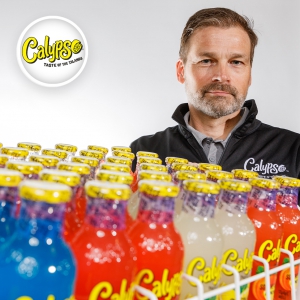
[00:00:10] Ray Latif: Hey everyone, I'm Ray Latif, and you're listening to the top podcast for the food and beverage industry, Taste Radio. This episode features an interview with David Klavsons, the CEO of fast-growing flavored lemonade brand, Calypso. Just a reminder to our listeners, if you like what you hear on Taste Radio, please share the podcast with friends and colleagues. And of course, we would love it if you could review us on the Apple Podcasts app or your listening platform of choice. Amid a sweltering summer, Calypso is having its moment in the sun. Self-described as the originator of the flavored lemonade category, Calypso is now in its 36th year in business and sells 20 varieties of its lemonade, Limeade and Teamonade lines nationwide. The number two brand in the lemonade category, Calypso is known for its tall, 16-ounce glass bottles, markets its products as being made with, quote, real fruit, real sugar, and real fruit bits, and unique Taste of the Islands flavor combinations. Over the past three years, Calypso has generated explosive revenue growth. The company reported a more than 50% sales increase during the first half of 2021, a leap that followed a 62% jump in 2020 and 33% growth in 2019. In the following interview, BevNET Managing Editor Martin Caballero sat down with Calypso CEO David Klavsons, who spoke about how the company has positioned itself for rapid and consistent growth by leveraging its well-recognized brand, key distribution partnerships, and consumer demand for high-quality ingredients.
[00:01:51] Martin Caballero: Hi, everybody. Thanks for joining me. My name is Martin Caballero. I'm the Managing Editor at BevNET.com. And I'm really happy to welcome David Klavsons to today's episode. David is the CEO of King Juice, who most of you guys probably know as the maker of Calypso Lemonade. We're going to really sort of dig into the growth of the company and get a little bit of background about David and how things are going there. So once again, thank you guys for joining us. And thank you, David, for being on today's episode.
[00:02:19] David Klavsons: Yeah, great. Thanks for having me on.
[00:02:22] Martin Caballero: Of course, really appreciate it. Now, a little bit of a timely note before we get into some of the details about the company and what you guys been up to. I know that later this month is National Lemonade Day. And I have to know, what does the CEO of one of the biggest lemonade companies in the US, what does he do? How does he celebrate National Lemonade Day?
[00:02:43] David Klavsons: Well, first of all, I love to give away a year's supply of lemonade. So if you haven't signed up yet, you need to do it. It is one of the hottest months of the year, and it's a month that everybody enjoys a great beverage, and Calypso is the one that I enjoy. So my consumption level has gone up significantly in the past few weeks.
[00:03:06] Martin Caballero: Absolutely. Yeah, a little bit, a little bit more than on a normal day, which I assume has some Calypso in it as well. So sounds like a good holiday. Well, David, it's great to talk with you today. I wanted to dig in a little bit about sort of your background and a little bit about what you were doing before you came to King Juice and I think around 2017. Tell me a little bit about just sort of your entrance into this industry and what attracted you to the opportunity at King Juice when it presented itself.
[00:03:32] David Klavsons: Right. So my background is really big CBG to begin with. PepsiCo, Nabisco, Kraft. And then I switched over to convenience retail. So I was on the other side of the desk at Hess and the East coast. Great experience there. And then moved into sports nutrition with Glambia, which is really what connected me to the Calypso brand. My co-packer was for Isopure beverage, part of the Glambia sports nutrition business. was King Juice. So I knew the founder. And when he decided to sell the business, the PE folks and I connected, and next thing you know, I'm running the business. I really just saw the potential in the Calypso brand that he had. It's a great product, great branding, great positioning with Taste of the Islands. And most importantly, it was number one in velocity. So it outsold Minute Maid and Lipton and Huberts at the time. So I knew there was something there, but it was just underinvested in.
[00:04:30] Martin Caballero: You know, I want to get into Calypso and King Juice specifically, you know, in a minute, but tell me a little bit about the opportunity that you saw at that time in this shelf stable juice category. I mean, I think on BevNET, as readers will know, we've covered a lot of the premium market that sort of the juice bars and the cold press juices and those kinds of things that have grown in the refrigerated space. It seems to have gotten a lot of attention over the past years. But what was the kind of opportunities that you saw in that shelf stable juice space?
[00:04:59] David Klavsons: Well, you know, when I first looked at it, I had that same perception. It's, you know, part of the juice category. When in reality, when we ask consumers, why did they buy this? Why do they love this brand? They didn't view it as juice. It was actually viewed as lemonade. So it's a category in itself. You call it a subcategory of juice, but it also competes heavily with tea, for example. It is becoming its own category. It's big enough to where it can be recognized as one. So less about juice and more about lemonade. And that's one of the big learnings I had. And the fact that it beats a lot of teas in velocity, was really astonishing and it was one of the foundations for our ability to build the brand to the level that it's at today.
[00:05:53] Martin Caballero: Now, this is something that I think we'll probably touch on a little bit later as well. But again, just looking at that sort of top level macro perspective for lemonades and teas, sugar has clearly been a challenge for it as it has been for soft drinks and other categories as well. How did you sort of interpret that sort of element coming into play? I think we're going to talk about the lights in a bit, but just sort of on that top level perspective, how do you sort of approach that big sugar question that comes with this category?
[00:06:20] David Klavsons: Here's a couple of statistics that led me down the path of this is still a great opportunity regardless of sugar content. I call it permissible indulgence. And lemonade is recognized as being sweet and tart, a combination of both sugar and the tartness of lemon. So if you look at low and no sugar as part of CSDs, it's about 25% of the category. T's about 27%. So if you flip those numbers around, 75% of the business is still in those products that have a certain level of sugar. So it didn't scare me. I just also knew that we needed to have an entry into the market that captured that consumer that isn't looking for that level of sugar. That 25% of the market, and quite frankly, in lemonade, because it's hard to do, only about 10% of the lemonade business is in low or no sugar. Now, we've been able to push it where we have distribution in the 15% plus as a percentage of our business within certain retailers. You know, it really hasn't been a drawback. Matter of fact, you know, our growth has proven it, that you've got a premium product that tastes great. It's got great branding, great positioning, and it's permissible, permissible indulgence that works for that 75% of the population that is still, you know, consuming that type of product.
[00:07:52] Martin Caballero: With that being said, tell me a little bit about your first days, first weeks as you took over at the company. Just having that fresh perspective on sort of the challenges and opportunities there. What were some of the priorities that you set about? And the other thing that I think is interesting just that goes along with that is that Eclipso is, you know, it has a long story attached to it before you got there. So how do you sort of working within that legacy? How do you sort of update that and sort of bring that along and not lose the baby with the bathwater?
[00:08:21] David Klavsons: Great question. So I'd say there was three challenges that hit us when we walked into the business. First of all, it was learning about the consumer, you know, who they are and why they love the brand, why the velocity was so high, why we were beating, you know, Minute Maid and Lipton, even though we had low distribution, you know, under 30% ACV, it was challenging the perceptions that people had about this brand, because it started in the independent class of trade. That was the legacy that was built. And, you know, the previous owner really, you know, wasn't that interested in chain business and doing all the things that's necessary to get the brand out there beyond the independent class of trade. So we had to challenge that perception and that history. And sure enough, it came out that people love this brand and they just couldn't get enough of it. They couldn't find it. So that was one, really learning about the consumer. The second one was we knew the packaging, the visual ID, the bottle. It was a bit outdated and it needed just some updating and modernization, if you will, without alienating that core consumer that grew up with the product. And then, you know, getting the marketing investments to drive impressions so that we could, you know, at least get folks to recognize that there was a change. So that was a second big one. And the third one was this was a relatively small business that didn't have much of an infrastructure, didn't have a team. So building the team, especially in sales, distribution with our distributors, and then our retailers, to believe in the growth opportunity. Because really, the story wasn't being told. It wasn't being told to distributors. It was, we ship you some product, they order it once in a while. And retailers really didn't see it as an emerging brand. And we've completely flipped all of those perceptions from distributors and retailers. and have created this availability of the product, and it has taken off with a new visual ID, new logo, and a new bottle, new packaging. And it has been a huge success over the last three years.
[00:10:35] Martin Caballero: That's really interesting because it seems like what you're saying is all the changes that you guys kind of made were kind of cosmetic or maybe in a little bit of the positioning, but the liquid itself remains pretty much the same. And again, sort of going back to that sugar question, it seems like that sort of fits with the theory that people are going to make some room for this as a permissible indulgence within their routine of drinking beverages.
[00:11:00] David Klavsons: That's exactly right. The product itself is one of the things that attracted me to the brand. The product is fantastic. And we have, you know, folks that create unbelievable flavors that no one else has been able to replicate or even come close to within, you know, lemonade, which it's hard to work with because you've got this lemon that is very, very tart. You have to have not just the right level of sugar, but citric acid and flavorings. natural flavorings and making sure that you've got a high, high quality product that existed. So we didn't need to change the product itself. We just needed to tell people about it and put it in a package that was much more appealing. And sure enough, the business did very, very well. You know, just to give you some numbers, we spent a year doing a lot of that work and research and beefing up the organization and preparing ourselves and you know, redoing the packaging and the visual ID. And in 2019, we're up 33% from being relatively flat business. And then in 19 and 20, we were up 62%. And this year, you know, 50% through the first half of the year.
[00:12:14] Martin Caballero: Well, tell me a little bit, David, about those conversations with some of those chain retailers going into places where there's certainly options when it comes to lemonade some, you know, really big companies in that space with their various entries. What is the hook for them and sort of how do you bring them on board to realize the potential of what you guys can do and that backs up those numbers that you just mentioned?
[00:12:37] David Klavsons: Well, like one of the things I said earlier is we had to get people to believe in this brand and product. It had a fairly loyal following with consumers, but one of the biggest pieces of the story that really wasn't told is its velocity. When you put this stuff on a shelf, it sells. And one of the hardest things to do with retailers is getting them to believe, especially if you're not one of the big suppliers that can get the shelf space without telling the story. And we just spent a lot of time with retailers, with distributors, And the mantra was just get it in, get it into the store. Because we know once it's in the store, and we didn't care quite frankly, whether it was in tea, whether it was King Juice, whether it was a new age, just get it in the store. Because the evolution of the brand itself when it comes to merchandising was you get into the store, it sells well, you get a You get a side stack, the next thing you know, you get an end cap. And then you're into pallet displays that blow through on the weekend. It's that kind of a product. You don't get that very often in a brand and a product that you get the turns with merchandising that are five, six times the level of the product that turns off the shelf. It's significant. It reminds me of selling Oreos where off the shelf you do well, but boy, you put it on display, you're going to blow through product. So it is a unique situation with this brand.
[00:14:17] Martin Caballero: Well, jumping a little bit just to follow up on that point that you made about innovation again, so you guys have a brand that really resonates with people, the light innovation, the lower sugar innovation, as you mentioned, makes sense to sort of open up that category. But it sounds like this isn't a brand that's going to be jumping into, you know, functional ingredients just yet, or this, you know, maybe other types of things. How much innovation is the right type of innovation for lemonade, which is really like a staple drink that's been around forever.
[00:14:42] David Klavsons: So the majority of our innovation so far has been on packaging. and flavor. And then the idea of zero sugar, which is really hard to do. We spent a year working through a zero sugar formula that tastes great. And it took a long time. Like I had said, only 10% of the lemonade category is in zero or low sugar. And I know why. Because none of this stuff tastes any good. It's not good at all. And you can see competitors that have come to the market that have fallen out because the product just doesn't taste good. So that innovation is key to our portfolio in lower no sugar pack type. And we haven't even been able to so far put resources against multi-pack, variety pack, you know, a club pack, take home size. So there's so much opportunity left in this brand because right now we're only in a single serve glass bottle. We're supporting the growth right now, just in one pack type. And the data would show that we're actually number one in single serve lemonade, and we beat out every other competitor. So we know we've got a very, very strong position, and we're contributing huge growth to retailers now. And they're recognizing it. We're at the point now with this brand that with the innovation that we have, With the momentum, with the velocities that we have, we have retailers actually coming to us, asking us to bring our product in for distribution, which is a whole nother level of, of relationship with retailers versus trying to get them to take your stuff. Now they're asking us for the product because they see it and they see that we're innovating. We're innovating on flavors. We're innovating on fact type. We're innovating on zero sugar.
[00:16:33] Martin Caballero: Well, we've been talking a little bit about chains and some of those retailers coming in. But you guys also, I think it was last year, came on board with a big geyser in New York City, you know, that up and down the street market as well as chains in the area as well. But really, those independent markets where as you mentioned before, the brand has really been seeded and done really well, and sort of fits in with the legacy of that sort of glass bottle lemonade category there. Tell me a little bit about how that experience has been and just sort of Again, being on the opposite side of the spectrum of the chains, what's going on in these independent accounts up and down the street in the big city?
[00:17:06] David Klavsons: The key with independence is getting in with the right distributor. And Big Guys is a great example. We switched distributors in New York, and we've already, in six months, tripled our business in New York. And when you have the access to 26,000 outlets in New York for distribution, and these distributors have their own cooler, or two coolers, or three coolers, your ability to get distribution in those independents goes up exponentially. If you're with a distributor that doesn't have their own cooler, doesn't have the shelf space, it's going to be a lot tougher. Like a big geyser, you still have to prove yourself. So far, it's worked incredibly well. They continue to order more and more every month, and they're going to be one of our top distributors probably by the end of next year. So independent class of trade, critical for us. It has been, you know, half of our business or so, and we continue to see it grow. It's, you know, up significantly. Just velocity and independence alone is up over 30%, you know, plus the distribution that we're gaining, which gets you to the 50, 60% growth that we've been seeing.
[00:18:16] Martin Caballero: With those gains that you guys have been making, what are some of the things that you guys are looking at on the sort of behind the scenes or in the back end to sort of support that growth, whether it's in terms of manufacturing, building out the sales team and sort of the internal staff? What are some of the things that you guys are doing to support growth?
[00:18:33] David Klavsons: So you got a lot to unpack there. So first, I'll give you the sales team. You know, I had mentioned the evolution of the brand in the store, right? Shelf to sidestack to end cap to pallet. So we've learned a lot of test and learn work over the last three years on what we need from a sales organization to support the business. First of all, we need the right people that can call on these big retailers and can have that discussion. So that's one side of the equation. The other though, just as important is the folks on the street that are brand development specialists that are in there selling for palette displays. And once they see some success, They keep going, and the retailers see it, and they buy more, and they put more up on display. So you've got this kind of wheel of success that happens in the field. So the sales organization is one. Big key account selling, but also at store level with these brand development specialists. On the marketing side, it's all about getting impressions. And for us, we started, I'll just give you one example of this. We started with 10,000 followers on Instagram. We're over 110,000 followers now. And we've had 25 million impressions just on Instagram year to date or through halfway through the year. I mean, that's huge. I mean, these are big brand kind of numbers that we're getting. So we get the word out. We get the followers and then you get this exponential effect on impressions if you do it right. And, you know, our marketing team led by Matt Anderson is doing a fantastic job. Sales organization led by Bridget Lozda, you know, with a Coke and Heineken background. We've got eight players in our key positions. And then the third piece you had mentioned is, you know, how do you support the volume? Because that's exponential growth. That's difficult to keep up with. And, you know, at first you don't think you're going to need that kind of support, but when you triple your business in, you know, four years, you need extra operational support. So a couple of things that we've done, we just signed an agreement in France. So we've got a big international business. an agreement with Refresco in France, where they're going to make our product out there. So that's a huge deal. So you eliminate all that shipping cost, and you can make the product closer to the market. So they're going to start up for us early next year. And then we just signed with two co-packers here in the US, one on the East Coast, one on the West Coast, to support our future growth. And they're starting up here in the next couple of months. So we think we've got the right supply chain network in place now with international East Coast, West Coast co-packers and then our Milwaukee plant here in the middle of the country. So those are probably the three big things that we've done to continue to support and drive this brand.
[00:21:41] Martin Caballero: So I guess with that, you know, added muscle in the background there, um, what are some of the next distribution targets for you guys over the next 12 months?
[00:21:50] David Klavsons: I think I had mentioned earlier, you were below 30% ACV when we started the business. We're at 40% ACV. So if you think about it, you know, that's only 33% distribution growth yet we've tripled the business. So you can see how velocity has played a big, big role. So the more we can gain the distribution, we'll be able to create exponential growth on that distribution because that's what we've seen so far. And there's no reason to believe that we can't continue it. So that's a big deal. So taking it from 40 to 50 to 60% over the next couple of years, is very realistic and could double the business again just in the next couple of years. in terms of retailers, we finally landed shelf space at Walmart, which is a huge, huge deal. We're in the mod, you know, it's in 500 stores right now in the mod, but we're in 1600 stores because we sell at store level. So that expansion, you think about 4,500 stores in Walmart and the distribution support that you can get there to drive the business. we still have big white space in Florida that we're closing. So there's opportunity in Florida and we're all lined up, ready to go. You know, we've got that, you know, hopefully Publix, uh, will, will jump on board with us and they're requesting our product. So that's a big deal. We've got the Northeast with retailers. We just landed in Haniford and price chopper and, you know, a number of retailers, Wakefern. So the expansion of distribution is clearly in the crosshairs. And if we can get from 40 to 50, you know, that 10 points could mean another 50, 60% growth for us in the business, just because of the exponential element of distribution with velocity.
[00:23:40] Martin Caballero: And you mentioned internationally, you guys are making some moves as well. What percentage of the business is that? And what kind of target do you guys have for that segment?
[00:23:49] David Klavsons: So that business continues to grow. We more than quadrupled it over the last couple of years. And it's in the mid-teens, I would say, for percent of the business. And it continues to grow, and it's quite a profitable business for us. So we expect that to continue as we expand countries. We're in over 20 countries right now. If you look at the biggest ones, UK, EU, multiple countries in the EU, Middle East, and then Australia are the biggest areas where we have the distribution. And it continues to grow and we continue to add countries to it. So there's no reason why that business can't be on a even more accelerated trend than the US business.
[00:24:34] Martin Caballero: We're talking a lot about growth numbers and growth targets and that kind of thing, which often brings speculation about exit or potentially next steps and that kind of thing. What's the sort of long-term vision for growing Calypso? And is that sort of in the mix of the conversation?
[00:24:49] David Klavsons: Well, right now we're just focused on growing this business. There's so much room to grow and there's really no need to look at exit until we've tapped into a good chunk of the opportunity. It's still so early. There is still so much opportunity here. Like I said, we're only in a single sort of glass bottle just to get to a multi-pack, you know, itself could double the business. Think about what it's done for other brands, you know, Snapple in its early days when it went into a multi-pack. So there's so much opportunity not ready yet to figure out when we're exiting the business.
[00:25:30] Martin Caballero: And stepping a little bit back from Calypso and just looking at King Juice as a company as a whole, what are some of the opportunities outside of that space that you guys are outside of Calypso that you guys are looking at? And just sort of how else can you make an impact on this space?
[00:25:44] David Klavsons: So we're a co-packer. So we do have some co-pack customers. Obviously, Calypso is our lion's share of the business. And we're not inviting new folks to come into the fold there, but we're supporting the ones that we have currently. And then within the Calypso brand, there's a number of different places we could go to extend the brand. For example, we've got a prototype in a spiked island lemonade, which is an unbelievably great tasting product that everybody loves. We're looking at it cautiously, and we'll see what happens with a potential launch down the road.
[00:26:23] Martin Caballero: Well, David, you know, just wrapping things up here, I think it's really interesting to see the success that you guys have had. And again, one of these categories where maybe if you're looking at some trends, you would say, okay, this may be a little bit tough to be selling lemonade when everyone's into functional products and lower sugar and things like that. And you guys have really thrived when we've seen some competitors fade away or sort of decrease the size of their business. What is it that you think just sort of people underestimate about the opportunity in this space? What is it that people aren't seeing that you guys clearly are in terms of the opportunity in lemonade and then just shelf-stable juice?
[00:27:00] David Klavsons: So lemonade is just so underdeveloped. Think about it as what shelf-stable tea was 30 years ago. It was underdeveloped. It wasn't a whole lot out there. Snapple came out with their product. And next thing you know, tea became a category. That's where lemonade is. It just hasn't been a category. You know, you, you asked me the first couple of questions, juice, juice category. How does it play in the juice? It's becoming its own category and it's surpassing all kinds of expectations. And it's not just the lemonade. It's also the flavored lemonade category. because there's so many, we have 20 different flavors of the product. You know, we carry nine SKUs at Kroger, nine different flavors. So, you know, there's this need for variety or indulgence and great tasting premium product. It's out there. You just have to go get it. Think about, think about what a lot of the big manufacturers have done. They go buy a business, they take it out of glass, put it in a PED. dumb it down, save costs, strip it out, and then they're surprised. And what happens next? We've got a great product, an unbelievably great tasting product with a great brand, a great position. Who doesn't want a trip to the islands, a taste of the islands? Who doesn't want that? Especially now with everything that's going on. And you couple that with this element of indulgence that people 75% of the people want. So where do you want to play? Premium, indulgent, or functional in a much smaller sphere? And oh, by the way, everybody's trying to play. That's the opposite. So pull yourself out of the obvious. and put yourself into somewhere that still has significant opportunity. But for some reason, people don't want to go there. Manufacturers don't want to go there. We did. And it's worked. And it's worked well.
[00:29:17] Martin Caballero: Yeah, you guys are clearly reaping the benefits. And it's been fun to watch. So long may it continue. David, thank you so much for joining me today and chatting a little bit about Calypso. It was really a pleasure to have you and let's do it again soon.
[00:29:30] David Klavsons: Great. Thanks.
[00:29:32] Martin Caballero: Thanks, David.
[00:29:36] Ray Latif: That brings us to the end of this episode of Taste Radio. Thank you so much for listening, and thanks to our guest, David Klavsons. As always, for questions, comments, ideas for future podcasts, please send us an email to ask at Taste Radio.com. On behalf of the entire Taste Radio team, thank you for listening, and we'll talk to you next time.