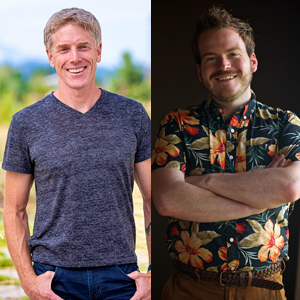
[00:00:10] Ray Latif: Hey folks, I'm Ray Latif and you're listening to the number one podcast for the food and beverage industry, Taste Radio. This episode features an interview with Brad Whiting and Seth O'Malley, the co-founders of innovative non-alcoholic spirit brand, Wilderton. Yes, breakout brands, particularly those that operate in hot categories, attract attention. But a fast start doesn't guarantee long-term success. Sustainable value comes from building an authentic relationship with consumers and delivering on attributes they're seeking. It's the Wilderton way. A maker of small batch, non-alcoholic spirits crafted from raw botanicals, Wilderton was Founded by Oregon craft spirits veterans Brad Whiting and Seth O'Malley and debuted in December 2020. Derived from wild plants that are sourced globally, Wilderton markets three signature expressions, each boasting the complexity and experience of a traditional spirit, yet without alcohol. As sober-curious lifestyles take hold in parts of the U.S., Wilderton has emphasized its distinctive ingredients and innovative distillation methods, an approach that is consistently winning over both teetotalers and spirit consumers who value optionality and quality when drinking. In the following interview, I spoke with Brad and Seth about their interest in non-alcoholic spirits, how they view Wilderton as differentiated from similarly positioned brands, why taste is key when communicating product attributes, and how to support, if not champion, other companies within the emerging category. Hey folks, it's Ray with Taste Radio. Right now I'm honored to be sitting down with Brad Whiting and Seth O'Malley of Wilderton. Gentlemen, how are you? Howdy, Ray. Great. Great to see you. Yeah, you're surviving tails here. Surviving is the best word to describe getting to the Friday of tails. Happy Friday to you. Yeah, well, you know. I've been more mature about my evening habits than in past events, so I feel pretty good. Although my back is off for some reason. I think I slept wrong the other day. Brad, good to see you. I saw you at Bar Convent Brooklyn in June, and we actually talked about coming out here and sitting down, or maybe not coming out to Tails, but sitting down for an interview because Wilderton has a pretty remarkable story. You make a fantastic product. Well done, Seth. Thank you. And it was on the cusp of the company launching a tasting room and distillery, or at least cutting the ribbon on both. That happened on July 1st.
[00:02:43] Brad Whiting: Yeah, absolutely. So I think when Seth and I were in Brooklyn, it was the final rush of what has been a rush. We took keys of our new space back in October of 2022. from a totally blank space in eight months to having the first in the nation, 100% non-alcoholic distillery and tasting room, which opened in Hood River, Oregon, as you mentioned, July 1st. Well, congratulations. Thank you very much. What's been the reception? It's been amazing. Everything from foot traffic of consumers to social media, to the press, bartenders, trade. It's been everything we hope for and more. Who's visiting? So the location of the distillery is in a small town, our hometown of Hood River, Oregon, which is about 60 miles from Portland. It is a big summertime vacation spot for folks from Seattle, Portland, San Francisco and beyond, a big outdoor destination. The distillery and tasting room are co-located in an area that is adjacent to breweries and restaurants. And one of the reasons we frankly put it there was In this very quickly evolving and growing non-ALK space, there's still a huge amount of education and a huge percentage of consumers that don't know this category even exists. So we thought it was really important to put it somewhere, frankly, that people would trip over it as they were otherwise enjoying food and beverages that they were more familiar with. Now they see what looks in all ways to them like a traditional brewery or distillery, but offering just a whole new category of options for them.
[00:04:21] Ray Latif: Seth, given that this was the United States' first 100% non-alcoholic distillery, I got to think it was pretty challenging to plan it out and to actually lay out the distillery in a way that makes sense for Wilderton, whatever makes sense means. You know, how do you go about planning?
[00:04:39] Seth O'Malley: Yeah, it did have a lot of its own challenges, but I looked at it first and foremost as building a distillery. So we needed an extraction vessel for our botanicals. We needed something to heat up water. We needed a still, but there are a lot of customizations that we had to make in order for it to work for our application. We needed low temperatures, so we have a little vacuum pump on the still, for instance. We have to have the layout suitable for food production, which is a little bit different than spirits production, when you don't have alcohol in the picture, it changes sort of the layout and space constraints. So it was a little bit of a puzzle and there's absolutely no playbook for really anything we're doing. So this was just part of that. But I'm pretty happy with what we've put together.
[00:05:24] Ray Latif: Is it very dissimilar from what you would see at a traditional distillery?
[00:05:29] Seth O'Malley: No, I don't think it is. When you look at it, you'll see a big pot still. Ours happens to be made of stainless steel instead of copper. That might stick out to some people who have done a lot of distillery tours. But by and large, we're using relatively conventional equipment. And that is really a fact that we're hanging our hat on. This is an actual still. We are using kind of old school analog processes. We have some customizations that we could talk about for people who are really curious about those details. But really what's important is that it is an actual distillery. We are carrying out the transformation from raw ingredients, raw materials to finished product under that same roof and people can watch that happen. That was really important to us. We're not using, you know, flavor chemicals that we sourced from a lab in New Jersey.
[00:06:17] Ray Latif: I'm going to challenge you here because I recently did an interview with a tequila maker and I had mentioned I'm going to be sitting down with you guys and he said, how do you distill a non-alcoholic spirit? And he's been doing this forever. So in 60 seconds, can you explain the process? Because I think 60 seconds is all people might give you. Sure.
[00:06:37] Seth O'Malley: Well, as long as I get to argue with him, I would tell him, however long his family has been distilling tequila, it's not as long as the ancient Egyptians were distilling plants into essential oils and hydrosols, that the first applications of distillation actually did not include alcohol. The first point I'd like to make to people when they raise this question, and it's very common, is that Distillation will concentrate alcohol if it's there to begin with, but distillation does not generate alcohol. Now what it does without alcohol is it will concentrate flavors and aromas. So what we do, what we use distillation for is we make an extract that is relatively dilute. and we take that extract and we distill it. And in that process, we take, let's say one gallon and we turn it into about 20 ounces. So we're reducing and kind of amplifying those flavors in that process without getting into any more detail. It's a process of concentration. I think that was exactly 60 seconds.
[00:07:35] Brad Whiting: Well done. I'd add in Ray, that comment from a seasoned alcohol distiller actually has a lot of resonance to me when I was originally coming up with this idea and looking for a person or a partner to help do it. Having worked with a lot of distilleries, worked in and around and with other distilleries for a long time, when I had this idea, I started knocking on doors and their answers were exactly the same as what your recent guest had, is, we make alcohol, why are you talking to me? And much like Seth said, it really is just a broadening of the perspective of what distillation can do and has done historically, but within a rubric that brings it back very closely to the craft spirit, which we view that we are creating a craft spirit in all ways, except that it doesn't have alcohol.
[00:08:26] Ray Latif: Brad, you've been in this business for some time, not the non-alcoholic spirit business, that's relatively new, but you've been involved in beverage alcohol for some time. Talk about your background and your interest in getting into this space.
[00:08:38] Brad Whiting: Yeah, for sure, Ray. So before founding Wilderton in 2019, I spent 14 years at a company in Oregon called Hood River Distillers. Hood River Distillers has a long, long history going back to 1934. And I joined at a very interesting time where we as a team built the Pendleton Whisky brand into a very successful brand. And along the way, we're able to acquire a few iconic craft distilleries in the Pacific Northwest, including Clear Creek Distillery in Portland and Big Gin up in Seattle. And my roles through those 14 years were primarily focused around sourcing all of the bulk spirits that the different brands used, and then having the honor to run the two small craft distilleries that we acquired. So through that time, I both had the opportunity to visit distilleries around the world, really fall in love with the cultures that had grown up around those different types of spirits. And so when I left Hood River Distillers in 2018 and was looking for what I wanted to do next, I think the natural and first thought I had was to create a whiskey brand. But frankly, there was sort of the, let's call it a stereotypical two-pronged approach where that was probably not going to be what my mid 40s body and young family needed was spending six nights a week drinking whiskey in bars. And at the same time, from my business degree, just looking at frankly, what Ben Branson had created in Seedlip and being really intrigued with kind of what was coming next in adult drinking and frankly feel very fortunate to have been and continue to be on this sort of leading edge of what is really a generational shift in how folks are consuming alcohol and having social drinking experiences. What's been great about this journey and the ups and downs that come with it is that it really was a twofold approach. It was creating a product that, frankly, I would want to swap in and out with my alcoholic consumptions. I'm not sober. That's not why I created this business, although certainly folks who have chosen to be sober are big supporters of this category. Really, it was a combination of something, frankly, that I wanted to drink and I didn't see available, but also certainly was a huge, huge business opportunity that we're all starting to see the early signs of coming to fruition.
[00:11:08] Ray Latif: You drink alcohol. You also drink non-alcoholic spirits. Who is the primary consumer for Wilderton at this point? Is it someone who is just looking for different drinking occasions on different days or is it primarily someone who just doesn't drink alcohol?
[00:11:22] Brad Whiting: The earliest adopters in this category are certainly folks who are abstaining from alcohol for whatever reason that that is. But our view is that by far the largest opportunity are looking for a more holistic and healthy way to approach alcohol and are often shifting either in the same night between alcohol and non-alc or certain days of the week. And, you know, there's some interesting data and I believe it was Nielsen that had this, but you know, plus or minus 80% of folks who are consuming non-alcoholic spirits also do drink. So the huge opportunity and largest market share are folks who do still drink alcohol to some extent.
[00:12:03] Ray Latif: Seth, when I'm looking at your lineup, you have some really beautiful, and I've tried, I think, almost every Wilderton expression. Your aperitivo is my favorite, but you have an aperitivo, more specifically, a bittersweet aperitivo, a luster, and an earthen. Are these expressions related to a traditional alcohol category, or are they sort of new expressions of what you perceive to be an analog to alcohol?
[00:12:35] Seth O'Malley: I guess I'll just talk about sort of how the three were conceived. So the first two products were Earthen and Luster. And when Brad and I were initially ideating this brand and thinking about what we wanted to bring to the table, we quickly decided that we were uninterested in creating something that is defined by a lack of alcohol, but otherwise seeks to be, you know, a replica. For me, as a distiller, that is my trade and that is my background. I'm humble to all of the facts of biology and chemistry that make a whiskey a whiskey and believe that fermentation and the production of alcohol is really essential to that end result. So when we looked at the non-alcohol category, instead of seeing it as a space for replicating alcohol without the alcohol, I saw it more as a positive opportunity to create new flavor traditions, to create new categories and new sensory experiences that were really material first. And what I mean by that is that if they are going to be based around water, you should select ingredients that do well with that and that come through and express well using that medium. Earthen and Lustre were our first two expressions, and those were really our commitment to non-analogues. They are first of their kind. Of course, you know, Lustre is bright and botanical, so we like to say that, you know, if you must, you can think of it as playing the same role that a gin might play. The Earthen, on the other hand, it's got a really extended finish. It has some color. Our color actually comes from, you know, botanical pigments. and you might use that for a short drink like a Sazerac variation or something. You can think of it like you would think of an aged spirit. Now the aperitivo was a little bit of a departure from that initial paradigm, which was, you know, completely non-analog to more of an overt kind of homage to the Italian red bitters. And the reason that I felt comfortable doing that was that I realized that it was possible to make a really incredible aperitivo without using alcohol. And my background initially was in tea, so I started off with water extraction. I got into botanical spirits after that and started creating, you know, absinthe and amari and genepi. And something that I learned through all of that is that these bitter botanicals, the things that really characterize an amaro or an aperitivo, really come through wonderfully in water. And so I started just toying around with it and realized, oh, wow, this is possible. Not only can we make a successful aperitivo, but we can make an awesome aperitivo that doesn't have alcohol.
[00:15:05] Ray Latif: Were these blends made to be versatile? In other words, can you drink the luster neat or on ice? Or is it specifically something where you're creating beverages that are made to be mixed?
[00:15:19] Seth O'Malley: In general, I would say that they are designed to be mixed. We do have people who will pour them on ice and enjoy them that way. The aperitivo, because of its distinctive body and palette, is more well-suited to that. But for the most part, we design these for cocktail applications. We believe that the main future of the NA Spirits world has to do with people drinking non-alcoholic cocktails, and we are seeking to provide home bartenders or professional bartenders tools for simple cocktails. And we build a lot of complexity into them so that you can make a simple cocktail that's very rewarding.
[00:15:56] Ray Latif: I mean, to me it would seem like it is challenging for a consumer to learn how to make a good cocktail. Even if you are giving them a great base spirit, non-alcoholic spirit, it seems like it might be challenging or intimidating for some folks to do it on their own, to do it at home. How do you take the intimidation out of that process?
[00:16:16] Brad Whiting: Yeah, absolutely. And you hit a key consideration and evolution that we've had as a brand in the time we've been in market. We in the industry often underestimate how challenging it is for consumers to make even the most simple traditional alcoholic cocktail. I remember once a consumer was adamant that they needed to understand how to make a gin and tonic. And I think as we think about that, and even if people have challenges with those traditional cocktails, understanding our products and how to use them is that next leap forward. And one of the things that we've really honed in on for our end consumer messaging, whether that flows through our point of sale, whether it flows through service suggestions on the bottle and the website, are tying each of the three expressions to a single mixer as really the easiest entry point for that product. So Lustre, as Seth mentioned, has some similar applications of a gin, even though it's not trying to be a gin, so Lustre and Tonic. Earthen, likewise, has some of those dark spirits kind of tones. So Earthen, we pair with ginger ale, and then the bittersweet aperitivo, playing very similarly into a spritz occasion with club soda. So what's been very, very successful over the last year is really, if you want to call it, dumbing it down or making it very, very simple for that end consumer to understand especially if they're picking up at retail, the perfect shelf set for us would have luster and tonic water literally right next to each other, have each of those three connections next to each other. So consumer grabs those two products, take it home and have a delicious cocktail with just mixing two ingredients.
[00:17:56] Ray Latif: Keep it simple, but very complex beverages, very complex non-alcoholic spirits. And your price point reflects the complexity that goes into each of these. They're line priced at $37 on your website. The average consumer who isn't familiar with non-alcoholic spirits or who doesn't necessarily know what goes into the process might balk at a price like that, say $37, there's no alcohol on this. How do you explain that to them? We get that question not infrequently.
[00:18:26] Brad Whiting: The technical answer is that our process, and Seth may speak more eloquently than I would to this, water is a decent extractive medium for botanicals, but not as powerful of an extractive media as ethanol is. So we end up using somewhere between 10 and 15 times more botanicals for the same amount of product. than a traditional spirit would. So our input costs are radically higher. And in the end, both our in-house production process and that differential in input costs really put us at a super premium price point for a traditional spirit. And frankly, the resistance that we've gotten from that is more fleeting than frankly I expected. I thought there'd be more pushback to that. And I think that maybe One step removed question about that is, as we have seen and been very successful in getting non-alcoholic cocktails onto bar menus, what we've really seen, even over the last couple of years, is a compression in the differential of pricing between alcoholic cocktails and non-alcoholic cocktails on menus. to the point where certainly in Portland and Seattle, our home markets, there are many accounts that now have line price, their elk and non-elk cocktails, and 201 are not getting pushback from their consumers. That's a really interesting sort of learning about the consumer who is looking for an elevated non-elk drink is that, you know, kind of one of my mantras has always been is that, you know, a cocktail is really about interesting products, you know, thoughtfully put together and beautifully presented. And it's always been that there's a supposition that there's alcohol in there. But folks who are going out that want an elevated drinking experience, but don't want alcohol are not assuming there's a discount there. They're getting the same beauty story, thoughtful combination in a in a Wilderton cocktail that they'd get from an alcoholic cocktail and are not seeing, you know, at least at many accounts, a assuming a discount would would apply to that.
[00:20:35] Ray Latif: We're here at Tales of the Cocktail and a vast majority of the people here are on the front lines, so to speak. They are the bartenders, they're the influencers who are going to convince consumers to drink a particular type of spirit or a cocktail. When you are speaking to the trade, what's convincing them? What's getting them interested in working with Wilderton?
[00:21:00] Brad Whiting: So there's a couple of answers to that question. There's what is getting them interested in working with non-elk in general and then wilderton specifically? for the larger category of non-alcoholic spirits and wine and beer, really there are two plays there. And this kind of comes into some of our selling stories. The first is just that hospitality, you know, if you own or work in a bar or restaurant, you're in the hospitality industry, you're not in the alcohol industry. And if arguably 25-ish percent of people that are coming into your establishment would rather not have alcohol, and you're not offering them an elevated opportunity, you're just not providing good hospitality. So there's a, I think there's a inclusive hospitality play. And then frankly, there's also a financial play. And if a bar can sell a $14 non-alcohol cocktail instead of a $3 soda water, I think both of those are compelling. compelling arguments both from the financial side and from the hospitality side. When it comes to Wilderton specifically, the two things that we're really seeing resonating are the fact that we do make it in-house. Most bartenders will, you know, go to the mat looking at why or how whiskey is made and you know, whether it was sourced or made in-house and whether the grain was grown locally and this and that. And now we are bringing them a non-alk option that has that same level of story, frankly, that nobody else does. And also the somewhat unique flavors and aromas that Seth has driven into these products. allows the bartender who, at the end of the day, are artists, a new palette to work from. And the intensity of our flavors can really work as the base of a cocktail as opposed to just being kind of a modifier. And that, again, is different from any of the other products in the industry. So I think hitting the bartender on both the art and opportunity side, as well as the craft side, has been really powerful for us.
[00:22:58] Seth O'Malley: I would add that we also offer the trade something that they value very highly, which is an enriching educational experience. And we're looking to do this, you know, even on a grander scale, the more people we can get out to our distillery and tasting room where we can show them around and show them how we make things, because I think that It is genuinely interesting to bartenders, the palette of ingredients that we're working with, our approach. Bartenders are more educated and more discerning than they've ever been. And they want to have those conversations about flavor nuances and how this got there and how you put this together. And that is the world that I inhabit. And when I can connect with bartenders about that craft, I think that really deepens their appreciation for our product.
[00:23:50] Ray Latif: Brad, you had mentioned, and I'm not sure if this is an industry number, you said 25% of people walking into a particular establishment might not be drinking alcohol. Is that a number that you pulled from a particular source?
[00:24:06] Brad Whiting: That number originated, I believe, with an IWSR study. That was a quoted number supported by anecdotal evidence.
[00:24:13] Ray Latif: Yeah. And is that number growing? I mean, I would assume it is, but is it growing and who are the people that are populating and growing that number?
[00:24:22] Brad Whiting: I don't have data to say that it's growing. Again, anecdotally, I would feel that it's growing as we're seeing more and more of those options pop up on menus. I think that's part of this challenge and whether it's at or challenging opportunity we have at the early phase of this industry is awareness. And until folks see these options on their grocery store shelves, on a bar menu, I think we're we're solving a need for the people that almost didn't even know they needed it until they see it in front of their face as an option. And yeah, I think what's been really interesting, and again, in Portland, Seattle, and now San Francisco, as we're expanding on the West Coast, is as those non-ALK menus are growing, we all know in the industry that if A menu item doesn't sell, it doesn't stay on the menu. And we are very, very proud that we almost never lose a menu placement. And again, whether it's our product or athletic beer, or an interesting non-alcoholic wine, the more menu space that is getting devoted to those categories is a de facto, I think, metric of the growing opportunity and number of people that are calling for them.
[00:25:35] Ray Latif: It seems like one of the advantages that the non-alcoholic spirit, beer, and wine categories have over, I guess, the high-test stuff is that you can ship it and you have no problem shipping it. And you can sell the products in alternative retail channels and non-traditional settings. You mentioned athletic beer, Brad, and it's interesting because I see that in so many places that I just didn't expect to see beer. Have you targeted alternative retail, non-traditional settings for alcohol products to sell Wilderton?
[00:26:09] Brad Whiting: There's definitely a long term opportunity there. Frankly, for us as a small company with limited bandwidth, we see our highest initial opportunity in traditional alcoholic venues. One interesting sort of side note to that is our bittersweet aperitivo plays amazingly well with coffee, cold brew coffee. And so we are starting to see coffee shops offering essentially a non out cocktail version of their cold brew. So for us, that's the, the initial kind of entry point there, but certainly I think athletics, a great example where you're now seeing a non out beer in a cold case at a sandwich shop at lunch that does not have an elk elk license. One thing I would challenge you on is kind of a funny side note. When you say we can ship it anywhere without any problems, um, is, uh, glass. Yeah. So Seth and I both had a lot of blind spots coming from the elk world to the non elk space. And one of them was manifested the first winter that we had the brand. And as everybody knows, if they put their favorite bottle of vodka in the freezer, it's not going to freeze. But if you put a water bottle in the freezer, it's going to freeze. And all of a sudden, the first January, almost 20% of our D2C shipments exploded somewhere between Oregon and their destination. Yikes. Always something you're not thinking about.
[00:27:38] Ray Latif: Entrepreneurship is a series of lessons in so many ways. Absolutely. Seth, you talked about inviting folks to the distillery in the tasting room to learn about the brand. And that seems like a great way to use the limited resources that a small company has. But I'm here at Tails and we're here and I see these big activations for competing brands. And it seems like there's a lot of impact that awareness, just general awareness can have. I guess, how do you balance the two? How do you think about investment in an activation that's going to gain a lot of eyeballs versus, again, these smaller one-off opportunities?
[00:28:23] Seth O'Malley: Well, I will start by saying that you're correct that an event like this really favors those with virtually unlimited resources. And the investment that it takes to really get front and center at Tails is just beyond what we can do right now. So there's that kind of practical answer. We did throw an event. We did a botanical game show at Preservation Hall. It was quaint and it was campy, but it was really fun. We did cash prizes and, you know, ask people.
[00:28:51] Ray Latif: How did I miss this? Cash prizes, cash prizes, big cash prizes. You two could have walked out with cash money. Actually, I don't think I could have. I would have had some questions back at home. Yes. But were you the host? Were you the game show host, Brad?
[00:29:05] Brad Whiting: No, no, Seth put on his finest seersucker suit and became somebody that Alex Trebek only could have wished he was.
[00:29:14] Ray Latif: Oh, okay, so Tangent, Alex Trebek was your inspiration for this?
[00:29:18] Seth O'Malley: Yeah, it was very Jeopardy adjacent. Ah, gotcha. You know, but it was the sort of thing that if you've got some creativity and, you know, you can put together something that's interesting to the trade, it could be really successful. So it was, yeah, it was smaller budget, and I think that would have been apparent, but it was a fun event, it was endearing, and it was our way of being here at Tails. We're also going to do the Meet the Distiller event, which is, you know, a trade show. Those are always great, but... For me, I really relish most of all those one-on-one experiences. The experience of discovery is something that I cherish in my own life and in my own experience. There's nothing like the thrill of learning new concepts and having new sensory experiences for me and being able to sort of usher people through that type of you know, through discovery processes, through education, and things as simple as smelling a container of sandalwood. We all know what sandalwood supposedly smells like, but how many people have actually ever seen or smelled it? And so those are the types of experiences that people can have when they actually come out to our distillery. And that, you know, for me is something that I look forward to the most in my work.
[00:30:28] Ray Latif: It feels like a much more memorable experience than just seeing a sign in so many ways.
[00:30:33] Brad Whiting: For us, again, as we choose how to allocate limited resources and figure out how we increase awareness and advocacy at the same time, I think for us, having a combination of a smaller number of deeply engaged, highly advocative people combined with awareness type of events like trade shows, like samplings, like BCB, that combination is something that we're always trying to find the right balance of.
[00:31:02] Ray Latif: Wilton was relatively ahead of the game. I mean, non-alcoholic spirits, there's some significant interest and demand for the space for sure. Launching in 2019, you would think you're ahead of other products that are coming to market now. But a rising tide lifts all boats and you want to support, I would think, even your competitors because you want more people to be engaged with non-alcoholic spirits. It's a double-edged sword though, because you might say, well, our quality is better. Our packaging is better. Our distilling process is better. So how do you compare and contrast without kicking your competitor in the butt?
[00:31:42] Brad Whiting: Great question. I think it has been really interesting. So to clarify, well, we founded the company in 2019. We launched into market. It took us nearly two years to get the liquid right. So we launched in December of 2020 into market. That still did put us relatively early in this craze. What has been really interesting is the camaraderie, frankly, up till this point amongst founders. I'm friends and friendly with most other brand founders in this space. We all believe that long term there is room for most good products out there. But I think we'd be fooling ourselves if sooner or later as store retail sets get set, that there won't be more competition. I think for us, again, we feel that we have a bit of a unique position not playing what we call the analog game of a non-alk gin, a non-alk rum, a non-alk whiskey, and that Wilderton does carve out a really unique space on the retail shelf and on a bar menu.
[00:32:53] SPEAKER_??: Thank you for watching.
[00:32:53] Seth O'Malley: Like I mentioned earlier, we built our brand on really a product first message and what we're talking about, what we are and not what we're not. And so when we talk about how we do things, we believe that it is differentiated, but I'm less interested in talking about how other people might do things and denigrating the competition than I am about really telling the story of, you know, craft and how we make things and telling a positive story. And so far we see that that seems to be working.
[00:33:23] Ray Latif: I mentioned that there are a couple brands that have a high profile presence here, and there's been a lot of money invested in those brands via strategics and otherwise. It would seem that the investment community has a high expectation for the continued growth or has high expectation for the continued growth of this category. That being said, how do you see investors evaluating the potential and the future of non-alcoholic spirits And are you adjusting your message or, you know, evolving your message to meet those expectations? Because, you know, at the end of the day, this is the beverage industry and everyone knows the beverage industry takes a lot of money to build a scaled brand.
[00:34:09] Brad Whiting: So I think that it's not exclusive to the non-ALC beverage space. I think if you ask most entrepreneurs this year versus a year ago versus two years ago, funding is getting tighter and harder to get in general. I think that this space of non-ALC spirits is probably not something that's a great fit for traditional VC because it is going to be a long runway and take a good amount of money over an extended period to build these brands. So I do think that strategics in the ALC space are probably where the longest vision and where most of this money is coming from currently. Because really, if you put your hat on, let's pick whoever it is, Pernod or Diageo, they've been in the ALC business, but really if Joe Consumer walks into a bar and orders a elk cocktail or a non-elk cocktail from a bottle on the back bar. Do they care if it's elk or non-elk? And they own that brand. It really doesn't matter. And they're looking at the trends just like we are, that elk consumption is declining. There's probably no reliable metric that says elk consumption overall is increasing. So I think they just see it as part of their long-term strategy to be beverage companies are going to include ALC and non-ALC. You're seeing some brands go the other way as far as adding ALC to a historically non-ALC franchise, but I think it's all back to the basic idea of a more fluid, less black and white drinking environment going forward that ALC and non-ALC really do play a large part in most people's lives.
[00:36:01] Ray Latif: I might be reading into this too much, but are you saying that Wilderton would benefit from having a strategic partner or is that something that you feel isn't necessarily in the cards today or doesn't necessarily need to be something in its future?
[00:36:19] Brad Whiting: My past experience being part of building a successful national brand from a small footprint really showed me that an eventual path to a strategic partnership is what it will take to make a truly national or international brand. So that would be something I would hope would be in Wilderton's future, yeah.
[00:36:44] Ray Latif: Well, if they're not already knocking on your door, I'm sure they will be soon. This has been a great conversation. I've always been a fan of what you guys have created. And I do remember, geez, I think it was Alexandra actually reaching out and introducing me to your brand. She said, this stuff is phenomenal, right? You got to taste it. I'm like, okay, tasted it. She's like, wow, you were right. And I'm so glad that we had this opportunity to chat because even though we're just at the beginning, still, even though, you know, it's, well, I guess two and a half-ish years in, which is still kind of the beginning, it feels like there's a really long runway for non-alcoholic spirits, and in particular, Wilderton. Thanks so much again, and let's definitely stay in touch. Thank you, Ray. Appreciate it. Thanks, Ray. That brings us to the end of this episode of Taste Radio. Thank you so much for listening, and thanks to our guests, Brad Whiting and Seth O'Malley. Taste Radio is a production of BevNET.com, Incorporated. Our audio engineer for Taste Radio is Joe Cracci. Our technical director is Joshua Pratt. And our video editor is Ryan Galang. Our social marketing manager is Amanda Smerlinski. And our designer is Amanda Huang. Just a reminder, if you like what you hear on Taste Radio, please share the podcast with friends and colleagues. And of course, we would love it if you could review us on the Apple Podcasts app or your listening platform of choice. Check us out on Instagram, our handle is BevNetTasteRadio. As always, for questions, comments, ideas for future podcasts, please send us an email to ask at Taste Radio. On behalf of the entire Taste Radio team, thank you for listening, and we'll talk to you next time.