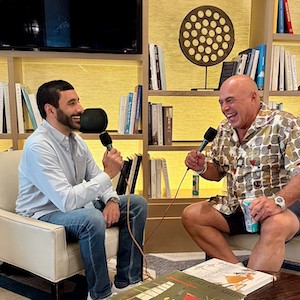
[00:00:10] Ray Latif: Hello, friends. I'm Ray Latif, and you're listening to the number one podcast for anyone building a business in food or beverage, Taste Radio. In this episode, we're joined by bartending icon and Modern Mixologist founder, Tony Abou-Ganim. Tony Abou-Ganim, a legendary figure in the world of cocktails and hospitality with nearly five decades behind the bar, is sounding an alarm for the industry he cherishes. Where did the fun go, he asks, a question that reverberates across the ever-evolving landscape of bars and beverage culture. As the founder of cocktail platform Modern Mixologist, Tony's career has been a masterclass in passion and perseverance. From his early days as a barbeque in small-town Michigan to becoming one of the most respected voices in hospitality, his journey is defined by innovation, excellence, and heart. A three-time champion on Iron Chef America, Tony helped launch the groundbreaking beverage program at the Bellagio Las Vegas. Today, he continues to shape the industry as a consultant for Royal Caribbean, high-profile venues, and leading beverage alcohol companies, where he lends his expertise to cutting-edge, ready-to-drink cocktail development. In this conversation, Tony reflects on his path in parallel with the evolution of cocktail culture, from the rise of craft mixology to the risk of elitism behind the bar. He explains why eliciting connection and joy is at the core of hospitality, shares his vision to revive his family's historic bar, and offers insights into where the industry is heading, touching on everything from the sober curious movement, to the soaring price of cocktails, and what it truly means to brighten someone's day, one drink at a time. Hey folks, it's Ray with Taste Radio. Right now, I am supremely honored to be sitting down with the one and only Tony Abou-Ganim, who is the founder of Modern Mixologist. Tony, great to see you. Hey, Ray. It's great to be with you. Yeah. Anytime you're in the Bahamas is a good time, right?
[00:02:14] Tony Abou-Ganim: Yeah. So blessed. Sometimes, you know, I think, you know, a bartender, a kid from Michigan, ends up getting to travel the world and make drinks is, it's pretty remarkable. But yeah, this is my third year back at the Nassau Paradise Island Wine and Food Festival and just, it's home away from home for me now, right?
[00:02:32] Ray Latif: Oh my goodness. Well, if you're home from Las Vegas and then your second home is here in the Bahamas, you must be having fun all the time.
[00:02:39] Tony Abou-Ganim: I often say, Ray, that I would not work this hard at a job, but I'm very, like I said, blessed to get these opportunities and do what I really love to do, and that's put smiles on faces and mix drinks for people.
[00:02:50] Ray Latif: Yeah. How did you get into this business? Because it's not, I mean, you're, forgive me for saying this, but you're an icon, a legend in this business, that of mixology and hospitality. How did you get started? Boy, that's a nice way of saying you're getting old. No, no, no, no, not at all. I think you are, if I had said you're an elder statesman, perhaps that would have been calling you old. But no, people look at you and they say, that's the standard.
[00:03:14] Tony Abou-Ganim: It's a great story. I mean, I grew up in the bar industry in Port Huron, Michigan. My cousin, Helen David, opened The Brass Rail Bar with her mother in 1937. And she ran that bar for nearly 70 years. So as a small boy, my father would take me into the bar, my Uncle Charlie worked behind the bar, my Uncle Saul, my cousin Tony and Maroon, the whole family. And you know, as a kid, I'd put the empty beer bottles back in the cases and then I'd get a Shirley Temple and I was always so in awe of like my uncle and his starched white shirt and tie behind this big beautiful bar and it's just I guess I was captured at an early age and when I turned 20 Helen put me to work at The Brass rail That's where I got my start. She was my first mentor and she passed in 2006. And in her memory, I started the Helen David Relief Fund, which is a charity that benefits bartenders going through cancer treatment. Helen was a two-time cancer, breast cancer survivor. So in her memory and to keep her memory alive and to help bartenders going through cancer treatment, I created the Helen and David Relief Fund. So the funny thing about all that Ray is it's now going full circle to where I am buying back the family bar, The Brass Rail in Port Huron, and going to reopen it and try to bring it back to its original luster from 1937. So it's 45 years later, a full circle motion.
[00:04:44] Ray Latif: What were they drinking in 1937?
[00:04:45] Tony Abou-Ganim: Well, I think grasshoppers and Randy Alexander's, sidecars, martinis, you know, and that's what I want to do. I, you know, we're in a very interesting time in the mixology world, but it's all founded in those classics. You know, those drinks that survive the test of time and just elevate that experience. You know, what is a great martini? You know, how is it presented? Glassware, ice, all of the details that go into making a great cocktail. When I started in 1980 and I told someone I was a bartender, their next question would be, well, what do you want to be? You know, being a bartender wasn't the profession. that you aspire to as a young man or young woman at that time. It was that part-time job. It was what you did while you were working on your acting career or finishing school. It wasn't something you set out to as a career. And I was that cat. I went to New York City in 1993 to be a theatrical actor. What I ended up doing was being a bartender because I realized, I met Dale DeGroff at the Rainbow Room in 1993 and I sat at the bar and I watched Dale work and I watched how his audience or his customers watched him and his art of hospitality and how the smile and the way he greeted everyone and knew their name and what they like to drink.
[00:06:11] Ray Latif: It seems theatrical actually.
[00:06:12] Tony Abou-Ganim: Very theatrical. Harry Denton always said, you know, the bar is the biggest stage in the world and your audience changes nightly. And it's so true. We are on stage when we're behind the bar. And a light bulb went off and I said, here I am in New York chasing this career as an actor, which I have virtually no control over. Why not put that same energy into being the best bartender I can be?
[00:06:36] Ray Latif: Do you feel like you are more passionate about hospitality or mixology?
[00:06:41] Tony Abou-Ganim: Hospitality. Yeah, absolutely. I often say I can teach you to make a great Negroni. I can't teach you to be passionate about that. And I can give you a recipe and I'll make the same recipe and mine will just taste differently. I'm not saying you will put love into your drinks, Ray, but that is to me the secret ingredient. It's the love that you put into the drink. that people can ultimately taste. There was a great Japanese bartender once who said, if you don't love making drinks, people will not love drinking those drinks. And I truly believe that. And ultimately, you should drink things that you like. I used to be a little more anal when people would mix, like, Remy with Coca-Cola. But if you like Remy with Coca-Cola, and you're paying for it, I'm going to make you the best Remy with Coca-Cola you've ever had. And that's, you know, that's the thing. I think life is too short to get caught up in all the little things, the nuances that would make me cringe. But if you enjoy it.
[00:07:43] Ray Latif: I want you to enjoy it. There's a key phrase in there, if you're paying for it. I guess in general terms, what have you seen as being the biggest positive over the past 20 years in this evolution that we've seen of bars and hospitality? What's been the most positive thing that you've seen happen?
[00:08:02] Tony Abou-Ganim: When I started, the only fresh thing behind a bar was a freshly opened bottle of artificial sweet and sour mix. Today, if you go into even a decent bar, you're going to get fresh squeezed juice. You're going to get premium spirits. You're going to get people who are paying attention to the quality of the ice and the glass where they're serving it and the garnish. It used to be that fluorescent red maraschino cherry was the go-to cherry. Now, again, those beautiful amarani cherries are everywhere and you know they're expensive. Olives, I mean I stopped drinking olives in my martinis and started drinking Gibsons because of the quality of the olives and the way they were treated. Today you have people like you know Daniel Singer and Filthy Foods and all these wonderful olives. So paying attention to the simplicity of the garnish but the quality of the garnish. I often say that if you've never had a scratch, fresh, premium, handshaking margarita. If all you know are those, like I said, the artificial sweet and sour that leaves baggage on the roof of your mouth like a Samsonite carry-on bag when you drink the drink, you don't have an appreciation. But it's hard to go back once you have experienced a great drink. And I think that's really what it's all about, experience. And I've been doing this 45 years, Ray, I want to learn something every day. I want to get better. I want to be better today than I was yesterday. And when I get to travel and come to events like Nassau Paradise Island Wine and Food Festival, I'm going to go to McKenzie's Conk Shack, and I'm going to go into town and drink Sky Juice. And I want to experience Kalik, the local beer. That's the beautiful thing about traveling and getting to do events like this. I get exposed to things I wouldn't get exposed to in Las Vegas. And, you know, it's like, again, the beauty of this gift that has been given to me.
[00:09:58] Ray Latif: Well, at least they have this sphere in Las Vegas. We do have the sphere.
[00:10:03] Tony Abou-Ganim: Funny story, I work with Royal Caribbean Cruise Lines and I was in Spain working on Icon of the Seas before it came over. So I fly back from Spain, I host a mezcal tasting at our restaurant, Libertine Social in Las Vegas, and then I go to see you two at the sphere. Wow. halfway through the show, Ray, I'm sawing logs at the Sphere with all the stuff going on. You two's playing. So I've been there, but I don't remember much of it.
[00:10:32] Ray Latif: Well, it's better than tripping out on mushrooms, which I've seen people on YouTube. You know, they have those videos that people are like, I'm going to go to the Sphere. I'm going to get whatever I'm going to. And then all of a sudden they are just out of their minds.
[00:10:44] Tony Abou-Ganim: So it really is something. So, yeah, I need to go back and Not as exhausted this time.
[00:10:50] Ray Latif: OK, well, yeah. Well, certainly for you, too. That's a tough one to sleep through, I think. That was a tough one to sleep through, yeah. I asked about what's been most beneficial to the industry. What's been the most positive change over the past 20 years? What's been the most detrimental?
[00:11:08] Tony Abou-Ganim: You know, when anything gets really popular rather quickly, Like I said, I've been doing it 45 years. My cousin Ella used to say to me, she used to say, Tony, I've forgotten more about the business than you know. And that was true. And I said, I want to be better today than I was yesterday. There's always something to learn. I'll tell you a story. When I was writing Vodka Distilled, I did a lot of research. I went to Russia. I went to Poland. I went to Finland, Sweden. So I put a lot of research into the book, but I also went to a lot of bars in the United States to see kind of what the take was, current take on vodka. And I remember I was in a bar in Oakland, young head bartender, you know, with all the croutons and probably 27 years old. And I'm looking at the menu, not a single vodka drink on the menu. I'm looking at the back. Matter of fact, half the stuff on the menu, I didn't even know what it was, which is crazy for me to say. No vodka bottles on the back bar. So I asked the guy. Now, he didn't know who I was or why I was there. I was just a patron paying my hiring money to drink his drinks. And I just asked. I said, I'm just curious. I don't see any vodka in the bar. You do serve vodka, don't you? The guy looks at me, he gets all kind of uppity, and he says, we stock two vodkas, and in my opinion, that's two too many. I was like, wow, you really embrace the art of hospitality. Next thing I asked for a raise was the check, because I was so insulted by that. And I think this kind of high, mighty pretentiousness that came along with, all right, this guy got a few write-ups in the paper or whatever, gave him this entitlement to forget about hospitality and it's all about him and his esoteric bitter selection but I think that has maybe COVID helped with that too because that seems like we are now welcoming people back much more into our home and Helen always said you should treat the bar as an extension of your home and treat your customers like you would guests in your home. And that's really, you know, when you think about the simplicity of hospitality, I want to make your day better when you leave my bar than when you first walked in. And I'm going to do so by serving you the best drink I can, but I want to put a smile on your face. And that's a, you know, there's bars that I go to, I would never dream of ordering a Negroni. But the bartender knows my name, big smile, warm welcome, knows what the Vegas Golden Knights did, knows how the stock market closed, knows this is my girlfriend and not my wife. No, there's no wife. I'm just kidding. But he'll pour me a pint of Guinness and two fingers of Jameson. And it's just a great, welcoming, hospitable experience. And at the end of the day, I think that's all people are after.
[00:14:18] Ray Latif: Yeah. People want to feel comfortable.
[00:14:20] Tony Abou-Ganim: Yeah.
[00:14:20] Ray Latif: And they don't want to feel like they're overwhelmed or in an unsafe place. People always talk about this is a safe place for you to talk or drink or what have you. And I think the last thing you want when you walk into a bar and just want an end of the day cocktail or beer is to feel like it's an uncomfortable situation.
[00:14:38] Tony Abou-Ganim: Yeah. And that's what... I hope to achieve with the rebirth of The Brass Rail is to be able to provide that amazing cocktail experience, but in an environment that is welcoming, that isn't intimidating, that isn't pretentious, that's plain, you know, disco and 70s classic rock. coupled with just great attention to making the best cocktails possible, but not putting the focus on the cocktail and how great I am because I can make this experience happen, but to make it fun and make it welcome to all comers.
[00:15:15] Ray Latif: And so when you're looking at trends and quote-unquote innovation in this space, how do you assess both?
[00:15:22] Tony Abou-Ganim: I think it was Mencken who once wrote, there'll never again be a totally original cocktail, just variations on cocktails that have come before it. And I really believe you can trace back virtually any new cocktail. to a classic style. My friend, Lievio Laurel, wrote a great book called The 12 Cocktails, which is saying there's 12 different styles of cocktails. For instance, let's take the margarita as an example. Gary Regan, God rest his soul, in his book, The Art of Mixology, said that that is the New Orleans sour, where you have base spirit, orange liqueur, and citrus. So you can look at the White Lady, you can look at the Brandy Crusta, you can look at the Sidecar, the Margarita, the Cosmopolitan, all kind of falling into that family of drink. And actually, my best known, what I would say, contemporary classic cocktail is the Cable Car that I created in 1996. which is a play on the brandy crusta, which is again, spiced rum, orange curacao, fresh lemon. So I'm not recreating the wheel, but I'm also making something that can be recreated, that has ingredients that every bar stocks. A lot of times now, you know, menus have gotten and cocktails have gotten so esoteric that outside of that bar, it's going to be hard to recreate that drink because it's a house made ingredient or something, like I said, really esoteric. And when you go back and look at the original cocktail books, they were more bartending manuals so that we could have consistency on drinks from bar to bar to bar. So when I write a menu, I try to do a little blend of both. original recipes, and lost and forgotten classics. You talked about ingredients. When we opened the Bellagio Las 1998, I wanted to do a drink called the Casino Cocktail. And in that, it calls for maraschino liqueur and orange bitters, two things that, in my bartending career up to that point, I had never seen. So I did a little research. I tracked down Henry Price, Price Imports. He was selling Lexardo Maraschino. and he was in San Francisco and it wasn't available in Nevada. I called Henry and I said, Henry, I want to make the casino cocktail need maraschino luxardo liqueur. Would you bring it in Nevada so I can make this one drink at the Bellagio Las he said, well, what do you think your initial order would be? And I said, based on other drinks at the Bellagio Las said, maybe we'd start with a half a pallet. Henry, the phone goes dead. And I said, Henry, you there? He said, did you say half a pallet or half a case? I said, half a pallet to start with and we'll see how it goes. He said, I haven't sold a half a pallet of Luxardo Maraschino in the United States, let alone to a single account. So two weeks later, it was in Nevada. And now you go into, again, any decent cocktail bar and you're going to see a bottle of Luxardo Maraschino. So these were products that were popular prior to Prohibition and then disappeared. Bitters is another example. Prior to Prohibition, every bar would have six, eight, ten different bitters, a lot of them that were made in-house. Prohibition did away with all of that, and we were lucky to find a bottle of Angostura bitters. You know the story about Angostura. What lasts longer, your marriage or your bottle of Angostura bitters? And again, today, I joke about it, but most bars are gonna have six, eight, 10 different bitters. They might not use many of them, but they've got them. So what we have available today, ingredient-wise, compared to when I started in 1980, It's just incredible.
[00:19:08] Ray Latif: Yeah, it really is amazing when you look at a barback nowadays. By the way, while you were talking, I was thinking to myself, you know, I've interviewed Jon Taffer and I'm thinking to myself, you know, Tony might be a better Jon Taffer, actually. Has anyone ever approached you and said, hey, you should do your own TV show? Because I think, you know, he's that personality. But I think when it comes to the truth, so to speak, I mean, no stain on Jon Taffer. He's really good at what he does. But.
[00:19:34] Tony Abou-Ganim: Well, it's so funny you say that, Ray, because Before Bar Rescue came out, I was working with an agent and we had done a couple of interviews both in LA and in New York for a show called On the Rocks. Okay. And it was basically Bar Rescue where I would come in and matter of fact a lot of what we pitched them ended up in bar rescue. I'm not saying there's, you know, anything but a coincidence here. But I remember that the producers say, could you be more of an asshole? And I was like, what? I was like, you know, you know, throw things and get mad. And I was like, no, I mean, I'd be, I'd be acting and I'd be acting poorly because that's just not who I am. Now I can go in and help them, you know, fix their problem. But it's so funny. And then we had a handshake deal for that show. And then it never came to fruition, and the next thing I heard was, oh, John Taffer with Bar Rescue. I was like, really? That's interesting. So I'm not, coincidence, maybe. I know John. John lives in Las Vegas, and we're friends. He actually got really mad at me because he asked me to be on the 100th episode as the guest mixologist. And I said, no, because it's just not my thing. Right, right. And he got really upset with me. He said, you know what you're doing? Turning me down.
[00:21:00] Ray Latif: Anyway, I didn't do it, but I can understand that, though. I mean, reality TV has gotten to the point where the most outrageous thing is the thing that you see and you look at, you know, Hell's Kitchen with Gordon Ramsey. And it's just that's not who the guy is. I think most people who know Gordon Ramsey think very, very highly of him. He's not that guy, but that's what sells. I mean, that's why I loved the old PBS TV shows, because that was real reality TV. travel, cooking, what have you. And then you have the Food Network and, you know, very entertaining TV, but it's less educational and so much more about the entertainment value or the shock value, I think, in some cases. But I think you should still have your own. Maybe, you know, YouTube is like the new access TV, right? And in some ways you can do a lot of PBS kind of content on YouTube and have it be beloved. And you know who hit that really well, who really straddled that line really well was Anthony Bourdain, obviously. I mean, he's just a legend and being able to entertain and educate in a really beautiful way. There are probably a bunch of people who are coming here who don't drink alcohol anymore or are reducing the amount of alcohol that they are drinking. And this is a trend that has been on the rise in the United States. Moderation or sober, curious lifestyles has had a big impact, at least I think it's had a big impact on the spirits industry and the bar industry. But you're on the ground in the trenches. What has been that impact? How have you seen things change?
[00:22:30] Tony Abou-Ganim: Well, I think it's a number of things. You know, there's health issues, people that are being more health conscious, people are being a little more frugal. And we talked about drinking at home. I mean, the $20 cocktail is here. You know, it's pretty much everywhere now.
[00:22:44] Ray Latif: Yeah, and it's not limited to places like this. I mean, you can go to pretty much any city in America and there'll be a $20, $25 cocktail on the menu.
[00:22:52] Tony Abou-Ganim: I remember when we opened the Bellagio Las 1998, and we were all sitting around this table with all the big wigs, and we were talking about pricing of the specialty drinks, and they were like, should we charge $6.50 or $7? Oh boy.
[00:23:07] Ray Latif: Man, I would love those days to come back.
[00:23:10] Tony Abou-Ganim: where I'm sitting there thinking, can we honestly charge somebody six 50 for a drink? Wow. I'd come from San Francisco where the top price was like $5 at that time. And I like six 50. Wow. Now that drink is like I said, 20, $22. So, so there's that. The other thing, there's so much out there. I mean, we are flooded with RTDs, with wine, with beer, craft beer, cocktail spirits. I mean, non-alcoholic. And if you believe the hype, and I'm not sure if I do entirely, but that younger drinkers are not drinking or drinking far less for whatever reasons, and it could be all the things we've talked about, who's going to drink all this stuff? I mean, I know people have gotten into collecting bourbons, but you look at the numbers and everything is down. And the other sad thing, Ray, is a lot of friends that I have in the industry are reaching out and letting me know that their job has been eliminated. I've had like five people just in the last two weeks that I found out were no longer employed. And do you think it's related to the decrease in consumption of alcohol? Well, yeah, I mean, it's got to play a part in it. I mean, because a lot of them are educators, although some of them are boots on the ground salespeople, you know, and yeah, that's the only thing that kind of makes sense that their jobs are eliminated because there's maybe just a lack of demand for the products they're selling. I don't know. I'll give you an example. I'm a partner with Sean McClain in a place called Highlands in Detroit at the Renaissance Center. And we opened just before the pandemic and GM had owned the building. They have since sold it, but had all the office space with all those GM employees at the Renson. So we had a built in clientele. And once work was out, you know, they jump on the elevator. We were on the 71st floor. Highbar would be just bumping after work with GM employees. COVID. Most of those jobs haven't come back. So that built-in clientele that we had is no longer there. So you got to look for those younger consumers.
[00:25:24] Ray Latif: Right. Yeah. Yeah. How do you reach those younger consumers? What's the best way to get them interested in, well, bars and mixology? I think, I mean, certainly you start out in bar culture. Yes. And then they graduate to mixology. How do you get him having fun again? Because I think when I was growing up, the funnest place in the city was going up. The most fun places were The Brass in the cities.
[00:25:46] Tony Abou-Ganim: Ray, you just nailed it right there. How do we make it fun again? Because I agree with you. I look around and I'm not saying it's not happening, but it's not happening the way I remember it happening. I used to just look forward to going to work because I knew I was going to have a lot of fun. Because it was just gonna be fun, right? And you know, the bartender was always, people would come up, you know, you're the star of the show, you're running the party, you're not part of the party. And it was always fun. I can still remember it was like a locker room at Harry Denton's on Stewart Street, and we'd gear up to go out, and it was just gonna be, you knew what you were in for, and it was just gonna be fun, and people having fun. And I don't know, I don't see that. nearly as much as I used to.
[00:26:34] Ray Latif: I think this goes back to your earlier point about the preciousness sometimes of mixology and certain cocktail bars. And I went to a bar, I won't say the name of the bar or the city because people are going to know what I'm talking about. And I walked in and everyone has been, this is the best cocktail bar in America. They know everything. They use the most interesting ingredients and so on and so forth. I walk in there and it's like a freaking library. And I'm just like, what is this place? And then I would go to a place like Employees Only. Now Employees Only has changed over the years. But when I first walked in there, I'm like, my goodness. Now this is a party. This is a scene. And they were still making outstanding, incredible cocktails. But everyone was there like it was New Year's Eve. And it could be any night of the week. It was incredible.
[00:27:17] Tony Abou-Ganim: Yeah. It's so funny you mention that because I always looked at Employees Only as that place that combine those two elements. It's a great attention to detail and wonderful cocktails and a respect for the craft, but let's not forget the party element. We want to make it fun. I remember standing at that bar once and this has got maybe 15 years ago, 12 years ago, and Steve Schneider was behind the bar and this gentleman came up to the bar and, you know, he ordered two Old Fashions. And this was just at the time when people had debunked the Muddled Cherry and Orange and, you know, Dave Wondrich, the great historian, had discovered that it predated the Penn Dentist Club and And Steve said to the general, and again, place was bumping three deep at the bar, Steve said, with or without muddled fruit? And the guy said, with muddled fruit. And I thought that moment, that was so cool because here now this drink is, nobody muddles fruit anymore. But if he would have made it the new style and not muddled the fruit, the customer would have been like, what the heck's this? And probably he would have wasted two drinks and had to remake them. But it shows that he wasn't, so arrogant that he knew better than how the guests wanted to drink his old-fashioned. Yeah. I don't know why that moment had such an impact, but it's always stuck with me, and I thought, again, let's give the customer what they want, regardless of how we feel it should be made.
[00:28:49] Ray Latif: Two things, Tony. I think that there's going to be a lot of people listening to this who aren't beveraging alcohol and saying, I would love to get in touch with Tony and I would love to have him as an advisor, as part of our team. How do folks get in touch with you? How do you assess opportunities for yourself?
[00:29:04] Tony Abou-Ganim: Well, the more I can do either in Las Vegas or Michigan, the better. I have traveled now with United as a bartender over 2 million miles. Wow. Yeah, so I'm looking to cut down on my travel, although it's hard to say no to a place like Nassau and coming to the Atlantis. But reach out to me on my website, The Modern Mixologist. I do a lot of charity work and we do a lot of bicycle rides throughout the country to benefit the Helen David Relief Fund, which is part of the United States Bartenders Guild. I love the event we did together years ago.
[00:29:39] Ray Latif: Yeah, the Cocktails Showdown.
[00:29:40] Tony Abou-Ganim: Yeah, I judge a lot of cocktail competitions. I'll be judging the USBG national competition at the Restaurant Bar Show in Las Vegas later this month. But I do a lot of this type of thing. So you reach out to me if it's something, you know, relationships. There you go. If there's one word, Ray, that I've learned over my 45 years, it's relationships, because they don't happen overnight. And most of the people that I work with today, you know, who I'll drop everything for are people that I've worked with 20 years. So, you know, if you have a project, you want to reach out, it might take me a while, you should see my house, right? I get stuff sent to me and I always will send back my tasty notes or my, you know, it's only one person's opinion, but I always wonder, you know, when people send me something that's in the bottle and they want my thoughts, Why didn't you send it to me when it was still in development and take my thoughts? It's just one person's thoughts. But, you know, I've been judging cocktail competitions and spirit competitions for a long time. We have the tag Global Spirits Awards. So, yeah, reach out. And if I don't get back to you right away, I'm probably somewhere on a beach in the Bahamas.
[00:30:58] Ray Latif: I think you bring up a really good point. And this is true for anyone who's developing a brand in food or beverage. get people to try before you go to market. And then you can make those tweaks, especially when it comes to ingredients or formulation or packaging, too, because you've got to come out of the gate strong no matter what you're doing.
[00:31:15] Tony Abou-Ganim: The old saying, you only get one chance at a first impression. You know, there is so much that goes into it. I have a chicory pecan bitters. And when they reached out to me, I said, the last thing we need are any more bitters. We're drowning in bitters. And they explained to me what they were doing with these old whiskey barrels. And I said, well, let me taste the first samples. It took us a year, Ray, before we got a product that we felt confident coming to market with. Same thing with Kahloa Rum with the Rum Rusher, the RTD that I collaborated on. It took us almost a year of back and forth collaboration to get a product that we felt confident putting our name on. So yeah, you get very attached to your product. And sometimes it's hard to take constructive criticism, but I'd rather get that beforehand than after the fact.
[00:32:06] Ray Latif: Especially from people who have the experience. Yeah. Last thing, I think people hearing this are going to say, hey, maybe I want to go to the Atlantis NASA food Island Wine festival or wine and Food Festival next year. Do people have the kind of access that I have right now to just have a conversation? Not an hour long conversation. But, you know, can someone just chat you up, have a drink for five minutes here? You buy me a Negroni, Ray, and you get an hour with me. I still owe you a Negroni, I guess.
[00:32:32] Tony Abou-Ganim: Yeah, that's the beautiful thing about festivals like the Nassau Paradise Island Festival is, you know, tonight I'll be making margaritas at Tequila and Tacos, Taco and Tequilas. So you come up, say hi, take a photo, have a margarita. You know, I have my cocktail clinic. on Saturdays. So, you know, making great cocktails at home. Plenty of time to come up and say hi and share a cocktail. And if you see me at the pool later, like I said, I probably wouldn't drink a Negroni. Well, maybe I would, but stop by and say hi. And yeah, that's what I love and why I'm so excited about going back to The Brass Rail is the great things I get to do, the great people I get to meet. But it's that interaction across the bar that really is so special to me and I'm so excited to be going back to my hometown 45 years later and being able to re-experience The Brass rail and those interactions across the bar.
[00:33:31] Ray Latif: Tony, this has been one of my favorite interviews in a long time. Thank you so much. I'm serious. Thank you so much. I really appreciate the time. Enjoy your time here. I know I'll be seeing you throughout the next few days, but I hope you get some time to relax yourself. Beautiful.
[00:33:44] Tony Abou-Ganim: Thank you again.
[00:33:45] Ray Latif: Cheers. Cheers. That brings us to the end of this episode of Taste Radio. Thank you so much for listening. Taste Radio is a production of BevNET.com, Incorporated. Our audio engineer for Taste Radio is Joe Cracci. Our technical director is Joshua Pratt, and our video editor is Ryan Galang. Our social marketing manager is Amanda Smerlinski, and our designer is Amanda Huang. Just a reminder, if you like what you hear on Taste Radio, please share the podcast with friends and colleagues. And of course, we would love it if you could review us on the Apple Podcasts app or your listening platform of choice. Check us out on Instagram. Our handle is BevNetTasteRadio. As always, for questions, comments, ideas for future podcasts, please send us an email to ask at Taste Radio.com. On behalf of the entire Taste Radio team, thank you for listening, and we'll talk to you next time. you