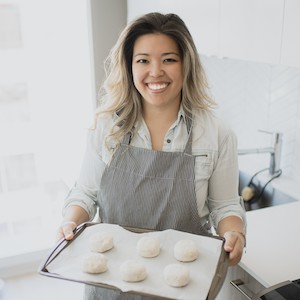
[00:00:10] Ray Latif: Hey everyone, I'm Ray Latif and you're tuned in to Taste Radio, the leading podcast for entrepreneurs and innovators in the food and beverage industry. In this episode, we're joined by Ayeshah Abuelhiga, the founder and CEO of Mason Dixie Foods, a fast-growing brand of frozen comfort food, best known for its clean ingredient biscuits and breakfast sandwiches. If the legacy food giants won't evolve, Mason-Dixie will do it for them, one honest, skillet-cooked meal at a time. When Ayeshah Abuelhiga founded Mason-Dixie Foods in 2014, she set out to deliver what real people are truly hungry for—clean, craveable, comfort food made without compromise. No preservatives. No shortcuts. Just real ingredients and real flavor. Today, Mason-Dixie offers a growing lineup of frozen biscuits, breakfast sandwiches, burritos, and fried chicken sandwiches, all made with fresh ingredients, real dairy, and no artificial ingredients, bleached flour, or seed oils. The products are available in more than 6,000 stores across the country, including Whole Foods, Costco, Sprouts, Giant, Harris Teeter, and more. In this episode, Ayeshah shares how she's taking on the legacy CPG heavyweights by building a bold next-gen frozen food brand. She dives into how Mason Dixie harnesses consumer insights, rigorous cost discipline, and category white space to expand far beyond biscuits. She also breaks down how the brand is reshaping the definition of, quote, natural for modern shoppers, proving it's possible to scale with integrity and lead with purpose without ever compromising on what matters most. Hey folks, it's Ray with Taste Radio. Right now I am supremely honored to be sitting down with Ayeshah Abuelhiga, who is the founder and CEO of Mason Dixie Foods. Ayeshah, so great to see you.
[00:02:12] Ayeshah Abuelhiga: Great to see you, Ray.
[00:02:14] Ray Latif: Thanks so much for flying up to our humble city of Boston. We are at BevNET HQ in Newton, Massachusetts, and we were chatting about our respective cities, yours being Baltimore and the thriving CPG scene that is happening out there, which I admit, you know, I haven't been out to Baltimore in a while since Expo West moved to Philadelphia. Now, obviously it's completely gone, but I'm so happy to hear that things are going well.
[00:02:37] Ayeshah Abuelhiga: Oh yeah. It's an incredible time. And I think it's, it's interesting to see, you know, out of dust, what flourishes, right. We've come out of a really tough time in the industry. It's harder than ever to be a startup in CPG. So it's really great to see these burgeoning brands that are coming up and doing it their own way. And being in Baltimore, we're so disconnected from the Austin, LA, Boston metropolises of CPG activity. So it's interesting to see how they're paving their own paths and thinking through really hard things, but succeeding majorly. So don't sleep on Baymore.
[00:03:09] Ray Latif: I will not. I will not. We've spoken a couple of times for Taste Radio, the first being in 2021. I think it might be my favorite title of an episode that I've ever penned. The title of the episode was Mason Dixie's Founder is the American Dream and She's Changing Baking Forever. I got a lot of compliments on that one. And then I got a lot of compliments on that episode, period, because it was such a great conversation. It was. It was fun. Yeah. Past four years, how are things going?
[00:03:33] Ayeshah Abuelhiga: Incredible. I mean I I can't complain. It's been a it was a rough ride for everybody You know the first doldrums coming out of kovat, but I think it really made us the stronger smarter more resilient business overall It forced us to really think about where we can win and how to win smarter And I think it's made us more efficient in how we kind of get there. So I'm really excited to have this conversation today and get more into those details too.
[00:03:56] Ray Latif: Yeah. Yeah. Did you ever think that you'd be dressing up as Colonel Sanders? No.
[00:04:02] Asha Abolasia: And the worst part is that was my stupid idea.
[00:04:05] Ray Latif: It was definitely not a stupid idea.
[00:04:08] Asha Abolasia: It worked out.
[00:04:08] Ray Latif: It was fantastic to the point where you actually ran out of your amazing chicken sandwiches.
[00:04:13] Asha Abolasia: Oh my gosh. Oh my gosh. 10,000 samples. What? 10,000.
[00:04:18] Ray Latif: 10,000 and you ran out of them like day one essentially?
[00:04:20] Asha Abolasia: One and a half days in.
[00:04:21] Ray Latif: Oh my gosh.
[00:04:22] Asha Abolasia: Which was incredible. I mean I can't lie. I mean Expo West incredible. It's a fun time to be creative And loose with because it's you know that's what I love about CPG. I mean I came out of management consulting I came out of automotive. These are very closed incredibly competitive Industries you don't share anything you're lucky if you get somebody's real name You know, you walk around and you get masked cars, right? Like you can't even see the model even though you know what the body kit is, right? Like it's just so different being in natural products and especially CPG industry just because everyone is just so excited to see another human that's going through the same things they are. So it's a fun time to like experiment with marketing and think about how you're portraying yourself to the outside world and see what sticks too, right? So, you know, this was the first time for us to do a little bit of a breakout from being conventionally safe, even though we've always done something fun, right? Like we broke out with the drive-thru theme a couple of years ago and I drove around in that mini child's Corvette. They still have. broken caustics over that so there's no cheese really no but It was sore for a very long time cuz shoving an adult butt into a toddler Drop-top. I don't even know what it was Cadillac. I think we had whatever it was not good But you know then the following year we did that big shopping cart that we drove around So those are like fun safe ways for us to kind of interact with the community, but then we were like alright if we're launching burritos and fried chicken I mean, all you do is think about KFC Taco Bell, right? I mean, it's just natural, right? So we kind of played on that as like a fun, you know, kind of risque spin because people didn't understand quite like, were we like straight copy? You know, it was a good conversation starter and created some like buzz. I mean, it was funny when our team was walking around the floor, they were like, everybody is talking about the booth because they're like, either word you're going to get sued or they loved it.
[00:06:15] Ray Latif: I never thought about you guys getting sued, but what was most interesting to me is that people were clamoring for the chicken sandwiches and for the burritos at a natural food show, right? So you're looking at chicken sandwiches made with biscuits, one made with a bun, just burritos made with traditional ingredients that you would expect. No, I was going to say fake, but plant-based, you know, meats or things like that. And it really said something about what consumers really want in a natural food show or otherwise. And I was thinking about you in particular yesterday, because I had a conversation with someone who had said, there's no food in our food anymore. And I was like, you know, Asha and Mason Dixie feel like they were on the front lines of fighting that battle.
[00:07:04] Asha Abolasia: A hundred percent. I think we might've talked about this when we did our first interview together, but you know, we weren't even allowed into Expo the first year we tried to get in.
[00:07:13] Ray Latif: Yes, I think I do remember that. Yeah.
[00:07:14] Asha Abolasia: Yeah. Cause it was so specific around being dietary or organic or gluten-free or else you could not come to the show. So we, we actually got a no the first year. So we ended up walking in instead cause we did have a restaurant. So we got the restaurant badge, see what's up, not gonna lie. We handed out biscuits. Can't get a ticket now it's been years, but um you know when we went back and said hey The reality is we're in Whole Foods. The reality is we're in sprouts. We're in all the natural retailers and You know Expo is saying that we're not natural because we're non-dietary, and I think that's just not true There's a big shift right now whether we like it or not right. I mean RFK is saying a lot of stuff that's making people think about food again. We'll take it. He's nuts, but we'll take it. You know, because I think it's a win for us brands to really think about what is important because we're also on this, you know, cusp of potential economic decline. Right? Everybody's worried about value and price and affordability and things. And when you're in that mode, you really got to start thinking about approachability of product. Right? It's going to be harder than ever to launch something that requires consumer education, seems tangential to your needs, tangential to your shopping list, and requires human education about what and how to consume it. When I started Mason Dixie, remember as a restaurant, the premise was that it was not okay that in fast food, it was all chemically laden, you know, biscuits with aluminum and fake coloring agents, fake butter.
[00:08:49] Ray Latif: And this is not hyperbole. This is actually what was in and in some cases still in the food.
[00:08:55] Asha Abolasia: 100%. I mean, there's big backlash right now on Chick-fil-A, for example, because people are only finally realizing how many preservatives and chemical additives are in the chicken. And it's like everybody's kid's favorite meal. So even this is now 11 years ago, 12 years ago, That was about all I was trying to forage against, right? Let's create what chicken and biscuits should be. Let's create what a fun, delicious brunch made of scratch ingredients should be. And what a surprise, when you use less crap, you have lower calories. When you use real Whole Foods, you have less negative impacts on nutrient load. It's never going to be perfect, but I always think that the most important change comes incrementally. And we kind of saw that with the plant-based movement. You try to tell everyone that they're bad because they didn't make certain choices, it will lash back. It's a rubber band effect, right? I mean, these are American staples. that have been industrialized over time for margin, for profit, whatever the reason. So rolling that back to me was critical. People should not be consuming aluminum in their favorite breakfast bread, right? We should not be using eggs made of pulverized whole egg protein, adding substrate to it to get it to go back. The egg is an incredible thing. It actually holds itself together really well. It's one of the best bonding agents in the world. Why are we messing with it? Leave it alone. Right? So we really held onto that premise. And I think for us, when we started to have success and realizing that there's a lot to be done and just cleaning up America's favorite staples, and we really honed in on that, that kind of really jettisoned us into a very different plane.
[00:10:35] Ray Latif: Yeah, and people are going to continue to eat these things. They will. Rob Hale, who I introduced you to at Expo West, he is with Stiefel, which is an investment bank. He was blown away. He's like, convenience wise, I can just make this for my kids at dinner once a week and be really, really happy because I'm going to serve them something else that may not be as healthy. And I was like, totally. And if he's the guy, he takes very good care of himself. And I'm sure he takes very good care of his family in terms of their nutrition. Like if he's saying that, then you guys are definitely doing something right. Whether it's at a natural food show, conventional or otherwise. Going again, back to our first conversation in 2021, you described Mason Dixie Foods as the modern face of Southern food, but the positioning has evolved a little bit more. You're really just trying to clean up the entire frozen food aisle. And you're looking at the breakfast and lunch occasions in particular, You're tackling a lot. I mean, that's a big vision, a big goal. Why are you looking at everything or seemingly a lot more than the original vision for the brand?
[00:11:34] Asha Abolasia: So last year, 18 months ago, right? We branched out from just our legacy biscuit sandwich, legacy biscuit heritage into the breakfast section by looking at how American consumers consume that day part, right? The interesting thing about it was that if breakfast eaters are incredibly loyal and incredibly ritualistic about what they have in the morning, if you're an oatmeal person, you're having that two to three days a week. You're not really deferring, right? And what we learned about that was it also happens with the bread base on your breakfast sandwich. People that really love croissants pretty much are going to have croissants two to three days a week, right? So when we realized that we were alienating a huge market base, we were like, all right, we have to branch out. We've got to think about what are those other American classics that we're not hitting on. And when we did that, we've had incredible success. I was really surprised. I mean, when we just had biscuits back in the day, when we first talked, right, it was like cheddar and buttermilk. It was like the, the hot dog race of the baseball game, right? Like mustard, you know, it was like 50%. 50%, it could be 55, 45, but they were like lockstep. And over the course of time, it started to be that buttermilk was like the lead and then cheddar kept falling back. When we released these sandwiches, all with different base bread types, they've all sold evenly.
[00:12:52] Ray Latif: And you have a pancake, a waffle, a croissant, an English muffin, and you have a bun as well?
[00:12:59] Asha Abolasia: Well, on the fried chicken. So people are really loyal to that base, right? So when we started looking at that, we're like, okay, well, What happened really was that we became a restaurant and a freezer. People started to really want their favorites. The customization, right, the have it your way of the American, you know, ordering pattern was happening in Frozen. And we were getting all these emails like, hey, can you make this? Can you make that? I mean, we got anything from pizza to hot dogs to corn dogs to doughnuts. I mean, like people want all their favorite things that have been just obliterated by food industrialization. They want them normal, but they want them in the convenience of their home and quick.
[00:13:46] Ray Latif: Can I pause for a second and ask about normal? Use that word normal.
[00:13:48] Asha Abolasia: Yeah.
[00:13:49] Ray Latif: And I think that is somehow a word that's been forgotten. Maybe it's the wrong word, but it's a word where I think a lot of natural food brands and companies have lost their way in some ways in terms of what consumers are asking for. They don't necessarily want the most overly complicated type of product. They don't necessarily want to be educated about a new ingredient sometimes. I mean, even if it's better for you, sometimes just giving people what they want in a better form is the best idea.
[00:14:20] Asha Abolasia: I encourage you next time you're at one of these trade shows to ask any of these founders how many of them have actually worked in a restaurant. How many of them have ever seen a human order food, interact with food? Even now, I think one of the biggest things I learned and we got better at over the course of the last four years is what it actually takes to sell our products. And what we were finding was a lot of times if you're hiring CPG industry professionals, they're just reading off the front of pack and they want three to four claims. And they go into the pitch and they go, 17 grams of protein, 200 calories, no added sugars. And I'm like, right, but the buyer could read that. That's not selling. Also, he probably doesn't give a shit. Everybody's gonna say the same thing. Everybody's gonna say they're high protein. Everybody's gonna say they're low calorie every so what is really gonna sell the product and So for us it never falters people want to be romanced. They want to know that these are whole cracked eggs They're actually fried. We separate the yolks from the whites to get an even cook We have a higher protein content sausage because we actually create our own grind Our fried chicken sandwich has our actual salt brine that we use in the restaurant and a panko breading. They want to be romanced. They want to know what they're eating, right? Because when they go to the restaurant, that's what the server does. And so for us, it's always been around making sure that taste first, sensory first. And when you start to really delve into that, you realize there's not a single human that goes, Yeah, what is the b6 content and nobody does that? No, nobody does that and honestly the questions about carbs and sugars and all that stuff Those are secondary if you're dietarily constrained, you're probably not even looking at our stuff, right? Who is your consumer right our consumer likes comfort food, but they don't like the discomfort of not knowing what's in it That's just a fact and when I say normal, it's just what I'm just saying is the average American you can ask anybody They're eating a burger once or twice a week. I mean, let's be real, right? They're having a slice of pizza. They're having a milkshake. They're doing those things, even if they lead a healthy lifestyle and run a marathon a week and go to the gym three days a week. It's all about balance. You know, it's funny, the natural products industry got really behind this healthy indulgence, but then when I looked at the indulgences, they were still dietary. No sugar in the candy. Well, then it's not candy, right? So, we got to get away from engineering food. The natural product space started to do that, I think, again, because we're not culinarily driven as much as we really should be.
[00:16:54] Ray Latif: I love the fact that you use the term romanced, romanticizing the food versus trying to educate consumers about the food. Again, the point of reference is so important. And I always go back to a quote from an interview I did with David Lester and Ben Goodwin from Ollipop, the co-founders of Ollipop. And David had said, if the foundation of your ability to sell your product is tied to educating the consumer, you're pushing a rock uphill. 100%.
[00:17:19] Asha Abolasia: Yeah.
[00:17:20] Ray Latif: And it's so difficult to cost so much money. to get people to understand what you're selling if they don't understand pretty quickly, like within a couple seconds. I was hoping you would create a chicken sandwich. I didn't know that that was in the pipeline, but I was hoping you would do it. But it almost seems like, again, if you go to, if you're pitching that to a Whole Foods and they're like, wait, frozen chicken sandwich, we don't sell these kinds of things. How did you think about who might sell your product? Because that's just as important as who's going to buy your product.
[00:17:49] Asha Abolasia: You know, it's a misnomer that people think that Whole Foods is, I'll never forget this saying, because the woman who discovered us and launched us into CPG was an Whole Foods marketing manager, and she always said that the brand needs to get away from being Canyon Ranch. And this was 10 years ago. And I think Whole Foods has successfully done that. There's the idea that Whole Foods has to be completely raw, raw diet people. And it's not, right? It's people who are super conscious. They have one of the highest trust factors in a brand like Whole Foods. So they come in and they expect to not have to worry, right? I don't need to actually turn the label around because I trust that it's good, that Whole Foods has done the work for me. That's the benefit of going to a natural retailer. That's why I shop natural, because I don't feel like doing the research of whether or not I could have this cheese it or not, because it's got chemical additives in it, right? So the reality is, Whole Foods has been for quite some time, even pre-Amazon acquisition, looking for conventionally oriented products, comped for natural, done well, done right. And because, to your point, the industry is skewed so far away from that, they actually struggle sometimes in certain categories to find things. And I think our buyer, Chris Manka at Whole Foods, has been an incredible champion for sourcing really good food. that has a mass appeal orientation and is less dietary. And he's done an incredible job doing that. Right. Like, um, I put a post out on LinkedIn the other day, cause we were featured in this kitchen article and it highlighted this, you know, new era of frozen. And when I think about it, I was like, it's so true. When I go to Whole Foods, there are brands that I really love to have that make tasty food, but I never have to worry about if it's bad for me. I trust the brands that are in there. So for us, when we looked at fried chicken, I mean, it's like, okay, oh God, there's so many reasons not to. And I actually think you did actually ask me a long time ago if we'd ever do chicken. And one of the challenges actually was who's going to do it the way we want to do it. Because no, I don't want that weird processed soy based chicken nugget thing you get at McDonald's, right? I don't want a nasty preformed patty that a Tyson's would do. I want it to make sure it looked, feel, tasted, or had the right mouth feel when you're eating it, just like you would at a restaurant if it's fresh fried. So, you know, some people are like, why? It needs to be whole muscle. I'm like, okay, if you want to chew on a leather boot after it's been microwaved, okay. There's a lot around doing chicken well, and it's why it's such a lacking innovation set right now. But we narrowed in on it, a few years of really hard work, kind of trying to get what our restaurant formulation was, feel, you know, felt into the formula. And when we presented it, Whole Foods is our launch partner. They've been incredible launch partners. They were surprised. And I think one of the best reactions out of the 10,000 samples we gave out and continue to give out is, I can't believe this came out of a box. That's the reaction you want. And I think Whole Foods really gets behind things that give you that appeal, right? The surprise and delight moments that everybody's looking for. Costco looks for that kind of thing too. Sprouts is starting to really look for that thing. So I think it's, for us, it was, it's a pivotal moment. It was our number one seller at the restaurant. So I've been waiting for this moment for a very long time. So I'm really excited.
[00:21:08] Ray Latif: I'm glad it's here.
[00:21:09] Asha Abolasia: Yeah.
[00:21:10] Ray Latif: I think that a lot of people love chicken sandwiches. You can't get a lot of them in packaged form. In fact, I can't even think of one that Whole Foods might've sold prior to yours. Burritos, on the other hand, seems like there's quite a few frozen burrito brands out there. Quite a few that are sold by Whole Foods or carried by Whole Foods. Seems like a much more competitive category to get into. What was your thought process there?
[00:21:34] Asha Abolasia: So when we looked at incrementality, right, in any grocery store, Tyson's and Kellogg's has 85% market share. So if there's 100 slots, there's only 15 available every category review. And you're fighting for those 15 against them and your colleagues, right, in the natural space. It's highly competitive. So when we looked at the sandwich set, I'm really proud of that set. Our team did a killer job. They're selling incredible. We have 30% or more year over year growth on those SKUs, same store, same SKU. So they're doing what they're supposed to be doing. So you don't wanna disrupt that. So you gotta think, what is gonna be incremental to those innovations that are still giving? And when we pulse consumers, number one requests that came out were other handhelds like burritos and wraps. Wraps is a little challenging, we're still working through that. But on the burrito end, we kind of delved into that. We're like, burritos, that's the surprising thing. We did a numerator study and we saw that we were actually taking share, our breakfast sandwiches were taking share away from natural and conventional burrito brands. And that was interesting. So like somebody was stopping buying a burrito to go and try a Mason Dixie sandwich. So I'm like, what if I could make them buy both, right? What if we just give them a burrito that they can trust? And then when we broke it apart, literally, we figured out most frozen burritos are just frozen IQF pieces wrapped in a tortilla. So it looks like those new fancy dog foods, right? That are frozen pellets. That's what it looks like when you break it apart because they're not actually cooked together. They're relying on you when you put it in the microwave to cook it. Hmm, that's weird right that is like space food, and that's weird a burrito I know I'm watching somebody on a griddle smash that egg up put that cheese in there put the meat You know like get it all and and throw to the tortilla and then riddle that thing right like make it really There was nobody doing that so we went and tried to source a skillet cook batch cooked manufacturer We put our formulation together and that's really what differentiates. It's an actual burrito that you would get at a restaurant. The mouth feels incredible. The flavors together are melded and you're not relying on the consumer to cook it for the first time, right? It's already been melded together. And the beautiful thing is too, we put it in a heat in wrapper. I cannot believe not a single burrito in the category you can heat in the wrapper.
[00:23:52] Ray Latif: Yeah, there have been some attempts and they haven't worked out as well as I think the brand wanted them to work. And I think about the burritos and how delicious they are, but I also think about your process and how expensive it probably was to create and now how expensive it might be just the quality of ingredients that you use. When you're thinking about developing new products, how much do you think about that price, that price point for end consumers and what they might be willing to pay for a better-for-you burrito, but not just a better-for-you burrito, one that you can say, this has all the things that you ever wanted and none of the crap that you don't want.
[00:24:35] Asha Abolasia: So when we first went to market, one of the first things we did as a brand was pulsed our own consumer database. And we were really lucky, right? We had credible restaurants that we had huge mailing lists for, and we just pulsed our consumer, right? We knew what they were paying at the restaurant. And we asked them, if you could have it frozen to take home and heat up, how much would you pay? And there's a magical break point of what their tolerance was. So we always try to start our innovations with that threshold, right? What is the tolerance of our consumer? And then work from there. Then we look at bill of material costs and scale and think about, okay, if we reach mass appeal and we can get scale, is there any room? Will we have more margin and can we drop price over time? If we cannot, we do not launch it. And so it is tough because we know we have to go out with a higher than we'd like to price point at times, right? But we know if we hit a certain break point on volume that we get significant breaks. A lot of that is due to the partners that we've chosen, the suppliers we've chosen. They need volume too, right? So the more we support them in creating these highly clean, highly natural, fresh ingredients, the more scale that we give them, the more scale we get back. So it's one of those things where it's a race for us to try to make sure that we're creating volume maximizers. And the goal is ultimately to continue to bring that price down for the consumer as we continue to grow. And we've done that a couple of times. I mean, with the biscuits, I mean, if people remember when we first started, they were $9.99 because we were making them. in the back of a drive-thru, right? Like it was expensive to do. And then when we surveyed everybody, it was like, all right, that pulse, that max pulse was around, it was like five to 650. So we landed at 599 and that's been one of those price points that stuck. You bring up a really interesting point though, right? Because I don't think people realize that just because there's economic uncertainty doesn't mean that there's no home for premiumization. The reality is that people will start to afford less luxuries away from home. Going out to a restaurant is three times more expensive than it was in 2019.
[00:26:35] Ray Latif: Really?
[00:26:36] Asha Abolasia: Oh, yeah.
[00:26:36] Ray Latif: Oh, my gosh.
[00:26:37] Asha Abolasia: I mean, just think about your chipotle burritos, right? I mean, I probably used to walk out with a $7.99 bowl, $8.99 with no drink, no chips, right? Now I go in and it's like $15.99.
[00:26:47] Ray Latif: Yeah, you know, I guess I haven't felt that as much as some people might have. And I just, Maybe this is my own problem. I don't look at prices as much as I should sometimes. And I haven't realized that, yeah, you're right. Like a burrito in 2019 might've been seven bucks and now it's definitely 12. It's crazy actually.
[00:27:05] Asha Abolasia: It's a good thing you said that though, because there are a lot of rates in the world that don't look at price. And if you're a premium brand, a natural brand with quality ingredients that you can stand behind, there really shouldn't be a reason you have to justify it because your consumer is not price-driven, they're quality-driven, right? So you're going there because you want to, and you will pay whatever the heck it is. And there's a lot of people that are like that. And then on the other side, right, like especially for us, we're a premium brand. However, when you take our chicken sandwich against a Chick-fil-A meal or a Chick-fil-A sandwich in some places were actually $1 to $1.50 cheaper than the standard Chick-fil-A sandwich. So when you think about that, if you're a family that has to make some of those sacrifices, you don't have to deny your family the things they want anymore. You can still have them at a price point that you're maybe a little bit more comfortable with. And honestly that you can see and you don't have to wait and deal with the surcharges on DoorDash and all the things, right? Like you actually get to enjoy the best that restaurants can give you at home. And I think that premiumization has to keep that in mind, right? There is always a place. You don't want to be ultra premium where you're scaring people away and now your competition is Chipotle because one-to-one people think it's fresher if they go to the restaurant, right? But if you can really show a price parity there that allows the consumer to have the best of both worlds, you're winning. And there's a lot to be gained from that.
[00:28:29] Ray Latif: What you just mentioned about Chick-fil-A and Mason Dixie Foods and giving people that option to have something that is perhaps better in quality, well definitely better in quality in terms of ingredients, just as tasty, at a more affordable price. I think about accessibility, right? And you've taken, and made no bones about this, taken direct aim at conglomerates out there. You mentioned a couple of them. And when we were at Expo West, you had mentioned, look, if we somehow convince Tyson to align with us, it would be much better for them. It would be great for us as well, because we would give Tyson an option for a lot of consumers that don't eat their products, will never eat their products. So on the one hand, you're saying, hey, Tyson, you guys suck. On the other hand, I think you're seeing that opportunity to align with a company like that and do better for them and make your products much more accessible, much more widely distributed. How do you walk that line?
[00:29:33] Asha Abolasia: It's tough. One, I think the world deserves better. These are companies that have way more resources than we do. And that's what they're making. That's very frustrating to me and most people. If you had all the resources in the world and you're fixated on still making frankenfood, that's a problem. The opportunity for us really exists in that I think this is, we're in a day and age where we're going to have to get creative. The natural products world is going to have a lot of impact on conventional brands. We're seeing that with Pepsi. I mean, the acquisition shakeups that they're doing right now is pretty incredible. And we're seeing that even in other acquisitions that have happened like Mars, they're letting the brand stay the way it is. They're not messing with it, because that's really what you kind of have to do to succeed and really create something with lasting power, the value that you wanted to buy that company for in the first place, right? I think there's a second phase here, though, that is, to me, more interesting. Why go out on a limb and buy the company and then try to figure it out obviously you don't do it well So this is gonna be weird right so why not partner and learn why not find ways to? Leverage those brands, and if they can really take your ecosystem and run don't you think that's more valuable for both? So to me it'd be great. I mean this is an all-call to Tyson If you're out there, come holler at a girl because if I could leverage their sales team and their distribution network, I guarantee you, I guarantee you the access point and the privilege of having something more natural premium and better for you would just crush. I guarantee you that partnering with their supply chain is going to bring costs down to make our affordability better so that more people can have healthier food. Guarantee it. These are the conversations we need to be having because at the end of the day, I hope all of us in the natural products industry are really hoping that we can give people something they deserve, better food, not just becoming the next hundred millionaire. I mean, like, I think those days are over. You know, you better love what you're doing. This is a hard business.
[00:31:36] Ray Latif: Yeah, Gail Becker from Kali Power did the exact same thing when I interviewed her at Expo West. She said, you know, if your goal isn't to, and I'm paraphrasing, if your goal isn't to give people better food and make dinners easier for them, more convenient for them, you should stay the hell out. Yep. Yeah. So, and I think there's a lot of truth to that. And going back to Tyson for a second, I think Tyson in some ways, not to keep picking on them, they probably do know that they have a problem, that they are not necessarily giving people, and I said necessarily, but not necessarily giving people the best food they could possibly give them. But the infrastructure is there and it's so hard to change that even 1%. So it sounds great, but Maybe at this point, the goal really is just to continue doing what you're doing and hope that the influence is enough to affect and to reach enough people. Is that enough for you though? I mean, right now, I mean, do you have, I guess what I'm talking about is a long-term vision. When you're thinking about Mason Dixie Foods 20 years from now, where do you want to see the brand? And do you work backwards from there?
[00:32:42] Asha Abolasia: Yes. So I think any visionary always starts with the ultimate vision. To me, it's always been to build a multi-billion dollar household name, legacy brand. You know, we talked about when I was a kid, it was Sarah Lee, it was, you know, it was Tyson's, right? It was Jimmy Dean, it was Betty Crocker, it was all those things. And I will tell you, none of those things are the things I had when I was a kid. They've all devolved in such terrible ways. And on top of that, it's not just improving legacy stuff, nostalgic stuff, to getting it back to natural, back to normal. It's also thinking about what the new normal is. My team and I have been talking about this a lot, right? Like, okay, fried chicken is one of, we're lucky, it's one of those iconically nostalgic, no one needs to fuck with it, right? It's the best food. It's just, it's just, everybody loves fried chicken, right? But the interesting thing is that if you ask a Gen Zer what their favorite fried chicken is, you're going to get like Taiwanese. You're going to get like Korean fried chicken. The flavor palette and exposure that the modern American has today is immensely different from when I grew up. Sure. Yeah. So the opportunity really is to create new American classics. What are the new American flavors? What are the new American sensory notes that we want to see? The brands that are out there, the big conventional, they just can't do it. I saw an article yesterday, Smuckers, they released an LTO. You're never going to believe it. It's on the Uncrustable.
[00:34:07] Ray Latif: Yeah, I saw that.
[00:34:13] Asha Abolasia: Oh my God, line up for that. I mean, come on, right? I mean, like we, we look at the aisle and right, we have all these crazy new flavors, right? We got Sichuan peppercorn and mango. We got like stuff that I thought, I think I saw a candy that was like savory. I was like, holy crap, that's weird. But it tasted great. Like our palates are so different now. And more than that, they're multiculturally becoming American, right? Like, I don't know a single American who hasn't had Indian food. But if I asked 20 years ago, I knew many people who had never had Indian food. So our palates are changing. Our interpretation of what American food is is changing, comfort food. And I just don't believe that legacy companies can really make that leap very well, because they have a heritage they have to kind of stick to. To your point, infrastructure, hundreds of millions of units a day are being produced on that ligature. They cannot break it. So you need brands like us to do that. You need to be watching people like us. And like I said, if I'm here till the day I die and people start cutting the phone cords cause I've got dementia and I'm just calling random people, you know, I want to know that I can stand behind every single product we make and whether it's in the frozen aisle and center aisle perimeter, wherever I want to build a brand that people can, they don't have to read the label. They just know it's going to be good and they know it's going to be good for them.
[00:35:27] Ray Latif: Yeah. It's funny about what conglomerates are doing to spice up their products. And a lot of times it's Mike's Hot Honey, which I love. I love that brand. But you're seeing Mike's Hot Honey in everything nowadays. I guess it's one way to quote unquote innovate, but... I mean, or steal audiences, right?
[00:35:45] Asha Abolasia: I mean, that's really what they're trying to do. I mean, if they were serious about it, they'd integrate the brand differently. Yeah, but you know not I love Mike's Hot Honey. I love Mike. He's an incredible human I think what they're doing in condiments is also interesting right because and this is important I think for for natural brands to think about it's breaking from Convention of what your product is and where it should be too, right? We're having this conversation around fried chicken. We're replacing ourselves in entrees Most entrees are family-sized Awkward because we were a single serve right and there really isn't a lot of single serve options in the frozen entree set today I think it's gonna grow, but that's something that makes us go Okay, let's see how that goes because at the end of the day to to your point. We have a chicken biscuit Don't forget our restaurant open at 7 a.m.. And it was still the number one item selling at 7 a.m.. So the question becomes right like Where does the product belong in the end? How can we test to make sure that the consumer that wants it is getting it? And are retailers going to get more creative on placement too to allow brands to exist where it's top of mind? I think it's critical right now, especially as more of us brands try to break through in the conventional space for accessibility, for approachability, for access, right? we gotta start thinking outside the box on, I think we talked about this actually at BevNET when we had the pitch slam, right?
[00:37:06] Ray Latif: Yeah, at Notch Live, yeah.
[00:37:08] Asha Abolasia: Yeah, because it was like all these awesome products that are first to market that don't really have a home. How do we start really rethinking what those homes are? Maybe it's less about the base product type and it's more about the occasion, right? I think that's a big conversation we're gonna have to start thinking about as really cool innovative products come to market.
[00:37:28] Ray Latif: Yeah, and I love that the occasions are kind of blurred. Breakfast for lunch, lunch for breakfast, what have you. I always, or I don't always ask this question. I probably should ask it a little bit more because this is a tough business. I always put an asterisk in there and say, well, I'm not an entrepreneur, so I don't necessarily know how tough it is, but I hear it's very, very tough. You're in this business and you hope to be happy. You hope what you're doing makes you happy. And there are varied opinions on whether your job should make you happy or not. What makes you happy professionally? What makes you happy personally?
[00:38:06] Asha Abolasia: You know, I quit a 15 plus year career where I worked for someone else. And I worked in the culture that that entity wanted and within the lines and towed it. And it was the most painful experience of my life because work was actual work. No matter how hard the days are, no matter how defeated I can feel at times, because it's us against big everything, right? It's David and Goliath every day.
[00:38:37] Ray Latif: and the up-and-comers who are targeting your back too.
[00:38:39] Asha Abolasia: There's all of that, right? But that's the challenge that I get to own 100% of. I get to choose how I show up. I get to choose who I work with. I get to choose the partners we collaborate with. I get to busy myself with things. If you know what, I really don't want to deal with that freight problem today. Shiny object, let's talk burritos and fried chicken, right? there's more to my day-to-day than just worrying about one deliverable, one customer, one thing at a time. And more than that too, I think all of us owe our, we're all trying to do better for the world, better for people, better for consumers. You can't just do that with your business in terms of the products you sell and the services you, right? You've got to do it externally too. The benefit of owning my own business is I get to partner with incredible organizations, nonprofits, charities that align with my values too. And it's actually part of the job, right? It's part of who we are and what we do. When I worked in corporate, it was only the two charities they give to every year. You had to go to the same events and it was the same shit every time. Like I just came back two nights ago, we did this big gala fundraising for a nonprofit locally in Baltimore that does placement and education for second chancers into the food and beverage world. The stories I get to hear, the people I get to help, we're part of the curriculum. They get to come in our office and they learn about the other side. People don't realize how many times folks are entering into the food world wanting to become an entrepreneur. They want to start a catering company. They want to start a CPG business and they have no freaking clue how to get started. Yes, you can learn how to have knife skills make all the mother sauces and then you leave and then you go Well, how the hell do I do anything right? And so being part of that process who is incredibly Rewarding it's engaging and it makes things fun because it all it forces me to go back every time To when I first got started before I got started and I had no clue what I was doing almost reliving that like Benjamin Button cycle It's part of it, right? That's what really makes the job fun, the choice to be in this industry fun. Food is uniting, it's invigorating, everyone has relationship to it. It's a universal language. And so to me, I had this conversation yesterday with the founder from Compass Coffee, right? You know, we're both college educated people. We worked in the outside world. And, you know, we have friends that are selling airplane parts and making millions of dollars and friends that are, you know, still consulting, but have six, seven, eight weeks of vacation. Right. And we're here grinding. He's roasting beans, slinging biscuits. Right and we're like what did we do and but at the end of the day like all we talked about from that moment on Was all the people we helped you know he had an event that night with a bunch of DC Startups that were you know incubating in their programs, so it's like that's the thing This industry gives you the opportunity to do if you take advantage of it mm-hmm, and I love it
[00:41:37] Ray Latif: You're feeding people good food. And there's no higher calling, I think. My family, I've spoken on the podcast about this, my family has been in the retail business for a long time, the retail food business for a long time. And I recall my dad always saying, you know, it's not just about the business. He's like, we're feeding our community, we're feeding our community good food. And I always come back to that and I'm like, wow, that is what a powerful statement, you know, and that's exactly what you're doing. And that, you know what, I would be happy, you know, and that's, that's a beautiful thing.
[00:42:10] Asha Abolasia: It is. It's a quintessential Southern American thing when somebody's mom, grandma asked, did you eat?
[00:42:16] Mason Dixie: Yeah.
[00:42:17] Asha Abolasia: Right? It's not actually about, did you actually eat? It's like, can I take care of you? That's really what that question is. And I think this industry allows us to ask that every day. Can I take care of you? And how? That's why I love it. Every day, there's a way to take care of somebody else through food.
[00:42:34] Ray Latif: I've loved every minute that we've ever had talking, you know, from our first conversation to a quick conversation interview at Expo West to, you know, being part of our Pitch Slam judging competition. So this is just another spectacular. in a series, I'm sure, of conversations that we'll continue to have. Thank you so much for coming up here. Thank you so much for the time. I know how busy you are. I know we talked about this before I put on the mics, how much travel you've been doing since Expo. So for you to come up here and sit down with me, it means a lot. And I'm really honored. Thank you.
[00:43:09] Asha Abolasia: It's part of the fun. So thank you. Thank you for having me.
[00:43:15] Ray Latif: That brings us to the end of this episode of Taste Radio. Thank you so much for listening. Taste Radio is a production of BevNET.com, Incorporated. Our audio engineer for Taste Radio is Joe Kratchy. Our technical director is Joshua Pratt, and our video editor is Ryan Galang. Our social marketing manager is Amanda Smerlinski, and our designer is Amanda Huang. Just a reminder, if you like what you hear on Taste Radio, please share the podcast with friends and colleagues. And of course, we would love it if you could review us on the Apple Podcasts app or your listening platform of choice. Check us out on Instagram. Our handle is bevnettasteradio. As always, for questions, comments, ideas for future podcasts, please send us an email to ask at Taste Radio.com. On behalf of the entire Taste Radio team, thank you for listening, and we'll talk to you next time.
[00:44:06] Mason Dixie: you