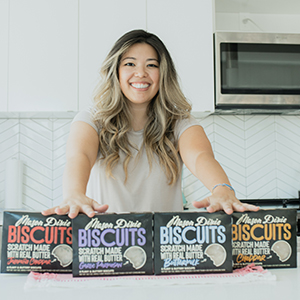
[00:00:10] Ray Latif: Hey, everyone, I'm Ray Latif, and you're listening to the Top Podcast for the food and beverage industry, Taste Radio. This episode features an interview with Ayeshah Abuelhiga, the founder and CEO of Mason Dixie Foods, the fastest-growing frozen baked goods company in America. Just a reminder to our listeners, if you like what you hear on Taste Radio, please share the podcast with friends and colleagues. And of course, we'd love it if you could review us on the Apple Podcasts app or your listening platform of choice. Ayeshah Abuelhiga's initial concept for Mason Dixie Foods, a restaurant chain inspired by Southern cuisine, didn't include a brand of better-for-you frozen biscuits. Yet, seven years after the company's launch and millions of frozen biscuits sold, she now has her sights set on revolutionizing the U.S. baking industry and dismantling the outdated traditions upon which it was built. A former corporate executive with Audi, Ayeshah has positioned Mason Dixie, which also markets clean ingredient scones, rolls, and soon-to-be-launched breakfast sandwiches, as quote, the modern face of Southern food. The brand is carried in over 5,000 stores across the U.S., including all Whole Foods Market locations, Target, Publix, Kroger, and Costco. Last year, Mason Dixie raised $6.3 million in a Series A round that was primarily led by female investors, and Asha expects the company to be profitable by the end of 2021. Her success, she notes, has given her the political capital to call out antiquated ways of doing business, particularly in the baking industry, a point she discusses in detail as part of our conversation. Ayeshah also speaks about how her personal history in the food business, along with bias and inequality in her career, impacted her foray into entrepreneurship, the spark that spurred the launch of a packaged food brand, and how she prepared for rapid growth. She also explained what is needed to create transformational change in baking, how the company is following up a major rebrand with an infusion of socially responsible messaging. Hey, folks, it's Ray with Taste Radio. Right now, I'm going to call with Ayeshah Abuelhiga, who's the founder and CEO of Mason Dixie Foods. Ayeshah, how are you?
[00:02:34] Ayeshah Abuelhiga: I'm great. Thanks for having me, Ray.
[00:02:36] Ray Latif: Thank you so much for joining me today. So great to see you. You know, as someone who owns a company that's all about baking, I'd assume you're a big baker at home and you love to bake. And over the past year, it seems like everyone's been doing more of that. I certainly have. Do you love baking at home? Do you still love it after all this time?
[00:02:54] Ayeshah Abuelhiga: you know, it's crazy. I d inclined about baking tha me perfection is now not I did something wrong in temperature and consisten like all these little thi play that you never reall your life now do on a re Oh God, I live in an apartment, so I'm at the beck and call of whatever they give me. I think it's like a GE electric, which is awful, electric oven. But I will say it's come in handy with testing product, right? Because our product is obviously not for someone with a really souped up conventional industrial oven, right? It's made for the crappiest of in-home ovens. So it's kind of nice to have a crappy oven at home because we have a nicer one at the office.
[00:03:40] Ray Latif: That's a good point. That's a good point. There's a show on HBO that I loved and I don't know, it got canceled after a couple of seasons called How to Make it in America. It was about these two entrepreneurs who were starting a fashion line. And one of them was trying to impress a date that he invited over, but he had a crappy oven. So we went out to Restaurant Kitchen Row in like the Lower East Side and bought a Viking stove that he installed in his crappy apartment. I thought it was one of the best parts of the series. It was really good.
[00:04:07] Ayeshah Abuelhiga: That's so cool. I wish I could do that. I don't know that I could even fit it in my apartment, but maybe upgrades later in life.
[00:04:13] Ray Latif: Yeah. Yeah. Or I don't know if you have a, you know, a maintenance guy in there, just pay him off.
[00:04:17] Ayeshah Abuelhiga: You know, I could, he has a crush on me, so I should ask him.
[00:04:23] Ray Latif: There you go. That's, that's your end to getting a Viking Wolf stove in your house. You know, I wonder, I mean, has the pandemic, you know, has at-home cooking been good for Mason Dixie? Have you started to see more and more people, you know, buy your products to cook at home?
[00:04:39] Ayeshah Abuelhiga: Yes, sadly and not sadly, right? The pandemic has been incredibly good to anyone in the baking industry. It was scary at first, right? Because, you know, nobody knew what was going on and supply chain was struggling. And then all of a sudden the buyers were canceling meetings. So we were like, oh man, you know, are we going to be able to sustain this growth curve that we had worked so hard to kind of maintain? And then all of a sudden the orders were coming in and it was like, 3x what we had planned. And, you know, I'm really grateful that we have incredible relationships with our co-packer and co-manufacturers because they really jumped on the opportunity. But yeah, it was, it was insane. So all the projections that we had were still met and exceeded despite the fact that we didn't get any real new distribution in last year.
[00:05:23] Ray Latif: Well, that's certainly good news. I keep seeing those King Arthur flower ads all over the place, which is like, you know, okay, you can't make it to yoga class, but you can, you know, do your kneading here at home and use a rolling pin and some dough and stuff. And I'm like, they're pretty cool. I think that's, that's well done. I don't know how effective they are, but maybe I think, I think their sales have been through the roof during the pandemic though.
[00:05:42] Ayeshah Abuelhiga: Yeah, they've had sustained sales and I still think that their flour, they're hitting all time records for flour sales. So, you know, kudos to them. We actually used to use King Arthur flour when we first got started. So they were, and still is to me, they're at the pinnacle of high-end natural artisan quality baking flour. So that was always kind of where we started when we first started creating our products.
[00:06:03] Ray Latif: Yeah, I think we got invited to go out to their facility once and I missed the opportunity to do so. Hopefully we'll be able to do that at some point in the near future because they're not too far away from where we are in Massachusetts.
[00:06:14] Ayeshah Abuelhiga: They're a really friendly group, too. You know, they still kind of have that family business spirit to them. So, you know, I think it really plays well into their brand and their ethos.
[00:06:24] Dixie Foods: Totally, totally.
[00:06:25] Ray Latif: So obviously the brand name is Mason Dixie Foods. I wonder why you called it Mason Dixie. And obviously there is a little bit of a negative connotation to that name. Was your decision about sort of reframing the term in a more positive light?
[00:06:41] Ayeshah Abuelhiga: No, actually. So when I first started the company, I wanted to call it Mason Dixie Biscuit Company, right? Because I was from Maryland. At the time, I remember we were a restaurant at first. So my chef, so a culinary chef, and then my pastry chef, we were all from Maryland. So it was kind of the unifying factor. Couldn't call it Maryland Biscuit Company didn't sound right, right? So we were like, that's weird. So we went with Mason Dixie because we were like, okay, that's kind of connoting that it's Southern, so people won't check us and be like, oh, you're from the North, those biscuits are going to suck. And so trying to trademark it, there's a thousand companies that are called Mason Dixie, Inc., Co., all those. So it wasn't going to work. So I was like, all right, well, it's a woman owned business because, I mean, I was the owner. So I was like, all right, why don't I just like cutesyfy it and I'll make Dixon into the feminine. and I'll call it Dixie, because I have three friends here named Dixie. So I was like, oh, that's cute. Now it's a feminine version of Mason Dixie, which then kind of connotates that it's like still Maryland. And so we went with it, and it was fine. I didn't even know at the time that Dixie was synonymous with the South, so I was just kind of like, Okay. So when everything started happening last year, it was just kind of like a shocker that it was being taken in such a big way. Rightfully so. But at the same time, I'm not white or a white supremacist or have any inclination to those tendencies. We're a minority, woman-owned, gay-owned business. So I don't, you know, we don't recognize any of that stuff. So, you know, the narrative sticks. I mean, it's just a name for us. And it was a feminine name.
[00:08:15] Ray Latif: Well, people certainly love the name and love your products. I wonder though, are people who learn about Mason Dixie Foods surprised that it is owned by a woman of Palestinian and Korean descent?
[00:08:31] Ayeshah Abuelhiga: Yeah, you know, it's funny. I'm prideful of it, right? But I'm also, you know, I grew up I hate when people say colorblind. I'd say trying to be color-assimilative, right? I grew up without any people of color really around me. In elementary school, I think I was one of only five people of color and the only Asian outside of my two sisters, right, or Asian heritage. And then in middle school, I was the only non-African American. And, you know, it wasn't really until high school that it was really pluralistic for me. So I always grew up assimilating into whatever cultures were around me and embraced me. So I never really thought it was going to be such an advent. And then last year happened, and I can't be more grateful about the diversity and inclusion in our branding. But I think because I don't sit there and identify myself with any one thing, I just said, I am 100% blue blooded American. I think it was really a revelation when we were talking to our agency. We did a major rebrand last year. And when we're talking to our agency, they're like, you really need to talk about this because Because I don't like that biscuits and Southern cuisine is synonymous with like white, blonde hair, blue-eyed people, right? I mean, the reality is the root of Southern cuisine is African-American, right? So I never was okay with that and wasn't really sure. And I guess maybe it's just humbleness, right? Like I just, I'm still unsure of how it gets received because the South is still so nostalgically aligned with these values that we don't really have. But when the agency was like, you really need to be front and forward, you know, I'm a loud, proud person. So they're like, let's get your character out there. Let's talk about what you stand for. Let's talk about the fact that you're not the icon of Southern Christianity. I'm not Paula Deen here. Right. And it's funny, too, because I always say, like, we actually chose an agency in London. Because when I interviewed American agencies, they all kept wanting to go to like some weird nostalgic past where grandma's kneading biscuits on a porch with tea. Honey, I don't have a white grandma. So that's not my story, right? Like, why are we telling this?
[00:10:35] Ray Latif: That's so weird. That's so weird. You're like, okay, meeting done. I mean, as soon as they say that, like what?
[00:10:41] Ayeshah Abuelhiga: I interviewed 17 agencies because 14 of them all went that direction. Wow. After even I said, don't go the nostalgic route because I don't identify with that. Like my story is very unique. Even my story to biscuits, it's very American and very immigrant. Cause I mean, I had two working parents, immigrant parents, right? Latchkey kid and two younger sisters. I had to make dinner, and then literally the first Thanksgiving I ever had to make food for, I asked my sisters what they wanted, and they both said biscuits. That is how biscuits came into my life, right? Like it wasn't some grandma serving them to me on the front porch. Now, I'm not going to here and say that's not an amazing nostalgic memory many people have. I love that what we're doing connotates that for people and takes them back to familial, amazing little vignettes in their mind about how amazing this food is. I love that. And it is iconically American to have those experiences, which I also love that, you know, again, half Arab, half Korean, business partners, gay brand is, you know, connotating for people. That's what's amazing about this country. And I think, you know, the rebrand for us and the opportunity to really center the brand a lot more, like the back of my face is on the back of the box, right? Like the front of my face is on the back of the box. But you know, it's like, it was a statement, I think, that the agency thought we should make, right? That like, it's time to be full frontal about who we are and realize that at the end of the day, people appreciate the American story for what it is. And I think that's really a narrative that we've really tried to stick to and just stop polarizing and really start bringing people together again.
[00:12:18] Ray Latif: Absolutely. I mean, your story is an American story. And I love that you called yourself 100% blue-blooded American, because I think that term has been twisted and manipulated to mean something else. And you are the American dream. You're living the American dream as an American. And I love that.
[00:12:38] Mason Dixie: Guessing your margins? That's risky. Belay Financial gives CPG brands the clarity to scale smarter, faster, stronger. Get your free inventory ebook by texting TASTE to 55123 and start making data work for you. Vibrant Ingredients is the natural ingredient partner powering food and beverage innovation, delivering flavor, function, and protection through a science-backed portfolio. Vibrant delivers purpose-driven solutions that help brands create extraordinary experiences. Discover what's possible with Vibrant today. Visit VibrantIngredients.com.
[00:13:25] Ray Latif: Let's talk about your history. Both your parents were immigrants, but you know, you obviously were born here. You told me, you know, before we got on the call that your parents were both business owners in the restaurant business. Was that your initial interest in food?
[00:13:40] Ayeshah Abuelhiga: Yeah, my parents actually were in Baltimore. It was kind of like, it's common here. I think in New York, they call them delis, even if it's not just sandwiches, but a little corner store that serves hot food. And in particular, my parents serve Southern cuisine. Why? Because it's sold well, no matter what, right? I remember as a kid watching people come in and out and they'd be like people in business suits, construction workers, homeless people. It didn't matter. Everybody, everybody loves fried chicken. Everybody loves biscuits. If you don't, something is literally seriously wrong with you.
[00:14:13] Ray Latif: Did they sell lake trout? I heard lake trout is big down there.
[00:14:17] Ayeshah Abuelhiga: fried chicken gizzards or It's like that's probabl mom, my mom is korean, bu hell out of something lik it, she'll fry it. Like s Literally, she is like the best fryer ever. So yeah, I mean, I grew up watching all these people coming in and out of the store and ordering this food. And there's something to be said about that, right? Again, you know, Southern cuisine, comfort cuisine is iconically American. You know, watching that growing up with that, I also realized how my mom made food. She never ripped open a bag and like poured it out. Like she made everything from scratch. she seasoned the chicken herself. There wasn't anything sitting in a brine that got purchased, you know, like that's how I always knew food to be. And then obviously I'm blessed, right? Like my, my dad's a Mediterranean heritage, incredibly healthy cooking, fresh cooking, right? Simple ingredients. We never really used a lot in any kind of Mediterranean cuisine we cooked. And then on my mom's side, Korean food, it's kind of like mother sauces in Korean food. There's like six mother ingredients that make everything. And it's all flavorful and amazing and fresh again. So I grew up very privileged in that despite being low income, we ate very well. And my parents always made sure that we had balanced diets. And my parents always made sure that we knew how to have the right amount of vegetables, protein and, and carb, right? Like we always ate like that. It was just cultural. And even though we grew up in Section 8 housing, I always realized that, like, I was lucky to have a packed lunch. I had a lot of friends who weren't. They were on dollar lunches, or they just didn't eat, or they got food out of a vending machine. So that, to me, I think was totally why it's been ingrained in me to be cognizant of food and how influential it can be in someone's life. I definitely think you are what you eat is like a real statement, right? And I think it stuck with me because even through my entire life, my first foray into being, I was first kid to go to college, right? First kid to go out on my own and, you know, cooking for yourself. You're like, I was lucky I was equipped with skills, right? But, you know, I think that paying and that realization that like, I could be doing more with food, I just didn't know how, right? I was, I had Asian guilt. I had immigrant guilt, right? I was like, I need to go to college. I need to be a doctor, lawyer, right? couldn't do those things. And I really, I just never felt like what I was doing was right, right. I spent 15 years after college in the professional world, you know, I was in tech, automotive, consulting, the whole nine. And I just never really felt fulfilled. There's something about needing to belong where my roots were, I guess. Even in college, I worked like two restaurant jobs plus two other white collar jobs to try to get up in the world. But I never felt quite as home as I did when I was at a restaurant because they're my people, right? Like Spanish is a second language at a restaurant. So, you know, like you feel at home because it's people from all walks of life and even the customers, right? You get all kinds. And it just was so unifying to me where For the first time ever, my exposure to the business world was unique to me. My parents didn't even tell me I could be a business person because they didn't know what the hell that was. They just thought that meant I owned a corner store carryout, right? They're like, oh, that's what business is. I'm like, really? You know, so I think intrinsically, it was always meant to be that I needed to go back to food. It was just where my comfort zone was.
[00:17:39] Ray Latif: Yeah, I grew up in the food business as well. My parents owned a chain of gourmet food stores and then later on a Mediterranean grocery store that my brothers now run. Wow. Yeah, yeah. So my dad was, you know, a lifetime entrepreneur. And I remember when I was, you know, after college, I went to business school undergrad at Boston University. And I was looking at some jobs like in the corporate world. And he's like, corporate world, like what do you want to sit on a desk and push a pencil your whole life? I was like, yeah, that's what people do, right? I mean, that's how people make money outside of like owning your own business. Yeah. But later on in life, you know, and no offense to my current job, I did realize the beauty of entrepreneurship. And I did realize, you know, how lucky you can be to be your own boss. And that's what you are right now. But it seems like you were kind of forced in that direction by a corporate structure that didn't reward people like you.
[00:18:35] Ayeshah Abuelhiga: That's right. That's exactly right. I think I think the pressure of coming from that as a second gen American, right, the pressure and the firstborn, the pressure to do well and make sure that I'm the breadwinner for the family, because when your parents work in a blue collar jobs or hands on retirement and savings are not really things right. my parents will never and would never have enough money to save. And I knew that, right? So I felt all this pressure to be like, all right, I'm going to go, I'm going to get a six-figure job as quickly as possible. I'm going to save all that money. I'm going to buy my parents' house out. And then I'm going to make sure that they can retire and never work again, right? That's the goal that I think every immigrant child has for their family. Whether we like it or not, whether it's like roboticism in our minds, we just have this need to do that, right? So I did. I worked my ass off. I scaled a lot as quickly as I could. I was a senior manager three years out of college, and I was already being poached and, you know, thrown around in the industry to the point where I got to work for some incredible companies. I helped work on the Transformers film, like the first one. figuring out robots get to downtown LA, right? I mean, it's like the things I've been able to do in my 15 year career in business world was amazing. But you know, in my in the back of my mind, I always thought, okay, I need if I'm going to do well, I need to find a job where I'm going to understand something that creates value. And I always thought luxury brands did that. So when I got recruited to work at Audi, I was like, this is the pinnacle. This is it. This is it. I'm going to become a C-suite executive there one day. And that's how I'm going to make sure my parents retire well. And then I got there, I learned everything about the industry in less than one year. And I was bored. And I had applied to maybe three jobs, two lateral moves, one upper management move. And I had declined all three times to guys, gearheads, with zero experience in the field. Mind you, I worked in the last stint, I worked as a product manager on intelligent vehicle systems. So like self-driving cars. I should have been promoted in that area. I'm the expert in that field. I've been working in it in five plus years. I worked with every manufacturer known to man on it. And they gave the job to a gear head who literally his last job was picking out leather fabric.
[00:20:48] Dixie Foods: Wow.
[00:20:49] Ayeshah Abuelhiga: So that's when I knew it was never going to happen. It was never going to happen. The world wasn't ready. And then when I looked at the C-suite too, there was one woman on it and she was an engineer, probably more qualified than anyone else on the C-suite, but she was given the CMO role with no marketing experience because that's what women do. We do marketing. and we do HR. We're not qualified to do man things. So it was really disheartening. And I always tell people, I'm like, everyone talks about a glass ceiling, but it's really a glass floor. Their eyes are not set on you to reach a pinnacle. It's actually like, You got to stay down here and if things go wrong, that glass floor breaks and you go down and everything else goes back to normal. And I just really wasn't down for it. I was sick and tired of it. You know, when you're smarter than your boss, you're right. Like when you're smarter than your manager, it starts to really get at you. Because there's envy, there's disappointment, there's so many emotions you feel day to day. And I just, I did, I felt those every day. So I had to leave. And I was like, you know what, I'm going to take this opportunity now to take the leap. And I know it's gonna be super upsetting to my parents. but I told myself the one thing they taught me was grit and the one thing they taught me was perseverance. Like I will never not be successful because I don't care if I have to work three jobs, two shifts at McDonald's, cleaning floors. I don't care. I don't care. I'm never not going to make money, right? I'm never not going to be able to feed myself because I don't have pride when it comes to what I do to make cash, right? So I was like, if I take this leap and everything goes wrong, I'll just start all over again. It took me 15 years to get to where that was with no experience. I have 15 years experience. I'll get, I'll get back, you know, and it was the best decision I ever made.
[00:22:30] Ray Latif: Clearly, clearly. And well, I'm so glad you shared that story because I think there are people and I'm going to lump myself into this group, you know, not currently, but in the past, you know, might've been ignorant about, know, the fact that advancement in corporate life or, you know, any type of, you know, business setting is difficult for women. And it's sad. And you hear these stories. And again, I'm so glad you shared it. It doesn't make sense. It doesn't do anything. It's bad for everyone. So like, why would you do it? And again, I think, you know, it's one of these things that, you know, you have to hear these stories, you have to be around people who have lived that experience to really understand, you know, what's going on, what continues to go on. Totally. Yeah. Well, again, you know, it all worked out in the end, and you opened a restaurant, and the restaurant business is notoriously difficult. Did you train yourself? Did you go work for a restaurant ahead of time to kind of learn, you know, the sort of the basics of operating one? And how did you mitigate the risk of owning, you know, an eating establishment?
[00:23:37] Ayeshah Abuelhiga: Yeah, so no, I'd never really kind of gotten a crash course into ownership or anything like that. It was more, I'd say, one of the most influential jobs. Audi, Microsoft, everything else aside, right? The most influential jobs I ever had was working for a restaurant group in DC called Passion Foods. And they were one of the IT restaurant hospitality groups in the 90s and 2000s. They had everyone important eating at one of their restaurants. And they were owned by a group of guys that had ascended in the industry, were the best servers at the most clutch restaurants, right, and best chefs and whatever. And they created this really awesome hospitality group with the best training curriculum I've ever experienced. I learned everything about steps of service. I learned everything about hospitality, about mise en place, about how a kitchen's set up, everything from there, unintentionally, right? It's just part of the curriculum. But when I started the business, I was like, man, man, I know everything. Like, how did I know this? This is crazy, right? Like, Gus was the man. So I think I had enough knowledge to be dangerous, certainly not the skill I needed, but enough to be dangerous. And I also knew what I didn't know, right? And at the time, this was 2013, 14, top chef was like at the pinnacle of entertainment, right? Everybody wanted to be a chef. Everybody wanted to, you know, have sex with the chef. Everybody wanted to be with a chef, right? And I was like, I am not a chef. And in fact, I am some nerdy girl that comes from tech and automotive and starts to open up a Southern, you know, chicken and biscuit place. So I was like, I got to get cachet and I got to get it quickly. And how am I going to do this? And the conservative part of me, the non-risk-taking, second-gen, you know, immigrant child in me goes, shit, you know, how are people going to respond to chicken and biscuits? Like Mediterranean's taken off, Sweetgreen's opened up their like 50th location. I'm like, whoa, what am I doing? What am I doing? And so I stopped for a second and I said, come on, tech brain, let's think about this. And I remembered Kickstarter had just also taken off and it was still very 1-800-MY-IDEA, very like, invention centric, right? There was maybe one other restaurant that had posted on there, but they'd done well. And I was like, this is interesting. So what if I put this concept on Kickstarter and I get some market data out of it, right? Like I'll see if people actually like this in California. If they don't, I should stop this now. Cause my goal was to open like a hundred plus unit better for you, southern comfort food chain. Because I thought it was a travesty that Chick-fil-A and KFC are the global images of American Southern cuisine. That's just, it's still, it's mortifying to me. So if I was going to do this, I was like, I have to prove that I have Chick-fil-A cachet. Like there's Chick-fil-A's in LA, right? So ended up posting on Kickstarter, took all my marketing comms, BD, tech prowess to pull this all together. And it was a huge smashing success. We were fully funded on it. You know, even if it was a dollar, I got money from people in California, Seattle, you know, everywhere and everyone. gave me a nugget in the messages about like why this was important to them. I didn't ask for it. It's like for every dollar donation they gave me, they gave me some amazing pictures. I have people's grandpa's photos from like, or great grandpa from like civil war, like it's crazy. People will like open up their whole world to me. And that's when I was like, I'm not just selling biscuits. I'm not just selling fried chicken. I'm selling like soul. I'm selling people's spirit and memories. So I knew I had something then and that's why I was like, all right, I got to play into that. I have to make sure that whatever we do is going to be the standard these people are expecting, right? So I did go out there and I found one of the top pastry chefs in the city. I found a really great culinary guy who like thought through everything, came up with the menu and ideas. Obviously, everything we did was a frame of reference from what I thought tasted good.
[00:27:24] Ray Latif: Why pastry, I'm wondering?
[00:27:26] Ayeshah Abuelhiga: So the biscuit was going to be the centerfold, right? Because in my mind, I was like, how am I going to execute this well, right? I'm not a supply chain master in chicken farming. So I was never going to get the deals on chickens. So I was like, I can't focus on the chicken because I'll never beat Chick-fil-A, right? I'll never beat KFC. but I can't focus on bread because no one does a good biscuit. They were filled with horrifying preservatives when I was ordering samples, right? Thinking I could maybe do this a little bit out of the box. No, the biscuits were terrible. They were mortifying. They weren't biscuits to begin with. And so I was like, if I'm going to do this, I need a really good pastry chef who's going to come up with a really great recipe and the way that I make it, right? So I literally, I gave him the recipe that I like. I photocopied it at the public library when I was 10. That day my sisters wanted biscuits for Thanksgiving.
[00:28:17] Ray Latif: You still had it.
[00:28:19] Ayeshah Abuelhiga: I still had it. I still have a little recipe book. It's like an old thing, like a photocopies of even like mac and cheese, like random stuff. And I gave it to him and I was like, okay, see this recipe only has like, it was a five ingredient recipe. But I was like, don't worry too much about anything, but just don't make it look perfect and make it look like I made it. Like I remember I used to cut to cut them out, right? So it's like, don't make them perfect. And he was like, okay, I got it. Literally the second try, it was like perfect. I was like, yes, this is exactly what I want. And apparently it was exactly what the people wanted to do, because we had lines wrapped around four city blocks. We did this pop-up at a gelato factory, and it was insane. And then all of a sudden everyone was like, oh, where can I get them? I missed the pop-up. And that's what led to like a food stall, right? And so we were in a little food hall down the street from where this gelato factory was and still had lines. It was 80 square feet, okay? And we were making biscuits you know, by the dozens at a facility a mile away, having to bake them and bring them in. And so, like, in 80 square feet, imagine less than an Expo booth.
[00:29:23] Dixie Foods: Oh, boy.
[00:29:23] Ayeshah Abuelhiga: Was the size of the restaurant. So, we literally were, like, pumping them out. And eventually, it was too much. One day, it was maybe a month and a half in on a Sunday. We'd run out of biscuits by 10.30, right? And it was crazy. And we had some loyal customers come by, and they were like, Hey, you know, I've actually never had them fresh out of the oven. I know you're out. Maybe next time. Can you save me some dough? And I was like, well, I don't know how I'm supposed to just hand you like a log of dough. And then this other, I remember some disgruntled customer. He was just like, he was on the spectrum, I think. And he, you know, very like schedule oriented. He was like, It's 1030. Like, why can't you sell me the dough? I don't understand. This is crazy. You should just sell the dough. I'll just make it myself at home, make it myself at home." And I'm just like, okay, that's the second time I've heard that in a day. Maybe there's something to this. Like if people really don't mind that it's going to be raw ass dough and they're going to take their chances, I'll do it, right? So my pastry chef's like, no, you're not. You're not going to do that. You're not going to, you know, ruin the sanctity and the preservation of this formula. Well, you know, he's like, you know, super proud of his stuff. And obviously we never tested anything frozen. And I was like, it's frozen. It's going to be fine. There's no preservatives or anything. He's like, yeah, but it should be fresh. Because he was getting in there at 3 o'clock in the morning and making them fresh every day, which is why we didn't have enough by 1030. So I was like, this is going to be a great advent for us, because then we can get ahead of supply and really start building inventory. So I took some pucks when he wasn't looking, put them in the freezer. and the next day I baked them off and they they fluffed up so big and I was like this is even better than what we're serving bro now we can even slice them and it's still thicker than what we were doing and obviously back to your first question right baking science things I've learned and the secret to biscuits is the colder the butter the higher the rise. So because that butter was frozen solid, it rose gorgeously. And that's when I was like, all right, this is cool now. This is cool because you get a Pillsbury biscuit. It's still this flat, right? It doesn't rise. You get one of ours and it's huge. So I went to Bed Bath & Beyond. about $100 vacuum sealer, right? Because everyone was CVing back then. So I was like, all right, I'm going to put these in the CV machine that everyone's using. And that'll be a good way because then the health department won't stop me. Because I remembered that the health department wasn't stopping CVing because it was hermetically sealed, right? Vacuum sealed. So I was like, this is perfect. They would stop me if it was a Ziploc bag. They wouldn't stop me. So we didn't have an outlet. We had one outlet and it was being used. So we had to put it in an igloo cooler, like a big boat one.
[00:31:57] Ray Latif: You had one outlet?
[00:31:58] Ayeshah Abuelhiga: We had one outlet. Oh my goodness. One hand sink, okay? Like it was, it was a thing. And so I was like, all right, if we don't have a freezer, we're gonna have to put it in a cooler. So we put them in an igloo cooler and filled it with ice. And I'll never forget the first day we did it. My chef was so upset. He was like, I can't believe you know, and I'm not I'm not doing this every day. You're gonna have to put them in this, you know, like, I'm like, okay, I'll do it. Literally 930. I'm still by the way, working my full time job at Audi because I had to finance this crazy like, oh, wow. Oh yeah, I didn't quit my day job until 2018, really, because I couldn't afford it. The growth was insane. And this is all down to this moment of why I couldn't quit my job. Because that day, he calls me at 930. I'm driving, I'm literally at work already, right? And he's like, hey, can you go back to the kitchen and get more biscuits? I'm thinking he's talking about sandwich biscuits, right? And I'm like, it's like a Thursday, bro. How are you out of biscuits, right? And I was like, did you not bring enough? Like, what happened? He was like, no, the frozen ones. And I was like, oh, you mean the ones that are a bad idea that won't sell? Oh, those sold out? Cool. Then I was like, holy shit, like people on a Thursday morning bought the frozen ones, stopped whatever they were doing to do that, and then went to work or I don't know what they were, I mean, you went out of your way to get frozen biscuits. So I was like, there's something here. And a few weeks later, we got secret shop by Whole Foods. And nine months later, we were on shelves, we beat out butter and milk sales the first launch day. And that's when it was like the revelation that I would like, literally have no time to my life forever was like that moment, because I was like, I can't quit my job. I have to finance how this is going to work, right? Because it's totally unplanned. I was trying to open 100 restaurants.
[00:33:44] Ray Latif: So I got to back up for just two things here. Number one, you beat out butter and milk sales in that entire Whole Foods store on the first day. On the first day. That's insane. That's insane. It was insane. Going back to the lines around the corner and just this crazy interest in your brand, where did the buzz come from? Was it organic or were you on Eater DC? Was it social media driven?
[00:34:09] Ayeshah Abuelhiga: No, we didn't even get into a press outlet until that. It was a Saturday and Sunday. We originally were only going to do it on Saturday because the guys at Dolcezza, the gelato factory, they were closed on Sunday. But the buzz was so crazy, and they made a lot of money. They had a Stumptown coffee lab inside. So they were making coffee and selling gelato. And there was a line there. This was in an industrial part of DC that had not been developed yet, right? So there was no reason for people to be there. So it was great for both of us. But that Saturday event was just promoted strictly via the people that I found on Kickstarter, and then any DC residents that had put into the Kickstarter campaign, followed the Facebook page. I mean, there was no Instagram back then yet either. It was literally- I think we had, I don't know, maybe a thousand followers at that point because Kickstarter was so great. And I just really just made sure that I was like, this is for you guys, right? To this day, I will never, never not think about the consumer because they are every reason why I'm here. And everything we did in the beginning was to thank them. We had a thank you event at a bar. to Kickstarter backers, right? We only invited Kickstarter backers. Obviously it was in DC. Like we had backers all over the country. I had three fly in, one from San Francisco, one from Austin, one from Chicago. They flew into DC to come to this bar. And I was literally like swinging hot dogs.
[00:35:27] Ray Latif: How much did they, how much did they, you know, buy in or how much did they pay for the Kickstarter campaign?
[00:35:32] Ayeshah Abuelhiga: I mean, the average contribution was like 20 bucks.
[00:35:35] Ray Latif: Wow.
[00:35:35] Ayeshah Abuelhiga: It's so funny, like things you forget about, right, in your path to where you are. But yeah, like we had this thank you event and it was just so that the local folks could meet us. Right. And I could say thank you personally. And I have pictures. It was, this bar was slammed. We had the whole rooftop, it was like packed, and I don't even know who else was there, who invited who, but the power of word of mouth, the power of gratitude, and the power of grassroots community is unreal. And that's what really got the first round of people into that first pop-up. And then the press came, because there's a line in Northeast DC, like in the hood, like at seven o'clock in the morning. So the press came, took photos, posted it in the Sunday paper, on digital, and that went viral. So that's why Sunday was a bigger day. And then when we got the food stall, that went viral. It was just like, everyone was rooting for us, like everyone in that city. And it was also crazy, man. It was August. August, there's no Congress in session, like no one's in D.C. So I think everybody who was in D.C. at that time came to one of our events.
[00:36:38] Ray Latif: And it's really hot in DC in August, too. Who wants to wait in line for hot biscuits on top of it? Yeah, wow. It's incredible.
[00:36:45] Ayeshah Abuelhiga: The oven that we were using was broken. We had a tabletop fryer. I mean, it was like, you know, you think about the things you do. No, but it was totally, it was all about the customers embracing us from day one, like straight up.
[00:36:57] Ray Latif: Did they embrace you or do they embrace your vision, your food? You know, when you're when you're building a Kickstarter campaign, you know, what did you say in there that really resonated with folks? Because now, I mean, you know, you've said, I want Mason Dixie to stand for the modern face of Southern food. Was it true? Was that the same statement back then?
[00:37:14] Ayeshah Abuelhiga: Yeah, we did. We had, we had that premise. You know, I think it was really helpful that even like the makeup of our team at the time, we had a LGBTQ pastry chef, we had an African American executive chef, and then there was me. And people really, I think, resonated with like, you could be anybody and do this, right? And I think there's something very humbling about the food, right? I mean, I'm not making sous-vide foie gras profiteroles. I was making chicken and biscuits, and people were, like, down for that, right? It didn't matter who you were. I mean, we were, we would deliver on a regular basis, at least once a month, a huge-ass order to senators all the time, right? Like, it doesn't matter who you are. Everybody's eating that food. And I think the approachability of the concept was one thing. I think the openness. I answered every message. I still answer DMs.
[00:38:01] Dixie Foods: Wow.
[00:38:02] Ayeshah Abuelhiga: they'll answer emails. Like I will never not be connected to my customer ever. It's so important. And I also think that remember we talked about the nostalgia. I think that people have like a connotation that plucks at heartstrings when they think about American Southern cuisine and the memories that they have for that. I mean the woman in San Francisco for example that came all the way out she didn't grow up eating so that she was actually vegan. That was the craziest thing.
[00:38:28] Dixie Foods: Wow.
[00:38:28] Ayeshah Abuelhiga: But she resonated with like, she was like, I've never, I've never had a restaurant concept speak to me the way you did. That's what she told me. And she actually flew out to several other events randomly across the last five years. And I saw her at fancy food, actually. She was just like, yeah, like, I think she's just really into supporting food based brands. And she was just like, right there. So I don't know, I don't know what the secret sauce is. I think it's just, you know, Kickstarter's changed too, right? There's so many things on there now. So that back then, there wasn't garbage in there, right? I mean, that potato salad guy was after me, you know, so.
[00:39:03] Ray Latif: The potato salad guy.
[00:39:05] Ayeshah Abuelhiga: Remember that guy? Millionaire over potato salad. So that algorithm, like chopping, didn't happen back then. This was hard grassroots support. And it was people, not only for our brand, I also think it was people that were really into the idea of Kickstarter, right? Really into the idea of backing something with wholeheart. And I think the combination of things, just timing everything was just perfect.
[00:39:26] Whole Foods: Do you want more repeat buyers on Amazon? Well, this free resource in collaboration with Straight Up Growth will help your brand turn first-time buyers into long-term subscribers. Download Winning the Repeat Purchase Game on Amazon now at Taste Radio slash SUG. That's Taste Radio slash S-U-G to start building retention-driven growth for your brand on Amazon. Scaling a beverage brand into major retail comes down to operational readiness. From packaging lead times to co-manufacturing strategy, the details can make or break a launch. In a new ebook in collaboration with Octopi and Asahi Beer USA, industry leaders share what they've learned in helping brands scale. Download it now at Taste Radio slash octopi.
[00:40:16] Ray Latif: So when everything blew up, I assume that you're like, okay, I've got to take advantage of this opportunity. You said you didn't quit your job because you had to finance it. Financing is just one part of it though. Projecting growth and planning for scale is another thing. It seems like you were well-trained for that as a process-driven executive, but I'm sure it's still pretty difficult because you're not in CPG. You weren't in CPG. Well, no, you weren't in CPG.
[00:40:40] Ayeshah Abuelhiga: Yeah, I was in luxury products, but not CPG.
[00:40:44] Ray Latif: Yeah. So, I mean, what were your initial steps in terms of how to plan for scale and then project growth? Because if you just base it on the growth that you currently had, I mean, I don't know where you start.
[00:40:56] Ayeshah Abuelhiga: Yeah, no, it's, it's hard, right? Like, again, plan concept was a restaurant, not consumer products at all. The whole happenstance of getting the Whole Foods and killing it, right? Like I was told if we sold through like 24 units that day, we'd be absolutely stellar, right? Like that's like the best day ever on ice cream. So I was like, okay. So they ordered 150 units that day, right? So it was supposed to last because it was the day before Thanksgiving. And so it was supposed to last Thanksgiving through holiday rush and they were going to assess that, right? So 150 units should have been pretty good for them for that one store. And we sold out of all of it in three hours. But then how does that skew your projections, right? Like you're like, wow, did Whole Foods just sell 150 every day? You know, like you don't, you don't know what velocity is. So I'd say backing it up, the first moment I knew I needed to get my shit together was the day that my pastry chef said he wasn't going to make them. And that's when I was just like, okay, because he was like, I'm busy enough. I've got the restaurant stuff. And I was like, no, totally, totally founded. I get you. So I literally ended up recruiting my business partner, Ross, who is our COO today. It was so funny. He had a nut company in the same commercial kitchen. And all of a sudden he stopped having a nut company. I was like, what happened? And he was like, I became allergic to nuts.
[00:42:13] Taste Radio: Oh, geez.
[00:42:15] Ayeshah Abuelhiga: He had to quit his business. And so I was like, well, why don't you join mine? And I can't pay you anything because I'm broke as hell. But, you know, if you do this for me, I'll pay what I can and then hopefully give you an equity stake. And by some miracle of God, he said yes. I think it was, he said yes at my birthday party. It was my 30th birthday. He was three sheets to the wind, break dancing on the floor. And I said, so are you starting on Monday? And he was like, yeah. So that was it. But it was transformational. And I always tell people when I go into like business panels and stuff, pick a good business partner. You cannot do this on your own. And I knew exactly the type of person he was. He's an operator, detail oriented. He's not afraid to get his hands dirty. He was making biscuits for two years. by hand, right? While also going on emails and setting up sales meetings while also, you know, coordinating orders and everything. So he knew the business enough to start it right with me. And, um, he also at that time was more of a risk taker and was like, we should, you know, keep getting accounts. And I was like, well, how the hell are we going to get accounts? There's two of us. You're making biscuits. I'm still trying to finance this thing. And like, somebody's got to deliver them, you know, someone, you know, how are we going to do it? And, you know, we found ways to do it. In the end, we hired people, we got volunteers. I had my one of my product managers at Audi who she was like, the A4 girl. I had her in her stilettos after work one day helping me vacuum seal because it was like I needed help. So it was like, you know, a wild ride of like a lot of help. And then I think once Whole Foods hit and we saw the volume there, that's when we were like, all right, how serious do we want to get? And we took about a year, I'd say 2016, we just focused on Whole Foods alone. We were in about, we were in all the stores regionally that we could drive to, right? So I think it was maybe just shy of 30, maybe 30 stores. But we were doing pretty good volume. And so I was like, oh, wow, if I multiplied the amount of revenue per store that we're making, and you know to the world that's a lot of money so why don't we do this and so Ross was like okay why don't we why don't we go approach some southern stores like yeah yeah southern if we make it in the south we can do this so I was like what's the southern chain he happens to be from Louisiana so he was like well there's Kroger Publix I was like both of them let's go there He gets on LinkedIn and he like messages the buyer and he goes, hey, she messaged me back. And I was like, oh, cool. So I'll never forget when we showed it to Publix, we didn't know that Publix has strict rules about meetings. Guys have to be in business suits. You got to wait in the meeting room, all this stuff. We had no fucking clue. So we were like.
[00:44:45] Ray Latif: Still to this day.
[00:44:46] Ayeshah Abuelhiga: full of this day. Yeah, I got it on. So in hot ass Florida, you know, but we didn't know he shows up like a startup kid, right? And like, you know, sweater, like a nice sweater and some jeans. And I did show up in business attire because I'm still corporate trained. And we get in this meeting and our, our buyer is stoic as hell, but she, she did taste the product. And then all of a sudden, like two months later, she's like, yeah, I'll take them 400 stores. And then Kroger, same thing, no idea how we got that meeting. We met the buyer and he was like, yeah, this is great. Almost a thousand stores, whatever it was at the time. I think all in all, I think it was 1100 stores total that we got. And so that, remember we were in like 30. So I was like, okay. You know, what do we do? So we pivoted in the intermediate time. We kind of like, we're making biscuits. We knew that they were going to be big enough. We knew we were going to get a lot of stores, not a thousand. We knew a lot. So we were making pallets of biscuits at the back of our, at this point we had a drive-thru restaurant and it had a parking lot. And we had like a frozen reefer trailer on the parking lot. And it was just filled with pallets of biscuits. Cause they were like, all right, we're going to start back stocking. And that way when the order's gone, we'll just pull from it. Except that doesn't work when your Whole Foods accounts are doing well and they're taking all the stock. So we filled it, it was gone. And so we were like, shit, you know, how do we do this? So we went to, at that time it was Haddon House, not UNFI yet, but we went to a Haddon House show. It was our first show. We obviously didn't know how to do a show. It was a complete bust. He and I were pissed. So we just stayed at the pool in Orlando because we were like, fucked. We didn't know what tradesman was. We didn't know you could do a discount. I didn't know what to do. We were like, no, it's $5.99.
[00:46:24] Ray Latif: You know, so- There are plenty of people who still don't know how to do that. So it's-
[00:46:30] Ayeshah Abuelhiga: So we weren't getting any sheets, we weren't getting any sales. So we just said, fuck this, we're just going to the pool. And we were hanging out at the pool and I was like, I'm just going to start calling random people to find a manufacturer. I literally went down the Specialty Foods Association list of suppliers. And I was like calling them. I ended up hitting this woman up who sold baking enzymes. And she was like, oh, I know every bakery that makes biscuits. She's like, I know just the factory. And if they don't take you, call me back and I'll help you. Honestly, this was a cold call, right? Cold. And she happened to pick up the phone. And the company she sent me to, I Google stalked the hell out of those people. I was like, what's your number? I think I called people's personal house numbers. I don't know what I got, but I called them all. Within three hours, I got a call back and it was the co-manufacturer we ended up using. And bless them, I have no idea, outside of being a woman in business themselves as well, I think that their founder saw something in the story that just reminded her of her. And she took us under the wing and all of a sudden we had a co-packer within three months. And then we had an order within a month. So not in any way recommended. And I was just, I was really lucky. I was persistent as hell, but we were lucky.
[00:47:44] Ray Latif: Did your success at Whole Foods really move the needle a lot for you? Were you able to say, look at the velocity that we're doing in these 30 stores. If we can get the manufacturing right, we can definitely do 1,100. Is that kind of the thought process for these buyers?
[00:47:56] Ayeshah Abuelhiga: I think it helped that they knew we were at Whole Foods, that we weren't just some podunk company from nowhere. Well, we're.
[00:48:03] Ray Latif: Totally we're. I haven't heard the word podunk in a while, but I'm going to start using it more often.
[00:48:10] Ayeshah Abuelhiga: I think in their minds, they're like, all right, they're not starting from absolute scratch. They obviously have some business at Whole Foods, and Whole Foods at that time was still a feeder, you know, a feeder brand identifier, right? So they were like, all right, if they're doing stuff at Whole Foods, and mind you, it's not like they were getting data. We were in 30 stores. It was more, I think, one, I think one of the best things ever was that we talked about a restaurant. They were really into the fact that, in fact, I think they cared less about Whole Foods and more that we had a restaurant where people clearly were coming. And that showed market proof, right? They were looking at Rao's, they were looking at even the Olive Garden stuff, salad dressing, right? Like they were looking at those examples of like, they have market traction already because they have a restaurant. And that really, I think, helped us get in. But I would say the Whole Foods was transformational in that it taught us a lot about what we needed to do. I'll never forget when I went to that first meeting with the samples and the woman who discovered us, she was like taking these bags and she was like trying to merchandise these sad little CV bags. And I was like, no, no, no, no, no, no, no, no. I was like, I'm going to get this right. Do not, don't even play around with this stuff. Right. I was like, I'll get you nice product. So I put it in a carton. Right. I was thinking through the whole thing because I could walk at that time. Whole Foods was still so community friendly. You could walk into there and start measuring shit. They wouldn't stop you. Right. So because they were so open to that, like you can sell your grandma's jam if you wanted to, if you talk to the manager, they'd let you in, right? So I think that characteristic helped us learn quicker, right? And they really pushed us too. When we first got started, I didn't even know about what some clean label things were. I just thought these real ingredients is enough, right? We didn't have natural flavorings. You know, we didn't have any of that, but I was like, that's good enough, right? Well, I didn't even know that baking powder, I thought there was one type of baking powder, right? I didn't know it had aluminum in it. And I was like, I didn't know that was bad. And then when they banned aluminum, this is the crazy story. They banned aluminum in personal care, but when they put it on the list of ingredients, it's just lists of things that are banned. So they didn't even think that it would impact bread. So they tried to ban us a year in. And I was like, hold up, what's going on? They're like, there's aluminum on your ingredient panel. And I went to their bakery, and I pulled every bread item and I was like, so do y'alls. So they gave us some time, they couldn't help us cause they also had to figure it out, but they gave us some time to like figure it out and we reformulated now and that's why we're still the cleanest label biscuit in the market. And it was them kind of pushing the needle on like a lot of these things and forcing us to be smarter about what we were doing ultimately.
[00:50:45] Ray Latif: I mean, that's a good thing. I mean, that's one of the benefits of Whole Foods is really pushing the industry forward. I mean, I didn't even know that there was aluminum in a lot of breads out there. I knew it was in deodorant, antiperspirant. And it's like, yeah, you look at some of this stuff, it's like 15% aluminum. Why am I putting this into my body? And then you don't realize it's actually in your food too. So kudos to Whole Foods for making that change. When we're talking about the frozen food category, it feels like, you know, those aisles are still lacking in terms of innovation. Was the fact that you were a different kind of brand, you know, an interesting product, interesting take on frozen a big asset as well? Because people always ask, does the category matter as much as the brand or the product? And I wonder if it did in your case.
[00:51:31] Ayeshah Abuelhiga: Yes. one of the reasons we had a lot of success we were a white horse and a very stale declining category and the fact that they saw two young people a girl and a gay guy walking in with some biscuits they're like holy shit like things are starting to change now and I think they thought there'd be more innovation than there has been we've still become the only real innovator in the category, which is fine with me. But like, I think that they thought this was a good trend to come, right, that there is going to be more. I think it was also that, again, they get a lot of credit for launching innovations that work. So that's why most buyers are still hesitant to launch your latest kale chip and your latest protein powder, right? They don't have proven velocity or proven volume to know that that item, that product type will sell. They know biscuits sell, right? They knew what the market size was. And I think they gave us the opportunity to show, okay, do people really want a $6 biscuit? Do they? And if they do, we hit it because they're going to get better margins. You know, all the things that make premium brands big. And that's what happened at our two-year review with Publix. We were grossing more dollars per door than Pillsbury. And that was it. Yeah. Even though it was less unit volume, we were bringing in more sales and we obviously came in with a high margin for them because we wanted to get it. So they were winning. We were winning. It was a win-win. And I think in the frozen category, I'm grateful for people innovating in the category, the more the better, because what we've proven out through data, right, is showing that the category was declining for such a long time. And let's say pre-COVID because COVID kind of messed things up. But pre-COVID, we could literally go to an account and say, OK, you were down 12% historically year over year in the category before us. And then when we came, they were up, even if it was one point. But that means we brought 13% incremental sales of category. So all that new growth was us. And they knew that. And then what we were able to prove, too, right? Pillsbury was still down. They were still the same kind of units sold-ish. So we weren't taking them from Pillsbury. We were bringing new customers to the aisle. That told them that there is untapped opportunity in profiling what they placed in the frozen category. And it showed that they haven't even started, right? Like if we're able to bring in a sleepy category like biscuits, what can somebody bring to pizza? What can somebody bring to entrees, right? That was the start of something big. Frozen is hard though. It's hard to innovate in this category. It's expensive. So I think it's a long way away still from being as prolific as nutritional sections are or snacks. But it's, you know, I think it's ripe for opportunity and admissions.
[00:54:11] Ray Latif: It's also, I mean, you have to open a door to pick up a product. It's still kind of hard to see through glass. I was talking to Marco Canora, who is the owner of Brodo Bone Broth. And, you know, we talked about that. How do you stand out as a bone broth brand? How do you stand out as a biscuit brand? I mean, your logo today and your branding today looks great. Did you have to really work on that early on to get people to see it through the door?
[00:54:34] Ayeshah Abuelhiga: So it's funny, remember she was trying to merchandise these clear bags, right? So first thing you don't do in Frozen, anything in a clear bag. So we were like immediately like, okay, I need to scan now. And I did a scan of every store I could get to. I took pictures and I realized there's a sea of red, yellow, or white and blue, right? Those are the colors in that set because there's three people that own the whole category. So I was like, okay, well, how do I differentiate? And I just remember, again, this is 2013-14's old trend, but still worked for us. Black was in. Haagen-Dazs did a high-end, low-calorie black box, and it was one of the fastest growing ice creams in the category for a long time. So black was synonymous with luxury, with premium. People were trained to look for black packaging. It's also more expensive, right? So when I put it in a black box, we were at Whole Foods and remember that first year, Ross and I did everything. We were doing the demos, we were, you know, counting people walking in the freezer set, we were doing everything. So I took a lot of anecdotes to see that even if people did not buy it, they stopped. They did a double take. They opened the door. Black was getting people to open the door for us in our category. Right. So when we went down the path of rebranding last year, for example, we were iconically black. It was our iconic thing in bread. But, you know, it was like when we move into these sweet items, God knows where they're going to put us. They're not going to put us in the biscuit category. Right. So I was like, it's going to be Wild Wild West. So make sure we stand out. So we push color, we push visibility of fonts and the product type. People get so hung up on putting all these fucking like protein call-outs and all these like non-GM, you know, you don't even know what the hell they're selling sometimes. And I'm like, ain't nothing clearer than a box that says rolls on it, right? Like that's it, like it's what's in there. People still need to be told what you're selling, right? People forget that they get so caught up in sell points that are important at a sales pitch. It's not important to the customer. They just don't know what the hell they're getting. So packaging is critical. I mean, and to this day, I mean, we have no marketing budget. It's predominantly in frozen. These are everything at trade. There's no money to like do massive POS and cap merchandising up, you know, nothing. So everything's in the packaging and we really invested in that.
[00:56:46] Ray Latif: Well, I do want to talk, you have a little bit more money than you did a few years ago with your big fundraise from last year. We'll get to that in a second. The last time we spoke, you were pretty outspoken about the baking industry as a whole. And I definitely want to get into that. The word you used was antiquated. And you also use the term, you know, male driven and sort of just out of touch. You are definitely a proponent of change. You are a transformational figure in the business, but it's hard. It's hard to make a dent, to make any kind of impact. So what is your approach to addressing these generational issues with that industry?
[00:57:27] Ayeshah Abuelhiga: Something I learned from being in male-dominated industries before baking. I think I have a knack for this, right? You don't open your mouth until you really have evidence, and you don't open your mouth until you really can prove what you're going to say. Because these guys are big guys, and they'll come at you 10 times harder with 10 times more money. You really got to own your strength first. So as vocal as I am now, it's only because I have, I've been given the privilege to be as vocal as I am now, because I couldn't do that four years ago. I was literally in a hundred thousand maybe stores, you know, like that's nothing that doesn't even make a dent in ACV when you look at IRI data. So who the fuck am I to tell them that they're dirty and they're doing it wrong, right?
[00:58:06] Ray Latif: When you say privilege, you mean sales, you mean revenue success?
[00:58:10] Ayeshah Abuelhiga: a proven market share. We've got, I think, even this little amount of time with just biscuits alone, we're at 15% ACV finally. So there's opportunity now for me. We're third ranked in the category. We're the third best-selling brand now from 36. At 36, I have no right. In their mind, I have no right. three, there's something to be reckoned with, right? Now she's creeping. So this is where I was like, all right, I'm going to earn my time. And when I get there, I'm going to be loud as hell. And I think you mentioned this when we kind of chatted before, like, why not be as vocal now in your social and, and it was again, I had to earn the right and here I am, we're about to launch a big innovation for launching the first ever natural sausage breakfast sandwich, natural as in actually having an egg. I know that's sad, but literally, the egg is an egg.
[00:59:00] Ray Latif: This sounds so good. I'm gonna throw my microphone through a window. It sounds so good. Oh my gosh.
[00:59:04] Ayeshah Abuelhiga: I'll get you samples, I promise. This is that moment where it's like everything we work for, it's inspired by our customers, by our restaurant. It's been five years in the making. We have decent market share. We have great brand ranking. We're still growing incredibly. I have the right to call these mofos out now, right? And I have the right to say, I don't think it's okay that, for example, the American Baking Society, their young professional membership is 45 and under. 45. That's how antiquated it is, right? The women in baking group has less than 100 members, okay? Our head of innovation and quality, she was the only woman in her field for the longest time in chemical leavening. Like, this is how antiquated the industry is, and it's just not okay. And here comes this super crazy, young, scary brand coming in, talking about taking aluminum out. I saw this article the other day, too, that was out. It's by some, I don't know, some large bakery, probably, that said, People prefer freshness over no preservatives.
[01:00:06] SPEAKER_??: What? How did you even find that?
[01:00:09] Ayeshah Abuelhiga: I was like, okay, so you're saying it's okay to put preservatives in there as long as the sell-by date is, or it's not, it's defrosted. Like, what are you saying, right? It's that kind of propaganda that still gets proliferated in the system. It's why Dave's Killer Bread was such a transformational brand in the category, right? It started making people think, what the hell am I eating? People forget the average American still consumes three loaves of bread a week. an equivalent. Really? Wow. I guess it must be household. Like, I mean, how many sandwiches can you get out of a loaf of bread? If you have two kids, probably not a lot. If you are consuming lunch away, even just the equivalency of like, even if you go eat out, chances are it's a bread based item. So on a whole, you're equivalent to the average household eating three loaves of bread a day, or a week, sorry. So it's still a huge category. It's completely overlooked because we get so sucked into like these trends, right? Like collagen, you know, functional water, CBD, these are all these trendy words, but at the end of the day, the average American, that blue-blooded American, is still consuming 100% sugar, 100% preservatives, 100% bad shit in an everyday item. And that's what we're trying to solve for, because my thing is, the average American isn't gonna make a whole shift to veganism, to paleo, to all these dietary things overnight. And if they are, kudos to them. I think everyone should have a balanced lifestyle and incorporate all these things into their life. It doesn't have to be all or nothing. But the o there is incremental ste what we're eating on a re want a biscuit, you don't for it. You just need to right? If you want a frie you want a sausage egg an about not get the sausag like bleach when you cook you know, an egg that isn't predominantly stabilizers. These are simple things, right? And they're little pleasures. Sadly, they're little pleasures for us, right? Like most of our consumers today, because they're buying biscuits, they're making our sandwich from scratch. But when you calculate the time it takes them to make a sandwich, it's like 47 minutes between biscuits for 30, sausage for seven minutes a side, and three to five minutes an egg. Nobody's going to wait 45 minutes on the regular. That's why it's a Sunday afternoon thing. And now here we go, throw it in the microwave. It's a minute 30. You have exactly what you would have made in 45 minutes. And that's transformational. So now I feel like I have earned the right. And I do want to go after those people. And so you'll see a lot of propaganda from me coming out in the next couple of months. So I'm really excited about it.
[01:02:41] Ray Latif: I'm excited to see it. I wonder though, if you are sort of the outcast, I'm not saying you are the outcast in the industry, it helps to have allies who are also considered to be outsiders. Let's use that word, outsiders. Have you found people who are of the same mind and how do you work together to address the issues that you're talking about? I mean, I'm assuming it's more helpful to have more than just one person with that megaphone, as small as it might be.
[01:03:06] Ayeshah Abuelhiga: Totally. I've been together with anyone doing anything in baking, right? Like Simple Mills is doing awesome stuff with organics and the baking category. Supernatural is doing some awesome stuff and like the littlest thing like sprinkles. People don't realize what the hell they're giving their kids in that nasty ass confetti cupcake, right? You know, like that's, it kills me when I'm like, You literally made sure it was allergen friendly, everything. And then you brought confetti cupcakes, you know? So I think we band together in that. I band together with full fat advocates, the Vital Farms of the world, like thank you. Like we cannot ignore the average American consumer because Canyon Ranch is so appealing. Not everyone can live there, right? Like everyone has the right to having just quality basic food with real ingredients, simple ingredients, easy to read ingredients. It's just our God-given right. You know, we've banded together with those folks. I'd say back to the financing conversation, it's been a really interesting time trying to get a company like us financed. This industry is interesting because it's all megaliths, multi-billion dollar boys clubs, right? And then there's me. So because no one's really innovated in the bread category in this way for a long time, it's not like these VCs and, you know, PE groups get a lot of decks coming by with bread in it. But the worst part is, is I'm like, I don't know what shitty data you're pulling, but bread is real. Like you can't, I had one VC try to tell me that it's more interesting to them to take advantage of investing in a brand that is doing maybe has maybe a $10 million market, but it's they own 100% of it in some weird natural biome of some sort, then to invest in a multi-billion dollar category with proven growth. And, you know, like it was crazy to me. And like the way they're talking to themselves is nuts. So it's really even hard to find basic investors in the CPG space that actually cared about the premise of just real good food. Right. And then back it up. COVID happens, all those guys that were like, oh, bread's not really trending. Now they're like, hey, hey, explosive growth. Hey, bye. And so I feel like, and this goes back to the financing conversation, we were successful in raising $6.3 million last year. And most of that came from people. They came from private investors. At the end of the day, I felt most comfortable with them. I think too often in this industry, we say VC is the way to go. It's the only way. And it's really not. You got to find your people. You got to find those that believe in you, your product, your brand first. And VCs start with trends. They start with reports. They start with facts first. They don't listen to you all the time. And so I found that I had the best conversations and the best cheerleaders with private investors, to the point where I told them it was really important that we maintain our woman owned status, right? Like we are certified woman owned. And I really wanted to keep that. And it was hard because most investors are men, right? So I was like, what can we do about this? And they're like, I'll get my wife to invest. And I was like, okay, so our cap table is predominantly women. So it's awesome. And the craziest thing about women, guys, get more women. They are the best marketing cheerleaders on the planet. Like you send them a t-shirt, they're at Publix, they're telling people, they don't even know, they're like, have you had these? Have you had these? You know, I invested in it. I invested in it. And it's like, yes, yes, you did. And it's like, they're so proud, and they're so vocal, and they force their families to be proud and vocal. And obviously, I already sold to the guys, right? That's who I went through originally. But the fact that they were, like, seeing the light, and they were seeing how important it was to me, I think really made them think, damn, I didn't, like you said earlier, right? I didn't think about what women have to deal with. Hell yeah, I want my wife to do it. Let her do it. Let her be on the cap table. So it's been an interesting transformational thing, I think, even in financing for us and finding our people and, you know, becoming an advocate to like really change the way people think about financing in this industry.
[01:07:01] Ray Latif: And, you know, you want to change the way people think about financing, but your broader mission is to change the way people think about food and baking and frozen food in general, which means that your vision is not necessarily in line with a VC or a PE firm who's like, OK, You know, I'm going to make my money and I'm going to be out. Yeah, your timeline is a lot longer, but you still have to get your investors their money back. They still want to return on their investment. So how do you balance the need to address their returns with your long term vision?
[01:07:35] Ayeshah Abuelhiga: as long as you show them that there's growth and that you're thinking big and that there's bigger opportunities, they'll also follow. And the ones that don't want to, it's okay. People buy out people all the time, right? There's always times to exit and you don't have to do full-scale exits. You can purchase back shares all the time. But I'm lucky, I have investors that every time I learn something where I'm like, whoa, another opportunity, like we didn't even think about C-Store this year. We were like, it's not been an achievable channel for us to date, because we're in frozen dough, right? So it's not like that would be sensical. Now with the sandwiches, all of a sudden, it's a thing. And I'm like, holy shit, everybody that does incredible in CPG, right, they're in C-store drug, they're in every, you know, POS centric place possible. And I was like, I'll never have that. you know, I'll never be a bag of chips or a candy bar. And now I'm like, holy shit, we're gonna be a bag of chips and a candy bar. So like the world's opened up so much. And now the investors are like, all like, Whoa, I never thought about that. So they're so behind it. I'm like, guys, you know, I'm shooting for the moon. And I go on walks with one of my investors sometimes. And he was like, Hey, Asha, stop thinking about 300 million, start thinking about a billion. Like, that's how my people think. And that's what motivates me. Because I'm like, now that he's that way, I'm like, yeah, I'm thinking about a billion. Like, let's go, right? They're there for it. You know, they're there for it. And one day, if they're not, it's an easy conversation, because I regularly communicate with them. They're my friends. So I think that's something that people lose, I think, a lot in institutional investment, because you're a part of a portfolio, right? To me, to them, we're not. We're partners. We're friends. And we're in this together, whatever that takes.
[01:09:13] Ray Latif: Would you ever align with a strategic? I have a feeling a strategic is knocked on your door, called your phone once or twice, and someone who's a fan of your brand might be like, wow, they sold out. I mean, is that a real concern or is that something where you're like, look, this is going to help us become that billion dollar brand?
[01:09:32] Ayeshah Abuelhiga: I think you've interviewed John Foraker before. So John's been a great mentor and ally in this growth process. He's watched our brand for a while. And I always look to him to kind of say like, to me, even though General Mills owns Annie's today, I still don't think General Mills owns Annie's. I mean, it can be done intelligently. Laura Barr, her name's still on that bar. She's still promoting the hell out of the brand. It can be done intelligently, and quite frankly, I do think a strategic needs to make an acquisition in companies like us in order to make the change happen. They can't do it themselves. That's why they go after brands like us, because it's easier for them to buy the concept than it is to start from scratch. I think I told you for the first time I saw a Pillsbury job posting on a biscuit innovator focused on natural. You know, like, OK, it's happening. So, you know, I think it's not out of the cards, but if it's going to happen ever, it's going to be on my terms. it's going to be on the brand's terms, on the customer's terms. And they have to realize that they're buying into all of that. And I've seen it happen, right? It goes back to too, I frequently on chats say, there's a big difference between a brand and a product. It doesn't matter what you want to be. There's nothing wrong with being a product company. People get so hung up on the word brand and they want to be a brand. I'm like, not everyone can be a brand. It's also okay just to be in vitamin water and have an awesome fucking product or, you know, like kind bar and just have an awesome product, right? It's okay. But to be a brand, it takes a lot more and it's a lot of work and there's strategies that look for product companies and that's fine. And just know that that product is probably going to be spun out into something that they make faster, smarter, easier. Right. But when they're buying a brand, they are buying into the ethos too. and it's their job as a strategic and it's our job as the foundational team to inform them of what it means that these are things you can change and these are things you're not. So you just have to be smart about it.
[01:11:30] Ray Latif: It's so funny you bring up vitamin water, because I wouldn't think of that immediately when you're talking about brands like that. But when vitamin water came out, there was this halo of health, right? The product itself, looking back, was not that healthy. Lots of sugar, even though it had vitamins, it had lots of sugar, natural flavors, et cetera. But it reminded me of something you said the last time we spoke, which was health is not an attribute of food. It's a lifestyle. And I think buying into that lifestyle, being that brand that's about a healthy lifestyle is more important than just saying, okay, we have ashwagandha or this or that in it, right?
[01:12:08] Ayeshah Abuelhiga: 100%. And that's something that we try to say, because people are always like, oh, well, you know, biscuits aren't healthy. I'm like, no food is healthy. You are healthy. Your lifestyle is healthy. That's why when we promote, we promote with all kinds of brands, right? Like we still promote with organic cage-free egg companies. We still promote with, you know, non-stabilized cheese companies. We still promote with I don't know, water that makes you go to bed easier because it's still free of the things that we don't believe are good for you, right? That's okay. It's okay. You should be doing all these things. I'm gonna do my biscuit thing and make sure I'm making the cleanest thing I can for you so you can still satisfy that craving, be smart about it, and still get your Pedersen's paleo-friendly bacon. Right? That's what this world needs. It needs more balance and it needs a shopping cart full of better for you items, no matter how that's qualified. Because the alternative is grim. That's the reality, right? So, you know, health is a choice. It's a lifestyle. It's not a food.
[01:13:09] Ray Latif: If health were a lifestyle choice, you know, I think that this is a non-choice to listen to this podcast. So I'm going to blast the hell out of this one because everyone needs to listen to this. I advocate that everyone listens to all our episodes, but this is one that's particularly important, Asha. We have to do this annually at least. I don't know if we can do it just to check in and see how you're doing. So I hope we can do that again. But I've had a blast and I've really enjoyed literally every second that I've spoken with you. So thank you so much.
[01:13:37] Ayeshah Abuelhiga: Thank you, Ray. This was fun.
[01:13:39] Ray Latif: Yeah, I can't wait to see you in person again soon.
[01:13:41] Ayeshah Abuelhiga: Definitely.
[01:13:42] Ray Latif: Hopefully it's in just a matter of months or less.
[01:13:46] Ayeshah Abuelhiga: I'll get you sandwiches so you can think of me while you're eating your breakfast.
[01:13:49] Ray Latif: Oh my goodness. Yes, yes and yes. Okay. Asha, thank you so much again and really appreciate the time.
[01:13:57] Ayeshah Abuelhiga: Awesome. Thanks, Ray. I appreciate it.
[01:13:59] Ray Latif: Thank you. That brings us to the end of this episode. Thank you so much for listening, and thanks to our guest, Asha Abulayshah. As always, for questions, comments, ideas for future podcasts, please send us an email to askattasteradio.com. On behalf of the entire Taste Radio team, thank you for listening, and we'll talk to you next time.