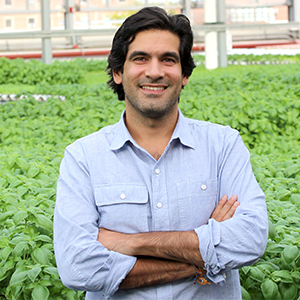
[00:00:10] Ray Latif: Hello, and thanks for tuning in to Taste Radio, the number one podcast for the food and beverage industry. I'm editor and producer Ray Latif, and you're listening to episode 201, which features an interview with Viraj Puri, the co-founder and CEO of Gotham Greens, a pioneering company in the business of indoor greenhouse agriculture and a fast-growing fresh produce and food brand. Just a reminder, if you like what you hear on Taste Radio, please share the podcast with friends and colleagues. And of course, we'd love it if you could review us on the Apple Podcasts app or your listening platform of choice. In the Uber on my way to the Whole Foods Market in Gowanus, Brooklyn, I tried to visualize the greenhouse farm that sat on the roof of the building. I thought I had a good sense of what it would look like, but like most things, there's nothing like seeing it in person. You can't help but to stare at the sea of lush, leafy greens, organized by rows of butterhead lettuce, arugula, and Thai basil among other plants. It's the second greenhouse built by Gotham Greens, which has been building and operating similar facilities since 2009. Self-described as a fresh food company farming with the future in mind, Gotham Greens has eight greenhouse facilities with a combined 600,000 square feet of growing space in five states and distributes its produce, along with pestos and dressings, to over 30 states. In the following interview, I spoke with Gotham Greens's co-founder and CEO, Viraj Puri, about the company's genesis, ambitious mission, and multifaceted business model, and his perspective on how to leverage technology and human resources most effectively. He also discusses the evolution of the Gotham Greens's brand, including its product and innovation strategy, best practices for working with local governments and leaders, and what's next for the future of the company. Hey folks, it's Ray with Taste Radio. I'm here in Brooklyn at the home, the headquarters, the initial Gotham Greens that's on top of a Whole Foods here in Brooklyn. And I'm with the co-founder and CEO of the company, Viraj Puri. Viraj, thank you so much for having me here.
[00:02:11] Viraj Puri: Great to have you, Ray. Welcome.
[00:02:13] Ray Latif: This is perhaps the most remarkable place I've ever recorded an interview.
[00:02:18] Viraj Puri: That's awesome.
[00:02:18] Ray Latif: We're in a small conference room looking out at your just beautiful greenhouse that is a mix of just luscious greens and bright lights because it's a dreary day here in New York. Such a remarkable place and I can't wait to get into it. Tell me a little bit about yourself because you weren't always in this business. You weren't always in the business of CPG or greenhouse farming. How'd you get into this?
[00:02:49] Viraj Puri: I certainly wasn't, Ray. I don't come from a food background or a CPG background, and neither do I come from a farming background. spent the early part of my career working broadly, I guess you can say, in clean tech. I spent some time working at a few engineering firms, working on green building design, renewable energy, sustainable agriculture. And I spent a couple of years overseas in Malawi, in East Africa, and the northern part of India in a region called Ladakh, also working on small-scale renewable energy and sustainability projects. And over the course of my travels and while working at an engineering firm, I had some exposure to climate-controlled greenhouses. And my interest was piqued. And it turned into a fascination and an obsession. And I just became absolutely enamored with how this amazing technology could grow such high-quality produce using so few resources. All that put together, I wrote a business plan with some partners back in 2008 And here we are 10 or 12 years later with over 300 employees and nine greenhouses across the US. So it's been really fun. Amazing stuff. I'm curious about your business plan.
[00:04:04] Ray Latif: How long was it?
[00:04:06] Viraj Puri: Good question. It was probably a good 10 or 15 pages. That's shorter than I would think, actually. It was a really interesting confluence of events. So I started to explore the whole produce supply chain, like I said, in the mid-2000s, mid-aughts. just realized what an enormous impact agriculture has on natural resources. It's the largest consumer of land on the planet. It's the largest consumer of fresh water. It's responsible for about 25% of global carbon emissions. It's the leading source of global water pollution. And at the same time, I started to really recognize all these shifting consumer trends toward wanting to eat more regionally, wanting to eat more locally, wanting to eat more sustainably. The whole farm to table, farm to fork movement was really gaining steam and popularity. And you were seeing this manifested in the popularity of farmers markets and all the rest of it. And you were seeing, like, just as a consumer of food and beverage, we started to notice all the disruption happening in the grocery store aisles across every different category. And because we had this exposure to hydroponic greenhouses, sort of the light bulb moment was why not build these greenhouses in closer proximity to large population centers and deliver this local sustainably grown fresh produce year round. So that was really the idea of the business. And then there was one really cool story, which was sort of a catalytic moment for the whole thing. Some beer and wine was definitely involved. But my partners and I were at an Italian restaurant not far from here in Brooklyn. And we got sort of talking to the servers. It was our own sort of Portlandia moment for any fans of the show. And we started talking about where the produce was coming from and the food was coming from and the mozzarella and all the rest of it. And we learned at that dinner that the basil that we were consuming at that meal was actually being grown in Israel and then being flown to the United States. And we were like, bam, that's it. That's crazy. There shouldn't be that much transportation, refrigerated planes involved with this delicate little herb. There's no reason why we can't be growing this right here in New York City. And that sort of led to the whole business plan, which took us a couple of years to draft. And we won a business plan competition and went around to friends and family. And we won a grant, which was really, really huge, gave us a lot of momentum, and built our first prototype greenhouse in the Greenpoint neighborhood of Brooklyn, which isn't too far away from here, that was actually our first greenhouse. And that was in 2011. And that's when we started packing and shipping fresh produce to supermarkets and restaurants across Brooklyn and Manhattan. And like I said earlier, fast forward eight, nine years later, we're in thousands of supermarkets across the country now. So it's been really fun.
[00:06:48] Ray Latif: My colleague, BevNET CMO Mike Schneider, and a Taste Radio host as well, he would refer to your idea as a BHAG, a Big Hairy Audacious Goal. And I'm always wondering about these BHAG ideas, when you put them on paper, who are you talking to? Are you talking to investors? Are you talking to yourself? Are you talking to retail? Who is the business plan for?
[00:07:09] Viraj Puri: That's a great question. We were really driven by this motivation and desire to solve a problem and provide a service to the environment and to the planet and to consumers. So I think a lot of our initial business plan was talking about the problem and talking about how we could address a solution. I think we really started off by in a very sort of altruistic way. And I think if you were to go back and read that business plan, it would really come across as very mission-driven. Like, we are facing a crisis of agriculture. We need different methodologies, systems, supply chains, ways of thinking. And our plan, our proposed solution, was one such idea that could contribute to a more sustainable and robust food system. And of course, because the business plan also has to have the P&L and the X's and O's and the return on investment, given how capital intensive this business was and continues to be, We had to also speak to that investor community, but we wanted to reach out to investors who would not just see this as a financial return, but would also see it as a sustainable business with sort of environmental and social impact.
[00:08:19] Ray Latif: Has that mission evolved? Is it static or is it always evolving?
[00:08:23] Viraj Puri: It's always evolving. I think given the commercial success that we've had, we've obviously had to really run this like a real business. I think in the beginning it was a... I hear that a lot from entrepreneurs.
[00:08:33] Ray Latif: I need to run this like a real business.
[00:08:36] Viraj Puri: In the beginning it was a science project, right? I mean, no one, to the best of our knowledge, had really attempted to do commercial scale greenhouse farming in New York City, at least at the scale that we were proposing to do it. The architecture, the engineering to just build a greenhouse like this, like the one we're sitting in or the others we have in New York and other cities, didn't have a lot of precedent. So whether it's the regulatory framework, like how to get zoning approval, or permits, or finding out insurance, and how you're going to get employees, and raw materials, and all that was very, very challenging. But yeah, I think the mission is still altruistic. But we've had to become more sophisticated in how we raise capital, and how we sell and market our products, how we distribute operations, food safety. So it's really grown from just kind of a fun science project that we thought may even be a one-off. into now what we see, you know, as a real value added sort of commercial scale supplier of fresh produce.
[00:09:35] Ray Latif: There's a lot of different ways you could describe the company beyond just being a supplier of fresh produce. I mean, you've said that it's a real estate company or a state development company, excuse me, a construction company. It's also a brand. In some ways it reminds me of a nonprofit. How would you describe Gotham Greens?
[00:09:50] Viraj Puri: Yeah, that's a really good question. I probably have described it as all those things. In any given day, I'm probably wearing all those different hats, but I would say we're a pioneering indoor agriculture company and sort of a fresh food company, really on this mission to transform how and where fresh produce is grown.
[00:10:31] Gotham Greens: Tune in at the end of this episode for an exclusive interview with Matt Lin of Belay Solutions. He sits down with Melissa Traverse to break down the biggest inventory and accounting mistakes CPG founders often make. You'll learn how to bring clarity to your numbers so you can scale with confidence.
[00:10:48] Ray Latif: Are you a tech company?
[00:10:51] Viraj Puri: Well, who isn't a tech company these days? We use a lot of technology, there's no doubt. I was in a tech meeting right before this on using a lot of We collect a lot of data, right? So we were looking at new dashboards that are collecting just hundreds of thousands of data points every day and synthesizing that data so that our team, both humans and from an AI perspective, can make well-informed decisions. So literally I was coming out of that meeting, so I think that's illustrative of the fact that how much we're reliant on technology, but even our production system is very technology reliant. This is a very sophisticated form of farming. Like these greenhouses have sensors located all over where we're tracking temperature, humidity, light level, CO2, oxygen, you know, dozens of variables. And then all that information is fed to a computer control system that we program using algorithms to sort of turn equipment on and off to achieve the desired conditions we want in the greenhouses. And there's just a lot of bells and whistles to optimize plant growth and yield and flavor and efficiency. But the technology is really a tool. I think growing is really half science and half art. We are dealing with biological products. We firmly believe that there's a very large human component to growing high quality produce. And there needs to be some love in it too. It's, uh, plants are not widgets, as we like to say. So the technology is really a tool. So I think we definitely position ourselves and like to think of ourselves more as, um, a fresh food company than a tech company.
[00:12:33] Ray Latif: I was going to ask if technology is your strongest asset, but it doesn't sound like it is, or it doesn't sound like it's your most important asset.
[00:12:39] Viraj Puri: Look, it's an incredibly important asset, but I would say our people are a larger asset because you can buy very expensive technology, very sophisticated technology, but you still need people to optimize it and run it well, especially when you're dealing with farming and a biological product. So I would say technology is vitally important to our day-to-day operations and to our success and as a part of our strategy going forward, but I wouldn't say it's the most important thing.
[00:13:05] Ray Latif: Do you have to teach your workforce, your employees to think conceptually? Because what might be in your head and your co-founder's heads about where the company is going, what it is, is not necessarily what they're doing on the day-to-day level. Does everyone have to be on the same page about what the overarching mission is? Or is it more important to focus on what they're doing at a given moment on a given day?
[00:13:25] Viraj Puri: I think they're complementary. I don't think they're mutually exclusive. I think increasingly as we're becoming a larger company, we're becoming more specialized. So there's growing, there's operations, there's food safety, there's sales, there's marketing, there's finance, you know, et cetera. So, and our headcount is now well over 300. So as we expand it's, harder for everyone to sort of be doing the exact same thing or in the same room. But in order to address that, we just believe in a lot of communication to ensure everyone is on the same page. So whether it's our company mission, whether it's weekly meetings, monthly meetings, other meetings at certain different frequencies and cadence to ensure that regardless of the department that an individual is working in, they are tied to the mission of Gotham Greens and where we're going and our rapid evolution. We've had to do that out of necessity because we're increasingly a decentralized company. That workforce of 300 is divided across New York, Rhode Island, Illinois, Maryland, and Colorado, all the states in which we own and operate greenhouses. So we use a lot of technology, video conferencing, you know, other things like that. But it's a good question. It's as much as we're growing plants, I think we're also sort of cultivating people. And that's been something that's been a huge learning experience of really how to grow a team and a company and a workforce. So Slack, good thing or bad thing? So I don't personally use it. I'm a little old school that way. I'm like a cell phone, text message, email guy. But yes, instant messaging is used a lot in our company.
[00:15:09] Ray Latif: It's used a lot in every company. Again, every company is a tech company to a certain extent, right? What you're doing here is hydroponics, right?
[00:15:16] Viraj Puri: Correct.
[00:15:17] Ray Latif: And hydroponics is, for folks who are not familiar with the concept?
[00:15:20] Viraj Puri: Yeah, hydroponics is a really interesting form of farming that is also known as soilless cultivation. So there's no soil being used in these greenhouses. We dissolve nutrients into irrigation water and then that irrigation water provides the required nutrition and oxygen and of course water that the plants need to grow. So it's literally a Greek word that means water working. The technique is practiced in many parts of the world. It sort of dates back to the hanging gardens of Babylon. But, you know, sort of in more contemporary times, it's this very kind of robust, commercially proven form of farming that's, like I said, practiced in many countries around the world and makes up a very large part of modern agriculture for certain types of crops. So, you know, plants don't need soil to grow per se. They need sunlight, water, nutrients, oxygen, CO2. And we're able to deliver all of that to the plant in a very kind of carefully recipe precision sort of driven way. And that allows us to get very high yields, very high productivity, and a lot of consistency, which makes us... a real value add on the supply chain side. So in other words, if a customer wants 100 cases of romaine lettuce every Tuesday, 52 weeks of the year, we're well positioned to do that given how much control we have over the growing process and over the climate. So that's sort of what hydroponics can achieve in a nutshell. And your process is proprietary, correct? Much of it is, yeah. I mean, like I said, hydroponics has been around for a long time. We didn't invent hydroponics, nor did we invent greenhouses, which are these climate control boxes. But all of our nutrient recipes are proprietary, our climate recipes, many of our seed cultivars, and all of sort of the operational intellectual property allows us to sort of do what we do.
[00:17:10] Ray Latif: Now what you're doing obviously is not going to replace traditional farming methods. Certainly not. It's a tiny, tiny piece. Even if that, it's a micro, micro piece of the entire business of farming greens. However, have you thought about ways to enhance traditional farming methods using the proprietary process that you've created? Are there some synergies there?
[00:17:31] Viraj Puri: There's definitely tie-ins, and I think at an academic and at a research and development level, the indoor farming community is working very closely with the outdoor farming community. Many of the principles are the same when it comes to breeding seeds, when it comes to pest management, when it comes to using resources more efficiently. So there are certainly a lot of tie-ins. To your earlier point, I mean, we certainly don't have any hubris that our form of farming greens is by any stretch of imagination, sort of the future of agriculture, or it's going to sort of solve all of our agricultural issues. It's not a panacea. What we're looking at could probably feed, what, a thousand people in the area or something like that. Something like that. Something like that. But you know, just even leafy greens alone are a, like $14 billion market in North America, and less than 1% currently is sort of grown in protected culture indoors. And leafy greens use a lot of water, five or 10 gallons of water for a head of lettuce, typically grown in a couple of counties in California and Arizona that are going through persistent drought and have been, and increasingly are oppressed for farm workers and long distance transportation, food safety issues. So by growing, you know, a head of lettuce right here in Brooklyn or in Chicago or in Baltimore and Providence, you know, using less than a gallon of water and only having to ship it a few miles and having much better food safety standards, I think... certainly can contribute to that sort of category of produce. And I think on balance, it sort of provides a really positive way to produce this, you know, high value, highly perishable type of crop. I mean, you know, with that basil example, yeah, I'm pretty confident not a lot of basil is being consumed in New York City anymore that's being, you know, flown in from Israel. And we're proud of that. And no offense to farmers and greenhouse farmers in Israel, but we can do it here locally.
[00:19:27] Ray Latif: For sure. I mean, that hyper-local model is something that I think some people, they love that idea that a community can be self-sufficient in a lot of ways, grow their own food, their own ingredients. Do you see that as a realistic opportunity for communities in America where most of what you consume is grown locally? Much of what you drink is produced locally?
[00:19:57] Viraj Puri: I don't know how practical that is, but I think that sort of misses the point a little bit. What I like about the hyperlocal movement is that it really brings awareness and gets people thinking about how and where their fresh food and beverages, like you said, are produced and consumed. we evolved into a very industrialized, centralized type of food production system and people were increasingly detached from how food was made, whether it's protein, vegetables, things. And I feel like we're going through a real renaissance and a revolution where people are increasingly interested in how food is being consumed and what they're putting in their own bodies and feeding their families. And so even if, Consumers are more conscious of how their food is produced and where it's being produced, I think, is a net positive. And if they can support local economies and enjoy food that's grown closer to home, I think that's great. But it's not just about it being local. It's like, what does that really stand for, right? It can stand for healthy economies, like spending your dollars closer to home and supporting your communities from an economic development standpoint. It can mean supporting biodiversity and environmental health. you know, it's what it sort of represents as opposed to just a label of being local, right? And I think it just brings people together around food in a more informed way, which I think is hugely positive. So in other words, I don't know how realistic it is that a given person's diet can, you know, 100% be locally sourced. But I think if a lot of it can be locally sourced, especially in certain seasons, but then the bulk of it is sort of maybe regionally sourced, and then the balance is sort of consumed in say moderation, and they're adults and kids alike are now a little bit more connected to how food is grown and the impact that it has, gets them to try new ingredients, try things they've never maybe had before just because they're more exposed to food, I think is really positive. Like if you can just even go to your neighborhood farm stand, you can just learn how food is produced. It doesn't mean that you have to, every single tomato you eat is grown locally, but maybe it'll inspire one to eat more tomatoes and use tomatoes in different dishes and learn more about the environment and learn more about healthy eating or science or, system. So on balance, I think local food and what local food stands for is very powerful.
[00:22:25] Ray Latif: Well, for people to understand it's even local, they'd have to know it's the Gotham Greens brand. Not all of your products are branded though. So, you know, what's the process for getting people to understand that Gotham Greens represents a hyper-local farming model?
[00:22:43] Viraj Puri: A lot of it is how we sort of communicate to the end customer. So many of our chef partners who buy and enjoy our products will tell the story either on menu, where potentially the salad is called out as a Gotham Greens lettuce salad, or in other cases, if it's maybe not on the menu, there's chalkboards up in the restaurant that talk about local purveyors and farmers and other suppliers, it's just relationships that our folks have, our marketing and sales people have with those chefs and intermediaries and food distributors and things like that where they can tell the story, which I think is powerful. And then it really ties back to our retail brand, which is branded. And we also have a line of salad dressings and pestos and other sauces and things like that. So we really try to drive people to our website or on social media where they can learn more about what we do. And on the retail packs, at least we try to tell that story as well.
[00:23:38] Ray Latif: Let's talk about your product strategy, because again, what I'm looking at is just a sea of green. And as much as I might want a raspberry, it doesn't seem like raspberries are in your future. So how do you think about expanding your product line? How do you think about your innovation strategy?
[00:23:53] Viraj Puri: Yeah, it's a great question. We grow primarily leafy greens, as you noted, but dozens and dozens of different varieties of leafy greens. So we have a lot of your standard lettuces, like green leaf lettuce and red leaf lettuce. Butter lettuce is big for us. Romaine, we have these different blends. Some of the Asian greens like bok choy, Thai basil, arugula, kale. So there's a whole diversity of greens that we grow. And our company, we actually used to grow tomatoes in this greenhouse. hydroponics and commercial scale greenhouses are generally well suited on a commercial scale, like sort of from a profit generating ability sense, generally best suited to either leafy crops, like all the ones I mentioned, or crops that grow on a vine. So that would be things like tomatoes, cucumbers, peppers, eggplants, squash, and certain berries. And those are the ones where it really kind of makes sense to grow in a greenhouse where you can actually get these yield efficiencies that are exponentially higher than sort of conventional farming, right? It wouldn't be practical to grow like root vegetables or tropical fruits or grains, things like rice or weed or barley or anything like that in a greenhouse. We kind of want to stay in our lane, right? Like, I think we are adding a lot of value for what we do. We pass on a lot of shelf life and freshness and quality for this highly perishable type of item, which often doesn't last a long time in people's fridges, especially if it has to crisscross the country or the world and spend a week in transport. While other things like grains or root vegetables or other types of fruits, they can be stored for longer periods of time. They can be shipped dry. They don't necessarily have to be shipped or stored refrigerated. So we really kind of want to focus on things that work well for us. That being said, we started to have some fun making some pestos with some of the basil that we grow, like one of the best. bits of feedback that we would get from our fans and customers on social media or otherwise was how much of our basil they buy and they make this amazing pesto out of it. And people would share their pesto recipes. And so, we kind of played around with our own recipe and did potlucks at work and did contests. And finally, someone was like, this is so good. We got to start selling it. You know, it's made with our fresh basil that we harvest every day. And so we launched that just kind of like as a fun side project. And that's kind of emerged as now like a really, really great pesto. And then we launched a vegan version of it and a spicy version of it and then the chimichurri version of it. And then a couple of years later, we were thinking, you know, people like love our lettuce. You know, what do you put on lettuce? Well, you put salad dressing on lettuce. So let's kind of play around with that. So then those have been formulated using ingredients that we grow in our greenhouses as well. So it's just sort of evolved from there. There's a lot of throwing darts at the dartboard. We just have fun with things, things that seem like a good idea. We have a very collaborative and creative office. So when cool ideas come up, we're like, yeah, let's run with it. See what happens.
[00:26:45] Ray Latif: I assume that the dartboard is at the end of a very narrow hallway.
[00:26:49] SPEAKER_??: Yes.
[00:26:51] Gotham Greens: Do you want more repeat buyers on Amazon? Well, this free resource in collaboration with Straight Up Growth will help your brand turn first-time buyers into long-term subscribers. Download Winning the Repeat Purchase Game on Amazon now at Taste Radio slash SUG. That's Taste Radio slash S-U-G to start building retention-driven growth for your brand on Amazon. Scaling a beverage brand into major retail comes down to operational readiness. From packaging lead times to co-manufacturing strategy, the details can make or break a launch. In a new e-book in collaboration with Octopi and Asahi Beer USA, industry leaders share what they've learned in helping brands scale. Download it now at Taste Radio slash octopi. Do you need to scale your team faster without compromising on talent? Join Oceans for a live webinar on April 20th and learn how leading companies are hiring top global professionals who are ready to grow with your business. Register for the webinar now at Taste Radio slash oceans. That's Taste Radio slash oceans.
[00:28:02] Ray Latif: I don't, you touched on this, I'm not sure if I misunderstood, but the products that you make are primarily consumed where they're grown. You're not shipping a lot of product across the country, right? Especially your fresh produce.
[00:28:17] Viraj Puri: Yeah, that's exactly right. Like our distribution model is all regional. Our New York greenhouses, for instance, supply sort of New York, New Jersey, Connecticut, so probably like 100-mile radius. Our greenhouse in Providence, Rhode Island serves as New England, so Massachusetts to Maine. Our greenhouse in Baltimore serves the Mid-Atlantic region and some of the Southeast states. Our greenhouses in Chicago service about eight or nine Midwestern states. And then the one in Denver does sort of Colorado and a couple surrounding states. So it's really like a regional distribution play. The vast majority of it is really hyperlocal, probably within 20 or 30 miles of like a major city, like Baltimore, D.C. or Boston, Providence, you know, New York, Denver, Chicago. But then, you know, some of it goes to surrounding states as well.
[00:29:05] Ray Latif: The regions that you mentioned, particularly certain parts of those regions, are highly affluent and affluent individuals, let's face it, often reach for the organic product on shelf. Surprisingly, your products aren't organic. How is that possible?
[00:29:22] Viraj Puri: That's a good question. So technically, we were talking about hydroponics earlier, and you know, when the USDA set up its organic seal and standard in the 1970s, it was really intended to be a soil preservation and conservation program, because so many farmers were alarmed with the overuse of fertilizer, the overuse of pesticides and the adverse impact that it was having on soil health and soil quality as well as groundwater supplies. So the whole program was really intended to be better stewards of the soil. Hydroponics interestingly doesn't even use soil. So who's a better steward than the soil than a hydroponic grower? Technically nobody, because we're letting soil stay and capture carbon and do what it needs to do and help with biodiversity. So we're essentially not taking any... farmland, we're basically taking non-arable land in cities, concrete jungles, rooftops, parking lots, you know, other types of sites and turning it into green productive space. But so getting hydroponics certification under the USDA organic program, it's a little bit challenging. It's a bit of an oxymoron. There's kind of a way to do it, but we're proud to talk about what hydroponics is, what hydroponics does. Our products are pesticide free. They're grown using less water, less energy with very strong farm worker welfare. So those are the stories that we like to tell. A lot of consumers are very familiar with the organic sort of badge, but increasingly they're becoming aware of indoor farming and hydroponics and things like that. And in many ways, organic is the gold standard, but it doesn't capture a lot of the other key performance indicators and variables that we think are really important, like energy use and water use and worker welfare, etc.
[00:31:08] Ray Latif: But you are non-GMO project verified, right? That's right, yeah.
[00:31:11] Viraj Puri: All of our seeds are non-GMO. And there aren't a lot of GMO lettuces out there, so most lettuce growers are non-GMO, but yes, we are verified and pesticide free and use 100% renewable electricity and recycle 100% of our irrigation water and a lot of these other kind of attributes that are important to customers today.
[00:31:30] Ray Latif: There are a lot of different attributes. What are the most important ones, say the top three to your customers and how do you deliver, how do you communicate those attributes in a way that gets them to spread the word about Gotham Greens?
[00:31:42] Viraj Puri: Yeah, I think, I think it's just the freshness, you know, that strikes everybody is just how fresh this lettuce is and these herbs are. I think a lot of people are probably familiar with buying a boxed lettuce or a bag lettuce and realizing, you know, a day later or two days later, it's sort of wilting in the container, in the bag, in the back of their fridge. And sometimes pretty filthy. Filthy, slimy, all the rest of it. And then people try our product and they're just struck by how vibrant it is, how fresh it is, how crispy and crunchy it is, and how long it lasts. And anecdotally, we hear stuff like, I bought your stuff and I made a small salad and I left it in my fridge and I went on vacation and I came back 10 days later and guess what? The lettuce was still crisp, right? And they're like, how could this ever happen? And then they buy it for life, right? And you know, a lot of that is because we're literally harvesting it and shipping it the same day. as opposed to product that might be coming from the West Coast or overseas, which could be a week old by the time it hits a supermarket shelf or your fridge. So I think like freshness, how long lasting it is, are the primary attributes that people are really struck by. I would say number two is you know, that it's pesticide free and it's got all these sort of sustainability attributes to it and, you know, sort of locally produced. And the third one I think ties back to the first one and the freshness and the long lasting is just the quality. You know, a lot of people view lettuce as just lettuce, but there's actually a lot of precision that goes into growing these plants and the care that our growers take to ensure that it's the right balance of sweetness and bitterness and it's the right texture and it's going to hold dressing well. And, the leaves are going to be completely unblemished and the perfect color, which indicates no nutrient deficiency or no pest pressure. And then that freshness and flavor really comes across. So I would say it's really quality, the freshness, how long lasting it is. And then just with our brand and our label and our packaging, we just want to show like, we want to communicate all of that through that. And I think people like to support products that speak to them.
[00:33:37] Ray Latif: This is going to sound like a stupid question. It probably is one, but I'll ask it anyway. Do you have to wash your product?
[00:33:43] Viraj Puri: You don't. It goes through very, very rigorous food safety standards and testing and environmental controls. And because it's grown in this indoor environment and it's in a soilless sort of situation, the product is unwashed and can be enjoyed that way. This is great. So when I take a tour of the greenhouse...
[00:33:59] Ray Latif: I might just start picking this. I'm not going to do that, Jody. Don't worry.
[00:34:03] Viraj Puri: And what's actually kind of ironic is, is that, you know, a lot of these food safety, not all, but some of these food safety outbreaks and scares and recalls that we've had are with, you know, various bacteria, viruses, you know, whether it's things like E. coli, salmonella. And ironically, not that you have, but no, no, no, no. I mean like just the category. Right. that have just faced the country, ironically comes from the washing of vegetables and greens. Because a lot of these things actually are bred in the water, the water that's used to wash the products. And then chlorine is added to water, the washing water, to ensure that these diseases are not bred. And then all that water and the chlorine and everything that it goes through actually also reduces the shelf life and, you know, allows some of those leaves from conventional farms to be sort of slimy in that bag sitting at the back of your fridge. So actually not washing it preserves flavor, preserves nutrition and shelf life. Well, you sold me for ice, so. Well, the proof is in the pudding. Once we go in the greenhouse, you can taste it for yourself.
[00:35:03] Ray Latif: Fair enough. You have how many facilities now? How many greenhouses?
[00:35:08] Viraj Puri: We have eight, eight that are operational. So three in New York, two in Chicago, one in Rhode Island and Providence, one in Baltimore and Providence in Denver.
[00:35:18] Ray Latif: I'm excited to visit the one in Providence, about 45 minutes away from where we live. It's interesting because I asked you prior to us getting on the mics, you know, if you're thinking about Boston or, you know, if Boston might be a viable market. Very expensive to open anything in Boston. Working with the local government can sometimes be... challenging because there are so many regulations around food production and it's opening any business. But it sounds like you've had good relationships with local municipalities. You know, for entrepreneurs who are listening, who are thinking about opening production facilities, you know, what's your advice for best practices for working with these local governments, these cities?
[00:35:55] Viraj Puri: Yeah, my advice would be go out there and meet them, meet the elected officials, meet the bureaucrats and technocrats who, you know, the civil servants and who are interested in economic development, job creation, attracting industry, and talk to them about what programs they might have. Are they looking to attract food businesses? Are they interested in this type of investment? I think you will find reciprocity. I think people will be really interested in what you're trying to do. And we were talking about Providence. I think that's a great example. We met with the governor of Rhode Island. We met with the mayor of Providence. They were both equally supportive of what we were proposing to do. And they deployed some resources, whether it's folks who worked in the economic development division and things like that or the real estate division and helped us secure a site and helped with the permitting process and the approvals. Being a part of the community, I think, goes a long way. And I think being responsible and engaged corporate citizens goes a long way in building up your company, your brand, attracting and retaining a workforce, and ultimately, hopefully, translates to just a more robust sort of society.
[00:37:06] Ray Latif: Is it just as easy as picking up the phone and getting a meeting with some of these folks? Or do you have a lobbying group that you work with? What's the process of getting a meeting with the governor, per se?
[00:37:16] Viraj Puri: Yeah, for us, it's a lot of direct outreach. No lobbyists for us, but not all of them are going to be responsive, right? Providence is a great example of where it's a great city. It's sort of a little bit in the shadow of Boston, perhaps, right? It's sort of between New York and Boston. It's not a major city, but it's only 45 minutes from Boston, a couple hours away from New York. It's got world-class universities, and it's just got a really interesting community of people who care a lot about their civic pride. we just found a little bit more traction in that state. And those elected officials were really, really, really supportive. So not to say they weren't in Massachusetts necessarily, but I think in some cases, if you just reach out, they're going to be responsive. And in some cases, they won't be. But you won't know unless you try. Well said.
[00:38:05] Ray Latif: We're on the roof of the Whole Foods here in Gowanus, correct?
[00:38:08] Viraj Puri: Yeah, that's right. This is actually the second greenhouse that we built. We completed this in 2013, late 2013, early 2014. And Whole Foods Market had been a customer of ours for a couple of years prior to that, stocking our lettuces and herbs in many of the New York supermarkets and New Jersey supermarkets. And we were always just kind of chatting with them about how we could promote the partnership even more. They mentioned to us that they were building this new flagship store in Brooklyn, and they were looking to really integrate a lot of sustainability and green features into the store. They were intrigued by some on-site farming. So we sort of got together and started talking about doing a rooftop greenhouse. And one thing led to another. So yeah, we are on the second floor slash roof of the Whole Foods I'm sorry, the Whole Foods store in Gowanus, Brooklyn. And Gotham Greens owns and operates a 20,000 square foot state-of-the-art greenhouse on the roof of that store, which shares some space with the rooftop cafe and sort of gastropub and a lot of the consumers, shoppers in the store. can come upstairs to the cafeteria or get a meal at the roof bar and look into the greenhouse through the glass windows and see sort of fresh produce being grown here that's harvested virtually every day of the year and then brought down in an elevator and put right into the produce section. And then the balance of the products that are grown in this greenhouse go to other Whole Foods in New York City as well as neighborhood restaurants. So this is just a great, this is one of our smaller greenhouses in our portfolio. It's about 20,000 square feet, but it still packs a punch. I mean, we produce yields here that would be equivalent to about a 10 or 15 acre conventional farm. So we're still packing, you know, thousands and thousands of boxes of lettuce every day. And so it is a workhorse for us. But it really also serves as a showcase for us to tell our story about local farming, urban farming. And it's so interesting sometimes when we could be in the dead of winter, could be snowing outside, and a customer is in the produce section buying our product and, you know, it's kind of puts two and two together. It'd be like, wow, this has actually been growing right upstairs. And I think people are in such a hurry in the supermarket and busy with their lives that they may not think about these things a lot. But when you can actually see the farm at the point of purchase, I think it's a really compelling visual and really underscores our entire business model.
[00:40:29] Ray Latif: It is absolutely amazing. It not only sounds like it's pretty clear you have a great relationship with Whole Foods. What happens when Target comes calling, when Costco comes calling, and they're asking for products that are grown on the top of a Whole Foods in Gowanus, Brooklyn?
[00:40:44] Viraj Puri: Yeah, so we sell to Target, you know, not out of this greenhouse, but this is a small greenhouse, right? So there's, this is all for Whole Foods, but it's a small one, but look, we have half a million square feet of greenhouse across the country. So we're able to service other retailers from our other greenhouses, but we enjoy a really unique and special relationship with Whole Foods. We're very values driven, very aligned, and we do a lot of great things together from a marketing standpoint. And I think together we've really helped you know, in a small way, popularize this whole category of indoor grown product and greenhouse grown product. You know, they were way ahead of the curve, you know, 10 years ago when they started stocking our products or, you know, seven years ago when they were like, we'll let you build one of these on the roof of our store, you know, because they saw the value proposition and, and of indoor grown product and, and the role that it can play. in fresh produce supply chains. So yeah, like I said, it's not exclusive to Whole Foods. We sell to hundreds of retailers, but Whole Foods is a great partner for sure. Do you do any direct-to-consumer? We don't currently do any direct-to-consumer. We do work with some online grocers, but we don't do direct-to-consumer.
[00:41:58] Ray Latif: If there's a retail channel that you're not currently in that you're looking to go into, and I'll just throw out convenience because it really doesn't seem like the right fit for Gotham Greens, but do you see that as a viable proposition? Do you see that as having potential for the brand down the line?
[00:42:13] Viraj Puri: Absolutely. I think especially as diets are changing, consumer preferences are changing, especially toward more fresh food, more plant-based food, I think you're going to start to see more fresh offerings in convenience stores. And I think when that happens, yeah, I think we'll be there.
[00:42:29] Ray Latif: Would you have to change your product strategy? Would you have to?
[00:42:31] Viraj Puri: Perhaps, perhaps. Yeah, I think it would have to really suit that format. Types of sort of offerings that people want in a convenience store, you know, whether it's convenient or fast or what it might be. So I think it would probably require a little bit of innovation and evolution, but we don't think that's far away.
[00:42:48] Ray Latif: We've covered quite a bit, Raj, and I really appreciate you taking the time. You've already accomplished quite a bit in a short amount of time. What's next? What's on the plate for, say, the next 10 years of Gotham Greens?
[00:43:01] Viraj Puri: Oh, I appreciate that. The mantras keep growing, literally and figuratively keep growing. We are really proud of the impact that we're making, growing more fresh produce, using fewer resources, and getting people to want to eat more plants, and employing people, and playing a positive role in economic development in many cities across America. And we want to keep doing that. I think we've barely scratched the surface. We only have greenhouses in five cities, though we have distribution to about 30 states. There's a lot more we can do. I think we're still a drop in the bucket in terms of the overall addressable market for leafy greens in North America. Like I said, it's like a $14 billion market. And we want to continue making a positive impact. We want to grow in a very sustainable way. We still view ourselves as a startup, but we've been around for 10 years. And I think that goes to show that we've taken a very measured, patient, sort of step-by-step growth strategy. We don't want to grow too fast where we can't maintain our sort of product quality and integrity, food safety, which is so important to us. But now we're reaching this inflection point where we are now becoming a much more national brand, which is super exciting. So I think you're going to start to see our products in more and more states, and we're going to build more and more greenhouses. So we're really excited for the years to come.
[00:44:18] Ray Latif: I'm really excited for the years to come as well. Viraj, this has been a fantastic interview. I really, really appreciate the time. Can't wait to walk into this greenhouse. I can smell it and I can see it. I just need to get in there. Thank you so much again and I hope to catch up again really soon.
[00:44:32] Viraj Puri: Absolutely. Thanks for coming. It's been really fun. Indeed.
[00:44:38] Ray Latif: That brings us to the end of episode 201. Thank you so much for listening and thanks to our guest, Viraj Puri. You can catch both Taste Radio and Taste Radio Insider on Taste Radio, the Apple Podcasts app, Stitcher, Google Play, or Spotify. As always, for questions, comments, ideas for future podcasts, please send us an email to askattasteradio.com. On behalf of the entire Taste Radio team, thank you for listening, and we'll talk to you next time.
[00:45:13] New York: Hello, I am Melissa Traverse here for the Taste Radio podcast, talking about some of the biggest tension points that CPG brands and founders face when they're scaling a brand, and those are financial accounting and inventory management. I am joined by Matt Lynn, inventory accounting guru from Belay Solutions, and he is going to shed some light on all of this that is going to help everybody out quite a bit. Matt, thank you so much for joining us today.
[00:45:44] Taste Radio: Thank you for having us, Melissa. It's great to be out here at Expo West and it's great to sit down and be able to chat this because it's kind of a passion project of ours, working mainly with CPG brands and hoping to help them scale.
[00:45:55] New York: It's been such a pleasure chatting with you and the team and learning all about what you do over there at Belay Solutions. Can you tell us a little bit about yourself and what your role is and the kinds of solutions that Belay gives to CPG brands and founders?
[00:46:11] Taste Radio: Yeah, absolutely. My role with Belay, I'm actually our inventory accounting manager. I run our inventory department. So we work with CPG brands, taking them from spreadsheets, putting them on inventory management systems, and really helping connect their tech stack between their sales, online marketplaces to that inventory management system, even down to their financial systems like QuickBooks. Belay overall is kind of an outsourced accounting firm. And with that, we're helping teams. We have different levels with bookkeeping, controller level work, even high level into CFO type items. So we really help those brands in any way that they need financially. And then I just have a subset of a department where we're really just laser focused on inventory.
[00:46:54] New York: It's certainly a complex topic and there are plenty of places to go wrong. Let's start by going right and start super simple. Can you tell us what some of the biggest red flags are that would help a founder understand or, you know, the person running a brand understand that it really is time to get some help with some of these areas?
[00:47:14] Taste Radio: 3 3 3 3 They have a lot of transactions that don't get coded or they just put them into placeholders to just get rid of it so it's not an eyesore. They'll notice they have revenue but no cash or they notice that they have a good amount of cash but their blind spot is really seeing the vendor invoices that are sitting there just needing to be paid and so they just lack that clarity that's going to really be around the corner.
[00:47:51] New York: You know, you were talking about one of the red flags that comes up that I think makes so much sense. When somebody asks you what your numbers are and you can't come up with the right number, that's a big problem because that's something that you really should be able to share with decision makers who you're ideally looking to do business with. What should you be able to call up at a moment's notice?
[00:48:16] Taste Radio: really at any time, you should be able to know an accurate margin. It's amazing how many founders we end up talking to that they can tell you their revenue numbers, they can tell you their selling price, and then the minute you start talking about cost or their cost of goods sold, they just get a deer in headlights look. So really, it's very hard to tell, am I even making money? Or if you don't know your entire landed cost. Maybe you know what the freight cost is, the duties separately, but you're not really getting that as part of your unit cost. So it's really hard to tell. Am I even making money or am I losing money from the very beginning?
[00:48:49] New York: And do you recommend that founders are able to call up a margin by channel?
[00:48:54] Taste Radio: Absolutely. And depending on the number of products and channels, you kind of want to know what are your best sellers, which ones are making the most and which ones maybe you're not making as much. But especially if you're branching out and you're doing D to C with B to B, absolutely want to know that.
[00:49:10] New York: Gotcha. You mentioned that when things feel really chaotic, that's probably a red flag. I would say that it probably almost always feels chaotic if you're running a CVG brand. And I know this may be hard to quantify, but is there a revenue number? Is there a number of doors number that would help a brand understand whether or not it makes sense to bring on a partner like Belay? Understanding that so many brands are bootstrapped or they might be tight for cash. What is that friction point?
[00:49:43] Taste Radio: a little bit different for everybody depending on where you're at in your process and sometimes just your level of understanding of financial aspects. You know, when you're first starting and you're really cash conscious and don't want to spend that much money, you may keep it on yourself. But as you're growing, as you're getting to those six-figure revenue numbers, and especially as you're approaching seven, you want to make sure you've got good financials. Because as you scale to that point, most likely you're going to be looking to raise capital. And investors, the first thing they're going to look at is your books. And are they clean? And do they show a clear picture of your business?
[00:50:13] New York: You know, another area that folks might look to to organize some of the chaos are their systems. So many folks stick with Excel spreadsheets for a good amount of time. How do you know that you need to outsource some of your accounting to an organization like Belay Solutions versus maybe signing on to a Synth7 or a NetSuite or something like that?
[00:50:36] Taste Radio: Well, that's actually something we really help with. When it comes to that cost question, that's something that trips people up. And sometimes if you just have a turnkey business, you buy and sell a finished good, you can maintain with spreadsheets. And we've had clients with million dollar revenue that can do that. But we see so many brands nowadays are using contract manufacturers. and they're just sourcing certain parts of their product. So when you start talking costs, they have no idea exactly what their unit cost is. So that's where we come in and we kind of understand, we'll speak with the customers and the clients and get their needs. And then if we think they're ready for a system, then we'll help put them on that system so they can get some of that clarity. And it's not something we force on anybody. There are plenty of times where founders come to us and we'll tell them bluntly, you're not ready for it right now, but we'll let you know when we think you are.
[00:51:22] New York: That sounds like excellent advice. What should a founder or somebody running a brand look for in an outsourced accounting partner? Are there certain checklist items that they should make sure that their partner be able to execute or be able to help them understand?
[00:51:39] Taste Radio: Absolutely. I think one of the keys, there's, there's a lot of outsourced accounting firms out there. Some focus on service-based SaaS companies, but if you're a CPG founder, you really want to make sure that your accounting firm has CPG experience. I would ask them, you know, what kind of brands have they worked with? And even beyond that industry specific, because there's so many subsets of CPG. And that's something that I think is great about what we do with Belay is that we kind of run the gamut. It's kind of like the insurance commercial. We know a thing or two because we've seen a thing or two across a broad spectrum.
[00:52:09] New York: Probably getting references is always helpful, right? Absolutely. All right. So this all sounds great. I think we have a really good understanding of would it make sense to hire an outsourced partner? You know, what some of the things you should be looking for are. What does offloading this kind of work mean for the brand? What can this do for lightening the load of a founder or lightening the load of a brand operator? Like, how does that help them in their everyday business?
[00:52:38] Taste Radio: It just tries to really help quiet the chaos. So what we're looking to do is just take some of the weight off that founder's shoulder, let them focus on building the brand, building the business, getting that exposure. If you don't have sales, you really don't have anything. So we want them to be able to focus on that while we take care of your back end office work. And we can just present that to you on a monthly basis, you can help make decisions, you can take that to investors. And really, you can just focus on growing your business.
[00:53:04] New York: I feel like I felt founders and the folks who are running brands collectively sigh. A breath of relief just hearing that. How can people learn more about Belay Solutions?
[00:53:15] Taste Radio: So people can text TASTE to 55123 for their free inventory guide to get started.
[00:53:20] New York: Matt Lynn, inventory accounting guru at Belay Solutions. Thank you so much for joining me here at Expo West. It's been such a pleasure to chat with you and learn about what you all do over there to help founders and brands with their financial accounting and inventory management. For everybody else out there, thank you for listening to the Taste Radio podcast. I am Melissa Traverse and we'll see you next time.