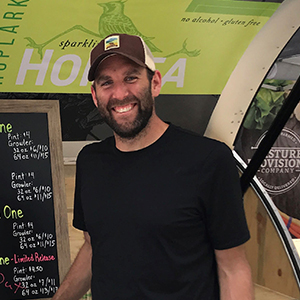
[00:00:10] Ray Latif: Hey, everyone, I'm Ray Latif, and you're listening to the top podcast for the food and beverage industry, Taste Radio. This is episode 231, which features an interview with Dean Eberhardt, the co-founder and CEO of Hoplark, the maker of innovative hop-infused teas. Just a reminder to our listeners, if you like what you hear on Taste Radio, please share the podcast with friends and colleagues. Of course, we'd love it if you could review us in the Apple Podcasts app or your listening platform of choice. Midway through my interview with Dean Eberhardt, he mentioned that some consumers think of Hoplark's hop tea products as, quote, naughty. The word isn't meant to imply that the beverages are bad. It's just the opposite. Dean explained that the hop-infused, non-alcoholic, and zero-calorie teas are such a good alternative to beer that someone might feel risqué in drinking them during the day or while driving a car. Launched in May of 2018, Hoplark emerged and has developed amid growing interest in super-curious lifestyles. And while the products are beloved by craft beer drinkers, they've also found a receptive audience among natural product consumers. Hoplark landed a national deal with Whole Foods just 16 months after its debut. The brand has continued to thrive despite the COVID-19 crisis, during which Hoplark has built a burgeoning direct-to-consumer business. As part of our conversation, Dean spoke about the development and rise of Hoplark, including why he chose not to pursue a career in his family's business, and how the decision paved the way for the creation of the brand. He also explained why Hoplark isn't specifically promoted to sober, curious consumers, the thought-provoking way he describes the product's functional attributes, the impact of limited-edition flavors on driving brand loyalty, and why the company turned down a venture capital deal this past summer. Hey folks, it's Ray with Taste Radio. I'm going to call right now with Dean Eberhardt, the co-founder and CEO of Hoplark. Dean, how are you? I'm doing great. Thanks so much for having me, Ray. I'm a huge fan of the podcast. Well, thank you so much. It's so great to see you. It's just amazing to think about two years ago, a little less than two years ago, handing you the trophy on the stage at BevNET Live Winter 2018, where you were the winner of our New Beverage Showdown 16 competition. Very well deserved. Does that feel like two years ago or does it feel like longer?
[00:02:24] Dean Eberhardt: In some respects it's 10 years in some respects it's like two weeks. It's incredible how that works.
[00:02:29] Ray Latif: It is. You know I remember trying your product at the show and I was just amazed by the flavors and how different it was how I guess innovative it was in comparison to a lot of other things that we've been seeing. And I think the judges felt the same way. So very well-deserved, as I mentioned. We'll get to the formulation and how the business has been going, but I got to ask you a question first, because as we discussed the other day, you're an early riser and I am not. I don't like getting up at farmer's hours, but you know, it's each his own. But you sent me this beautiful, beautiful picture of a sunrise, which was, I feel like I'm missing something now, because I don't get up for that early. I'm more of a sunset guy, but I got to ask, are you sunset, sunrise? You can't say both.
[00:03:11] Dean Eberhardt: Yeah, so I was when we were talking the other day, I just had this amazing sunrise that I was looking at. And, you know, it's so imagine I wake up in the morning, I've got all this energy, and I'm just excited to grab on to the day. But it's I have to walk this gauntlet of three kids bedrooms to try and get outdoors and like, get to the hill to see the sunrise. So it's a it's a bit of a really fun morning wake-up activity, let's say, because I know if I wake up one of my three children, I will not be able to go and enjoy my relaxing morning sunrise. I am an early bird, and that's a good thing. I enjoy focusing my thoughts in the morning to get ready for the day. How early do you have to wake up to wake up before your three kids? Sometimes pretty early, maybe before 5.30 occasionally, but now with the sun sunrise coming later, it's more they're waking up in like 6.15 or so. So it's better.
[00:04:10] Ray Latif: I don't know how you do it, but if you're seeing a sunrise, if it's more than just your morning coffee, it seems like it's worth it.
[00:04:17] Dean Eberhardt: Yeah, totally. And it really gets my mind in the right framing. So I appreciate that opportunity.
[00:04:23] Ray Latif: Yeah. Well, I appreciate the opportunity to speak with you. And once again, I think Hoplark has something that's so interesting and so differentiated that I really felt like this is such a good time to speak with you, especially because you've been rolling for a couple of years now. For folks at home who aren't familiar, what is Hoplark?
[00:04:44] Dean Eberhardt: Yeah. So, you know, Hoplark was born out of a vision of bringing amazing new flavor experiences. And, you know, our first product to market is Hop Tea. A lot of people are familiar with that, you know, coming to market a couple of years ago. And it's this vision of, you know, I've always been a flavor geek. And I've been a huge fan of innovative brands, so like Hendrix, Dogfish Head, La Cologne, brands that were pushing boundaries on flavor experiences. And I had this vision of creating a company that could do the same thing, and potentially across categories. But right now, we've been really focused on bringing hop tea to our customers, and they've responded in a big way. So what is hop tea, and what's the inspiration behind Liquid? You know, a couple years ago everyone, every entrepreneur imagines this this light bulb going off and this incredible aha moment. And I had that it was I was taking a month off of drinking and I was I was maybe about 40 pounds heavier than I am now and really needed to lose some weight and. like day 25 of a Whole30, I went to a brewery with my best friend and missed having a beer. And I just, I grabbed his IPA, I gave it a smell. And in that moment, imagined creating this beverage that kind of aligned with where I was looking to innovate in, you know, in new categories. And And we imagined replacing the Malton beer with tea and it kind of all connected. And like, we literally like we finished that beer quickly. We went back to my house, and we were homebrewers so we had some hops and we had some tea and we like threw something together. And the next day, we tried it and it was like. fully terrible. It was not good. But there was this slight glimmer. It's like being trapped in a cave and you can see a little bit of light off in the distance. You're like, okay, I can maybe get out. That's where we were at at that time. And that glimmer was all we needed to imagine bringing this product to market. And it took us literally 18 months in my garage to figure out how to, how to create the process to make it work. And, you know, we almost launched it six months in, but we had this vision. And six months in, it would have had some sugar in it to counteract some flavor stuff. And we had this vision that it was, we could make this thing with three ingredients, water, tea and hops, And it could taste amazing and has zero calories. And we stuck to that vision. And the rest is history. Like, we are really lucky to have been that stubborn, let's say, to have waited a full extra year before launching the product.
[00:07:22] Ray Latif: Why tea? You know, we're seeing more hop-infused waters come to market, sodas, things like that. Why was tea that third element in your beverage?
[00:07:32] Dean Eberhardt: Well, I mean, so I'm a craft beer geek, and we were homebrewers. And so The way beer works is there's malts and there's hops. And malts has a ton of variety. It gets cooked at different levels. So, you know, you have darker malts for porters, you have lighter malts for IPAs. And then you can also use a variety of different types of malts. And so I saw this opportunity where tea was was very similar to that in the sense of your black to your green tea, you have all these spectrums of the tea plant itself, but then you also have these herbal teas which can bring kind of a different perspective and so we literally imagine like we could kind of like this spectrum similar to craft beer and just using these two ingredients. And that's why it opened up this incredible avenues for exploration.
[00:08:21] Ray Latif: It also makes for a cool name. It really does. Thanks. Yeah. So what were you doing before you launched the brand? Did any parts of your career kind of lend itself or lend themselves to launching a beverage brand?
[00:08:37] Dean Eberhardt: I don't know about launching a beverage brand. Like I've always been, like I said, I've been a flavor and beverage geek for my whole life. I was the guy that was, you know, inviting friends over in my twenties to share my new scotch with them. So like it would share the experience, but also they would drink the bottle so I could buy another. That's the depth of my geekdom. But yeah, I mean, I got thrown into entrepreneurship at a really young age and I've been, Really blessed with a ton of experience, although it came at you know, it was with some pretty deep tragedy like when I when I was 24 My dad passed away really suddenly in a plane crash and and I got thrown into this small family manufacturing company on the south side of chicago and I mean imagine being Five months out of college and trying to figure out how to be an employee for the first time, and also having to be like the chairman of an organization it was very confusing and challenging, and I wouldn't really wish it on anyone but it did give me this depth of knowledge. And I had a deal with my dad that I wasn't going to really run his company. So I built a startup in an adjacent space. We were looking to revolutionize the plastic recycling industry. And we had a really cool plan, great team. We brought on investment, and it was going to work. And then the oil market crashed in 2014 and we were a commodity derived straight from oil. So we were upside down basically from day one. And I know I've listened to a lot of podcasts that you guys have done. And I know there's several folks that have come on and talk about having been fired from a previous startup and like add me to the club, like I was fired from my own startup. And it was really an incredible awakening for me. I thought at the time, I'm like, okay, I'm gonna take the summer of Dean, I'm going to play a bunch of golf. I'm going to, the Cubs are going to win the world series. They did. That was cool. And I played, I literally, literally played one round of golf and woke up the next day and was like, this isn't good. I need to go find my own thing. And I went to Alison, my wife, and told her, I'm like, if we don't get out of Chicago immediately, I'm gonna relapse back into the family business. We're gonna be stuck here forever. Not that Chicago's a great place, but it wasn't necessarily our place. I was kind of living someone else's life. And six weeks later, we lived in Boulder Colorado with our family. So it was an incredible time of change for us, but also just this like, unbelievable opportunity for me to pursue my real passion and spread my wings a bit.
[00:11:37] Whole Foods: Vibrant Ingredients is the natural ingredient partner powering food and beverage innovation, delivering flavor, function, and protection through a science-backed portfolio. Vibrant delivers purpose-driven solutions that help brands create extraordinary experiences. Discover what's possible with Vibrant today. Visit VibrantIngredients.com.
[00:12:04] Ray Latif: So in between leaving Chicago and launching the brand Hoplark, were you interested in getting into craft beer? It sounds like, you know, again, being a craft beer geek in Boulder Colorado, this seems like there's a lot of opportunity to get into that industry.
[00:12:20] Dean Eberhardt: You know, I don't want to, I don't want to disparage it. I love, I love the craft beer industry. It's not just crowded, it's, I'm going to use a controversial word here, but it's a little boring. Not everyone is, but I just didn't see that much. opportunity to have that exciting of a product that was different from, you know, what else is coming to market. And so every time we got close to thinking about doing that, it was always like, we don't have enough of a perspective. And that's where I think the light bulb moment, this aha moment of creating hop tea really came in when I was, you know, had that craving for the beer, was on the diet. Like it was like, I had been thinking about it for years. And I think that's why it was, it all kind of clicked at once.
[00:13:05] Ray Latif: The beer industry is so amazing. I grew up with craft beer and it's changed so much in the past 10 years, the craft beer industry, but the beer industry as a whole. If you had told me that Guinness was going to be launching a non-alcoholic 0.0 beer in 2020, I would have told you you're crazy, but that's the world we live in right now. It is tilting toward a lighter style, I guess a healthier lifestyle, one that's less tied to drinking alcohol. That being said, it seems like the positioning of your brand as a non-alcoholic alternative to beer would really work. And I think there's a lot of people who think about Hoplark as this sort of great option for sober, curious folks, but you're not really in that lane, right?
[00:13:58] Dean Eberhardt: I mean, we're, we're in, it's, it's a both and thing for us. So we're, you know, I, I like to think of the brand as alcohol agnostic. Like a lot of the concerns that I have is I never want to position a product that's focused on what's not in it. It's always about, you know, we want to build things talking about what's great about it. And so, you know, as we've been positioning hop tea, it's more about, this is just the coolest tea or coolest beverage you could drink. anytime as opposed to necessarily this is what you're going to drink when you're not having something you really want to drink. And so, you know, for us, that's been pretty magical and it's not. It wasn't just like in our heads like we launched the. the product at a single farmers market in Denver, and we loved listening. It was our favorite thing. I remember handing, you know, samples to customers. We would hand these blank cups of like, because we want feedback on the liquid, just is this exclusively the liquid? And I'd be on my toes excited about what they were going to say. Are you going to like this flavor? We just launched this one. And what we saw was, we used to call it the face. When our customers tried Hop Tea the first time, it was so different. They'd have these reactions that were just stunning. A combination of, what is this? How is this. And so, you know, we knew we were really onto something by paying really close attention. And what those customers taught us was, this isn't just a sober product. It was so much more than that they were drinking it morning, noon and night, and every day consistently. So it was a Sunday farmer's market and we'd have folks coming back with growlers and they'd be buying more because they'd be like, hey, I finished all my hop tea on Monday morning. This is a problem. Please get into stores. And so we took note of that for sure. I think we've been really lucky that the Sober Curiosity movement has come into play at the same time that we launched. But the brand was never... When we launched, we knew nothing about Sober Curious. It wasn't built for that. It was built because we thought we were bringing a really cool product to market. And that allowed us to, I think, be a little more open-minded about where it could land and what the potential could be. And that's worked super well.
[00:16:22] Ray Latif: Do you get any flack from folks who are telling you, look, you need to hone in right on this opportunity because it is so big and broad, because we are seeing major players, particularly in beer, really put a lot of emphasis on these new non-alcoholic products?
[00:16:39] Dean Eberhardt: Well, I mean, in a lot of respects, I'm a marketing textbooks, worst nightmare, because I let the customer find their own way. We let the customer find their own journey on this as opposed to necessarily choosing a lane. And in doing so it's gone really expansive. And so a lot of, I get feedback in two respects. One is. we need to pick a lane and that hasn't proven true yet, but it might be true eventually. The other one is like early on, maybe two weeks in, three weeks in, the naturally Boulder community or the natural food community in Boulder, I was getting flack from folks saying, you should position this as an NA beer. This is the best NA beer. You should like, you should do this, that, and the other thing. And I was seeing the opposite at the farmer's market. And so people that are deeply respected in Boulder, entrepreneurs that have exited, marketers that are geniuses, were telling me the exact opposite of what my gut was from experienced customers. And I'm really lucky that we stuck to our beliefs and our experience because it was really difficult. We had a lot of naysayers on what our choice of positioning was.
[00:17:47] Ray Latif: Well, for your customers to give you feedback on your product, they have to find it. And you can go a lot of different ways on shelf. You could go into the tea set. You could go into the dry tea set. You could go into the non-alcohol beer set. You could be lined up with potentially sparkling waters. Where is the best fit for Hoplark? And where is the best fit for Hop Tea?
[00:18:09] Dean Eberhardt: Oh, Ray, that's such a fun question. I think the answer is like, yes. I mean, our goal is to meet our customer where they want to find us. And so like early on into this point in a lot of natural grocery, that's been the tea aisle. You know, we saw this great opportunity to disrupt the tea aisle. It's a little stagnant, not a lot of innovation, and we're like really weird and innovative. So we stand out, which is cool, but we've seen as our scope expands across the market, like we've seen retailers want to put this in the NA beer set or along with kombucha or functional beverage, and it all works. Because we're not necessarily meeting a customer that already exists. We're totally carving a new category. And so all we need is the right placement, the right attention, and the right customer eyes, and they'll try the product. That's the thing that we've learned.
[00:19:01] Ray Latif: What elements of the product are really resonating with consumers. You said Taste Radio I 100 percent agree. I also think carbonation is something that the carbonation of liquid is outstanding. Those little bubbles aren't so little that they really clog up your throat. You know like some products do. But you know what other parts of the brand are really attractive to consumers.
[00:19:24] Dean Eberhardt: Well, we're weird. We make it ourselves. So we get to hold a really tight leash on quality. So we know that the product we're presenting to our customers is top notch and top quality, and we really care about that. So we write our customer story that we've been pretty intentional about. Looks a lot like the product sits on shelf. It says hop tea. That's fairly understandable to a lot of consumers. And it drives this really intrigued moment. Like, what is that? Like, what is that? Like, oh, it's $2.99? I have to try that. And then they have this really elevated taste experience, and it connects the story. And then what happens? So they've been intrigued. They tried it. They like it. And then they turn the can around, and they're like, wait, wait a second. Zero calories, three ingredients. And that's when we get this, It's just incredible customer love and connection and wow moment. And Ray, we get a lot of Instagram love. Our most common Instagram photo has a steering wheel in the background. And that's because our customers are so excited to share the product. They can't wait until they're out of their car. They're drinking on their way home. They stop at a stoplight and they take a shot and share it on Instagram. in that moment, that's how excited they are. Like hundreds of these, like we joke about it, like the steering wheel palette, the steering wheel in the background, like it's over and over and over again.
[00:20:50] Ray Latif: Does the packaging have something to do with it as well? Because, you know, Instagram photos only work if the packaging is dynamic and something that is shareable. You know, I totally get that zero calories, no sugar, three ingredients is really a drop, but for people to want to take a picture of it, the can's got to look pretty nice.
[00:21:09] Dean Eberhardt: Yeah, no, no doubt about that. I mean, I tell when I talk with entrepreneurs that are launching brands, it's like, you know, I look at this entire industry as thinking about a singular customer's relationship with a singular shelf, you know, with a singular product and like, like, how does that work in a singular taste experience? And if we can get that to work, it makes a lot of sense. And so we came in knowing that or thinking that way. And so we spent a lot of time honing in on packaging. And what we were looking for was, you know, kind of like craft beer plus food. So we got this vibrant color palette going across and this color blocking, but there's also this craft beer vibe with this cool hop and tea design in the background. So yeah, we couldn't be happier with how the can design turned out and people seem to really enjoy it.
[00:21:57] Ray Latif: Well, I think you hit on two really important elements of the modern beverage brand. One, low calorie and low sugar. Two, taste. I think taste is probably a little bit higher up at this point. But then three, function. Where does function fit into your brand? Does it? Does it have a role in hoplark? I love the question.
[00:22:19] Dean Eberhardt: There's this functional revolution going on, right? And I'm not that excited about function for the sake of function, because I think it can distract from the experience. Like our function is really experience. Our function is really flavor and taste. And we've leaned into that. I mean, yes, we have caffeine and it allows our customers to replace coffee with it. They can drink it as a midday pick me up. One of the words we keep hearing over and over again from our customers is a word I don't hear that often. It's naughty. the word naughty and and it's it's about like I'm feeling a little naughty at work having hop tea or I'm like driving in my car and drinking a hop tea and feeling a little naughty, which is. unexpected in a good way. Like we're tapping into some emotion there. And so, yeah, I mean, there's function. It's just not necessarily explicit. And that's, you know, I love playing that game for sure. Letting the customer find it themselves is, it's a way bigger win than having to be really explicit. Cause, cause that allows for a broader market and not having to go after some smaller niche.
[00:23:25] Ray Latif: It's just saying it's a perceived function. They're perceiving that this is similar to an alcoholic beverage, or they're getting the same sort of emotional feeling of drinking an alcoholic beverage. I guess I'm not 100% clear what naughty means to that consumer.
[00:23:43] Dean Eberhardt: Well, yeah, it's like, I want to drink a beer at work right now, but I can't, but this is really fun. And I'm going to do this and man, is it way better than an NA beer? So like, that's kind of like the thing that we hear from our customers. And so, yeah, we want to tap into that emotion of like where the customer gets themselves. And that's not every customer. That's a lot of the customers. Um, but we, we, we treat the experience as the function that we're bringing to the table.
[00:24:08] Ray Latif: Do brewers and craft beer drinkers feel naughty when they're drinking your beer? I ask because you did a pretty significant sampling at an event called the Great American Beer Festival, which is packed with breweries and beer lovers from across the country. And from what you're telling me, it was pretty successful. Again, I'm not sure if they felt naughty drinking it, but you could tell me more. I don't think they felt naughty, but I do think they loved it.
[00:24:36] Dean Eberhardt: I mean, we handed out. I think we had something like 4,000 or 6,000 cans over the course of the weekend. I just remember being really getting the whole weekend because I'm a fan of all these breweries and all these brands. to have head brewers and whole teams from these breweries come up to us and just tell us how amazing the product was and grab tons of cans and bring it back to the team. Hearing that the Sierra Nevada team was chugging it all weekend, those are like dreams that I used to have, right? And so to have that come to fruition in a world that I'd never really encountered before at GABF, that was amazing.
[00:25:16] Ray Latif: You also did a pretty big sampling at Natural Products Expo East. I believe that was last year. What did that experience teach you about the brand and how natural retailers, brand owners, buyers, etc. think about the brand?
[00:25:30] Dean Eberhardt: I mean, it really taught us that, you know, the market was way bigger than we expected. Like people really love it from all walks of life. Like we, we came into launching the product thinking that it was going to be sober folks for sure. And then maybe a bit of craft beer, but really what it's become is like, We've never had to teach someone who's sober how to use the product. They understand it intuitively. Our core demographic is craft beer drinkers, which is really broad, but then also health and wellness and active lifestyle folks. And so bringing just a handout sampling to Expo East with a lot of folks in the industry that have a critical eye to what's going to work or what flavors work, the feedback we got was off the charts. It was unbelievable to us how expansive the love was. So that was really fun.
[00:26:21] Ray Latif: Now, you're just handing cans out. It's not really an experiential kind of thing. It's just you're giving them an opportunity to sample your product. But going back to this notion of the experience is the function, how do you enhance that experience? What are some ways that you are bringing more to that consumer, introducing more of who you are and what you're about to that consumer?
[00:26:44] Dean Eberhardt: I tend to tell folks, you know, when everyone's going left, my brain goes, okay, so like we definitely need to go right. And in this turn, there's a lot of marketing in this industry. And my thought from what I was seeing in the farmer's market was, maybe we don't have to necessarily do all that. Maybe we can build the product on customer traction and customer sharing and kind of grassroots efforts. And that's really worked super well for us. So we haven't, you mentioned probably our two main, if not like only biggest marketing expenditures in our history. We haven't done a lot. What we found is customers are pulling it off the shelf without us necessarily even having to do demos because they're so intrigued in the product. Like we've been really lucky with that. And then we let the customer do the work and they tell their friends and they do stuff. So we're learning and we're looking to build a, like a really strong marketing message on top of the platform we've already built. But we didn't have to do it from day one and we didn't do it from day one. That was because we really wanted to see what we had first and it's been really cool to watch that be built out by the customers.
[00:27:58] Ray Latif: It's hard to do sampling events during a pandemic. In fact, it's in some cases downright impossible. You can't do it at any trade shows because trade shows don't exist or at least are not running right now. Let's talk about your COVID strategy. This is something that It feels like you were ahead of the game. You were ahead of some brands and companies in terms of preparing for this pandemic. Talk through what your strategy looked like and how you were able to get a leg up on this pandemic. this catastrophe.
[00:28:29] Dean Eberhardt: Yeah, I mean, it's been really challenging for the industry. I'm a very optimistic entrepreneur. I'm a very optimistic person. I try and live in opportunity, but I also bring this concept of productive paranoia into our business world. And so what could happen? What do we need to prepare for? What are we not missing? And when I started seeing this go in January, like I remember, going to fancy food show in San Francisco in January being like, should I be shaking people's hands right now? I was watching this. We secured our entire annual supply chain of tea out of Southeast Asia in January. That was a thing we had to spend a bunch of money on. It was not easy, but we made that choice because We were concerned about what was coming. And so when everything hit like we, we've been talking about it for probably two months or a month and a half at that time and, and what we honed in on was like, what can we actually control here. And what can we not control? So for us, we knew we couldn't control the number of customers going to grocery stores anymore. We couldn't control that folks weren't necessarily spending the time to discover brands on shelf. We couldn't control that across the nation, like the prepared foods world went away, which really dramatically impacted the cold case that we were in. We could control none of those things. So I told the team, like, we're not gonna measure any of that. We're not gonna talk about it. Like, what can we control? And what we found was, you know, we were able to talk directly to the customer online and we could build a story that, you know, really connected our brand with our biggest supporters digitally. And so that's what we leaned into. And, um, and yeah, around the same time, like I, I mean, it was, it was a chaotic time. Like I helped start a founders group of, you know, seven or eight folks here in Boulder. And we've, we've met every Monday morning to like, kind of give, give each other a big bear hug, um, on zoom. from, you know, March 15th to like now, we're still going. And it's been a really amazing watching the community kind of support itself, support each other. And there's just a lot, I mean, a lot of challenge, but like how do we, the way we look at it is how do we get in front of it and build opportunity in the face of the challenge.
[00:30:45] Taste Radio: Do you want more repeat buyers on Amazon? Well, this free resource in collaboration with Straight Up Growth will help your brand turn first-time buyers into long-term subscribers. Download Winning the Repeat Purchase Game on Amazon now at Taste Radio slash SUG. That's Taste Radio slash S-U-G to start building retention-driven growth for your brand on Amazon. Scaling a beverage brand into major retail comes down to operational readiness. From packaging lead times to co-manufacturing strategy, the details can make or break a launch. In a new e-book in collaboration with Octopi and Asahi Beer USA, industry leaders share what they've learned in helping brands scale. Download it now at Taste Radio slash octopi. Do you need to scale your team faster without compromising on talent? Join Oceans for a live webinar on April 20th and learn how leading companies are hiring top global professionals who are ready to grow with your business. Register for the webinar now at Taste Radio slash oceans. That's Taste Radio slash oceans.
[00:31:56] Ray Latif: So Dean, when I was speaking with entrepreneurs in March and April, it seemed like everyone said that they were pivoting to DTC. And this is something that, you know, it was out of necessity. It wasn't something that people really necessarily wanted to do. They just had to do it. Seven, eight months later, you can see some were more successful at it than others. You have been quite successful at it. How do you make it work?
[00:32:19] Dean Eberhardt: a couple of things. We've been very lucky in that, you know, we saw our customers come to us pretty dramatically when they stopped going to grocery stores. So as kind of the world shifted away from going into stores and there were some supply constraints on like our product wasn't considered the essential good like a rice or a pasta. So we weren't even getting on the distributor trucks to get to the stores sometimes. When our customers saw that, they started coming to us. So we saw a Forex growth from February to April without us doing anything. And that was like, we were really lucky. And that, honestly, it's probably the best validation we've had in the history of the company on the product, just the amount of customers coming to us. But the way we approach it because we knew we knew and kind of don't still know too much about e commerce execution, we focused in on what do we actually understand. And so we understand the customer really well. And we knew they wanted two things. One, subscriptions made a ton of sense because we were seeing the daily multi cans a day, all day long consumption patterns in our customer and hearing from them. And so we built a pretty quickly built a subscription program that's gone incredibly well. But the biggest piece was, you know, we're an innovative product and our customers love innovation. And when we had our tap room open before COVID hit, Like we would we would launch these like micro limited release launches and our local customers would go nuts for them and so we saw this opportunity to bring our taproom limited release program to a nationwide e commerce plan and. And I remember Andrew and I joke about, we had some expectations for this. I think we had a little bet going on how much we were going to sell the first weekend that we launched our first product, limited release. And any expectation either of us had was totally knocked off the charts our customers went. so nuts for it. And so now we have this platform that is, we're testing out new stuff. Like our first limited release in May was the Citra Bomb one. It was our first whoa hop tea. We have this hop spectrum on how happy it is. And this one was the first one we ever launched at the top of the spectrum. And now just this week, it's launching nationwide at Whole Foods. And because we knew that we were looking for another SKU, they wanted another SKU, that's been a great partnership. And so we learned from our customers how much they loved it. And we latch onto that opportunity. But it's also allowed us to explore new flavor trials and continue to define what hop tea is. And that's been just incredibly enjoyable. And to see the customer response, it's been probably the thing I'm most proud of maybe in the history of the company.
[00:35:03] Ray Latif: You said you didn't know everything about direct-to-consumer. How quickly did you need to get up to speed on certain elements? I mean, what are some of the most critical aspects of direct-to-consumer? I can imagine that actual shipping and the cost of shipping is probably part one.
[00:35:21] Dean Eberhardt: Well, all that, so all the fulfillment stuff, because we make it ourselves and we have our own brewery, we were already doing that. One of our teammates like pivoted into a, how do I grow the fulfillment side of this business and she's done an amazing job, just building a team, to the point where even like there's now we have, you know, she built someone know, raise someone into a role to manage that and they're doing a great job too. That part was pretty natural for us because we understand the logistics side. The hardest part was honestly all these three-letter acronyms. I didn't even know what they meant. I'm joking, but there's just so much to it. It's this massive world of complexity. And my thought from the start was always, you know, we can't be everything for everyone and if we go into this world of complexity and just go like an inch deep like that would never work, because we never win anything so we just went. like a mile and a half deep in these couple of areas that were really directly related to consumer and then what's happening is that allows us to come and build up our capability and all these other, you know, the complexity stuff so you know we just brought on a VP of marketing that you know is amazing and she's going to revolutionize, let's say our ability to be pro at this, but that wasn't the first thing we did, right? That was like, once we build the stable base, once we drove, increased our customer lifetime value pretty dramatically with these programs, like now we're coming at it like the way a lot of brands start.
[00:36:53] Ray Latif: And I think it's going to work pretty well. It's really interesting that you're hiring a VP of marketing to support your e-commerce strategy. I would think you'd be hiring a director of e-commerce. Why a VP of marketing?
[00:37:05] Dean Eberhardt: I think that marketing in our industry is like Vision and strategy and then execution. And I really love the vision strategy piece and I bring a lot of my co workers or teammates into the orbit around how to make that happen. What we were missing was the execution piece. And so having that be so elevated organizationally and drive the importance of that, it's not just necessarily e-commerce, but that's the main background and the main focus right now. And I get to play in the vision strategy side of like the brand, but really we're working on, like we're working on together. Like it's been a fun, it's only been a couple of weeks, but it's been, I think it's gonna work pretty well. But yeah, it's all right now on the digital side, it's all about execution. But I also wanted to, bring on a teammate that had, you know, really strong vision for where we could get to. But that's why we hired such a capable individual in that role.
[00:38:07] Ray Latif: And is part of their role bringing more loyal consumers to the brand? Because you already have this foundation of loyal consumers that can help be influencers and ambassadors for Hoplark. But in terms of developing your e-commerce strategy and your customer acquisition strategy, is it just about getting to those consumers? Is it about just introducing the brand to those consumers? Or is it, you know, something deeper? Is it more about consumer education at this point?
[00:38:33] Dean Eberhardt: At this point, you're right, you're spot on. It is really just about introducing the brand. We have really strong product market fit when we have a customer land, they land hard, they're really excited about it. And so we really just need to expand that. But that's difficult. It's a really competitive universe online and you're not just competing now all of a sudden we're not just competing on the t-shelf we're competing with mattress brands and you know trunk club and whomever might be you know doing all kinds of advertising it's across every basically every consumer industry and so you know how do you stand out how do you make it profitable how do you keep your voice like those are really fun questions um because they they constantly make us allow us to innovate and ask deep, inquisitive, thoughtful, like how best to do this sort of thing. So yeah, I mean, that's been a really cool part of the journey.
[00:39:29] Ray Latif: So I've spoken to a bunch of investors over the past six months, and I'd say probably 60 or 70% of the time, the name of your brand comes up. Hoplark comes up. It seems like everyone is interested or wants a piece of your company. How are you sifting through investment opportunities at this point. I mean are you raising money. And you know what are you looking for in an investor. You're in a position that a lot of brands would love to be in.
[00:40:01] Dean Eberhardt: Well I've been deeply humbled and kind of honored by that. I appreciate you saying that. It's kind of amazing to hear. We've been so lucky luck plus timing, you know, we didn't we didn't build this product for a sober movement the sober movement just started to like happened as we launched it. That's just incredible timing and you know, we got a really early look at Whole Foods like from Whole Foods like that was really. lucky and it worked well on shelf and it connected with the customer, right? You know, we got, I mean, even back to like, we got into a farmer's market we probably shouldn't have gotten into. And if we hadn't, like none of this would have happened, like it's, or it would have, you know, been a different journey. And so I've just been deeply appreciative of, you know, the things that have happened that allow us to get to here. And Andrew and I talk about We are in a position where we're able to pick and choose who we work with. And that's, you know, we appreciate the heck out of that. That's amazing. And so what we've been asking, you know, we went down, we've gone down the path with several VC groups over the years. And specifically this summer, we almost went pretty far down a path and almost took a deal. And what we realized was, first, we had to answer what we wanted to be when we grow up. And what we realized was, because we're creating a new category, because we see we have a pretty expansive market vision for what this could be, if you study category creators, historically, a lot of them don't exit. A lot of them actually just become category captains and stay and continue and build. And so, you know, we actually view a potential exit as like, maybe not the optimal outcome. We're actually going after more of a stabilized category captain position, you know, exits are okay. And that, you know, narrows the audience of potential investors down to more long-term hold folks that are excited about the brand and looking to be a part of the journey in the long term and see where we're going. and, and not necessarily a shorter term kind of quick exit or even medium term exit strategy. So that's been a great discovery for us. And, um, and it really matches. I mean, we're actively looking for those long-term investment partners. You ask, are we raising money? Like everyone who's growing in this industry is always raising money. Right. And so, you know, we're actively looking for those longer term investment partners and that matches what we're trying to do on a long-term basis with the brand. We're not done. We see hop tea as the beginning of the story, not the end of the story. And we see an opportunity to just continue to build taste experiences around real plants and beverage, not like extracts. uh, real plant extracts, like actual real plants and match them with unique flavor experiences. Our customers have never had before. And that's, that's the thing that, you know, that's really grounding our vision and where we want to take this. And yeah, I mean, we, we think that we think that we can find, continue to find excited investors that also see that vision and can help us, you know, achieve our goals.
[00:43:09] Ray Latif: How much of your perspective was crafted or influenced by being fired from your own startup?
[00:43:16] Dean Eberhardt: Dude, so much. I mean, I got to build a team, right? And so, like, I had this incredible experience of I've managed the family business. It's an amazing community. They're great. They're great folks. Like, I love them. And I've, I've overseen that I got to build an entire management team in that environment. And that was a learning platform for like what did and didn't work. But, but Ray, like, think about it. Like I had this raw commodity, like low price commodity business I was building. And I pivot to the next one is the most specialized non-commodity thing you could imagine. Well, that's clearly intentional. And so I've been loving this. This has been really fun. I couldn't be more excited about the future. I get to live into my gifts as an entrepreneur and a leader. I feel like The thing that I can do extremely well is match product with market opportunity and make something that's truly unique and exciting for customers. And that's joy, man. There's nothing more fun than getting to do the thing that you enjoy just day in and day out.
[00:44:27] Ray Latif: You know, I've asked a couple entrepreneurs that I've interviewed recently about manufacturing and self-manufacturing, and it seems like it's an important part of what you do. And I can imagine that, you know, your passion for the brand and for the company is partly by literally making it. You're making your own products. Is that something that's going to exist in the future? Is that something that needs to stay a part of the company, needs to be a critical part of the company's future? I love that question.
[00:44:57] Dean Eberhardt: I think that, you know, we love that we make it and we're proud that we make it and it allows us to own the quality story and the flavor experience for the customer. As we have pivoted into this more specialty world of e-commerce and watching the specialty world kind of match with or be very different than, you know, our distributed SKUs, I'm not going to say it's 100% for everything, but we're pretty good at it. And it's a thing that we understand fairly well. It's a thing I have a background in, which I'm really grateful for. And we're going to keep that as an open topic, like 100%, we're going to keep making all the specialty stuff and the new stuff and the cool stuff. But as we grow, we have to keep asking these questions. And our distributed SKUs, they're pretty high volume at this point. And it may, you know, where the co-packing world, because of our specialty process and stuff, maybe didn't match up to what we were trying to do before. Like that, that may change in the future. Like we may, it may make some sense, especially because I love making it. It's wonderful. We've got to build a team early. It's been amazing. Uh, bring more voices and more folks into onto the team. And we'll certainly continue to have a brewery and do all the, all the fun specialty, um, things, but, but our passion is newness and connection with customer. It's not. A hundred percent, like making this skew over and over again. So we're open to the possibility, but for now we love making it. And it's, uh, it's been, it's been a hugely important part of our journey.
[00:46:29] Ray Latif: Dean, this has been such a great conversation. I do want to go back to one quick point you made earlier about a long-term vision for the company, being a category captain for a potential hop category, hot beverage category. Does that long-term vision allow you to think about growth a little bit more, I guess, efficiently. It seems like you have an opportunity to really press the gas on growth and be in a lot of places really quickly, especially if you do get that VC money or that investment capital that you need. I guess what I'm asking in a nutshell is, how do you want to grow? How important is rapid growth to you?
[00:47:08] Dean Eberhardt: I'm so grounded in this small manufacturing company in Chicago that for me, building a business is always about building a real thing. And to me, that connects with the product. The product's real, the business is real, the people are real, and that's like doing it the right way. It's one of our core values. So growth for the sake of growth has never been something that's that exciting for us. What's been really exciting is just is continuing to meet customers with products that they love. And if that means that it's going to generate growth like great like that's wonderful. But it's not necessarily all about that. And we try and stay grounded in like this is this is what we can do. This is you know our longer term vision. Let's focus on core fundamentals of business like building a team, building our manufacturing capability, building the marketing strategy that makes sense before we go in because we don't want to necessarily go overextended. Now, I think that we've done a lot of that and I think that we're going to see some pretty rapid expansion here in the next couple of years because the product fits so well with the customer. but I do, you know, it's a, it's a little bit of that. Whenever it goes left, we're going to go right sort of thing. And the market for years has been saying growth, price growth. And so we've given it a bit of a thoughtful eye and just thinking about like, what, you know, what is the right move here? I think the category captain thing, like hop tea, that's going to be a fun journey for us, but actually on Hoplark, like it's not always necessarily going to have hops. It's not always necessarily going to have tea. And there's a lot of opportunity to, again, bring real plants to a new flavor experience. And we're just excited to see where that goes. That's a multi-year vision. That's not a distraction today. It's just kind of like we see a lot of opportunity to continue to put smiles on customers' faces. And yeah, we want to lean into that.
[00:49:00] Ray Latif: I am very excited to see what's in store for Hoplark and for you, Dean. It can be easy to get down in 2020, but it's so good speaking with you because you have such an infectious passion for your company and for this industry. I'm so glad. I'm so happy to have the opportunity to speak with you today. Thank you so much and good luck with everything going forward. Thanks so much, Ray. It was a pleasure. And yeah, thanks for having me. I really appreciate it. Thank you. That brings us to the end of episode 231. Thank you so much for listening, and thanks to our guest, Dean Eberhardt. As always, for questions, comments, ideas for future podcasts, please send us an email to ask at Taste Radio. On behalf of the entire Taste Radio team, thank you for listening, and we'll talk to you next time.