[00:00:04] Ray Latif: Hello and thanks for tuning in to Taste Radio Insider. I'm Ray Latif and you're listening to episode 45 of the podcast. I'm with BevNET CMO and my Taste Radio co-host Mike Schneider. We're recording from the Taste Radio studio at BevNET headquarters in Watertown, Mass. And in this episode, we speak with Ray DeRosa, the founder and CEO of Lion Tea, an innovative brand of dandelion-based teas. Our conversation explores the critical importance that data, relationships, and mentors had in the development of his business and why simply surviving in the first two years gave the company a foundation for growth. If you like what you hear on Taste Radio Insider, please share the podcast with friends and colleagues. Of course, we'd love it if you could rate us on the Apple Podcasts app or your listening platform of choice. I sing-song that one. You're sing-songing now. Yes. You know, it's interesting the number of shots that come in all at once in this office. They seem to come in droves. And I know we've talked about shots, and by shots, I New Beverage shots. Right. I know we've talked about this in past episodes of Taste Radio Insider, but in particular, the number of new brands or new line extensions or brand extensions that are coming to market has been kind of scary. Dare I say Sunday Scaries? Sunday Scaries recently launched a new line of CBD-infused shots. This is called the YOLO Shot. Sunday Scaries is a San Diego-based company. It makes CBD-infused tinctures and gummy supplements. You can read all about these new shots on BevNET.com. Martín Caballero, the managing editor of BevNET, wrote this story on July 29th. Mike, have you tried these yet?
[00:01:42] Mike Schneider: I haven't tried these yet. I'm going to try them now for the first time, but I did see them come in and we met the Sunday Scaries crew at Expo West. Do you remember them? I don't. I don't recall. You may not have had your Bluetooth on because what they were, they were looking around to see who had Bluetooth enabled and they were airdropping strange photos to people. So what they, yeah, on their phones. So what they would do is they'd look for booths and then they look for people's phones. And they would start airdropping these weird photos. And what they were doing was like looking to see who's looking at their phone and trying to figure out if they should accept the photo or not. Then they'd walk up and go, Hey, that was us. That was us. And they were using it as an icebreaker. Huh? Is that legal? To airdrop photos to people? Of course it is. If you keep your Bluetooth on, you're allowing somebody to send you something. So I don't know why you'd question whether it's legal or not. I mean, is it strange practice? Was it guerrilla? Was it clever? Yes. I think there's other ways to get yourself some awareness at an event. You should be thinking about how do I drive traffic to my booth if you have a booth and what kind of conversations do I want the people at my booth to be having? Or you should be thinking about if you don't have a booth, how can you set up efficient meetings?
[00:02:49] Ray Latif: How do you connect with people that you don't know or you haven't met before? Do you do it through LinkedIn? Because lately I've been... getting a lot of messages, direct messages on Instagram, and I've been communicating and meeting people that way. And I know Gary Vaynerchuk has been a huge proponent of that. He's like, Instagram messaging is like one of the most effective ways of communicating with folks that you don't necessarily have a direct connection to or don't have a personal relationship with.
[00:03:13] Mike Schneider: I know there's a lot of brands out there that will reach out to us either on BevNET or Nosh.com or Brewbound account or either to our personal Instagrams if they want to meet us. And I think that's a great way. I think reaching out to someone through LinkedIn is a little, it's a different way of doing it. And that for me is also pretty effective. And I think when people... reach out to me on LinkedIn, I will respond to them. But I think it just depends on how active the person that you're trying to reach out to is.
[00:03:41] Ray Latif: I usually like look at their Instagram profile and see if it's sort of business focused. If it's a lot of pictures of their family or their dog, I'll probably try the LinkedIn route or find their email address a different way. You just killed that YOLO shot.
[00:03:55] Mike Schneider: I just, it's a shot, right? I just took down the sour fruit punch Sunday Scaries and, um, I like the name. I think it was appropriate. I feel wow when I drank the Sunday Scaries YOLO shot. A little sweet for me, but let's see how it does. I don't know what the impact of this is going to be. I just drank it two seconds ago, so.
[00:04:15] Ray Latif: Can we test this Instagram thing, by the way? Sure. Expo West is coming up, right? Right. It's September 11th to the 14th. It'll be in Baltimore. This is the last one that will be in Baltimore before it moves to Philadelphia next year. But I encourage folks, if you want to meet us at Expo West, try this. Direct message me or Mike John Craven or anyone else on the team. Mike's Instagram handle is BevNetMike. Mine is BevTrade, B-E-V-T-R-A-Y-D-E. And of course, BevNET Craven is John Craven's handle. You can also reach out to us at BevNET, but I think that might be a little more difficult. If you want to meet us specifically, try that route. Let's see how it works. Going back to shots, I have in my hand a new line of organic energy shots from the brand Ethan's. Ethan's is known for their functional shots that include apple cider vinegar, MCT shots, and immunity boosting fire shots. Ethan Hirschberg is the founder. He is the son of Gary Hirschberg, the co-founder of Stonyfield Farm. I haven't tried these yet, but I'm going to. Really nice looking package. This light blue color for their pomegranate blueberry variety really pops on shelf, or I think it would. We also have sent to us today a multivitamin herbal supplement. That's the description. The brand is called Just in Case, J-U-S-T, apostrophe N, Case. Your immunity drink in a shot. Thanks so much to the folks who sent this to us. And you know how they connected with me?
[00:05:46] Mike Schneider: Instagram.
[00:05:47] Ray Latif: Instagram is correct. They sent me a direct message and they're like, hey, we'd like to send you some product. They sent us some product and here it is in my hand. So thanks so much, guys. A couple visits to the office this past week. We had Steve Hirsch, who's the founder and president of Gus Soda, G-U-S, for Grown Up Soda. He's been in this business for going on, I believe, 16 years. A craft soda brand, really... Not as long as David Carr. David Carr from Guayaquil, no. David Carr, great interview you did there in episode 172, Mike. Thank you. Of Taste Radio, the flagship show.
[00:06:20] Mike Schneider: Regenerative business model. Very, very fascinating. Multi-layered. It's like, it was like a yerba mate onion. We were just peeling back. It was a fascinating interview.
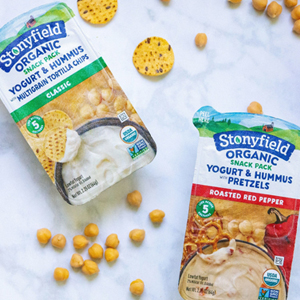
[00:06:30] Ray Latif: Also, we had a visit from Doug Kaplan, who's the co-founder of a brand called Back Bay Roasters. They make cold brew coffee that's HPP'd. They're right in our backyard of Boston. I'm holding in my hand a cold brew latte. This is good stuff. And we sat down with Doug for a new edition of Elevator Talk that'll be published next month. Look for that. Have you tried these? I mentioned Stonyfield Farm. Have you tried these Stonyfield organic snack packs? This one has yogurt and hummus with pretzels. Yeah, I've tried that. That's it? You've tried this? I've tried it. I'll say that. You're not a fan of the yogurt and hummus blend?
[00:07:11] Mike Schneider: I don't understand the blend of yogurt and hummus. I like yogurt with pretzels and I like hummus with pretzels and yummus or hoagurt or whatever it is. It wasn't really my jam. Yummus.
[00:07:22] Ray Latif: I like that. Yummus. Yeah. How about these Grillo's Sandwich Makers? They're thin slices of, or relatively thin slices of Grillo's Pickles, another local brand based in Needham, Mass. Needham, Mass. Needham. I said Needham. Yeah, really interesting brand, really interesting company. You were just thinking of something that would go well with the pickles. I was. Yeah. There you go. Yeah, I'm hoping we can talk to Travis Grillo, the founder of the company. He's got a really interesting story. He started his business in a pickle cart. in Boston Common, and it's grown to be a pretty well-known brand.
[00:07:55] Mike Schneider: I think most people around here know Grillo's Pickles and know that it's local. Yeah. We had another matcha brand come in, Min's Matcha. Min's? How do you spell that? M-I-N apostrophe S, or Min's or Me. I think Min's like mini, short for mini.
[00:08:07] Ray Latif: Okay.
[00:08:08] Mike Schneider: I really like this package. First of all, the ingredients are easy to read and I think that's because it's a simple ingredient panel here. It's, you know, purified water, organic cane sugar, organic lemon juice, organic Japanese matcha green tea, organic peach flavoring, organic ethyl alcohol, natural flavors.
[00:08:24] Ray Latif: And that's on a pink label. On a pink label. 10 ounce glass bottle with a gold cap and I want to call it a safety sticker along the top so you know if it's been opened.
[00:08:34] Mike Schneider: Three primary call outs that I understand. One is, It's small batch, so it has the batch number, best by date, and then also a caffeine level of two dots out of four, which I don't know exactly what that means, but I think it's cool.
[00:08:47] Ray Latif: Is the batch number and the expiration date, are those written by hand? They appear to be wiping away, right? Oh, and by hand they are.
[00:08:57] Mike Schneider: What's this heart mean?
[00:08:59] Ray Latif: Uh, Start The bottle of matcha is a donor?
[00:09:02] Mike Schneider: Maybe. Oregon donor matcha. 60 calories crafted with love. The taste, it's pretty good. It was a little grainy, but it's, it's, it's pretty good.
[00:09:11] Ray Latif: Shake well.
[00:09:12] Mike Schneider: I must not have shaken it well enough.
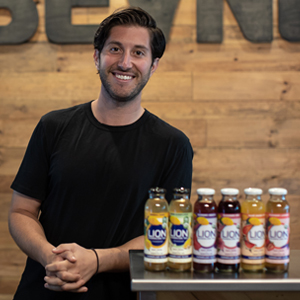
[00:09:14] Ray Latif: Well done. Well, if you you got to shake this bottle of Lion Tea as well to Lion Tea, as I mentioned Start The top of the show, the brand of dandelion based teas, the one I have in my hand is their original dandy. This one has zero sugar. The drinks are promoted for their detox and digestive health benefits. Ray DeRosa, as I mentioned, is the founder and CEO. He launched LionTea in 2017, and his journey as New Beverage entrepreneur has been lined with many of the familiar pitfalls that befall newcomers to the industry. Despite early stumbles, he stayed the course and found traction in the form of national distribution at natural grocery chain, The Fresh Market, and a fast-growing e-commerce business on Amazon. In the following interview, I spoke with Ray about the origins of Lionte, why direct and personal interaction with consumers is key for young brands, why partnerships with retail buyers are so important, and how mentorship Health-Ade Kombucha's CEO and co-founder, Daina Trout, supported his development as a leader. Hey folks, it's Ray with Taste Radio. I am in the Taste Radio studio in Watertown, Mass. Sitting with me right now is Ray DeRosa, the founder and CEO of Lion Tea. Ray, how are you? Hey, Ray, I'm good. Happy to be here. Ray and Ray.
[00:10:30] Lion Tea: Yep, absolutely.
[00:10:30] Ray Latif: First time that's happened. Yeah, me too. So you're here in the Boston area. Where are you based? We're based in Brooklyn.
[00:10:37] Lion Tea: Been based out of there for close to three years now.
[00:10:40] Ray Latif: I first met you at BevNET Live Summer 2017. You participated in the New Beverage Showdown, New Beverage Showdown 13, made it to the finals. So great job on that. Folks at home who may have missed the showdown or not come to BevNET Live, tell us a bit about LionTea. What is it? Why'd you Start The company?
[00:10:59] Lion Tea: Sure. So the idea for LionTea came about 10 years ago. I actually partied too hard on my 21st birthday.
[00:11:06] Ray Latif: You were not the first person to do that, so don't worry about that.
[00:11:09] Lion Tea: I woke up the day after with a massive hangover and blurry vision. I thought I just partied too hard and turns out I triggered a rare eye condition.
[00:11:18] Ray Latif: You might be one of the first people to do that, actually, though.
[00:11:20] Lion Tea: I sure hope so. It was not fun. Jeez. And my mom, who is super Greek and super holistic, she actually has the eye condition as well, immediately started pumping me full of this concentrated dandelion tea and vitamins. Within three days, my vision was back to 2020. So I was instantly kind of in awe of these dandelions and knew that I just wanted to try to spread them with as many people as possible. I entered a business plan competition at Temple University and won. I bottled up 300 bottles of tea in my truck, drove across country with my dog, and Start The company out there. Long story short, I got my butt kicked inside eight months. I had no idea how capital intensive or how much you needed a support team around you to build a business like that. It ended up being really great for us because the market is in such a different place now and so much more ready for brands like ours than it was back then. And, you know, having that opportunity to kind of show the marketplace what we had Start The New Beverage Showdown was really awesome. I mean, we made it to the finals, but we were just babies. You know, we were 30 days old. You had maybe the first cases that came off the production run. And so, you It was great feedback to hear so early on because what we heard was you guys made something that's super tasty and functional, but you have a lot of work to do on the brand. And that was exactly what we heard in the marketplace. So hearing it that early on really kind of taught us like, okay, let's see if we can communicate this message better as we go.
[00:12:47] Ray Latif: And again, that was just about two years ago. And chatting before we got on the mics, one of the things that really stuck with me that you said was that we've survived. And that's not often something you hear entrepreneurs say, like as a measure of success, that we survived these first two years, but it was so important for you just to make it this far and to say, okay, now that we've got this experience under our belt and the fact that we're still on the market, We've got at least that foundation to build off of.
[00:13:19] Lion Tea: Yeah. You know, it's, you make this weird dandelion tea, right? And you're like, is anyone going to like this? Is anyone going to want it or purchase it? And, but Start The same time, you know, you, you have this expectation in the industry to kind of go really far, really fast. And it's just a bit different than every other industry I've been part of. And every company that I've started in the past is more, you know, create a solid foundation and then build upon it.
[00:13:46] Ray Latif: Why was there that expectation of grow really fast for you? I mean, is that just from seeing other brands do as well as they had?
[00:13:55] Lion Tea: I think it's the way the industry is measured too, right? How many doors are you in? Where are you? Like, are you nationwide yet? You know, are you ready to go nationwide? And You're like, dude, we just did our first production run. I'm just like hoping somebody wants to buy our stuff. And so it was just interesting to find our path, you know? And so we started going down the traditional path of, you know, go kind of launch in New York, right? And then get that base underneath you. And then before we knew it, we were up to like 500 doors around New York, New Jersey, Connecticut. And it was just such an inefficient model. You know, we were burning cash. Our velocities were going down. So basically I did like an analysis of our profitability within stores and reorder rates and all that. And I just drew a line in the sand. And it's like, if it's on this side, you know, cut them. And if it's on the other side, support that out of them. It was that point when our business started to really get sound and those doors that we kept with actually ended up creating more revenue for us in the long run than, you know, having 500, 600 doors in the entire industry.
[00:15:02] Ray Latif: What about those retailers? What about those locations worked for you? How did you support the brand in those stores?
[00:15:11] Lion Tea: It started with the buyers. You know, so when we walked in, the cool thing that I learned is dandelions have this really loyal, small, I'll say, but following, you know, people understand that they are a medicinal super plant and not this pesky weed that we have in our backyard. And so you could hear it on the buyers when they're like, Oh yeah, I know dandelions. And. we're going to give you a shot because what we learned was we have to drive awareness about our product. Most people don't know about the end lines or the benefits, but we've created something that's super tasty and super functional. And once we can make consumers aware, it starts to take off. Now that usually takes three or four months to really Start The show. And so when we started taking that approach of we're not going to work everywhere, we want to find the right partners that support us and we're going to support them. And it just changed the game for us.
[00:16:00] Ray Latif: We'll be right back with more from Ray DeRosa after this quick break.
[00:16:05] The Fresh: This is the sound of Rise Nitro Cold Brew. It's the sound of cold brewed awesomeness. The sound of freshness, the sound of organic. It's the sound that says, hey world, I'm ready for you. Bring it on.
[00:16:21] Ray Latif: Again, you said that there's a whole contingent of people that know about dandelions, but what about the people that don't know about dandelions? How'd you get them on your side?
[00:16:28] Lion Tea: brand ambassadors, I'd like to say it's something more complicated, but we have a world-class brand ambassador team and they're fun. People enjoy talking to them, you know, and you get to just taste the product and, and, you know, talk about dandelions and, and it's really enjoyable experience for everybody. And. It's a low impact, you know, in terms of these marketing initiatives that you can take, but there's really nothing that compares in the early days to just talking to 50 or 75 people about your product. And, you know, it took us a long time to realize If we let people try our product and understand the functionality, they're going to come back for it. And that might be a more expensive model because we're using a unique ingredient that people don't know about, but it's a model that works for us. If we have the retail support to give it the time it needs to take off. And now we have all this data around stores that have been working with us for two years that yes, it does take off after three or four months. And you know, people come back and continue to repurchase the product.
[00:17:29] Ray Latif: Were you out there as a brand ambassador yourself?
[00:17:32] Lion Tea: I did all of our first. 50, 100, I don't know. I've lost count of the demos. I also, everyone in our company does a demo at least once a month to hear what consumers are saying. I love it. You know, it's fun. You talk about dandelions, you get to taste some product, you know, and, uh, I think it's really important too, because. just to know what people are saying. You know, there's no market research that compares to just letting consumers try your product and let them tell you, especially if they don't know that I'm running the company, right? I'm just a brand investor to them. So if they don't like it, they tell me. And if they do, no one comes up to you and is like, Hey, Ray DeRosa.
[00:18:07] Mike Schneider: Oh my God.
[00:18:07] Lion Tea: It doesn't work that way. Um, so that was when, you know, there's certain kinds of like places you need to get to, to feel confident enough that, you're going to actually have a chance to make it. Right. And so when we started consistently hearing like, wow, this is actually really good. That was something that people we realized, right. It's like people don't expect it to taste good. And when they say it's actually really good, they get it. They're like, this is something that's functional, but I actually enjoy it and I'm going to come back for it. So those little tidbits actually give you a chance to build some confidence and say, all right, now we know we have something that people like and come back for. How do we build. our path to kind of get to each next level.
[00:18:51] Ray Latif: The qualitative data that you just talked about is really important. Was there quantitative data that you could pull from those stores as well?
[00:18:59] Lion Tea: We did a really good job kind of jerry-rigging our systems in the early days, you know, Excel files. There's also some software, you know, like Repsly has been really invaluable because at least you can track, you know, reorders in natural independence, you know, what the communication were, is the buyer, somebody supportive, not supportive, and helping us to direct our marketing spends accordingly. But, you know, other than that, it's trying to get some distributor paperwork six or eight weeks after the month and sort through it, you know, in Excel files and just doing the best you can with it.
[00:19:35] Ray Latif: I'd love to talk about two of your biggest retailers at this point. Number one, Amazon, and then The Fresh Market, which you're chain-wide at that retailer. Starting with Amazon, it was also interesting because you mentioned variety packs do pretty well on Amazon as a trial to your brand, and you did the wonderfully difficult process of hand-filling those variety packs for a time, right?
[00:20:01] Lion Tea: Yeah. what I think is a good idea, you know, like, cause you don't know, right. You're just like, I think this could be cool, but I also might just think it's cool and nobody else does. And so I like to take those projects on myself and kind of prove the concept before we really invest in it. Right. Cause it's cheap when I'm doing it. So, you know, I bought our first box of 50 and it's, it's almost pretty sad. They're like these liquor boxes, right? Like it's made for beer bottles and stuff. So it wasn't branded. And you know, we put these variety packs on Amazon and they started taking off. And next thing I know, I'm making like 75 of them a week at night, you know, from like 10 to 12 with my girlfriend. And she's like, I I think you proved the concept like it's time to now find a solution for this. That brings you guys closer together, right? Yeah, sometimes, you know, no, I mean, honestly, without her and her help, I don't know how we would have survived. But, um, you know, it was just it was cool because. What we saw was even with these terrible looking variety packs, and I'm almost embarrassed to even show you guys what they looked like, but even with those, we saw when we sent them out that 42% of people ordered a case within 14 days, and 50% of those people ordered their two favorites. And so we're like, wow, like if we can just get these into people's hands, you know, this is something. And so once we saw that, I think I've made about 1800 variety packs in the last year. By hand. Yeah. Wow. And so that's when I was like, okay, now I feel comfortable investing in these and having somebody fill them for us and then, you know, selling them through Amazon.
[00:21:38] Ray Latif: You dropped some numbers there. Was it Amazon that provided the information that you needed or was that also sort of a jerry-rigged kind of thing?
[00:21:44] Lion Tea: Amazon will provide the information. It's just, it's very raw data. So you're spreadsheeting, you know, using pivot tables to basically match, you know, like, okay, they ordered a variety pack, where's their next order? And when was it? So, you know, that's just me like locking myself in the office and just Excel filing. you know, pretty regularly, because the data is there, just it's not very usable. So you kind of have to figure it out. And also, it was really important for us, like we have such limited resources is how are we going to invest them. And this was the first time we had any kind of real data. So we're like, let's just dig into it and see what's happening. And when we did, We started to see how many repeat purchases and how much people were enjoying the product because we saw also a lot of word of mouth purchases happening from our product and a lot of organic reviews, which is, it's tough to get.
[00:22:40] Ray Latif: We'll be right back with more from Ray DeRosa after this quick word from our sponsor.
[00:22:44] The Fresh: At Rise, we know the passion it takes to create something different. So we created an all-organic nitro coffee to fuel that journey and to make you roar. Every time you open a Rise Nitro, you'll hear that roar. Rise Brewing Co. Nitro Coffee. Release your roar.
[00:23:00] Ray Latif: I also mentioned The Fresh Market, National with that chain. Tell us about how you got in there.
[00:23:10] Lion Tea: For us, we were looking for the right key retailer and key partner, you know, and because what we learned from other brands who came before us was it's about finding the partners that are going to provide you extraordinary support in the early days that ultimately make you successful and. Dwight Richman from the restaurant market ended up being a Dandelion lover. And you know, he's like, I've been into Dandelion tea for a long time. I think they're about to have their moment and we'll give you a shot. And that was really what we needed was somebody who believed in us, who understood what we were trying to do and who was willing to give us a shot. So we're, we're really excited about that partnership.
[00:23:46] Ray Latif: And it could just be one person, but that one person supporting you and supporting your vision makes all the difference. Is that what I'm hearing?
[00:23:53] Lion Tea: Yeah, you know, it's just, this is such a hard industry to make it in, right? And if you can just survive long enough to prove the concept, then you have a chance, right? You're really just trying to level up each time is prove the concept, get a little further along, prove the concept again, until eventually you become a brand to be reckoned with and something that, you know, Start The push your weight around a bit. And in those early days, it was really important for us to align ourselves with mentors and other brands that have been there and tried that. And especially for us, like we're creating a new category, a new ingredient, which is a really like a big challenge. And it's not like we can go out there and piggyback on a market that's already there and say, we have the best one. We're like, here's a new ingredient you should try. And here's why it tastes good. And here's why it's functional. And so it was really important to see what worked and what didn't work. And I was really excited about how many other founders and other brands were willing to kind of say, here's what we did. Here's what worked, what didn't. And here's, you know, your, your version of it.
[00:25:01] Ray Latif: The phrase you use was collaboratively.
[00:25:03] Lion Tea: Collaboratively competitive, which means we're all selling drinks, right? So in a sense of the word, we're all competing, but I think. I honestly think everybody knows how hard this is. And so if you could just pass along some knowledge to some good people who are trying to make it work, then, you know, everybody else is kind of doing that same thing. So there are people ahead of me, you know, like Daina Trout from HealthAid has been an amazing mentor and has really taught me so much about this industry so that I want to be there to try to help other, you know, up and coming entrepreneurs learn, you know, what we did in the early days and what might be able to help them avoid some of the pitfalls of this industry.
[00:25:40] Ray Latif: How do you approach someone like a Dinah?
[00:25:43] Lion Tea: Uh, just love, you know, like the people who are here, you know, trying to do something, not just to go make a bunch of money, but because you truly believe in what you're doing and that it's helping people. I think there's, there's a, group of us, you know, who are looking to kind of bring that into the industry. And I'd actually met her Start The BevNET Showdown. So we were pitching and I was looking for her because we modeled everything that we did in the early days off of what HealthAid did. So she's like my hero. And I went up to be like, Hey, like, you're so awesome. She's like, is this you? And she had a bottle of our tea in her hand. I was like, this is like a dream come true for me. And, you know, we'd struck up a relationship and I think, um, you know, understanding that We're here as a mentor-mentee relationship and really focused on getting a value out of that, I think, is what makes founders willing to give up some of that. Really, that time is so valuable, but to pass that along to us is the reason why I do it for other founders too, is try to help them get a little further a little faster.
[00:26:48] Ray Latif: Well, Ray, I got to tell you, I think from what I saw two years ago to what I'm seeing now is pretty remarkable. And I commend you for everything that you've been able to accomplish to this point. And certainly very much for this lemon elderflower variety that I'm holding in my hand. This is your zero sugar variety. It is quite delicious. And not even for the daily detox or digestive aid would I drink this, but just for the flavor, it's, it's phenomenal. Is this the one that you climbed the 30 foot ladder for?
[00:27:15] Lion Tea: It is the one I climbed the 30-foot ladder for. Yeah. So for all you up-and-coming beverage entrepreneurs, what I learned the hard way is you get three chances to make these taste good. And especially when you're making a new flavor, they almost rarely do. And so It's an art and a science to get formulation down, and unfortunately both failed me on the lemon elderflower. And for a brand like ours, you run it knowing that it's not tasting the way you want it to, or you dump it, which is like, would kill us. Or the third option is to climb a ladder with the ingredients that you think you need and hope for the best. And so, you know, I went for getting up to the top of the ladder, adding a couple of ingredients, and sure enough, it balanced everything out and we were able to run it. Well done. Well done.
[00:28:00] Ray Latif: Ray, this has been a fantastic interview. I really appreciate you taking the time to sit down with me. Good luck with everything going forward and come back soon. Yeah. Thank you very much. Thanks for having me. All right. That brings us to the end of episode 45 of Taste Radio Insider. Thank you so much for listening, and thanks for our guest, Ray DeRosa. Please subscribe to Taste Radio Insider on the Apple Podcasts app, Spotify, Stitcher, SoundCloud, or Google Play. As always, for questions, comments, ideas for future podcasts, please send us an email to askattasteradio.com. On behalf of the entire Taste Radio team, thank you for listening, and we'll talk to you next time.
[00:28:40] SPEAKER_??: you