[00:00:04] Ray Latif: Hello and thanks for tuning in to Taste Radio Insider. I'm Ray Latif, the editor and producer of Taste Radio, and you're listening to episode 57 of the podcast. I'm with my BevNET and Nosh colleagues, John Craven, Mike Schneider, and Carol Ortenburg, and we're recording from the Taste Radio studio at BevNET headquarters in Watertown, Mass. In this episode, we feature an interview with Shilen Patel, the co-founder of Distill Ventures, which describes itself as, quote, the world's first accelerator for the spirits industry, and invests in early-stage distilled and non-alcoholic drink brands. If you like what you hear on Taste Radio Insider, please share the podcast with friends and colleagues. Of course, we'd love it if you could review us on the Apple Podcasts app or your listening platform of choice. I always feel like I'm screaming into the mic when I'm doing the intro. You are. Am I? I'm just projecting. You're very exciting.
[00:00:51] Elizabeth Banks: You're projecting.
[00:00:51] Ray Latif: It's okay. You would be a good, like, you know, because you're always there in your blazer, like, doing the showdown at BevNET Live. Like, you'd be a good, like, WWE, like, announcer. You know, I don't know if I've mentioned this on the podcast before, but you've done that. You are a better looking mean gene, Oakland. Oh, thank you for saying that. I just had a, that means a lot for coming from you, Mike. Um, no, I don't know if I've ever mentioned this. I've always wanted to be a game show host. That was like my dream job as a kid. And so that's why the showdown gives me so much pleasure because it's like, I'm Peter Tamarkin from press Your Luck. I knew you were going to say, press Your Luck. No whammies. Did you know this here? Wait on three. to no whammies. Oh, Ray, you can do better than that. How are you going to get the job? It was a contestant. Yes. He would always just go wild when they won like $5,000 in a spin. So did you know there's a new Press Your Luck? There's a reboot of it, Elizabeth Banks. I didn't know game shows still existed.
[00:01:53] Elizabeth Banks: Isn't it on the Game Show Network?
[00:01:55] Ray Latif: No, so there was a show called Whammy, which was a lame attempt at rebooting Press Your Luck. Now there's an actual new Press Your Luck. It's on Primetime, I believe it's on ABC, and it's hosted by Elizabeth Banks. It's pretty good. Could you do game show trivia? Would you be good at that? If I said, all right, what's the one with the slot machine cards behind you when you pull the lever? I have no idea. Joker's Wild, of course.
[00:02:20] Elizabeth Banks: Oh, that's old.
[00:02:20] Ray Latif: What about the one with the dragon that'll eat you if you pick the wrong square? Tic-tac-toe. Okay, there you go.
[00:02:25] Elizabeth Banks: I feel like Neil Martinez Belkin from our editorial team now writes about the music industry. Ray, maybe you have a career writing inside the game show industry.
[00:02:35] Ray Latif: Second career? Oh, gee. That would be a great career move, I think.
[00:02:40] Elizabeth Banks: Expose a on Press Your Luck.
[00:02:43] Ray Latif: Yes. She's trying to get rid of you. I like that.
[00:02:45] Elizabeth Banks: That's good. The mind of Ray would be the first one in his spare time. Nice and weekends toiling in a basement, writing about Press Your Luck.
[00:02:55] Ray Latif: Can you imagine seeing this live? Cause that's, that's coming up. We were just talking about BevNET live and you're going to have your opportunity to see Taste Radio live. Exactly, that'll be on December 7th Saturday at 10 a.m. In the morning some exceptional guests that will be on stage that we'll be talking to If you are coming to Nosh live or bet net live or both Perhaps it's something you should check out brew bound live. Feel free to check it out. Yeah, it's included with your ticket Yeah, we're gonna have a theater in the round style set up So it'll be fun. Yeah, who's gonna be there who jay-z?
[00:03:27] SPEAKER_??: Oh
[00:03:29] Ray Latif: I'm just going to keep saying Jay-Z's going to be there until somehow he does show up. He'll manifest his destiny. You know he has a cognac brand, D'USSE. And he's going to come right after David Beckham and we're going to have George Clooney as well, right? If Becks attends, I'll be very, very happy. That'd be so awesome.
[00:03:50] Elizabeth Banks: I am thinking though, maybe we should change the livestream lounge interviews.
[00:03:54] Ray Latif: Livestream studio.
[00:03:55] Elizabeth Banks: Livestream studio to have like a Jeopardy board in the background. And before you can do an interview, you have to be like, Ray, I'll take functional beverage ingredients for 400.
[00:04:07] Ray Latif: No, you, you, you go right to a thousand now. That's the new way to play. CBD for a thousand.
[00:04:12] Elizabeth Banks: CBD for a thousand. old brands that end in L for 500.
[00:04:19] Ray Latif: Legacy brands ending in L for 500, Ray. Mike, you've been messing around with these two little products that you have in your hand. I've been smashing these two things together. So I've got Zuma Valley Coconut Balls Pineapple, which Carol pointed out to me have some new packaging.
[00:04:35] Elizabeth Banks: Yes, they upgraded their packaging. Branding stayed pretty consistent, as I think you noticed, but just next level, graduating to that next level pouch.
[00:04:43] Ray Latif: This next level pouch gives you, you know, just that little extra something, something. It's a little, it looks a little more. I don't even, the thing is, what is it? Is it a snack? Oh, it's a snack. These are great. You haven't had these before?
[00:04:55] Elizabeth Banks: These are amazing.
[00:04:55] Ray Latif: It's just one ingredient. Yeah, coconut and pineapple knows some of them are one ingredient. They're really good This looks like something I'd bring on the plane as a snack like it's just you know one of those healthier items that Because they almost never have good snacks on planes Really passengers You could also do that. It could be a game.
[00:05:20] Elizabeth Banks: You might get in trouble.
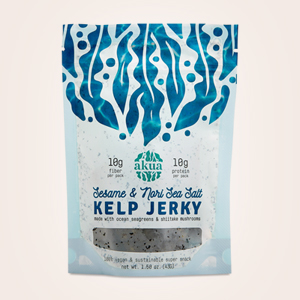
[00:05:20] Ray Latif: You're just like, here, throw it into someone. Yes. Well, what else do you have in your hand there? Well, I have this interesting jerky that Carol handed me. It's spicy Thai and spirulina Kelp Jerky from Akua. And it's made with two things that exist together in nature, ocean sea greens and shiitake mushrooms. Akua? How do you spell that? A-K-U-A. OK. Or it could be aqua. Where are they based out of? Maybe it's aqua. How do you say it? Yeah, maybe I could be wrong I think Akua sounds right were they from Whole place yeah one second here Quickly Mike I'm trying ray wasting tape You know it's not all the way at the bottom. No you just find it easily.
[00:06:05] SPEAKER_??: Oh
[00:06:07] Ray Latif: It doesn't say it doesn't say oh, no, it's from it's from out of this world This has a lot of ingredients in it that you didn't mention such as Well, they need a copy edit black purple oh No, I can't wait to eat that black purple. It's my favorite. I assume that's the typo Graven's going in for it. I just want to You're gonna smell it. I'm gonna taste it. Actually, you're gonna smell it.
[00:06:35] Elizabeth Banks: Don't mingle it too much.
[00:06:36] Ray Latif: I'm just gonna smell it.
[00:06:37] Elizabeth Banks: We also have one exotic snack here.
[00:06:39] Ray Latif: Good luck. Here I go. All right, we're a cool. It's a pungent pungent flavor. So I think the kelp. Yes. You've got to be ready for that. Whoa. Yeah. Can I have some umami crunchy snack? So what are these John Craven and Mike is handing to you? Looks like a bag of mushrooms with barbecue flavoring.
[00:07:04] Elizabeth Banks: Oh, no, it is a bag of mushrooms and barbecue flavor Don't you guys love having me on the show?
[00:07:09] Ray Latif: I bring you all the great snacks see The Mushroom this one has a this is a taste adventure This one says a it's a choking hazard unsuitable for children under five I have not seen that on a snacking product in a long time. Is it a bag of Legos? Oh They roughly look like little tiny mushrooms Only try one it is pretty good.
[00:07:32] Elizabeth Banks: Okay. Those are actually from Israel and It is a company that's trying to use it's The Mushroom benefit company I believe is their name and they're trying to The Mushroom in multiple different ways. So they also The Mushroom The Mushroom snacks. I thought these were pretty craveable Mike's definitely in the bag of them before I
[00:07:50] Ray Latif: Oh, I've garbage mouth these. I try to eat while I'm recording, but I don't know. The Mushroom benefits are legit. That's legit. That's legit. There you go.
[00:07:58] Elizabeth Banks: Yeah.
[00:07:59] Ray Latif: So this Akua is a whole taste adventure here. They've gone way beyond just ocean sea greens and shiitake mushrooms. I mean, when you bite into this thing there, and then you look at the back, it explains everything. Cause it's coconut aminos, apple cider vinegar, chickpea flour. I mean, kosher salt. Birdseye chili ginger garlic. I mean this is a this is a proprietary blend. This could be every jeopardy answer on the board Still eating it to It's kind of not really jerky though. I mean you look like I don't know you're eating just like Sushi wrappers, you know
[00:08:38] Elizabeth Banks: It has the texture of jerky. This is something we've been exploring a lot on Nosh is like, what do you call dried things that are flat? The Mushroom jerky, fruit jerky.
[00:08:47] Ray Latif: A bar? How about a bar? It's not a bar. This is not a bar. And it is snack. Closest to jerky. But to say it's jerky, I mean, if you put this in the hand of the jerky lover, like the average Bubba, you put this in their hand, they're going to be angry. They're going to be pretty angry for sure. That's the name of the category, the Bubba category. So like, that's who comes in to the C store most often and picks up the jerky. So like, they're not going to, I don't think going to think this is jerky? Well, we had a brand on Elevator Talk a few months ago called Soley. S-O-L-E-Y. And they make a fruit-based jerky. And they make it with just a couple of ingredients as well. The one I saw at Whole Foods recently was made with pineapple and coconut. It's interesting. I mean, like, I like the concept. I don't know if you can call it. I don't know if you need to call it a jerky.
[00:09:38] Elizabeth Banks: It's almost like a fruit leather. If you ate those as a kid, like a better for you fruit leather.
[00:09:42] Ray Latif: Yeah. I'm not sure why you need to call certain things jerky to John Kramer's point. I think the word snack would be better. There you go. I like this, I think. I'm not sure, but I think I like it.
[00:09:53] Elizabeth Banks: I mean, to be fair, you do have to put a statement of identity on your packaging, and that is kind of regulated, so I'm guessing some of that maybe.
[00:10:01] Ray Latif: I don't think jerky is regulated. I don't know. You could say, how about another one that's on trend? Snacking kelp.
[00:10:10] Elizabeth Banks: You could say snacking kelp.
[00:10:11] Ray Latif: Kelp fins. There's many ways.
[00:10:13] Elizabeth Banks: Kelpios.
[00:10:15] Ray Latif: I don't want to think about jerky. I don't really like meat jerkies. I don't really want to think about jerky when I'm eating, say, fruit or if I were to choose to eat kelp. Carol, did you bring these snacks back from Denver?
[00:10:26] Elizabeth Banks: I unfortunately did not. I was at the Mobile Innovation Summit and the content was pretty riveting.
[00:10:32] Ray Latif: Mobile Innovation Summit. No time for looting. That's great. What is the Mobile Innovation Summit or MIS for short? It's miss, it's hit or miss. Was it a hit or miss event?
[00:10:43] Elizabeth Banks: They actually, I'm looking at my name tag and it was a big M and an I. I'm guessing they did not put the S on there for that reason. Got it. But it was kind of examining all the latest and greatest trends in sort of digital marketing and digital communications with your consumer and how you can use different touch points to reach them. variety of speakers. I was honored to be on stage moderating a panel about women in venture capital, investing in women, and how the venture capital industry is sort of changing and what folks can do to support just diverse pools of entrepreneurs in general. But there was also sessions, Joel Warady, who will be coming up on the podcast soon from Enjoy Life, talking about how his company likes to think digital but act analog. And what does that mean exactly? Like, how does a special diet snack food company embrace both of those things? So there were some really great, amazing speakers. I learned a lot about also just new techniques brands can use in marketing and for promotions that, you know, is sometimes stuff we don't get to hear about, which is pretty cool.
[00:11:52] Ray Latif: We got a debrief on these new ideas. I can't wait to hear about them.
[00:11:56] Elizabeth Banks: While I was in Denver, I did manage to sneak away for lunch one day at this really cool small chain called Five on Black. And it's chipotle for Brazilian food. So you pick a base of rice and then you can get like a Brazilian stew or roast chicken and instead... Do they have the swords or no? They don't have the swords. But you do get Brazilian cheese bread with your meal, which is kind of amazing. But all the toppings are really interesting, like a cilantro chutney or a tomato vinaigrette. And it was kind of like- Did they have the Kelp Jerky? They did not have top-able Kelp Jerky.
[00:12:33] Shilen Patel: Snacking kelp.
[00:12:34] Elizabeth Banks: They didn't have snacking kelp.
[00:12:35] Shilen Patel: Just checking.
[00:12:36] Elizabeth Banks: It was pretty cool to see a fast casual concept represent a type of cuisine that I personally don't get to eat very often.
[00:12:44] Ray Latif: Did you get to eat much when you were in New Orleans? I hear you went from Denver and New Orleans and back here to Boston. How are you not completely exhausted by the way?
[00:12:52] Elizabeth Banks: I am exhausted. I'm just propped up on caffeine right now.
[00:12:54] Ray Latif: Okay, good.
[00:12:55] Elizabeth Banks: Mike has been making me lattes and Minor Figures cold brew.
[00:13:00] Ray Latif: Minor Figures. Chill British coffee brand. Yeah. And oat milk. And oat milk.
[00:13:06] Elizabeth Banks: But yeah, New Orleans always has great food. Went there after for some, some family adventures and was super excited. I walk into Whole Foods and what's going on? A demo of Big Easy Bucha, which is, you know, being a local New Orleans, Holds a special spot in my heart and was really cool to get to test out their new apple pie Limited edition kombucha flavor, which is apple pie infused with apples and cinnamon John Craven. They suggest you add moonshine Pomegranate syrup and garnish with a cinnamon stick and make a moon shiny apple.
[00:13:42] Ray Latif: I prefer moonshine straight
[00:13:46] Elizabeth Banks: Is this your career, distilling in your backyard?
[00:13:48] Ray Latif: Do I drink moonshine? Not really, that's just like alcohol. Do you prefer snacking shine? Snacking shine? Yeah, like drinking shine. You know, it's like drinking vinegar, you know?
[00:13:57] Elizabeth Banks: But yeah, it's a cool kombucha company. They say you can drink it out of the bottle. They also have kombucha shots. Or their founder, one of them, was a former bartender, and so he comes up with cocktails to make with all of their kombuchas.
[00:14:10] Ray Latif: Well, I will say their kombucha, I've had it a couple of times. It is quite tasty, so. would now on a mix of those how do you feel that service regal Oh God, here we go. Um, well now I hate it because they have a Manchester United bottle. Is that the dancers? What are they trying to say? This is the bottle of swill or what? So wonderful. The folks behind Chivas Regal to not only create this limited edition Manchester United bottle, which celebrates their 13 Premier League titles, but they sent us one and I have it in a very special place in my home and I'm going to keep it there until we win our next one. Picture you out in the street somewhere Picture you out in the street somewhere after a match, you know riding with some other supporters and you know, just swinging that right from the bottom While you're draped in like a flag or something. This is the best idea I've heard in a long time. And throwing it at the other team supporters when it's over. Why would you ever waste Shiva's Regal or the Mantis Unite Shiva's Regal more specifically? No, no, no, when you're done with the bottle. Oh, when you're done with the bottle.
[00:15:16] Distill Ventures: You just throw it in the crowd.
[00:15:17] Ray Latif: Yes. OK, now. Put gasoline in it first. This is going to come back to haunt me because this audio is going to be used by the police at some point. It's true. Nate, please tell Nate, our director, please tell me you stopped the recording. No? All right, fine. Speaking of British brands, it's probably time we get to our interview with Shilen Patel, who, as I mentioned at the top of the show, is the co-founder of UK-based Distill Ventures. Launched in 2013, Distill Ventures, or DV for short, is an independently run brand accelerator backed by Diageo, the global spirits conglomerate whose portfolio includes iconic brands like Johnnie Walker and Bulleit Bourbon. Over the past six years, DV has invested approximately $70 million into 15 small and early-stage brands, including Westward American Single Malt Whiskey and non-alcoholic spirit Seedlip. In an interview with John Craven and Mike Schneider, Shallan discussed the formation and mission behind DV and its relationship with Diageo, why he's bullish about the future of low- and no-alcohol adult beverages, and why product quality is of paramount importance to DV's investment philosophy. All right, John and Mike here in London at the offices of Distill Ventures and we are joined by Shilen Patel. Thanks for joining us. Not at all.
[00:16:34] Johnnie Walker: Thanks for having me.
[00:16:36] Ray Latif: So you guys are probably best known for your investment in Seedlip and your partnership with Diageo. But since you're one of the co-founders here, I'd rather you give our listeners a quick intro to Distill Ventures and what it's all about.
[00:16:53] Johnnie Walker: Sure, so Distill Ventures is six years old and it really came about because my business partner and I, his name's Frank Lampin, he and I were looking out into the startup community for food and beverages and really just thinking it was massively under supported. So we had some friends who were trying very hard to start businesses in this space and who we felt like were possibly finding it harder than they should be. And some of that was to do with money. This isn't, especially the drinks industry, has not necessarily been over time a place where it's been easy to get investment. It's been a place where investors have tended to stay away. In the UK, you mean? In the UK, definitely. In Europe, definitely. US, yeah, less so. And we probably more importantly thought it's a space where it isn't very easy to get help. It's not a sort of place where the community itself is amazing. You can go out and ask people and they'll be happy to help you, but it's not a place that's awash with data. It's not an industry where there's a lot of proven case studies that people can kind of look at and understand how things work. And so our general thought was that this doesn't seem right, there's got to be a way of helping entrepreneurs. We had done a lot of work with Diageo over the course of a number of years and we had found them to be an incredibly good partner, really super smart about their industry, very, very open about sharing knowledge with us when we'd worked with them in the past. And so for us it really was a matter of putting those two thoughts together and seeing if there was a win-win here. whereby we together with Diageo, in partnership with Diageo, could leverage both our knowledge bases, theirs of drinks and the industry, ours of entrepreneurship and growing businesses and founding businesses, and with their money, which is always useful, see if we could go and find some entrepreneurs who were looking for that sort of assistance. with the aim being that we would help those entrepreneurs make fewer mistakes. That's kind of job one. Let's open the lid on what works and what doesn't work. Let's show you a bit about what we know and let's make sure that you don't make some silly mistakes as you're beginning to found your business and grow it. So they can make all new ones. So they can make some new ones. Yeah, true. I mean, the big thing was just like, you know, don't make some really bad assumptions, right? And you guys will know all about this from the US. the number of people in Europe who make a bunch of assumptions about how you might or might not enter the US market and what those assumptions are they're generally 90% wrong right so let's make sure they make fewer mistakes and then let's see if we can help them go further a bit faster and part of that of course is money you know it's helpful to have money although what I'd say about money is our view of money is it's about going slower to go faster for us the ability to give our partner companies, our invested companies, cash is really to prevent them from having to make compromises about running their businesses really well, so they don't have to keep the lights on quite as much as everyone else, so they can go slower, learn better, which I think makes for better businesses in the long term, more sustainable businesses, so it's a bit of an aside. Yeah, really see if we could help them go a bit further faster with the ultimate aim, if they were interested in an exit, and not all entrepreneurs are interested in exits. But if they were interested in an exit, then Diageo is a pretty good company to exit to.
[00:20:09] Ray Latif: And, you know, I mentioned Seedlip, who we've had on our podcast, as well as Starward Whiskey that we've also had on our podcast. But what are some of the other companies that you guys are working with?
[00:20:20] Johnnie Walker: The first thing to say is we have a principal at DV, which we call Entrepreneur First. which is I think a little bit different from many accelerators. Our view is it's the entrepreneurs and their needs that should go above everything else. And so one of the results of that is we don't talk about who we're invested in unless the entrepreneurs particularly want to talk about it. It's their business. We only ever take minority stakes. they should be able to tell their stories how they want to. So I'm just going to say that up front, because that means I can't tell you about all of them. There are a number that have gone public, and you've mentioned a couple. So Westwood and Seedlip are in there. Starwood, which is an Australian whiskey. Stauning Whiskey is a lovely whiskey company out of Denmark and we do have a great interest in what we call new world whiskey. Whiskies that don't come from traditional provenances or if they do come from traditional provenances they're taking a very different take on whiskey, Westwood would be a good example of that. And it's not that we don't believe in traditional whiskeys, we do. They just, they've got a lot of money and they're really successful already. So our view is, you know, whiskey is such a great category to explore as consumers, why shouldn't we be trying to figure out what these whiskeys could taste like coming from very different provenances. So we do spend a lot of time in New World Whiskey and we do spend a lot of time in non-alc. No and low-alc is how we would describe that. Our definition of that, which is probably important to talk about a little bit, is we're really interested in drinks and experiences that consumers would have on adult socializing occasions. So sometimes people read our non-ALC interest as, are you interested in soft drinks? No, not really. Not because We don't think it's an interesting category but our investor is Diageo and so we are interested in how adults will think about socialising in the future and what role full alcohol products will have in that, what role lower alcohol products will have in that and what role no alcohol products will have in that.
[00:22:22] Ray Latif: So you guys have a really great piece on your website about low and no alcohol products, which I would definitely recommend listeners who are interested check out to your point of, you know, sort of this adult consumer looking for other experiences. It seems like there's a lot of stuff out there, you know, competing for that right now, certainly in the U.S., cannabis being a big talking point, you know, session beer. different types of spirits, canned cocktails, you know, can you give us kind of just some insight into like you being non-alcoholic lead for DB, you know, what's your kind of like worldview on this stuff right now?
[00:23:00] Johnnie Walker: Let me start at the top, which is, you know, the question I often start with when you're seeing trends like this emerges, why, why do we think consumers are looking for this choice? And I think it's worth dwelling on that for a little bit. This does appear to be certainly from our perspective, a very, proactive and active set of choices from consumers. This is not something that where we're just offering products and people are just discovering them, they are literally asking for them. And you know, I think the big overarching trend of people's insight and interest in their own health and wellness has to be one of the single biggest drivers for that. People are obviously paying much more consideration to what they put in their bodies, where it comes from, how it's made, what it may or may not be doing for them in terms of health and nutrition and everything. And clearly people are becoming more cognizant of the idea of how much alcohol am I consuming. And that does appear to be, as I said, about consumer choice. This is like people making proactive decisions about what they feel is good for them. I think what I find interesting about that in general is the fact that it's a very very broad set of needs that consumers, I certainly hear, articulated back to me. So generally the assumption that people come new to this category come with is, oh well this is about designated driver, right? Or this is about pregnant women, right? And the answer is actually I don't think it is. I mean clearly it is in the sense that those are needs that people have on specific occasions. But certainly our learning here at DV would be that the vast majority of this shift is coming from people thinking more generally and holistically about what they're drinking and when they're drinking it. and that for instance they are just more conscious of trying to find more moments in their social lives where they don't want to compromise on the idea of connecting with their friends and family and other human beings but don't want to feel pressured into making this a drinking occasion or probably better said an occasion where I might be drinking lots of drinks or many drinks in the evening. And therefore, this does appear to be them saying, well, look, if I can find drinks and experiences which I feel are good enough, then having one less drink, even if it's as small as that change in their lives, is a positive change I'm making. And as I said, I think the number of people and the diversity of reasons they're giving for why they're making these shifts is the bit that fascinates me.
[00:25:40] Ray Latif: So this is part of the better for you movement. Do you see a specific generation leading the charge there? And do you see a decrease in maybe peer pressure? Because the idea in the past was if you weren't the one who was having drinks, you'd be called something like a lightweight or something along those lines.
[00:25:56] Johnnie Walker: Yeah. I think for people coming new into this space, the assumption is often, because To Press talks about it a lot, that this is a young person's trend, a millennial's trend. I mean, I personally don't like that word, but the media certainly here in Europe, I don't know what it's like in the US, would certainly exaggerate how that generation is very different from any generation that's gone before it. Not the US.
[00:26:19] Shilen Patel: We would never do that.
[00:26:20] Johnnie Walker: I'm not entirely convinced that that's true. We would do that. What I find particularly interesting is that we see the shift going on across every age group. So this isn't, in Europe certainly, this isn't about young people outright rejecting alcohol. This would appear to be consumers of every age group, age cohort, making considered choices about what they want to do and how they want to do it. We do see a female bias, interestingly. I think that might be driven by the kind of health and wellness trend, which seems to have a slight female bias to this. Plus, women are smarter than us, right? They just spot stuff a lot quicker than men do, I think. There doesn't appear to be a kind of young bias, which is, I think, the assumption maybe people make about it.
[00:27:02] Distill Ventures: Guessing your margins? That's risky. Belay Financial gives CPG brands the clarity to scale smarter, faster, stronger. Get your free inventory ebook by texting TASTE to 55123 and start making data work for you.
[00:27:22] Shilen Patel: Tune in at the end of this episode for an exclusive interview with Matt Lynn of Belay Solutions. He sits down with Melissa Traverse to break down the biggest inventory and accounting mistakes CPG founders often make. You'll learn how to bring clarity to your numbers so you can scale with confidence.
[00:27:39] Ray Latif: the specific product categories, you know, it seems like this trend is something that, you know, exists in a variety of different formats, things like, you know, seed lip that are trying to replace traditional spirits, ready drink cocktails that are low or no alcohol, again, session beer and whatnot. Which categories are the consumers, you know, kind of latching onto, like, is that demographic specific at all?
[00:28:06] Johnnie Walker: Well, I think the first thing to note is that there are a couple of categories in the world of alcohol that have had options in this space for, well, in some cases, decades, in other cases, a lot longer than that. So beer and wine have had low and no alc versions for a long time. It's taken a long time for, I think, the technology to get good enough for consumers to think that they might be worthwhile options. And there's certainly been, I think, a lot of negativity around them for lots of decades until very recently. We talk here at DV a lot about not creating less than propositions. And what do I mean by that? You know, I think there's a difference, not necessarily saying this is bad, but there's a difference between making something and then removing the alcohol. and making something that either never had the alcohol in it or had very little alcohol in it. And for me, the difference in there is that one of those things you said, I spent a lot of time and attention making this wonderful thing, and then by the way, I took something out. And it doesn't really matter how well you took it out. I think that necessarily creates a kind of viewpoint in people's heads that this is less than the thing that you originally made. And I'm quite interested as a result by the way in some of the brewers who refute that and sort of try and make things low ABV from start to finish for instance. Our view would be that there's a real difference for consumer perception between those things that are less than propositions and I think things like seedlet which never said I'm gonna make gin and I'm gonna strip the alcohol out. In fact juniper isn't a strong flavor in any of the seedlet products. And I think the difference here is to say to people, we can use similar processes to the ones that you know are used in the production of alcohol. We can use similar base ingredients, but what we're not going to do is try and absolutely mimic the thing that you already know and love. And I personally think that's good. I think that's a sensible approach to take that we shouldn't be suggesting to consumers that the only way of consuming non-alcoholic drinks is a non-alcoholic version of the thing that you already know and love. So I, you know, in particular categories, I tend to therefore kind of look at wine and beer and say, well, you're predominantly dominated by people who've made something and then strip the booze out. And what I like about where the direction of the spirits categories going in this space is almost all of it's made to be a particular ABV from start to finish. So whether those are aperitifs and vermouths. what we would call mid-proofs in the industry, which are kind of, you know, made using very particular ingredients and very particular production methodologies to end up at a sensible ABV, which allows you to have mixed drinks that are low ABV, or whether it's products like seedlet, which are literally new design processes, production processes to extract flavor and create very little alcohol in some cases or no alcohol in a few exceptional cases. I think those processes, because they're designed with the end point in mind, I just quite like that approach. I'm going to make this, again, language we use here at DV. We're interested in founders who start with a mentality that says, I'm going to try and make this drink. equal to or better than your favorite alcohol drink. Wow, that puts it in a whole different level, right? Now I'm not asking you to make compromises, I'm asking you to make side-by-side choices of things that might be as good as each other.
[00:31:28] Ray Latif: Certainly sounds better than we took something away. I think that's an interesting, you know, it's like decaf coffee or something like that.
[00:31:34] Johnnie Walker: Right.
[00:31:35] Ray Latif: You know, as you pointed out, some of these ideas are decades old, some are new and are gaining steam. Where do you think this all kind of goes? Is this something that is the doomsday threat for alcohol? Assuming you're not going to say that, but how big can this trend get?
[00:31:53] Johnnie Walker: It's a great question. I think my immediate reaction is, again, a phrase that we use here a lot to remind ourselves actually more than anything else. It's five past midnight on day one of a new category. It's pretty rare that you see the birth of a category anywhere. I mean, I consider it a personal privilege to be in any way, shape or form even vaguely associated with the creation of a new category. That's just an amazing thing, I think myself. But I do have to keep reminding myself and team members keep reminding me. It's very very early on. This is a very nascent emergent trend I think. And I think it would be wrong for any of us to look at where it is today and say that gives us any strong sense of what it could become. So let me start there. Having said that, I wouldn't be non-ALC lead and a quarter of our portfolio of invested companies here at DV, which is what it is, wouldn't be non-ALC if we didn't believe in the category. We have a strong belief that this has the potential to be a category that's both mainstream and mass and sustainable over the long term. And I'm particular about those points. I have a kind of personal thing which is I don't necessarily have a lot of interest in fads, personal viewpoint. I'm interested in things that are so good that they might be here in a couple of hundred years time. And as a result, our main consideration with the work that we do here at DV in this category is to try and help founders create the types of brands and products and companies that will be here 200 years from now. Whether the products are the same today as they will be in, let's say, even 10 years time, I doubt it. I think the products will be different. We're going to see a lot of innovation. I think people are just getting started on what are all the production techniques I can use to make some of these liquids. I think the obvious stuff has been done. I'm really looking forward to, you know, they always say that the best innovations happen when people start scratching beyond the obvious stuff. So I'm really excited about what might happen in the next two to five years as people start scratching underneath the surface. But I think it's too early to say whether it's definitively going to be this big successful new category, but I certainly hope it will be.
[00:34:12] Ray Latif: Well, if it's five past midnight of the new category, I guess like many new categories that end up being big, they go through many rounds of, you know, iterations, innovations. a lot of the things that happened in the early days might not be where it lands, right?
[00:34:28] Johnnie Walker: Absolutely right. And we make very few assumptions here at DV about what right might be. Our main driver, really, is liquid quality. Actually, almost every conversation here at DV that's assessing a no and low arc opportunity starts and ends with, how good do we think the liquid is? Do we think this comes close to that kind of idea of this could be something that people see as equal to or better than their favorite current drink?
[00:34:57] Ray Latif: This is also a crossover opportunity where you could treat this more like beverage, non-alcoholic beverage or alcoholic beverage. Which way do you see this going initially at least?
[00:35:10] Johnnie Walker: The two thoughts I have here are contradictory, so let me try and make sense of them. The first is that consumers generally like things to Big Easy to understand. We have a lot of decisions to make in any given day and not a lot of time to make them. My experience tells me that asking consumers to try and understand something completely new or where they don't have context for how does this fit into my life, how do I use it, how do I drink it, is a really tough ask. If it needs a lot of education, it's really hard to do that. The flip side of that, the contrary trend that keeps me in tension on that, if you like, is the blurring of lines that I see going on in almost every category of food and drink that I care to look at. and how people are probably, in my experience, I'm 48, and in my experience of being in CPG, Consumer Packaged Goods, for over 20 years, more open than I've ever seen them to blurring the lines, to forcing those category changes themselves and using products on occasions where they weren't necessarily designed for. So I do find it fascinating that we have to hold those two things in tension. But in the end, what I come down to is that's all driven by the consumer. In the end, it's individual human beings making decisions about what's right for their lives. And I think we just happen to live in a bit of history where these consumers are very happy to not have a one-size-fits-all solution. I think lots of consumers looking for lots of different solutions is the thing that I find fascinating about this.
[00:36:47] Ray Latif: So I could probably have a Negroni at halftime at some point. That'd be amazing. I would love that. Well, I think what you said is pretty interesting in certain markets, the U.S. being one of them. alcohol and, you know, non-alcohol products have, you know, had a dividing line due to, you know, regulations. So I think in a lot of cases, it's just a binary sort of decision of, you know, if it has alcohol, it goes this way. If it's not out, it goes that way. And I think that seems like, you know, one of the more, just from the industry perspective, you know, disruptive components of this is that, um, products that are, you know, non-alcoholic spirits, cocktails, whatever, aren't bound by the same rules. And it seems like, you know, we're seeing products that are ending up in this no-alcohol space as flavor extensions of a non-alcoholic brand. You know, they're trying to create a craft cocktail experience for their soda line or whatnot. So it does seem like, you know, this particular situation is somewhat uncharted territory in that regards.
[00:37:55] Johnnie Walker: Yeah, I'd agree. I think it is fluid. I mean, there's the general question of, you know, how far can particular brands or companies stretch, I think is a fairly fundamental thing here. Consumers who already bought into something that, let's say, comes from the world of coffee, a brand that's strong in the world of coffee, how far can that really stretch is an idea that I find interesting. But I think you're right about the fluid, the potential fluidity of this category. One of the things I end up... finding myself do, I don't know if this will make sense, but I find myself quite interested in where you will go to buy liquids in your local grocery store. Like the retailers in, certainly in Europe, call these shopper missions, like which aisle do I go to in order to buy what? And the lines are already incredibly blurred, right? I mean, you mentioned coffee earlier. Here in Europe, coffee already appears in the hot drinks aisle. the refrigerated aisle for cold brew, there's the convenience fridges that you're pulling stuff out of, you know, another category that's hot here at the moment in Europe, kombucha, it's found in multiple locations, you know, so that blurring of what are these products for and where do I go to buy them in the shops already happening. And I do find it fascinating, that soft drinks aisle, what's going to end up in there? Or where will those products end up elsewhere in store? And the same for what you traditionally hear in Europe called the BWS aisle, the beer, wine and spirits aisle. Traditionally the furthest aisle away from the entrance, the one that very few people ever end up in. You know, where will the non-ALC products end up eventually? Don't know.
[00:39:32] Ray Latif: Well, how do we know where they want them to end up? I mean, we know where the entrepreneurs would like them to end up. But the question is, what will retailers do with them? Yeah.
[00:39:41] Shilen Patel: And what about the use occasion? I mean, that's... Download Winning the Repeat Purchase Game on Amazon now at Taste Radio slash SUG. That's Taste Radio slash S-U-G to start building retention-driven growth for your brand on Amazon. Scaling a beverage brand into major retail comes down to operational readiness. From packaging lead times to co-manufacturing strategy, the details can make or break a launch. In a new e-book in collaboration with Octopi and Asahi Beer USA, industry leaders share what they've learned in helping brands scale. Download it now at Taste Radio slash octopi. Do you need to scale your team faster without compromising on talent? Join Oceans for a live webinar on April 20th and learn how leading companies are hiring top global professionals who are ready to grow with your business. Register for the webinar now at Taste Radio slash oceans. That's Taste Radio slash oceans.
[00:40:53] Ray Latif: Another thing that again, alcohol based on its effects says, you know, you don't go, I don't know, have one for breakfast, right? Yeah. So I mean, with products that are blurring these lines, you know, are consumers presently even, you know, still bound by those kind of norms?
[00:41:12] Johnnie Walker: Yeah, this is one of my favorite questions, actually. So as well as the health and wellness trend, which we talked about a bit earlier, there's a definite, in my opinion, trend going on, which is that socializing itself... is in a huge amount of change. The way that we connect as human beings with each other, and I'm not just talking about technology here, by the way, but the experiences around which we would like to meet our friends and family, the things that we'd like to do on those occasions, I think is in massive flux. And in my opinion, the main role for alcohol has always been in these adult social occasions. This is adults meeting each other, having great times together, talking, conversing, connecting, et cetera. And what I do find interesting is as the breadth of experiences that are available to human beings are changing, consumers appear to be pretty open to creating brand new socializing occasions. So we've just talked about the morning. I mean, Seedlip did some really interesting activity with a company called Daybreaker, who you all listeners may be aware of, who effectively run Dance, music, rave, mornings, you know, the thing that we've all traditionally associated with very late at night in the weekends as an energizing way of starting your day. There's no boost served on them. And yet whenever I've been to those events, they've been uplifting, positive, social occasions that set you up for the day. Wow, that's amazing, right? We, you know, we're socializing at times of the day we'd never really imagined happening.
[00:42:43] Ray Latif: in a way that we socialize in the evening.
[00:42:45] Johnnie Walker: Yeah, and then I can think of a bunch of examples that are like, you know, brand new social occasions that have never really existed at all. So I was talking to a couple of young guys the other day, and I was talking to them about how do they entertain their clients, because I'm old enough to remember the days when entertaining a client meant, you know, going out for dinner and having a good night out. And their answer was, well, we go to SoulCycle with them. Wow. I mean, that's like new behaviors. And so, you know, the question about what role might liquids play in that, I guess I'm choosing my language carefully here. You know, I don't think it's necessarily about saying, well, is alcohol, you know, necessarily need to be present there? Well, I think the adults can make that decision for themselves. They're pretty intelligent people. They know when consuming alcohol might be a bad idea. But the role for liquids, which they consider to be good for socializing, that's the bit that I find fascinating. How does someone decide whether a liquid is a good liquid for a social occasion as opposed to, let's say, a refreshing occasion? Oh, I've just finished some sport. I'm thirsty. What do I drink? And what I find interesting about that is the idea of flavor. Like what role does flavor and complexity of flavor play? And the simple, my oversimplified view of this is if it's a sip, not gulp drink, if this is a drink you spend some time over, then it's a good one for socializing, right? Because it lets you have the conversation and it's part of the conversation and part of the flow. If it's a gulp drink, well, that's for a different purpose. And so again I'm quite interested in what are the types of flavors that you can create for these sip moments.
[00:44:28] Ray Latif: What's your greatest fear with this space?
[00:44:30] Johnnie Walker: My greatest fear for the category really is that people see it as a bandwagon and it gets overhyped and some people might see it as a fast way to make some money and might cut corners. and forget again to this point about what makes alcohol and drinks so incredibly powerful generally in the world is these amazing stories of people who've created liquids that have amazing backgrounds and the techniques and the production and everything and you know just the sheer amount of energy they put into them
[00:45:08] Ray Latif: You know, shifting back to kind of what DV is all about, one of the things that you guys have is this sort of scholarship program or I don't remember what you call it exactly, but, you know, kind of working with really early stage people. Can you talk about that a little bit?
[00:45:24] Johnnie Walker: Sure. You know, how was that born? It was born out of. having a lot of would-be entrepreneurs and founders who are at very early stages coming to see us and asking the open question what do you what do you think of this liquid that I've been making and some people have been making some things in their kitchens and some people had managed to get to a development lab and were and because it's such a nascent area people were you know there's no obvious point or mechanism to allow you to compare. I mean you can take the market leaders and go and compare yourself to those, but if you're trying to do something relatively new or very new, how do you know whether you've made something good enough? So what we wanted to do was... The billion dollar question. Was to say, you know, traditionally people wouldn't necessarily approach us until they thought they had something cracked. And actually my interest personally and selfishly is I'd rather speak to entrepreneurs much earlier in the process because I would like to be able to have a chance to input into how they develop their liquids and what they do to develop those liquids and help them understand what we've learned here at DV about what makes something good enough and how are people decoding whether something's good enough or not.
[00:46:34] Ray Latif: You're talking about an experienced entrepreneur with an idea or even new entrepreneurs with ideas?
[00:46:38] Johnnie Walker: I think a real mix, actually. We're really open. Not all our entrepreneurs are seasoned entrepreneurs who've already built several businesses and this is business number three or four. You know, some of our most successful entrepreneurs have been first-time entrepreneurs. Ben was a first-time entrepreneur at Seedlip. So in the end, it's the quality of the idea and the quality of the thinking for me. That's the thing that kind of sets things apart.
[00:47:00] Ray Latif: So since you want to talk to entrepreneurs early, and I would imagine that some listeners when they hear that they're already googling, you know, looking up your email and phone number. What type of entrepreneur do you want to speak to? And what's sort of the right way to, you know, approach you or Distill Ventures in general?
[00:47:19] Johnnie Walker: Sure. Let me answer this in a couple of different ways. So for DV, generally, we're interested in people who have an idea, that has a very, very clear sense of how it's different and better than the other things that people might choose. And I'm kind of picking my words carefully, I guess. It's really not very helpful for us to meet people where they're saying, I've made X, it's like 5% better than Y. It's not that that isn't good, like go for your lives. It's quite hard work by the way that, but we're particularly interested here at DV at people who are trying to create more disruptive change than that, first thought. The second is in general terms across ALC and non-ALC, we ideally like people to be super clear about their role in that story as a founder. We talk a lot here at DV about founder led brands, and that's because we have a view that I have this phrase I use a lot, if you put it in your body or on your body, consumers really care about the human beings behind those companies now. That's just a truth I think. And as a result, I think the brands and the companies that are likely to be most successful are the ones that have founders who have really genuine, authentic, interesting stories to tell. Not, I started a business because I thought this would make me lots of money. I started this business because there was something that really bugged me about X and so I went on a journey to see if I could fix that problem. Like that is great storytelling for me, especially if a load of things went wrong along the way and then you eventually got there. So we tend to look for really founder-led businesses that have these authentic stories and we look for differentiation. In non-ALC, given that that's the main subject today, beyond that we look for people who are super clear about how and why people will use this product. It's very easy, and I think wrong, starting a business going, I think people will use this on lots of different occasions. Like, I've designed this so that almost everyone will use it almost all of the time. And the reason I think that's a bad idea is it's just incredibly hard to communicate that to anyone so that they know what to do with it. So I tend to be really interested in in founders who go I've got a hunch I think this is really for this sort of consumer on this sort of occasion that's where I think it's heartland is and yeah it might get used on a few others but I think it's really I designed it for instance for here That's when I get super interested. Like I'm like, okay, well, let's judge it against that thing. Cause then you can look at the flavor profile of the liquid and you can assess, does it seem to fit? Does that feel like a post dinner drink?
[00:50:02] Ray Latif: And does their communication strategy work on that specific audience?
[00:50:06] Johnnie Walker: Does the brand talk to me in that way? Does the pack fit? You know, does the price point seem sensible? That's more than anything what we look for. What we're pretty easy about is have you finished any of that work? We don't necessarily need people to have 100% answers on that or the liquid or anything else. I just need people to have a pretty clear view. We talked a little bit earlier about pitching. You should be able to communicate that in like five sentences max. I always think a good acid test of whether your idea is good enough is if you can't pick the phone up to your mom and explain it to her, in the first two minutes of talking to your mom and have your mom go, yeah, I get that, then you're nowhere near clear enough.
[00:50:46] Ray Latif: So let's say I have all those things. Do I just reach out to you or what? To get to the question that everybody wants to know.
[00:50:53] Johnnie Walker: Yeah, no, good. So, well, we have a website. Distill Ventures and on that website there is a very very specific section which is targeted at people who want to talk to us. It has a series of questions that you can answer, answer them as fully or not as you might want to be, but that is the best way of getting in touch with us.
[00:51:12] Ray Latif: I guess based on what you've said, they can reach out as early as they want.
[00:51:17] Johnnie Walker: Absolutely. So please don't feel like you might be too early stage. As long as you go to the website and you fill in that form and you fill in as many of the questions as you can. And if you don't know the answer that you're really honest about not knowing the answer, what that does is it lets us assess how quickly do we want to get into the conversation with you? And it also allows us to give you feedback. Like one of the things we're big on here is this isn't just about us selecting stuff. For us to create a good impact in the world, we see our job as going out and helping entrepreneurs irrespective of whether we might or might not be interested in investing in them. A good vibrant entrepreneurial community across the drinks industry is good for all of us. So one of the things that we do come to those forms with is a view that says, even if we're not interested in investing right now, we'll definitely give you some sensible feedback, which we hope will mean that you might end up with a better version of what you've got today, tomorrow.
[00:52:09] Ray Latif: If I'm a new entrepreneur, I might have a great idea. I also should have some idea about how to produce what I'm going to make, perhaps some idea of, you know, projection, maybe some retail experience, or how much of that stuff is actually important. It's great. It's a great question.
[00:52:24] Johnnie Walker: Yeah, I mean, look, the one thing we don't ask for, especially well, early stages, the first the one thing we don't ask for is a business plan. I think there's this sort of, weird view in the world that to be able to start a business you have to have written a 70-page document that guesses at some numbers that are like five years away, which I think is a colossal waste of time. I'm much more interested in someone, as I said earlier, being very very clear on what's the problem you're trying to solve. Like if I generally, when I'm giving pitching advice, I say there's really only three questions you need to answer. The first one is what's the problem in the world that I'm solving? The second question is, why is my solution different and better than anyone else's? And the third question is, what do I need to do next to validate it, or grow it, or what's the thing I'm looking for next? And if you can answer those three questions, I think you're probably reasonably clear on what you're trying to do. The trick, I think, for entrepreneurs is to work out which bits of that they're unclear on and why. Are you unclear that this liquid is good enough to do that? Well, okay, great, go and ask someone. And we're, I think, good people to ask for those sorts of things.
[00:53:26] Ray Latif: In the U.S., that's generally good enough to lock in a friends and family round, you know, because you're trying to prove out that I have something that has legs.
[00:53:33] Johnnie Walker: Yeah. And we, you know, our seed investments are not dissimilar to friends and family rounds.
[00:53:38] Ray Latif: All right. Well, Shlan, I really appreciate your time and joining us here on the podcast. This has been really insightful for us.
[00:53:45] Johnnie Walker: Not at all. My pleasure. It's been a really good chat. Really enjoyed it. Thank you.
[00:53:49] Ray Latif: Many thanks. That brings us to the end of episode 57 of Taste Radio Insider. Thank you so much for listening, and thanks to our guest, Shilen Patel. Please subscribe to Taste Radio Insider on the Apple Podcasts app, Spotify, Stitcher, SoundCloud, or Google Play. As always, for questions, comments, ideas for future podcasts, please send us an email to ask at Taste Radio. On behalf of the entire Taste Radio team, thank you for listening, and we'll talk to you next time.
[00:54:23] Elizabeth Banks: you
[00:54:29] Bulleit Bourbon: Hello, I am Melissa Traverse here for the Taste Radio podcast, talking about some of the biggest tension points that CPG brands and founders face when they're scaling a brand, and those are financial accounting and inventory management. I am joined by Matt Lynn, inventory accounting guru from Belay Solutions, and he is going to shed some light on all of this that is going to help everybody out quite a bit. Matt, thank you so much for joining us today.
[00:54:59] Ray Latif: Thank you for having us, Melissa. It's great to be out here at Expo West and it's great to sit down and be able to chat this because it's kind of a passion project of ours, working mainly with CPG brands and hoping to help them scale.
[00:55:11] Bulleit Bourbon: It's been such a pleasure chatting with you and the team and learning all about what you do over there at Belay Solutions. Can you tell us a little bit about yourself and what your role is and the kinds of solutions that Belay gives to CPG brands and founders?
[00:55:27] Ray Latif: Yeah, absolutely. My role with Belay, I'm actually our inventory accounting manager. I run our inventory department, so we work with CPG brands, taking them from spreadsheets, putting them on inventory management systems, and really helping connect their tech stack between their sales online marketplaces to that inventory management system, even down to their financial systems like QuickBooks. Belay overall is kind of an outsourced accounting firm. And with that, we're helping teams. We have different levels with bookkeeping, controller level work, even high level into CFO type items. So we really help those brands in any way that they need financially. And then I just have a subset of a department where we're really just laser focused on inventory.
[00:56:09] Bulleit Bourbon: It's certainly a complex topic and there are plenty of places to go wrong. Let's start by going right and start super simple. Can you tell us what some of the biggest red flags are that would help a founder understand or, you know, the person running a brand understand that it really is time to get some help with some of these areas?
[00:56:30] Ray Latif: and they're kind of just piecing it together and doing their best. And what they'll see is that reconciliations take forever if they even happen. they have a lot of transactions that don't get coded or they just put them into placeholders to just get rid of it so it's not an eyesore. They'll notice they have revenue but no cash or they notice that they have a good amount of cash but their blind spot is really seeing the vendor invoices that are sitting there just needing to be paid and so they just lack that clarity that's going to really be around the corner.
[00:57:07] Bulleit Bourbon: You know, you were talking about one of the red flags that comes up that I think makes so much sense. When somebody asks you what your numbers are and you can't come up with the right number, that's a big problem because that's something that you really should be able to share with decision makers who, you know, you're ideally looking to do business with. What should you be able to call up at a moment's notice?
[00:57:32] Ray Latif: Really, at any time, you should be able to know an accurate margin. It's amazing how many founders we end up talking to that they can tell you their revenue numbers, they can tell you their selling price, and then the minute you start talking about cost or their cost of goods sold, they just get a deer-in-headlights look. So really, it's very hard to tell, am I even making money? or if you don't know your entire landed cost. Maybe you know what the freight cost is, the duties separately, but you're not really getting that as part of your unit cost. So it's really hard to tell. Am I even making money or am I losing money from the very beginning?
[00:58:05] Bulleit Bourbon: And do you recommend that founders are able to call up a margin by channel?
[00:58:09] Ray Latif: Absolutely. And depending on the number of products and channels, you kind of want to know what are your best sellers, which ones are making the most and which ones maybe you're not making as much. But especially if you're branching out and you're doing D to C with B to B, absolutely want to know that.
[00:58:26] Bulleit Bourbon: Gotcha. You mentioned that when things feel really chaotic, that's probably a red flag. I would say that it probably almost always feels chaotic if you're running a CBD brand. And I know this may be hard to quantify, but is there a revenue number? Is there a number of doors number that would help a brand understand whether or not it makes sense to bring on a partner like Belay? Understanding that so many brands are bootstrapped or they might be tight for cash. What is that friction point?
[00:58:56] Ray Latif: 3 3 3 3 3 3 3 3 3 3 3 3 But as you're growing, as you're getting to those six-figure revenue numbers, and especially as you're approaching seven, you want to make sure you've got good financials. Because as you scale to that point, most likely you're going to be looking to raise capital. And investors, the first thing they're going to look at is your books. And are they clean? And do they show a clear picture of your business?
[00:59:29] Bulleit Bourbon: You know, another area that folks might look to to organize some of the chaos are their systems. So many folks stick with Excel spreadsheets for a good amount of time. How do you know that you need to outsource some of your accounting to an organization like Belay Solutions versus maybe signing on to a Synth7 or a NetSuite or something like that?
[00:59:52] Ray Latif: Well, that's actually something we really help with when it comes to that cost question. That's something that trips people up. And sometimes if you just have a turnkey business, you buy and sell a finished good, you can maintain with spreadsheets. And we've had clients with million dollar revenue that can do that. But we see so many brands nowadays are using contract manufacturers. and they're just sourcing certain parts of their product. So when you start talking cost, they have no idea exactly what their unit cost is. So that's where we come in and we kind of understand, we'll speak with the customers and the clients and get their needs. And then if we think they're ready for a system, then we'll help put them on that system so they can get some of that clarity. And it's not something we force on anybody. There are plenty of times where founders come to us and we'll tell them bluntly, you're not ready for it right now, but we'll let you know when we think you are.
[01:00:38] Bulleit Bourbon: That sounds like excellent advice. What should a founder or somebody running a brand look for in an outsourced accounting partner? Are there certain checklist items that they should make sure that their partner be able to execute or be able to help them understand?
[01:00:55] Ray Latif: Absolutely. I think one of the keys, there's, there's a lot of outsourced accounting firms out there. Some focus on service-based SaaS companies, but if you're a CPG founder, you really want to make sure that your accounting firm has CPG experience. I would ask them, you know, what kind of brands have they worked with? And even beyond that industry specific, because there's so many subsets of CPG. And that's something that I think is great about what we do with Belay is that we kind of run the gamut. It's kind of like the insurance commercial. We know a thing or two because we've seen a thing or two across a broad spectrum.
[01:01:25] Bulleit Bourbon: Probably getting references is always helpful, right? Absolutely. All right. So this all sounds great. I think we have a really good understanding of would it make sense to hire an outsourced partner? You know, what some of the things you should be looking for are. What does offloading this kind of work mean for the brand? What can this do for lightening the load of a founder or lightening the load of a brand operator? Like, how does that help them in their everyday business?
[01:01:54] Ray Latif: It just tries to really help quiet the chaos. So what we're looking to do is just take some of the weight off that founder's shoulder. Let them focus on building the brand, building the business, getting that exposure. If you don't have sales, you really don't have anything. So we want them to be able to focus on that while we take care of your back-end office work. And we can just present that to you on a monthly basis. You can help make decisions. You can take that to investors. And really, you can just focus on growing your business.
[01:02:19] Bulleit Bourbon: I feel like I felt founders and the folks who are running brands collectively sigh. Breath of relief just hearing that. How can people learn more about Belay Solutions?
[01:02:31] Ray Latif: So people can text TASTE to 55123 for their free inventory guide to get started.
[01:02:36] Bulleit Bourbon: Matt Lin, inventory accounting guru at Belay Solutions. Thank you so much for joining me here at Expo West. It's been such a pleasure to chat with you and learn about what you all do over there to help founders and brands with their financial accounting and inventory management. For everybody else out there, thank you for listening to the Taste Radio podcast. I am Melissa Traverse and we'll see you next time.