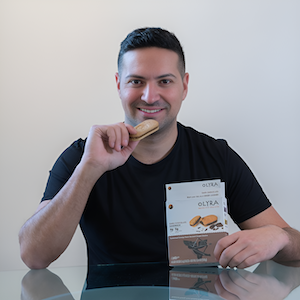
[00:00:10] Ray Latif: Hello friends, I'm Ray Latif and you're tuned into Taste Radio, the leading podcast for entrepreneurs and innovators in the food and beverage industry. In this episode, we're joined by Yannis Ouzounopoulos, the founder and CEO of Olira, a fast-growing brand bringing ancient Greek grains to the modern breakfast aisle. While many founders chased the latest trends, Yannis Ouzounopoulos saw opportunity in an overlooked $4 billion category and struck breakfast gold. Yiannis is the founder and CEO of Olira, a fast-growing brand of organic breakfast bars and biscuits inspired by his family's fifth-generation flour-mailing tradition in Greece. Launched in 2017, Olero was born from Giannis' conviction that the U.S. breakfast bar aisle, vast but stagnant, was ripe for disruption. His solution? Better-for-you products made with ancient grains, authentic ingredients, and significantly less sugar. That vision proved prescient. Today, Olira's products can be found in thousands of retail locations across the U.S., including Whole Foods, Sprouts, Harris Teeter and The Fresh Market. In this episode, Yanis shares the origin story behind Olira and how both free and paid data sources helped shape everything from product development to shelf strategy and consumer messaging. He also dives into why he prioritizes long-term thinking, the importance of staying close to the consumer, and the ongoing process of refining taste and brand positioning. Hey folks, it's Ray with Taste Radio. Right now, I am honored to be sitting down with Yannis from Olira. Yannis, how are you? I'm super excited to be here. I am super excited to see you, and I tried my best to pronounce the name of your brand correctly. Most people know it as Olira, But you pronounce it, and the correct pronunciation is... Olira. Olira. Well done, well done. And I didn't even attempt to pronounce your last name, which is... Oh, I totally forgot about it.
[00:02:25] Yannis Ouzounopoulos: My full last name is Yannis Ouzounopoulos. I was close.
[00:02:30] Ray Latif: By saying nothing, I was close. We're here at our office in Newton, Massachusetts. Thank you so much for coming out here. Where are you based? I'm based in New York. In New York, right on.
[00:02:39] Yannis Ouzounopoulos: Whereabouts in New York? In Manhattan, actually. I immigrated to New York seven years ago, and I had no correlation with the US. So the reason that I decided to move to New York versus any other city is because of the retail landscape. At the moment, I thought it makes sense for me. But soon I realized it didn't make sense. How so? Because honestly I didn't know anything about the retail industry and I realized that like more than 90% are retail chains and less than 10% is small independent stores. And I thought this is across the US besides New York. New York is the exact opposite. It's like more than 90% independence and less than 10% change. So I could go to New York and go around and sell my products. This was one of the reasons. The second reason was that it has direct flights to Greece.
[00:03:35] Ray Latif: This was also very important to me. But being in Manhattan, I imagine the traffic sometimes to JFK can be harrowing, a little bothersome sometimes.
[00:03:45] Yannis Ouzounopoulos: True, that's true.
[00:03:45] Ray Latif: But yeah, as you mentioned, New York is very much up and down the street. In other words, you sell your products to those independent retailers, the bodegas up and down the street. They have distributors, obviously, but you're doing those face-to-face meetings. What have you learned about talking with people, talking with bodega owners, managers, about selling your product, introducing, educating about what you do?
[00:04:05] Yannis Ouzounopoulos: Yes, so that's exactly the case. That's how I started going around in these delis in New York. And what I realized was that it's easy to get on the shelves. It's not hard. It's not hard to get on the shelves. It's not hard to get on the shelves. But what's hard is to really track the sales in these independent stores, because they, especially in the city, They do not really track as much their sales. What they have is a lot of, as you mentioned, all these distributors going every day, so practically they sell in and wherever they see space, they put their products on. So, I had to be doing this like every week and find any spaces to put my products. And I realized that it was very useful because I saw that there was something there on my products because they were getting on the stores, but this was not scalable. It was not the best use of my time spending all day going around doing this sales process. And that's when I realized that in order to understand how the performance would be, it's better to work with chains for two reasons. The first one is because most chains have very organized planograms. So there is a specific place on the set where each product is positioned. And this is important because specifically in our category, I mean beverages in the fridge is slightly different, but in our category because of that merchandising is not necessary. You don't have to go as much at least and put your products on the shelves.
[00:05:44] Ray Latif: And there's a point of reference. You're positioned next to other products that sell something similar. You're not next to, say, dish detergent or batteries like you might be in a bodega in New York City.
[00:05:54] Yannis Ouzounopoulos: Exactly, exactly. So the one reason is planogram. And the second reason is scale. In order to have a viable business in the food CPG space, you need the critical mass to make the bare minimum expenses. So, and that bare mass unfortunately means a big number of stores which cannot come just by doing door-to-door. Door-to-door is important to make any kind of experiment, but in the very, very early stage. If you want to have, if you want to try and make a sustainable business, sooner or later, if you want to do it in retail, you have to go in more stores.
[00:06:33] Ray Latif: Well, it sounds like you've learned a few things over these past seven years for sure, but just to back up and give some context, when did you come up with this idea? And we chatted last week, you talked about your family's history in this food business and your interest in starting a consumer brand. But yeah, if you could tell our audience a bit about the history of, I'm going to use the Americanized version, old era.
[00:06:55] Yannis Ouzounopoulos: So I was born and raised in Greece. I had no correlation with the US whatsoever. Intentionally or unintentionally? I'm here. So that's a good point. Well done. So my family owns a flour mill and it is a heritage business. It is, my mother is running the family business. It is, I'm the fifth generation, so it has run for over one century. And what we do is we work, we partner with local farmers to form different grains. Then we are milling them and we are producing different kinds of baking ingredients, mainly different type of flours, and supplying the baking industries in Greece with, I would say, higher end baking ingredients. So this was my background and I studied chemical engineering and food science. And I started working in the family business and I was trying to identify any kind of market needs, opportunities that we could go after using any kind of competitive or competitive advantages. My goal was to help the core business diversify. So how can we go from just producing and offering baking ingredients to using the knowledge from this century old business to doing another activity. So it was pretty open, the scope, very open. But the goal was very specific. And I thought, I did a working hypothesis, which is right and wrong at the same time.
[00:08:43] Ray Latif: Currently, or was it right and wrong back then? Always.
[00:08:46] Yannis Ouzounopoulos: Always. Okay. All right. Fair enough. It still is. So the working hypothesis was, okay, I'm in Greece in a small town in Alexandria, a farming town. And I thought, let me study and understand what's going on in the US. The reason being is that the US is the most innovative market in the world. So everything starts from the US, which is right. However, there is always a however. However, every market operates very differently. And every market have their own nutritional habits and their own distribution channels. So although this, everything in the food industry, All the trends and the innovation, the vast majority comes from the US. Every market is very different. So during this research, I identified an opportunity in the US, which was not originally the goal. The goal was to identify any kind of innovation that I can replicate or bring to Europe. So yeah, that's how I guess I started.
[00:10:00] Ray Latif: And so the opportunity, the white space that you saw for a product like yours in the United States manifested itself in these products. I guess this is the big question here. What would you call your products? I would call them breakfast bars. That's what I was gonna say, but yeah. I understand a bit of the confusion. Well, it's not a one-to-one comparison to say Kellogg's like Nutri-Grain bars, which are... I'm just gonna leave my own opinions aside on that one. They have, your products have a taste and a texture that is very different from that. So in one way, it's comparable in that it's a breakfast bar, but in another way, it's a completely different product.
[00:10:49] Yannis Ouzounopoulos: Thank you for that.
[00:10:51] Ray Latif: I appreciate it. Well, it's true. So you saw that there was an opportunity to innovate upon what I think most people would agree is kind of a tired category.
[00:11:05] Yannis Ouzounopoulos: The bars in the U.S., you can segment the bars in different ways. If we see the big picture, all the bars is roughly eight billion. And there are two main segments.
[00:11:17] Ray Latif: Can I back up? The breakfast bar category is in eight billion?
[00:11:20] Yannis Ouzounopoulos: The bars in general. Okay, bars in general. The breakfast bars, which is, so the two segments are the bars in general, all of them are eight billion.
[00:11:28] Ray Latif: This includes protein bars, snack bars, et cetera.
[00:11:30] Yannis Ouzounopoulos: And it's, it's, it's segmented between two main categories and you can find them in two different points in the two different aisles in the grocery store. So it's the snack slash breakfast, slash fulfilling on the go bars. And then it's a nutritional slash protein slash diet bars. And there are few differences between the two categories. First of all, the use occasion is slightly different, and the audience is different. And usually, nutrition bars are usually sold individually, and the core audience is like 70% is men, whereas in the wholesome slash breakfast slash snack bars, it is multi-packs, 70% women. And all the innovation was coming into the nutrition bar set with all these new products from RxBar to Bearbells to... Whereas in the breakfast bars, it was very sleepy. And if you see the big picture out of 8 billion, Four was in the sleeping category and another four was into the very competitive nutrition bar set.
[00:12:54] Ray Latif: It's crazy to think about the statistics that you're sharing right now because there has been so much interest, so many new brands coming to market in the protein nutrition bar set and almost nothing in the breakfast bar set. And it's a $4 billion category. Well, I guess breakfast bar and nutrition bar to a certain extent or just breakfast bars? Breakfast bars.
[00:13:14] Yannis Ouzounopoulos: Yeah, it's four and four, which is a total.
[00:13:17] Ray Latif: It's mind-blowing. Where did you acquire this data?
[00:13:20] Yannis Ouzounopoulos: That's a good point as well, because originally I thought it would be expensive to buy data, that kind of data, but you can find a lot of data online without paying anything. So all these, these are reports from Mondelez and from Kellogg's and actually Kellogg's not anymore, I think.
[00:13:39] Ray Latif: Well, it's, it sounds like their public reports are out there for public consumption. You just have to access them or it's, and it's free to access them. Incredible. I see. I mean, I think that's something that's overlooked quite a bit is people think you need to buy very expensive data and at a certain point in your brand's life cycle, that might be necessary, but when you're just getting started out and you just want a general perspective on what's happening in a particular category, that information is out there.
[00:14:05] Yannis Ouzounopoulos: Yes. And so the getting the big numbers, the market numbers is very accessible and everyone should start there. Something that I think is one of the mistakes that I did is that I created a business plan on how, on why this brand and this project, how it would be viable. And there are three main parameters in every business plan in our industry. It is number of stores, it is gross margin and velocity. So you know that or you can have a good estimation on number of stores when you begin. You know your numbers or you know your gross margin. Most of the business plans that I've seen and the one that I did originally was wrong, because I miscalculated the velocity. And honestly, you have to buy data for velocity, that's not free currently, but it's very reasonably priced and it's definitely an investment. It's definitely, yeah, you can buy the basics for like 2K. It's an investment that any new brand wanting to go into the industry needs to do because you need to understand what the estimated velocities should be. You don't have to go deep, just understand what are the average velocities because, and I'll give you a few numbers. I was estimating without having an idea that we're going to be selling like three units per store per week per SKU. This was 0.5, which is one-sixth, and the numbers are one-sixth. So if I had done this research earlier, I would have known that I would have to scale up faster, and the unit economics are very different.
[00:15:52] Ray Latif: Well, I think velocity is, if you're doing estimations and trying to predict what your velocities might be, it's a very inexact science because your velocities are tied to brain awareness, brain education, promotion, all different kinds of things. So yes, you might say, I believe that I'm going to do three units per store, per week, per SKU. That's just an estimation, because again, You really need to educate the customer or the customer needs to be aware of and excited about your brand. How do you connect with consumers? How have you connected with consumers? How has that process of getting to trial developed over the years?
[00:16:34] Yannis Ouzounopoulos: So this is very, very critical for every brand. And honestly, originally we were not doing it that well. It took us a while to figure out how and what's the best way of doing it. Why wasn't it working? Because, honestly, we started in retail, so we didn't know who our consumers were. We were focusing more on the numbers, and we were exploring on different products, on how would they perform on the shelves, but we didn't have, we were not big online, so we didn't have this direct relationship and communication with end consumers. So, there were a few elements that were important. So, we originally launched and what we saw as originally the opportunity was the breakfast biscuits category. And the name was also, as you mentioned, how do you call your products? We didn't choose to call our products breakfast biscuits. We followed the leader, which was Belvita. And what Belvita did, and this was the original opportunity that we saw, was they positioned a cookie into the breakfast bars instead of positioning it into the cookies. So consumers are having cookies because they want sugar, they want chocolate, they have a sweet tooth. Whereas they consume breakfast bars because they have a need for energy on the go. So, Belvita did something extremely smart. They positioned cookies into the bars, into the breakfast bars, with a different use occasion. So, it's a cookie, but the occasion was not the sweet tooth, rather than the energy on the go.
[00:18:21] Ray Latif: Yeah, I never thought about that. That's really interesting. A cookie for a day part use that a cookie is typically not consumed, when a cookie is not typically consumed.
[00:18:29] Yannis Ouzounopoulos: And strategically, how did they do this? By positioning the product in a different, in the set where the use occasion was different. And it was Mondelez, so they had the muscles to do that. So very smart of them. And they created a half a billion category of breakfast biscuits, which didn't have a better for you alternative. So the original idea that we had, okay, let's create a better-for-you Belvita, but the Belvita audience is very conventional. They wouldn't care about a better-for-you Belvita. And that's where we realized that how do we communicate to the better-for-you, and what do this audience, which is the better-for-you audience, care more about?
[00:19:17] Ray Latif: It sounds like the positioning of your brand had to change for you to fit what the customer wanted. And I was chatting about this with my colleagues yesterday, and it seems like sometimes, by no fault of their own, entrepreneurs often look for a solution without a problem, right? Like you've identified a problem that doesn't necessarily exist or doesn't necessarily exist for a large number of consumers. And so when you actually figure out that solution that a lot of people need, that's when the traction begins. And it seems like, and correct me if I'm wrong, but it sounds like that kind of positioning, that triggered the change in positioning for Alira.
[00:20:02] Yannis Ouzounopoulos: Yeah, yeah and something that I also realized is that it is always about the implementation because taste is not just having a product for example that has chocolate but how do you have the best tasting chocolate breakfast biscuit in the market. So, and that's where, that's not easy to do. And that's where also it's incredibly important to get the insights and are honestly the best insights that we have are from Amazon because Amazon are authentic consumers and people talk on Amazon. People, they give their feedback and you can very fast within, and very fast I mean like within a couple of months being on Amazon, you can understand and you can get feedback on not just if they like your products or dislike, but what do they like or dislike and how do you enhance the ones that they like and how do you either change or communicate what they don't like. For example, the sweetness level. Our products are sweet, but not too sweet. So some people, most of their people are happily surprised with that. But some people are not. So how do we communicate to our consumers that you should expect a product sweet, but not as sweet?
[00:21:23] Ray Latif: To put it another way, do you still have to do focus groups? Do you still have to do surveys? Or can you rely on and do you rely on Amazon data information reviews as the primary way to make adjustments to your taste, flavor, texture?
[00:21:39] Yannis Ouzounopoulos: So we have four different levels of approaching the enhancements of every product. First of all, once we launch a product, we know that we're going to change it.
[00:21:52] Ray Latif: Okay. So let's back up there and unpack that. Once you launch a product, you know, you're going to change it.
[00:21:58] Yannis Ouzounopoulos: Yes. Okay. That's very, that doesn't seem very intuitive. That's very important. Okay. Why to be open? Because when you launch a product, we know that we do not know everything and we do certain assumptions, but we have to listen and understand, as I mentioned, what consumers like, what they like, and how do we keep improving? And we have four levels currently of working on that. The first one is something that we built in-house, and I think it's extremely important. We're calling it our Century Evaluation. So every week, this is actually something that Charles Coristine suggested.
[00:22:36] Ray Latif: Charles Coristine, who's the CEO of Lesser Evil, and I know you're a big fan of his, and we'll talk about your interest in that company, and Charles in particular, but please go ahead.
[00:22:46] Yannis Ouzounopoulos: Yeah, so Charles pointed out how thorough we have to be in each batch of the product. So what we do is we have essentially a form where we try every batch of our product twice a week. The whole team gets together. It's also a bonding experience. And we evaluate all the different batches of our products. So through that, we understand way better our products. And that's the first level of understanding what your product is about and perhaps what do you need to change or enhance. The second level is having your loyal tribe of consumers, which is we have a small group of loyal consumers that we've created a group. And when we're doing any changes, we first communicate it to them. So it's in-house, like a century team, then it's our loyal consumers team, and then we move beyond that. So depending on the maturity of the product in market, so for example, our fruit and grain bites, they are performing really well in the market. Okay, so we receive, as I mentioned, feedback from consumers on Amazon that we analyze and see what we change. But then, since it's performing really well, I'll give you an example of what we saw online and we didn't know, neither us or our consumers, was We had a lot of comments on crumbliness, on the product was very crumbly. So we knew we had to fix that. It was a very direct comment that we enhanced. And there are other comments that are a bit indirect and we do not know whether, how we should approach it. And that's, I'm leading to the fourth level of insights.
[00:24:30] Ray Latif: There's a pretty significant process to determine what you need to change. It's not just one thing or the other. And it's interesting that you talked about the different levels and layers that you have. You brought up Charles Coristine, who again, is the CEO of Lesser Evil. He did an incredible job turning that company around. It was recently acquired by Hershey for $750 million. So I would say he did a few things quite right. And I think of him because of two reasons. One, after our podcast with him, featuring him in 2021, you were like, I need to meet this guy. And you went out and met him. And I'll tell listeners right now, like Giannis did absolutely the right thing, because if you are so moved by someone's strategy or how they present themselves or their philosophy on the food and beverage industry, definitely seek that person out and go extend that conversation. And I think the other part of it is, I see O'Leary in the same context as Lesser Evil in that you're both focused on the long term. Lesser Evil has always been focused on how do we create a legacy brand more than how do we create this fly-by-night product that we can sell for whatever kind of price. It took a long time for Lesser Evil to get it right, but get it right they did. They own their own manufacturing, which is a completely different kind of business. But, you know, Charles is so close to it. When I was with him last year, he was walking the factory floor, trying the popcorn. He knows everyone's name. He's fully immersed and invested in the business in a way that was really impressive. And again, it reflected the fact that It was, he had a long-term business strategy. It wasn't something where he was just like, okay, I'm going to sit in an office and push some papers around and hopefully we can, you know, sell this thing. And I think that's your philosophy as well. I mean, everything that you've talked about seems to be, this is a process. This is the learning experience to get us to a place where people recognize us as a legacy brand.
[00:26:24] Yannis Ouzounopoulos: Yes. And one of the things that I've learned from Charles is, and I've learned this also through experience. I was not a popcorn consumer. Okay. I became, not because of Charles, but because of Lesser River product. It's addictive. It's the best tasting popcorn out there. So you have to be very passionate about that and being focused on how do you have the best tasting product out there. That's one of the things. Who am I to talk about Charles Febb?
[00:26:59] Ray Latif: No, I think you're 100% right. It's a different texture. It's a different type of popcorn than you might typically expect to try. There's some similarities here, right? This is a different
[00:27:09] Yannis Ouzounopoulos: That's our approach. Our approach is how do we make the best tasting. So our goal, and we can go back to the example of Nature's Bakery, very successful product. I think that not only they did a better for you Fig Newton, but their product tastes better than Fig Newton. And going back to what you said earlier, taste is king, so it's not just being replicable to another product or being as good, but at the end you have to be better in terms of taste and secondarily being better for you in terms of functional elements.
[00:27:45] Ray Latif: Going forward, do you feel like leaning into the Greek part of what you do, calling out your family's history in the business, do you think that will continue to be a part of the brand? Do you think that consumers appreciate it as much as they seemingly do today?
[00:28:04] Yannis Ouzounopoulos: We're trying to prioritize again what is important to our consumers because what is important to us is not the same as what is important to our consumers. So you need to understand what's important to consumers and then use that to message it to your future consumers. And that's what we're in the process of doing right now.
[00:28:24] Ray Latif: I mean, if you ask me what's important to me, and you didn't, I'm just asking myself. So in essence, I'm doing my own interview here. When I look at your vanilla sandwich breakfast biscuits, and I see the product right here, the first thing I think of is, it's not really an Oreo cookie, I forget what it's called, but there's a different, Oreo does have. Yeah, no, you're talking about Keebler. Keebler, I think it's the Keebler products. I think, oh, this looks delicious. Something I could dip in my coffee in the morning. And I'm seeing seven grams of fiber, four grams of protein. To be honest, the thing that I'm looking for is, well, how much sugar is in this damn thing, you know? And it's not a lot, which is great. It's six grams of sugar. But so when you think about what the consumer wants, it's a little different on the fruit and grain bites. You have nine grams of fiber and six grams of sugar. It's protein on this breakfast bite. How do you know what to put on front and back in terms of that nutritional content?
[00:29:17] Yannis Ouzounopoulos: That, again, we use the consumer panel. Consumer what? Consumer panel. We worked with a company called Toluna, where we do consumer research. And it's an investment from our side, but we definitely believe it's worth it. So specifically for that matter, we did a consumer panel asking consumers, when they look at fruit and grain bites, what is more important to them? fiber, sugar, or different other elements. And when they look at the breakfast biscuits, what is more important to them? So we use that to fine tune once.
[00:29:55] Ray Latif: It's so interesting too, because four grams of protein isn't a ton of protein, but I guess in the morning, if you want something that's healthy and it's going to sustain you through the day, protein is an important component. Very interesting.
[00:30:06] Yannis Ouzounopoulos: That's a very, very good point. And we were surprised, honestly, because we didn't just use protein or high protein. We used the exact specifics. Is it important for you to have, is it more important to have four grams of protein or is it important to have like high fiber or low sugar or six grams of sugar? And the results were very clear on each product.
[00:30:29] Ray Latif: You've been doing this for seven years, Giannis. I know it's been a process and you're learning every single day. What keeps you going? What keeps you invested and waking up every morning excited to continue doing what you do? Because it's an expensive business. It's a business where you have to live and breathe it every single day, hour, minute of your life. And I think sometimes entrepreneurs can be like, this is a grind. I'm getting tired. But what keeps you going? What keeps you motivated?
[00:30:56] Yannis Ouzounopoulos: So this has changed significantly during this whole process and journey.
[00:31:01] Ray Latif: Your perspective on this?
[00:31:02] Yannis Ouzounopoulos: Yes, a few times. And I also read this to the Ramp Your Brand book from Dr. Richardson, if I'm not killing the last name.
[00:31:15] Ray Latif: Richardson sounds right. Yeah. I think I know what you're talking about.
[00:31:17] Yannis Ouzounopoulos: Yeah. It's very interesting because, first of all, everyone that gets into this business, they have to understand that it is a very long journey. You have to have that in mind. It's a very long journey. There is no overnight success in the industry, it's 10 years. And because the first years you need to survive. You need to survive trying to identify what works and what doesn't work. And this is a big struggle. It is very hard to do that. And you need a lot of passion, of course, and you need a lot of determination. And so throughout this process, it is so hard that founders, until they identify what works, they get hit hard. So because of that, at some point when things start going well, they want to exit fast because they have had a hardship. So they went, I cannot do it anymore. They love what they do, but it's like, it was a very hard time. So because of the hardships of the first years until you figure out what works, founders get so much tired that they want to exit fast. However, once you figure out what works, it's still a very long journey ahead of you. And I think that's when the good part starts. And I feel that that's where I am today. So I've been in three phases, let's call it. Originally, the first phase for me was, how can I create a business that will help our family business diversify, and it will help our local farmers, and I really want to create something that will grow around the family business. This was my original golden vision that get me in the morning. The second period was, how can we keep the lights on?
[00:33:14] Ray Latif: You have this grand vision at the outside. How can we do something incredible, game-changing, and then the next stage is, how do we pay the damn bills?
[00:33:25] Yannis Ouzounopoulos: Yeah, so this was a long phase and a hard phase. And now I'm on a different phase on how do we, now that we find our products, we've built an incredible team that we're very, very proud of. And I enjoy working. That's to me, that's now what it's critical. I enjoy really the people that I'm working with. And I know that there are going to be a lot of hardships, but I also know with this team, we can go through anything. So now I'm in a phase that I want to enjoy the journey with my team.
[00:34:01] Ray Latif: Giannis, I've loved sitting down with you and chatting about everything that you do. It's so interesting to see where you started, how you've learned, how you've adapted, and how you continue to adapt and evolve. Because as you pointed out, with your products, you know from the outset that you're going to change. And this is a business of change. This is a business of evolution, learning, and consistently trying to get to perfection, but knowing perfection doesn't exist. So I love your approach, I love your philosophy, and I'm so excited to see where the Brandt Gehrs from here and where you personally go from here.
[00:34:37] Yannis Ouzounopoulos: Thank you very much. I'm not sure that I shared this. I shared it with you earlier, but Taste Radio was pivotal for me throughout this journey, listening to so many different episodes, so many different approaches. It was extremely insightful. And obviously it was important for me because not only I got insights, but through your network, I also connected with many people in the industry that have been incredible.
[00:35:04] Ray Latif: Well, thank you so much for saying that. I really appreciate it. Our marketing team appreciates it. And it's what we try to do is we try to share the stories that can benefit others to help them build their businesses, scale their businesses and do it with as few mistakes as possible. And I know you went through some challenges, but it is a process where everyone can learn from each other. That brings us to the end of this episode of Taste Radio. Thank you so much for listening. Taste Radio is a production of BevNET.com, Incorporated. Our audio engineer for Taste Radio is Joe Cracci. Our technical director is Joshua Pratt, and our video editor is Ryan Galang. Our social marketing manager is Amanda Smerlinski, and our designer is Amanda Huang. Just a reminder, if you like what you hear on Taste Radio, please share the podcast with friends and colleagues. And of course, we would love it if you could review us on the Apple Podcasts app or your listening platform of choice. Check us out on Instagram. Our handle is bevnettasteradio. As always, for questions, comments, ideas for future podcasts, please send us an email to ask at Taste Radio.com. On behalf of the entire Taste Radio team, thank you for listening, and we'll talk to you next time. you