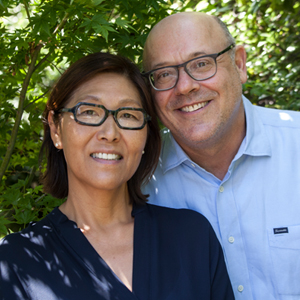
[00:00:10] Ray Latif: Hello, and thanks for tuning into Taste Radio, the number one podcast for the food and beverage industry. I'm editor and producer Ray Latif, and you're listening to episode 210, which features an interview with Annie Chun and Steve Broad, the co-founders of Annie Chun's and Gimme Snacks. Tune in on Friday, April 24th for episode 82 of Taste Radio Insider, when we sit down with Lee Robinson, the executive leader for dairy and beverage at Whole Foods Market. Just a reminder, if you like what you hear on Taste Radio, please share the podcast with friends and colleagues. And of course, we'd love it if you could review us on the Apple Podcasts app or your listening platform of choice. After building one of the most successful ethnic-themed packaged food brands in America, Annie Chun and Steve Broad set their sights on disrupting the snack category with seaweed. The co-founders of Annie Chun's, a brand of Asian-inspired noodle bowls, soup bowls, sauces, and snacks, Annie and Steve grew sales to $15 million annually before selling the company in 2009 South Korea-based CJ Foods. Three years later, the entrepreneurial bug bit them once more, and sensing an opportunity to adapt a traditional Korean snack for an American audience, they launched Gimme, a brand of dried organic seaweed snacks. Committed to sourcing sustainably grown organic seaweed, GIMME helped pioneer a new segment of Asian-centric, better-for-you brands in the snack aisle that has established itself as the leading company in the burgeoning space. In the following interview, I spoke with Annie and Steve about the origins of Annie Chun's and its evolution from a farmer's market brand to one distributed in grocery stores across the country. They also spoke about lessons learned from their first venture and how they incorporated those into Gimme and why they continually evaluate the brand's positioning to appeal to American consumers. Hey folks, it's Ray with Taste Radio. I'm gonna call right now with Annie Chun and Steve Broad, the co-founders of Gimme Snacks and Annie Chun's. Annie, Steve, how are ya? Great, thank you. How are you? I'm doing pretty good. The sun is shining. It was a vicious rainstorm yesterday, and I'm happy that we're past that. Did you have a rainstorm in your neck of the woods?
[00:02:27] Steve Broad: No, we've had sunny weather here. Fortunate. Where are you calling in from? We're in Marin County, just north of San Francisco.
[00:02:36] Ray Latif: Fantastic. And that's where your first brand, Annie Chun's, was founded, right? Indeed, at the Marin County Farm Market. Annie, could you tell us a bit about why and how you launched Annie Chun's?
[00:02:51] Annie Chun: Well, I guess that was 1991. I did not have any grand plan. I was just in a place where I was tired of working for companies and trying to make career as an immigrant. And then I saw the opportunity, so I just jumped in and changed that. And that was to go to farmer's market and start to sell my sauce. and had never had a grand plan about like, wow, I'm going to grow this company really big. Never crossed my mind. I just was happy doing something that I was following my heart. So cooking was always, you know, pretty easy and fun for me since I grew up with a mother who was wonderful, wonderful cook. So I went out with two types of sauce, fresh Thai curry and Thai peanut sauce. At that time, I wanted to do Korean food, but we did not have enough audience. But Thai food was coming around in 1991. So little did I know that I was jumping into something much more complicated. you know, to grow the business. But all I thought it was that I was super happy following my heart, doing the things that I wanted to do, being around people in outdoor market, selling my sauce. So I was keep doing that. And that led to one after the other, one after the other. And, you know, that led it to be what Annie Chun is today.
[00:04:35] Ray Latif: Yeah, it's interesting. You know, in 1991, we didn't see many ethnic food brands, ethnic packaged food brands, and particularly Korean themed packaged food brands or Korean centric food brands. I can imagine how challenging it was at the outset, but how did you get people to understand, number one, what the food was, and number two, how to use it in their kitchens? Because I'm assuming you're essentially using the sauces to cook at home. I mean, it's not like something that you'd use with a hamburger per se.
[00:05:07] Annie Chun: Right. So that was a good learning experience for me. But the thing was, I had a chance to talk to consumer one-on-one by selling each jar. So I was making the sauce that it was very friendly, user-friendly and ready to pour. And surprisingly, the consumers who was shopping at local farmers market had a very open mind and they were so willing to try something different. And they thought it tasted great and it was very healthy and fresh. So I had a good jumpstart with that. And by doing that, I was learning, okay, I need to come up with a recipe. variety of different recipes, how they can use to more sophisticated cooking, to simple cookings. So my true experience was just by following my heart, something that I felt comfortable to do, and not be afraid to go out there and start to meeting people, exchanging ideas, and just learning and adopting and growing at the same time.
[00:06:17] Ray Latif: Now, you said more people knew about Thai food at the time. How did that affect how you communicated the brand and the positioning of Annie Chun's?
[00:06:27] Annie Chun: Honestly, while I was in farmer's market, I had no clue how I was going to build the brand. But later on, I learned from consumer that people do like ethnic flavors. People do like simple, healthy ingredients. They wanted to make a change. They wanted to feel like they can cook friendly Asian food without having to go to restaurant. So any chun became more of a Pan-Asian flavor. Like I say, I wanted to do Korean food, but I knew that I wasn't going to sell much bottles. So I started with the Thai food. Then I introduced something kind of like Japanese flair, which was my family recipe called the shiitake mushroom sauce. So one by one, I was layering off like I guess my new experiment, like what people might like and how easier to use, more people will like this flavor, not as esoteric. It just went on like that.
[00:07:30] Ray Latif: A lot of brands start at the farmer's market and you do have a captive, loyal audience a lot of times from folks that you can connect with on a one-on-one basis. It's a little bit more difficult when you're scaling and trying to get on shelf at retail chains. How did you make that jump, that initial jump from farmer's markets to retail?
[00:07:52] Steve Broad: Yeah, we first realized that there was some strong demand at the farmer's market. We started doing multiple farmer's markets through the Bay Area. And that was our initial course for the first couple years. And then in March 1994, we did our first fancy food show. So we had four sauces by then, and we had gone to a food technologist to make sure their shelf stable, et cetera. And at that show, actually, we had some great response, Marshall Fields, Wild Oats, Safeway in Alaska, even American Airlines in Dallas, Fort Worth was, you know, we were shipping glass jars of gallons of mushroom sauce. And then the following year, in fact, we won first place at the Fancy Food Show for Outstanding Healthy Nutritious Product. And that was a period where the health food was really starting to have a big uptick. So the fact that we were sort of making all-natural Asian flavors, and as Anne noted, the genesis from the farmer's market was with Thai food, because that was kind of an early trend. And then it slowly kind of started to convert to more of her family's background, which, in fact, her grandparent mother had been one of the first women of Korea to be educated in Japan. So a lot of Japanese influence played a role in their family. And that became some of the genesis of our best core flavors, eventually, like miso and udon and teriyaki. You know, early on, it was just sort of hand to mouth and learning as we go. But we got a lot of press and a lot of great response. But again, we were not flush with money. In fact, we had to, you know, borrow the first 10,000 and then it was constant like that. So it was a lot of hand to mouth and not with big funds. And we were, you know, pretty tidy, but always, as Anne mentioned, kind of always been innovating. For example, At the farmer's market, she used to serve the shiitake mushroom sauce on rice noodles. And so we at one point looked to import those rice noodles from Thailand, but it would have been requiring buying a whole container for like $20,000, you know, way too much money. But we were at one of the fancy food shows, I think in 96 and serving on rice noodle. and this Chinese gentleman came up to us and turns out he had a factory in L.A. and he had the idea to bring rice noodle machine to the U.S., which was kind of the first time rice noodles, the Thai rice noodle was made here. And then Ann had the idea, why don't we flavor the rice noodles? So in addition to original, we did a Thai basil flavor. We had a chili Hunan and a mushroom garlic, I think, flavor. So we kind of had this whole concept of sort of like the Italians back in the history, they had the pasta sauce and the spaghetti and then they made it easy for everybody to kind of make pasta. And that was our concept. We had the bottle of Thai peanut sauce and the rice noodle and everybody could make Pad Thai or something. And so that was sort of the became part of the theme of making Asian food more convenient. And It was at a period of time when the specialty food and the natural food started to merge because back in the day specialty food was very specialty and natural food was kind of very hardcore. And then slowly there became this blending where specialty food crossed over and the quality of the natural food in the natural food stores was starting to ramp up, which now we see, you know, them being very gourmet. even while they're natural compared to the early days.
[00:11:45] Ray Latif: Once you got into places like Whole Foods, did your positioning have to change? Did you have to adjust how you were communicating the product and the flavor names to an audience that may not have been as familiar with Asian cooking and Asian ingredients?
[00:12:02] Steve Broad: Absolutely. In fact, Anne was always very sensitive to that. So we kept it, you know, to more like soy ginger or peanut sesame, kind of more common garlic scallion, for example, as opposed to calling out like specific Asian cuisine names. And then eventually, and this was even 10 years later in the early 2000s, we finally went to a packaging designer and kind of really started to put out a proper brand look, but that was 10 years later. So it was a lot of small steps over a long period of time.
[00:12:40] Ray Latif: Were you comfortable with taking those small steps? I mean, Steve, you talked about starting with $10,000, which, you know, doesn't really sound like a lot of money to start a company, especially one that's been as successful as Annie Chun's. But when you are taking those small steps, was that intentional or was that sort of just driven by the fact that you weren't necessarily looking to take on a lot of money and a lot of debt or give away equity in the company?
[00:13:06] Steve Broad: Well, as noted that 10,000 was borrowed. So we started from the borrowing position, but it was kind of a twofold thing. I think first it was our own sort of not knowing exactly how it all plays out. So kind of, you know, step-by-step that way. And secondly, I think also the consumer public wasn't necessarily ready en masse for what we were doing. It's kind of ironic because some of the products like Aseptic, the Tetra Pak Asian soup, like miso udon, which we were the first to do Asian flavors globally. And now, you know, we've noticed last year at the expo, you know, now there's several companies doing Asian flavors. That's like 15 years after we did it. So we were kind of way ahead of our time. And that's when you do need actually funds to be able to wait till the consumer public also catches up. Or in these days, fortunately, with the whole social digital, you know, there's more chance to connect quicker than I think 20 years ago or 15 years ago.
[00:14:12] Ray Latif: Yeah. And, you know, when we talked last, you know, in our pre-interview call, one of the things that was really interesting to me is that you said that a lot of decisions were driven by survival, that there wasn't a lot of room to test and learn. There wasn't a lot of room for errors. You know, how do you run a company, frankly, when, you know, you're not really sure that a product is going to work, that you just have to go to market with what you have.
[00:14:41] Steve Broad: Yeah. I mean, fortunately, the background of our company had been sort of very direct to consumer, first in the farmer's markets and then in starting with stores doing demos, you know, even around the country. So you kind of get to see a lot from, you know, interacting directly with people. And then, yeah, I mean, another point was the fact that we're married and we have two children and, you know, our children were small and grew up. And so they were, you know, maybe our second and third babies now, but so we were doing this whole family thing along with business. So that kind of was, you know, some of the dynamic that we faced. And fortunately we have supportive family on both of our sides to allow us to get out when we needed to. But I think Anne, from her experience, having immigrated here and then done a lot of, you know, different jobs, including in retail, and started to really sense, like, about the American consumer, and then had a really kind of unique and amazing way of sort of taking some of her authentic and cultural experience and then translating it into what the American consumer could relate to. And I think that was just, you know, fortunate that we had that base. You know, there was a lot of learning. As I mentioned, we started with sauce and then we got into the noodle. So because the thing about sauce is that it could take a consumer how many days, weeks to finish a bottle. So then we had the noodle to kind of pair it off. And then the big hit was when we put the noodle and sauce together in what we call the meal kit. And that's when we also did our rebrand in 2001. And that exploded relatively. And then we went into, as I mentioned, the aseptic soup, Asian flavors. And that was a certain success with the retailers, but not commercially, because the consumer didn't know what to do. But that led to our noodle bowl, where, for example, Ann did a couple key things different. One, In Asian culture or in Japanese culture, you don't really have noodles with miso soup, but we put the noodles there to kind of give more of a meal effect. Typically, miso is made with bonito, but Anne had the idea to want to make it vegetarian, therefore used like shiitake mushroom and kombu, which is a seaweed extract to help build the flavor and still have a very complex flavor. And I think that was one of our hallmarks is that The flavor and the quality was so great for bottled food and packaged food. However, that also definitely affected margin. And that's one of the biggest learnings I gained out of Annie Chun's was the fact that margin is so important and it's really hard. In fact, you can't survive if you don't have a relatively good margin.
[00:17:45] Ray Latif: How do you balance the two, you know, this need for exceptionally high quality when it comes to ingredients and margin?
[00:17:53] Steve Broad: Well, that's an interesting point, and I think it becomes part of a company philosophy, because certainly a lot of our competition was of significantly lesser quality, but when a consumer maybe doesn't know what to expect, they don't know what good quality is, and they were, you know, had a lot of success as well. But I think what defined and what's extended the brand for now 25 years or whatever it's been. And it's still on shelf compared to a lot of other competitors that were much bigger. I think that kind of base quality. So from the quality, it's really not necessarily the super high incremental costs, but I think that's where operational efficiency becomes so important because ingredients is one component, but the operations is so important as well. And that was some of our challenge because we'd have multiple vendors and we did want to make our sauce in USA, not in China or Thailand. So that added to cost. And then the kind of noodle we used, which was like a fresh but shelf stable noodle was made, we found in Korea. So we were importing and then assembling in the US and that became a very extended and expensive supply chain. So that's where the margin thing gets hit so much as opposed to ingredients.
[00:19:27] Ray Latif: It sounds like it was a grind to scale and to develop Annie Chun's. At the end of the day, you built a very successful brand and one that it sounds like you're pretty happy exiting. What got you back into the business with Gimme Snacks?
[00:19:44] Steve Broad: Well, I guess we did have success, as you note, and more than kind of financial success, it was commercial success. So at the end of the day, you know, we were still not so old and, you know, look to work and just felt that for what we do, kind of being an entrepreneur is kind of where the comfort zone is.
[00:20:10] Ray Latif: you sold Annie Chun's, you know, did you feel like there was an opportunity to do something that you hadn't been able to do with that brand?
[00:20:18] Steve Broad: Probably. I think that there was probably maybe a certain sense of unfinished business because the fact that we were so resource constrained with Annie Chun's and I mean, part of the reason we went to sell was because at some point, financial resources are needed to grow a business. And at that time, there was probably far limited sources compared to this day and age where a lot of private equity has now gotten involved in the natural space, but that was a lot less so 15 years ago, 20 years ago.
[00:21:01] Ray Latif: When you decided to launch Gimme Snacks, how much more preparation did you put into business planning as opposed to what you did with Any Challenge, which sounds like just, you know, get out there, get into the farmers markets and sell?
[00:21:15] Steve Broad: Oh, yeah. I mean, of course, far more, you know, from having a proper supply arrangement and agreements and doing the proper trademark work and doing the proper branding work. And yeah, all those pieces that we had no idea in the beginning what to do with Annie Chun's and learned along the way. Of course, we could you know, utilize that knowledge and experience to execute so that we build the proper infrastructure to grow a bigger business. Because at the end of the day, it starts with your base and you build up. And if your base is improper, then you're going to have to go rebuild that base before you can really get to the next level.
[00:21:56] Ray Latif: So you launch with seaweed snacks, which isn't the most easily understood snack or food in the United States, at least. Why did you decide to go with that product as your initial, as the initial product for Forgive me.
[00:22:12] Steve Broad: Well, the main reason was we were innovating and we were the first to pioneer organic seaweed snacks. So prior to what we did, nobody had the USD organic seaweed snack. So that was important. And then second, we were innovating with products. So not only did we do the organic seaweed, but we also created a product line called crumbles, which sort of helped us out in the beginning and it was a different species of seaweed and we did a honeydew john and a cheddar cheese flavor and a teriyaki flavor and in the beginning actually the retailers all didn't take gimme even if we were the first to be organic And we were also non-GMO. But because they said, oh, we have seaweed snacks, they're all selling well. But they said, oh, we need more. So they took our crumbles. And then the following year, Whole Foods had made a declaration to be non-GMO in five years. Then the buyer also emphasized to his regents that, hey, this is organic, non-GMO, we should do this. And kind of the rest is history. Once we got on shelf, because of our focus on quality, again, it really, the consume, and also we made the packaging not Asian. We just kept it light and friendly and a little more futuristic. And sort of the combination of the brand and the quality has propelled us to the leadership position today.
[00:23:42] Ray Latif: Annie, Steve mentioned that you were better prepared this time around to launch a food brand, a packaged food brand. At the end of the day, did you feel like your preparation was enough to limit the mistakes and limit the pitfalls that came with your first brand, Annie Chun's?
[00:24:01] Annie Chun: Of course, but as much as we had an experience with Annie Chun, This was working with the CV was completely different thing. It was whole new learning experience that in terms of business and distributions operation, we already had a lesson behind that we were able to make the stride and eliminate the mistakes. But anytime you're entering new experience, you are also facing big challenges. So I have to say, In some level or many levels, we have learned so much more and different experience through this second business.
[00:24:45] Ray Latif: What are some of those lessons that you learned this time around that are distinct from your first brand?
[00:24:52] Steve Broad: The fact of the matter is, with Annie Chun's, the food was relatively more processed. When you're making sauce, when you're making noodles, that's basically processed foods. So it's easier to keep a tighter specification. But when we're dealing with seaweed, it's very minimally processed, so it's all about that raw material. So the way we achieved it, and we were very fortunate in the, beginning to partner with basically the largest seaweed company in Korea. And they had a lot of contacts and they nurtured their relationships with the farmers. And it's all about what the farmers are doing in growing the seaweed and where it's grown and the water temperature and what time of the, because the seaweed grows in the winter from December to March.
[00:25:43] Ray Latif: It's interesting you mentioned an acquired taste because when someone first encounters seaweed snacks, when I first encountered seaweed snacks, I really didn't know what to make of them. I wasn't sure if it was something that I was supposed to eat because it was better for me or it was just fun or if it was, there was a specific flavor that I would appreciate. How do you sell? the products? How do you position seaweed snacks? And is it different than when you first started? Is it about nutrition? Is it about fun? Is it about flavor?
[00:26:14] Steve Broad: Yeah, I'd say it's about all of those. And additionally, I think it's about discovering new experiences for the consumer and that seaweed can be a whole new world for people who just can't imagine. And interesting enough, it can become an acquired taste because sometimes it doesn't necessarily hit somebody right off the bat, but slowly they integrate it. And if you start to use it, incorporate it into your food. You can put a little rice or cheese inside the seaweed and roll it up and eat it. And different ways, avocado, I mean, there's a whole range of uses beyond just eating it straight. And the key for us is that, you know, because of our focus on quality, our seaweed doesn't come off fishy taste. And that's what can really turn off consumer is when it has a little bit fishy kind of sense, which it can't.
[00:27:10] Ray Latif: I would assume that would turn off a lot of mainstream consumers. Mainstream consumers aren't necessarily looking for fishy tasting snacks. So when you are innovating and when you are thinking about expanding the line, is it really just about appealing to your base or is it first and foremost about appealing to your base and then potentially expanding to more mainstream focus consumers? Or when you do innovate, are you really looking to go beyond that base and reach folks that are not as familiar with, say, a seaweed snack.
[00:27:43] Steve Broad: Yeah, I would say that it hopefully serves both. I mean, I think in terms of our base, I mean, we're far from capturing all the potential consumers we could be, but as well, I mean, the goal is to try to expand and compete against other mainstream snacks. And I kind of view it the way Glasso had a smart water, then they created the vitamin water, which became much bigger, but now people have realized that they're still taking in some sugar and they've now smart water is so much bigger. So I think with seaweed, if we create those more mainstream products like a vitamin water, that eventually people will move back to the lowest calorie, cleanest, most nutritious form, which is the seaweed snack.
[00:28:32] Ray Latif: Well, Steve Broad Annie, this has been a great conversation. Thank you so much for sharing the history and the strategy behind creating two really outstanding brands. I remember when I first encountered Annie Chun's, I thought, wow, this is exactly what we needed because as you noted, there was nothing like it on the market. And I think it's the same thing with Gimme Snacks too. I, as I mentioned, was a little skeptical about seaweed snacks and ever since now I've been a fiend when it comes to eating seaweed snacks. So thank you so much for being pioneers in our food industry and for, you know, leading a new generation of brands in this amazing space. Great. Well, thank you so much for your time.
[00:29:15] Annie Chun: Thank you so much.
[00:29:16] Ray Latif: Thank you. That brings us to the end of episode 210. Thank you so much for listening, and thanks to our guests, Annie Chun and Steve Broad. You can catch both Taste Radio and Taste Radio Insider on Taste Radio, the Apple Podcasts app, Stitcher, Google Podcasts, and Spotify. As always, for questions, comments, ideas for future podcasts, please send us an email to askatasteradio.com. On behalf of the entire Taste Radio team, thank you for listening, and we'll talk to you next time.
[00:29:58] South Korea-based: Hello, I am Melissa Traverse here for the Taste Radio podcast, talking about some of the biggest tension points that CPG brands and founders face when they're scaling a brand, and those are financial accounting and inventory management. I am joined by Matt Lynn, inventory accounting guru from Belay Solutions, and he is going to shed some light on all of this that is going to help everybody out quite a bit. Matt, thank you so much for joining us today.
[00:30:28] Taste Radio: Thank you for having us, Melissa. It's great to be out here at Expo West and it's great to sit down and be able to chat this because it's kind of a passion project of ours, working mainly with CPG brands and hoping to help them scale.
[00:30:40] South Korea-based: It's been such a pleasure chatting with you and the team and learning all about what you do over there at Belay Solutions. Can you tell us a little bit about yourself and what your role is and the kinds of solutions that Belay gives to CPG brands and founders?
[00:30:55] Taste Radio: Yeah, absolutely. My role with Belay, I'm actually our inventory accounting manager. I run our inventory department, so we work with CPG brands, taking them from spreadsheets, putting them on inventory management systems, and really helping connect their tech stack between their sales online marketplaces to that inventory management system, even down to their financial systems like QuickBooks. Belay overall is kind of an outsourced accounting firm. And with that, we're helping teams. We have different levels with bookkeeping, controller level work, even high level into CFO type items. So we really help those brands in any way that they need financially. And then I just have a subset of a department where we're really just laser focused on inventory.
[00:31:38] South Korea-based: It's certainly a complex topic and there are plenty of places to go wrong. Let's start by going right and start super simple. Can you tell us what some of the biggest red flags are that would help a founder understand or, you know, the person running a brand understand that it really is time to get some help with some of these areas?
[00:31:59] Taste Radio: WKYT. They have a lot of transactions that don't get coded or they just put them into placeholders to just get rid of it so it's not an eyesore. They'll notice they have revenue but no cash or they notice that they have a good amount of cash but their blind spot is really seeing the vendor invoices that are sitting there just needing to be paid and so they just lack that clarity that's going to really be around the corner.
[00:32:36] South Korea-based: You know, you were talking about one of the red flags that comes up that I think makes so much sense. When somebody asks you what your numbers are and you can't come up with the right number, that's a big problem because that's something that you really should be able to share with decision makers who you're ideally looking to do business with. What should you be able to call up at a moment's notice?
[00:33:00] Taste Radio: Really, at any time, you should be able to know an accurate margin. It's amazing how many founders we end up talking to that they can tell you their revenue numbers, they can tell you their selling price, and then the minute you start talking about cost or their cost of goods sold, they just get a deer-in-headlights look. So really, it's very hard to tell, am I even making money? or if you don't know your entire landed cost. Maybe you know what the freight cost is, the duties separately, but you're not really getting that as part of your unit cost. So it's really hard to tell. Am I even making money or am I losing money from the very beginning?
[00:33:33] South Korea-based: And do you recommend that founders are able to call up a margin by channel?
[00:33:38] Taste Radio: Absolutely. And depending on the number of products and channels, you kind of want to know what are your best sellers, which ones are making the most and which ones maybe you're not making as much. But especially if you're branching out and you're doing D to C with B to B, absolutely want to know that.
[00:33:55] South Korea-based: Gotcha. You mentioned that when things feel really chaotic, that's probably a red flag. I would say that it probably almost always feels chaotic if you're running a CBD brand. And I know this may be hard to quantify, but is there a revenue number? Is there a number of doors number that would help a brand understand whether or not it makes sense to bring on a partner like Belay? Understanding that so many brands are bootstrapped or they might be tight for cash. What is that friction point?
[00:34:28] Taste Radio: a little bit different for everybody depending on where you're at in your process and sometimes just your level of understanding of financial aspects. You know, when you're first starting and you're really cash conscious and don't want to spend that much money, you may keep it on yourself. But as you're growing, as you're getting to those six-figure revenue numbers, and especially as you're approaching seven, you want to make sure you've got good financials. Because as you scale to that point, most likely you're going to be looking to raise capital. And investors, the first thing they're going to look at is your books. And are they clean? And do they show a clear picture of your business?
[00:34:58] South Korea-based: You know, another area that folks might look to to organize some of the chaos are their systems. So many folks stick with Excel spreadsheets for a good amount of time. How do you know that you need to outsource some of your accounting to an organization like Belay Solutions versus maybe signing on to a Synth7 or a NetSuite or something like that?
[00:35:20] Taste Radio: Well, that's actually something we really help with when it comes to that cost question. That's something that trips people up. And sometimes if you just have a turnkey business, you buy and sell a finished good, you can maintain with spreadsheets. And we've had clients with million dollar revenue that can do that. But we see so many brands nowadays are using contract manufacturers. and they're just sourcing certain parts of their product. So when you start talking cost, they have no idea exactly what their unit cost is. So that's where we come in and we kind of understand, we'll speak with the customers and the clients and get their needs. And then if we think they're ready for a system, then we'll help put them on that system so they can get some of that clarity. And it's not something we force on anybody. There are plenty of times where founders come to us and we'll tell them bluntly, you're not ready for it right now, but we'll let you know when we think you are.
[00:36:07] South Korea-based: That sounds like excellent advice. What should a founder or somebody running a brand look for in an outsourced accounting partner? Are there certain checklist items that they should make sure that their partner be able to execute or be able to help them understand?
[00:36:24] Taste Radio: Absolutely. I think one of the keys, there's, there's a lot of outsourced accounting firms out there. Some focus on service-based SaaS companies, but if you're a CPG founder, you really want to make sure that your accounting firm has CPG experience. I would ask them, you know, what kind of brands have they worked with and even beyond that industry specific, because there's so many subsets of CPG. And that's something that I think is great about what we do with Belay is that we kind of run the gamut. It's kind of like the insurance commercial. We know a thing or two because we've seen a thing or two across a broad spectrum.
[00:36:53] South Korea-based: Probably getting references is always helpful, right? Absolutely. All right. So this all sounds great. I think we have a really good understanding of would it make sense to hire an outsourced partner? You know, what some of the things you should be looking for are. What does offloading this kind of work mean for the brand? What can this do for lightening the load of a founder or lightening the load of a brand operator? Like, how does that help them in their everyday business?
[00:37:23] Taste Radio: It just tries to really help quiet the chaos. So what we're looking to do is just take some of the weight off that founder's shoulder, let them focus on building the brand, building the business, getting that exposure. If you don't have sales, you really don't have anything. So we want them to be able to focus on that while we take care of your back end office work. And we can just present that to you on a monthly basis, you can help make decisions, you can take that to investors. And really, you can just focus on growing your business.
[00:37:48] South Korea-based: I feel like I felt founders and the folks who are running brands collectively sigh. Breath of relief just hearing that. How can people learn more about Belay Solutions?
[00:37:59] Taste Radio: So people can text TASTE to 55123 for their free inventory guide to get started.
[00:38:05] South Korea-based: Matt Lin, inventory accounting guru at Belay Solutions. Thank you so much for joining me here at Expo West. It's been such a pleasure to chat with you and learn about what you all do over there to help founders and brands with their financial accounting and inventory management. For everybody else out there, thank you for listening to the Taste Radio podcast. I am Melissa Traverse and we'll see you next time.