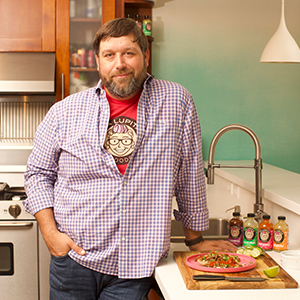
[00:00:10] Ray Latif: Hello friends, I'm Ray Latif and you're listening to the number one podcast for the food and beverage industry, Taste Radio. This episode features an interview with Hector Saldivar, the founder and CEO of Tia Lupita, a fast-growing brand that is attempting to reframe Americans' perspective on Mexican cuisine via better-for-you versions of traditional foods. Just a reminder to our listeners, if you like what you hear on Taste Radio, please share the podcast with friends and colleagues. And of course, we would love it if you could review us on the Apple Podcasts app or your listening platform of choice. Years ago, Taco Bell implored people to quote, make a run for the border. It's a slogan that probably irked Hector Saldivar, Mexican-born entrepreneur who views fast-food tacos and burritos as degrading to traditional Mexican dishes. To counter the narrative of Mexican food as being cheap, greasy, and lacking in nutritional value, Saldivar launched Tia Lupita, a brand rooted in the flavors of his mother's kitchen and better-for-you sustainable ingredients. Tia Lupita markets a flagship line of clean-label hot sauces, along with grain-free and low-carb tortillas and tortilla chips that are made with a base of cactus flower. The brand, whose logo features a caricature of Hector's bespectacled mother with a pink curling roller in her hair, has carried it retailers including Whole Foods, Central Market, and recently landed chain-wide distribution of its hot sauces at H-E-B. In the following interview, I spoke with Hector about how Tia Lupita is at once a modern and authentic Mexican food brand, educating around one of its key ingredients, the retail strategy for three distinct product lines, and what he's learned as an immigrant entrepreneur. Hey, folks, it's Ray with Taste Radio. Right now, I am on a call with Hector Saldivar, who is the founder and CEO of Tia Lupita. Hector, how are you?
[00:02:09] Hector Saldivar: Hi, Ray. I'm great. And thank you so much for having me. I'm a huge fan.
[00:02:14] Ray Latif: Well, I'm a huge fan of your brand. So mutual admiration here. I really appreciate your time. I know you're very, very busy. Tia Lupita just announced a very big retail win. Can you talk about that retailer that you guys got into?
[00:02:30] Hector Saldivar: Yes, absolutely. We just started rolling out at HEB. which is Texas largest retail chain. And surprisingly, I think it's like the seventh or eighth largest retail chain in the United States. And what's surprising about that, it's not the number seven or eight position is that, They are only like in a selective part of Texas, right? They're not even in Dallas. They're only in Houston, Austin, San Antonio, and the border, right? And so just dominating that territory to be that large and that impactful, that's pretty neat. But most importantly for me, the win or being present in that chain is that the proximity it has to my family. Me, I'm from Monterrey, Mexico, which is maybe 100 miles from the Texas border. And actually, my mom was born and raised in a border town in Reynosa, which borders McAllen, Texas. And so every time we went to visit family, we had to cross the border and visit HEB. That was like a thing we had to do. And then we would go to HEB, experience it, and bring all the American goodies back home to Mexico. And that'll last us until next trip. Now, I am there. My family members can go and shop the products that I started under my mom's name or honoring my mom, right? So that's pretty neat. They can finally validate that I did start this.
[00:04:11] Ray Latif: It's not just like, oh, here's my brand. They actually see your brand.
[00:04:15] Hector Saldivar: Exactly. No, guys, for real. I started a food company. Yes. No, no. Oh, yeah. Where can I get it? Whole Foods in Sacramento, where is that? So now they can go to McAllen or Laredo or Brownsville stores and find us.
[00:04:33] Ray Latif: Very cool. Well, congratulations on that. Hector, you mentioned you're from Mexico. And when I was reviewing your LinkedIn profile, your bio is great. And the first words in your bio are, I am an immigrant. Now it continues from there. But I wonder why you chose to lead with that, you know, at a time when immigration is such a divisive issue in this country. And even just the word, just stating the word, immigrant or immigration, can stoke a lot of emotion, passion, and frankly, unfortunately, you know, the kind of division that has been existing in our country or that has existed in our country for way too long. This is very funny, right?
[00:05:18] Hector Saldivar: You know, when I moved here 16 years ago, I didn't know I was an immigrant. I am the definition of an immigrant. I came here looking for better job conditions. I came here looking for a better lifestyle and living conditions. But I didn't know that until, like you mentioned recently, immigrant became a bad word, a four letter word, if you wish. And I was, upset about it. And I started Tia Lupita right in the middle of that mix, a time of divisive rhetoric, building walls and profiling. And I like to say that, you know, in that time of building walls. My mom was building a bridge at the same time, right? Trying to connect to me from Mexico to the United States by sending me her care packages of hot sauces. And that's what we're trying to do with Tia Lupita. It's build a bridge to better for you Mexican food products. But starting with that word, immigrant, it's also also letting know other people under the same that fall under the same around that. You shouldn't be ashamed of that. We all need to stick together. I love to talk, and I'm sure I'm going to mention the word allies through the podcast a lot. We need more allies in this space. There is a significant under-representation of Hispanic founders and immigrant founders here in the United States. And so just by starting like that, I'm putting my two cents and saying, hey, I'm one of you guys. Reach out to me. Whatever I can do to help, we'll stick together. Food is love. And when you're eating good food in a table, it doesn't matter what nationality you are. It doesn't matter where you come from. It doesn't matter your political points of view or religious points of view. You are eating food and you're having an enjoyable time among friends. That's the important piece. That's the important takeaway.
[00:07:27] Ray Latif: Absolutely. And what you just described reminds me of a podcast interview I did with a man named Christopher Kimball, who's known from the show America's Test Kitchen and now his own platform called Milk Street. And it struck me, one of his quotes was, you can almost experience the culture through the food. There's a context around a recipe and you learn a lot about the people and nobody can stop that from coming across the border. The culture, the cuisine, what you are trying to share with American consumers is something remarkable and something, I'm going to use the word authentic in recent interviews I've done. Authentic is one of those words that some people are less inclined to use when we're talking about ethnic food. But yours is really, it has a special place in your heart because it did come from your family and those care packages that your mom sent. Was that the inspiration behind Tia Lupita? I mean, could you talk about that background and how you started the company and why you felt this passion to share your culture with others?
[00:08:32] Hector Saldivar: Yeah, absolutely. Like you mentioned, it started with care packages, specifically hot sauce. A regular mom's care package to their kids would be maybe a sweater or socks. I would get hot sauce, which was totally fine. I missed that hot sauce so much. I couldn't find a hot sauce in the marketplace that tasted or had the same ingredients as my mom. And again, stepping back, this is a family recipe that had been passed down to a single family member of each generation. I like to explain it this way. In Mexico, we don't inherit cars, jewelry, or money, right? What gets passed down to us are our family recipes. Those are our family heirlooms. That's how our family legacy lives on. You will always hear a Mexican say, ooh, I'm going to make my grandmother's mole tonight. or there's a party and somebody needs to bring, I'm going to make my aunt enchiladas. So in my case, it was hot sauce. And I would share that hot sauce. As soon as I get it, I would share it with friends and colleagues. Yes, it was that guy who brings the hot sauce to the workplace. And as I started sharing that, people started falling in love with my mom's hot sauce. They realized that there was something different and special. And so every time I went back home, I would get requests, tell your mom to make me a bottle, I'll pay for it, whatever. And for many years, that was the case until I was, guys, I can't do this anymore. I'm leaving clothes behind. The custom agents are getting suspicious. And so that's when they truly inner circle or network started pushing like, Well, dude, you cannot leave us hanging, right? You have to sell it. You have to make it. And so it was recurring. It didn't happen right away. It was 10 years of brewing, of fermenting in the making, right, until the opportunity presented itself. And yeah, in 2018, we sold our first bottle. And from there, you know, things started to evolve really quickly into others. It was self-fulfilling a little bit, if you wish, you know, it's that. Also making sure that this tradition, this heritage, this inheritance of mine kept living forever, right? Again, this is a recipe that had been passed down to a single family member of each generation, so it came down to me. I have two other sisters and they had no interest. thankfully, of learning how to do this hot sauce and to be the gatekeepers of the recipe. So I did ask for my mom's blessing, actually, because she kind of knew that this recipe, this inheritance was going to end up with me and it was going to, now everybody would enjoy this.
[00:11:34] Ray Latif: You said that the opportunity presented itself. How did you sense that the opportunity was right? And what did you see in that timing?
[00:11:45] Hector Saldivar: So I worked in food and beverage in CPG. You know, that's how I did my career. I worked for Nestle, I worked for Diamond Foods. This last company got acquired by Snyder Lance and moved operations, was moving operations from San Francisco to Charlotte in North Carolina. So that was the fork in the road. That was the, Do I go to Charlotte and with my family and continue my career there or do we stay here or look for another job in CPG? And, you know, it was actually my wife's idea. I said, hey, why don't you take this opportunity and start this? Why don't you apply all your learnings of being in this realm of work and see if you can start this? And maybe, you know, we'll have something cool and something local here that you can make a living of. We'll give it a year, famous last words, right? It's like, we'll give it a year and see how it goes, right? And we're almost closing year four now.
[00:12:58] Ray Latif: One of the things that struck me about Tilapita and something you've talked about a lot is this notion of removing stereotypes about Mexican food, yet at the same time modernizing Mexican food. And I think there could be a disconnect between those two things. I think it can be hard to try to do both at the same time. How are you attempting to achieve both with Tia Lupita?
[00:13:24] Hector Saldivar: Right. No, absolutely. Not only do I want to update Mexican food, but also the Mexican image, the image of the guy the Mexican guy, the bandito with the mustache, or guys leaning on a cactus with a big sombrero, or, you know, the lady with a big dress and the flowers in her hair and all that stuff. Mexican people are much more than that. Yeah, it's cool traits there, but when I go to Mexico, when I go to Monterrey, I don't see that. You know, and so I kind of want to modernize that. That's why I remember a while back in a pitch asking the investors, you know, you want to see a real Mexican woman? And I showed them a picture of my mom. This is a Mexican woman. This is what I see. This is a Mexican woman that I see when I go to Mexico, right? And so it's time for that. And also, you know, as we try to modernize Mexican food, It's a word that we can use, but I think it's update also would be a better word. You were talking about authenticity, right? Or are we authentic? Because someone told me, well, are you really authentic if you use okara? You know, we use an upcycled flower, right? Which is okara. And I'm like, Yeah, it's probably not an ingredient that the Aztecs used when they were making tortillas back in the day, but it's something that we have available now. And it's something that, based on current conditions of the world, we should start using. We need to start using, right? That's the idea behind Tia Lupita is that. We're being authentic with the food that we bring, either because they're family recipes, they come from an original place, but also we're updating and innovating with ingredients that we have on hand. Cactus, nopales, is an innovative ingredient here in the United States, but not necessarily in Mexico. In Mexico, you know, it's been used since the dawn of the civilization. It's even in the Mexican flag, but it's how the god Quetzalcoatl told the Aztec tribe, you will find the city where you find an eagle devouring a snake on top of a cactus. But knowing that for us Mexican, nopales or cactus is so part of our everyday lives, but it isn't here, that's another opportunity for sure.
[00:15:54] Ray Latif: Yeah, cactus is a very big part of what you guys do. And I think telling that story about how cactus has played and continues to play a role in the history and heritage of Mexico is one that I haven't necessarily heard before. And I'm so glad that you shared it with me. And I think that speaks to your ability to share the story of T. lupida so brilliantly and eloquently. But when you are telling that story, if it's you in front of the customer, that's one thing. If it's just someone picking up a bottle of Tia Lupita hot sauce at an AGB, how do you share that story in a way that's going to inspire them not only to buy the brand, but to want to learn more about it?
[00:16:40] Hector Saldivar: I think we have a very fun and approachable branding and packaging. Interesting enough, You know, remember, we started with hot sauce, right? And so I knew that the hot sauce set was very busy, it's very competitive, right? But when doing my research, I noticed that all were using the same bottles, for example, the five-ounce Woozie, the skinny hot sauce. You know which one, you close your eyes, you think hot sauce, you'll picture that bottle. And the other thing I noticed was that most of the hot sauces were very polarizing, were very macho driven, they were communicating a lot of pain, suffering, devils, skulls and bones, donkeys, farting flames, all that stuff. So I knew that I had to capture the shopper in four seconds or less as they were shopping that set. And so I went the opposite way. I decided to use a short stub, a Boston round, 8-ounce Boston round bottle, and communicate approachability with my mom's face, hand drawn, using her curler, the same way that you would find my mom in the kitchen.
[00:17:57] Ray Latif: The same picture that's on your t-shirt right now.
[00:17:59] Hector Saldivar: The same picture that's on my picture. Exactly. I thought worst case scenario, somebody would see that, And even if they don't grab it, it'll put a smile in someone's face. That has become our symbol of approachability. And people can connect. And it doesn't say, oh, this lady is Mexican. You don't know where this lady is from. And by the way, I've gotten a lot of notes and feedback of people saying, my grandmother uses a curler the same way. Or my mom, my aunt, that's how they would wear that curler. They could immediately relate.
[00:18:36] Ray Latif: Yeah, it's great to see the Mexican food community, the Latinx food community coming together and so many folks interested in supporting early stage entrepreneurs and getting the word out about their brands and Mexican food and Latinx food. As that competition grows, however, you are seeing some overlaps in terms of what people are selling and essentially, this growing cohort, while it is sort of a rising tide lifting all boats, you are essentially competitors. How do you compete and yet at the same time try to support those that are doing the education, that are helping get the word out about modern Mexican food and ones that are trying to stay true to that cultural experience that you grew up with?
[00:19:24] Hector Saldivar: That is a question that has been thrown my way by a couple of investors actually, you know, it's like, How are you managing all this hype that there is with Mexican food, or Better For You, or all this innovation that is happening around that? I honestly welcome it. Somebody to help lift while we rise. It's a phrase that I recently heard that I loved. Help lift as we rise. And I think you mentioned it as well. the more people coming to the category is, that's the way I see it. We're helping each other, bringing more people, more eyeballs to the category. And from there, it's up to them to choose what they want, who they like, what is their taste buds preference. Maybe for us, maybe, you know, it's the spiciness, it's the bold, flavorful heat. For a lot of them, it may be something else, right? Maybe a sweeter product in their line or in their offering. maybe it could be nutritionals, right? We offer different nutritionals than other brands that are maybe not focused that much in calories or carbs, and so those are the different ways to differentiate us. But it's really cool to see, it's really I just saw recently that ethnic inspired foods are growing double than non-ethnic or non-international in the retail, in the food space. Last year, and to that point just peeling the onion a little bit more, last year during the pandemic, Mexican food became the number one consumed food, overtaking Italian food. So there's more people right now eating tacos than pizza and pasta in the United States, not only in restaurants and for takeout, but also at home, which means they're cooking, right? And so it means that the occasion has evolved from Taco Tuesday to everyday Taco Tuesday.
[00:21:36] Ray Latif: I mean, that's helpful for you as a brand, I'm sure, in that people are looking to eat more Mexican food, and they're looking for brands to help highlight or improve upon their at-home eating experience. But that being said, you touched on this earlier, the nutritional benefits of your products versus those of competing ones is a key point of differentiation. But to consumers that are buying Mexican products or Mexican inspired products, are they looking at those bottles? Are they looking at the labels as much as they are interested in taste? Taste is king.
[00:22:17] Hector Saldivar: That's always going to be the case. Taste is king. You know, you can have the best branding in the world, the best celebrity spokesperson, but if the product tastes like cardboard, you will not get the repeat order. And the repeat order is the lifeline of a product, of any product. There is this trend for better for you and healthy as well. So I am that perfect example. I am a Mexican that has acculturated and into what the U.S. consumer dynamics are here in the States. And it's paying attention to ingredient lists, paying attention to the nutritional panel, seeing if it's sustainable or if there's mission driven, all that stuff. 16 years ago, buying that stuff in Mexico, I didn't care of that, but I've acculturated. There is this movement in the United States, and it's trickling down everywhere. So when I moved here 16 years ago, the company that brought me here was selling nostalgic products from the motherland to Mexican immigrants. I've come full circle. Now I'm offering Tia Lupita to the kids of these immigrants. And not only that, we're allowing ourselves to cross over because, again, the American palate is evolving and accepting this ethnic food. But absolutely, taste above everything. And then it's the nutritional value, the nutritional values and attributes of the product.
[00:23:47] Ray Latif: I can think of one person for whom taste is more important than any other consumer, and that's your mom.
[00:23:53] Hector Saldivar: Absolutely, absolutely. You nailed it. And by the way, until just recently, my mom approached me and said, I think your hot sauce tastes better than mine. Oh, wow. And so, yeah, yeah, yeah. Yes, it's like the grasshopper has taken the master, you know, finally. It was like, it was, there's always going to, especially in a Mexican household, it's like, nobody bits my cooking. I only have the secret touch this and that. And so same, same with my mom. But yeah, until recently my mom was like, yeah, I think your hot sauce tastes better than mine now. I'm like,
[00:24:36] Ray Latif: That's a bold statement for your mom to make. It must have taken a lot for her to say that, or it must have taken that hot sauce to be pretty extraordinary for yours to beat hers.
[00:24:45] Hector Saldivar: It'll never taste like what she does at home. It will never taste. But I am very happy with what we've produced. Only a certain few will notice that this doesn't taste like the kitchen version of my mom's hot sauce.
[00:25:01] Ray Latif: Well, and it says something because, you know, you're mass producing your recipe, you're mass producing this product. And if she's making one pot of hot sauce in her kitchen, you know, typically that's always going to be better than, you know, mass produced product. But if you can actually say, my mom, and that's a great selling point, you should put that on Instagram or something like that. I have to tape her.
[00:25:24] Hector Saldivar: I'm going to have to tape her. She gets really nervous when I put a camera on her, but I'll have to secretly tape her saying that maybe over the holidays.
[00:25:33] Ray Latif: Well, I'm trying to think of other cultural comparisons. It'd almost be like, you know, if someone was Italian and their mom made tomato sauce and, you know. Or meatballs, or yeah. Yeah, exactly. Or, you know, something like would be my case, you know, my mom makes hummus. And if I made hummus, that was better. If I had a brand of hummus that was better than hers. Although I don't think I would ever say that. I'd have a hard time saying that, or at least promoting that. You know, everything that your mom makes is gold, everything.
[00:26:02] Hector Saldivar: Absolutely, absolutely, absolutely. No, for for me, I mean, I totally get it, but I'm like, I know it rolls out easy. Oh, hot sauce. Oh, that's honestly, my mom didn't have the recipe written down. She measured everything with a wooden spoon. And so, you know, I flew her in to San Francisco and I had to learn. It was a full week of me imitating her and how to make the hot sauce and how to peel the stems of the peppers and what to leave and what not. And so it took a while. It took a while. Me first learning how to do this. And then, like you said, is it scalable? Can I mass produce this? And so for me getting that validation, it's the best.
[00:26:50] Ray Latif: Did your mom teach you how to make tortillas and tortilla chips as well, or is that something that you had to learn?
[00:26:55] Hector Saldivar: So my mom makes tortillas back home, for sure. This is something that we do in most Mexican households. The key here being the cactus in the pie. So my mom made fresh tortillas, not necessarily using cactus. The cactus thing came to me as, you know, in Mexico We've developed this technique in order to reduce calories and carbs. And so we have a corn and cactus, you know, so we use the mixed-amount fresh corn meal, if you want to call it that way, and we mix it with cactus. And so that's actually what you can find in Mexico. That's what I would bring from Mexico for my own personal consumption, because I love tacos, but I'm always on a diet. And so tacos and diet should never be in the same sentence, right?
[00:27:49] Ray Latif: So as long as they're not diet tacos, don't ever call them diet tacos. That doesn't sound good.
[00:27:54] Hector Saldivar: I think I've cracked the code of having tacos and being on a diet. So that way I didn't feel that guilty eating tacos when I knew that my tortilla was only 30 calories and only four grams of carbs, right? Quick comparison, a regular tortilla has around 90 calories and 17 to 24 grams of carbs. So anyways, that product existed in Mexico, but not in the United States. How do I know that? Because I had to lug those tortillas for me to eat them here because I couldn't find them in the marketplace. And so that was my white space. That was like, why isn't anybody doing it? And am I the only one that loves tacos, but it's always on a diet? And so I said, that's how I will expand Tila Vida and pivot into just not only a hot sauce brand, but a platform brand and trying to innovate in other categories and other lines. knowing you know that we're bringing innovation to the tortilla category with cactus, well I said can we do this also grain-free knowing that there was this explosion of grain-free tortillas and that one we developed here in the United States and that's where we use alternative flours like okara and cassava and so I'm really proud of that one because Using upcycled flowers is super neat. It's one of those things that you never think about, but we're impacting a little bit the supply chain. We're helping reduce our food supply chain by 40% by using upcycled flowers, right? And then add the sustainability of cactus. We like to say that we're helping save the planet one taco at a time. It's the most sustainable tortilla there. So yeah, so that was made here in the United States with flowers that we have available here in the marketplace and great partnerships, for example, with Renewal Mill, who is providing us our upcycled flower. And then, you know, we're continuing to innovate under those same guidelines where we're working right now with re-grained. They use upcycled barley and wheat leftover from beer, the beer companies, right? And so we want to try to offer one like truly, truly like an upcycled tortilla, right? So we're innovating that front. And tortilla chips, I'll be 100% honest, it was, I like to say, it's a happy accident. So I was validating if the tortilla, the cactus tortillas had a place in the marketplace. I was doing some consumer discovery shows, and someone approached me and said, this tortilla is delicious. And are you thinking of making tortilla chips? And I was like, what? You know, if you have tortillas, you can make tortilla chips, just cut them in triangles. And I'm like, oh yeah, that makes perfect sense. And so that literally, that's how the tortilla chip line started. So it was somebody noticing that, I can't wait to taste the tortilla chip version of this tortilla.
[00:30:55] Ray Latif: They're all great products, and they're all products that we've had in our office here and that you've gotten a lot of praise on across the food and beverage industry. People just, when they hear the name Tealupita, they are very praiseworthy of not just the brand, but all your products. And, you know, this happened in a recent episode of Taste Radio where I was speaking with the chief growth officer of Erewhon, who mentioned two brands that he always has in his shopping cart, one of them being Tealupita. Now, for a place like Erewhon, I can imagine that you're selling all three lines or at least two out of the three lines. But as you're growing the brand, your workhorse is the hot sauce. But I'm sure that you wanna sell the tortilla chips and the tortillas in all the retail locations that you're authorized in. These are different buyers, maybe for different aisles. How do you prioritize or how do you, I guess, give equal attention to all three lines?
[00:31:55] Hector Saldivar: No, absolutely. So right now we're channel focused. we're developing and maturing ourselves in the specialty natural channel, right? But with the hot sauces, we've allowed ourself now to cross over to the conventional channel, right? You know, hot sauces are very straightforward. You know what you're gonna use it for, right? A lot of people might not be looking at attributes. They're just looking at the taste profile, right? And so with that line, we've allowed ourself to Anywhere that has a cash register, we should be selling a Tellurida hot sauce. And also knowing that in that set, in the hot sauce set, within the condiments category, premium and super premium hot sauces are what are outpacing the growth of that set. We're growing at a 300, 400% rate. And what buyers love, aside from the growth, it's usually incremental dollars. It's the same dynamic as the beer set. People will always get your everyday beer, that $5.99 six pack. But in addition, they are going to get that same shopper is going to get that $17, $18 craft artisanal IPA to reward themselves. Maybe they will not drink it every day, right? But they'll drink it, you know, if they have people over or to reward themselves after something nice. Same thing with hot sauce. You have your everyday hot sauce there, retail at 199, 299, and that same shopper will reach out for that premium hot sauce, super premium hot sauce to reward themselves when they're cooking really something really nice or when they have people over. And so it's incremental, it's not cannibalizing, they're still getting the workhorse and they're getting the premium. So we're taking advantage of that for sure. It's one of those things that, all right, we've proven that, so now we can play everywhere. With tortillas and tortilla chips, we need to be a little bit more strategic. And because it's definitely more attribute driven and also price points are a little bit on the premium side as well. And so, but we do know, for example, that the refrigerated tortilla set is one of the fastest growing sets. And so, you know, we're playing, we're tweaking at the moment where, okay, we know that we're working in the natural specialty channel, Can we cross over to the conventional, even in the club channel? And with tortilla chips, that one is the one that we really, really don't, we don't wanna mess around in going into places where we're just gonna sit there, right? That is very price sensitive or people don't care about the attributes or sustainability story. And so with that, we really need to be curated. We really need to start just building on that base. It's like when sustainable protein flowers came about. I'm talking about the bugs or cricket flowers, right? They didn't go to Walmart right away. They didn't go to Kroger or Albertsons. They needed to start in very specialized channels. I think, you know, even when they started, I think they developed really well in gift shops and amusement parks. And then from there, they started evolving into other retail channels and stores. So long-winded answer, we're very channel focused, channel being channel specific for each of our line. And then the prioritization is being dictated by the demand. So hot sauce continues to be, you know, 60% of our business, but we see tortillas during having a secretariat story and September, October, you know, we sold more tortillas and hot sauce in the marketplace. So, yeah, we see a lot of potential on it. Yeah. And so, yeah, we're excited to continue increasing our distribution in the marketplace.
[00:36:01] Ray Latif: One thing that we haven't discussed, and this has been an awesome conversation, thank you so much, Hector. Absolutely. One thing we haven't discussed is sort of an elephant in the room, and I'm sure it follows you around anywhere you go, and that's Siete. You know, I'm sure, or I would guess, that a lot of times when you're talking to industry folks about your brand, they mention that name. and they do some of the things that you guys do in terms of products, and they do a lot of it, and they have massive backing in terms of investment, and they've been on the market, and they're everywhere. In fact, I think, you know, when we did our pre-interview call, I was sitting in my car, and I saw someone walk out of a store, and they were wearing a Siete t-shirt. When a competitor like that has such reach and has such a such a head start, for lack of a better word, do you even try to compete with that? Or, you know, what is your answer to folks who say, well, you know, there's Siete, so why do I need a Tia Lupita?
[00:37:06] Hector Saldivar: Absolutely. And by the way, I love Seattle. It's going to be a very similar story, actually. They started with tortillas and then expanded to hot sauces. I started with hot sauces and expanded to tortillas. They're from Laredo, Texas. I'm from Monterey, which literally we're like an hour and 30 minutes away from each other. And so the similarities are pretty cool. What they're doing is great. Like you said, they got the head start and they saw that white space and went for it, right? I might have seen that white space, but didn't do much about it until later. But again, it's one of those things that because they're paving the way, I'm super grateful that they're doing that. The one way that I can differentiate myself very quickly from aside from them is that they're very focused on, you know, grain free and probably the what they call the whole 30 diet, the whole CrossFit environment. They leaned into that very much and they created a very good base from that. And also, And you will hear Miguel Garza say this, it's about they're a Mexican-American brand, you know, and focusing on that hyphen, right? And so now you see them expanding into cookies and with flavors like birthday cake and stuff like that, which not necessarily are flavors that you would find back in Mexico. So there's that, I guess, differentiator as well that we, for example, in our chips, We don't do any nacho cheese flavor or sour cream and onion or barbecue flavor chips. We want to stick with the flavors that you would find in the Mexican chip set back home, you know, which are spicy and bold. That's kind of like a way, in a very simplistic way, to differentiate ourselves. And again, pushing sustainability and innovation, right? So, you know, under those guidelines, I think people will know the difference. It's humorous and I'm gonna say, Coca-Cola was the first, but it's okay to be Pepsi. They're the first and they're doing great, tremendous backing. I'm okay being number two under the growth of Siete. If the valuations continue to evolve as we're hearing it is in the marketplace.
[00:39:40] Ray Latif: Well, if you can become an iconic brand like Pepsi, I think you've done pretty well for yourself, Hector.
[00:39:47] Hector Saldivar: Yeah.
[00:39:48] Ray Latif: And I think you're off to a great start. As I mentioned before, you know, we love your products in our office. Everyone I've ever talked to says they love tealapeda products. And that's kind of rare, I think. That's rare in our industry for so many people to consistently say that this is a great brand, not just a great brand, but they make really tasty and nutritious products. So congratulations on everything that you've accomplished to this point. I can't believe we've been talking for an hour. I feel like we could talk for another three or four hours. Well, let's crack a beer another time and let's continue our conversation another time. But in the meantime, thank you so much for taking a few minutes out of your day to chat with me. It's been really informative, really fun, and I know our audience is going to love it.
[00:40:38] Hector Saldivar: Thank you so much, Ray. It was an honor and a pleasure. And thanks again for helping us elevate our story and our message out there.
[00:40:49] Ray Latif: Absolutely. Thanks so much again. Thanks. That brings us to the end of this episode. Thank you so much for listening, and thanks to our guest, Hector Saldivar. As always, for questions, comments, ideas for future podcasts, please send us an email to askatasteradio.com. On behalf of the entire Taste Radio team, thank you for listening, and we'll talk to you next time.