[00:00:04] Jacqui Brugliera: At the Snack Brigade, we don't believe snacking should be a bad thing. We're on a mission to make better for you, better for all, with our wholesome, delicious, puffed snacks. With bold and delicious flavors like cheesy cheddar, sizzling sriracha, Saucillian pizza, and apple pie, everyone will find their favorite. Join us at the Snack Brigade on the front lines to usher in a new generation of snacking. United. We snack.
[00:00:37] Whole Foods: And now, Taste Radio.
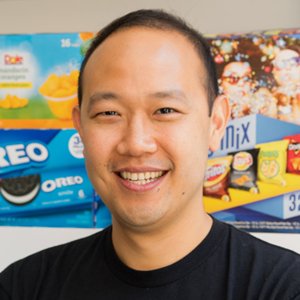
[00:00:50] Ray Latif: Hey everyone, I'm Ray Latif and you're listening to the Top Podcast for the food and beverage industry, Taste Radio. This is episode 152, which features an interview with Chieh Huang, the co-founder and CEO of Boxed, a fast-growing online retailer that's been dubbed the Costco for millennials. Tune in on Friday, March 8th for episode 24 of our Taste Radio Insider podcast, which includes an interview with Benjamin Witte, the founder and CEO of CBD sparkling water brand Recess. Just a reminder to our listeners, if you like what you hear on Taste Radio, please share the podcast with friends and colleagues. And of course, we'd love it if you could rate us on iTunes. When it launched in 2013, Boxed had all the hallmarks of a startup. Audacious idea? Check. Parents' garage as the company office? Check. Low probability of success? Check. Unlike many startups, however, Boxed, an online retailer of bulk goods, has thrived in the years since its debut. The company reached $100 million in sales in 2016 and has attracted interest from a variety of investors who've injected over $243 million into the business. Last year, it was reported that Kroger made an offer to buy Boxed for half a billion dollars, an acquisition that was turned down by the company. How, I wonder, has Boxed, which is less than six years old, achieved this position? I recently sat down with the company's co-founder and CEO, Chieh Huang, to get the answers. In our conversation, he spoke about his background and that of Boxed, and why the acquisitions of Whole Foods and Jet.com were critical to the development of the company. He also discussed the evolution of mobile commerce, the importance of user experience and customer service, and how Box curates its product assortment and utilizes consumer data. And in one of the most notable moments of our conversation, Chieh explained why he believes the future of online food shopping will look like Netflix. Hey folks, it's Ray with Taste Radio. I'm in New York City at the headquarters of Boxed and I am with Chieh Huang, the CEO and co-founder of Boxed. Thank you so much for having me here in your wonderful office. Thanks for having me on the show, Ray.
[00:02:56] Chieh Huang: I'm glad I could personally let you into the building as I was walking in.
[00:02:59] Ray Latif: You may have seen me in a moment of like frustration and panic as I'm like pressing the button out there. And I'm like, wait, Is that Chieh right there?
[00:03:08] Chieh Huang: The secret is the button works 50% of the time. So if you're a vendor selling into box, it's right there. That's the first test of tenacity.
[00:03:18] Ray Latif: Well, I did hear a bell, but then it worked, but then no one responded to it.
[00:03:23] Chieh Huang: Also, our normal person who's at the front of the house, she is on vacation today. So everyone's filling in. So no one really knows how to work the buzzer.
[00:03:33] Ray Latif: Yeah, they must have seen me downstairs. I didn't curse. Yeah, which was nice. But there's a there's that video camera.
[00:03:39] Chieh Huang: I didn't. That's why they let you in. They were like, he's not not not enough grit.
[00:03:43] Ray Latif: Yeah, journalists. We don't want people in here. Yeah. Great office. I told you when I walked in. I mean, this has a great like startup vibe to it. You just see people milling about and doing their work. And you know, there's just there's a lot going on here. When do you move into the space?
[00:03:59] Chieh Huang: We moved into this space, I would say, almost two years ago now. We're starting to outgrow it. As you're seeing, like, this space right next to us was not intended to be office space. But a lot of folks are starting to populate here and in the cafeteria. But the history of this space was that it used to be Squarespace's office. And before that, IDEO's office. And then we inherited it from Squarespace. And everything, the design, The furniture, everything was Squarespace's old stuff. So when people come and visit, they're like, I think I've been here before. I'm like, yes, you have.
[00:04:30] Ray Latif: Some of the furniture is still the same?
[00:04:32] Chieh Huang: All the furniture is still the same. Wow. Yeah. So Squarespace has great taste. So everything's the same. Well done, Squarespace. They have great taste or we're just very frugal. So we didn't want to buy new furniture. So maybe it's a mix of both.
[00:04:46] Ray Latif: And this addresses the question about whether or not you're a startup. If you keep, if you inherit furniture, you're a startup, right?
[00:04:55] Chieh Huang: Okay, all right. We're forever a startup, man. I know a deal when, you know, if it's free 99, then I'll take it. Free 99.
[00:05:02] Ray Latif: One of the interesting things you just told me was that you don't have an office.
[00:05:06] Chieh Huang: I've never had an office, and I don't intend to have an office. And I'm sorry to all the executives that are listening to this that perhaps are in the interview process where I promise you get an office when I get an office, but the reality is I don't want an office. That's not to say I don't need private time sometimes. In those cases, you know, kind of as we were riffing before, I'll book a conference room and just sit in it for about 30 minutes or so. I like being on the floor because it makes me accessible. Now, there's the downside of that because it makes you really accessible. So anything, people are just coming, hey, you know, like, did you know this happened? Or what's up with this? But overall, I think that has put me in a position where I kind of know I'm still very much in tune with the company, even though we have hundreds of people now, that I'm not like, oh, what happened where, you know? So, but there's definitely good and bad of it.
[00:05:56] Ray Latif: It feels like you're sort of in the trenches with your team, right? Yeah. In a way. And let's talk about that team that you built, this company that you built, launched out of your garage. Was it your parent? I believe it was your parents' garage in 2013.
[00:06:09] Chieh Huang: Cradle of civilization in New Jersey. What were you doing before you launched the company? So we were actually at a gaming company called Zynga. Zynga had acquired our startup where that startup was one of the first mobile gaming studios for social games. So you know how ubiquitous mobile devices are and how we feel so comfortable with them today? I still remember sitting in a New Jersey diner, I know this is very cliche, sitting in a New Jersey diner with the co-founders for our gaming startup and saying, this iPhone thing might be really big, you know? And it's like, it's crazy now, but a lot of people shunned the iPhone when it first came out. It was 900 bucks and you got a rebate because it was so expensive. Not a lot of people used it. Like all the industry experts laughed at it, but we just thought, like computing devices in terms of their power only go one direction. And the touch interface was so intuitive that if this thing got really powerful, there's probably nothing you could do on a desktop that you couldn't do on this device. And over the last now eight, nine years since that first probably more than that, actually, since that first diner lunch, that's played out to be pretty true. So we started off in gaming, did well there, and eventually wanted to take that gaming expertise, not gaming expertise, but the mobile expertise and port it over to food retail and CPG in general.
[00:07:30] Ray Latif: When you launched the company, did you see it as a retailer or did you see it as a tech company?
[00:07:35] Chieh Huang: It's funny because we always thought we needed to be a tech company if not a tech first retailer. But the hard part is that it was hard to not fall in the trap of calling ourselves a tech company simply because we sell things online. A lot of companies out there that just sell stuff online, that in upon itself does not, you're not a tech company. It's just another channel. So on day one, even though we build ourselves and held ourselves out to that standard, we did not meet that standard early on. We were in our garage, our backend warehouse management system was basically one button. And the only button, the only function in the backend was to take down the site and the app. in case we had so many orders we couldn't keep up. It was kind of wishful thinking, because when we launched, nobody ordered. And so it's like, I think someone's parents placed an order and we're like, oh my gosh, they really love you. So we didn't meet that threshold early on. But because we couldn't afford to buy off-the-shelf warehouse management software, and because we knew we could build the software ourselves, we then started to build out that initial checkout system, that front-end system. I've seen like threads online about like, what is box built on? And people are generally pretty shocked that 95% of our stack is built in house. Wow. Yet today, front end systems, warehouse management software, inventory management, customer segmentation, ad platform, cost per click ad platform for the brands, all the way down to the robotics, we design, engineer, and physically manufacture the robotics ourselves. So it's about as self-sufficient as it gets. Vertically integrated in some ways.
[00:09:12] Ray Latif: Exactly. Yeah. Why this idea for a bulk shopping experience online? I mean, obviously you have to be concerned about the old SWOT analysis and you think about threats. Well, there's a really big one called Amazon. There's another really big one called Costco. I mean, why do you think Box could make it?
[00:09:30] Chieh Huang: You know, the reality is probably we're a little naive and maybe a little crazy and probably a lot of stupid. But luckily over these last five years, the tailwinds of change in retail, in food retail and CPG have blown in our direction and have enabled us to be where we are today. If we did not see this massive digital shift over the last three years, we would not be around. It just would not have worked. So a lot of it is actually timing paired with that kind of hardheadedness of just saying, we think we can do things differently than how it's been done. To your point of why bulk retail, it's interesting because, you know, there's all these things in the press about big retailers saying, I need bigger packs from CPG companies. We're kicking out all this stuff because we're not making money on it. When we spreadsheeted out the business, we were like, man, unless we generate this much in an average sale, it's really hard to make money. If we sold like little tchotchkes or little travel sizes of CPG products, unless someone buys 30 of them, you're not going to cover the cost of shipping. So with that said, we saw early on that bulk retail from an economics point of view was probably the best way to go. And it also differentiated ourselves because of the channel conflict with behemoths like Amazon.
[00:10:44] Ray Latif: You talked about the changing winds. Well, what's causing those changing winds? You know, what are the factors that are making online shopping so exciting for consumers today? Yep.
[00:10:56] Chieh Huang: I think there's two sides of that, right? There is the consumer reason and the business-driven reason. The consumer reason is actually something that we live with every day. So one of the scariest yet most interesting stats, I don't know if it's true or not, but someone told me, and he had a medical degree, so I assume it was right, but I can't say it was, you know, I'm like, trust me, I'm a doctor. But he said that he read somewhere that there was a professor at an undergraduate who had tracked decibel levels, so noise levels of the undergraduate cafeteria over the last 10 years. And today, it is 25% of the decibel level of 10 years ago. Less. 25% less, yeah. No, it's only 25%. So, it's a huge, a massive decline. It's like a library. It's a quarter of what it was. Exactly. So, what explains that? Well, we sit there. We don't need to talk to people anymore. We sit on our phones. We stare at them. And instead of just being the default thing when something's awkward, it's like now it's like people go straight to their phones when they sit down and eat. Unless they're going with a huge group. So, with that said, I think that trend, as that group graduated college, and as that group comes into their own and starts buying CPG, that group being the millennials. Millennials are now the biggest baby-producing generation in America, the biggest generation in the workforce. And pretty soon, I don't have a stat to back this up, probably the biggest CPG-purchasing generation in America, too. It's natural, right? They're just going into that curve. So how do they interact with brands? How do they interact with shopping? That generation generally doesn't say, oh, I need something, man, I gotta go to a store. They might go to a store, and a lot of them still do, I still do, but they're thinking, oh man, I need something, can I get this online first? So that's the consumer-facing reason. And that's shifted really fast. In 2013, when we first started, I remember getting crazy emails that said, like, capital ha ha, you expect me to put my credit card number in a mobile app? You are nuts. And now five years later, it's like, of course you would. So that's the consumer reason. The business reason, in a lot of ways, you have to thank Amazon. You kind of have to thank Walmart, too. So Walmart bought Jet, Amazon bought Whole Foods and Jet entire industry, supplier and retailer, collectively freaked out. And they all finally saw that they were pretty far behind, and they need to catch up quick. And so by then advertising their capabilities and pushing capabilities, It got into the mind of the consumer that said, OK, if I'm seeing all these signs to buy online, should I be buying online? Right. And it became a self-fulfilling prophecy.
[00:13:35] Ray Latif: Talk about your customers specifically. What motivates your customers to go to Boxed and how do you acquire customers here?
[00:13:43] Chieh Huang: So two separate questions, right? Like first one, I think it's a few fold. I think it is the pack sizes that is a huge differentiator for us that if you're a single person living in a 250 square foot human kennel in New York City, you're not gonna need the sizes we sell. But then because we sell big and you can save a lot of money and time, that's a primary reason. Below that though, because there are now a few players that do the same thing, The overall experience, getting it all in one shipment or one box, the overall kind of look and feel of the site, to be able to kind of serve you what you need when you need it, and just like tapping through the site very seamlessly, all of that creates an experience in which people generally just say, it's just really easy. Like, I don't know what it is, but I just go through a box and just tap, tap, tap, tap, and I'm done. Now, on the other side of things, where do we acquire those folks? Of course, you have the typical digital spend, you know, whether it's Google, Facebook, Twitter, all these different kind of channels. Word of mouth is really big. But our biggest thing is once we have a customer, we need them to repeat because we don't have $500 million a year in kind of marketing spend. So we have to be very smart. And once we get someone, we have to keep them.
[00:15:01] New York: Why feel good when you can feel oh so good? Makers of ridiculously good superfoods, Oh So Good, just opened its first cafe in West Hollywood. Try their bone broth soups and bone broth waffles to see what all the rage is about. And let me tell you, they really are oh so good. Visit ohsogoodbones.com to learn more.
[00:15:22] Ray Latif: User experience, you mentioned, very important. I just had a conversation with Kara Golden, who's the CEO of Hint. Is Hint part of your, do you sell Hint on your site? Yeah, yeah, we definitely do, yeah. It's a great product. And she, yeah, it is. She stressed to companies that have a billion dollars worth of business, or if you're just starting out with, you know, make it easy to transact, keep it simple. Talking about e-commerce. That's one side of it. The other side of it is have really good customer service, which is something we didn't talk about. And customer service is a really important part of what you guys do. You have something called a momcierge. Is that what it's called?
[00:15:55] Chieh Huang: Yeah.
[00:15:56] Ray Latif: And there's a human element to what you do in customer service where someone can actually talk to a human being. Is this right?
[00:16:03] Chieh Huang: Yeah, as crazy as it sounds, you know. In 2019, yes. I'm actually really proud of our customer service department and how we do it. Because the secret is that it's actually a really tiny team. But yet you would never feel that way from a customer standpoint. I think our average reply to an email is only a few minutes during business hours. And if you count the overnight hours, it's still in the minutes, not hours of a response. So it almost feels like a chat. How large is your team? I believe now it's between 15 to 20 people. Okay. So still minuscule compared to you know, a business our size now. There's a few ways we get that to work. One is when they do get an email, like, you know, how we prioritize it and how we respond is a core part of their training. But more importantly, how we respond and how we treat customers. And it's not like, man, kiss the ground that they walk on. It's like, these are just normal people that want to be treated like human beings like you do when you call into a CS like kind of agent. And so as crazy as that sounds, it's actually really effective to kind of operate CS like that. The way we've been able to keep kind of CS agents from kind of ballooning in headcount is that every few weeks, every two weeks now, the VP of customer service, she sends out an email to every department saying, What did you mess up for the customer that created these tickets for us? So instead of saying more business, more tickets, more CS agents, it's like, no, no, no, like, let's get to the root cause so people aren't even disappointed that they have to write in. And that's been very, very effective for us.
[00:17:37] Ray Latif: Is that something where you learned as you go or are you following practices that you've seen out there in the field already?
[00:17:44] Chieh Huang: I'd have to say this is the right time to admit that in this case, we hired great people and I don't even know how they learned, but they just did it. And I take all the credit. I'm on this podcast with you and taking the credit for it, but this was not my system. It was all their hard work and their kind of ingenuity or them taking it from another system they've seen it before at. So yeah, we hired great folks in that department and they created this.
[00:18:08] Ray Latif: Let's talk about hiring for a moment. You have an interesting process I read about how you interview employees. Tell us a little bit about that.
[00:18:18] Chieh Huang: So, it used to be I interviewed everyone, when we were like five people, I interviewed everyone at every stage. Then it's like, okay, you only interview certain departments or certain stages. And then now, I only interview folks when they're about to get their offer or they're one of two candidates left, and it's a real dead heat. I don't make hiring decisions anymore, aside from my personal direct reports. I leave it up to the hiring manager and the HR department. With that said, I guess it's a really quirky kind of interview in the sense that I don't ask anything on the resume and the only rules of the game are that I don't want you to talk about anything that you wrote on your resume. Because at this point in time, people here have already vetted you. You have the functional expertise to do the job. What I'm trying to get is that, not will you be a good cultural fit, are you just a good person? Like, can we just get a, are you just normal? You know, like, and normal being a good thing. And so that's really what I'm getting at because the practical reason is that waking hours in a day, we're at work longer than we're at home. And so if that's the case, like I just want... normal people around here where you're just like, well, that's a great human being. And so, so I asked them all sorts of weird questions. It recently was published, almost the entire question list was published on TED and Inc. And so now I'm in search of a brand new set of questions because the last batch I did, you could tell they knew the questions were coming. They were the best answers ever. And I was like, no, I got to change it.
[00:19:48] Ray Latif: Yeah, it's funny, you know, working 40 hours, 100 hours a week, whatever it is, you know, per company, per employee. And you do live with these folks. It is in essence, your work family. I mean, do you have to do you think about your employees as family?
[00:20:05] Chieh Huang: Um, I don't think so. I think that might be a surprise to a lot of folks out there. I think early on, my thinking has evolved. in that I used to think of, you know, this being, we need to be one big happy family. I don't think you do. I think the reality is this is work and you have a family and they should come first. While you're here though, we should treat you with respect and the company should treat you like an adult and you should hold yourself out to be a professional adult as well. We don't need to be like one big kind of happy family. I think in doing so, I think it creates this unrealistic expectation of you choosing work over your blood family. And so for us, we don't need to get to that level to still have a really good environment to work in. I think we do take some lessons from a family in the sense that like, like take a cousin or a sibling that you're not close with. You know, some people don't talk to their siblings for years. But if that sibling called and said, I'm in real trouble, can you pick me up 100 miles away? Guess what? 99% of people are like, I'm there. Let me know where you are. Same thing here, right? It's just like, We don't have to go drinking hand in hand every day or go out to lunch every week. But you know what, if you need help, like, I'm there for you. So that characteristic of a family, I think we take. But I don't say anymore since the first year we started the company that you're joining the family, you know, I just, I just don't think it's realistic.
[00:21:33] Ray Latif: And how do you build culture? What is the culture around here? The culture is not utopian.
[00:21:39] Chieh Huang: And I think that's another very big shock for people. Because they read all these positive press articles about, man, like, you know, great place to work. You know, they have this test for assholes to see if like, you know, and so there's no assholes that work there. It's not like that. We treat people with respect. And I think the culture is, one, treating people like adults. Two, not being tolerant of assholes. And then three, grit. The thing I'm most proud about about our culture is not like, You saw there's no ping pong tables here. It's not like, you know.
[00:22:09] Ray Latif: Today's a very, very big kitchen. Yeah, we have a huge kitchen.
[00:22:12] Chieh Huang: There's no ping pong tables. Cause you know, the vast majority of our assortment is now food and that's where we test everything. But with that said, I think someone recently asked me what I'm most proud about in terms of our culture. And that's for a large, if not 90% of the people we hire, the hallmark is that it's not even working long hours. It's just, We'll do whatever it takes to get it done, and nothing can keep us down. That stems from coming in eyes wide open to an industry where you do have behemoths, like you mentioned, that are not the biggest retailers in the world, but the biggest companies in the world, period. So we knew early on, we're going to get knocked down and probably multiple times a day. And so it's so important to get back up afterwards and say, you know what, we took a hard knock, how do we solve it? That's what I'm most proud about is that people here, doesn't matter what happens to us, no one ever says, yeah, this is, we can't recover from this. And we just keep marching.
[00:23:08] Ray Latif: You talked about the product assortment, you mentioned the product assortment for box and that a lot of what you're doing now is food. How do you curate that assortment? You know, what do you take into consideration these days when adding new products and brands?
[00:23:20] Chieh Huang: I've realized that probably I'm not fit to curate it myself. So when we first launched it was only now it's 1,600 products. When we first launched, it was 250 products, and they were the wrong products. So now, because we have such great relationships with the brands, they bring their innovation pipeline to us. We kind of give them feedback on what we're seeing in the market. We'll go to the shows, walk the floors, what are the biggest trends. And so we have a full team of professional buyers that go out and try to curate that assortment. Because with 1,600 items, every item counts. Every single slot counts. And so they do a wonderful job. But that's how it's done. So I'm no longer in that selection process. So when folks like write me just like, I've got this awesome new kombucha. I'm like, dude, I don't make any buying decisions anymore. So you should probably email the merchants.
[00:24:06] Ray Latif: Well, I guess in terms of higher level kind of strategy, definitely perishable refrigerated foods and beverages have been a huge part of the growth of the overall grocery business, not at Box, just in general. You don't sell any refrigerated products right now, do you? We do in five locations.
[00:24:26] Chieh Huang: So, in five cities throughout the country, you can, because the Box experience, you put in your zip code and we unlock the assortment that's closest to you and that's why we can deliver so quickly and in such a cost-efficient way. We also know, based upon that zip code, if we're legally allowed to kind of present you with a spirits selection, a wine selection, and anything else that we can offer you in that region. And so when you put in that zip code, you'll know in five locations we can also offer you fresh. But I agree with that, like, we only have fresh in five locations, but it's something that we are actively trying to grow in a way that really works. And what I mean is that, you know, some folks are just putting apples in a box and shipping it to you. It's like, I'm not sure how sustainable that business is. How do we get fresh foods to you in a cost efficient, margin positive way while still delivering value? It's really the question that not a lot of people have solved, if anyone.
[00:25:19] Ray Latif: What percentage of your business is food and beverage at this point?
[00:25:21] Chieh Huang: At this point in time, our business is probably 65 to 70% food and beverage. Up from virtually none when we first started. Big trends are people actually considering buying groceries online and feeling comfortable putting in payment information on a mobile device, as crazy as that sounds now. But the other one has been people accepting of buying food and beverage online. Because originally I thought, you know, probably just cleaning products and paper products, but at least a big enough population of people now are comfortable buying food and beverage online to make businesses big and work.
[00:26:00] Whole Foods: If you're a Better For You packaged food brand executive, it's basically your job to attend Nosh Live. Early registration pricing is available until mid-April. Plan ahead to save and get the most from the experience. Tickets and more information are available at noshlive.com.
[00:26:16] Ray Latif: Now, when working with brands, it's always great to be able to have an exclusive on your site. You do have some brand exclusives. Recently, you launched SmartWater's antioxidant alkaline products on Box. How does that relationship work? How do you enhance those relationships? And what's the sort of quid pro quo there?
[00:26:36] Chieh Huang: Yeah, that's a relationship we're really proud of. And it just shows the growth of the mindset of CPG companies, of making bets and kind of knowing that it's not a winner-takes-all on one channel. So for us, you know, for me, it was a huge moment because, you know, Smartwater, wonderful product, big brand, and for them to trust us with that national launch, I mean, it's like holding the keys to a gigantic brand. I mean, it's just, it's harrowing, exciting, and flattering at the same time. I can't speak for certain why they chose us, If I had to guess, though, it would be that I think when people come to Boxed, they're not looking for just a transactional experience. We actually make a lot of these brands come to life. So there's Brandt Gehrs we make available to our customers. Even for the Smartwater kind of launch, we did like activation events where, you know, we had a bunch of the top food journalists come to kind of try it, you know, hear about the brand. That's something where if you have tens if not hundreds of millions of products, you can't show that level of love for every product. So you default to being a transactional item. So meaning that if you want that, great, we don't even care where who sells that, but you're just buying that product. And it's not up to us to educate you on why that brand is powerful. For us, it's very different with 1600 items, we can give that love and actually really jointly learn with the CPG company on who's buying that product? How are they interacting? You know, what else do they buy? All those interesting things, I think, I would think played into their decision to kind of launch that item nationally with us.
[00:28:06] Ray Latif: When it comes to data, a lot's coming in. How do you decipher it? How do you categorize data so that it's beneficial for you and then for the brands as well?
[00:28:15] Chieh Huang: Well, first is that, you know, be really careful with PII. Like, so we never share out personally identifiable information. So that's, so I think that's the first no-go. But in general, to just make sure you're seeing the markers that really count. Like if someone's buying something, what else might they buy? You know, all these different adjacencies. How are they? perusing through the site to actually get to your product. Those are all markers that are actually tracked in store by a lot of sophisticated retailers. But for us, that's also a treasure trove of data for us to be able to serve you better. Because if we know what we also might not like, and not simply because, I don't know, I'm looking at this water bottle, because you bought the water bottle, I'm gonna serve you with 40 other water bottle recommendations. No, I already bought the water bottle. I don't need that again. But for us to know, a lot of folks who buy that also buy this, and to serve that in the right format and time, actually as a customer, it saves you a lot of headache, because you're just like, oh yeah, I want that, bam, you know, and you keep moving on. So I think that's how kind of everyone benefits from data and analysis of it.
[00:29:15] Ray Latif: This is kind of a big wide open question, but, you know, from your perspective and having been doing this for some time, you know, what is the future of online shopping look like? What is the future of food shopping look like online?
[00:29:27] Chieh Huang: Great question, and I think there's a very easy answer. And I think it'll feel a lot like Netflix. And most folks are like, all right, he's going off his rocker. Let me repeat the question. I don't think you understand the question. But if you think about what Netflix does really well, it doesn't matter if you're on your PS4, your laptop, your iPhone, your Android. It doesn't matter if your cousin who's still bumming off your password is still using your Netflix account. It doesn't care where you are, it knows exactly what you like, the medium in which you want it delivered, you want it downloaded, you want it to stream it, you want it in 1080p, you want it 720p, it doesn't really matter. They just deliver the content however you want and you choose. You have the ultimate keys when you're on Netflix. For food shopping and grocery shopping online, that does not exist. If you want it in three hours, that's a separate checkout, a separate service. If you want the big pack, you have to go to this retailer or that retailer. If you want fresh foods delivered via truck, that's a whole nother checkout or a whole nother retailer. It's just like, oh my gosh, man, like what's going on here? So I think the winner just has that Netflix style experience. We sell food. whatever you want it, however you want it, you dictate, and we tell you the pricing and when to expect it to be delivered. Something as simple as that does not exist today, even with Amazon, right? If you want Amazon something to be delivered now, you're checking on Prime now. with a different assortment. If you want ice cream delivered via truck, you got to check out on Amazon Fresh. If you want a box of Oreos in a big size, you got to go to Prime Pantry. So all that, it's like this experience where the customer's like, yo, I just want what I want, how I want it. And no one's been able to answer that call. That's not to say because the industry is full of people who don't know what they're doing. It's exactly the opposite. It's that the problems are so tough on the back end with inventory, where you have inventory, and how much you have of it, that it's a really difficult problem to solve from a logistics perspective. But whomever solves that first, I feel like will pave the way for everyone as having the playbook on how to win online.
[00:31:34] Ray Latif: Box has grown quite a bit since you launched six years ago. Building the company, building the brand has got to be of utmost importance. What are some of the ways that you're trying to be more top of mind with online consumers and get the brand to a point where it's almost synonymous with buying bulk online? That's a wonderful question and a wonderful point.
[00:31:55] Chieh Huang: The thing that has surprised us and frankly, a lot of our investors as well, is that the company has gotten this big with very low unaided awareness. So if you did unaided awareness studies, like we'll be in the low single digits, maybe the low single digit, you know, like 1%. And yet we're this size. And so that is the next frontier what we have to break through because I can't even imagine how big we'd be if we had 15% unaided awareness across America, given that at our current rates, we're already this size. So it is a huge, huge thing that we're trying to unlock and trying to solve.
[00:32:30] Ray Latif: What do your customers think about when they think about Boxed? How do they perceive your company?
[00:32:33] Chieh Huang: There's like, we have like 1000 spreadsheet surveys of like, you know, every, you know, you've seen these kind of like scientific studies of customers. So boiling that down into one, what they see and feel is that it's a human brand, and one they're proud to shop at. And that might not seem like a really compelling thing, but at the end of the day, if everyone's selling Oreo cookies and all the value is roughly the same, where are you going to spend your money? And for most folks, it's like spending their money with people that they like and that they're proud to support. And I think that's us. There are specific examples of how we drive engagement and how we drive love from our customers. So for example, we're still, I think, the only national retailer of third-party brands that has taken a firm stance against the pink tax and the tampon tax.
[00:33:21] Ray Latif: For our listeners who aren't familiar, what is the pink tax?
[00:33:23] Chieh Huang: So I don't even know if it's fair to call it a phenomenon, but basically in like 32 states in the US, it might be more than that, but I think it's low 30s these days, states still charge taxes on feminine care products like they're luxury good items. Yeah, it's nuts, right? It's like, you know, if my wife called me and just said, yeah, can you pick up some pads on the way home? I'm like, you know, not this month, luxury goods, you know, we're trying to save up. Oh, geez. You know, like, what would happen? You know, not good, nothing good. So we rebate that tax, and we still have to collect it by law, but we rebate it back to them as if they didn't have to pay it. If there's a razor or a product that's 25% more expensive or 50% more expensive simply because it's pink and marketed towards women, we also lower that price. We take a bottom line hit to that, of course, and now I think it's a, cumulatively, it's a seven-figure hit that we've taken. But when you kind of divide out that math over the amount of love that women customers all around the country have said, man, I shop box because they're taking a stand on something that's really important to me, you know, it turns out to be worth it. That's an example of how we drive engagement and acquire customers without actually just spending $100 million on marketing.
[00:34:33] Ray Latif: Now, last year, it was reported that Kroger made an offer to purchase, to acquire Box. The reported number was between $400 and $500 million. How do you define your valuation today?
[00:34:47] Chieh Huang: Yeah, so our valuation, I think it's out there in this New York Times piece that they wrote about us. is a hair under $600 million or so these days. So it was a good idea not to take the offer in 2018? I wouldn't say necessarily. Who knows how the world is going to play out, you know? It's a very small retail circle. You see all the same folks at the same meetings every year. And I'm not saying this as just like a punt. But you generally grow huge respect for everyone in that circle. Because we all have very difficult jobs. And anytime, you know... not confirming or denying any of the rumors out there, but anytime when someone comes to you and says, hey, I think we could be really powerful together, as an entrepreneur, that's really exciting, and that's really flattering. And so we never take those decisions lightly, and we never take those conversations lightly. But I would say, since we've started, I think, we've had several of those conversations. We still decided and we still are on the path to march on as an independent company, and so far, so good. But I'm not so full of hubris to say, right call, because who knows how the story ends, but we just know we still have to come to work every day and try to make it true.
[00:35:59] Ray Latif: That's got to be a difficult decision, though, when you say, hey, well, we can get a lot of people paid, including our investors, obviously, you might be set for the rest of your life.
[00:36:09] Chieh Huang: Concerning I don't have an office and I had a hamburger for lunch. So yeah, it's like multiple lifetimes.
[00:36:15] Ray Latif: So I mean, so what does it take? I mean, what do you consider success? How do you define it?
[00:36:19] Chieh Huang: I define success, you mean for the company or for me? Both. I define success for the company as the most junior employee or the folks in the fulfillment centers as having a great outcome, having good jobs, good pay, and monetizing the options. Because even our W2 employees, our full-time employees in our fulfillment centers, even if they're just picking and packing, they have stock options in the company as well. So I think that's the ultimate. marker of success, at least from the company's point of view, is to take care of the folks that need it the most. And so, that's not to say I feel like that is a marker of success for me. I've always felt like I'm still human first, you know? So, success for me is just not having someone write, here lies, when all is said and done, here lies the best toilet paper salesperson in the history of mankind, you know? Sold company for hundreds of billions of dollars. Whatever, man. You know, with inflation in a hundred years, people read it and be like, oh, that's like 20 bucks.
[00:37:18] Ray Latif: Nobody talks about Mr. Charmin anymore, right?
[00:37:20] Chieh Huang: Exactly. I know, right? It's like, it's like this cartoon bear now, you know, who even knows who like developed it. But I think the success will just be that I was able to live a life where I enjoyed what I did, where I felt pretty good at it and really was able to do a lot of good things where I touched people's lives in a positive way. And I think that I would be very happy if that's all that it said. And then even under that, if it said like, total idiot, terrible business person, be like, you know what? Haters gonna hate. But yeah, that's where I judge my personal success. And so that's the reason why I feel so blessed today is because I feel like in a lot of ways, I'm living the dream because I'm accomplishing that every day I come to work.
[00:38:05] Ray Latif: Well, on that note, Che, I can't thank you enough for taking the time to be with me today. I know you're an incredibly busy person, and I really sincerely appreciate this conversation. Good luck with everything going forward.
[00:38:16] Chieh Huang: Just been super awesome to host you here, and hopefully people out there will give it a try if they haven't heard of it before. Right on. Box.com. It's pretty easy, right?
[00:38:25] Ray Latif: All right. That brings us to the end of episode 152. Thank you for listening, and thanks to our guest, Chieh Huang. You can catch both Taste Radio and Taste Radio Insider on Taste Radio.com, iTunes, Stitcher, Google Play, SoundCloud, and Spotify. As always, for questions, comments, ideas for future podcasts, please send us an email to ask at Taste Radio.com. On behalf of the entire Taste Radio team, thank you for listening, and we'll talk to you next time.